Shiba Inu-Themed BONK Tokens Are Yielding Nearly 1,000% for Solana Liquidity Providers

CoinDeskPublicado a 2023-01-04Actualizado a 2023-01-04

Resumen

The meme coin is up over 150% in the past 24 hours and have recorded some of the highest trading volumes on Solana-based decentralized exchanges.

A flat market and contagion risks aren’t deterring crypto traders from finding the next major narrative to generate returns, and a meme coin is at the center of that in the Solana (SOL) ecosystem.

Bonk, a Shiba Inu-themed token that was issued on Dec. 25, has returned 2,220% to traders in the past week, with a 150% rise in the past 24 hours alone. The token was airdropped to Solana NFT (non-fungible token) communities and creators, which led to quick hype and trading volumes for the token, as CoinDesk reported Tuesday.

Early investors aren’t the only ones gaining, however. Liquidity pools on Solana-based decentralized exchanges (DEXs) such as Orca have attracted over $20 million in volume for trading pairs involving BONK – cumulatively netting thousands of dollars in fees for liquidity providers.

Liquidity providers are investors who stake their cryptocurrency tokens on DEXs to earn transaction fees, usually in the form of token rewards.

Data from Orca shows the BONK/SOL pair has conducted over $14 million in trading volume, while the BONK/USD coin pair saw over $6.2 million. Both pools are paying out nearly 1% hourly to liquidity providers, or over 24% each day.

The metrics made bonk the most traded token on Orca, a popular Solana DEX, with trading volumes higher than even solana, usually the most popular trading pair with USDC.
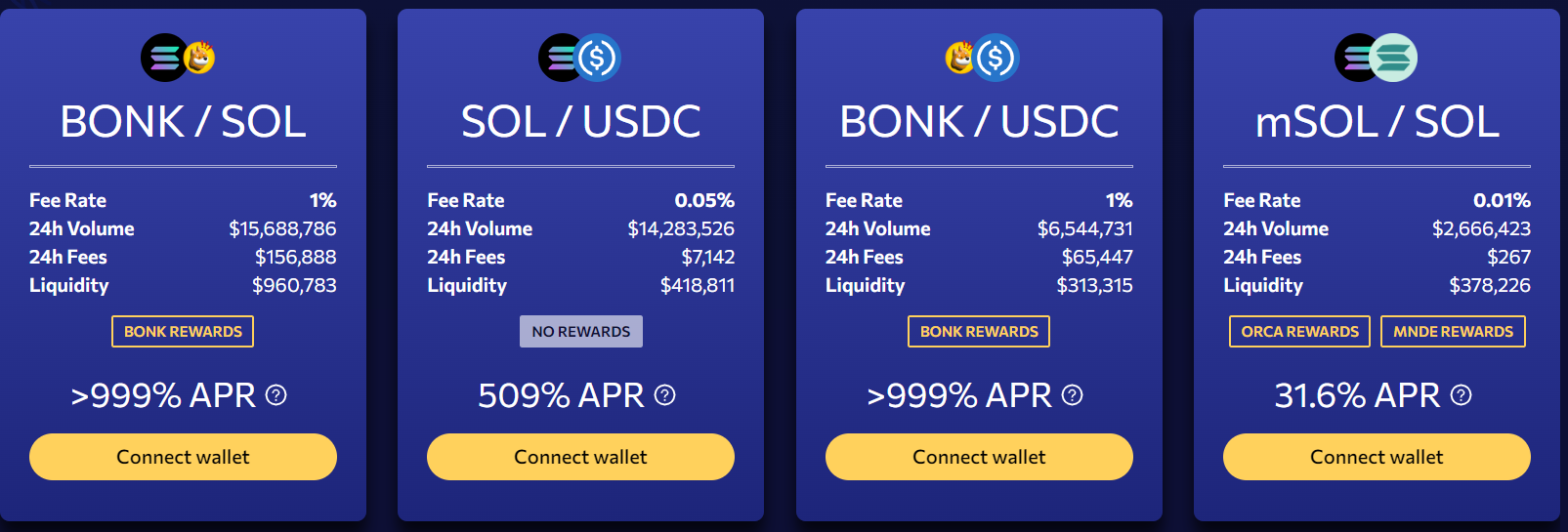
As such, the yields are likely to be short-lived if the demand and hype for BONK slows down in the coming weeks and traders take profits.

Despite being fashioned as a meme coin, Bonk tokens are seeing steady adoption in the Solana ecosystem. Several Solana projects have already integrated Bonk tokens for use as payments for listed NFTs, and some introduced “burn” mechanisms for NFT-based events. Over 1 billion BONK was burned in the past 24 hours, according to tweets.

Meanwhile, the interest around bonk has likely contributed to the demand for SOL tokens. The native token of the Solana network is up 16% in the past 24 hours, erasing losses from a steep decline last week.


Lecturas Relacionadas

US Government Lifts Ban on Crypto Perpetual Contracts for the First Time: What Does It Mean for the Market?

The U.S. Commodity Futures Trading Commission (CFTC) has issued guidance permitting 24/7 trading and clearing for crypto asset derivatives, effectively opening the U.S. market to crypto perpetual contracts for the first time. This move ends the previous ban and allows American individuals and institutions to trade these instruments around the clock. Direct beneficiaries include Kalshi, which received approval to list a Bitcoin perpetual contract; Coinbase, now the first CFTC-regulated futures commission merchant for U.S. clients to access global crypto derivatives; and CME, which will transition its Bitcoin futures and options to 24/7 trading. The CFTC emphasized this is a specific allowance for crypto assets, noting that traditional commodities like agriculture may not be suitable for non-stop trading. It also requires platforms to undergo case-by-case reviews for compliance and risk management. Industry leaders like Michael Saylor and Brian Armstrong praised the decision for integrating Bitcoin into capital markets and granting U.S. users access to a major global market segment. However, consumer advocacy group Better Markets criticized the CFTC for allegedly neglecting investor protection and favoring the industry it regulates. Other platforms like Kraken have announced plans to launch regulated perpetual futures for the U.S. market. The policy shift is expected to redirect significant liquidity and institutional participation to the newly accessible U.S. crypto derivatives landscape.

Odaily星球日报Hace 21 min(s)

US Government Lifts Ban on Crypto Perpetual Contracts for the First Time: What Does It Mean for the Market?

Odaily星球日报Hace 21 min(s)

How the CLARITY Act Reshapes the Stablecoin Yield Economy

The CLARITY Act, recently advanced by the U.S. Senate Banking Committee, fundamentally reshapes the stablecoin yield economy by closing loopholes left by the earlier GENIUS Act. Its Section 404 expands the ban on "hold-to-earn" rewards to all Digital Asset Service Providers (DASPs) and their affiliates, prohibiting any passive, interest-like yield. Crucially, it introduces a legal distinction, permitting "use-to-earn" rewards based on actual activities like spending, trading, or staking. In anticipation of this regulatory shift, major Wall Street asset managers—Morgan Stanley, BlackRock, and JPMorgan—have launched a series of tokenized money market funds (e.g., BlackRock's BRSRV, JPMorgan's JLTXX) designed explicitly for stablecoin reserve assets. These products represent a new, compliant yield layer: the stablecoin issuer earns interest from the underlying tokenized fund, which can then be passed to users through redesigned activity-based rewards. This marks a paradigm shift from a "hold-to-earn" to a "use-to-earn" market. While pathways remain for exchanges to redesign rewards (Path A) and for DeFi protocols to offer yield (Path B), the tokenized reserve asset layer (Path C) emerges as the most robust and strategically positioned infrastructure. However, this concentration—exemplified by BlackRock's BUIDL fund backing over 90% of USDtb's reserves—introduces new systemic risks. The final outcome hinges on regulatory decisions, particularly the OCC's proposed 20% cap on tokenized assets in reserves, which will determine the scalability of this new financial infrastructure layer.

marsbitHace 2 hora(s)

How the CLARITY Act Reshapes the Stablecoin Yield Economy

marsbitHace 2 hora(s)

Kalshi and Coinbase Receive CFTC Approval, Ushering in the Most Regulation-Friendly Era for the Crypto Industry?

The U.S. Commodity Futures Trading Commission (CFTC) took two landmark actions on May 29. It approved Kalshi's application to list a Bitcoin perpetual futures contract and issued a no-action letter to Coinbase Financial Markets. This allows Coinbase to offer certain perpetual futures products to U.S. customers through a subsidiary, with digital assets permitted as collateral. These moves, coupled with a new CFTC policy statement, provide a clearer regulatory pathway for perpetual contracts in the U.S., moving them from a regulatory gray area. CFTC Chair Mike Selig stated this is a key step for U.S. crypto leadership but noted the policy is not yet permanent. The article explains that CFTC's previous reluctance stemmed from legal ambiguities, as perpetual contracts lack an expiration date. However, such contracts dominate global crypto derivatives, accounting for ~78% of centralized exchange volume in 2025, forcing U.S. regulators to adapt to competition from offshore platforms like Hyperliquid. The approvals offer two compliance paths: Kalshi's direct listing and Coinbase's model using foreign futures. This is expected to attract institutional capital back to regulated U.S. venues, stimulate the launch of more products like ETH perpetuals, and enhance U.S. competitiveness in the global crypto derivatives market. The author suggests this may signal a "regulatorily friendly" era for crypto.

marsbitHace 5 hora(s)

Kalshi and Coinbase Receive CFTC Approval, Ushering in the Most Regulation-Friendly Era for the Crypto Industry?

marsbitHace 5 hora(s)

Trading

Spot
Futuros
活动图片