$93 Million Casually Misappropriated? The Truth Behind the Stream Finance Collapse

marsbitPublicado a 2025-12-17Actualizado a 2025-12-17

Resumen

Stream Finance, a DeFi yield protocol with over $200M TVL, collapsed on November 4, 2025, after announcing a $93M loss caused by an "external fund manager." Its stablecoin xUSD plummeted 77%, triggering a $285M contagion across lending protocols like Morpho and Euler, leading to a $1B DeFi outflow. Initially blamed on "Curator" risk managers, the truth emerged from a December 8 lawsuit: founder Caleb McMeans had transferred protocol control to trader Ryan DeMattia with "no formal relationship." On October 10, DeMattia’s personal leveraged positions were liquidated during an ETH crash, and he allegedly used Stream’s funds to cover his losses—weeks before the Balancer hack (November 3) was falsely cited as the cause. The disaster was amplified by xUSD’s recursive lending structure but rooted in unregulated, off-chain asset control without multisig or custody safeguards. The incident highlights DeFi’s vulnerability to opaque operations and personal misconduct, not systemic failure of Curator models or yield strategies.

November 4, 2025, marked a "Black Tuesday" for the DeFi world.

Stream Finance, a yield aggregation protocol with a TVL that once exceeded $200 million and was touted as "The SuperApp DeFi Deserves," suddenly announced that an "external fund manager" had caused approximately $93 million in losses, and all deposit and withdrawal functions were suspended effective immediately.

Upon the news, its issued "stablecoin" xUSD flash-crashed from $1 to $0.26, a 77% drop in 24 hours. More critically, xUSD was widely used as collateral in major lending protocols like Morpho, Euler, Silo, and Gearbox—one bomb detonated, causing severe shockwaves throughout the DeFi lending market.

According to statistics from DeFi research firm Yields And More (YAM), Stream-related debt exposure reached a staggering $285 million:

  • Elixir's deUSD, which had lent 65% of its reserves (about $68 million USDC) to Stream, directly announced its closure. Its price plummeted from $1 to $0.015, nearly zero.

  • Compound suspended its USDC/USDS/USDT markets.

  • Euler froze related liquidity pools.

  • Morpho incurred bad debt.

Within a week, the DeFi market saw a net outflow of about $1 billion. Some compared this to the "Terra moment of 2025," Aave founder Stani Kulechov even warned on social media: "The next Terra Luna might be brewing."

I happened to be researching Curator in depth recently, and because of the Stream Finance incident, Curator was pushed into the spotlight. So I looked into the sequence of events to help everyone understand the full picture as much as possible.

Scapegoat: How Did Curator End Up Taking the Blame?

After the incident, public criticism quickly pointed to one role: Curator.

How was this blame shifted? Looking back at Stream's official statement on November 4th, the loss was caused by an "external fund manager."

This wording easily brings to mind the Curator role in DeFi lending protocols like Morpho and Euler—those "curators" responsible for managing liquidity pools and setting risk parameters.

The chain reaction following Stream's collapse made this narrative seem even more "confirmed":

On November 6th, Lista DAO urgently initiated a governance vote to force liquidate Vaults managed by MEV Capital and Re7 Labs—borrowing rates had soared to 800%, and the borrowers showed no signs of repayment. Re7 Labs subsequently issued a statement admitting it had an exposure of about $14.65 million in its xUSD isolated vault on Euler.

Top Curators' Vaults collectively exploding, emergency votes for forced liquidation—wasn't this a Curator problem?

BlockBeats published a widely circulated article after the event titled "DeFi's Potential $8 Billion Bomb, Only $100 Million Has Exploded So Far," attributing the collapse to "external Curators using user funds for opaque off-chain transactions" and characterizing it as a "systemic crisis of the Curator model."

Meanwhile, another "coincidence" made things even more mysterious—just one day before Stream's collapse (November 3rd), Balancer was hacked, losing approximately $128 million.

Thus, the mainstream narrative became: Curators misappropriated client funds for high-risk strategies, invested in Balancer, Balancer got hacked, money was lost, the Curator model is unreliable.

But there's a key question here: Was Curator really the core cause behind Stream's collapse?

It wasn't until December 8th, when court documents were made public, that we got a glimpse of the full picture.

The Truth Emerges: A Different Story Revealed by Court Documents

On December 8th, Stream Trading Corp. (the original Stream founding team) filed a lawsuit in San Francisco Federal Court against Caleb McMeans (online alias 0xlaw) and Ryan DeMattia.

This lawsuit revealed a completely different story.

Project Handover: A "Acquisition" Without Cash

According to a detailed report by DL News on the court documents:

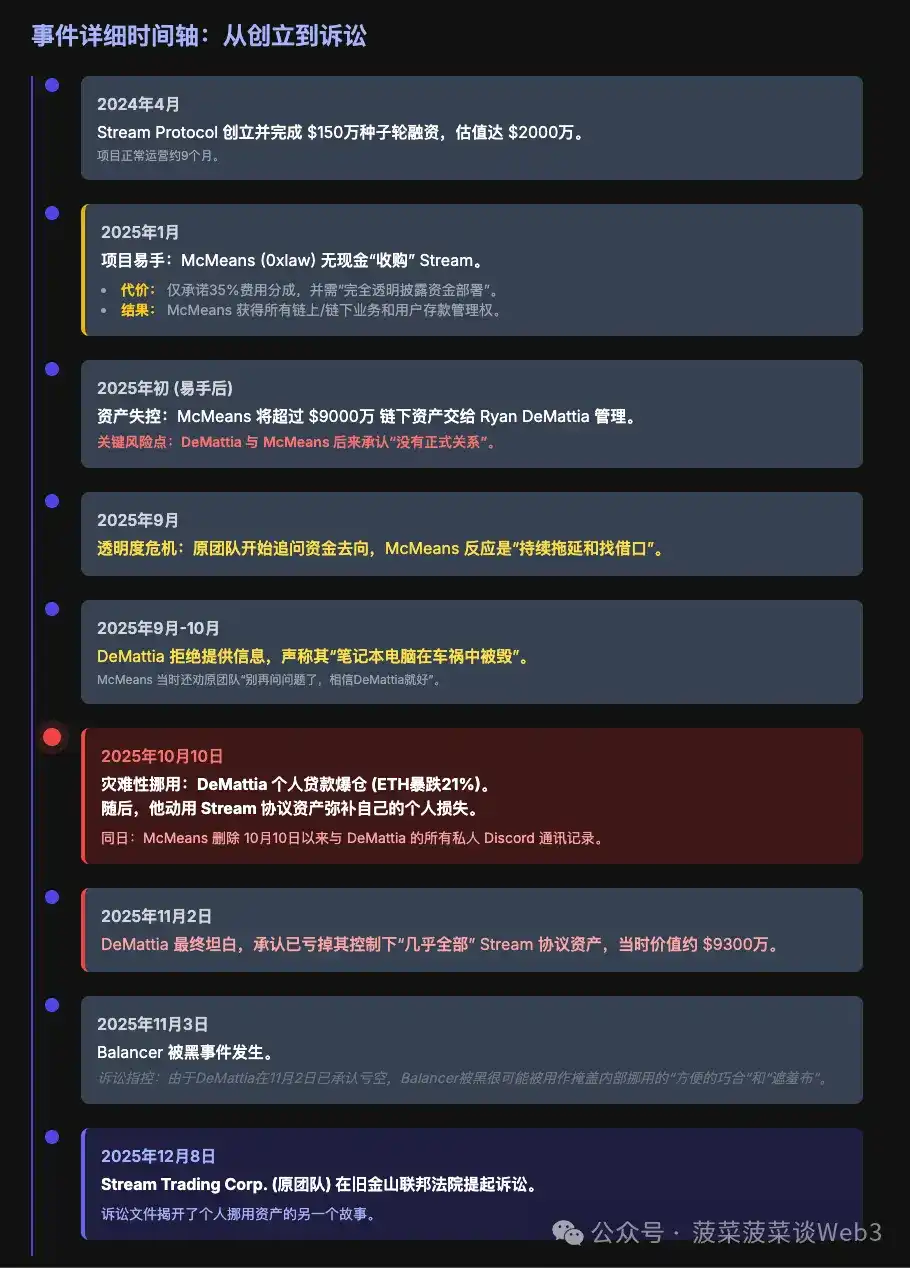
In February 2024, Argentine crypto investor Diogenes Casares founded the Stream Protocol. In April of the same year, the project completed a $1.5 million seed round led by Polychain, with a valuation of $20 million.

However, after just 9 months of operation, by November 2024, the founding team decided to shut down the project due to "operational challenges."

At that moment, trader Caleb McMeans appeared. He proposed acquiring Stream, presenting himself as an "expert in managing complex yield strategies."

In January 2025, both parties signed an agreement:

  • McMeans gained full control of the protocol, including all on-chain transactions, off-chain business agreements, and user deposit management rights.

  • In exchange, he would pay the original team a 35% fee share and promised to "fully transparently disclose the deployment locations of the funds."

Note: This was not a cash acquisition—McMeans did not pay money to buy the protocol but signed a "I operate, you get fees" agreement. The original team retained the role of service provider for the smart contracts, website, and token.

Out-of-Control Assets: $90+ Million Handed to Someone with "No Formal Relationship"

The problem arose after McMeans took over. According to the lawsuit, he handed over more than $90 million in protocol assets to a person named Ryan DeMattia for off-chain management.

Who is DeMattia? The lawsuit's description is quite subtle: McMeans initially called him an "employee" but later admitted to having "no formal relationship" with DeMattia.

No formal relationship, yet he gave this person control over $90+ million in off-chain assets. Outrageous?

It gets even more outrageous.

Laptop Destroyed in a Car Crash

In September 2025, the original founding team began demanding more transparency from McMeans, wanting to know where the funds were. McMeans' response was "continuous delays and excuses."

When the team pressed DeMattia, his response was even more spectacular—direct quote from the lawsuit:

"DeMattia offered a series of patently false excuses for why he could not provide any further information, even claiming at one point that his laptop had been destroyed in a car crash."

The creativity of this excuse is perhaps only matched by "my dog ate my homework."

The lawsuit continues, stating that McMeans at the time advised the original team to "stop asking questions and just trust DeMattia."

October 10th: Personal Liquidation, Misappropriation to Cover Losses

Then, October 10th arrived.

On that day, the price of ETH plummeted 21%, setting a record for the largest single-day liquidation in crypto history, with approximately $20 billion in positions liquidated. The lawsuit describes:

"But upon information and belief, on October 10, 2025, Mr. DeMattia faced a margin call on a personal loan for which he lacked sufficient funds to cover, had his position liquidated, and then used Stream Protocol assets to which he had access to cover his loss."

Translation: DeMattia's own leveraged position was liquidated, he didn't have money to cover the margin call, so he顺手 used Stream's money to fill the hole.

On November 2nd, DeMattia finally "confessed." According to DL News:

"On November 2, he admitted he had lost 'nearly all' of the Stream protocol assets under his control, which were worth about $93 million at the time."

Timeline Mismatch: Balancer Was Just a Smokescreen

Please note this date: November 2nd.

When was Balancer hacked? November 3rd.

If Stream's $93 million was lost in the Balancer hack, the loss should have occurred on November 3rd. But DeMattia admitted on November 2nd that it was "all lost"—the timeline doesn't match.

More crucial evidence: The lawsuit points out that McMeans deleted "all private Discord communication records with DeMattia since October 10th"—exactly the day DeMattia is believed to have started misappropriating funds.

If the loss was truly due to an external event like the Balancer hack, why delete chat records starting from October 10th?

The answer becomes clear: The Balancer hack was likely just a "convenient coincidence," used to divert attention, confuse the timeline, and provide a "force majeure" smokescreen for internal misappropriation.

BlockEden's analysis report also corroborates this: "No evidence of a smart contract hack or exploit has been found."
Essence: Personal Misappropriation, Amateurish Operation

So, was this collapse caused by a systemic failure of the Curator model, or blatant amateurish behavior leading to personal misappropriation of assets?

The lawsuit provides a clear answer: This was personal misappropriation.

DeMattia was not a professional Curator institution; he was an off-chain trader privately hired by McMeans, with "no formal relationship" to the protocol. He was given actual control over $90+ million, with no custody segregation, no multi-signature protection, no on-chain verifiability—when his personal position was liquidated, he directly used users' money to fill his own hole.

The Amplifier: How xUSD Recursive Lending Blew the Hole Wider

This personal misappropriation led to a collapse that, due to xUSD's recursive lending strategy, blew a $285 million hole.

If Stream were just a simple custody protocol, DeMattia misappropriating $93 million would have resulted in at most a $93 million loss. But because xUSD was designed to be a "yield-enhanced stablecoin" that could circulate, be used as collateral, and be re-borrowed across various protocols, this $93 million hole spread like a virus through DeFi's composability, infecting the entire ecosystem.

Recursive lending was not the cause of the disaster, but it was the amplifier of its scale.

Yearn developer Schlag had warned before the collapse: "Using the same 1.9 million USDC, they minted about 14.5 million xUSD"—a 7.6x capital amplification. When the underlying assets failed, this multiplier became an accelerator of destruction.

When the underlying assets (the $93 million held by Stream) disappeared, the entire recursive lending structure instantly collapsed, inflating the debt exposure from $93 million to $285 million.

Conclusion: Review, Reflection, and the Future

Let's梳理 (organize) the complete chain of this collapse:

Starting Point: The Stream Finance project "sold" the protocol to trader McMeans, who then handed $93 million in user assets to DeMattia, with whom he had "no formal relationship," for off-chain management.

Trigger: ETH price crashed on October 10th, DeMattia's personal position was liquidated, and he directly misappropriated Stream's funds to cover his losses.

Amplifier: The xUSD recursive lending structure amplified the $93 million hole into a $285 million debt exposure, infecting the entire DeFi lending market.

Smokescreen: Balancer was hacked for $128 million on November 3rd, becoming the perfect excuse to divert attention—even though DeMattia had already admitted the loss on November 2nd.

Scapegoat: Public opinion pointed the finger at the Curator model, ignoring the real problem of personal misappropriation.

What is the essence of this collapse?

Not a failure of the Curator model

In protocols like Morpho and Euler, Curators have defined boundaries—they can set risk parameters, adjust collateral ratios, decide which assets to accept, but cannot directly transfer user funds. User assets deposited into Vaults are locked in smart contracts; Curators cannot move them.

The problem with the Curators pushed into the spotlight was "negligence": accepting problematic assets like xUSD as collateral without conducting thorough due diligence.

Not the original sin of recursive lending strategy

Recursive borrowing itself is just a tool to amplify returns and risks. Used well, it's efficient capital operation; used poorly, it's suicidal leverage. Stream's recursive lending amplified the scale of the disaster but was not its cause.

The real problem is: One person could control tens of millions of user assets without any constraints

  • No custody segregation

  • No multi-signature protection

  • No on-chain verifiable fund flow

  • No compliance audits whatsoever

  • Not even a formal employment contract

This is the most primitive betrayal of trust—handing money to a person, and that person taking it away.

This is also the current state of the DeFi industry: Amateurish operations are rampant, and regulation is absent. A DeFi protocol can be casually "transferred," user funds can be casually misappropriated, and there are no real institutional constraints at any step of the entire process.

But crisis often breeds turning points.

The Stream collapse is forcing the industry to mature. As regulatory frameworks and legislation continue to be refined and implemented, more transparent, compliant, and professional protocols and service providers represent the real future opportunity for this industry.

References:

  1. DL News: "Stream Finance founders sue business partner, allege $93m used to cover personal losses"https://www.dlnews.com/articles/defi/stream-finance-founders-sue-partner-over-alleged-93m-loss/

  2. The Defiant: "Stream Files Lawsuit Against Operator '0xlaw' Over $93 Million Loss"https://thedefiant.io/news/defi/stream-finance-files-lawsuit-against-0xlaw-mcmeans

  3. The Defiant: "How Stream Finance's Collapse Exposed DeFi's Looping Yield Bubble"https://thedefiant.io/news/defi/how-stream-finance-s-collapse-exposed-defi-s-looping-yield-bubble

  4. Lawsuit Case: Stream Trading Corp. v. McMeans, Case No. 3:25-cv-10524, U.S. District Court for the Northern District of California, filed December 8, 2025

  5. BlockEden: "Anatomy of a $285M DeFi Contagion: The Stream Finance xUSD Collapse"https://blockeden.xyz/blog/2025/11/08/m-defi-contagion/

  6. Tiger Research: "Collapse of the Defi Jenga: The Stream Finance Breakdown"https://reports.tiger-research.com/p/collapse-of-the-defi-jenga-the-stream-eng

  7. The Block: "Analysts map $285M in potential exposure across DeFi after Stream Finance's $93M loss"https://www.theblock.co/post/377491/analysts-map-285m-in-potential-exposure-across-defi-after-stream-finances-93m-loss

  8. BlockBeats: "DeFi's Potential $8 Billion Bomb, Only $100 Million Has Exploded So Far" (《DeFi潜在80亿美金的雷,现在只爆了1个亿》)

  9. Yields And More (YAM): Stream Finance Debt Exposure Analysis

  10. Re7 Labs: Statement on Stream Finance Insolvency and xUSD Exposurehttps://x.com/Re7Labs/status/1985694621251387506


Criptos en tendencia

Preguntas relacionadas

QWhat was the main reason behind the $93 million loss at Stream Finance according to the lawsuit filed by the original team?

AAccording to the lawsuit filed by Stream Trading Corp., the $93 million loss was primarily due to personal misappropriation of funds by Ryan DeMattia, who used Stream Protocol assets to cover his personal trading losses after his leveraged positions were liquidated during the ETH price crash on October 10, 2025.

QHow did the xUSD stablecoin and its looping strategy amplify the impact of the initial $93 million loss?

AThe xUSD stablecoin was designed as a 'yield-enhanced' stablecoin that could be used as collateral for recursive lending across multiple DeFi protocols like Morpho, Euler, and Silo. This looping strategy amplified the initial $93 million loss into a total debt exposure of $285 million, as the collapse of the underlying asset caused the entire leveraged structure to fail simultaneously.

QWhy was the Balancer hack on November 3rd not the actual cause of Stream's collapse, despite initial narratives?

AThe Balancer hack on November 3rd could not have been the cause because Ryan DeMattia had already admitted to losing 'nearly all' of the $93 million in assets under his control on November 2nd, one day before the Balancer exploit. The timing discrepancy and the hack were likely used as a convenient excuse to obscure the true cause, which was internal misappropriation.

QWhat critical failures in Stream Finance's operational structure allowed this misappropriation to occur?

ACritical failures included: no custody isolation of user funds, no multi-signature protection for asset movements, no on-chain verifiability of fund flows, lack of formal compliance audits, and most notably, entrusting over $90 million to an individual (Ryan DeMattia) with whom the operator (Caleb McMeans) had 'no formal relationship' and no official employment contract.

QDid the lawsuit reveal that the problem was fundamentally a failure of the Curator model or something else?

AThe lawsuit revealed that the problem was not a fundamental failure of the Curator model used in protocols like Morpho or Euler. Instead, it was a case of primitive trust betrayal and irresponsible personal mismanagement. The actual Curators in question were guilty of negligence (e.g., accepting xUSD as collateral without proper due diligence), but they did not have the ability to directly misappropriate user funds, which are locked in smart contracts.

Lecturas Relacionadas

Analyzing the Impact of AI on Economic Growth and Productivity

**Title: Analyzing AI's Impact on Economic Growth and Productivity** This article examines three contrasting views on AI's influence on economic growth and productivity. **The Optimistic View** posits that AI, especially through automating R&D ("recursive self-improvement"), could dramatically accelerate growth, even triggering a technological "singularity" with explosive, potentially infinite, economic expansion. **The Moderate/Mainstream View** acknowledges AI's productivity benefits but emphasizes significant real-world constraints that could limit its impact. These include: limited cost savings per task, structural ceilings on which jobs and industries are "exposed" to AI, adoption bottlenecks (e.g., compute, energy, regulatory hurdles), and the "weak link" effect where non-automatable tasks cap overall gains. Consequently, the realized AI dividend may be far lower than optimistic projections, with estimates typically ranging from 0.1% to 1.3% annual productivity growth. **The Pessimistic View** stems from two strands. The first aligns with the moderate view but applies extremely conservative assumptions about task exposure and efficiency gains, yielding minimal projected impact. The second introduces a demand-side critique: if AI primarily replaces rather than augments labor, it could depress labor's share of income, weaken consumer demand, and create a "demand trap" that ultimately stifles growth, unless offset by redistribution policies. **The authors' assessment** is nuanced: * **Short-term (1-2 years):** AI will support growth primarily through investment spending, not significant productivity gains. * **Medium-term (3-5 years):** Three potential paths emerge based on AI demand and bottleneck severity: 1. **"Optimistic Path":** High demand, few bottlenecks. Rapid productivity gains but risk of major job displacement and social conflict without redistribution. 2. **"Moderate Path" (most likely):** High demand but significant, surmountable bottlenecks. Leads to moderate productivity gains, financial market volatility (K-shaped returns), and sectoral job losses. 3. **"Pessimistic Path":** Low demand or severe bottlenecks. Minimal productivity and growth impact, triggering financial market corrections but allowing a smoother societal transition with less labor disruption. * **Long-term:** AI holds potential for a major productivity revolution and prosperity. The conclusion stresses that no path is smooth. Technologically "optimistic" outcomes could be socially detrimental, while "pessimistic" technological diffusion might be more socially stable. Policymakers must monitor developments and prepare balanced responses to manage economic, financial, and social sustainability.

marsbitHace 4 min(s)

Analyzing the Impact of AI on Economic Growth and Productivity

marsbitHace 4 min(s)

The New Cold War is a Tech Stock War

The New Cold War is a Tech Stock War The article argues that the contemporary geopolitical and economic rivalry between the US and China represents a "New Cold War," but one fundamentally fought through technology and financial markets, not physical barriers or conventional trade. Historically, US dominance was secured through financial systems. The Soviet Union, reliant on the rigid "Transferable Ruble," was ultimately undermined by its dependency on the US dollar for oil trade. Later, Japan's semiconductor challenge was countered not just by tariffs (e.g., Plaza Accord, 301 investigations) but by binding it to US Treasury bonds. China presents a more complex, "embedded" challenger. While it holds vast dollar reserves and US debt like Japan, its industrial base is stronger and more diversified than the Soviet Union's. Surviving the initial 2018 trade war phase, the conflict has evolved into a "tech-financial war." The core battlefield is now the stock market. US tech stocks (AI, semiconductors) are treated as sovereign assets, buoyed by bipartisan national will. China is pushing to strengthen its own financial markets to convert industrial strength into financial power and fund its tech ambitions. Companies like ChangXin (semiconductors), Moonshot AI, and DJI compete not just for market share but as financial proxies for their respective systems. The new paradigm is moving from globally efficient monopolies (Apple, Google) towards companies that achieve monopolistic profits within their respective geopolitical spheres. This competition over "pricing power" and financial valuation in segmented markets defines the current era, making the stock market the primary arena for this tech-centric struggle.

marsbitHace 13 min(s)

The New Cold War is a Tech Stock War

marsbitHace 13 min(s)

RWA Weekly: Ten European Financial Institutions Establish Tokenized Asset Cooperative; Ondo Launches New Execution Network Ondo Network

RWA Weekly: European Banks Form Tokenized Asset Cooperative; Ondo Launches New Execution Network Ondo Network Covering July 24-31, 2026, the RWA sector saw a steady on-chain total value locked (TVL) of $36.8 billion, with holder count hitting a record high. However, stablecoin transfer volumes fell sharply (~30%), indicating low on-chain settlement demand. Key regulatory moves include South Korea advancing stablecoin legislation and a push to scrap crypto taxes, Kenya lowering capital requirements for stablecoin issuers, and Zimbabwe approving seven projects for its crypto sandbox. In project developments, BIS-led Project Agorá successfully tested cross-border payments with tokenized funds across six currencies. Ten major European financial institutions formed the RL1 blockchain cooperative to build tokenized asset infrastructure. Other notable updates: Aviva launched a tokenized dollar liquidity fund on XRPL, POSCO International tokenized commercial invoices on Injective, and a Brazilian farmer used tokenized cattle as collateral for a loan. Additional progress includes BNY Mellon migrating its core transfer agent operations to blockchain, Securitize gaining SEC investment advisor registration, and Tether’s compliant stablecoin USA₮ launching on Celo. Ondo Finance introduced Ondo Network, a new execution layer focused on speed and privacy, moving away from its initial chain plans. An analysis highlights that despite the growing scale of on-chain RWAs (~$32B), approximately 90% remain underutilized in DeFi, pointing to a critical challenge in unlocking liquidity and fostering real-world application beyond mere issuance.

marsbitHace 14 min(s)

RWA Weekly: Ten European Financial Institutions Establish Tokenized Asset Cooperative; Ondo Launches New Execution Network Ondo Network

marsbitHace 14 min(s)

South Korean Stock Market Sees Sharp Rebound After Forceful De-leveraging, SK Hynix Rises 30%

On July 31, South Korean stocks staged a historic rebound. The benchmark KOSPI index surged 18.27%, with chipmaker SK Hynix hitting a 30% gain limit. This followed a brutal, near-40% decline in the KOSPI over the previous month, driven largely by a deleveraging spiral involving leveraged ETFs. Analysts attributed the sharp sell-off to structural liquidity issues rather than deteriorating corporate fundamentals. The rally was triggered by a confluence of positive catalysts. Firstly, strong earnings from U.S. cloud giants Microsoft and Amazon alleviated fears of an "AI bubble burst," boosting global tech sentiment. Secondly, SK Group Chairman Chey Tae-won made a rare personal purchase of SK Hynix shares, seen as a strong vote of confidence. Thirdly, the South Korean government announced a 20 trillion won ($139 billion) AI investment fund. In response to the market turmoil, South Korean regulators are tightening controls on leveraged ETFs, admitting oversight shortcomings. Measures include raising minimum cash保证金 requirements for散户 investors and suspending new product launches. While the rebound signals eased liquidity pressure, analysts note deep structural issues remain. The market's future stability is seen as dependent on global tech capital expenditure trends and memory chip price cycles, with some viewing the surge as a technical correction rather than a definitive trend reversal.

marsbitHace 34 min(s)

South Korean Stock Market Sees Sharp Rebound After Forceful De-leveraging, SK Hynix Rises 30%

marsbitHace 34 min(s)

Trading

Spot

Artículos destacados

Cómo comprar O

¡Bienvenido a HTX.com! Hemos hecho que comprar O1 exchange (O) sea simple y conveniente. Sigue nuestra guía paso a paso para iniciar tu viaje de criptos.Paso 1: crea tu cuenta HTXUtiliza tu correo electrónico o número de teléfono para registrarte y obtener una cuenta gratuita en HTX. Experimenta un proceso de registro sin complicaciones y desbloquea todas las funciones.Obtener mi cuentaPaso 2: ve a Comprar cripto y elige tu método de pagoTarjeta de crédito/débito: usa tu Visa o Mastercard para comprar O1 exchange (O) al instante.Saldo: utiliza fondos del saldo de tu cuenta HTX para tradear sin problemas.Terceros: hemos agregado métodos de pago populares como Google Pay y Apple Pay para mejorar la comodidad.P2P: tradear directamente con otros usuarios en HTX.Over-the-Counter (OTC): ofrecemos servicios personalizados y tipos de cambio competitivos para los traders.Paso 3: guarda tu O1 exchange (O)Después de comprar tu O1 exchange (O), guárdalo en tu cuenta HTX. Alternativamente, puedes enviarlo a otro lugar mediante transferencia blockchain o utilizarlo para tradear otras criptomonedas.Paso 4: tradear O1 exchange (O)Tradear fácilmente con O1 exchange (O) en HTX's mercado spot. Simplemente accede a tu cuenta, selecciona tu par de trading, ejecuta tus trades y monitorea en tiempo real. Ofrecemos una experiencia fácil de usar tanto para principiantes como para traders experimentados.

366 Vistas totalesPublicado en 2026.06.19Actualizado en 2026.06.29

Cómo comprar O

Cómo comprar PROS

¡Bienvenido a HTX.com! Hemos hecho que comprar Pharos (PROS) sea simple y conveniente. Sigue nuestra guía paso a paso para iniciar tu viaje de criptos.Paso 1: crea tu cuenta HTXUtiliza tu correo electrónico o número de teléfono para registrarte y obtener una cuenta gratuita en HTX. Experimenta un proceso de registro sin complicaciones y desbloquea todas las funciones.Obtener mi cuentaPaso 2: ve a Comprar cripto y elige tu método de pagoTarjeta de crédito/débito: usa tu Visa o Mastercard para comprar Pharos (PROS) al instante.Saldo: utiliza fondos del saldo de tu cuenta HTX para tradear sin problemas.Terceros: hemos agregado métodos de pago populares como Google Pay y Apple Pay para mejorar la comodidad.P2P: tradear directamente con otros usuarios en HTX.Over-the-Counter (OTC): ofrecemos servicios personalizados y tipos de cambio competitivos para los traders.Paso 3: guarda tu Pharos (PROS)Después de comprar tu Pharos (PROS), guárdalo en tu cuenta HTX. Alternativamente, puedes enviarlo a otro lugar mediante transferencia blockchain o utilizarlo para tradear otras criptomonedas.Paso 4: tradear Pharos (PROS)Tradear fácilmente con Pharos (PROS) en HTX's mercado spot. Simplemente accede a tu cuenta, selecciona tu par de trading, ejecuta tus trades y monitorea en tiempo real. Ofrecemos una experiencia fácil de usar tanto para principiantes como para traders experimentados.

387 Vistas totalesPublicado en 2026.06.22Actualizado en 2026.06.29

Cómo comprar PROS

Qué es VERONA

I. Introducción al Proyecto VERONA es una blockchain construida para todos, en todas partes a través de la abstracción de cadenas. Utilizando su capa de Abstracción Generalizada, VERONA se distingue por integrar funcionalidades complejas de blockchain, como cuentas, firmas e interoperabilidad, directamente a nivel de protocolo. Este enfoque permite interactuar con aplicaciones de blockchain sin necesidad de entender las tecnologías subyacentes.1) Información Básica Nombre: VERONA (VERONA)III. Enlaces Relacionados Enlace al sitio web oficial: https://xion.burnt.com/ Libro Blanco: https://xion.burnt.com/whitepaper.pdf Exploradores: https://explorer.burnt.com/ Redes Sociales: https://x.com/burnt_xion Nota: La introducción del proyecto proviene de los materiales publicados o proporcionados por el equipo oficial del proyecto, que es solo para referencia y no constituye asesoramiento de inversión. HTX no se hace responsable de ninguna pérdida directa o indirecta resultante.

428 Vistas totalesPublicado en 2026.06.22Actualizado en 2026.06.22

Qué es VERONA

Discusiones

Bienvenido a la comunidad de HTX. Aquí puedes mantenerte informado sobre los últimos desarrollos de la plataforma y acceder a análisis profesionales del mercado. A continuación se presentan las opiniones de los usuarios sobre el precio de A (A).

活动图片