Revealed: the Alameda venture capital portfolio

Financial TimesPublicado a 2022-12-07Actualizado a 2022-12-08

Resumen

A look inside Sam and Caroline’s grab-bag of crypto, etc.

As well as running a crypto exchange that didn’t exchange crypto and owning a hedge fund that didn’t hedge, Sam Bankman-Fried had a venture capital fund that didn’t venture its own capital.

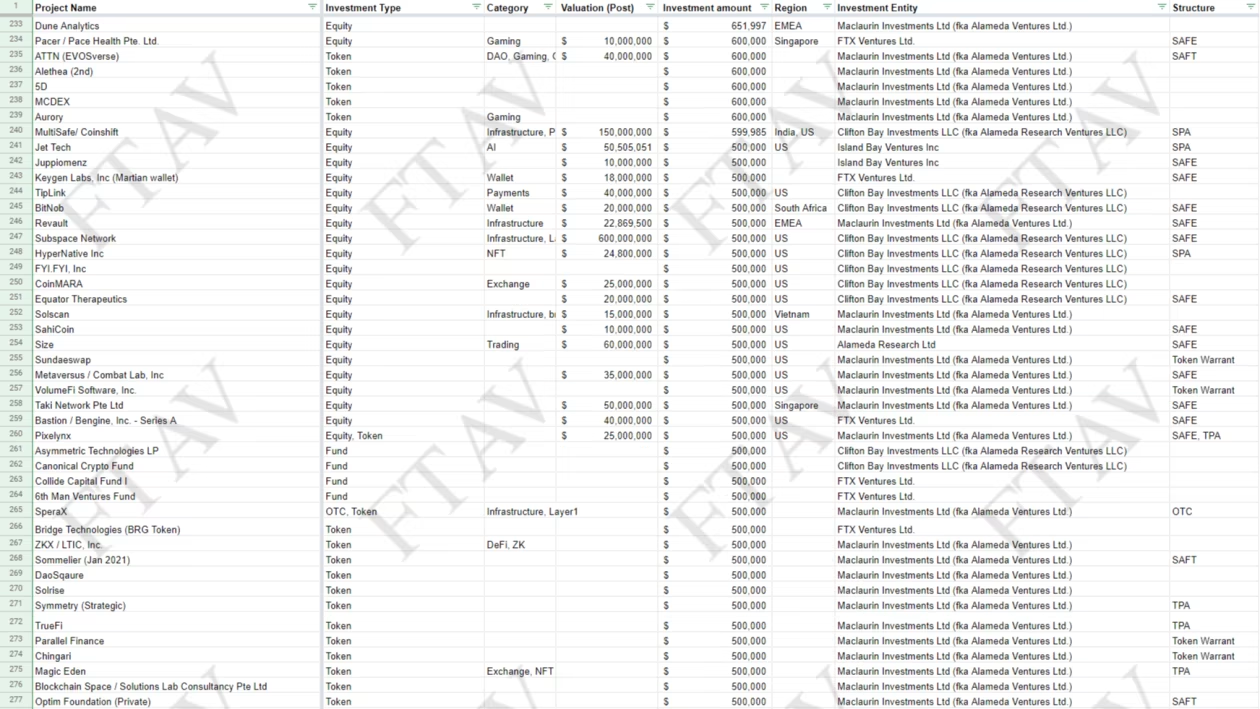
The VC division, in contrast to the rest of the FTX group, can now provide some insight into where some of the money went. Here’s where it went:

The screenshot above and all those below are taken from an Excel spreadsheet dated early November, when SBF was seeking rescue funding amid a run on FTX customer deposits. Mobile and app users are advised to click the magnifying glass below each image for more detail.

According to a person familiar with the rescue effort, the document shows an Alameda Research private equity portfolio — with some FTX bets mixed in — that was being offered as collateral in an attempt to secure a new credit line for the stricken group.

The disparate bundle of nearly 500 illiquid investments is split across 10 holding companies. The total investment value is given on the spreadsheet as in excess of $5.4bn.

As well as forming a central plank in efforts to maximise recoveries from FTX’s bankruptcy, the portfolio might offer regulators insight into whether the group’s trading and exchange businesses were ever operationally separate as claimed.

Bankman-Fried conceded in an interview with the Financial Times that he was involved in Alameda’s venture capital activities but has so far ducked questions around the misuse of FTX customer funds.

Going by the spreadsheet, boundaries between SBF’s companies were blurred. Two of Alameda’s biggest holdings, the crypto miner Genesis and the artificial intelligence research group Anthropic, are also listed on the draft FTX balance sheet published last month by FTAV. (Semafor subseqently reported that FTX had seized certain assets from Alameda after a margin call.)

As previously reported, the portfolio includes stakes in FTX backers Sequoia Capital and Anthony Scaramucci’s SkyBridge Capital, as well as in Elon Musk’s SpaceX and Boring Company projects through the investment in K5.

Of Alameda’s remaining investments, crypto and DeFi projects account for the majority. But the list also includes numerous start-up video game studios and betting platforms, online banks, publishers, a fertility clinic, a military drone maker and a vertical farming company,

Some entries have no clear link to an active business, suggesting they may be misspelt or mislabeled.

Note that FT Alphaville has excluded entries where an investment type is not given, which removes approximately a dozen names with a total stated investment of about $100mn. All other data are presented as they were shown to prospective FTX investors. The FT makes no claim as to the data’s accuracy or completeness.

When asked about why FTX used customer funds to prop up Alameda, SBF has repeatedly pleaded ignorance. The former FTX CEO said that to avoid conflicts of interest he chose not to get involved in Alameda’s trading and risk management, so before last month was not fully aware of its parlous state.

However, SBF told the FT that in early summer he had participated in conversations where Alameda’s financial health and borrowing were discussed. The venture capital investments Alameda had made were “effectively, some of them, on margin”, he added.

Alameda’s spreadsheet predates SBF’s current media blitz by a month, though it comes with all the same warnings about potentially selective recall and unreliable presentation, As the FT’s Joshua Oliver reports:

Bankman-Fried’s attempt to account for what went wrong was laced with caveats and references to his incomplete memory. He cited lack of “confidence” in his answers at least a dozen times, calling other responses “idle speculation” or “shitty answers”. At one point, he paused for half a minute with his head in his hands.

Caroline Ellison, former CEO of Alameda and SBF’s one-time romantic partner, could not be reached for comment.


Lecturas Relacionadas

$26 Billion: An 'All-Chinese Team' Backs the World's Highest-Valued AI Programming Company

Cognition AI, the company behind the AI programmer "Devin," has raised over $1 billion in new funding at a valuation of $26 billion, just eight months after reaching a $10.2 billion valuation. The round was led by Lux Capital, General Catalyst, and 8VC. Founded by three young Chinese entrepreneurs with strong competitive programming backgrounds, Cognition initially gained fame with Devin, marketed as the world's first AI software engineer capable of handling tasks from start to finish. While its early demos were impressive, real-world usage revealed reliability and cost-effectiveness issues, leading to a significant price cut for Devin in 2025. A pivotal moment came when Cognition acquired the assets of AI IDE company Windsurf after a failed acquisition by OpenAI. This move gave Cognition a crucial developer-facing tool, allowing it to pursue a two-pronged strategy: Devin for autonomous task execution and Windsurf for integrated, collaborative coding within an IDE. This shift helped the company move away from the controversial "AI replacement" narrative towards a model of augmenting human engineers, particularly for repetitive or maintenance tasks. This strategic pivot is backed by strong commercial metrics. The company reports a 10x increase in enterprise usage this year, with an annual revenue run-rate of $492 million and a 50% month-over-month growth in enterprise Devin usage over the past six months. Its client list now includes major corporations like Goldman Sachs and Mercedes-Benz, as well as government agencies like NASA and the U.S. Army. Investors are betting on Cognition becoming a foundational piece of next-generation software engineering infrastructure, positioning it at the center of a hybrid future where AI agents and human developers work in tandem.

marsbitHace 10 min(s)

$26 Billion: An 'All-Chinese Team' Backs the World's Highest-Valued AI Programming Company

marsbitHace 10 min(s)

The Hottest 00s Generation on Wall Street

"Wall Street's Hottest '00s Phenom: The 25-Year-Old Fund Manager Who Bet on AI's 'Boring' Backbone" At just 25, Leopold Aschenbrenner, once fired by OpenAI, now runs a hedge fund worth $13.7 billion. His strategy? Betting against the consensus. While others chased AI chips, he invested early in the physical infrastructure powering the AI boom: electricity, data centers, and energy. Expelled from OpenAI's safety team in 2024, Aschenbrenner foresaw the coming bottleneck. He argued that AI progress would be limited not by algorithms, but by power, chip capacity, and space. Acting on this, he founded Situational Awareness LP to go long on these "old economy" assets. His bets have paid off spectacularly. His fund's assets soared from $255 million in late 2024 to $13.7 billion by Q1 2026. His portfolio is a direct reflection of his thesis: major long positions in fuel cell company Bloom Energy and data center/bitcoin mining firms like CleanSpark and Riot Platforms, which control critical land and power resources. Conversely, he holds massive put options against overheated semiconductor giants like NVIDIA and AMD. A notable exception was his bullish bet on storage company SanDisk, which surged ~160% in Q2. Aschenbrenner's vision is materializing. Tech giants like Amazon, Alphabet, and Meta are ramping up colossal capital expenditure on data centers. Global data center power consumption is projected to skyrocket, with AI accounting for over half by 2030. The demand for enabling technologies like optical fiber and modules is also exploding. His story underscores a fundamental truth of the AI era: the ethereal intelligence of algorithms rests on a very physical, heavy, and power-hungry foundation. The future is being built not just in code, but in concrete, copper, and kilowatts.

marsbitHace 2 hora(s)

The Hottest 00s Generation on Wall Street

marsbitHace 2 hora(s)

Review of Cathie Wood's Masterstroke Operation on Circle

A Recap of Cathie Wood's Masterful Trading in Circle's IPO This article analyzes the strategic moves made by ARK Invest's Cathie Wood around the IPO of Circle (CRCL). Despite her typical long-term, narrative-driven investment style, Wood executed a textbook "buy low, sell high" trade. Wood secured a core position of approximately 4.49 million shares at the $31 IPO price. The stock debuted at $69, surged to a high of $299 in June 2025 fueled by stablecoin regulatory news (the GENIUS Act), and then entered a prolonged decline. During this rally, ARK systematically sold around 1.7 million shares at an average price near $210, driven partly by internal fund rebalancing rules triggered by the stock's soaring weight. This move locked in substantial profits. As the stock later fell due to lockup expirations, new share issuance, and interest rate concerns—even dipping below $50—Wood began repurchasing shares. Starting in November 2025 around $86, she continued buying on the way down, eventually rebuilding her position to roughly the original size by Q1 2026. Key takeaways include: 1) Having a strong, independent long-term thesis (viewing Circle as critical digital dollar infrastructure). 2) Trading in tranches instead of trying to time exact tops or bottoms. 3) Maintaining strict position-sizing discipline, using rules to force profit-taking and preserve buying power. For most retail investors, chasing the dramatic "pop" at open is dangerous, as the subsequent 83% drawdown showed. Wood's success hinged on pre-IPO access, a clear investment thesis, and disciplined execution.

marsbitHace 4 hora(s)

Review of Cathie Wood's Masterstroke Operation on Circle

marsbitHace 4 hora(s)

Sharplink CEO: Ethereum's Future is Unfolding Now

In an article titled "Sharplink CEO: Ethereum's Future is Unfolding," Joseph Chalom, a former BlackRock executive and current Sharplink CEO, argues that the current debates surrounding the Ethereum Foundation (EF) and ETH price miss the bigger picture. He asserts that Ethereum's long-term institutional adoption is secured by its foundational strengths: trust, security, and liquidity. Chalom highlights Ethereum's dominance in settling stablecoin value, tokenizing real-world assets (RWA), and facilitating high-value DeFi transactions as evidence of its winning position. He defends the Ethereum Foundation's focus on rigorous protocol development and a decade-long track record of major upgrades (The Merge, EIP-1559, Dencun, etc.), viewing its upcoming technical roadmap as the most ambitious in the industry. Contrary to critics, Chalom posits that Ethereum's decentralization and reliable neutrality are core strengths for institutional adoption, not weaknesses, as they prevent control by any single entity. Drawing a parallel to Amazon's early days, he suggests that ETH's intrinsic value is tied to the expansion of its network, which is poised for a step-change in transaction volume across stablecoins, RWAs, DeFi, and agentic finance. Chalom advocates for a "be greedy when others are fearful" approach, citing historical examples from Warren Buffett and his own experience at BlackRock during the crypto winter. He concludes that while the EF should remain focused on core protocol attributes (CROPS: Censorship Resistance, Capture Resistance, Open Source, Privacy, Security), there is a leadership gap in market outreach. Chalom calls for ecosystem participants, including Sharplink and other key players, to become more vocal advocates to support the coming institutional adoption supercycle, asserting that "Ethereum's future is unfolding now."

marsbitHace 4 hora(s)

Sharplink CEO: Ethereum's Future is Unfolding Now

marsbitHace 4 hora(s)

6 Questions to Understand the Business Trends of AI

The AI industry has entered its "summer" phase, according to a six-dimensional scoring framework assessing its development cycle. Each dimension—narrative vs. delivery, system connectivity, delivery capability, ROI rationalization, common industry trends, and capital environment—scores 1 point, totaling 6 points. This places the industry firmly in summer (5-7 points), characterized by a coexistence of grand promises and tangible deliverables, with increasing pressure to demonstrate value and profitability. Key signals mark this shift. ByteDance's Doubao launched paid subscriptions, while OpenAI introduced an advertising platform. These moves are driven by dual forces: immense cost pressures from scaling user bases and massive compute requirements, and the maturation of commercial opportunities. Major players like Anthropic report explosive growth, highlighting AI's transition into core productivity infrastructure. For businesses, the path forward involves three strategic steps. First, identify a small, high-impact use case to quickly demonstrate a closed-loop value proposition, such as automating customer service or content generation. Second, systematically replicate successful pilots across the organization by standardizing processes, building shared AI capabilities, and aligning talent, incentives, and leadership. Finally, move beyond simply adding AI to existing workflows and undertake systemic reconstruction—redesigning processes for parallel AI-human collaboration, implementing real-time dashboards, and establishing automated trigger chains. The era where storytelling alone secured funding is over. The focus has shifted to delivering measurable efficiency gains, cost savings, and new revenue streams, as evidenced by real-world implementations in companies like Semir, Anta, and Midea. Success now depends on starting with a focused proof point, scaling it organization-wide, and ultimately allowing AI to redefine operational paradigms.

marsbitHace 10 hora(s)

6 Questions to Understand the Business Trends of AI

marsbitHace 10 hora(s)

Trading

Spot
Futuros
活动图片