ApeCoin Treasury Is Gradually Selling Its Own Reserves

u.todayPublicado a 2022-11-30Actualizado a 2022-12-02

Resumen

At press time, APE is barely holding above the $3 threshold and is losing 1.4% of its value in the last 24 hours.

The notorious ApeCoin, which has been a problem in most investors' portfolios for weeks after a disastrous 60% plunge in November, appeared to be in the spotlight after on-chain sleuths noticed the unhealthy spending behavior of Ape's treasury.
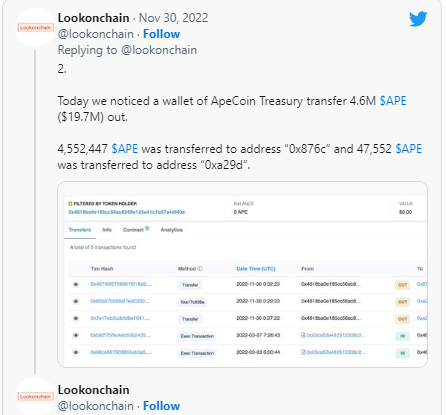
More than 4.6 million APE tokens worth approximately $19.7 million have been moved out of the wallet owned by the ApeCoin treasury. Tokens were distributed among various addresses. The largest portion of the moved funds has been sent to the address "0x876c," while around 50,000 APE tokens were moved to "0xa29d."

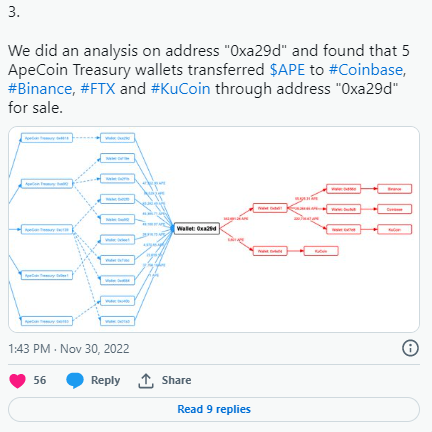
As on-chain analysis on address "0xa29d" suggests, at least five ApeCoin Treasury wallets used it as a relay between addresses tied to Coinbase, Binance, FTX and others. Such a sophisticated scheme could have been used for hiding one's tracks and not making a transfer of funds for sale so obvious.
Earlier today, another four ApeCoin Treasury wallets used a similar method of selling their reserves: sending assets to different addresses on the blockchain and then moving them to exchanges. A total of 99.8% of the tokens have been transferred to new addresses every time.
At first glance, the ApeCoin project is actively selling its holdings while trying to hide its tracks by constantly using fresh addresses prior to sending funds to various cryptocurrency exchanges.
The performance of APE on the market confirms this thesis as it swiftly lost more than 60% of its value in no time. Despite a 60% recovery from the bottom, APE still has a long way to go before returning to pre-dump levels.
At press time, APE is barely holding above the $3 threshold and is losing 1.4% of its value in the last 24 hours.

Criptos en tendencia

Lecturas Relacionadas

Foundation Steps Back, Ethlabs Steps Forward: Ethereum Undergoes Its Largest Restructuring in History

On June 23rd, the Ethereum ecosystem witnessed two major shifts, signaling a significant governance realignment. First, former Ethereum Foundation researchers established Ethlabs, a new independent non-profit. Backed by major ETH holders like Bitmine and SharpLink, Ethlabs aims to address practical needs for institutional adoption, including faster settlement, native asset issuance, cross-chain transactions, and mainnet scaling. Secondly, the Ethereum Foundation announced a major restructuring, laying off 54 employees (20% of its staff) to become a leaner entity focused on protocol governance and maintenance rather than being the primary builder. This move represents a pivotal correction. Criticisms had mounted over the Foundation's perceived slowness, lack of clear strategy, and over-reliance on Vitalik Buterin's influence. Ethlabs emerges as a more execution-oriented, "industrialized" layer focused on market adoption—bridging the gap between research and real-world use. Notably, Vitalik Buterin is absent from its list of supporters, interpreted as an intentional step to avoid excessive personal endorsement and allow the organization to build independent credibility. The Ethereum Foundation's downsizing and redefinition mark a retreat from its former central coordinating role. It now aims to share the "privilege of stewarding Ethereum" with other emerging groups like Ethlabs, the Ethereum Applications Guild, and The Ethereum Economic Zone. Analysts frame this dual shift as the Foundation ensuring Ethereum remains "correct" (credibly neutral), while Ethlabs must prove it remains "effective" (competitive and attractive for capital and adoption). This addresses community "shareholder-like anxiety" about ETH's market performance. While risks exist—such as concerns over shifting from Foundation centrality to large-holder influence—the consensus is that the greater risk for Ethereum was inaction, caught between technical idealism and organizational inertia. These steps aim to create a more multi-stakeholder, execution-driven future for the network.

链捕手Hace 3 hora(s)

Foundation Steps Back, Ethlabs Steps Forward: Ethereum Undergoes Its Largest Restructuring in History

链捕手Hace 3 hora(s)

Second Half of U.S. Crypto Policy: The Clarity Act Aims for 60 Votes, CFTC's "One-Person Commission" Becomes Biggest Variable

In a pivotal year for US crypto policy, the "CLARITY Act" is advancing in the Senate but faces a high hurdle, needing 60 votes to pass. Key challenges include bridging partisan divides on ethics and swaying undecided Republican senators within a tight legislative calendar of only about 40 working days. The policy "second half" involves intense negotiations on a broader framework for Web3 and DeFi, including crypto tax reforms and the Blockchain Regulatory Certainty Act. A significant uncertainty is the understaffed CFTC, operating with four commissioner vacancies, which complicates regulatory clarity. Meanwhile, the departure of key "crypto champions"—SEC Commissioner Hester Peirce and Senator Cynthia Lummis—will impact ongoing policy efforts. Industry experts are cautiously optimistic but realistic. Sara K. Weed notes that while progress is being made, CLARITY is unlikely to pass this Congress, pushing agencies like the SEC and CFTC to provide more guidance. Sulolit Mukherjee suggests meaningful crypto tax legislation is more likely to be attached to larger must-pass bills. Rashan Colbert discusses the jurisdictional debate over prediction markets, emphasizing the need for a regulatory framework that fosters their development as financial tools rather than treating them broadly as gambling. The clock is ticking, but opportunities remain for substantive progress through continued bipartisan dialogue and pragmatic efforts.

marsbitHace 6 hora(s)

Second Half of U.S. Crypto Policy: The Clarity Act Aims for 60 Votes, CFTC's "One-Person Commission" Becomes Biggest Variable

marsbitHace 6 hora(s)

Dan Koe's New Essay: Escaping the Fate of the Wage Slave, How to Survive the AI Replacement Wave?

Dan Koe argues that the true threat in the AI era isn't technology itself, but a reliance on others for one's livelihood and happiness. The core problem is "wage slavery"—spending life on unfulfilling work. To survive and thrive, one must escape this by building their own enterprise. The key is developing five elements: Agency (initiative), Taste (discernment), Persuasion, Persistence, and Iteration. These boil down to problem-solving skills and experiential knowledge, which cannot be learned passively but only through doing your own projects. The solution is to become "unemployable" by shifting your identity. This requires: 1) Radically changing your environment to force growth, 2) Choosing a medium (like content creation) that provides real feedback through trial and error, and 3) Mastering either code or, preferably, media (content). Content creation is more valuable because its subjective nature and need for human perspective create a durable advantage over generic AI output. To start, define your life's work by answering foundational questions about your innate knowledge, unique abilities, and contrarian beliefs. Then, immediately act by publishing your first piece of content. The cycle of creating, receiving feedback, and iterating is the essential path to developing the skills needed for an independent, meaningful career and financial resilience.

marsbitHace 6 hora(s)

Dan Koe's New Essay: Escaping the Fate of the Wage Slave, How to Survive the AI Replacement Wave?

marsbitHace 6 hora(s)

Research Report Analysis: Morgan Stanley Details SanDisk SNDK, The Truth About Cloud Data Center Pricing Power and AI Inference Benefits

Morgan Stanley raised its price target for SanDisk (SNDK) from $1100 to $1750 on June 22, maintaining an Overweight rating. The upgrade is driven by AI inference demand reshaping the NAND market, particularly for KV Cache and context window storage in cloud data centers. These cloud clients exhibit price inelasticity and sign long-term contracts, granting SanDisk significant pricing power. SanDisk's New Business Model (NBM) agreements, covering over one-third of FY27 bit shipments with 3-5 year terms and fixed price/price collar structures, are crucial. They are projected to sustain gross margins around 80% even at floor prices, providing a buffer against cyclical downturns. Morgan Stanley forecasts gross margins to surge from 30.3% in FY25 to 86.7% in FY27e. With NAND supply expected to remain tight into 2026/2027 and cloud/data centers becoming the largest end-market, SanDisk holds supply-side pricing power. The company targets 15-19% bit growth via technology transitions, not capacity expansion. Revenue is projected to grow ~6.6x from FY25 to FY27, with EPS rising from $2.74 to $14.73, driven by high-margin cloud business. Key upside catalysts include faster enterprise SSD adoption and edge AI growth. Downside risks involve slower industry growth, competitor capex increases, market share loss, and competition from Chinese players like YMTC. The investment thesis rests on AI-driven structural demand, NBM's margin protection, and sustained supply tightness. The $1750 target implies ~28x FY27e P/E.

marsbitHace 7 hora(s)

Research Report Analysis: Morgan Stanley Details SanDisk SNDK, The Truth About Cloud Data Center Pricing Power and AI Inference Benefits

marsbitHace 7 hora(s)

Trading

Spot
Futuros

Artículos destacados

Qué es APECOIN

Entendiendo Asia Pacific Electronic Coin ($APECoin) En una era donde la intersección de la tecnología y el ambientalismo se vuelve cada vez más crítica, las criptomonedas están dejando su huella como posibles catalizadores de cambio. Entre estas innovaciones, Asia Pacific Electronic Coin ($APECoin) se destaca como un proyecto distintivo diseñado para apoyar iniciativas ambientales en toda la región de Asia Pacífico. Este artículo profundiza en la fundación, características únicas e impacto de $APECoin dentro del panorama más amplio de blockchain. ¿Qué es Asia Pacific Electronic Coin ($APECoin)? Asia Pacific Electronic Coin ($APECoin) es un token ERC20 y TRC20, realizado en abril de 2020 después de su conceptualización en diciembre de 2019. Esta innovación nació del deseo de fomentar prácticas ecológicas y apoyar un conjunto de proyectos ambientales orientados a la sostenibilidad y las iniciativas verdes. Objetivos y Metas $APECoin no es simplemente una moneda digital; se concibe como un medio de intercambio que permite a los usuarios participar en transacciones que benefician directamente causas ambientales. Su ecosistema está diseñado para facilitar diversas actividades financieras mientras promueve la adopción de prácticas ecológicas. La moneda tiene como objetivo principal: Apoyar Iniciativas Ambientales: A través de cada transacción, se destina una parte a financiar proyectos sostenibles enfocados en la conservación y la energía renovable. Promover Innovaciones Ecológicas: Fomentando startups y proyectos que se alinean con la sostenibilidad ambiental mediante el uso de su token como medio de valor. Crear un Mercado Sostenible: La plataforma incluye un e-mercado donde pueden realizarse transacciones financieras dentro de un marco dedicado a promover prácticas verdes. Creador de Asia Pacific Electronic Coin ($APECoin) Si bien los detalles sobre el creador individual de $APECoin no se han divulgado públicamente, el proyecto cuenta con el respaldo significativo del Grupo APEC, un consorcio enfocado en abogar por iniciativas ambientales. Este respaldo agrega credibilidad y relevancia al proyecto, conectándolo a una red más amplia comprometida con la sostenibilidad y las prácticas ecológicas. Inversores de Asia Pacific Electronic Coin ($APECoin) El panorama de inversión en torno a $APECoin permanece en gran medida no revelado. Los nombres específicos de fundaciones u organizaciones de inversión que apoyan esta criptomoneda aún no se han hecho públicos. Sin embargo, lo que es evidente es un interés creciente entre los inversores interesados en apoyar proyectos sostenibles que demuestren potencial de impacto en el ámbito cripto. ¿Cómo funciona Asia Pacific Electronic Coin ($APECoin)? $APECoin se destaca por su innovador modelo operativo, que aprovecha la tecnología blockchain y los contratos inteligentes. Esta combinación no solo garantiza eficiencia en las transacciones, sino que también refuerza el cumplimiento de los marcos regulatorios, mejorando la seguridad y transparencia de las transacciones. Características Únicas de $APECoin Operaciones Basadas en Blockchain: Al establecer sus operaciones en una plataforma de blockchain, $APECoin asegura que todas las transacciones sean inmutables y estén protegidas mediante técnicas criptográficas avanzadas. Esta descentralización subraya la integridad del token dentro de su ecosistema. Contratos Inteligentes: $APECoin emplea contratos inteligentes que facilitan transacciones sin problemas mientras garantizan el cumplimiento de las regulaciones aplicables. Estos acuerdos automatizados minimizan la posibilidad de disputas, agilizan los procesos y contribuyen a un marco de transacciones confiable. E-Mercado: Una de las características distintivas de $APECoin es su e-mercado dedicado. Este entorno digital sirve como un centro para servicios que apoyan prácticas ecológicas, proporcionando una plataforma para intercambios que promueven la visión verde del proyecto. A través de estos atributos, $APECoin se establece en un nicho dentro de la vasta extensión del mercado de criptomonedas, casando efectivamente los principios de blockchain con la responsabilidad ambiental. Cronología de Asia Pacific Electronic Coin ($APECoin) Entender la trayectoria de $APECoin proporciona una visión sobre sus hitos de desarrollo y aspiraciones futuras. Aquí hay una cronología que resalta eventos significativos en la historia del proyecto: Diciembre 2019: Conceptualización de Asia Pacific Electronic Coin, iniciada con la ambición de impulsar la sostenibilidad a través de la criptomoneda. Abril 2020: Lanzamiento oficial de $APECoin, marcando su entrada en el mercado como un token dedicado a proyectos ambientales. 2020-2021: Realización de la Oferta Inicial de Intercambio (IEO), permitiendo a los usuarios comprar $APECoin, junto con el registro en varias plataformas de intercambio electrónico para mejorar la accesibilidad. En su relativamente corta trayectoria, $APECoin ha avanzado significativamente en sentar las bases para una criptomoneda segura y con impacto impulsada por objetivos ambientales. Conclusión Asia Pacific Electronic Coin ($APECoin) encarna la unión de la tecnología y la responsabilidad ambiental, fomentando el crecimiento en el ecosistema cripto mientras defiende la sostenibilidad. Con su estructura única, el respaldo de entidades reputadas y una visión hacia un futuro más verde, $APECoin es más que una criptomoneda; es un proyecto pionero destinado a nutrir la innovación responsable en la región de Asia Pacífico. A través de su compromiso con la inclusión financiera y su apoyo a iniciativas ambientales, se erige como un formidable ejemplo de cómo las monedas digitales pueden aprovecharse para generar un impacto social positivo. A medida que el proyecto sigue evolucionando, los interesados dentro de la comunidad cripto y más allá estarán atentos a cómo $APECoin da forma a la conversación en torno a las prácticas sostenibles en el creciente mundo de las criptomonedas.

45 Vistas totalesPublicado en 2024.12.03Actualizado en 2024.12.03
Qué es APECOIN

Cómo comprar APE

¡Bienvenido a HTX.com! Hemos hecho que comprar ApeCoin (APE) sea simple y conveniente. Sigue nuestra guía paso a paso para iniciar tu viaje de criptos.Paso 1: crea tu cuenta HTXUtiliza tu correo electrónico o número de teléfono para registrarte y obtener una cuenta gratuita en HTX. Experimenta un proceso de registro sin complicaciones y desbloquea todas las funciones.Obtener mi cuentaPaso 2: ve a Comprar cripto y elige tu método de pagoTarjeta de crédito/débito: usa tu Visa o Mastercard para comprar ApeCoin (APE) al instante.Saldo: utiliza fondos del saldo de tu cuenta HTX para tradear sin problemas.Terceros: hemos agregado métodos de pago populares como Google Pay y Apple Pay para mejorar la comodidad.P2P: tradear directamente con otros usuarios en HTX.Over-the-Counter (OTC): ofrecemos servicios personalizados y tipos de cambio competitivos para los traders.Paso 3: guarda tu ApeCoin (APE)Después de comprar tu ApeCoin (APE), guárdalo en tu cuenta HTX. Alternativamente, puedes enviarlo a otro lugar mediante transferencia blockchain o utilizarlo para tradear otras criptomonedas.Paso 4: tradear ApeCoin (APE)Tradear fácilmente con ApeCoin (APE) en HTX's mercado spot. Simplemente accede a tu cuenta, selecciona tu par de trading, ejecuta tus trades y monitorea en tiempo real. Ofrecemos una experiencia fácil de usar tanto para principiantes como para traders experimentados.

81 Vistas totalesPublicado en 2025.02.24Actualizado en 2026.06.02

Cómo comprar APE

Discusiones

Bienvenido a la comunidad de HTX. Aquí puedes mantenerte informado sobre los últimos desarrollos de la plataforma y acceder a análisis profesionales del mercado. A continuación se presentan las opiniones de los usuarios sobre el precio de APE (APE).

活动图片