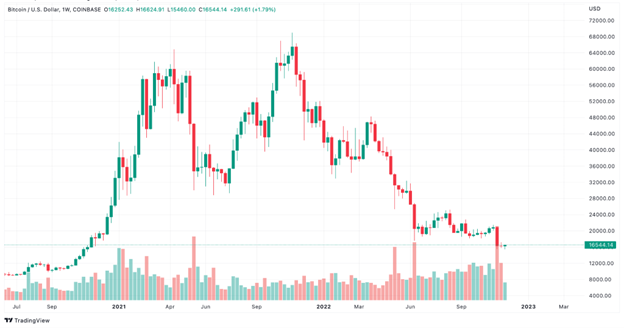
Bitcoin is now down 75% from its previous all-time high of $62,000 – set in November 2021.
The crypto market is suffering from a plethora of reasons – inside and outside of the industry.
Like most things that unravel, crypto started to unwind gradually at the start of the year and then pretty much collapsed all at once.
From global economic instability to European wars to localized crypto empire collapses – here are five reasons why Bitcoin is on the path to $10k
Why is Crypto Crashing?
This is a prevalent question in the industry:
“Why is crypto Crashing?”
Analysts have a plethora of reasons to highlight.
The price of Bitcoin reached an all-time high price of $62,000 in November 2021. Since then, the price has tanked by a total of 75% to the current $16,500 range.
Like every market, Bitcoin moves in cycles of bull runs and bear busts. The past two years leading up to November 2021 were undoubtedly the most extensive bull run for crypto. Unfortunately, we are currently trading inside one of the biggest bear busts in history for Bitcoin.
You only need to look at the weekly chart for the coin to see the impact;
With that being said, here are five of the most popular reasons why crypto is currently crashing and why it’s likely to end up beneath $10,000 before it starts to recover.
1 – Global Macroeconomics – Inflation and War
One of the primary drivers behind the crypto crash is related to broader macroeconomics, particularly inflation and war.
The fallout from the COVID-19 pandemic caused central banks worldwide to start printing money to stimulate the economy.
As a result of the additional stimulus measures, inflation started to creep higher over the past two years. According to the U.S. Bureau of Labor Statistics, Inflation has been rising since 2021 and peaked above 9% earlier this year.
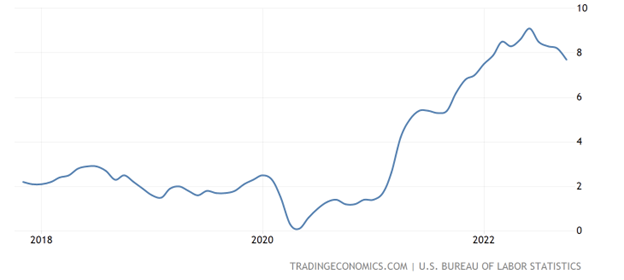
In fact, the inflation rate reached a 40-year high during this time period;
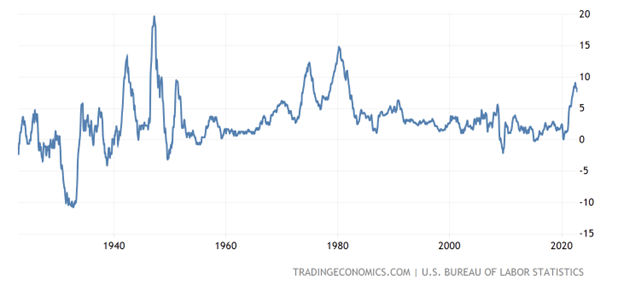
With inflation rising, the cost of living significantly increases. As a result, prices go up, and everything including housing, utility, shopping, and entertainment sees a significant cost rise.
In this type of situation, central banks must implement tight monetary policy to keep prices in check and stop the economy from growing too quickly. Typically, they use increasing interest rates to combat rising inflation.
Increasing interest rates causes borrowing money to become more expensive. This leads to less spending in the economy and more savings. In addition, there is less liquidity available in capital markets as the cost of borrowing is much more expensive.
With reduced spending, inflation tends to head lower, but it takes some time.
The US Federal Reserve has been hiking interest rates since March 2022. In fact, they have increased interest rates at the most aggressive rate since the 1980s in an effort to curb inflation.
The US Fed started slowly increasing rates in March by hiking the rate by 25 basis points (BPS). Then, in the following meeting in May, they hiked by a further 50 BPS. In June, the most significant hike came in at 75 BPS, causing the market to accelerate downward.
Since June, the Fed hiked by 75 BPS in July, September, and November. As a result, the current interest rate in the United States is now sitting at 4%, and rates are still expected to go much higher.
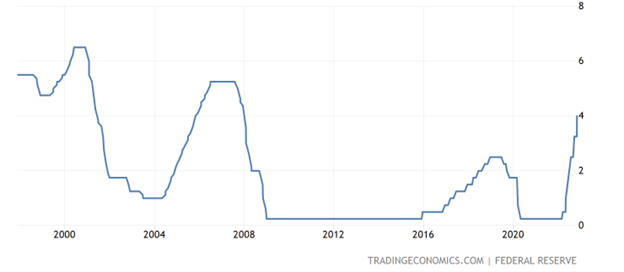
Many experts assume that the market won’t even start to recover until the US Fed stops hiking interest rates.
It’s not just inflation that’s causing global economic pressure. Russia has been waging war on Ukraine since February this year, and it doesn’t seem to end anytime soon. With war occurring on European soil, investors are erring on the side of caution until the uncertainty has vanished.
2 – Luna Collapse
Amidst the first wave of interest rate hikes, one of crypto’s top-20 ranked projects came crashing down, propelling the bearish downward pressure in the industry. This was the first strong indicator that Bitcoin was heading toward $10,000.
It was during the Terra Luna collapse when analysts started to hint at potential $10,000 prices for BTC;
CryptoWhale: LUNA makes up around 0.98% of Bitcoin's volume, whereas USDT makes up over 79.2%.
The de-pegging and collapse of Tether will impact the markets a hundred times worse than Luna, and tank us far below my $10,000 targets.
Good Luck Everyone – Stay safe!
— Faisals Crypto News (@faisalscrypto) May 12, 2022
On May 7th, 2022, the price of the TerraUSD (UST) stablecoin lost its $1 peg and sent the market into a frenzy. The price for UST fell to just 35 cents by May 9th and continued to plummet the following week. In addition, the companion token used to stabilize UST, LUNA, fell from $80 to under ten cents by May 12th.
As you can imagine, the crypto market started to tank. Bitcoin fell from above $40,000 to hit as low as $26,000:
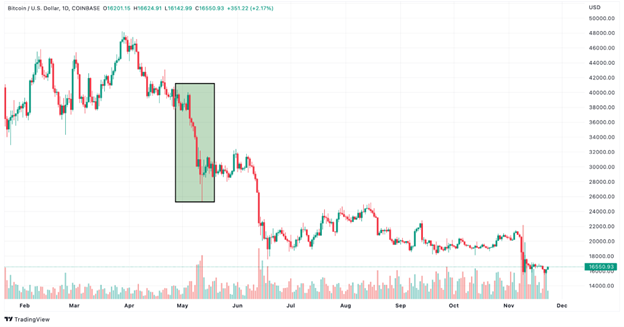
As a result of the Luna collapse, the market lost an estimated $60 billion in the space of a few days.
This was the first major breakdown of the strong support structure for 2022, and it only worsened from there.
The meltdown affected the entire market during a time of increased volatility resulting from the global macroeconomic crisis, resulting in a liquidity squeeze in the industry. In addition, prominent cryptocurrency hedge funds such as Three Arrows Capital also were wiped out during the fallout.
3. FTX Collapse
The Luna collapse wasn’t the only localized crypto meltdown in 2022. More recently, in November 2022, one of the biggest cryptocurrency exchanges in the industry was utterly wiped out. On November 11th, 2022, FTX.US filed for Chapter 11 bankruptcy, and to make matters worse, the exchange suffered a hack that saw $600 million being drained from its wallets.
The exchange crashed due to a lack of liquidity and mismanaged funds. Changpeng Zhao (CZ), owner of Binance exchange, Tweeted Binance was about to sell all of their FTT funds due to the CoinDesk report of FTX’s liquidity crisis.
As part of Binance’s exit from FTX equity last year, Binance received roughly $2.1 billion USD equivalent in cash (BUSD and FTT). Due to recent revelations that have came to light, we have decided to liquidate any remaining FTT on our books. 1/4
— CZ 🔶 Binance (@cz_binance) November 6, 2022
This Tweet was the final nail in the coffin for FTX. It sent panic to all FTX users, who quickly rushed to the exchange to withdraw funds. As a result, the liquidity crisis at FTX worsened, eventually leading to bankruptcy.
The result of the FTX collapse was another 25% price drop in BTC as it fell from $21,300 to reach as low as $15,500.
This price drop was quite significant as it caused BTC to break through the 200-weekly moving average level, which brings us to the following reason…
4. Losing Critical Support at 200-weekly Moving Average
The 200-weekly moving average level has been a technical support point for most analysts in the industry.
In its history, Bitcoin met the 200-weekly average price on four separate occasions and rebounded from the level on each occasion.
However, the FTX collapse sent the market beneath the critical support level for the first time.
#Bitcoin and 200 weeks moving average
During its short life span, #bitcoin has found support at 200 WMA on 4 occasions and rallied from there.
But not this time. It's been 15 weeks since the break of 200 WMA.
Ominous. pic.twitter.com/XOfMeqFF5N
— Mayank Narula (@Mayank_Narula1) November 22, 2022
The level was critical support for analysts across the industry and was the only significant barrier before $10,000. The loss of the 200-weekly moving average now means that the next level of crucial support lies at $10,000.
5. Loss of Sentiment
Finally, the loss of sentiment is the final vital reason to mention why Bitcoin is heading to $10,000 before any hope of recovery.
The sentiment of an asset is what drives markets. So if investors are optimistic about the future price of Bitcoin, then the sentiment is high and they will keep buying.
On the other side, if investors aren’t optimistic about the future price of Bitcoin, then sentiment will be low and they have no reason to keep buying.
The crypto fear and greed index is a great metric to analyze sentiment. It’s currently at one of the lowest levels in history, indicating that there is extreme fear in the market;
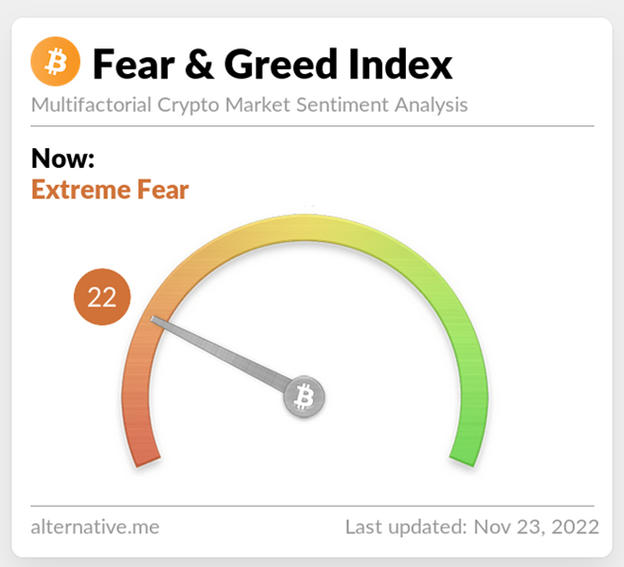
As a result of the extreme fear, the market will likely continue the downward pressure until hitting the next major psychological level – which is at $10,000.
Cryptos to Hedge With as Bitcoin Sinks
Despite the bearish pressure in the market, there are still many segments in the industry that are still experiencing growth. These projects have very promising futures, and, as a result, investors are quickly flocking to them as a hedge against the Bitcoin breakdown toward $10,000.