Sad Story Behind Bankruptcy of Alameda Research and FTX

u.todayPublicado a 2022-11-23Actualizado a 2022-11-23

Resumen

Alameda Research became insolvent and was bailed out by FTX, marking beginning of major meltdown on cryptocurrency market

Without a doubt, November is proving to be the darkest month on the cryptocurrency market. Drama ensued between Bitcoin (BTC) and the altcoins shortly after the CEO of Binance announced that the exchange would divest itself of the FTX token.

However, the big problem with this story is Alameda Research, Sam Bankman-Fried’s (SBF) trading company. This is because, in early November, there was a complaint that Alameda was experiencing insolvency problems.

Coindesk released a report, shared by Binance, which said that Alameda may not have enough funds to cover its outstanding debts. SBF's trading company had a sizable portion of its funds in illiquid tokens based on the Solana blockchain, and the largest proportion of its assets were concentrated in FTT.

In this scenario, the company would have entered the bankruptcy list alongside Terraform Labs, Celsius Network and Three Arrows Capital (3AC). This problem would have hit FTX, so FTX asked for help from major crypto exchange Binance, and its CEO Changpeng Zhao (CZ) said it would step in with help and buy the younger exchange.

Shortly after doing its due diligence on FTX, Binance made the decision to no longer purchase the crypto trading platform. However, this is not the only scandal FTX has been involved in. Although SBF wanted to pass security and report that everything was in order, he had to borrow $1 billion in new capital from Wall Street and Silicon Valley billionaires.

An interesting point in this story is that this action by SBF occurred just a few hours before FTX filed its distress call with Binance.

Furthermore, the exchange’s problems cannot be solved with just $1 billion. After all, it needs at least $8 billion to stay afloat.

Therefore, the belief that FTX was not experiencing a liquidity problem is false. Furthermore, Alameda Research is not as honest as it claims. It would have filed for bankruptcy long before everything collapsed.

Collapse of SBF’s ecosystem

Idolized by the cryptocurrency market, SBF managed to attract attention by accumulating a net worth that surpassed the $16 billion mark.

FTX, his flagship company until then, had been leading the crypto industry for some time. SBF was even proud to say that he managed to exceed the turnover of Coinbase, even with fewer customers and being a relative newcomer to the industry.

“We have excellent numbers. We trade 6 times more volume than Coinbase while. We have 20 times less users. When you look at these numbers you can see there’s a lot of potential.”

Despite being involved in controversies related to project launches, SBF managed to be highlighted in many of them, and the most recent one was the APT token.

Of course, we cannot fail to mention that FTX made a million-dollar rescue of BlockFi, and SBF held a large bid for the assets of Voyager Capital shortly after the collapse of the Terra ecosystem (LUNA). This act certainly helped bolster FTX’s image as a solvent company. This was not without reason. FTX won a dispute with Binance itself for Voyager's assets.

But not everything was going as smoothly as it seemed

Something was not quite right at Alameda Research. For instance, Sam Trabucco decided to step down as CEO of the platform at the end of August.

As the decision seemed quite random at the time, some corners of the market no longer paid attention to it.

Shortly after, FTX’s former president, Brett Harrison, decided it was time to leave office — another big warning sign. After all, why would two great executives leave companies that were doing so well? That sounded even more suspicious.

After these exits, SEC pressure fell on FTX. The Texas Securities Regulator launched an investigation into FTX and SBF.

As Texas State Securities Board executive director Joe Rotunda reported in October, accounts FTX offered that paid investors income in exchange for depositing their cryptocurrencies with the company were under investigation.

Bankruptcy of Alameda Research

All of these facts already indicated that something was wrong, but the real bankruptcy of Alameda would certainly have come before that.

According to the tweet shared by Lucas Nuzzi, Head of R&D at CoinMetrics, the trading company went bankrupt in the second quarter of 2022. Nuzzi informed everyone that Alameda only survived because FTX reportedly offered funds to them. The Coinmetrics researcher said on his Twitter profile that the hoax ended 40 days ago, when 173 million FTT, priced at $4 billion, suddenly became active on-chain.

That same day, $8 billion worth of FTT was moved on-chain. That was the biggest daily move for FTX token in its existence.

But that is not the end of the story. Nuzzi found a transaction that interacted with an FTT token ICO contract in 2019. According to the researcher, the only recipient of the value of $4 billion was Alameda Research.

In Nuzzi’s conception, Alameda’s bankruptcy came at the same time as Three Arrows Capital — that is, in the second quarter of this year.

Without a doubt, FTX decided to protect the trading company so that things did not get any worse for FTT.

If in May Alameda had died, the FTT ICO contract would have been executed and brought down a big sale for all tokens that were purchased in September.

Knowing that, we now understand that when FTX said it was helping Voyager Digital, it was really committed to saving Alameda.

FTX may bring more negative impacts to cryptocurrencies

Bitcoin and the altcoins were extremely affected by the Big Money resolution between Binance and the FTX.

What was already not going well due to macroeconomic pressures got worse with the chaotic scene among major cryptocurrency trading companies.

In fact, FUD has intensified among FTX investors, who now express concern about the amount invested.

Venture investors, on the other hand, fear that their investments will be completely wiped out.

In addition, FTX-backed lending company BlockFi announced it would shut down withdrawals from its customers.

Genesis Block, also affected by the FTX drama, will cease trading and close its website on Dec. 10.

But this does not mean that these projects are the only ones affected by the fall of the old market giants. Solana is one of the altcoins that proves this.

Without a doubt, Nov. 8, 2022, will go down in the history of the crypto market as the craziest in its existence.

Criptos en tendencia

Lecturas Relacionadas

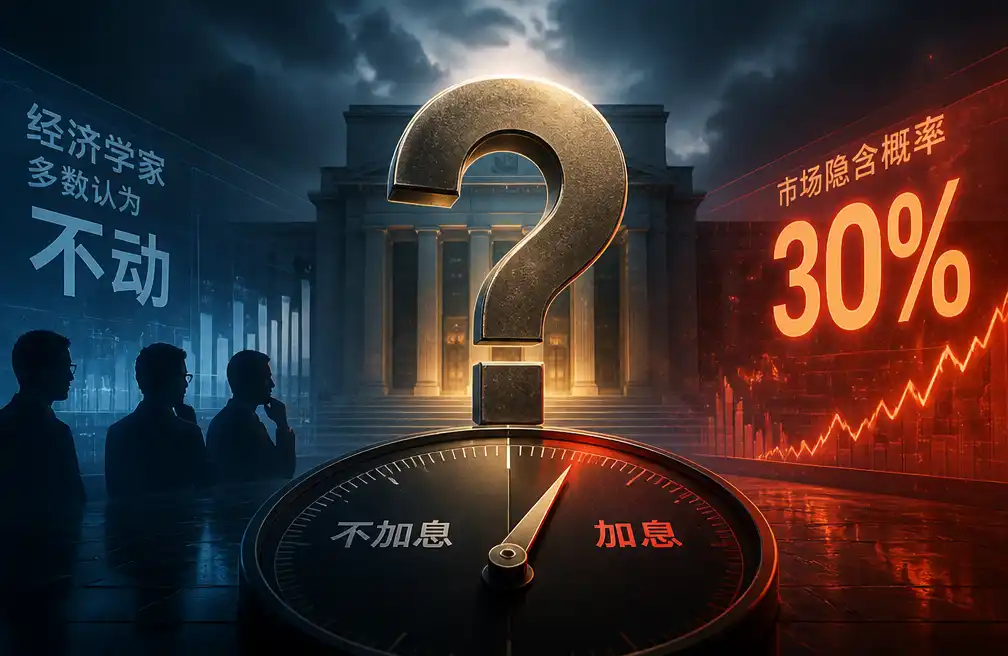
To Hike or Not Tonight: Economists Unanimous on 'No', Markets Price in a 30% Chance

Federal funds futures are repricing ahead of the July FOMC decision, as traders pay a higher premium for the risk of a surprise rate hike or more hawkish signals. This contrasts with economists, where a Reuters survey of 104 analysts unanimously expects rates to remain unchanged at 3.50%-3.75%, with 78 foreseeing no change through year-end. Yet, futures markets have priced in about a 30% probability of a 25-basis-point hike. The core debate, especially under new Fed Chair Kevin Warsh, centers on how the Fed will respond to the oil price shock from Middle East tensions. The market is not necessarily predicting a hike tonight but is hedging against two tail risks: an immediate rate increase, or a hold combined with communication that seriously opens the door for a September hike. This hedging activity has driven up open interest in Fed funds futures. Analysts are divided on how to weight the oil price surge in the Fed's reaction function. Hawkish voices (e.g., BofA) worry that completely dismissing the price pressure could challenge the Fed's inflation credibility in Warsh's first major test. Dovish views (e.g., Citi) argue the shock is primarily supply-driven and that overreacting with rate hikes could unnecessarily hurt growth, unless clear signs of secondary inflation emerge. Warsh's new tenure amplifies policy path uncertainty, as markets lack a stable baseline for his communication style. This environment forces traders to price in a wider range of outcomes, explaining the divergence between unanimous economist forecasts and market hedging. The key focus will be on Warsh's post-meeting commentary. If he downplays the oil shock and stresses anchored long-term expectations, hawkish pricing may recede. If he emphasizes the risk of broader price spillovers and prioritizes returning to 2% inflation, the market will interpret this as reopening the door for a September hike. This would sustain support for the USD, keep pressure on JPY (testing intervention thresholds), and challenge risk assets like stocks and crypto through higher discount rates and weaker sentiment. The baseline remains no action in July, but the communication will determine how far this repricing extends.

marsbitHace 31 min(s)

To Hike or Not Tonight: Economists Unanimous on 'No', Markets Price in a 30% Chance

marsbitHace 31 min(s)

The Semiconductor Industry's Most Obscure Chokepoint Material: It Has Multiplied in Price Unnoticed, and China Just Banned Its Export

"Helium: The Silent Choke Point in Semiconductors" Helium, despite being the universe's second most abundant element, is critically scarce on Earth. It cannot be synthesized artificially and escapes Earth's gravity once released, making it a non-renewable resource. Yet, it is indispensable for advanced semiconductor manufacturing, requiring ultra-high purity (99.9999%) for processes like wafer etching, leak detection, and thermal management in lithography tools, with no viable substitutes. This low-profile resource, whose price has doubled unnoticed, suddenly gained attention when China imposed an export ban on July 10th. The ban is a response to a severe global shortage triggered months earlier. In March, missile attacks damaged the world's largest helium production hub in Qatar's Ras Laffan, halting a third of global supply with repairs expected to take 3-5 years. Concurrently, Russia tightened export controls, and the US sold off its federal helium reserve. Approximately 200 specialized transport containers, each worth ~$1 million, were stranded with perishable cargo. Global spot prices skyrocketed, and chipmakers like TSMC warned of potential impacts. China, which imports over 84% of its helium (primarily from Qatar and Russia), faces a severe squeeze. Despite being helium-poor, China has developed domestic extraction technology over five years, processing byproduct gases from LNG plants to produce ultra-pure helium. Domestic output, while still only covering less than 20% of demand, enabled the recent export ban aimed at securing domestic supply for its own expanding chip industry. The industry now faces "Helium Shortage 5.0." With key global sources constrained for years, this invisible gas—once wasted on party balloons—has become a critical, geopolitically charged bottleneck for chips, healthcare (MRI machines), and beyond, forcing the world to finally treat it as the finite strategic resource it is.

marsbitHace 1 hora(s)

The Semiconductor Industry's Most Obscure Chokepoint Material: It Has Multiplied in Price Unnoticed, and China Just Banned Its Export

marsbitHace 1 hora(s)

Early Investor of Unitree Bets on a Brain-Computer Interface Company

"Wabo Technologies, a brain-computer interface (BCI) startup, has secured new funding from Vertex Ventures (under Temasek), Hongtai Fund, Chengdu Future Industry Fund, and Huifengda Capital. Vertex Ventures is known for its early bet on Unitree Robotics. Inspired by the sci-fi film "Avatar," founder Zhang Xingzhi has pursued human-machine interaction for over a decade. He established Wabo in late 2025, coinciding with China's push for BCI as a future industry. Unlike companies focused solely on medical hardware, Wabo positions itself as a model company. Its core mission is to develop a "Human Neural Intent Model" that decodes EEG, EMG, and behavioral signals to understand a user's goals, confirmations, corrections, and stop intentions before physical action, translating them into standardized control signals for machines, robots, or smart devices. The young, full-stack team, backed by academic collaborators from Tianjin University and Fudan University, quickly attracted investors. The company had previously raised a seed round from Ceyuan Capital. Investors were impressed by Wabo's systematic capabilities in data collection, signal processing, and engineering, seeing potential beyond a single hardware product toward a reusable layer of human intent interpretation. Applications span medical rehabilitation, smart homes, embodied AI, and even space exploration, with Wabo partnering with Tianjin University on pioneering "space BCI" research. Wabo plans a dual-headquarters strategy, with Shanghai focusing on high-end R&D and model development, and Chengdu handling hardware, product development, and supply chain. The BCI sector in China is heating up, with over 30 financing deals in early 2026. Zhang believes future competition will center on who can build a sustainable data-model-scenario loop. He predicts industry consolidation within three years, with only companies that master this闭环 surviving. The vision from "Avatar" is inching closer to reality."

marsbitHace 1 hora(s)

Early Investor of Unitree Bets on a Brain-Computer Interface Company

marsbitHace 1 hora(s)

Trading

Spot

Artículos destacados

Cómo comprar FTT

¡Bienvenido a HTX.com! Hemos hecho que comprar FTX Token (FTT) sea simple y conveniente. Sigue nuestra guía paso a paso para iniciar tu viaje de criptos.Paso 1: crea tu cuenta HTXUtiliza tu correo electrónico o número de teléfono para registrarte y obtener una cuenta gratuita en HTX. Experimenta un proceso de registro sin complicaciones y desbloquea todas las funciones.Obtener mi cuentaPaso 2: ve a Comprar cripto y elige tu método de pagoTarjeta de crédito/débito: usa tu Visa o Mastercard para comprar FTX Token (FTT) al instante.Saldo: utiliza fondos del saldo de tu cuenta HTX para tradear sin problemas.Terceros: hemos agregado métodos de pago populares como Google Pay y Apple Pay para mejorar la comodidad.P2P: tradear directamente con otros usuarios en HTX.Over-the-Counter (OTC): ofrecemos servicios personalizados y tipos de cambio competitivos para los traders.Paso 3: guarda tu FTX Token (FTT)Después de comprar tu FTX Token (FTT), guárdalo en tu cuenta HTX. Alternativamente, puedes enviarlo a otro lugar mediante transferencia blockchain o utilizarlo para tradear otras criptomonedas.Paso 4: tradear FTX Token (FTT)Tradear fácilmente con FTX Token (FTT) en HTX's mercado spot. Simplemente accede a tu cuenta, selecciona tu par de trading, ejecuta tus trades y monitorea en tiempo real. Ofrecemos una experiencia fácil de usar tanto para principiantes como para traders experimentados.

159 Vistas totalesPublicado en 2024.12.12Actualizado en 2025.03.21

Cómo comprar FTT

Discusiones

Bienvenido a la comunidad de HTX. Aquí puedes mantenerte informado sobre los últimos desarrollos de la plataforma y acceder a análisis profesionales del mercado. A continuación se presentan las opiniones de los usuarios sobre el precio de FTT (FTT).

活动图片