Don’t Count on Bitcoin (BTC) Crashing to $10,000, Says Crypto Analyst Jason Pizzino – Here’s Why

Daily HodlPublicado a 2022-11-13Actualizado a 2022-11-13

Resumen

A popular crypto strategist and trader says Bitcoin's (BTC) price is unlikely to fall all...

A popular crypto strategist and trader says Bitcoin’s price is unlikely to fall all the way down to $10,000.
“”

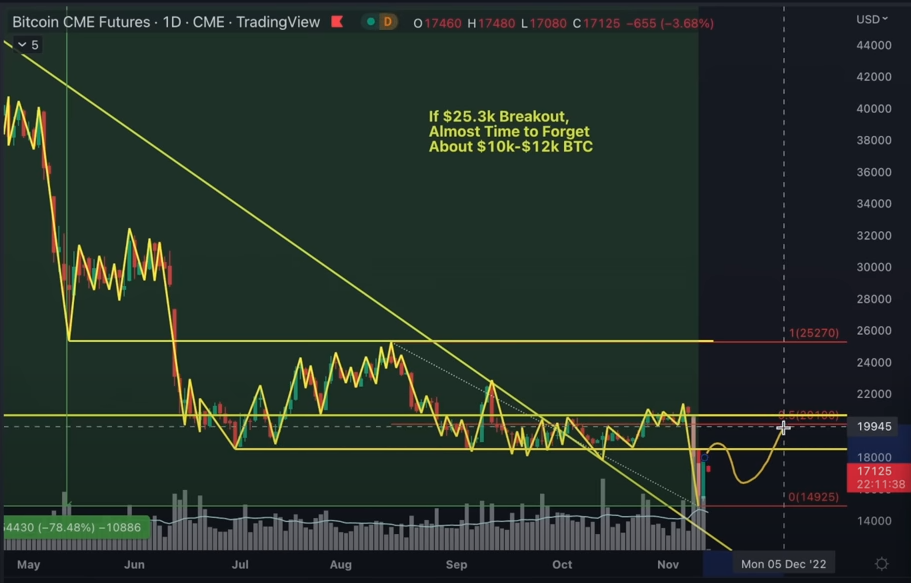
In a new strategy session, analyst Jason Pizzino tells his 279,000 YouTube subscribers that Bitcoin bulls will likely defend a high time frame support level and keep it away from plunging toward $10,000.
“”

“There’s a pretty reasonable chance that we won’t see the $10,000 like I’ve talked about for quite a while on the futures market. You got a nice number here of $14,900 on the spot market for the cycle low thus far. It is at around $15,500 depending on which exchange you’re on.”
“”

He says that if the price trends higher, Bitcoin may quickly erase the losses sustained since the FTX collapse.

“”

“If we get above around $18,500 or $18,600, that is going to be a very strong sign that this was just a shakeout, a big wash, and we will over the weeks, over the course of November, maybe attempt to recover a few more of those losses and head back towards $20,000. It doesn’t mean we can’t close up above that $18,500, come back down, put in a higher low over the weeks, this will take time. In that case, that’s a strong sign that we’ll probably come back up and test some higher prices.”
Source: Jason Pizzino/YouTube

“”

But he also says if Bitcoin’s price weakens and begins to close regularly below $17,500, the price may dip to a lower support level.
“”

“Should we continue down during November, well then we got prices as far down as about $13,500, which lines up relatively well with the previous old cycle tops of the period in 2019.”
“”

At time of writing, Bitcoin is changing hands for $16,858, down 1.78% on the day.

Lecturas Relacionadas

From 'Western Learning Ants' to Korean Pension Funds: Why Does Korean Capital Continue to Flow to the US?

Summary: "From 'Western Ants' to National Pension: Why Korean Capital Continues to Flow to the U.S.?" South Korea’s capital is increasingly moving toward U.S. markets, driven by two key investor groups. Individual retail investors, known as "Western Ants," actively trade U.S. stocks overnight, seeking exposure to major tech firms and higher returns often unavailable in Korea’s concentrated domestic market. Simultaneously, the National Pension Service (NPS), managing over $1.16 trillion in assets, is expanding its global investment footprint. Facing demographic pressures and the sheer size of its fund, NPS has steadily increased overseas allocations, with over half its financial assets now invested abroad. A recent memorandum of understanding with six top U.S. venture capital firms (including Sequoia and a16z) marks a strategic extension into Silicon Valley’s private investment ecosystem, aiming to access growth-stage tech opportunities while leveraging external managers’ expertise. While both flows reflect limitations of Korea’s home market, their risk profiles differ sharply: retail investors often pursue speculative, concentrated bets, whereas NPS must ensure long-term, diversified returns for national retirement security. This outward shift also creates macroeconomic tensions, as demand for dollars from both groups pressures the Korean won, prompting coordinated measures between NPS and the central bank to mitigate currency volatility. Ultimately, Korea’s growing financial integration with global markets—especially the U.S.—signals a broader structural shift where citizens’ wealth and pension sustainability are increasingly tied to worldwide economic dynamics.

marsbitHace 8 min(s)

From 'Western Learning Ants' to Korean Pension Funds: Why Does Korean Capital Continue to Flow to the US?

marsbitHace 8 min(s)

This Strategy Earned Hefei One Trillion Yuan

This article analyzes the "Hefei Model" that enabled a municipal state-owned investment to generate paper profits exceeding one trillion yuan through the 2026 IPO of ChangXin Memory Technologies (CXMT). It argues against framing this success as a "lucky gamble," instead presenting it as the result of a deliberate institutional system designed to enable long-term industrial investment. The system comprises three core components. First, a **quantified risk-tolerance mechanism**, including a 40% loss allowance for venture funds and a clear "duty-fulfilled exemption" list, decouples project failure from personal career risk for decision-makers, allowing them to focus on industrial potential rather than personal liability. Second, **strategic investment in critical supply chain gaps**: Hefei doesn't just invest in "good" projects, but targets "missing" links essential for its key industries (appliances, displays, cars). The investment in CXMT aimed to fill the critical DRAM memory chip gap, subsequently attracting over 450 upstream and downstream firms and creating a full semiconductor cluster. Third, **institutional authorization for counter-cyclical investment**: Protected by the risk-tolerance framework, Hefei supported CXMT with increased investment during the 2023 global memory industry downturn, enabling it to scale production and capitalize on the 2025 AI-driven demand surge. The article concludes that the true lesson is not the specific investment but building the institutional infrastructure—quantified risk tolerance, deep industry chain analysis, and counter-cyclical mandates—that makes such long-term, strategic bets possible. It notes the final challenge is perfecting the exit mechanism to complete the investment cycle and transform paper gains into sustainable fiscal returns and reinvestment capacity.

marsbitHace 22 min(s)

This Strategy Earned Hefei One Trillion Yuan

marsbitHace 22 min(s)

Silicon Valley VC's On-the-Ground Observations of Chinese Entrepreneurship: A Harsher Capital Environment Breeding Fiercer Companies

A Silicon Valley VC's on-the-ground observations of China's startup ecosystem reveal a harsher capital environment forging more aggressive and execution-driven companies. Unlike Silicon Valley's patient capital focused on long-term growth, China's venture landscape is characterized by intense pressure for exits. Startups often face "equity in name, debt in reality" terms with strict timelines and personal founder liability, pushing IPO as the nearly mandatory exit path due to a virtually non-existent M&A market. This high-stakes system, while potentially fostering short-termism, cultivates extreme cost discipline, rapid execution, and formidable commercialization skills—traits evident as these companies expand overseas. The funding ecosystem comprises three main pools: local RMB funds (often government-backed with economic development mandates), domestic USD funds (more founder-friendly, like Sequoia China), and dwindling direct foreign capital. Financial Advisors (FAs) play a crucial intermediary role, packaging deals and navigating China's opaque, relationship-based business networks where platforms like LinkedIn haven't taken root. Underpinning it all is significant state influence through industrial policy, directing capital and incentives toward strategic sectors like semiconductors and AI. The result is a distinct, parallel innovation model—less forgiving than Silicon Valley's, but capable of concentrating resources, accelerating iteration, and producing fiercely competitive companies in targeted industries.

marsbitHace 28 min(s)

Silicon Valley VC's On-the-Ground Observations of Chinese Entrepreneurship: A Harsher Capital Environment Breeding Fiercer Companies

marsbitHace 28 min(s)

Trading

Spot
活动图片