XRP Price Prediction: Why The Bulls Could Protect This Crucial Support

newsbtcPublicado a 2022-11-10Actualizado a 2022-11-10

Resumen

XRP price started a major decline from the $0.50 resistance against the US Dollar. The recent collapse of FTX and FTT sparked a sharp move towards the $0.32 support. Ripple...

XRP price started a major decline from the $0.50 resistance against the US Dollar. The recent collapse of FTX and FTT sparked a sharp move towards the $0.32 support.

""

  • Ripple is down over 15% and there was a drop below the $0.40 support against the US dollar.
  • The price is trading well below $0.4000 and the 100-day simple moving average.
  • There was a break below a major contracting triangle with support at $0.455 on the daily chart of the XRP/USD pair (data source from Kraken).
  • The pair could start a recovery wave if the bulls remain active near the $0.32 support.

""

Ripple’s XRP Price Tests Key Support
""

In the past 3-4 days, the crypto market saw a major decline. Bitcoin, ethereum, ftt, bnb, and sol saw a substantial decline. Ripple’s XRP price also faced the heat and declined heavily from the $0.50 resistance zone.
""

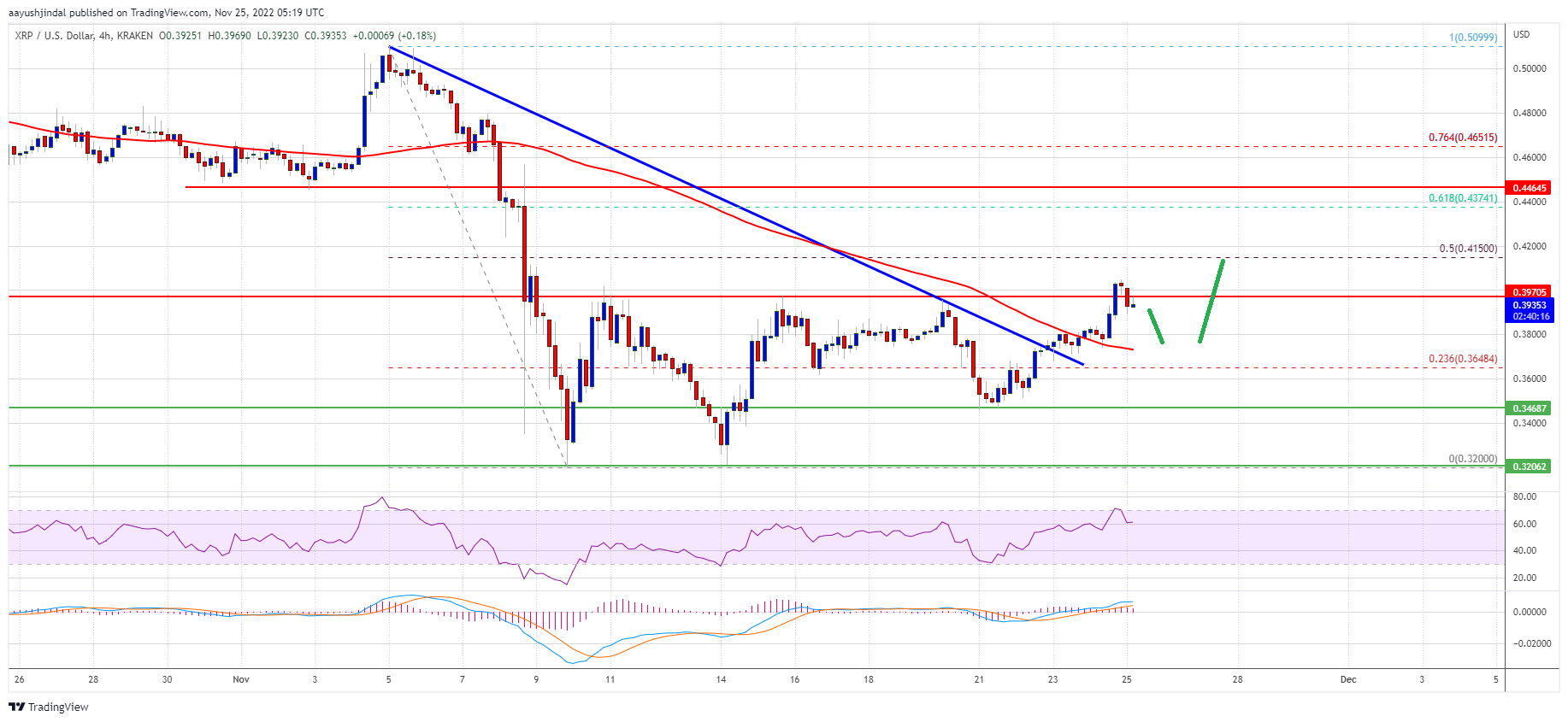
There was a clear move below the $0.450 and $0.40 support levels. Besides, there was a break below a major contracting triangle with support at $0.455 on the daily chart of the XRP/USD pair. The pair dropped below the $0.350 support and tested a crucial support at $0.320.
""

A low is formed near the $0.320 level and the price is now consolidating losses. XRP is now trading well below $0.4000 and the 100-day simple moving average.
""

An immediate resistance is near the $0.3650 level. It is close to the 23.6% Fib retracement level of the downward move from the $0.5099 swing high to $0.3200 low. The first major resistance is seen near the $0.380 level, above which the price might recover towards the $0.415 level and the 100-day simple moving average.
Ripple’s XRP Price

Source: XRPUSD on TradingView.com
""

The 50% Fib retracement level of the downward move from the $0.5099 swing high to $0.3200 low is also near $0.415. A clear break above the $0.415 resistance could open the doors for a sharp increase towards the $0.5000 resistance. The next major resistance above the $0.5000 level could be near the $0.5200 level.
""

Dips Supported?
""

If ripple fails to clear the $0.380 resistance, it could start a fresh decline. An initial support on the downside is near the $0.3400 level.
""

The main support could be near the $0.3200 level or the $0.3000 zone. If the price fails to stay above $0.3000, it could start another major decline.
""

Technical Indicators:
""

Daily MACD – The MACD for XRP/USD is now losing momentum in the bearish zone.
Daily RSI (Relative Strength Index) – The RSI for XRP/USD is now below the 50 level.

Major Support Levels – $0.3400, $0.3200 and $0.3000.
Major Resistance Levels – $0.3650, $0.3800 and $0.4150.

Lecturas Relacionadas

OpenAI Partners with PE Firms, Investing $4 Billion. Let's Talk About Silicon Valley's Hottest New Role: FDE.

The hottest new role in Silicon Valley is the Forward Deployment Engineer (FDE), a hybrid of engineer and business consultant whose core mission is to transform AI demos into native, practical workflows within client organizations. The recent surge in demand is driven by a strategic shift from leading AI companies. OpenAI, partnering with 19 private equity firms in a $4 billion investment, formed a Deployment Company and acquired Tomoro along with its 150 FDEs. Anthropic also announced a $1.5 billion joint venture with financial institutions like Blackstone. The article, based on interviews with industry experts Jove (FDE lead at Cresta) and Oliver (VP at Invisible Technologies, ex-McKinsey), explores the FDE role and the rise of deployment-focused companies. Key insights include: **The FDE Role:** Jove describes an FDE as a "Forward Deployed CTO"—a technically strong engineer who works intimately with clients to implement AI solutions, learn from the process, and feed those insights back to improve the core product. They require expertise in AI agents, client-facing experience, resilience, and the ability to handle complex, imperfect systems. While AI tools enhance their efficiency, the role's complexity makes full automation a distant prospect. **Industry Shift:** Model companies are moving beyond selling tools to ensuring real-world adoption. This blurs the line between model and application companies. Collaborations with private equity (PE) firms are key, providing access to large portfolios of traditional businesses needing AI transformation. For PE firms, these partnerships offer signal value to LPs, create tangible value in portfolio companies, and provide exposure to high-growth AI assets. **Consulting & Transformation:** AI deployment involves deep, customized workflow redesign, moving beyond simple tool augmentation. Companies like Invisible Technologies build modular platforms to create bespoke, AI-native workflows for clients. While traditional consulting will see growth in helping businesses rethink their models for AI, the real value is captured by firms that leave behind transformed, operational systems. Critical success factors include building robust data foundations and strategically deciding which workflow steps should be deterministic versus AI-driven. The ultimate goal shifts from pure cost-cutting to unlocking new revenue opportunities previously impossible without AI-scale capabilities.

marsbitHace 8 min(s)

OpenAI Partners with PE Firms, Investing $4 Billion. Let's Talk About Silicon Valley's Hottest New Role: FDE.

marsbitHace 8 min(s)

Why Is DeFi Insurance Unpopular?

The article explores the core reasons why DeFi insurance remains largely unutilized despite its potential to eliminate traditional insurance inefficiencies and malicious claim denials through automated smart contracts. Key points include: 1. **Low Adoption & Minimal Payouts:** Leading provider Nexus Mutual has paid only ~$18M in claims since 2019, dwarfed by single hack losses (e.g., Kelp DAO's $292M loss). 2. **High Correlation Risk:** Unlike traditional insurance (e.g., house fires), DeFi risks (oracle failures, bridge hacks) are systemic and can simultaneously impact multiple protocols, threatening to drain entire insurance pools. 3. **Prohibitive Cost vs. Reward:** For many protocols (Aave, Morpho, Compound), insurance premiums (1.5%-6%) consume a significant portion or even all of the native yield (3%-4%), leaving investors with meager returns. In some cases (Maple Finance, Ethena), premiums can even result in net-negative yields. 4. **Inadequate Capacity:** The total DeFi insurance pool (e.g., Nexus Mutual's $81.56M) is minuscule compared to the hundreds of billions in total value locked (TVL), creating a massive supply-demand gap. 5. **Structural Flaws:** The claims assessment model (e.g., Nexus Mutual's member voting) creates a conflict of interest, as voters bear the loss if a claim is paid. There is also no regulatory mandate forcing DeFi protocols to obtain insurance. The industry is adapting by focusing on preventative measures (e.g., bug bounty coverage) and seeking external capital via reinsurance. However, the fundamental issues of small pool size, correlated risk, and misaligned economic incentives persist. The article concludes that DeFi insurance, like a public lighthouse, provides shared security benefits, but if everyone relies on others to pay for it, no one will, leaving the ecosystem vulnerable.

Foresight NewsHace 22 min(s)

Why Is DeFi Insurance Unpopular?

Foresight NewsHace 22 min(s)

Trading

Spot
Futuros
活动图片