Proof-of-Stake L1 Blockchain Token Aptos Climbs Close to 20% Higher in 24 Hours

newsbtcPublicado a 2022-10-24Actualizado a 2022-10-24

Resumen

Aptos Market Cap Climbs Over $1 Billion, APT Transactions per Second Increases From 4 to 16.

Proof-of-Stake L1 Blockchain Token Aptos Climbs Close to 20% Higher in 24 Hours

Five days ago, the Aptos blockchain went live after the project received an influx of capital from venture capital (VC) firms and crypto exchanges like a16z, Binance, and FTX. During the past 24 hours, aptos (APT) is up more than 19% against the U.S. dollar and up 11.1% against bitcoin’s value. The VC-backed blockchain token has managed to situate itself within the top 60 largest crypto market capitalizations in existence.

Aptos Market Cap Climbs Over $1 Billion, APT Transactions per Second Increases From 4 to 16

A new token has entered the top 100 largest crypto market caps after the developers from Aptos Labs announced the project’s mainnet launch on Monday, October 17, 2022. Prior to the mainnet launch, the layer one (L1) blockchain project has been backed by millions stemming from VC firms and crypto exchanges like Multicoin Capital, Binance, FTX, and Andreessen Horowitz (a16z).

The co-founders of Aptos Labs, Mo Shaikh and Avery Ching, worked for Facebook (now Meta) on the now-defunct Diem blockchain project. After the mainnet went live, Aptos took a great deal of flak from the crypto community, as the blockchain dubbed a ‘Solana killer’ was immediately criticized at launch.

An engineer from Paradigm stressed in a tweet that “Aptos is broken” and further noted that “Aptos is currently has lower [transactions per second (TPS)] than Bitcoin and a majority of tokens are either staked or ready to be dumped on retail investors.” At the time, the Paradigm engineer said that Aptos was handling 4 TPS, but promised 100,000 transactions per second (TPS) in its finalized version.

Aptos network explorer on October 22, 2022.

At the time of writing, Aptos is recording around 16.68 TPS and ​​8,188,514 APT transactions have been settled to date. The current 16 TPS tracked by the Aptos explorer is faster than Bitcoin’s 2.87 TPS recorded on October 22.

Meanwhile, the Aptos blockchain is very new and the native token APT has managed to situate itself in the top 60 standings in terms of market capitalization size. Presently, aptos (APT) is ranked 52 out of more than 13,000 listed crypto coin projects today.
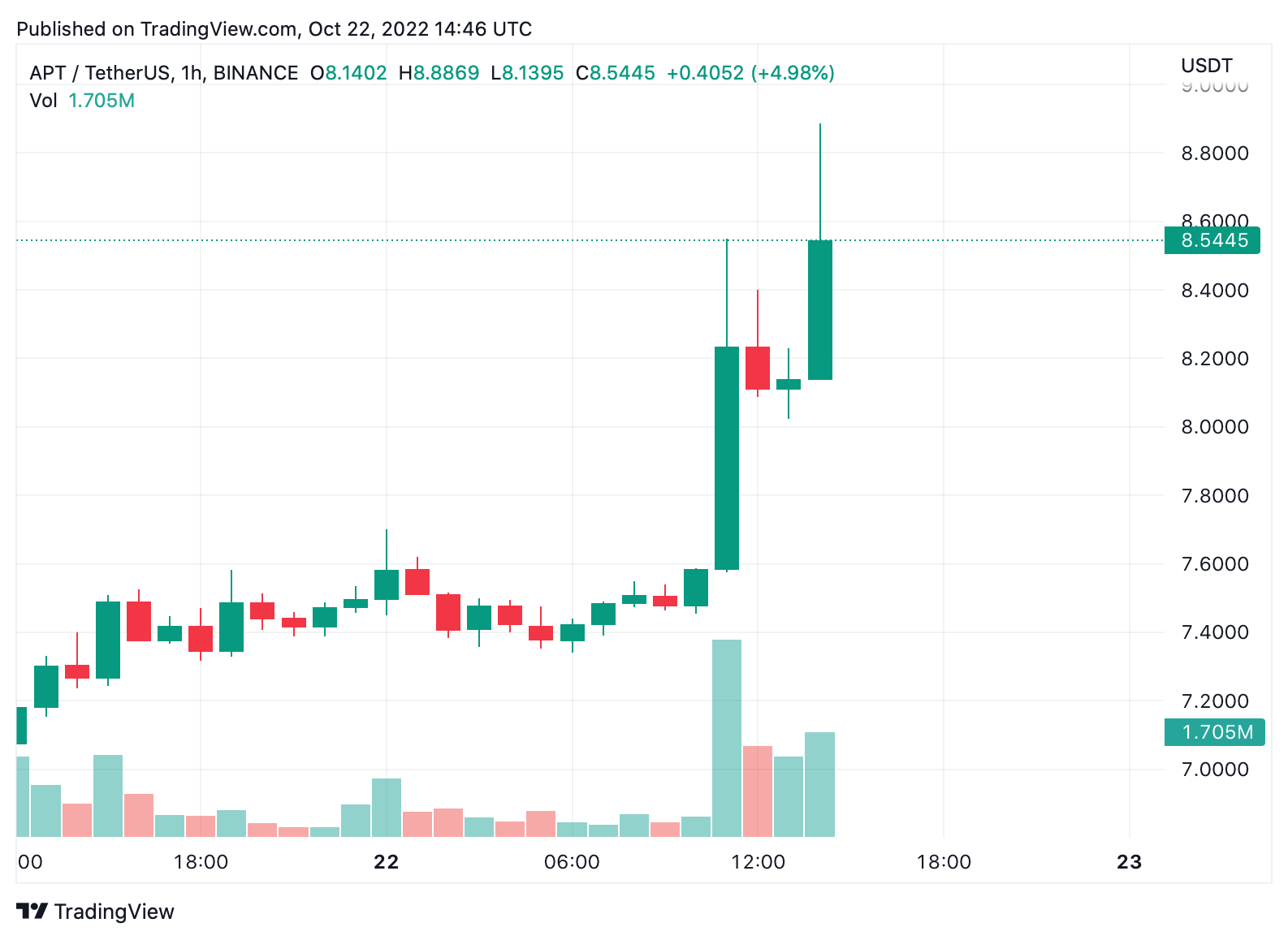
APT/USDT chart on Saturday, October 22, 2022.

APT has a circulating supply of around 130,000,000 tokens and the total supply can reach 1,000,935,772 APT tokens. On Saturday, October 22, APT has seen $322.34 million in global trade volume and the market capitalization today is just over a billion at approximately $1,060,489,188.

Market stats show the APT token has been trading for prices between $7.24 today up to $8.65 per unit. The Aptos blockchain currency is up more than 20% from the low recorded three days ago at $6.73 per coin.

Huobi Global is currently the most active exchange on Saturday, and Huobi is followed by Binance, Okex, and Digifinex respectively. Tether (USDT) is the most active trading pair with APT today and the USDT pairs are followed by BUSD, USD, and BTC.


Criptos en tendencia

Lecturas Relacionadas

Borrowed Faith: How Much of the Bitcoin ETF Flows Are Real Money

"Rented Faith: How Much of Bitcoin ETF Flows Are Real Money?" Bitcoin ETF inflows are often seen as a barometer of institutional conviction. However, week-to-week analysis reveals they are primarily driven by a hidden arbitrage trade rather than directional bullishness. This is the cash-and-carry trade: buying the ETF while simultaneously shorting Bitcoin futures on the CME to lock in the price difference (basis). This delta-neutral activity registers as ETF inflows but reflects a rate-seeking, not price-betting, strategy. Data shows weekly ETF flow volatility is closely tied to hedge fund ("leveraged funds") short positions on CME futures, with a correlation of 0.70. About half of weekly flow variation can be explained by this single factor. In contrast, Bitcoin's weekly price changes have no statistically significant power to predict flows. Crucially, while this arbitrage trade dominates weekly *fluctuations*, it is not the main component of the cumulative *stock*. Of the ~$55 billion total net inflow, the estimated net arbitrage position is only about $1 billion. The vast majority is steady, directional buying averaging ~$400 million per week. Thus, ETF flows overstate the *volatility* of belief, not its *level*. The "rented" arbitrage capital churns, while "owned" directional capital forms the bedrock. This arbitrage trade has been unwinding for two years, with hedge fund shorts peaking at ~$14 billion in late 2024 and falling to ~$4.5 billion. Recent outflows align with basis compression, signaling the trade's exit, not a loss of faith. For Ethereum ETFs, the same dynamic is weaker due to negative carry from forgone staking yield. The key takeaway: To interpret ETF flows, watch the basis vs. Treasury yields and CME hedge fund net shorts. They reveal how much of the weekly "demand" headline is driven by rented, rate-seeking capital versus real conviction.

链捕手Hace 1 min(s)

Borrowed Faith: How Much of the Bitcoin ETF Flows Are Real Money

链捕手Hace 1 min(s)

Two Giants' Credit Expansion: Loan Balances of $9.9 Billion vs. $14.6 Billion, Brazil Emerges as the Main Battlefield

Title: Two Giants "Credit" Surge: Loan Balances of 99 Billion vs. 146 Billion USD, Brazil Emerges as Main Battlefield Summary: The article compares the rapid expansion of credit businesses by two major e-commerce and fintech players, Sea (via Monee) and Mercado Libre (via Mercado Pago), in overseas markets like Southeast Asia and Latin America, contrasting with a slowing domestic Chinese credit market. Using Q1 2026 financial data, it highlights their significant growth. Sea's Monee reached a loan balance of $99 billion, up 71% year-over-year (YoY), contributing 17.5% to Sea's total revenue. Mercado Pago's loan balance hit $146 billion, up 87% YoY, contributing 45% to its parent company's revenue. Both maintained stable risk metrics (e.g., Monee's 90+ day NPL at 1.1%) despite rapid scaling. Brazil is identified as a key and accelerating growth market for both. Sea's Brazilian operations saw loan volumes exceed $10 billion, growing 250% YoY, with SPayLater GMV penetration still low (~10%) indicating high potential. Sea also secured a key Brazilian financial credit license (SCFI). Mercado Libre's Brazil segment contributed over half (54%) of total group revenue, with its credit business there generating $11.24 billion in revenue, up 89% YoY and accounting for 12.7% of global revenue. Mercado Pago's credit portfolio, especially credit cards (46% of loans, +105% YoY), is a strategic focus, described as crucial as building logistics was a decade ago. Its net interest margin after loss (NIMAL) remains high at 17.8%. The article concludes that while Brazil presents immense opportunities, the success is largely driven by these integrated "e-commerce + fintech" giants with proprietary transaction data and ecosystems, making it challenging for standalone fintech players to compete effectively.

链捕手Hace 23 min(s)

Two Giants' Credit Expansion: Loan Balances of $9.9 Billion vs. $14.6 Billion, Brazil Emerges as the Main Battlefield

链捕手Hace 23 min(s)

Research Report Analysis: Is Intel Making a Comeback with Apple? Bernstein's Calculations Show the Right Direction, but the Price Is Already Overvalued

Bernstein analyst Stacy A. Rasgon published a report on June 18 regarding Intel, assessing the potential impact of recent political support for a US-based PC chip design and manufacturing collaboration between Apple and Intel. The report views this as a significant signal for the foundry landscape shift but concludes the initial financial contribution would be minimal. Key conclusions: 1) An Apple deal is seen as a small-scale "proof of concept." Even if Intel wins 40% of Apple's premium notebook chip orders (~5 million units/year), Bernstein estimates it would generate only about $500M in annual revenue and ~$0.03 EPS, negligible against Intel's ~$55B revenue. 2) Political encouragement is not equivalent to enforceable mandates. Winning orders ultimately depends on Intel demonstrating competitive technology (like its 18A node), cost, and reliable supply. 3) The path from validation to large-scale production involves significant challenges, capital investment, and time. Due to these uncertainties, Bernstein maintains a Market-Perform (Hold) rating with a $100 price target, implying potential downside from the ~$121.10 price at the report date. The analysis highlights the tension between near-term validation value—serving as a crucial trust signal for Intel's foundry ambitions and US supply chain resilience—and the long-term opportunity to attract larger cloud and AI chip customers. The investment thesis hinges on successful 18A execution and sustained policy support, not on immediate financial gains from Apple.

marsbitHace 47 min(s)

Research Report Analysis: Is Intel Making a Comeback with Apple? Bernstein's Calculations Show the Right Direction, but the Price Is Already Overvalued

marsbitHace 47 min(s)

Trading

Spot
Futuros

Artículos destacados

Cómo comprar APT

¡Bienvenido a HTX.com! Hemos hecho que comprar Aptos (APT) sea simple y conveniente. Sigue nuestra guía paso a paso para iniciar tu viaje de criptos.Paso 1: crea tu cuenta HTXUtiliza tu correo electrónico o número de teléfono para registrarte y obtener una cuenta gratuita en HTX. Experimenta un proceso de registro sin complicaciones y desbloquea todas las funciones.Obtener mi cuentaPaso 2: ve a Comprar cripto y elige tu método de pagoTarjeta de crédito/débito: usa tu Visa o Mastercard para comprar Aptos (APT) al instante.Saldo: utiliza fondos del saldo de tu cuenta HTX para tradear sin problemas.Terceros: hemos agregado métodos de pago populares como Google Pay y Apple Pay para mejorar la comodidad.P2P: tradear directamente con otros usuarios en HTX.Over-the-Counter (OTC): ofrecemos servicios personalizados y tipos de cambio competitivos para los traders.Paso 3: guarda tu Aptos (APT)Después de comprar tu Aptos (APT), guárdalo en tu cuenta HTX. Alternativamente, puedes enviarlo a otro lugar mediante transferencia blockchain o utilizarlo para tradear otras criptomonedas.Paso 4: tradear Aptos (APT)Tradear fácilmente con Aptos (APT) en HTX's mercado spot. Simplemente accede a tu cuenta, selecciona tu par de trading, ejecuta tus trades y monitorea en tiempo real. Ofrecemos una experiencia fácil de usar tanto para principiantes como para traders experimentados.

171 Vistas totalesPublicado en 2024.12.11Actualizado en 2026.06.02

Cómo comprar APT

Discusiones

Bienvenido a la comunidad de HTX. Aquí puedes mantenerte informado sobre los últimos desarrollos de la plataforma y acceder a análisis profesionales del mercado. A continuación se presentan las opiniones de los usuarios sobre el precio de APT (APT).

活动图片