Justin Sun: HT Is Seriously Undervalued Compared to BNB

HuobiPublicado a 2022-10-21Actualizado a 2022-10-24

Resumen

On the evening of October 20, Justin Sun, the global advisor of Huobi Global, talked about the price of HT in a Twitter Space live broadcast. He believes that the price of HT is seriously undervalued compared to BNB.

On the evening of October 20, Justin Sun, the global advisor of Huobi Global, talked about the price of HT in a Twitter Space live broadcast. He believes that the price of HT is seriously undervalued compared to BNB. Here are several reasons:

● These two tokens have the same circulation

● Huobi Global has more tools to empower HT

● Popular coins such as APT have a higher trading volume on Huobi Global

Is it real?

Firstly, look at the circulation. The total supply of BNB is 200 million, while the total supply of HT is 500 million, 300 million more than its compatitor. However, nearly 300 million HTs have already been burnt through the “HT Token Burn Program Community Vote”. From the perspective of circulating supply, the current circulating supply of HT is around 130 million, and the circulating supply of BNB is 160 million. The circulating supply of HT is less than that of BNB. Focusing on non-circulating HT, with 200 million in circulation compared to 160 million, the price of BNB is around 270 US dollars per token, while the price of HT is only 7 US dollars per token, the gap is indeed too wide.

From the burning curve below, by burning 150 million HT in March 2020, the burning speed of HT was significantly accelerated, while BNB was relatively slow.
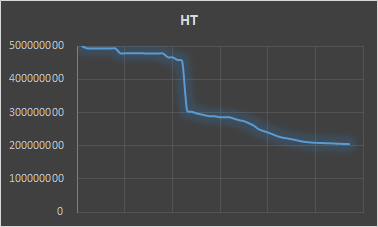
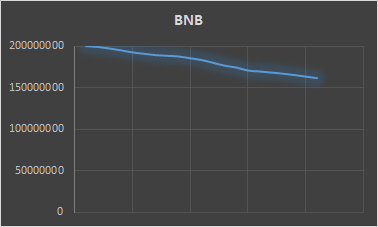
Second, when HT was initially released, part of it was used to buy point cards as gifts, and HT could be used to purchase VIP members, and also could be used to vote for listing. Since the end of 2020, the empowerment actions will be significantly reduced. In addition, the Chinese users would force to leave in 2021, and the empowerment actions of HT were basically suspended. However, the empowerment of BNB actions was continuous, which lead to a rebound in the price of BNB at the end of 2021, and widens its price gap with HT. The empowerment move of HT is indeed a little weaker, but there is no fundamental difference between them by circulation and brand influence, if HT could follow the BNB in the empowerment perspective, the price gap may see a quick narrowing in the short run.

Lastly, take the trading volume of the popular currency APT as an example to analyze the gap between the giants. According to the data of Coingecko, the trading volume of the APT/USDT trading pair in Binance for the last 1 day is around 120 million US dollars, while in Huobi it is about 40 million US dollars. the gap was just about 3 times. This gap is much narrower than the price gap between HT and BNB.

The following are quoted from Justin in the live broadcast. You can tell for yourself whether it makes sense or not:
“I personally believe that HT is definitely undervalued because the circulation of HT and BNB is exactly the same, about 160 million. Now a BNB coin is a few hundred dollars, while HT is only 7-8 dollars, I think HT is still undervalued. Although Binance has a strong network effect, Huobi Global is still an excellent exchange.

For example, in the past two days, Huobi Global is still the main battlefield for the trading of APT which is a new and top-level project. To a certain extent, the price of HT does not match the users, trading depth, and capital of Huobi global. In another word, HT is still underestimated.

I’m not trying to spread FOMO emotion to you guys. Suppose I’m not a Huobi Global consultant, my judgment of the undervalue of HT will still be firm. So HT now is definitely will be a profitable investment. The reason HT was undervalued is that Huobi Global did not empower HT. Now that I am a Huobi Global consultant, I must ensure that Huobi Global will focus on empowering HT. In meetings for the last few days, I have emphasized more than 50 times to make sure that our organization's top priority is to empower HT and turn the direction of operation back to HT prosperity. "
Lecturas Relacionadas

After R&D Investment Catches Up with the U.S., Is the Sino-U.S. Chip Competition Still Just About Money?

The article examines the significance of recent data showing China's total R&D expenditure, measured by purchasing power parity (PPP), catching up to or slightly surpassing that of the United States in 2024. It argues that while this milestone reflects China's immense capacity to mobilize research resources, the competition in semiconductors now extends far beyond sheer financial input. The analysis highlights key differences: China's R&D is heavily skewed towards experimental development (over 80%), focusing on product engineering and industrialization, whereas the U.S. allocates a proportionally larger share (about 15%) to basic research. Furthermore, leading U.S. semiconductor firms reinvest a significant portion of their substantial global sales revenue into R&D, creating a sustainable commercial innovation cycle that is difficult to replicate. The article emphasizes that semiconductor progress depends on converting R&D into commercially viable products that pass rigorous customer validation and achieve repeat orders, not just on spending levels. It concludes that as China enters the top tier of R&D spenders, the critical challenges shift to improving resource allocation efficiency, fostering long-term basic research, and building effective mechanisms to bridge the gap between laboratory discoveries and reliable, market-ready industrial capabilities.

marsbitHace 14 min(s)

After R&D Investment Catches Up with the U.S., Is the Sino-U.S. Chip Competition Still Just About Money?

marsbitHace 14 min(s)

Top 10% of American Households Capture 88% of Wealth, How Is the AI Era Cake Divided?

AI Worsens Wealth Inequality as Top 10% of US Families Garner 88% of Stock Gains (2019-2026) A report from the China Finance 40 Forum highlights that the AI boom is significantly widening wealth inequality in the United States. From 2019 to Q1 2026, wealth from directly held stocks by US households nearly doubled from $29 trillion to approximately $55 trillion, with rapid growth concentrated post-2023, coinciding with the AI-driven stock market surge. The distribution of these gains has been starkly uneven. Between 2022 and Q1 2026, the wealth increase of about $21 trillion was captured almost entirely by the wealthiest families: the top 10% secured roughly 88% ($18.5 trillion), while the bottom 50% received only about 1% ($0.2 trillion). This has contributed to a growing disparity in disposable income shares. The report, referencing economic historian Robert Allen, draws parallels to historical technological shifts like the "Engels' Pause" during the First Industrial Revolution, where worker wages stagnated despite productivity gains. It suggests AI could induce a similar period where capital收益 outpace labor income, exacerbating inequality. Huang Yiping of Peking University identifies four mechanisms through which AI impacts income distribution: capital-bias (reducing labor's income share), task polarization (hollowing out middle-skill jobs), skill-based digital divides, and wealth amplification through assets. He warns that if this trend continues, strong supply growth driven by AI could be undermined by persistently weak consumer demand, threatening sustainable economic growth. To address these challenges, the report proposes a three-pronged strategy: 1) Defensive measures like strengthening social safety nets and antitrust enforcement; 2) Empowering workers through education reform and lifelong learning to collaborate with AI; and 3) Rebalancing via policies such as potential taxes on AI超额收益 and mechanisms for broader sharing of technology's benefits, ensuring AI's红利 are more equitably distributed.

marsbitHace 20 min(s)

Top 10% of American Households Capture 88% of Wealth, How Is the AI Era Cake Divided?

marsbitHace 20 min(s)

Trading

Spot
活动图片