The Risks in DeFi Stack

HACKERNOONPublicado a 2022-10-17Actualizado a 2022-10-17

Resumen

Decentralized Finance or DeFi is a form of blockchain-based finance that offers financial services without any central intermediaries.

Decentralized Finance or DeFi is a form of blockchain-based finance that offers financial services without any central intermediaries. What used to be a niche ecosystem with a TVL of less than $100 Million in the year 2017 grew to over $200 Billion at the peak of the last bull run in 2022.

TVL or Total Value Locked is the value of the crypto assets locked in a DeFi smart contract. - Source

The flip side of the tremendous growth is that it has become a honeypot for some of the most sophisticated hackers across the world. Billions of dollars have been lost to security vulnerabilities and economic failures.

If you are a crypto believer, you can’t ignore the movement of Decentralized Finance. While the ecosystem is too nascent for us to identify all potential risks, a look at the DeFi stack can help us understand the different ways things can break and thus inform how we can go about participating in the ecosystem.

None of what follows is financial advice. Neither will I claim to be an exhaustive list of risks in DeFi. Treat it more as a starting point and a framework for identifying different risks that may exist in a DeFi Investment Approach.

The DeFi Stack

We can look at the DeFi ecosystem as a combination of the following five layers.

Blockchain Networks - All DeFi protocols are deployed on a blockchain network. The blockchain network provides the computational platform for the execution of the smart contracts that power the DeFi service.

Crypto Tokens - The tokens are the underlying assets that are used by the protocol to deliver a service. A Lending Protocol might enable the lending and borrowing of a particular crypto token to be used by traders as a form of leverage. A Decentralized Exchange might have a pool that allows users to swap one token for another.

Protocol - DeFi Protocols are open-source computer programs that run on blockchain networks and provide financial services.

dApp Interface - These are the web interfaces that users use to interact with the DeFi Protocols. Some wallets such as Argent, Coinbase, and Brew Money offer in wallet integrations with Protocols too directly from the mobile.

Wallets - Cryptocurrency wallets hold the private keys that allow users to make payments, deploy and withdraw funds from defi protocols, and more.

Risks in Blockchain Network Layer

Unlike popular perception, blockchains are not infallible. Security vulnerabilities can allow malicious actors to siphon off funds or take over control of the network.

The 51% Attack

A 51% Attack on a Blockchain Network is a scenario where one single entity or group has control over 50% of the network hash rate. The implication of this is that the group can censor transactions, and reorder and rewrite blocks leading to double spending where a network participant can spend/utilize the same asset multiple times.

"Hashrate" refers to the total combined computational power that is being used to mine

and process transactions on a Proof-of-Work blockchain, such as Bitcoin. - Source

A 51% attack while complex and expensive to pull off is a risk that even mature blockchain networks such as Bitcoin have had to face at some point in time.

Bitcoin’s reckoning with 51% Attack

In 2014, ghash.io, a popular bitcoin mining pool for a brief duration of 24-48 hours had over 51% of Bitcoin’s hash rate. While GHash didn’t demonstrate any signs of malicious intent, it did raise debates on how bitcoin can avoid such scenarios of a pool or entity taking over 51% of the network’s hash rate. In this particular case, miners from the pool volunteered to move away from ghash. Moreover, ghash publicly vowed to limit its hash rate to 40% of the network’s hash rate.

A mining pool is the pooling of resources by miners, who share their processing power over a network, to split the reward equally, according to the amount of work they contributed to the probability of finding a block. - Source

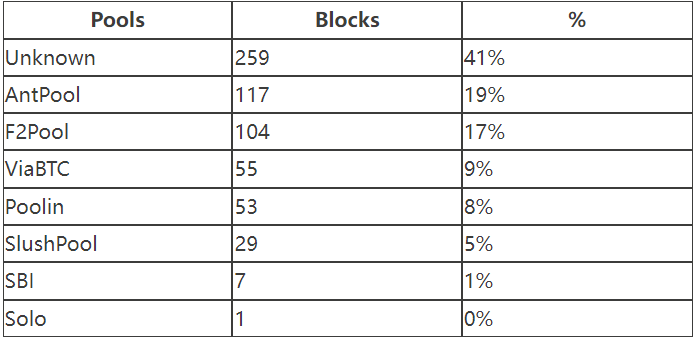
Bitcoin hash rate is more widely distributed today. For instance, the last days of data for blocks mined look like the following. The largest mining pool makes up for 19% of the network’s hashrate.
51% Attacks on Ethereum Classic

Ethereum Classic blockchain came into being after the infamous The DAO Hack. It has a market cap of over $4 Billion. In August 2020 Ethereum Classic was attacked three times and over $5 Million were siphoned off from the network through double-spending.

Vulnerabilities in Blockchain Network

Eventually, blockchain networks are powered by code and code can be buggy. In August 2010 an anonymous hacker was able to exploit a bug to create 184 Billion Bitcoin. Bitcoin supply is supposed to be capped at 21 Million. The anomaly was detected by the Bitcoin community soon. Satoshi Nakamoto coded up a fix for the issue and rolled it out within 5 hours that soft forked the network to state before the faulty block was mined.

In blockchain technology, a soft fork is a change to the software protocol where only previously valid transaction blocks are made invalid. Because old nodes will recognize the new blocks as valid, a soft fork is backwards-compatible. This kind of fork requires only a majority of the miners upgrading to enforce the new rules. - Source

In the recent past, Polygon, one of the leading scaling solutions for Ethereum and a sidechain, lost over 800K Matic worth $ 2 million to a hack. Two white hat hackers reported the vulnerability and Polygon rolled out a fix within 48 hours. Polygon Foundation covered the money lost and paid out a sum of $3.5 Million in bounty to the two white hat hackers.

The Volatility in Crypto Assets

Every asset class has inherent volatility. Crypto Assets more so. In stock markets, a 1% dip makes headlines and is reported as a crash. In crypto markets, it is fairly common to see such fluctuations in prices multiple times in a month.
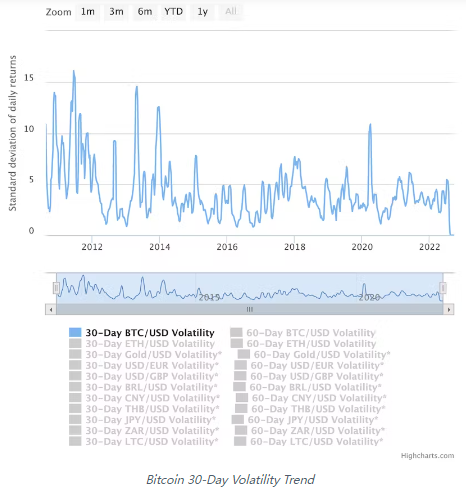
Bitcoin 30-Day Volatility Trend

The above graph shows the trend of Bitcoin price volatility over time. While it may seem that over the years, the volatility is reducing a bit, but still, 5% up and down swings are not that uncommon.

Volatility refers to the amount of uncertainty or risk related to the size of changes in a security's value. - Investopedia

30-Day Rolling Volatility = Standard Deviation of the last 30 percentage changes in Total Return Price * Square-root of number of trading days

Token prices are a function of market perception. The perception can be based on how the specific project is doing or it can be more macro as in where the overall market is headed.

For instance, the crypto market still has a very high correlation with bitcoin price. Whenever bitcoin price dips, we see people liquidating their other crypto assets bringing down the overall market. This is understandable considering even now bitcoin makes up almost 40% of the total crypto market.

Earlier this year, in May, 2022 a bank run on US Terra Stablecoin wiped off $ 40 Billion from the market. Anchor Protocol was one of the most popular lending protocols on Luna that offered ~20% APY on US Terra Stablecoin deposits. While the protocol itself worked as it was supposed to, a known economical weakness in Luna ecosystem led to US Terra losing its peg to US Dollar.

1 US Terra = 3 cents as of now

The Fault in the Protocols

Security breaches, code exploits, and flash loan attacks led to the loss of billions of dollars in DeFi. As per Chainanalysis, over $ 1.3 Billion were stolen in the first 3 months of 2022.

Security Breaches are instances when a hacker gains control of the private key or keys of wallets that have admin controls over the protocol. [The Ronin Hack](https://medium.com/uno-re/biggest-crypto-hack-of-all-time-a-breakdown-of-the-ronin-network-hack-ef8d9e25ba6b#:\~:text=The attacker discovered a backdoor,them using the stolen keys.) is one of the largest hacks in DeFi where allegedly a North Korean Hacking Group stole over $ 600 Million worth crypto tokens.

Ronin is an Ethereum Sidechain developed and operated by Sky Mavis to support their popular play-2-earn game, Axie Infinity.

Ronin Network has nine validators to process the transactions and as long as the majority of them approve a transaction it goes through. The catch was that the nine keys were controlled by just two entities. Sky Mavis had 4 keys and Axie DAO 5. However, Axie DAO had earlier provided Sky Mavis with access to sign transactions on its behalf for a short-term period. The access was never revoked. This miss allowed hackers to gain access to the majority of the keys and process the transactions.

Code Exploits are faults in smart contracts that allow a hacker to siphon off funds. The Polynetwork hack where $610 Million worth of crypto assets were hacked (and later returned) is one of the largest hacks that happened due to code exploits.

Polynetwork is a protocol that enables cross-chain assets transfer.

In this particular case, the hacker was able to figure out a way to invoke a restricted smart contract that enabled them to take control of the wallets that held assets managed by Polynetwork and transfer them to a wallet they controlled.

Frontend and DNS Exploits

Users interact with DeFi protocols by connecting their wallet to a protocol through a web interface. In May 2022 a hacker was able to leverage a vulnerability in the DNS to inject a malicious smart contract on the web interface for mm.finance, a leading DeFi protocol on Cronos chain, and diverted over $2 Million to their wallet.

The domain name system (i.e., “DNS”) is responsible for translating domain names into a specific IP address so that the initiating client can load the requested Internet resources. The domain name system works much like a phone book where users can search for a requested person and retrieve their phone number. - [Learn more](https://www.infoblox.com/glossary/domain-name-system-dns/#:~:text=The%20domain%20name%20system%20(i.e.,and%20retrieve%20their%20phone%20number.)

Losing Private keys or Seed Phrase

Cryptocurrency Wallets store the public key and the private key. The private key is used to access the fund and transfer them. The public key is your address. Private Keys or the more popular seed phrase where a 12 - 24 words phrase is used to generate the private keys.

If a hacker is able to access your seed phrase or your wallet’s private keys, they can take over your assets. Malicious software on your computer or mobile, or phishing attacks that trick users into sharing their seed phrase on a website are some of the common ways in which hackers gain access to their seed phrase and steal assets in your wallet.

In April 2022 an iPhone user lost crypto and NFTs in his wallet when a hacker pretending to be an Apple representative tricked the user to share a secure code that was sent to the user’s number and use that to hack into their iCloud Account. From there on, they were able to access the user’s wallet seed phrase

Navigating DeFi Safely

It is essential to practice caution when navigating DeFi considering the different risks that exist in the stack. As you delve into the DeFi Ecosystem, choosing the right platforms and ecosystems for your risk tolerance is a critical step. A few things to look for

Track record

How long has the blockchain or protocols been in existence? How have they performed in volatile market conditions?

What has been the TVL's growth over time?

What is the caliber of the core team working on the protocol or chain?

Independent Audits

Has it gone through independent security audits?

How robust are their processes? Here processes can range from their development activities, and security practices, to taking key decisions with community participation

Liquidity

How much liquidity the asset or the protocol has? This is especially critical in selecting an asset or protocol. Low liquidity can translate to higher risks.

How much AUM does the DAOs’Community’s treasury have?

A lot of products have emerged that help with such research. A few of them are DeFiLllama, DeFi Safety, and Exponential Finance. Beyond this, there are a few things you can do as a user that can ensure the safety of your funds

Maintain Wallet Hygiene

Don’t hold all your assets in a single wallet. Use a Hardware Wallet

Never share your seed phrase or private key online or offline

Maintain multiple backups of your seed phrase

Ensure safety in the devices where your wallets reside, desktop, mobile, or browser.

Be cautious about the dApps you’re interacting with and the kind of permissions you are allowing. Do a regular audit of the funds

Stay Informed - You can do all of these yet, if the dapp or protocol you interact with has been hacked, you can end up losing your funds. Stay aware of the happenings in the chain, assets, and protocols you use. You can use twitter for that.

Despite these risks, DeFi presents multiple opportunities for early adopters to not only grow their crypto assets but also get familiar with an emerging phenomenon that will reimagine how financial services are delivered in the coming years.

Criptos en tendencia

Lecturas Relacionadas

Report Interpretation: J.P. Morgan Details Micron's Pre-Earnings Sentiment, Current Hardware Sector Dynamics

Morgan Stanley analyst Joshua Meyers' report (June 21, 2026) highlights key trends in the hardware and semiconductor sector ahead of Micron's earnings. The core takeaways are: 1. **Micron & Memory:** Memory remains a high-conviction long theme, driven by strong AI demand and rising ASPs. However, investor focus is shifting to the sustainability of Micron's >80% gross margins and the specifics of potential new long-term supply agreements (SCAs). 2. **Hardware Supply Chain:** AI-related demand for servers, networking, and storage remains robust, but company performance is diverging. Celestica (CLS) shows improved margin confidence, Western Digital and Seagate benefit from pricing, Fabrinet (FN) sees predictable AI optics growth, and Teradyne (TER) anticipates a new Google customer. 3. **AI Capex & WFE Forecasts:** JPMorgan increased its Wafer Fab Equipment (WFE) market growth forecasts to 28% in 2026 and 29% in 2027. AI infrastructure financing is evolving, with higher project-level debt reducing constraints on capex expansion. The report signals that while the AI-driven hardware cycle is strong, the market is entering a phase focused on execution verification (e.g., Micron's SCA details, Fabrinet's ramp with Amazon) and valuation sustainability. Key near-term signals include Micron's guidance, Arista Networks' outlook, and the pace of demand normalization post potential tariff-related pull-ins.

marsbitHace 14 min(s)

Report Interpretation: J.P. Morgan Details Micron's Pre-Earnings Sentiment, Current Hardware Sector Dynamics

marsbitHace 14 min(s)

Research Report Analysis: The Fed's New Chair's Debut – New Leader, But Same Script?

Report Analysis: Federal Reserve's New Chair Debut – A New Captain, But the Same Script? Morgan Stanley's chief global economist Seth B. Carpenter analyzes the first FOMC meeting under new Fed Chair Kevin Warsh in a June 21 report. Warsh deliberately avoided providing forward guidance on interest rates, aligning with his philosophy. However, market expectations for a rate hike this year were reinforced. Key signals lie elsewhere: inflation may fall more than expected, and quantitative tightening (QT) could be more aggressive than anticipated. The FOMC's "dot plot" suggests only one rate hike in 2026. Carpenter argues that if inflation undershoots forecasts, the logic for even a single hike weakens, especially as projections indicate potential rate cuts in 2027. On QT, Warsh's stance is clear. Carpenter notes that measures like halving the Treasury's account balance could shrink the Fed's balance sheet by around $500 billion with minimal market impact. Combined with adjustments to reserve interest and liquidity rules, the ultimate QT scale may exceed expectations, though its market effect might be less disruptive unless the Fed actively sells Mortgage-Backed Securities (MBS). While Warsh initiated a review of the Fed's policy framework, the 2% inflation target remains intact for now. The report concludes that the market may be overestimating the significance of reduced forward guidance and the near-term rate hike risk, while potentially underestimating the scope and manageable nature of the coming balance sheet reduction. The key debates will hinge on upcoming core PCE data, the specifics of the QT path, and the framework review's findings.

marsbitHace 25 min(s)

Research Report Analysis: The Fed's New Chair's Debut – New Leader, But Same Script?

marsbitHace 25 min(s)

Critical Game Week: BTC Retracement Confirmation vs. HYPE Support Battle | Guest Analysis

This weekly analysis outlines a critical juncture for BTC and HYPE markets, focusing on key price level confirmations. **BTC Analysis:** BTC is at a pivotal point after a five-wave rally from the June 5th low of $59,100. The price has broken below a short-term rising channel's lower boundary, with the current move seen as a pullback to test this breakdown. Failure to reclaim this level could lead to a retest of the $59,000-$60,000 support zone. The core scenario hinges on this channel retest outcome. * **Key Levels:** Resistance at $64,500-$65,000 (channel boundary) and $69,500-$70,500. Support at $59,000-$60,000 and $55,000. * **Strategy:** A core bearish stance is maintained (20% short from last week), with short-term plans for tactical trades. Three detailed contingency plans (A/B/C) are provided for short positions on resistance tests or breakdowns, emphasizing strict stop-loss discipline. **HYPE Analysis:** HYPE shows strong momentum but is currently in a corrective phase after hitting a new high of $76.94. The price is retesting the crucial $64-$66 support area. * **Key Levels:** Resistance near $77 and $80-$82. Support at $64-$66 and $52-$54. * **Strategy:** The short-term approach is "buy on dips, avoid chasing rallies." A long position is considered only if clear stabilization signals appear at the $64-$66 or deeper $52-$54 support zones, with tight risk controls. **General Risk Management:** A standardized trailing stop-loss protocol is emphasized: set initial stop, breakeven at +1% profit, then trail stops upward to lock in gains. *Disclaimer: All analysis is presented as a personal trading framework, not investment advice. Market conditions are complex and require dynamic adjustment.*

marsbitHace 39 min(s)

Critical Game Week: BTC Retracement Confirmation vs. HYPE Support Battle | Guest Analysis

marsbitHace 39 min(s)

Research Report Interpretation: Citi Attends AWS Summit, Bullish on Cloud Business Acceleration but Data Governance Remains Key Variable

Citi analyst Tyler Radke's team attended the AWS New York Summit (June 17-18), engaging with over 10 clients and partners. In a June 19 report, they highlighted the summit's focus on scaling agent AI for enterprise deployment. Citi maintains a "Buy" rating on Amazon, forecasting AWS revenue growth to accelerate to 37% in FY27 from 30% in FY26, noting this estimate may be conservative. Key takeaways: 1. **AWS Strategy Shift:** AWS is moving from proof-of-concepts to scalable deployment. New offerings like AWS Context (building enterprise knowledge graphs), Amazon Quick (cross-application AI assistant), and security tool Continuum address core enterprise pain points for AI adoption. 2. **Data Infrastructure Beneficiaries:** Data infrastructure companies like Snowflake, Elastic, Oracle, and ClickHouse are seen as direct beneficiaries of scaling AI workloads, as evidenced by strong growth and use cases presented. 3. **Critical Role of Data Governance:** As AI agents scale from hundreds to thousands, effective data governance becomes the key variable for deploying AI in core business processes. AWS Context represents AWS's strategic extension from providing compute/models to offering a data governance infrastructure layer. The report emphasizes that without solving data governance, AI will remain confined to pilot projects. The investment thesis focuses on AWS revenue acceleration and data infrastructure vendors' growth, while monitoring signals like AWS's quarterly revenue growth, Bedrock AgentCore task volume, and pricing impacts on companies like Elastic.

marsbitHace 45 min(s)

Research Report Interpretation: Citi Attends AWS Summit, Bullish on Cloud Business Acceleration but Data Governance Remains Key Variable

marsbitHace 45 min(s)

Crucial Week of Contention: BTC Tests Support and HYPE's Key Level Battle | Special Analysis

**Market Enters Critical Week: Bitcoin Pullback Test and HYPE Support Battle** The market enters a crucial phase of contention this week. The marginal shifts in Federal Reserve policy expectations continue to dictate the pricing rhythm for risk assets. Meanwhile, in the crypto market, following a period of sideways consolidation, the divergence between bulls and bears is becoming concentrated at key price levels. **Bitcoin (BTC) Analysis & Strategy** * **Technical View:** The 4-hour chart suggests BTC is in a five-wave structure since the June 5th low near $59,100. Price action shows a short-term rising channel. The recent drop below this channel's lower boundary is now being followed by a pullback attempt (wave 40-41). The outcome of this retest is critical. * **This Week's Outlook:** The core focus is whether BTC can reclaim and hold above the channel's lower boundary. * **Bullish Scenario:** A successful hold could lead to a continued rebound, potentially challenging the $69,500 - $70,500 resistance zone. * **Bearish Scenario:** Failure to hold may trigger a renewed test of the $59,000 - $60,000 core support area, with $55,000 as a deeper support level. * **Operational Strategy:** The author maintains a 20% mid-term short position initiated last week near $64,500, based on a model signaling a shift to a bearish structure. Short-term tactics involve using 30% capital for potential "spread" trades, with three contingency plans (A, B, C) outlined for reacting to resistance tests, breakouts, or support breakdowns. **HYPE Analysis & Strategy** * **Technical View:** On the 4-hour chart, HYPE shows strong momentum, having recently broken to a new high since January. The current pullback presents a clear three-wave correction structure, bringing the price back to the critical $64 - $66 support zone. * **This Week's Outlook:** The focus is on the battle for the $64 - $66 support area. * **Bullish Scenario:** Holding this support could signal a continuation of the uptrend from the June 10th low, leading to new highs. * **Bearish Scenario:** A breakdown could extend the correction, potentially testing the deeper $52 - $54 support band. * **Operational Strategy:** The recommended short-term approach is "buy on dips, avoid chasing rallies." A light long position (under 30% capital) could be considered if HYPE shows stabilization signals at the $64-$66 or $52-$54 support zones, confirmed by model signals. Strict stop-loss discipline is emphasized. **General Risk Management:** A strict trailing stop-loss protocol is advised: set an initial stop; move to breakeven at +1% profit; lock in profits progressively thereafter. *Disclaimer: All analysis is presented as the author's personal technical perspective and trading log, not as investment advice. Markets are complex and dynamic; risk control is paramount.*

Odaily星球日报Hace 45 min(s)

Crucial Week of Contention: BTC Tests Support and HYPE's Key Level Battle | Special Analysis

Odaily星球日报Hace 45 min(s)

Trading

Spot
Futuros

Artículos destacados

Qué es BITCOIN

Entendiendo HarryPotterObamaSonic10Inu (ERC-20) y Su Posición en el Espacio Cripto En los últimos años, el mercado de criptomonedas ha sido testigo de un aumento en la popularidad de las monedas meme, capturando el interés no solo de los comerciantes, sino también de aquellos que buscan compromiso comunitario y valor de entretenimiento. Entre estos tokens únicos se encuentra HarryPotterObamaSonic10Inu (ERC-20), un proyecto intrigante que mezcla referencias culturales en el tejido de las criptomonedas. Este artículo profundiza en los aspectos clave de HarryPotterObamaSonic10Inu, explorando sus mecanismos, ethos impulsado por la comunidad y su relación con el paisaje cripto más amplio. ¿Qué es HarryPotterObamaSonic10Inu (ERC-20)? Como su nombre sugiere, HarryPotterObamaSonic10Inu es una moneda meme construida sobre la blockchain de Ethereum, clasificada bajo el estándar ERC-20. A diferencia de las criptomonedas tradicionales que pueden enfatizar la utilidad práctica o el potencial de inversión, este token prospera en el valor de entretenimiento y la fuerza de su comunidad. El proyecto tiene como objetivo fomentar un entorno donde los usuarios comprometidos puedan reunirse, compartir ideas y participar en actividades inspiradas por diversos fenómenos culturales. Una característica notable de HarryPotterObamaSonic10Inu es su cero impuestos en las transacciones. Este atractivo elemento tiene como objetivo incentivar el comercio y la participación comunitaria, sin cargos adicionales que puedan disuadir a los comerciantes de pequeña escala. El suministro total de la moneda está establecido en mil millones de tokens, una cifra que marca su intención de mantener una circulación sustancial dentro de la comunidad. Creador de HarryPotterObamaSonic10Inu (ERC-20) Los orígenes de HarryPotterObamaSonic10Inu están algo envueltos en misterio; los detalles sobre el creador siguen siendo desconocidos. El desarrollo de este token carece de un equipo identificable o de un plan explícito, lo cual no es inusual dentro del sector de monedas meme. En cambio, el proyecto ha surgido de manera orgánica, con su progreso muy dependiente del entusiasmo y la participación de su comunidad. Inversores de HarryPotterObamaSonic10Inu (ERC-20) En cuanto a inversiones externas y respaldo, HarryPotterObamaSonic10Inu también sigue siendo ambiguo. El token no lista ninguna fundación de inversión conocida o apoyo organizacional significativo. En cambio, la savia del proyecto es su comunidad de base, que informa su crecimiento y sostenibilidad a través de la acción colectiva y el compromiso en el espacio cripto. ¿Cómo Funciona HarryPotterObamaSonic10Inu (ERC-20)? Como una moneda meme, HarryPotterObamaSonic10Inu opera principalmente fuera de los marcos tradicionales que a menudo rigen el valor de los activos. Hay varios aspectos distintivos que definen cómo funciona el proyecto: Transacciones Sin Impuestos: Sin tarifas impositivas en las transacciones, los usuarios pueden comprar y vender el token libremente sin preocuparse por costos ocultos. Compromiso Comunitario: El proyecto prospera en la interacción comunitaria, aprovechando plataformas de redes sociales para crear entusiasmo y facilitar la participación. Las discusiones, el intercambio de contenido y el compromiso son elementos cruciales que ayudan a expandir su alcance y fomentar la lealtad entre los seguidores. Sin Utilidad Práctica: Cabe señalar que HarryPotterObamaSonic10Inu no ofrece utilidad concreta dentro del ecosistema financiero. Más bien, se clasifica como un token principalmente para actividades de entretenimiento y comunitarias. Referencia Cultural: El token incorpora astutamente elementos de la cultura popular para atraer interés, conectando con entusiastas de los memes y seguidores de las criptomonedas por igual. HarryPotterObamaSonic10Inu ejemplifica cómo las monedas meme operan de manera diferente a los proyectos de criptomonedas más tradicionales, ingresando al mercado como construcciones sociales innovadoras en lugar de activos utilitarios. Cronología de HarryPotterObamaSonic10Inu (ERC-20) La historia de HarryPotterObamaSonic10Inu está marcada por varios hitos notables: Creación: El token surgió de un meme viral, capturando la imaginación de muchos entusiastas de las criptomonedas. Las fechas específicas de creación no están disponibles, subrayando su ascenso orgánico. Listado en Exchanges: HarryPotterObamaSonic10Inu ha llegado a varios exchanges, permitiendo un acceso y comercio más fácil por parte de la comunidad. Iniciativas de Compromiso Comunitario: Actividades continuas destinadas a mejorar la interacción comunitaria, incluyendo concursos, campañas en redes sociales y generación de contenido por parte de fanáticos y defensores. Planes de Expansión Futuros: La hoja de ruta del proyecto incluye el lanzamiento de una colección de NFT, mercancía y un sitio de comercio electrónico relacionado con sus temas culturales, involucrando aún más a la comunidad e intentando añadir más dimensiones a su ecosistema. Puntos Clave Sobre HarryPotterObamaSonic10Inu (ERC-20) Naturaleza Impulsada por la Comunidad: El proyecto prioriza la participación colectiva y la creatividad, asegurando que la involucración de los usuarios esté a la vanguardia de su desarrollo. Clasificación como Moneda Meme: Representa la epítome de las criptomonedas basadas en el entretenimiento, diferenciándose de los vehículos de inversión tradicionales. Sin Afiliación Directa con Bitcoin: A pesar de la similitud en el nombre del ticker, HarryPotterObamaSonic10Inu es distinto y no tiene relación con Bitcoin u otras criptomonedas establecidas. Enfoque en la Colaboración: HarryPotterObamaSonic10Inu está diseñado para crear un espacio para la colaboración y el intercambio de historias entre sus poseedores, proporcionando una vía para la creatividad y el vínculo comunitario. Perspectivas Futuras: La ambición de expandirse más allá de su premisa inicial hacia NFTs y mercancías describe un camino para que el proyecto potencialmente ingrese a avenidas más tradicionales dentro de la cultura digital. A medida que las monedas meme continúan capturando la imaginación de la comunidad de criptomonedas, HarryPotterObamaSonic10Inu (ERC-20) se destaca debido a sus lazos culturales y su enfoque centrado en la comunidad. Si bien puede no encajar en el molde típico de un token impulsado por la utilidad, su esencia radica en la alegría y la camaradería fomentadas entre sus seguidores, destacando la naturaleza en evolución de las criptomonedas en una era cada vez más digital. A medida que el proyecto continúa desarrollándose, será importante observar cómo las dinámicas comunitarias influyen en su trayectoria en el cambiante paisaje de la tecnología blockchain.

1.8k Vistas totalesPublicado en 2024.04.01Actualizado en 2024.12.03

Qué es BITCOIN

Cómo comprar BTC

¡Bienvenido a HTX.com! Hemos hecho que comprar Bitcoin (BTC) sea simple y conveniente. Sigue nuestra guía paso a paso para iniciar tu viaje de criptos.Paso 1: crea tu cuenta HTXUtiliza tu correo electrónico o número de teléfono para registrarte y obtener una cuenta gratuita en HTX. Experimenta un proceso de registro sin complicaciones y desbloquea todas las funciones.Obtener mi cuentaPaso 2: ve a Comprar cripto y elige tu método de pagoTarjeta de crédito/débito: usa tu Visa o Mastercard para comprar Bitcoin (BTC) al instante.Saldo: utiliza fondos del saldo de tu cuenta HTX para tradear sin problemas.Terceros: hemos agregado métodos de pago populares como Google Pay y Apple Pay para mejorar la comodidad.P2P: tradear directamente con otros usuarios en HTX.Over-the-Counter (OTC): ofrecemos servicios personalizados y tipos de cambio competitivos para los traders.Paso 3: guarda tu Bitcoin (BTC)Después de comprar tu Bitcoin (BTC), guárdalo en tu cuenta HTX. Alternativamente, puedes enviarlo a otro lugar mediante transferencia blockchain o utilizarlo para tradear otras criptomonedas.Paso 4: tradear Bitcoin (BTC)Tradear fácilmente con Bitcoin (BTC) en HTX's mercado spot. Simplemente accede a tu cuenta, selecciona tu par de trading, ejecuta tus trades y monitorea en tiempo real. Ofrecemos una experiencia fácil de usar tanto para principiantes como para traders experimentados.

5.2k Vistas totalesPublicado en 2024.12.12Actualizado en 2026.06.02

Cómo comprar BTC

Qué es $BITCOIN

ORO DIGITAL ($BITCOIN): Un Análisis Integral Introducción al ORO DIGITAL ($BITCOIN) ORO DIGITAL ($BITCOIN) es un proyecto basado en blockchain que opera en la red Solana, cuyo objetivo es combinar las características de los metales preciosos tradicionales con la innovación de las tecnologías descentralizadas. Aunque comparte un nombre con Bitcoin, a menudo referido como “oro digital” debido a su percepción como un refugio de valor, ORO DIGITAL es un token separado diseñado para crear un ecosistema único dentro del paisaje Web3. Su meta es posicionarse como un activo digital alternativo viable, aunque los detalles sobre sus aplicaciones y funcionalidades aún están en desarrollo. ¿Qué es ORO DIGITAL ($BITCOIN)? ORO DIGITAL ($BITCOIN) es un token de criptomoneda diseñado explícitamente para su uso en la blockchain de Solana. A diferencia de Bitcoin, que proporciona un papel de almacenamiento de valor ampliamente reconocido, este token parece centrarse en aplicaciones y características más amplias. Aspectos notables incluyen: Infraestructura Blockchain: El token está construido sobre la blockchain de Solana, conocida por su capacidad para manejar transacciones de alta velocidad y bajo costo. Dinámicas de Suministro: ORO DIGITAL tiene un suministro máximo limitado a 100 cuatrillones de tokens (100P $BITCOIN), aunque los detalles sobre su suministro circulante no se han divulgado actualmente. Utilidad: Si bien las funcionalidades precisas no están delineadas explícitamente, hay indicios de que el token podría ser utilizado para diversas aplicaciones, potencialmente involucrando aplicaciones descentralizadas (dApps) o estrategias de tokenización de activos. ¿Quién es el Creador de ORO DIGITAL ($BITCOIN)? En la actualidad, la identidad de los creadores y el equipo de desarrollo detrás de ORO DIGITAL ($BITCOIN) sigue siendo desconocida. Esta situación es típica entre muchos proyectos innovadores dentro del espacio blockchain, particularmente aquellos alineados con las finanzas descentralizadas y fenómenos de monedas meme. Si bien tal anonimato puede fomentar una cultura impulsada por la comunidad, intensifica las preocupaciones sobre la gobernanza y la responsabilidad. ¿Quiénes son los Inversores de ORO DIGITAL ($BITCOIN)? La información disponible indica que ORO DIGITAL ($BITCOIN) no tiene patrocinadores institucionales conocidos ni inversiones destacadas de capital de riesgo. El proyecto parece operar en un modelo de peer-to-peer centrado en el apoyo y la adopción de la comunidad en lugar de rutas de financiamiento tradicionales. Su actividad y liquidez se sitúan principalmente en intercambios descentralizados (DEX), como PumpSwap, en lugar de plataformas de trading centralizadas establecidas, lo que resalta aún más su enfoque de base. Cómo Funciona ORO DIGITAL ($BITCOIN) Los mecanismos operativos de ORO DIGITAL ($BITCOIN) pueden elaborarse en función de su diseño blockchain y atributos de red: Mecanismo de Consenso: Al aprovechar el único proof-of-history (PoH) de Solana combinado con un modelo de proof-of-stake (PoS), el proyecto asegura una validación de transacciones eficiente que contribuye al alto rendimiento de la red. Tokenómica: Si bien los mecanismos deflacionarios específicos no se han detallado extensamente, el vasto suministro máximo de tokens implica que podría atender microtransacciones o casos de uso nicho que aún están por definirse. Interoperabilidad: Existe el potencial de integración con el ecosistema más amplio de Solana, incluyendo varias plataformas de finanzas descentralizadas (DeFi). Sin embargo, los detalles sobre integraciones específicas permanecen no especificados. Cronología de Eventos Clave Aquí hay una cronología que destaca hitos significativos relacionados con ORO DIGITAL ($BITCOIN): 2023: El despliegue inicial del token ocurre en la blockchain de Solana, marcado por su dirección de contrato. 2024: ORO DIGITAL gana visibilidad al estar disponible para trading en intercambios descentralizados como PumpSwap, permitiendo a los usuarios comerciar contra SOL. 2025: El proyecto presencia actividad de trading esporádica y potencial interés en compromisos liderados por la comunidad, aunque no se han documentado asociaciones notables o avances técnicos hasta el momento. Análisis Crítico Fortalezas Escalabilidad: La infraestructura subyacente de Solana soporta altos volúmenes de transacciones, lo que podría mejorar la utilidad de $BITCOIN en varios escenarios de transacción. Accesibilidad: El potencial bajo precio de trading por token podría atraer a inversores minoristas, facilitando una participación más amplia debido a oportunidades de propiedad fraccionada. Riesgos Falta de Transparencia: La ausencia de patrocinadores, desarrolladores o un proceso de auditoría conocidos públicamente puede generar escepticismo sobre la sostenibilidad y confiabilidad del proyecto. Volatilidad del Mercado: La actividad de trading depende en gran medida del comportamiento especulativo, lo que puede resultar en una volatilidad de precios significativa y en incertidumbre para los inversores. Conclusión ORO DIGITAL ($BITCOIN) surge como un proyecto intrigante pero ambiguo dentro del ecosistema de Solana en rápida evolución. Si bien intenta aprovechar la narrativa del “oro digital”, su alejamiento del papel establecido de Bitcoin como refugio de valor subraya la necesidad de una diferenciación más clara de su utilidad y estructura de gobernanza previstas. La aceptación y adopción futura dependerán probablemente de abordar la actual opacidad y de definir sus estrategias operativas y económicas de manera más explícita. Nota: Este informe abarca información sintetizada disponible hasta octubre de 2023, y pueden haber ocurrido desarrollos más allá del período de investigación.

96 Vistas totalesPublicado en 2025.05.13Actualizado en 2025.05.13

Qué es $BITCOIN

Discusiones

Bienvenido a la comunidad de HTX. Aquí puedes mantenerte informado sobre los últimos desarrollos de la plataforma y acceder a análisis profesionales del mercado. A continuación se presentan las opiniones de los usuarios sobre el precio de BTC (BTC).

活动图片