SEC突查无聊猿,APE大跌13%,NFT市场如何走?

阿法兔研究笔记Publicado a 2022-10-13Actualizado a 2022-10-14

Resumen

美国证券交易委员会正在对无聊猿游艇俱乐部的母公司进行调查,会对 NFT 的未来产生怎样的影响?

美国证券交易委员会正在对无聊猿游艇俱乐部的母公司进行调查,会对 NFT 的未来产生怎样的影响?

根据彭博社报道,美国证券交易委员会(SEC)正在调查无聊猿游艇俱乐部(Bored Ape Yacht Club)系列 NFT 的创建者 Yuga Labs Inc.,主要调查的是其数字资产的销售是否违反联邦法律。

据一位业内人士透露,美国证券交易委员会正在审查 Yuga Labs Inc.发行的 NFT 是否类似于证券,需要遵循与证券相同的披露规则,除此之外,华尔街的主要监管机构也在审查 ApeCoin 的发行情况,ApeCoin 是给 Bored Ape Yacht Club 和相关 NFT 的持有人发放的

Yuga Labs 并没有被指控有不当行为(Yuga hasn’t been accused of wrongdoing),当然,美国证券交易委员会对它们进行调查,并不意味着该公司一定会受到起诉。

Yuga 在给彭博新闻社的一份声明提到:「众所周知,政策制定者和监管机构一直在寻求了解 web3 的新奇世界。我们希望与行业的其他成员和监管机构合作,定义和塑造这个新兴的生态系统,作为 Web3 的先行者,Yuga 会与配合监管机构的一切询问」。(笔者评论:公关表态能力还是很强的)

本次调查是美国证券交易委员会(SEC)主席 Gary Gensler 为确保加密货币市场遵守其法规而进行新举措,因为 Gensler 曾多次表示,大多数加密货币资产应该由该机构监管,因为它们具有 1940 年代最高法院定义过的证券特征,之前的判例赋予 SEC 权力。近年来,SEC 已经对部分数字资产公司提起了数十起执法案件,因为它们没有在 SEC 进行注册(register their offerings),执法包括 2 月份对 BlockFi Inc.的 5000 万美元处罚。

2021 年成立的 Yuga Labs,因为无聊猿 NFT 的出圈,已经成为加密货币领域最突出的品牌之一,买家包括诸多名人例如麦当娜。

NFT 确实属于数字资产,可用于代表对绘画或体育纪念品等物品的所有权,这些代币也可以作为不可篡改的证书。

但是,美国证券交易委员会从 2022 年 3 月开始一直在广泛调查 NFT 市场,包括参与交易的加密货币交易所,作为审查的一部分,美国证券交易委员会也正在调查部分 NFT,特别是可以把资产分解成可以轻松买卖的 NFT。

SEC 还在调查 ApeCoin 是否等同于证券,ApeCoin 在 3 月份被分发给部分 Bored Ape NFT 的持有人。根据 CoinMarketCap 的数据,截至纽约下午 2022 年 10 月 12 日 1 点 45 分,ApeCoin 的价格下跌约 9%,至 4.76 美元。

关键的法律问题是,NFT 是否是 SEC 所定义的证券。

美国证券交易委员会通常采用 Howey 测试(豪威测试)判断一项发行物是否属于证券:

什么是豪威测试?

注意:在美国,想要发行 Security Token 的公司需要接受 SEC 的监管。不遵守这些法规的区块链项目面临着被罚款或关闭的风险。因此,了解你想要研究或者投资的 Token 是目标用途的 Token 还是 Security Token 很重要。

一般来说,根据 Howey 测试,如果一个 Token 不能被定性为 SecurityToken,那么它就是一个 Utility Token;
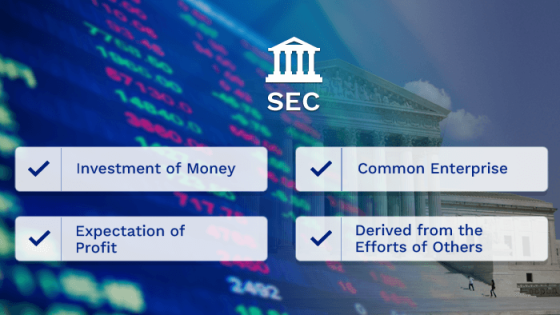
豪威测试(Howey test)指的一种判断特定交易是否构成证券发行的标准。这个测试主要源于美国最高院 1946 年的一个判决,这次判决中使用了一个特定的标准,用于判断特定交易是否构成证券发行。如果此交易被认定为证券,则需要遵守美国 1933 年证券法和 1934 年证券交易法的规定。目前市面上很多的 ICO,都有可能被认定为证券发行,从而接受相关监管。

豪威测试的标准:

①确有金钱 / 资本投入(The Investment of Money)

②投资于共同事业(Common Enterprise)

③投资人有收益预期、期待获取利润(Expectation of Profit)

④不直接参与经营,仅仅凭借发起人或第三方的努力。(Effort of Others)

为了确定一个 Token 是 Security Token 还是实用 Token 的可能性,可以使用 Crypto Rating Council Website( 加密货币评级委员会 ) 网站给出的分数,分数越高,Token 就越可能是 Security Token。

在这个框架下,如果某项资产涉及投资者投入资金资助一家公司,意图从该组织领导层的努力中获利,那么这项资产通常属于 SEC 的管辖范围。

前情提要

注意,2022 年 6 月,美国纽约检察官办公室的新闻稿就已经提到过称,在 OpenSea 的前高管 Nate Chastain 被捕之后,检察官指控其与 NFT 有内幕交易、欺诈和洗钱这些问题存在。

官方(检察官)称 OpenSea 前高管的行为为「内幕交易」,这个词其实是专门给二级市场股票或其他证券交易的短语。

从表述来看,这到底是内幕交易,还是官方试图把 NFT 的含义认定为证券?这个案例比较重要,因为这些词语的性质和标签,如果确定了 NFT 是证券,可能会对数字资产的未来产生很大的影响。

Guidehouse 的合伙人(全球立法和监管风险)负责人 Alma Angotti 认为,「从法律意义上来说,NFT 很可能成为股票和证券的保护伞。」比如说,NFT 很可能在通过 Howey 测试后,其实本质还是证券的一种。如果你购买一块 NFT 并希望价格上涨,这样你就可以从中赚钱,这与证券没有太大区别。

Angotti 此前曾担任美国证券交易委员会,美国财政部金融犯罪执法网络和金融业监管局的执法官员,现在主要负责 Guidehouse 的加密货币,数字资产和金融科技这块的业务。

「盗用公司的机密信息是欺诈,一旦你通过货币系统转移欺诈的收益,那就是洗钱,」Angotti 说。纽约检察官达米安·威廉姆斯(Damian Williams)在新闻稿中回应了这一点:NFT 可能是创新,但这种类型的犯罪计划不是。

Nathaniel Chastain 背叛了 OpenSea,利用其机密的商业信息为自己赚钱。检察官对 Nathaniel Chastain 指控表明,美国官方还是致力于消除内幕交易,无论是发生在股票市场还是区块链上。

根据司法部的起诉书,Nathaniel Chastain 在 2021 年夏天购买了大约 45 个 NFT 之前,使用了 OpenSea 关于其市场上将展示哪些 NFT 的内部信息。起诉书称,通常可以以两到五倍于其购买价格的价格来出售这些 NFT。

Chastain 被指控犯有一项电汇欺诈罪和一项洗钱罪,总共可能判处最高 40 年徒刑。

这个案子和指控会改变 NFT 的未来?

专家 Angotti 说,尽管 OpenSea 在指控首次曝光后解雇了 Chastain,但 Angotti 指出,该公司的致命缺陷在于没有采取适当的控制措施来降低这种风险,平台需要考虑,风险到底在哪?因为不能在平台上存在欺诈行为,更不希望犯罪分子通过平台洗钱。即使 Chastain 被无罪释放,NFT 没有被定义为证券,但是官方仍会会关注这个行业。美国司法部显然将加密和 NFT 作为执法重点;他们有一个完整的特别工作组。

要持续对 SEC 和 Yuga Labs 进行观察。
Lecturas Relacionadas

Chip Stocks Lead U.S. Market Decline: Is AI Trading Being Hit by Both Interest Rates and Returns?

Chip stocks led a broad decline in US markets, with the Nasdaq dropping 2.2% and the S&P 500 falling 1.4%. This selloff reflects a dual challenge for the once-high-flying AI hardware trade: rising interest rate expectations and growing investor impatience for clear returns from massive AI capital expenditures. The pressure was most acute on hardware leaders. Nvidia fell about 4%, dipping below a $5 trillion market cap, while Micron plunged 13.2% ahead of its earnings report. Declines across memory, storage, AI, and mobile chips indicated a sector-wide retreat. The selloff spread globally, with South Korea's KOSPI index dropping nearly 10% as key suppliers SK Hynix and Samsung recorded double-digit losses. Investors appeared to be taking profits from the most crowded trades first. Macro headwinds intensified as market expectations shifted toward a more aggressive Federal Reserve. Forecasts for multiple rate hikes in 2026 pressured high-valuation tech stocks, which rely on long-term growth projections that become less attractive as discount rates rise. Concurrently, investors are scrutinizing the profit potential of the immense AI spending by cloud giants like Alphabet, Amazon, and Meta. While these expenditures drive demand for chips and hardware, the market is now questioning whether AI services will generate sufficient returns to justify the ongoing costs. This adjustment is not necessarily a bubble burst but a recalibration. AI demand fundamentals remain, but the narrative of endless growth can no longer fully offset concerns over higher interest rates and a longer path to profitability. Near-term direction may hinge on Micron's upcoming earnings guidance and incoming inflation data, which will influence both the AI demand outlook and the Fed's policy path. The market is transitioning from blindly buying growth to demanding clearer visibility on returns.

marsbitHace 49 min(s)

Chip Stocks Lead U.S. Market Decline: Is AI Trading Being Hit by Both Interest Rates and Returns?

marsbitHace 49 min(s)

OpenAI's New Paper: How to Train an AI that "Doesn't Deteriorate Under Pressure"?

OpenAI's new paper "Reinforcement Learning Towards Broadly and Persistently Beneficial Models" explores training AI to maintain safe, helpful, and honest behavior even under pressure, in unseen scenarios, or after being fine-tuned for harmful purposes. Moving beyond simple rule-based "don'ts," the research focuses on cultivating "beneficial traits" like honesty, risk-awareness, corrigibility, and transparency. It investigates if reinforcement learning (RL), often prone to "reward hacking" where models exploit loopholes, can instead be used to instill robust, generalized positive behaviors. Researchers created a multi-domain synthetic dialogue dataset covering areas like healthcare and law. They trained a model by replacing 5% of standard RL data with "beneficial trait" data. This model outperformed the baseline in 83% of 53 evaluations, showing average gains of 9.1% in alignment, safety, and helpfulness. Crucially, improvements generalized: a model trained only on healthcare "good behavior" data also performed better in 17 out of 19 non-healthcare alignment tests. The paper also tests "alignment persistence." When subjected to adversarial prompts or harmful fine-tuning, the beneficial trait model showed greater resilience, with smaller performance drops and less "spillover" of bad behavior to unrelated tasks. While not a complete solution, this work suggests a shift from post-hoc correction to proactively shaping robust, principled AI behavior, a critical step for deploying models in high-stakes, complex decision-making scenarios.

marsbitHace 52 min(s)

OpenAI's New Paper: How to Train an AI that "Doesn't Deteriorate Under Pressure"?

marsbitHace 52 min(s)

Semiconductor Stock Rebound: Is the Technical Correction Over or a Trend Reversal?

The core of recent semiconductor stock volatility is not about daily price swings, but rather the market questioning whether AI-driven semiconductor pricing has entered a new phase. Following a sharp sell-off in Korean stocks on June 23rd, led by Samsung and SK Hynix, a subsequent rebound is seen more as a technical positioning adjustment rather than a confirmed trend reversal. The key variable is HBM (High Bandwidth Memory), essential for AI chips. Its supply-demand imbalance granted memory makers significant pricing power. The current market focus is on whether this dynamic remains strong enough to justify elevated valuations. All eyes are on Micron's upcoming earnings report. The critical factor is not whether results meet already high expectations, but whether the company's guidance confirms that AI memory pricing power, order visibility, and future margins are still expanding. Micron's outlook will serve as a crucial test for the broader AI semiconductor chain, including Samsung, SK Hynix, and other infrastructure players. The recent bounce appears to be a pre-earnings positioning repair. For it to evolve into a sustained uptrend, concrete evidence is needed that the AI infrastructure expansion cycle's fundamentals—particularly for high-end memory—remain robust and can continue to surpass elevated market expectations. The risk is that strong demand alone may not be sufficient if future guidance hints at peaking momentum or increasing supply-side pressures.

marsbitHace 1 hora(s)

Semiconductor Stock Rebound: Is the Technical Correction Over or a Trend Reversal?

marsbitHace 1 hora(s)

Trading

Spot
Futuros
活动图片