77% Of Bitcoin Treasury Firms Sitting Underwater—Highest Since 2023

bitcoinistPublicado a 2026-03-10Actualizado a 2026-03-10

Resumen

A recent analysis reveals that 77.4% of Bitcoin treasury companies are currently underwater on their Bitcoin holdings, the highest level since 2023. These firms, which hold BTC as a reserve asset, are facing significant losses due to the recent price decline. Notably, 65.6% of these companies are experiencing losses exceeding 20% below their cost basis. MicroStrategy, a major player, has an average acquisition price of $75,985, placing it over 12% in the red. The trend is reminiscent of the May 2022 bear market. Despite this, U.S. spot Bitcoin ETFs have recently seen a return of inflows, suggesting a potential resurgence in demand. Bitcoin's price currently hovers around $67,600.

Data shows the Bitcoin price decline has left the majority of treasury companies in a state of loss, with 65% sitting more than 20% below cost basis.

Over 77% Of Bitcoin Treasury Firms Are Underwater On Their Buys

As pointed out by Capriole Investments founder Charles Edwards in a new post on X, a high amount of Bitcoin treasury companies are sitting on losses at the moment. Treasury companies refer to firms that keep BTC on their balance sheet as a reserve asset. Companies of this type that are publicly traded do so to allow their investors indirect exposure to the digital asset via their stock.

The approach was popularized by Michael Saylor’s Strategy (previously MicroStrategy), which has amassed a humongous Bitcoin stack after its consistent accumulation over the years. During the past few months, BTC has observed a bearish shift, so these firms have naturally been impacted. Below is the chart shared by Edwards that shows the trend in the percentage of such companies that are underwater on their BTC buys.
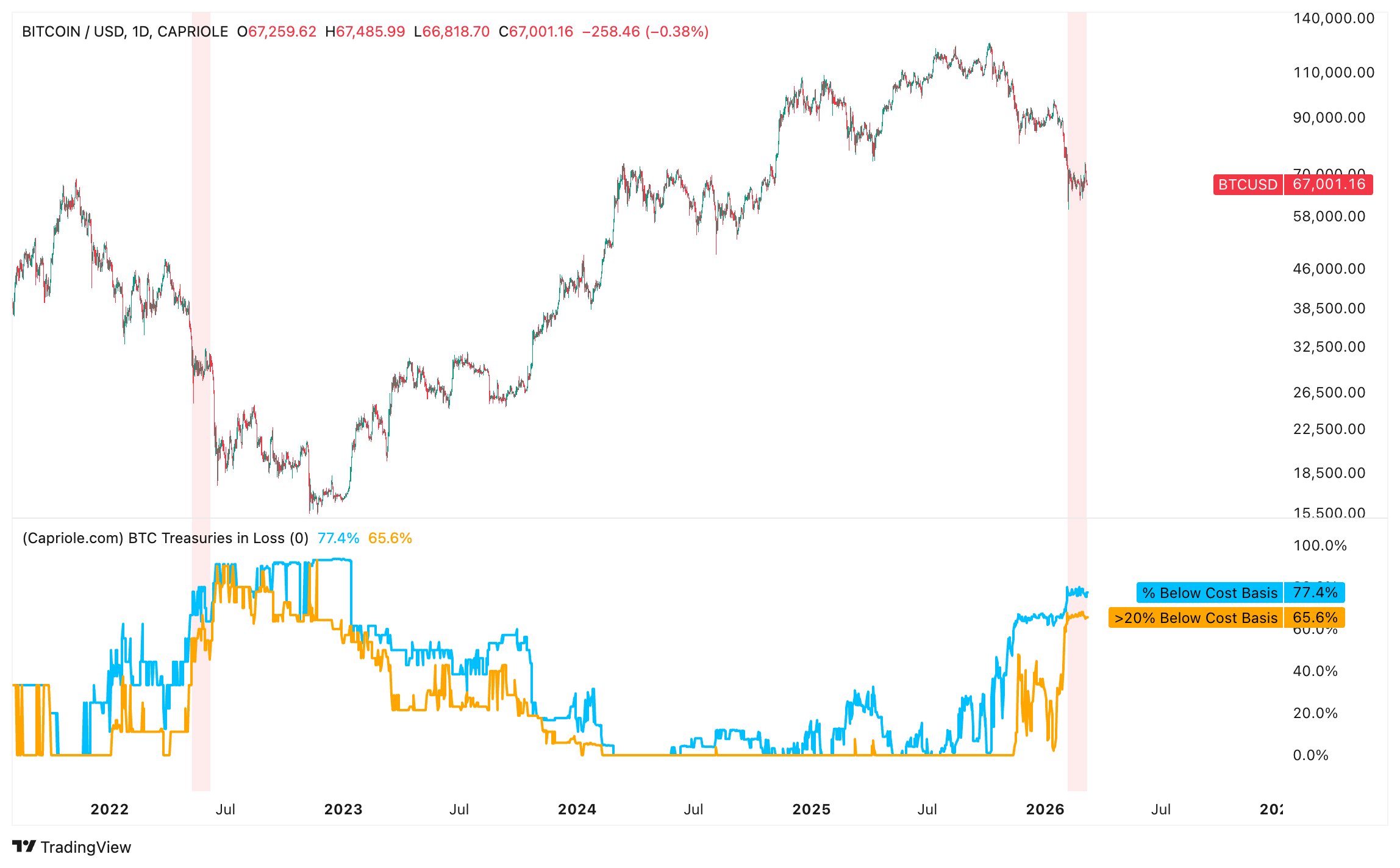
Companies have increasingly gone underwater as the bearish momentum has advanced | Source: @caprioleio on X

As is visible in the graph, the total percentage of Bitcoin treasury firms in loss has gone up recently, with its value today sitting at 77.4%. Thus, it would appear that a strong majority of the companies have their holdings below their cost basis. This includes Strategy, which has an average acquisition level of $75,985, more than 12% above the current spot price.

A large percentage of the firms are in even worse losses than Strategy. In the same chart, data for the treasuries with holdings sitting more than 20% below their cost basis is also displayed. It would appear that this metric has a value of 65.6%, implying that less than 12% of the underwater companies are in losses smaller than 20%.

From the graph, it’s also apparent that the recent trend in the treasury firms resembles that of May 2022, when the bear market of that year was in full swing. Back then, the percentage figure eventually went on to touch even higher highs.

Like how public treasury companies provide for an indirect route into Bitcoin, there is also another such indirect means in the market available today: the spot exchange-traded funds (ETFs). These funds buy and hold the asset on behalf of their users, allowing them to get exposure to BTC’s price movements without having to deal with blockchain elements.

The bearish market shift also caused the US spot ETFs to face net outflows, as data from SoSoValue shows. During the last couple of weeks, however, inflows have poured into these funds, implying that demand for Bitcoin may be starting to return.
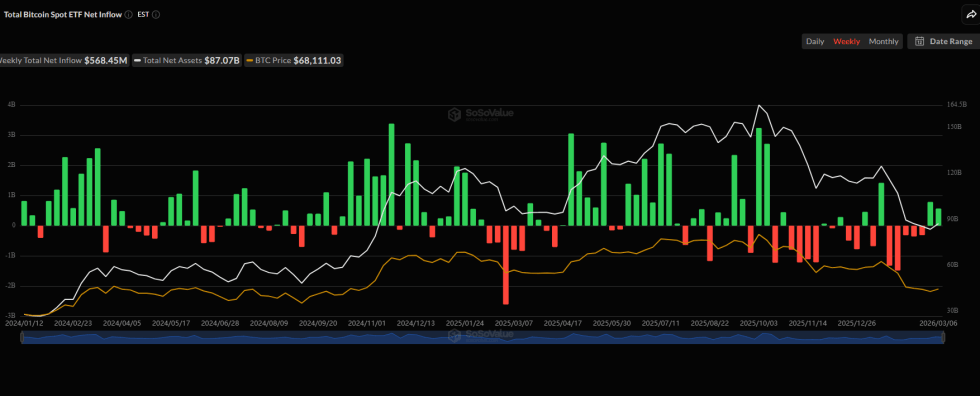
How the weekly netflow related to the spot BTC ETFs has changed over the last couple of years | Source: SoSoValue

BTC Price

Bitcoin has retraced its recovery during the past few days as its price is back at the $67,600 mark.

The trend in the price of the coin over the last five days | Source: BTCUSDT on TradingView


Preguntas relacionadas

QWhat percentage of Bitcoin treasury firms are currently underwater on their Bitcoin buys according to the article?

A77.4% of Bitcoin treasury firms are currently underwater on their Bitcoin buys.

QWhat is the average acquisition price of Bitcoin for the company Strategy (MicroStrategy) mentioned in the article?

AStrategy (MicroStrategy) has an average Bitcoin acquisition price of $75,985.

QWhat percentage of the underwater treasury firms are sitting on losses greater than 20% below their cost basis?

A65.6% of the treasury firms are sitting on losses more than 20% below their cost basis.

QAccording to the article, what recent trend in US spot ETFs suggests that demand for Bitcoin may be returning?

AThe article states that inflows have poured into US spot Bitcoin ETFs over the last couple of weeks, suggesting demand may be returning.

QWhat was the price of Bitcoin at the time the article was written?

AAt the time the article was written, the price of Bitcoin was at the $67,600 mark.

Lecturas Relacionadas

How the $900 Billion Anthropic Was Built?

Anthropic, the AI startup behind Claude, is reportedly in early talks to raise at least $30 billion in new funding, targeting a valuation exceeding $900 billion. This would propel it past OpenAI's recent $852 billion valuation. The funding round is expected to close by late May 2026. The company's valuation surge is driven by extraordinary revenue growth, reportedly reaching an annualized $30 billion by March 2026 from $1 billion in December 2024. However, OpenAI questions this figure, suggesting a net revenue closer to $22 billion after cloud platform fees. Despite high revenue, Anthropic's gross margin is reportedly around 40%, and it is not yet profitable, with breakeven projected for 2028. A significant portion of the new capital would fund massive, pre-committed computing infrastructure with partners like Amazon, Google, and Microsoft. This highlights a new AI financing model where high valuations fuel compute spending, which in turn requires even higher future valuations to sustain. Notably, many early-stage investors are reportedly sitting out this round. Bankers privately estimate a potential IPO valuation between $400-500 billion, creating a rare scenario where the final private funding round valuation ($900B+) could far exceed the expected public market debut. Anthropic is targeting an IPO between October 2026 and the first half of 2027. Its public listing is poised to be a critical test for the entire AI sector's valuation logic, potentially validating or challenging the high-stakes "valuation-compute-valuation" cycle that has defined private market investments.

链捕手Hace 1 hora(s)

How the $900 Billion Anthropic Was Built?

链捕手Hace 1 hora(s)

UBS Enters the Fray, 20 Swiss Banks Now Offer Crypto Trading, Covering 2.5 Million Accounts

Global wealth management giant UBS has entered the cryptocurrency market, offering Bitcoin and Ethereum trading to select private banking clients in Switzerland as of January 2026. This move is part of a broader trend in Switzerland, where approximately 20 banks now provide crypto services, collectively covering over 2.5 million accounts. Client data from Zurich Cantonal Bank (ZKB) challenges the stereotype of crypto being solely for the young, revealing that the average buyer is aged 30-50 and predominantly male. Notably, over 40% of these clients previously held no investment portfolio, indicating crypto is activating dormant capital. The business case is proving substantial. For several Swiss banks, crypto-related activities already contribute a significant and disproportionate share of profits, with unit economics often outperforming traditional banking services. This institutional adoption in Switzerland reflects a global trend, with a recent survey showing 73% of institutional investors planning to increase crypto allocations in 2026. Switzerland's early regulatory clarity through its DLT Act and established custody infrastructure have provided a foundation for this growth. However, upcoming challenges include the implementation of the OECD's Crypto Asset Reporting Framework (CARF) in 2027 and ongoing reforms by Swiss regulator FINMA. The final shape of these regulations will be crucial in determining whether Switzerland can maintain its leading position in the global banking crypto sector.

marsbitHace 1 hora(s)

UBS Enters the Fray, 20 Swiss Banks Now Offer Crypto Trading, Covering 2.5 Million Accounts

marsbitHace 1 hora(s)

Circle Releases Arc Network Whitepaper: Can the New Economic Mechanism Drive It to Become the "Clearing Coordination Layer" for Institutional-Grade Stablecoin Payments?

Circle has released the whitepaper for its Arc Network, detailing plans for a new economic coordination layer using the proposed ARC token. Arc is a Layer 1 blockchain designed for enterprise-level stablecoin payments, featuring USDC as its native gas token, a high-performance consensus mechanism for instant transaction finality, and optional enterprise privacy features. Currently operating on a Proof-of-Authority (PoA) model, the network plans a future transition to a Proof-of-Stake (PoS) system. The ARC token is intended to serve as the network's native coordination asset, facilitating governance, enabling staking rewards, and managing fee mechanisms. User fees paid in stablecoins would be converted to ARC, with portions distributed as rewards and burned. The governance model will blend token-based voting with institutional oversight, especially for high-sensitivity matters like security and compliance. While positioning Arc as a potential settlement layer for institutional stablecoin payments, the whitepaper acknowledges challenges. These include the network's current centralization, the unfinished and potentially volatile ARC token economics, and the evolving global regulatory landscape for stablecoins. The development signals a broader industry trend where Web3 infrastructure competition is shifting from pure performance to factors like liquidity, compliance, and institutional-grade stability.

marsbitHace 2 hora(s)

Circle Releases Arc Network Whitepaper: Can the New Economic Mechanism Drive It to Become the "Clearing Coordination Layer" for Institutional-Grade Stablecoin Payments?

marsbitHace 2 hora(s)

Trading

Spot
Futuros
活动图片




