[Key interpretation] The top ten whales in XRP have significantly reduced their positions, and BTC volume shrinks for the first time

HuobiPublicado a 2022-09-26Actualizado a 2022-09-27

Resumen

BTC investors' money holding cost decreased, and the trading volume shrank for the first time.

1. BTC turnover shows signs of shrinking

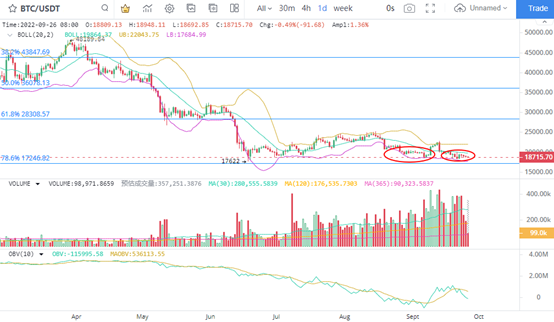
In the process of narrowing the price fluctuation space of BTC, although the cumulative decline has not significantly expanded, the market is on the eve of the change. As the trading volume retreats from its highest level in two years, the short-term trading volume shrinks, which means that BTC will change its position during the downward movement of the closing price. From the closing point, BTC's closing price on each trading day has been declining in recent years, apparently effectively falling below the lowest closing price of 18970 US dollars on June 18. At the same time, the focus of BTC investors' currency holdings has obviously retreated, and the current volume and price do not support the rapid rise of BTC.
2. The number of ETH sending addresses rebounds

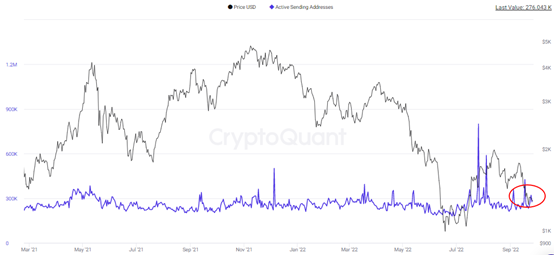
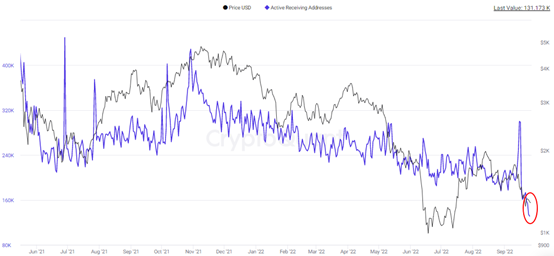
The number of active addresses of ETH has not changed much. During the period of small rebound, it is mainly due to the growth of the number of sending addresses. From the numerical point of view, the number of sending addresses rose to a short-term high of 321000 on September 24. Although the number rose, it was lower than 425000 on September 17. This shows that the number of ETH sent by investors is gradually decreasing. The gradual decline from 799000 on August 26 means that the market is in the period of adjustment.
3. The number of ETH receiving addresses is abnormally low

The number of receiving addresses of ETH is unusually low, which means that there is less adjustment to participate in the short-term transfer or transaction of ETH. Different from the number of sending addresses, the number of receiving addresses of ETH decreased, and fell back to the lowest of 131000 within one year on September 25, which means that OTC investors continue to reduce their market entry transactions, and the market adjustment expectation remains unchanged. Consistent with the trend of BTC, ETH's recent amplitude is small, but the closing price has been retreating, and the adjustment expectation remains unchanged.
4. XRP price short-term adjustment

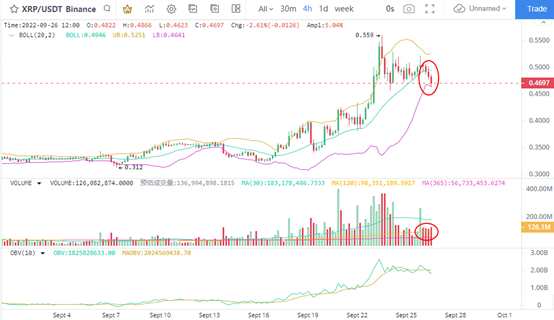
In the 4-hour K line chart, during the short-term retreat of XRP price, the price rebounded obviously under the Bollinger line. In terms of trading volume, the trading volume remained stable during the short-term continuous decline, and the selling pressure was effectively released. At present, the short-term pullback is dominated by low suction. Judging from the recent price trend, the support of US $0.45 and US $0.4 during the release of selling pressure can be properly paid attention to. On the message side, XRP
The news shows that the lawsuit between the Swiss currency and the SEC will probably be decided in December. At the same time, the market expectation is generally optimistic about XRP's judgment in the near future, which makes XRP's price fluctuate strongly in the near future.

On September 18, Ripple's defense lawyer James K. Filan said on Twitter that Brad Garlinghouse, CEO of Ripple Labs, had filed a motion for summary judgment in advance.

The next day, Caroline D. Pham, a member of the Commodity Futures Trading Commission, talked with Brad Garlinghouse. It was previously reported that Ripple and the SEC had asked the court to resolve their ongoing legal disputes.

The encryption community is optimistic about the possibility of compromise because Ripple Labs claims that there is no investment contract. Therefore, the summary judgment motion is considered a prudent strategy that may lead to a settlement with the SEC.

5. XRP's main currency holding and distribution

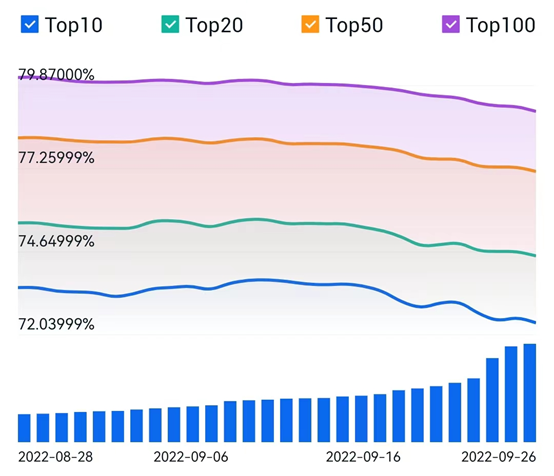
In terms of coin holding, the number of coins held at Whale's address has continued a clear downward trend recently, while XRP prices rose and fell in the same period, indicating that the spread of coin holding does not support the price rise. The number of XRP's top 10, top 20 and top 50 coins held in Xihong Temple decreased from 73%, 75% and 78% on August 28 to 72%, 74% and 77%, and the currency holding divergence trend was clear. Therefore, in terms of trading, in addition to focusing on the overall market strength and XRP litigation results, attention should be paid to adjusting risks in recent low absorption buying.
Lecturas Relacionadas

Trends in US Stocks (June 22): Strait of Hormuz Agreement Changes Course, Thursday's PCE and Micron to Determine Chip Sector Direction

U.S. Stock Market Outlook (June 22): Strait of Hormuz Deal Falters, Thursday's PCE & Micron to Set Chip Sector Direction. Geopolitical tensions resurged over the weekend as Iran's IRGC announced the closure of the Strait of Hormuz, and its negotiation team walked out after threats from Trump, pausing U.S.-Iran talks. This renewed risk premium is weighing on U.S. equity futures ahead of the open. Last week's market was driven by chip stocks, with the Philly Semiconductor Index hitting a record high. While the Fed's hawkish tone was overshadowed by initial deal optimism, the S&P 500 gained 0.9% for the week. SpaceX debuted strongly but ended with two down days. Key events this week: The status of U.S.-Iran negotiations remains the immediate variable for oil and energy stocks. Monday sees Marvell and Flex added to the S&P 500. Tuesday's MSCI reclassification could benefit South Korean semiconductors and memory stocks. **Thursday, June 25th, is the critical day**, featuring the May Core PCE report and Micron's earnings. Hotter PCE data could solidify expectations for two 2024 rate hikes, while softer data would rapidly reprice rate cut bets. Micron's report is a key test for the AI narrative; the market will scrutinize its 2027 HBM supply visibility, HBM4 progress, and its position in Nvidia's Vera Rubin supply chain. Nvidia's AGM and a potential OpenAI GPT-5.6 release will make Thursday a pivotal 24 hours for AI. Friday concludes with the Russell reconstitution, elevating small-cap volatility. In summary, last week's gains face a true test. The path hinges on two concurrent threads: geopolitical developments with Iran and the AI narrative defined by Micron's guidance and Nvidia's updates. The chip sector's record highs are vulnerable if Thursday brings hot PCE data and conservative guidance from Micron. Conversely, positive outcomes could reaffirm the AI bull case, making this week's volatility a potential entry window.

marsbitHace 1 hora(s)

Trends in US Stocks (June 22): Strait of Hormuz Agreement Changes Course, Thursday's PCE and Micron to Determine Chip Sector Direction

marsbitHace 1 hora(s)

OpenAI's "Most Open" Move: Codex No Longer Exclusively Favors GPT

OpenAI has significantly opened up its Codex programming agent by introducing a "model provider" configuration layer that allows users to connect it with various open-source models, not just its proprietary GPT. Through a configuration file or a simple `--oss` command-line flag, Codex can now route requests to local services like Ollama or LM Studio, or to third-party APIs such as Mistral or DeepSeek. This move is seen as one of OpenAI's most "open" steps, potentially lowering costs and enhancing privacy for developers who can run code generation offline. However, integration isn't seamless for all models. Codex primarily uses OpenAI's newer Responses API, while many open-source models rely on the older Chat Completions interface. This creates compatibility issues, especially for advanced features like function calling. The developer community is already building "routing" or adapter layers (e.g., CC Switch, LiteLLM) to translate between these protocols, enabling hybrid setups where GPT handles planning and open-source models handle execution. Analysts interpret this as a strategic shift for OpenAI: from competing solely on model superiority to controlling the platform and interface standards. By making Codex a flexible, pluggable entry point for AI-assisted programming, OpenAI aims to become the central hub in the developer toolchain ecosystem, even as users gain the freedom to switch underlying models.

marsbitHace 1 hora(s)

OpenAI's "Most Open" Move: Codex No Longer Exclusively Favors GPT

marsbitHace 1 hora(s)

When 500 Million People Abandon ChatGPT

ChatGPT's Global AI Assistant Market Share Drops Below 50% Three and a half years after its groundbreaking launch, ChatGPT faces a pivotal moment. While it remains the largest AI assistant globally, its market share has fallen below 50% for the first time, reaching 46.4% as of May, according to Sensor Tower's 2026 AI landscape report. Google's Gemini (27.7%) and Anthropic's Claude (10.3%) are now its main competitors, with Grok, Perplexity, and others also gaining ground. The market has evolved from awe and initial adoption into a phase of product comparison, ecosystem integration, and commercialization. User behavior has matured significantly. Loyalty is low; users readily switch between assistants for specific tasks. Gemini benefits from deep integration within Google's ecosystem (Search, Gmail, Android), while Claude has carved a niche among productivity-focused users with strong retention, nearly matching ChatGPT's. User choice is now influenced by a complex mix of capability, ecosystem, price, use case, and even brand trust. Commercialization is accelerating. AI app downloads continue but growth is slowing, while user spending is rising. Over $4.2 billion was spent in-app during H1 2026. Claude leads in premium subscription conversion rates (13%). OpenAI is expanding its revenue streams, testing ads shown to 17% of ChatGPT users daily by May. This shift highlights the immense financial pressure of model training and inference costs. Despite revenue growth, OpenAI's cash burn is intense, reaching $3.7 billion in Q1 2026. The company projects this could rise to $25-57 billion in the coming years, underscoring the industry-wide challenge of scaling profitably. The symbolism is clear: ChatGPT no longer defines the AI assistant market alone. The era of a single dominant product is over. Gemini, Claude, and specialized tools are collectively shaping user habits and business models. As AI assistants move from novelty to utility—judged on accuracy, efficiency, and value—they are becoming embedded in everyday digital life. ChatGPT may have lost its majority, but AI as a whole is winning, entering a mature, competitive, and diverse new phase.

marsbitHace 1 hora(s)

When 500 Million People Abandon ChatGPT

marsbitHace 1 hora(s)

Trading

Spot
Futuros
活动图片