$635M in, $405M out – How the Fed quietly shook the crypto market

ambcryptoPublicado a 2026-03-25Actualizado a 2026-03-25

Resumen

The crypto market slowed last week, with many attributing the decline to Middle East tensions. However, the primary driver was the U.S. Federal Reserve's cautious policy signals. According to CoinShares, digital asset investments saw $230 million in inflows—significantly lower than previous weeks. Notably, $635 million entered just before the Fed meeting, but $405 million exited shortly after, indicating investors are highly sensitive to interest rate expectations. Bitcoin led with $219 million in weekly inflows, though short-Bitcoin products also gained $6 million, reflecting mixed sentiment. Solana remained strong with $17 million inflows over seven weeks, while Ethereum saw $27.5 million in outflows. Chainlink and Hyperliquid attracted $9.1 million combined. Despite price declines—ETH and HYPE fell ~6.7%, BTC dropped ~4%, and SOL dipped only 2%—capital continued flowing in. User activity was highest for Chainlink, while Solana maintained steady social volume. The Altcoin Season Index read 47, below the 75 threshold for a confirmed altcoin season, but sustained inflows suggest a potential buildup toward a broader rally. Institutional behavior showed a "buy the dip" mindset rather than panic selling.

The crypto market slowed down last week. And, while many blamed global tensions in the Middle East, the real reason behind the same might have been the U.S. Federal Reserve.

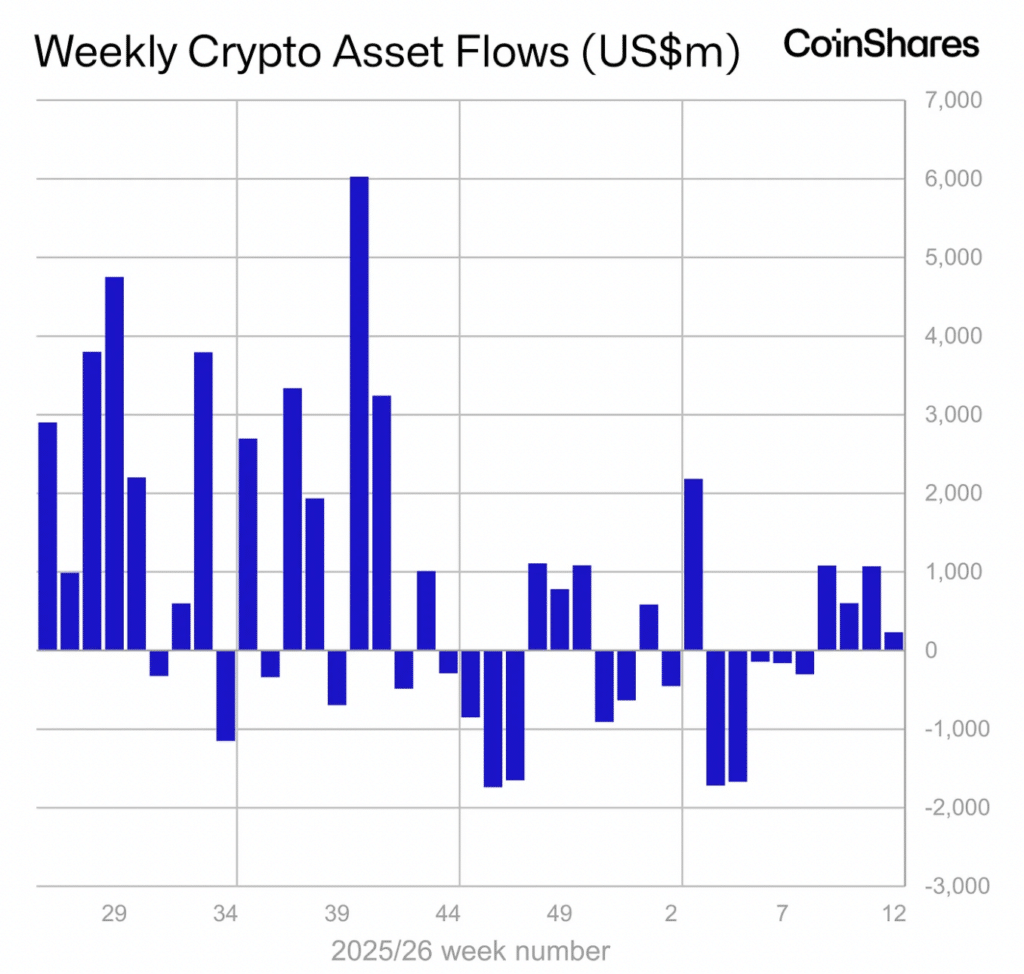
According to a report from CoinShares, digital asset investment products saw $230 million in inflows. However, this figure was much lower than the ones seen in previous weeks.
Source: CoinShares

Looking closer, most of the money came in before the Fed’s meeting, with $635 million added in just two days. After the Fed signaled a more cautious approach, about $405 million quickly left the market.

This suggested that investors may be reacting more to interest rate expectations than global conflicts, adjusting their positions based on future monetary policy.

While total inflows of $230 million hinted at a recovering market, the data showed that investor sentiment is still mixed.

Analysis of different coins and their performance over the past week

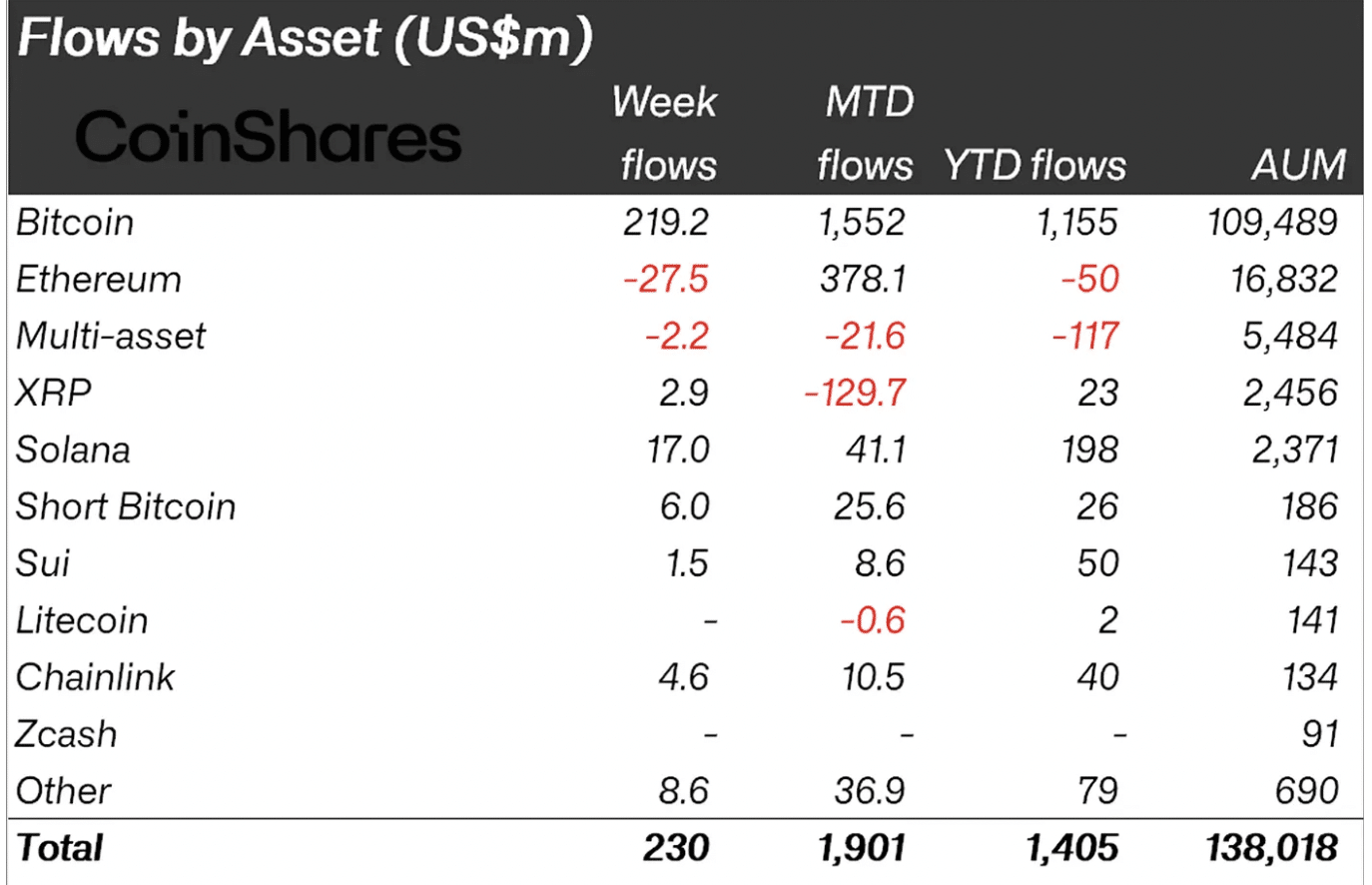
Bitcoin [BTC] is still leading the market, bringing in about $219 million in weekly inflows. However, the overall picture revealed that investors are unsure about what comes next.

Interestingly, short-Bitcoin products also saw $6 million in inflows, which means some investors are betting on a price drop while others are buying the dip.

At the same time, Chainlink [LINK] and Hyperliquid [HYPE] have been gaining attention, bringing in a combined $9.1 million.

Notably, Solana [SOL] has been strong, bringing in $17 million and extending its inflow streak to seven weeks. Ethereum [ETH], however, saw $27.5 million in outflows.
Source: CoinShares

Overall, this suggsted that the investors are being cautious after the recent signals from the FOMC.

Price action and more

These figures come on the back of most cryptocurrencies falling on the charts over the past week. ETH and HYPE were hit the hardest, both falling by around 6.69%.

LINK also dropped by about 5.21% over the past week. BTC performed a bit better, with a smaller decline of 3.97%. Meanwhile, SOL exhibited the most strength, slipping only 2.03% over the same period.

However, even though prices were falling, money was still flowing into the market.

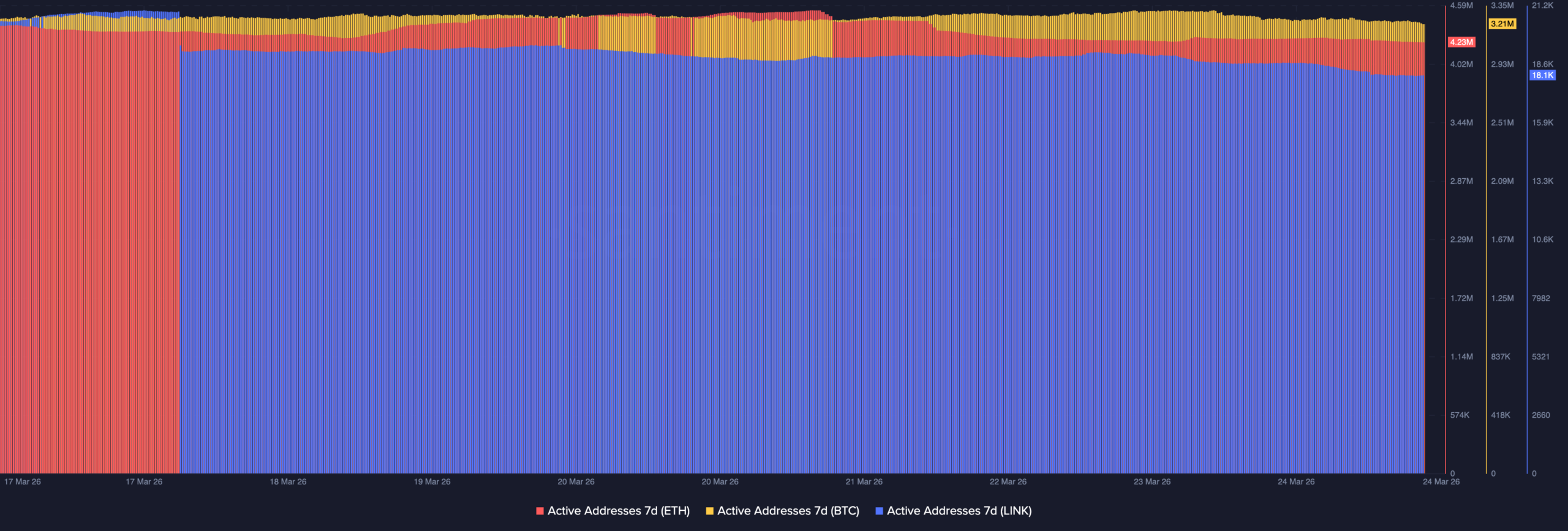
In fact, Santiment’s 7-day active addresses suggested that Chainlink was leading in terms of user activity. All while Ethereum and Bitcoin showed more moderate and stable usage patterns.
Source: Santiment

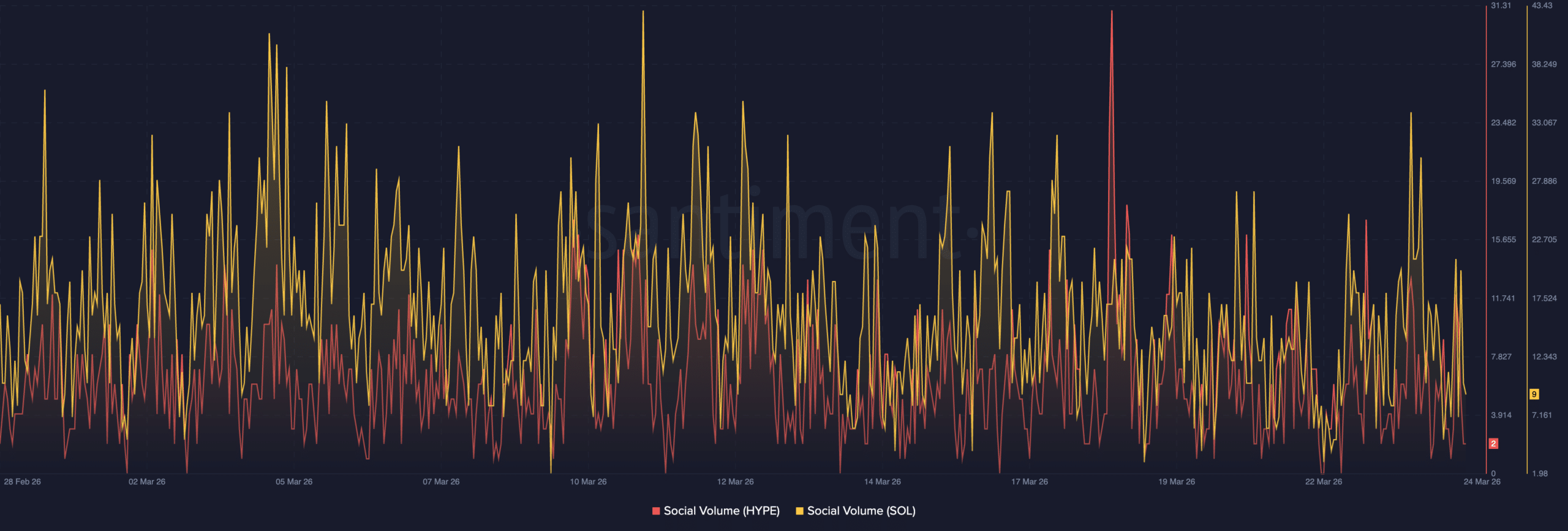
Additionally, the social volume data suggested that Solana has maintained a steady and strong presence in discussions over time.

On the contrary, while Hyperliquid has seen short bursts of attention, it has struggled to sustain any consistent momentum.
Source: Santiment

Is altcoin season around the corner?

All this has also pushed analysts to think that the altcoin season is imminent.

For its part though, the Altcoin Season Index, with a press time reading of 47, needs to reach 75 to confirm a full altcoin season.
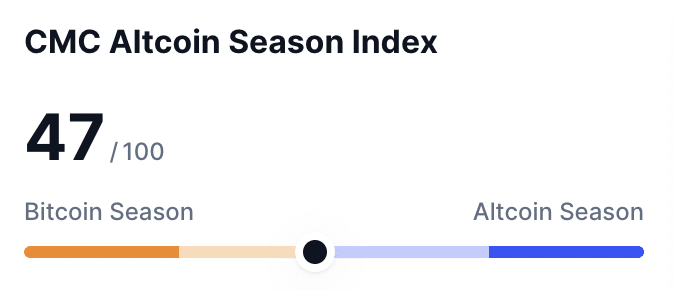
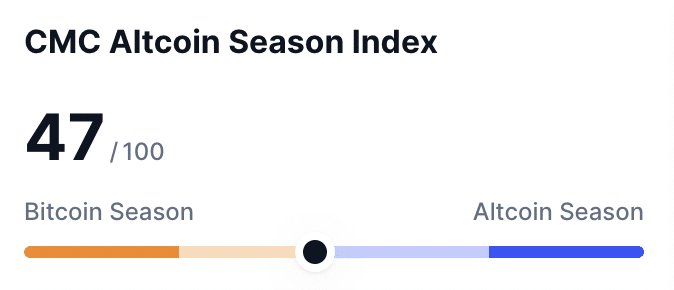
Source: CoinMarketCap

Hence, if inflows from regions like the U.S and Europe continue, this phase could be the final buildup before a broader altcoin rally begins.


Final Summary

  • Institutional behavior hinted at a “buy the dip” mindset, rather than panic selling.
  • Gap between price action and capital inflows alluded to hidden strength beneath short-term market weakness.


Preguntas relacionadas

QWhat was the main reason behind the crypto market slowdown last week, according to the article?

AThe main reason was the U.S. Federal Reserve's cautious approach, as investors reacted more to interest rate expectations than global conflicts.

QHow much money flowed into digital asset investment products before the Fed's meeting, and how much left after?

A$635 million flowed in before the Fed's meeting, and about $405 million left after the Fed signaled a more cautious approach.

QWhich cryptocurrency saw the largest weekly inflows, and how much was it?

ABitcoin [BTC) saw the largest weekly inflows, bringing in about $219 million.

QWhat does the Altcoin Season Index need to reach to confirm a full altcoin season?

AThe Altcoin Season Index needs to reach 75 to confirm a full altcoin season.

QWhat was the overall net inflow for digital asset investment products last week?

AThe overall net inflow for digital asset investment products last week was $230 million.

Lecturas Relacionadas

Within Strategy's Framework, STRC's Dividend Yield Remains at 12% as Share Price Stays Below Par Value

Michael Saylor, Executive Chairman of Strategy (MSTR), confirmed that the dividend rate for its STRC perpetual preferred shares will remain at 12.00% through August 2026. The rate has increased from 9% at its July 2025 launch to the current high via a "ratchet" mechanism, which permanently raises the rate by 0.5% whenever the share price falls below $95. This mechanism is intended to push the price back toward its $100 par value and support Strategy's "at-the-market" (ATM) program for issuing new shares to fund Bitcoin purchases. However, the mechanism has not worked as intended. STRC shares closed at $89.46 on July 31, remaining about 10-11% below par value despite the record-high dividend. Competition from rival Strive's higher-yielding SATA securities has pressured demand. The persistent discount has forced Strategy to suspend new STRC issuances via its ATM program, limiting this funding channel for Bitcoin acquisitions. STRC's struggles reflect Bitcoin's own volatility, as the preferred shares historically move in tandem. Analysts have warned the ratchet structure carries long-term, one-way risk. A law firm is investigating Strategy's ability to maintain dividend payments if Bitcoin's price stays low. Retail investors own roughly 83% of outstanding STRC shares, a group seen as prone to panic selling during downturns. In response, Strategy has established financial reserves, including a liquidity cushion covering about 26 months of dividend/interest obligations, and a $2 billion share buyback program alongside a Bitcoin monetization framework, though the company emphasized it is not obligated to sell any Bitcoin.

cryptonews.ruHace 13 min(s)

Within Strategy's Framework, STRC's Dividend Yield Remains at 12% as Share Price Stays Below Par Value

cryptonews.ruHace 13 min(s)

Analyst: Bitcoin's Price Will Drop to $60k in August, Then Rebound to $70k

Financial analyst Andrey Poroshin has provided a new forecast for Bitcoin's price dynamics in August. Poroshin, an analyst at the Bitbanker exchange, expects the cryptocurrency market to experience a downturn this month, with prices retesting the $60,000 level due to a lack of supportive macroeconomic catalysts. He noted that the recent US Federal Reserve decision to hold interest rates did not significantly impact the market, while inflation remains above the 2% target. Poroshin stated that Bitcoin is ending July under pressure from moderate volatility and a lack of new macroeconomic stimuli, leading to continued market caution. According to his base scenario, Bitcoin will drop to a range of $60,000 to $62,000 before recovering to $70,000. He pointed out that even $70,000 remains below the cost of mining in the US, which has prompted some miners to shift towards AI data center operations. Poroshin cited the winding down of BitMEX's operations as a potential catalyst for a price rebound, suggesting the exit of weaker players often coincides with market reversals and reduced short-term selling pressure. He believes Bitcoin is currently less susceptible to geopolitical shocks, such as the Iran-US conflict, and does not expect significant market changes in August related to the pending CLARITY Act. Looking ahead, Poroshin forecasts that September will bring more active price fluctuations driven by potential Fed rate decisions and possible discussions or approval of the CLARITY Act.

cryptonews.ruHace 14 min(s)

Analyst: Bitcoin's Price Will Drop to $60k in August, Then Rebound to $70k

cryptonews.ruHace 14 min(s)

Trading

Spot
活动图片




