Golem Price Pumping 55% to $0.3645 - Should You Buy this Crypto Today?

CryptonewsPublicado a 2022-09-13Actualizado a 2022-09-13

Resumen

Golem is on a bullish streak, having increased by more than 55% in seven days to trade at $0.36350. GLM is known for massive euphoric surges followed by severe retracements.

Golem Price Pumping 55% to $0.3645 - Should You Buy this Crypto Today?

Golem is on a bullish streak, having increased by more than 55% in seven days to trade at $0.36350. GLM is known for massive euphoric surges followed by severe retracements. Speaking about Golem Network's introduction, it's a revolutionary decentralized computation network that distributes excess computing power to those in need. 
The network creates a peer-to-peer organization where users can buy and sell computing and join on an equal footing. GLM is the utility token that is the gateway to the Golem Network. Users can also rent idle digital resources or assets with extra computational power using the Golem (GLM) cryptocurrency in peer-to-peer transactions.
Golem Price & Tokenomics
The current Golem price is $0.368242, and the 24-hour trading volume is $393 million. Golem has increased by 4.99% in the last 24 hours. A day before, the GLM/USD pair opened at $0.3317, placing a high of $0.4782 and a low value of $0.3134. 
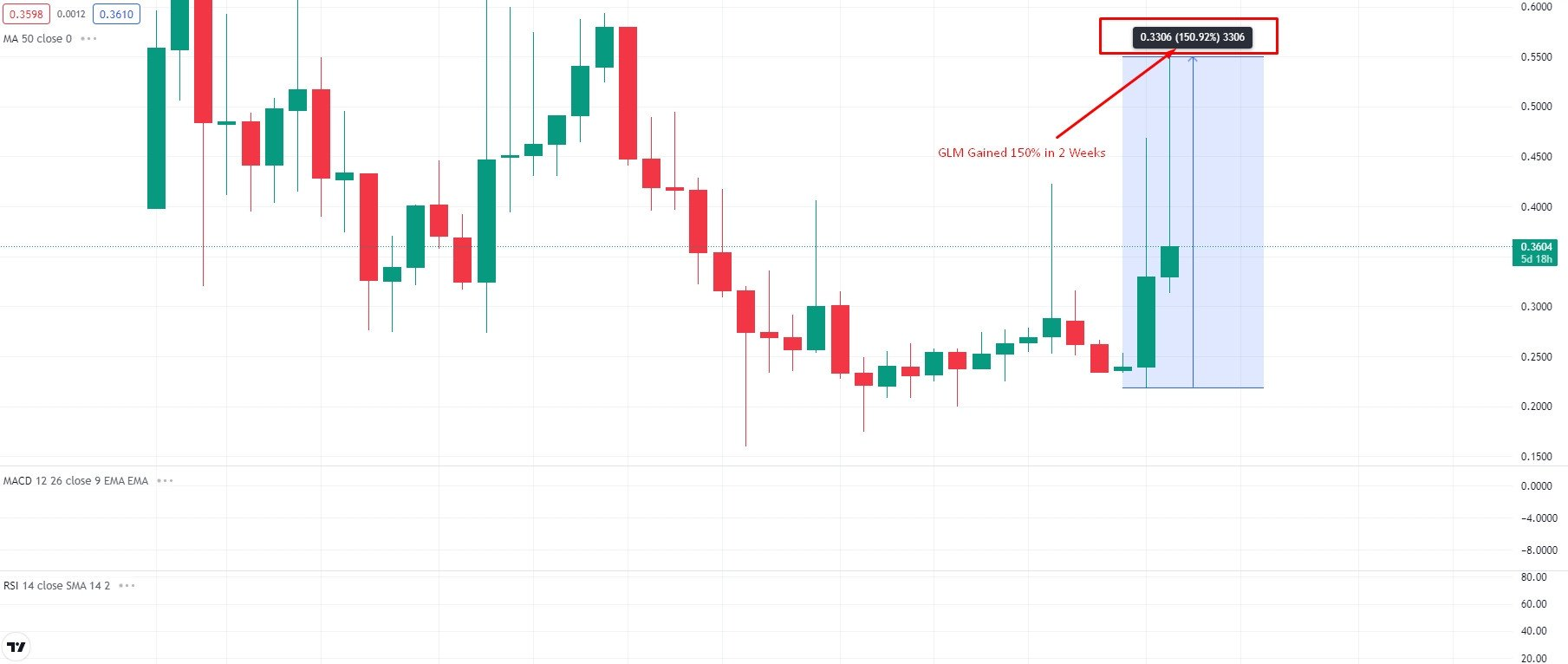
CoinMarketCap now ranks #98, with a live market cap of $368 million. It has 1,000,000,000 GLM coins in circulation and a maximum supply of 1,000,000,000 GLM coins.
What's driving an uptrend in GLM? Let's find out...
Hiring Campaign Boost's Investors 
The network's official Twitter feed released a tweet on September 6th. According to the tweet, their coders earn between $3,000 and $10,000 monthly. However, the benefits they bring go far beyond monetary compensation. They urged developers not to send CVs if that was all they wanted.


Hiring new employees indicates that the company is expanding, which boosts investor confidence. As a result, investors begin investing in those companies, expecting a higher growth rate to cause a surge in the coin's price. This could be one of the reasons for the recent uptick in Golem prices.

According to the tweet, Golem provides a transforming experience similar to discovering your ability. According to Mattias Nystrom, Head of Community at the Golem Project, developers at Golem may choose the currency they compensate, but we also offer a lot more. 
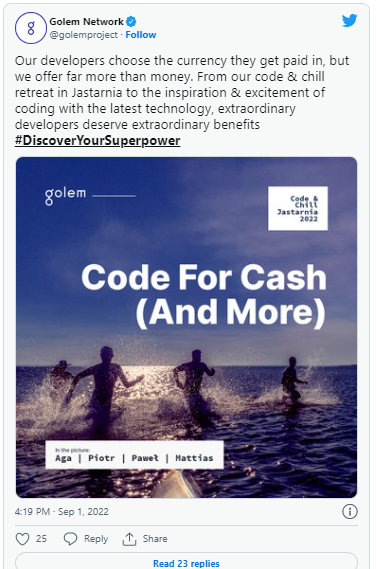

For instance, he said that excellent coders should be given special treatment, such as access to our Jastarnia code, a relaxing resort, and the inspiration and thrill of working with cutting-edge technology. The network claims they are always looking for talented developers to join Golem. 
Furthermore, they understand that talent recognizes talent. That is why they offer a fantastic team member referral program called #DiscoverYourSuperpower, which rewards current employees with +$4,500 for recommending new superhero developers to the company.
The fundamental purpose of the GLM Rewards Program is to create a movement that enables people across national boundaries to promote cooperation within the Golem community.
GLM Technical Outlook: Should You Buy this Crypto Today?
On the technical front, the GLM/USD has shown a bearish retracement, falling from $0.5500 to $0.3625. GLM has completed a 61.8% Fibonacci retracement at $0.3746 and is heading lower. 
On the downside, the 78.6% Fibonacci retracement level will be the next level of support and may underpin GLM at $0.3275. GLM's immediate resistance remains at $0.3746 and 0.4079. A break above these levels may allow for additional buying until the $0.4413 and 0.4820 levels. 

The GLM has closed the "three black soldiers" candlestick pattern on the 4-hour timeframe, indicating a strong bearish bias in the short run. As a result, it appears that investors should hold off on entering the market until GLM completes the 78.6% retracement.


Lecturas Relacionadas

The Hunter Becomes the Hunted: The Most Profitable MEV Bot Gets Hacked

A well-known and highly profitable Ethereum MEV Bot, Jaredfromsubway.eth, suffered a sophisticated on-chain attack this Saturday, losing over $7.5 million. Analysis by Blockaid and others reveals this was not a conventional phishing or smart contract exploit, but a targeted "counter-MEV honeypot attack." The attacker meticulously laid a trap over several weeks, deploying 66 fake token contracts and liquidity pools disguised as major assets like WETH and USDC. These pools created the illusion of arbitrage opportunities. The MEV Bot's automated system detected these signals, executed trades, and in the process, granted approval permissions to attacker-controlled contracts. These approvals were not revoked, creating a persistent vulnerability. The attacker then exploited this in a single transaction, draining the bot's ETH, USDC, and USDT holdings. Jaredfromsubway.eth is notorious as one of Ethereum's most active and profitable MEV Bots, primarily known for executing "sandwich attacks" to profit from transaction slippage. Estimates suggest it has earned tens of millions in MEV revenue. The incident highlights escalating crypto security threats, demonstrating that even top-tier automated "predators" are vulnerable to novel, logic-based attacks designed to exploit their own operational rules. Following the hack, an unverified X account impersonating Jaredfromsubway.eth emerged, falsely offering a bounty for the return of funds, prompting developer warnings for users to stay vigilant.

marsbitHace 1 hora(s)

The Hunter Becomes the Hunted: The Most Profitable MEV Bot Gets Hacked

marsbitHace 1 hora(s)

The Reality of Payments in Latin America Is Not What You Think

The payment landscape in Latin America is undergoing a fundamental shift, driven by on-the-ground realities that challenge common perceptions. Based on over 500 hours of field research across the region, key insights emerge. Firstly, QR code payments, like Brazil's Pix, are becoming the dominant payment method in most emerging markets, overtaking cards. However, these domestic instant payment systems lack international interoperability, creating a significant gap for cross-border users. Secondly, the narrative around crypto cards is often misunderstood; their primary volume comes from high-net-worth professionals using them for salary conversions (e.g., USDT to local currency via Pix), not retail micro-payments. Competition in payments is shifting from customer acquisition to controlling the settlement layer, leading fintechs to acquire banking licenses for efficiency. Thirdly, treating "Latin America" as a single market is a mistake. Countries like Argentina, Brazil, and Mexico have distinct economic realities, user segments, and regulatory approaches. Brazil alone has at least five distinct user segments with different financial flows. Overlooked markets like Guatemala, Honduras, and El Salvador (the "forgotten five") offer high remittance volumes with lower competitive density. Finally, regulation in Latin America is often ahead of the US, with clearer frameworks for digital assets and a pragmatic approach from regulators focused on safety rather than obstruction. The margin on stablecoin forex is rapidly compressing toward zero, meaning future winners will be those building value-added services on top of the infrastructure, not just the cheapest exchange.

marsbitHace 1 hora(s)

The Reality of Payments in Latin America Is Not What You Think

marsbitHace 1 hora(s)

Making Music in a Bear Market: The Survival Experiment of a Bitcoin Band

"Orange Pill Jam: A Bitcoin Band's Survival in the Bear Market" Orange Pill Jam is a musical group exploring themes of financial sovereignty and privacy, born from the Bitcoin community. Formed after singer Mermaid performed her song "Dollar Apocalypse" at a 2022 conference, the band creates music intended for both Bitcoin enthusiasts and general audiences. Their creative process involves Mermaid writing lyrics and melodies, which producer/multi-instrumentalist Michi then shapes with a precise, rhythm-focused approach, often demanding numerous retakes to achieve his unique standard of timing. Their songs, like "Cypherpunks' Manifesto" and "Fire of Freedom," tackle concepts of digital privacy, the pitfalls of "free" services, and personal sovereignty, influenced by experiences in places like El Salvador. Despite operating in a crypto bear market with a Copyleft model (offering music for free sharing/remixing and accepting optional Bitcoin donations), they face practical challenges. Their growth is slow on platforms like YouTube and Spotify, which aren't optimized for their niche content. The band also navigates the rise of AI-generated music. While acknowledging AI's efficiency for certain tasks, they believe human creativity occupies a unique space that algorithms cannot replicate—the ability to create new genres and capture intangible rhythmic feeling. For Orange Pill Jam, the core argument for both Bitcoin in a downturn and human artistry in the AI age lies in this irreplaceable, intentional, and imperfectly human creative process. Their project persists as an anti-algorithm experiment, valuing the unquantifiable impact of music over scalable metrics.

marsbitHace 1 hora(s)

Making Music in a Bear Market: The Survival Experiment of a Bitcoin Band

marsbitHace 1 hora(s)

Trading

Spot
Futuros
活动图片