Original author: Ma He, Foresight News
In early August, the Optimism Foundation formally submitted a proposal on the governance forum, planning to reallocate the remaining 546.9 million OP tokens from the user airdrop allocation to a "Strategic Ecosystem Fund." As this may materially affect token holders' expectations regarding future airdrops, it requires a vote for approval. The voting commenced at 12:07 Beijing Time on August 14 and will close at 12:07 Beijing Time on August 20.
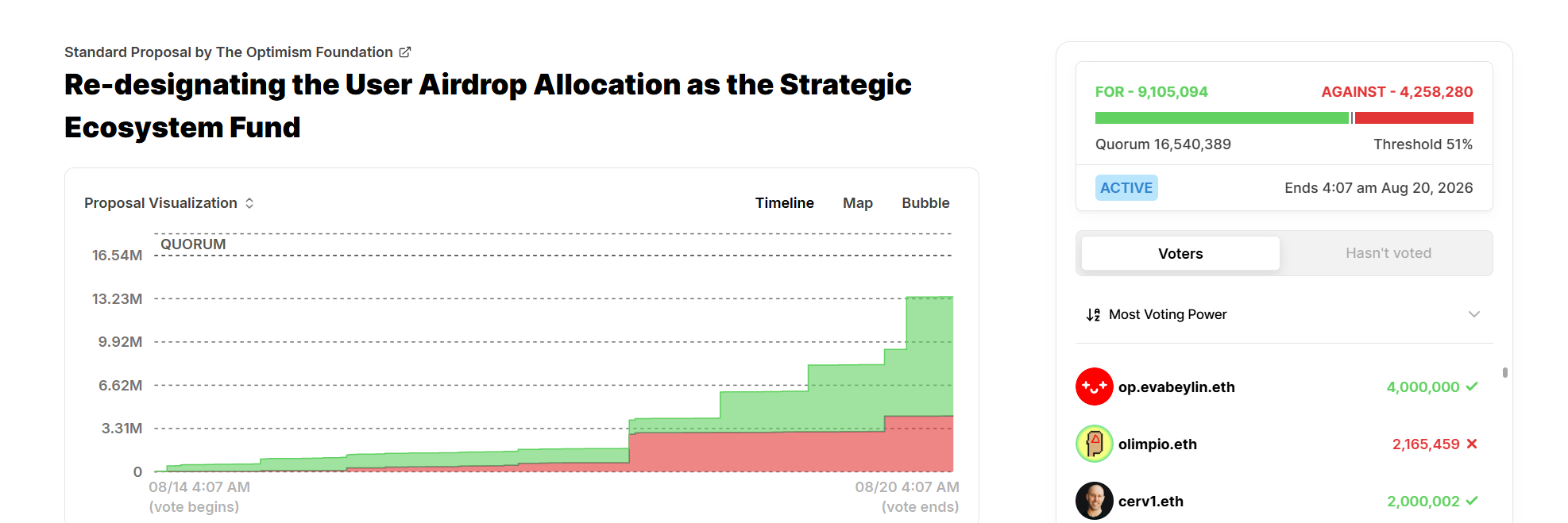
According to the latest on-chain data available, there are approximately 9.105 million OP tokens in support votes and about 4.258 million OP tokens in opposition votes. The quorum requirement is approximately 16.54 million OP tokens, and there remains a significant gap between the current participation level and reaching the required threshold. The final voting outcome has not yet been decided, and community contention continues.
OP Buybacks Halted After May This Year
The initial total supply of OP is approximately 4.295 billion tokens. Of this, 19% (about 816 million tokens) was explicitly reserved for user airdrops. While this arrangement is not a formal legal obligation, Optimism has repeatedly confirmed it in public communications over the years, including as recently as October 2024 when Airdrop 5 was distributed, still mentioning that approximately 550 million tokens could be used for future airdrops.
The actual execution shows: between 2022 and 2024, five rounds of airdrops were completed, distributing a cumulative total of about 269.1 million OP tokens, accounting for approximately 33% of the reserved total. The first round accounted for the highest proportion. Subsequent rounds continuously adjusted criteria, shifting from early usage and gas consumption towards delegated governance, OP Mainnet activity, NFT creators, and Superchain activities, among others.
The fourth year (May 2025 to April 2026) saw no new airdrops, with the official clearly pivoting towards "targeted growth projects with measurable retention and revenue outcomes."
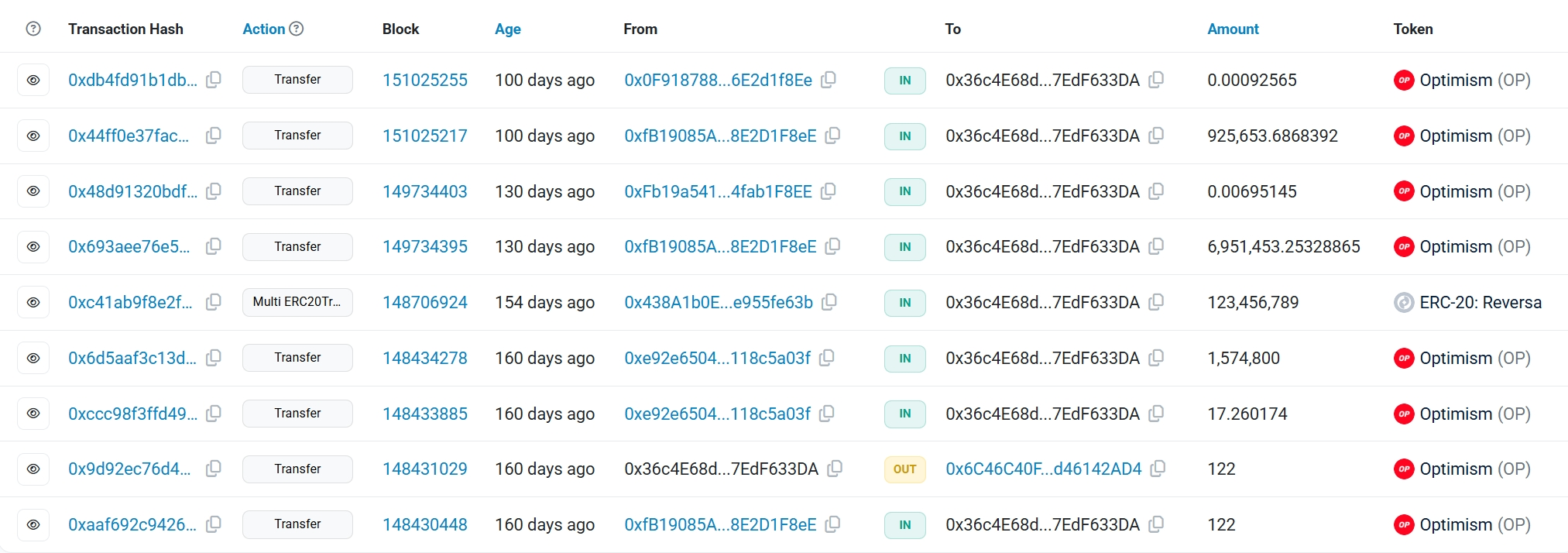
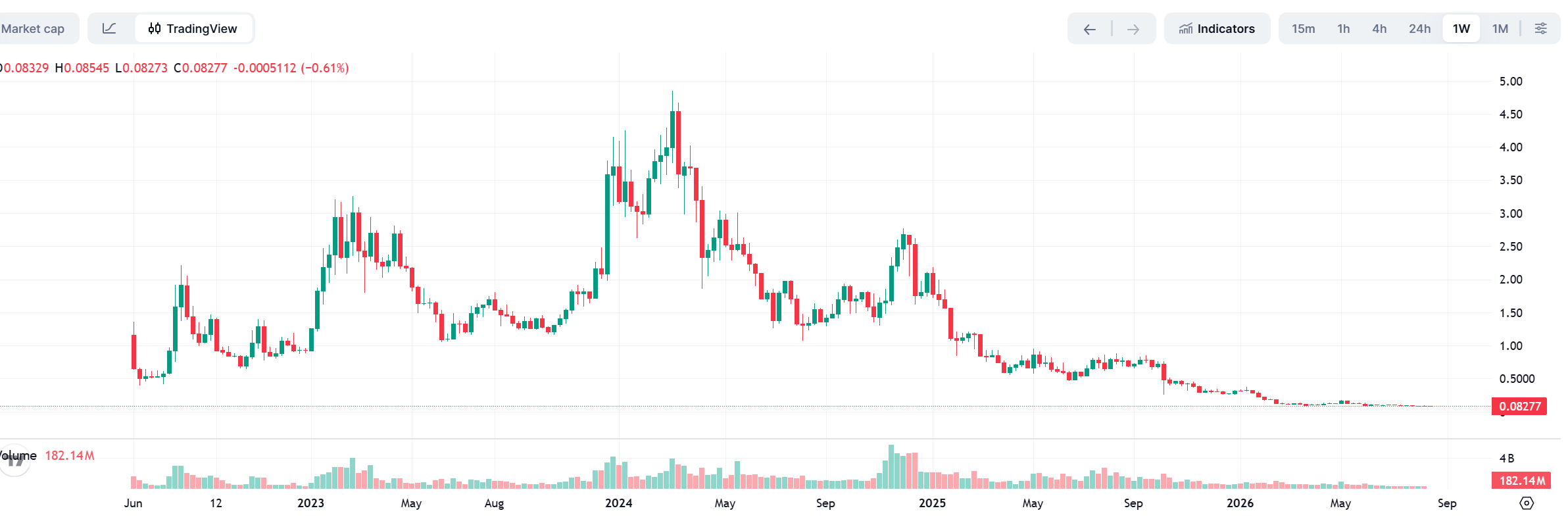
On-chain data also indicates that Optimism has not followed through with its original plan to buy back OP after May. After completing the second and third rounds (March and April) of monthly community buybacks, the official unilaterally halted the subsequent buyback plan. In March, the foundation spent 367.905 ETH to buy back 6,951,453 OP, and in April, 50.16 ETH to buy back 925,654 OP. To date, its cumulative buyback of OP tokens stands at 9,451,924 OP, valued at approximately $756,200 based on the latest price of $0.08.
The foundation stated it will reassess after the 12-month period ends and does not commit to a long-term continuation.
Simultaneously, the overall OP deployment volume for the fourth year decreased by approximately 35% compared to the third year. New circulating supply from the Governance Fund decreased by 53% year-on-year, Retro Funding (a public goods funding mechanism where OP rewards are distributed based on actual contributions) expenditures dropped by 30%, and airdrops were zeroed. The foundation also released a fourth-year budget update and fifth-year outlook, projecting approximately 273 million new OP tokens entering circulation in the fifth year (excluding the potential reallocation from this airdrop quota), with about 200 million OP expected to be deployed from the Ecosystem Fund.

According to DefiLlama data, its Total Value Locked (TVL) has significantly dropped from a peak of $5.5 billion to $526 million.
Strategic Shift Towards Enterprise Growth
The Layer 2 network crypto market is currently facing issues like user attrition and a lack of innovation. According to the latest data from Token Terminal, its core developers have dwindled to 42, compared to 144 at its peak at the end of 2024.
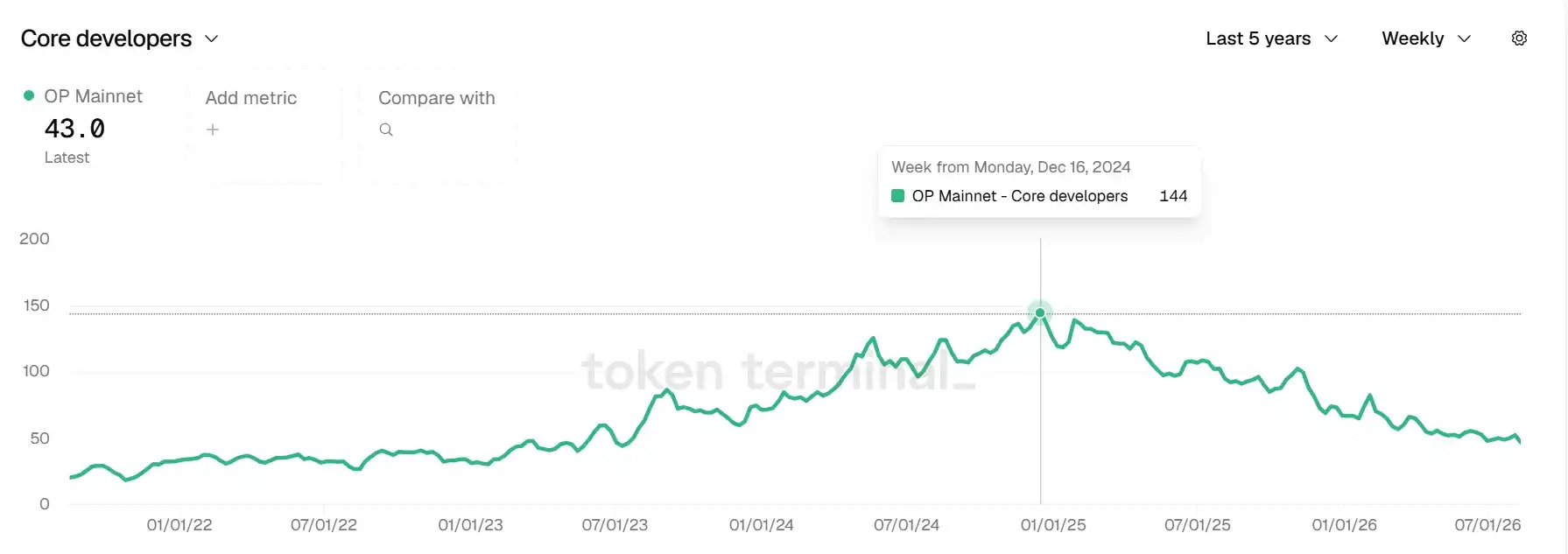
Currently, Optimism is pivoting towards the enterprise market, including fintech, exchanges, payment institutions, and traditional financial institutions. Current partnerships include Bitpanda, Ink, and Dunamu, among others.
Specifically, the proposal requires:
- Creating a new allocation category called "Strategic Ecosystem Fund";
- Reallocating the remaining 546.9 million OP tokens from the user airdrop category into this fund;
- The fund's use includes facilitating partnership deals to bring chains, protocols, institutions, and infrastructure to the OP Stack, deepening incentives for on-chain activity and liquidity on OP Mainnet, and expanding collaborations with top-tier brands and institutions.
The already distributed Rounds 1 to 5 airdrops will not be affected. If the proposal passes, the foundation will update the token allocation documentation and public accounting records and will continue using the existing grant oversight and annual budget reporting mechanisms. The fifth-year budget outlook itself already assumes zero airdrop deployment and notes that this outlook is independent of this reallocation proposal.
After being initiated by the official, early voting leaned in favor. However, as community discussions intensified, opposition voices quickly rose. Main criticisms focus on three points: the portion originally reserved for users is being reallocated to foundation-controlled enterprise growth funds, effectively allowing the official team to reclaim tokens under the guise of DAO governance; and with airdrops and Retro Funding successively phased out, incentive pathways for ordinary users are further narrowed.
The changing stance of the airdrop whale olimpio.eth, a long-time participant in Optimism governance, has drawn attention. This account previously maintained a high participation rate in over 120 governance votes. Its voting record shows it cast 2,165,459 votes in opposition, which the community views as its first-ever vote against a proposal in Optimism governance history. Some participating players criticized
Community discussions repeatedly feature calls to "preserve the right to future airdrops." Conversely, there are also views that even if the proposal fails, the official currently has no plans for new airdrops, making the practical impact limited.
If the proposal ultimately passes, Optimism's token allocation structure will formally shift further from the dual-track model of "user airdrops + ecosystem incentives" towards a greater tilt towards enterprise and institutional growth. This aligns with its OP Enterprise product line, Superchain expansion, and the overall trend of expenditure discipline. For token holders, this may strengthen the expectation of "growth prioritized over broad distribution" in the short term, potentially putting greater pressure on the token price.
There remains about a two-day window before the voting deadline, leaving room for a change in the final outcome. As of the time of writing, market data shows that the Optimism (OP) token's current market capitalization is approximately $185 million, with the token price fluctuating around $0.08, and a Fully Diluted Valuation (FDV) of $348 million.