El Salvador faces significant paper losses after a year of buying bitcoin

THE BLOCKPublicado a 2022-09-08Actualizado a 2022-09-09

Resumen

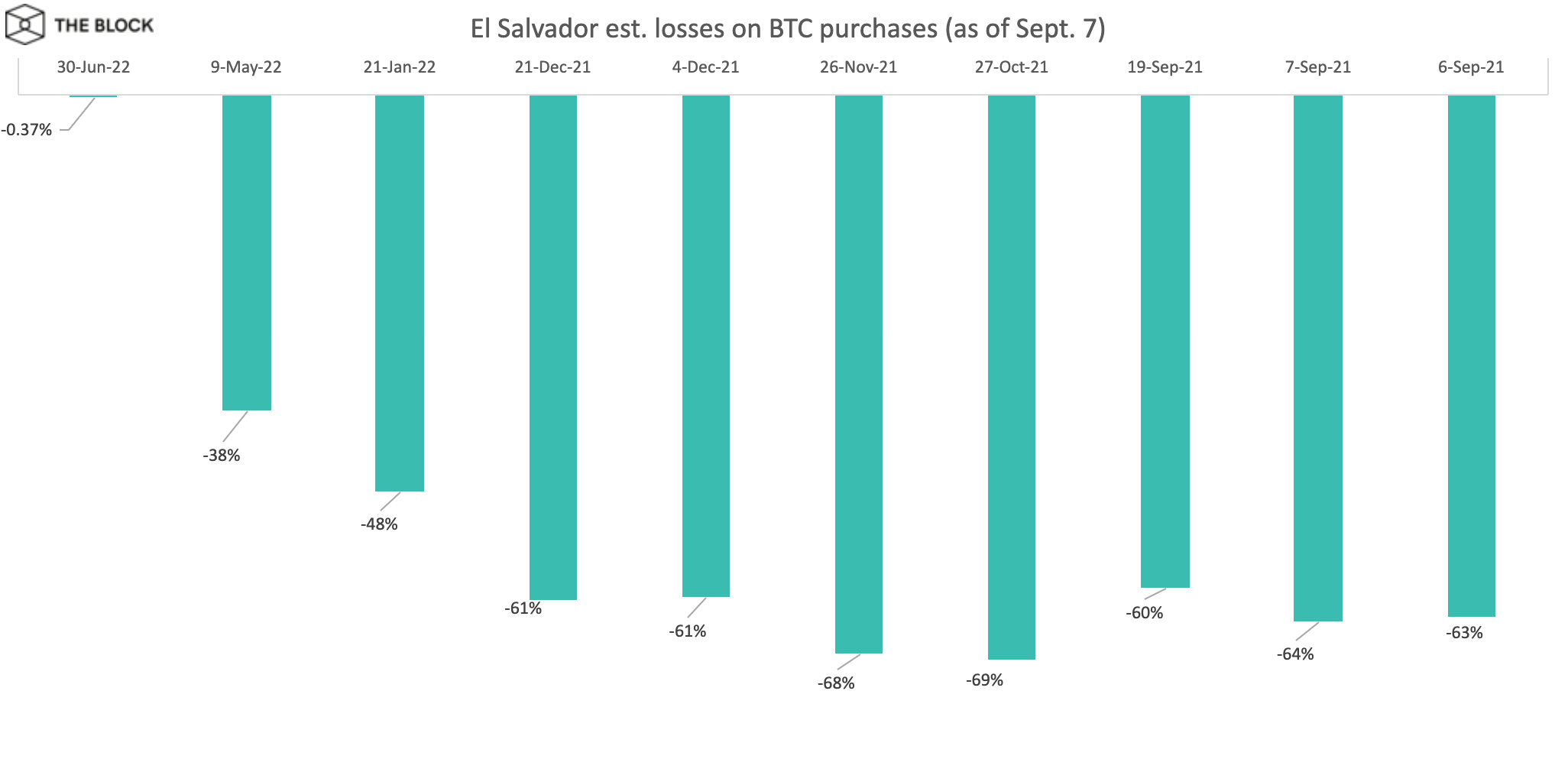
The country’s bitcoin portfolio has lost about 58% of its value on paper, based on average purchase price and bitcoin’s value earlier on Sept. 7.

El Salvador placed a big bet on bitcoin exactly a year ago, making it an official legal tender alongside the U.S. dollar and filling its coffers with the cryptocurrency in a series of purchases. However, the country appears to be facing significant losses related to its bitcoin buys, at least on paper.

El Salvador's bitcoin portfolio is down about 58%

The public does not know exactly how much bitcoin El Salvador is holding right now, as the government has not made this official data public. But based on the bitcoin buys El Salvador's President Nayib Bukele has disclosed on Twitter since last September, the country has purchased 2,381 bitcoins. If it is still holding onto all of those, El Salvador's portfolio would be down about 58% based on the average purchase price of the assets compared with current bitcoin prices.

Source and methodology: Data calculated using a combination of information shared by El Salvador's President Nayib Bukele through Twitter, and bitcoin daily averages on the day of purchasing from Blockchain.com (where the purchase price wasn’t shared by the president). Amounts calculated using a bitcoin price of $18,930 from earlier on Sept. 7. Methodology based on the Nayib Bukele Portfolio Tracker.

Only an estimate

While the public assumed for the better part of the year that El Salvador has been hanging on to all of its bitcoin, finance minister Alejandro Zelaya revealed during a June interview that the country had sold some to fund the Chivo Pets pet hospital project. However, he maintained that the government was holding onto its bitcoin as a general strategy.

Bukele had said in October the project would be funded with part of a $4 million "surplus" in a government trust fund based on bitcoin's rising value at the time, and that it was not selling any crypto for the project. So, the exact amount the government may have actually sold is unclear.

Follow the tweets

The above data is based on Bukele's tweets about purchasing bitcoin throughout the year. One site that has been tracking the purchases, the Nayib Bukele Portfolio Tracker, estimates that the country had spent more than $107 million on bitcoin and lost more than $61 million, based on the current price of the cryptocurrency.

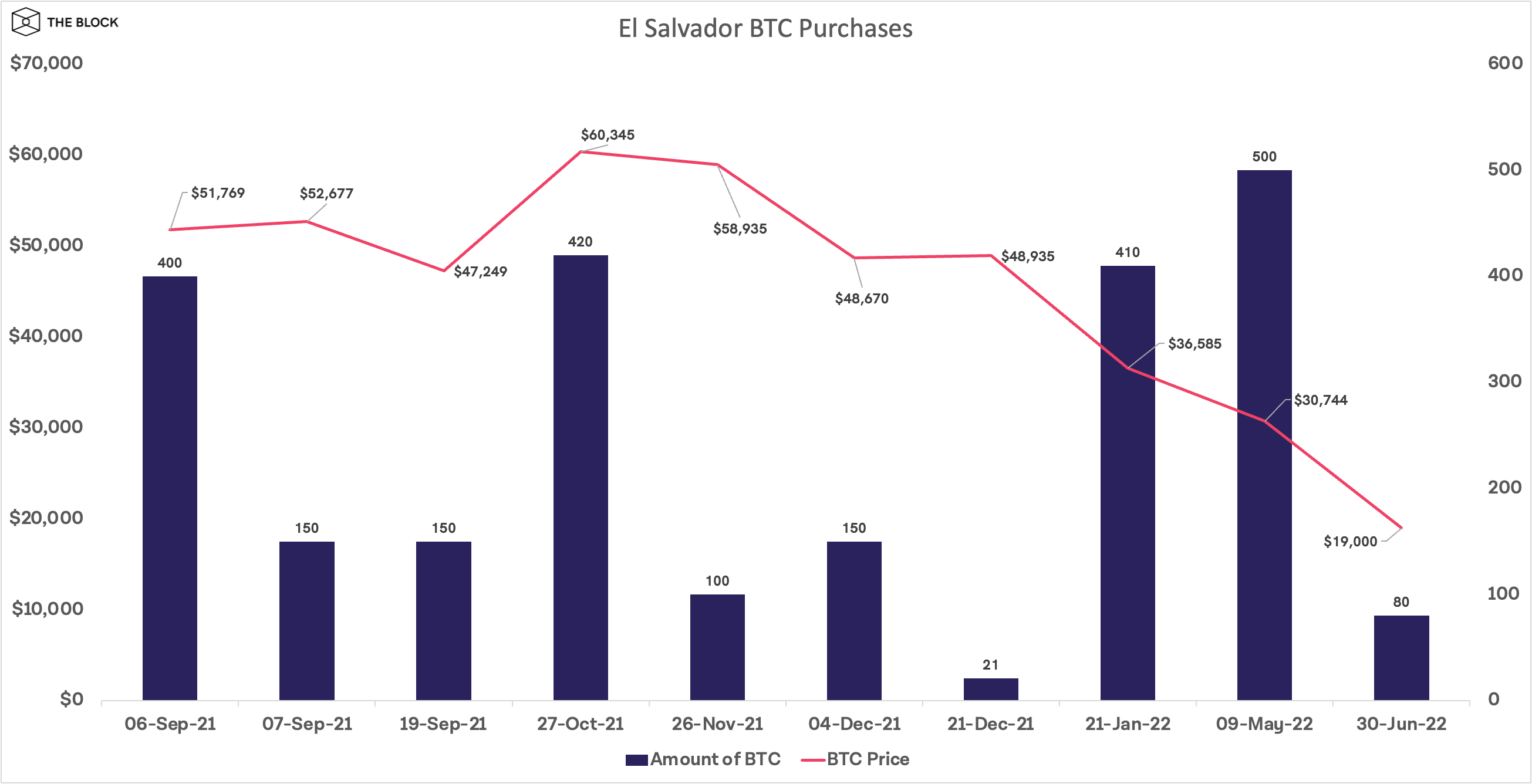
El Salvador bitcoin purchases, based on Bukele’s tweets

June 30, 2022 - 80 BTC

May 9, 2022 - 500 BTC

Jan. 21, 2022 - 410 BTC

Dec. 21, 2021 - 21 BTC

Dec. 4, 2021 - 150 BTC

Nov. 26, 2021 - 100 BTC

Oct. 27, 2021 - 420 BTC

Sept. 19, 2021 - 150 BTC

Sept. 7, 2021 - 150 BTC

Sept. 6, 2021 - 200 BTC

Sept. 6, 2021 - 200 BTC (first purchase)

Source: The Block's analysis of Bukele’s tweets relating to bitcoin purchases.

Lecturas Relacionadas

Bitcoin Trading Strategy Breakdown: Celebrity Predictions and Classic Models All Fail, Only These Four Indicators Remain

Analysis of Bitcoin Trading Strategies: Why Celebrity Forecasts and Classic Models Fail, Leaving Only These Four Reliable Indicators This analysis examines the failure of common Bitcoin prediction methods and identifies four reliable indicators for constructing a trading strategy. The author reviewed all major BTC prediction approaches from 2017-2025, categorizing them into three groups: celebrity price targets (consistently over-optimistic), analytical models like Stock-to-Flow (broken post-2022), and on-chain signals. The key finding is that more data often creates confusion, not clarity. The strategy discards unreliable elements: celebrity predictions (incentivized to be extreme), pure models (invalidated by post-ETF market changes), and the Fear & Greed Index used alone (too many false signals). Four reliable indicators were selected: 1. **MVRV Z-Score:** Accurately identifies cycle bottoms when entering its green zone (e.g., 2018, 2020, 2022). Note: Its ability to call tops is now ineffective post-2024. 2. **SOPR (28-day MA):** Consistently signals bottoms when below 1.0, indicating holders are selling at a loss. 3. **ETF Net Flow:** A crucial post-2024 metric showing institutional momentum (e.g., sustained inflows = buying). 4. **Macro Liquidity (Fed policy & M2):** Sets the overall directional bias (e.g., bullish during easing cycles). The core strategy involves waiting for a multi-signal共振 (resonance). For example, a bottom signal requires MVRV in the green zone + SOPR < 1.0. A top signal requires overheated on-chain data + sustained ETF outflows. Macro policy sets the overall direction. The Fear & Greed Index is only used as a weighted confirmatory signal, never alone. Action is only taken when three or more indicators align. The author automated this into a monitoring system that sends Telegram alerts only when signals trigger. As of the article's date (April 15, 2026), the system showed a strong bottom signal: extreme fear (F&G=12), MVRV in the buy zone, and SOPR < 1.0. The only contrary signal was weak ETF flows. Historically, such triple on-chain共振 has preceded 100%+ returns. The conclusion emphasizes building a personal framework over relying on external predictions, allowing for iterative improvement and customization based on individual risk tolerance.

marsbitHace 2 hora(s)

Bitcoin Trading Strategy Breakdown: Celebrity Predictions and Classic Models All Fail, Only These Four Indicators Remain

marsbitHace 2 hora(s)

Trading

Spot
Futuros
活动图片