$50 Million Gone with One 'Confirmation'! The Most Expensive Slip in DeFi History is Born

比推Publicado a 2026-03-13Actualizado a 2026-03-13

Resumen

An anonymous crypto "whale" accidentally lost nearly $50 million in what is being called DeFi's most expensive "fat-finger" error. The user attempted to swap 50.43 million USDT for AAVE tokens via the Aave mobile app interface. Due to extremely low liquidity for AAVE tokens, the massive trade caused catastrophic slippage of over 99%, resulting in the user receiving only 324 AAVE (worth ~$36,000) instead of the intended amount. Aave's founder Stani Kulechov confirmed the user manually confirmed a risk warning checkbox on the high-slippage transaction before proceeding. The protocol functioned as designed, but the incident sparked intense debate: some argue users bear full responsibility in DeFi, while others criticize the UI/UX for inadequate safeguards for such large transactions. The wallet has been linked by analysts to a Bitcoin whale address holding ~80,000 BTC, suggesting the user may be a wealthy early adopter. Aave has pledged to refund the $600,000 in fees from the trade and improve safety measures like stricter slippage limits. The event highlights critical DeFi challenges: amplified risk from user errors, urgent need for better UX safeguards, MEV exploitation, and user education gaps.

Last night, an incident dubbed the "most absurd fat-finger error in DeFi history" exploded across the crypto community.

The protagonist of the story is an anonymous "whale." Through the app interface of the DeFi lending protocol Aave, he initiated a seemingly simple transaction: exchanging a whopping $50.43 million USDT stablecoin for AAVE tokens.

How large was this transaction? Large enough to instantly "dry up" the liquidity for the vast majority of tokens on the market. Due to the inherently limited trading depth of AAVE tokens, such a massive buy order directly triggered a disastrous slippage. Simply put, slippage is the deviation between the price you expect to trade at and the price you actually get. In this transaction, the slippage was over 99%.

Transaction link: https://etherscan.io/tx/0x9fa9feab3c1989a33424728c23e6de07a40a26a98ff7ff5139f3492ce430801f

What does this mean? When this transaction was finally executed through on-chain routers like CoW Swap, this user received only 324 AAVE tokens, worth about $36,000 at the market price at the time.
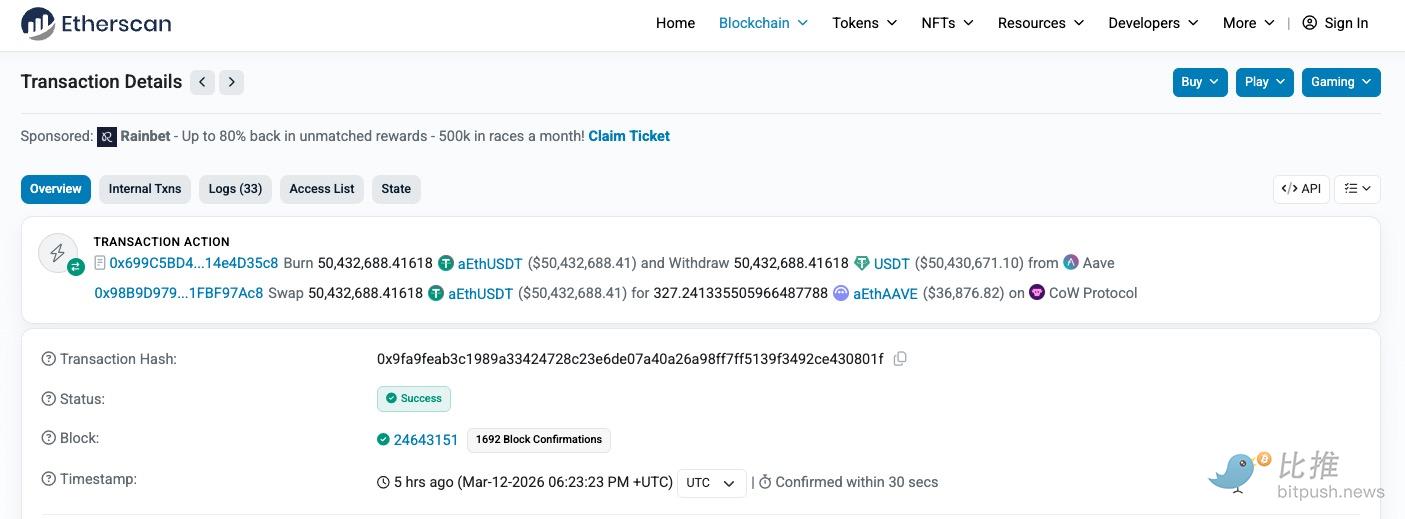
$50.43 million vs. $36,000. One transaction, nearly $50 million evaporated in an instant.

Aave's founder, Stani Kulechov, later explained the incident on social media.
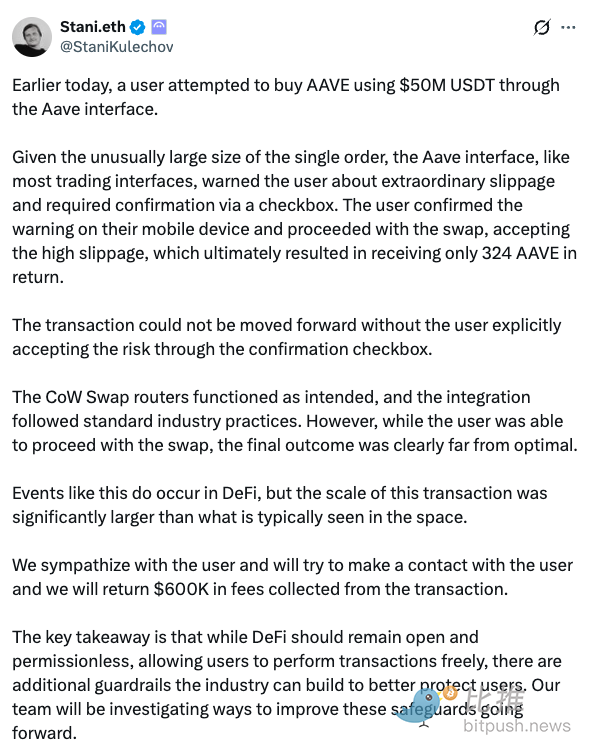
According to his description, the user completed the operation on Aave's mobile app. When the system detected the extreme slippage this massive transaction could cause, the interface popped up a risk warning and required the user to check a confirmation box to indicate they were aware of the risks. On their phone, the user checked that small box and then clicked confirm.
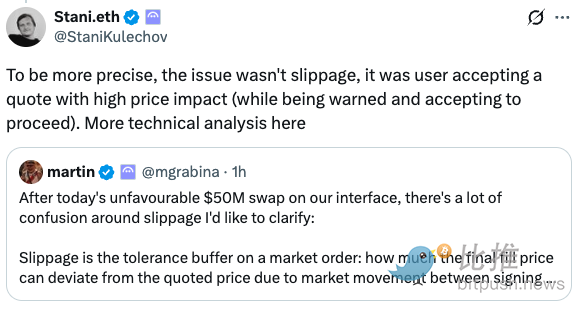
He stated that all procedures were standard and the protocol itself was functioning normally.

The event shocked the entire crypto community, combining elements of the "absurd":

1. Scale: $50 million, even in the crypto world frequented by institutions, is a huge sum of money that many would look up to.

2. Mobile operation, how bold? This was one of the most heated points of discussion in the community. A comment from one netizen received many likes: "Who keeps $50 million on their phone???"

3. Checkbox too 'makeshift'?: The most ironic part of the whole event was that decisive "checkbox." In traditional finance, a multi-million dollar transaction requires layers of approval, multiple reviews, and phone confirmations. In decentralized DeFi, the entire firewall is simplified into a checkbox that can be passed with a simple tap. The community mocked this as the "DeFi version of 'I have read and agree to the terms and conditions'."

The owner of address 0x98b sparked community speculation. Through on-chain tracing, analyst Specter believes this wallet is likely related to the 1011 insider whale Garrett Jin.
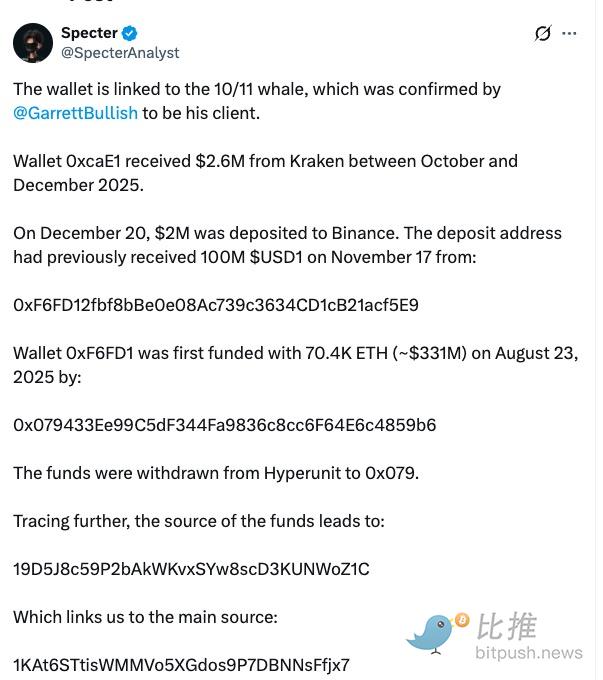
The analyst pointed out that fund flow shows the wallet received about $2.6M from Kraken (Oct-Dec 2025) and was traced back to the Bitcoin address 1KAt6STtisWMMVo5XGdos9P7DBNNsFfjx7—a famous Bitcoin cold wallet holding about 80,000 BTC (worth billions of dollars), often associated with early Bitcoin miners or institutional investors. The community speculates that this "whale" might be a Bitcoin millionaire diversifying into Ethereum, but a operational error led to huge losses.

Of course, there are also conspiracy theorists怀疑ing if this is some form of "money laundering"? But it's just speculation for now, without any solid evidence.

Blame the User, or Blame the Protocol?

The event quickly split into two main camps on social media:

One view holds that the user must be responsible for their own actions. The core spirit of DeFi is "not your keys, not your coins"; you control your assets, so you must pay for every operation you make. In a permissionless financial system, you can't expect someone to save you when you make a mistake.

More people pointed the finger at Aave's interface design. They argued that a UI that uses merely a checkbox to prevent a $50 million loss is itself a failure. Some developers suggested that for such extreme, obviously unreasonable transactions, the interface should impose more "aggressive" friction, such as forcing the user to type a specific phrase like "I confirm I will lose 99.9% of my funds" to proceed, or directly setting an insurmountable slippage上限.

The core of this debate actually touches on the biggest paradox DeFi currently faces: how to provide users with sufficient safety protections while adhering to the core principles of decentralization and permissionlessness?

Aave's team reacted quite quickly. Founder Stani promised to refund the approximately $600,000 in fees collected from this transaction to the victim. More importantly, they announced they would review and improve related protective measures, such as optimizing UI/UX design and setting stricter slippage上限s, to prevent similar tragedies from happening again.

What Does This Incident Leave Us With?

This $50 million "slip" incident, although an extreme case, once again highlights the deep-seated worries of DeFi:

1. DeFi's Risk Amplification Effect: Automation, permissionlessness, and composability—the magic of DeFi—also amplify any tiny user error. One "slip," and the cost could be losing everything.

2. Urgency of UI/UX Optimization: For DeFi to go mainstream, user experience and safety protections must be improved. How to introduce more "smart guardrails" while maintaining the spirit of decentralization, such as multiple confirmations for large transactions, AI-assisted risk assessment, etc., is a topic every protocol needs to consider.

3. Challenges of MEV and Ethereum's Mechanism: The loss being extracted by MEV highlights the "law of the jungle" on the blockchain. This might accelerate the migration to fairer mechanisms, like PBS optimizations or Layer 2 solutions.

4. Lack of User Education: Many users may not fully understand professional concepts like "slippage" and "liquidity depth." If a whale can make such a mistake, let alone the average retail investor? The entire industry needs to invest more resources to help users build necessary risk awareness.

After all, the price of such a "slip" is just too expensive.


Twitter:https://twitter.com/BitpushNewsCN

Bitpush TG Discussion Group:https://t.me/BitPushCommunity

Bitpush TG Subscription: https://t.me/bitpush

Original link:https://www.bitpush.news/articles/7619291

Criptos en tendencia

Preguntas relacionadas

QWhat was the main cause of the user losing nearly $50 million in the DeFi transaction?

AThe user lost nearly $50 million due to extreme slippage of over 99% caused by attempting to swap a massive amount of 50.43 million USDT for AAVE tokens, which had limited liquidity to handle such a large order.

QHow did the Aave interface attempt to warn the user about the risks of this transaction?

AThe Aave interface detected the extreme slippage risk and displayed a warning popup with a checkbox that the user had to manually select to confirm they understood the risks before proceeding.

QWhat was the community's reaction regarding the use of a simple checkbox for such a large transaction?

AThe community criticized the UI design, calling it a 'DeFi version of 'I have read and agree to the terms'' and argued that a simple checkbox was insufficient protection for a $50 million transaction, suggesting more aggressive safeguards like mandatory phrase confirmation or hard slippage limits.

QWho is suspected to be the owner of the wallet (0x98b) that initiated this transaction, according to on-chain analysts?

AOn-chain analysts, like Specter, suspect the wallet is likely associated with Garrett Jin, an insider whale, with funds traced back to a famous Bitcoin cold wallet holding around 80,000 BTC, potentially belonging to an early Bitcoin miner or institutional investor.

QWhat actions did Aave's founder take in response to this incident?

AAave's founder, Stani Kulechov, promised to refund the approximately $600,000 in protocol fees collected from the transaction to the victim and announced plans to review and improve protective measures, such as optimizing UI/UX design and implementing stricter slippage limits.

Lecturas Relacionadas

Annual Salary of Millions Competing for Electricians, Meta Rushes to Open Its Own Technical School

The AI boom is facing an unexpected bottleneck: a severe shortage of skilled construction workers and electricians. As tech giants like Meta, OpenAI, and Alphabet race to build massive data centers—such as OpenAI's $16 billion "Stargate" project—they are hitting a critical labor wall. The U.S. needs an estimated 130,000 more electricians, 240,000 construction workers, and 150,000 supervisors by 2030 for AI infrastructure alone, but tens of thousands of electrician jobs go unfilled each year. While AI companies offer high premiums, with electricians earning up to $280,000 annually, worker scarcity still causes massive losses—delays on a single project can cost $14.2 million per month. The complexity of building AI data centers, which require immense power (equivalent to powering hundreds of thousands of homes), sophisticated electrical systems, and advanced liquid cooling solutions, demands highly skilled technicians who are in short supply. To combat this, companies are investing heavily in training. Meta has committed $115 million to a free training school offering tuition, housing, and stipends, targeting 5,000 new workers. OpenAI is partnering with unions to secure skilled labor. These efforts are paying off, with a significant rise in Gen Z interest in trade schools over college. However, the power demands are staggering. AI data centers are driving a rapid surge in electricity consumption, projected to account for up to 12% of U.S. power use by 2028 and raising costs for consumers. Furthermore, the construction boom is project-based, leading to a potential future glut of trained workers once building peaks, which could depress wages industry-wide. The race for AI supremacy now depends as much on skilled hands as on advanced chips.

marsbitHace 28 min(s)

Annual Salary of Millions Competing for Electricians, Meta Rushes to Open Its Own Technical School

marsbitHace 28 min(s)

OpenAI No Longer Sells Its Most Expensive Model for Profit

OpenAI is shifting its business strategy away from promoting its most expensive, flagship models for every task. Recent price cuts—80% for GPT-5.6 Luna and 20% for Terra—signal a deeper change: the company now actively advises users that many tasks don't require the most powerful model. Instead, OpenAI recommends a tiered approach: use the high-end GPT-5.6 Sol for complex planning and analysis, then delegate execution to cheaper models like Luna. This mirrors moves by Anthropic, which recently launched Claude Opus 5 at half the price of its top model, Fable 5. Both companies are de-emphasizing flagship models as primary revenue drivers, using them instead for brand prestige and technological showcases. The industry is entering a "mass-market" phase, similar to automotive, where high-volume, cost-effective models handle daily operations and drive scale. OpenAI's price reductions are partly enabled by AI models themselves optimizing underlying code and infrastructure, creating a self-reinforcing cycle of efficiency gains and cost reduction. Competition is shifting from "who is smartest" to "who offers the best value." The goal is no longer selling individual models but fostering widespread API adoption and ecosystem lock-in. By making AI calls cheap and ubiquitous, companies like OpenAI aim to become the indispensable, utility-like infrastructure powering automated workflows—the "water and electricity" of software, quietly embedded everywhere.

marsbitHace 28 min(s)

OpenAI No Longer Sells Its Most Expensive Model for Profit

marsbitHace 28 min(s)

Will the Fed Definitely Raise Interest Rates in September? How Will Crypto and U.S. Stocks Withstand the Pressure?

The market's expectation for a September Fed rate hike surged dramatically in early August, jumping from under 50% to over 80% within a week. This shift followed a contentious July FOMC meeting, where a 9-3 vote to hold rates revealed growing dissent from hawkish members advocating for an immediate hike to combat persistent inflation. The primary catalyst for this repricing is rising oil prices, driven by renewed geopolitical tensions around the Strait of Hormuz, which threaten global supply. Energy costs directly influence inflation metrics, making the upcoming July CPI report (due August 12th) a critical data point. If it shows inflation reaccelerating, the probability of a September hike will solidify. For Bitcoin and crypto assets, this is typically bearish news. Bitcoin continues to behave as a high-beta, liquidity-sensitive risk asset. A rate hike raises the opportunity cost of holding non-yielding assets and could drive capital toward money markets, pressuring crypto prices in the short term. However, historical patterns suggest that if a hike is perceived as the end of a tightening cycle rather than the start, any negative price impact may be brief. U.S. stocks, particularly crypto-linked equities like Coinbase and growth-oriented tech stocks, are also vulnerable. Higher rates increase discount rates in valuation models, putting pressure on high-multiple companies. This coincides with a pivotal tech earnings season where investor focus has shifted from massive AI capital expenditure to tangible revenue and cash flow generation. Companies with negative cash flow and weak growth narratives could face heightened volatility if borrowing costs rise in September. In summary, a September Fed hike has evolved into a mainstream market scenario. Key factors to watch are oil prices, the July CPI report, and Fed communications, which will determine the final decision and its impact on volatile crypto and equity markets.

marsbitHace 39 min(s)

Will the Fed Definitely Raise Interest Rates in September? How Will Crypto and U.S. Stocks Withstand the Pressure?

marsbitHace 39 min(s)

Trading

Spot

Artículos destacados

Cómo comprar ONE

¡Bienvenido a HTX.com! Hemos hecho que comprar Harmony (ONE) sea simple y conveniente. Sigue nuestra guía paso a paso para iniciar tu viaje de criptos.Paso 1: crea tu cuenta HTXUtiliza tu correo electrónico o número de teléfono para registrarte y obtener una cuenta gratuita en HTX. Experimenta un proceso de registro sin complicaciones y desbloquea todas las funciones.Obtener mi cuentaPaso 2: ve a Comprar cripto y elige tu método de pagoTarjeta de crédito/débito: usa tu Visa o Mastercard para comprar Harmony (ONE) al instante.Saldo: utiliza fondos del saldo de tu cuenta HTX para tradear sin problemas.Terceros: hemos agregado métodos de pago populares como Google Pay y Apple Pay para mejorar la comodidad.P2P: tradear directamente con otros usuarios en HTX.Over-the-Counter (OTC): ofrecemos servicios personalizados y tipos de cambio competitivos para los traders.Paso 3: guarda tu Harmony (ONE)Después de comprar tu Harmony (ONE), guárdalo en tu cuenta HTX. Alternativamente, puedes enviarlo a otro lugar mediante transferencia blockchain o utilizarlo para tradear otras criptomonedas.Paso 4: tradear Harmony (ONE)Tradear fácilmente con Harmony (ONE) en HTX's mercado spot. Simplemente accede a tu cuenta, selecciona tu par de trading, ejecuta tus trades y monitorea en tiempo real. Ofrecemos una experiencia fácil de usar tanto para principiantes como para traders experimentados.

404 Vistas totalesPublicado en 2024.12.12Actualizado en 2026.06.02

Cómo comprar ONE

Discusiones

Bienvenido a la comunidad de HTX. Aquí puedes mantenerte informado sobre los últimos desarrollos de la plataforma y acceder a análisis profesionales del mercado. A continuación se presentan las opiniones de los usuarios sobre el precio de ONE (ONE).

活动图片













