$50 Million Funding Ignites Airdrop Anticipation, Variational Becomes New Focus of Perp DEX

Odaily星球日报Publicado a 2026-05-21Actualizado a 2026-05-21

Resumen

Variational, a perpetual decentralized exchange (Perp DEX) on Arbitrum, has become a focal point in the crypto community after announcing a $50 million Series A funding round led by Dragonfly Capital, with participation from Bain Capital Crypto and Coinbase Ventures. This news caused a significant pre-listing price surge and increased predictions of a high fully diluted valuation (FDV) upon launch. A key feature of Variational is its zero-trading-fee model. It differentiates itself by aggregating multi-source liquidity, including traditional and crypto-native market makers, to address on-chain liquidity challenges. According to DefiLlama, it ranks fourth among Perp DEXs by open interest and is notable as the only top-five platform yet to issue a token. The primary way for users to engage is through its "Trade-to-Earn" Omni Points program. Points are awarded weekly based on trading activity, with bonuses for early users and a tiered reward system that incentivizes higher trading volumes. The program also includes a referral system offering USDC rewards and extra points. The design emphasizes organic trading over mere volume farming. While an exact Token Generation Event (TGE) date for the VAR token is not confirmed, official documentation states the points program will run at least until the end of Q3 2026. Community and prediction market sentiment generally expects the TGE to occur in Q3 or Q4 of this year.

Original | Odaily Planet Daily (@OdailyChina)

Author | Asher (@Asher_0210)
A funding announcement has made Perp DEX Variational the hot topic in the airdrop farming community.

Last night, Variational announced the completion of a $50 million Series A funding round, led by Dragonfly Capital, with participation from Bain Capital Crypto and Coinbase Ventures. Influenced by this news, Variational's pre-market price surged over 36% briefly, hitting $6.9 at one point (corresponding to an FDV of $690 million). It has since pulled back and is currently quoted at $6.1 (corresponding to an FDV of $610 million).
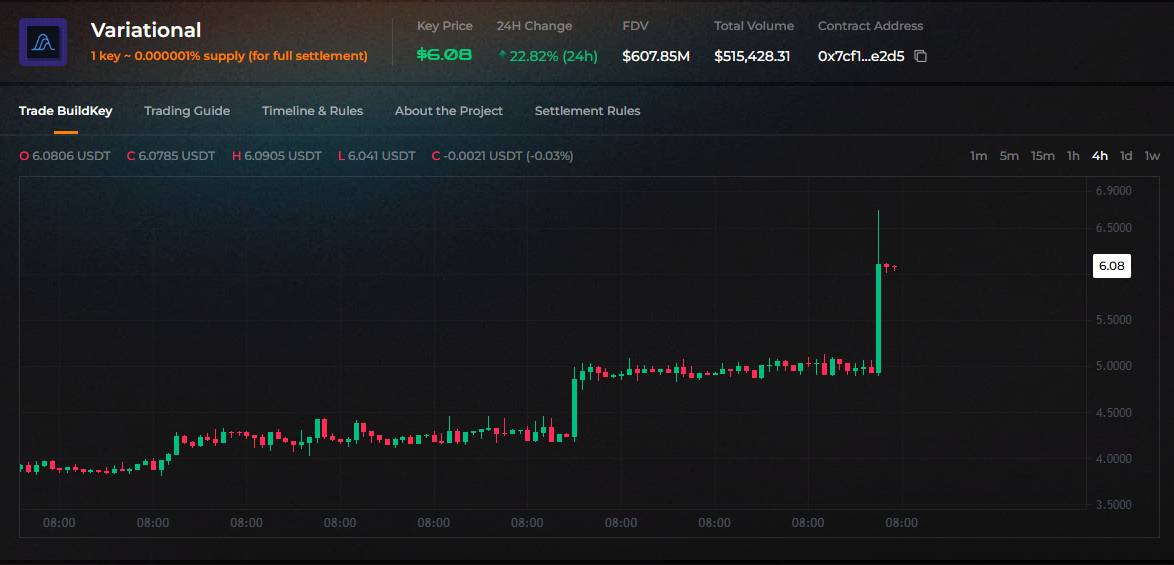
Variational pre-market price movement

Additionally, the probability for the event “Variational's FDV exceeds $500 million one day after listing” on prediction platform predict.fun has risen to 57%; the probability for “Variational's FDV exceeds $1 billion one day after listing” has risen to 27%.
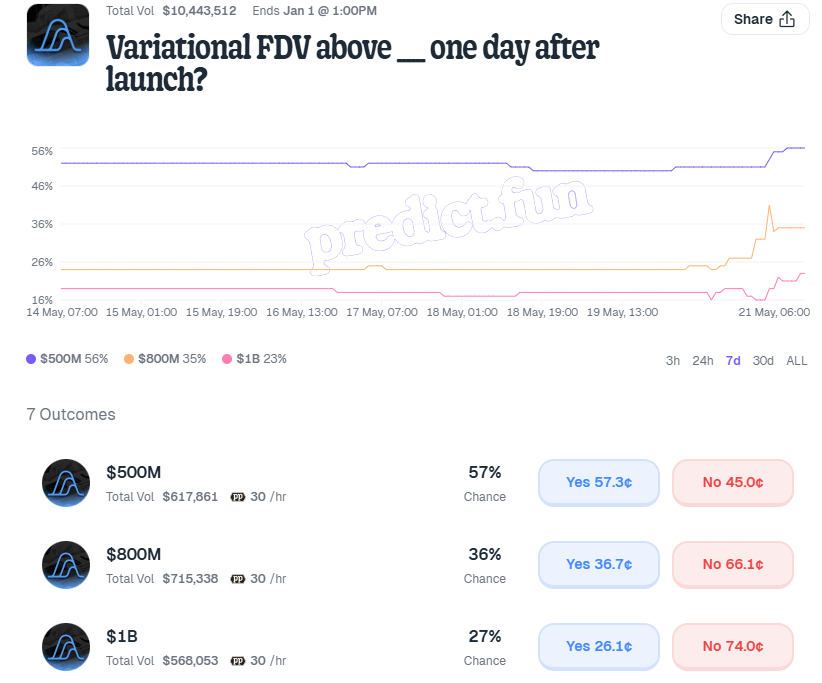
Prediction event for "Variational FDV one day after listing" on predict.fun

Next, Odaily Planet Daily will introduce Variational, its trade-to-earn points rules, and the TGE timeline.

Variational: Zero-Fee Perp DEX Deployed on Arbitrum
Variational is a Perp DEX platform deployed on Arbitrum. The company is headquartered in the Cayman Islands, and its core product is Omni. In simple terms, users can trade perpetual contracts for mainstream crypto assets like BTC, ETH, and SOL on Variational, as well as for long-tail assets, stocks, commodities, volatility indices, and more.

Compared to most Perp DEXs, the most obvious feature of Variational is zero transaction fees. When trading on Omni, the platform does not charge regular transaction fees. The main costs come from spreads, slippage, funding rates, and deposit/withdrawal fees.

Furthermore, Variational's underlying design differs from traditional Perp DEXs. It does not rely solely on internal platform matching or a single liquidity pool to handle trades. Instead, it connects to multi-source liquidity through a "brokerage-like" model, including traditional financial market makers, crypto-native market makers, and major trading platforms, to solve the "liquidity cold start" problem in on-chain markets.

According to DefiLlama data, Variational's trading volume over the past month has exceeded $16 billion, and its current open interest exceeds $800 million, ranking fourth in the Perp DEX sector. Notably, among the top five Perp DEXs by open interest, Variational is the only platform that has not yet issued a token.
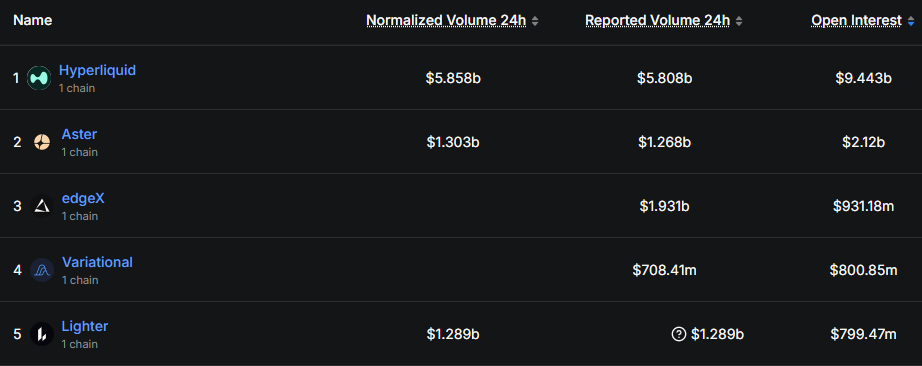
Perp DEX open interest ranking

Trade-to-Earn Points: Detailed Rules for Variational

For ordinary users, the most direct way to participate in Variational currently is still through trading to earn points.

Variational officially launched the Omni Points Program on December 17, 2025, and retroactively distributed 3 million points to historical traders at launch, covering activity up to December 11, 2025. Since then, points are distributed every Friday at 00:00 UTC, accounting for platform activity from the previous cycle ending Thursday at 00:00 UTC.

Additionally, according to the documentation, the project commits to allocating approximately 50% of the token supply to the community (through points, revenue sharing, and other mechanisms, not solely airdrops), while also planning to use at least 30% of protocol revenue for VAR token buybacks and burns.

The core of Variational's points system is not complicated: the more active the trading, the greater the chance to earn more points. However, Variational does not distribute points solely based on trading volume; it incorporates designs that favor trading quality. Specifics include:

  • Points are directly related to user trading activity: The platform rewards page indicates that the points program is designed to reward protocol users, who can earn points through platform activities. The official team reserves the right to adjust points and address non-organic behavior, meaning that obvious meaningless volume farming or arbitrage-style point farming may be subject to reduction or disqualification later;
  • Early users receive an extra bonus: Accounts that traded before the points program launched receive a 10% point bonus on subsequently earned points;
  • Introduction of a Reward Tiers system: A user's total trading volume over the past 30 days affects their tier, calculated as personal trading volume plus 0.2 times the invited trading volume. Different tiers correspond to different point multipliers: Iron at 0%, Bronze at 0.5%, Silver at 1%, Gold at 2%, Platinum at 3%, Diamond at 4%, Infinity at 5%. The thresholds are: Bronze requires $1 million Total Volume in the past 30 days, Silver $5 million, Gold $25 million, Platinum $100 million, Diamond $750 million, Infinity $2.5 billion;
  • Referrals also bring points and USDC rewards: Referrers receive 5% USDC of the spreads paid by the referred users. Additionally, whenever a referred user earns 10 points, the referrer earns 1 point.

Judging from the rules, Variational's points design leans more towards organic trading rather than pure volume farming. For airdrop farmers, the focus is not just on completing a single transaction, but on considering whether their trading frequency, capital efficiency, position risk, and points cost align.

When Will Variational Conduct Its TGE?

Currently, Variational has not announced a clear TGE date for VAR. However, based on information disclosed in the official documentation, points distribution will continue at least until the end of Q3 2026. Therefore, the community generally expects the TGE to occur in Q3 to Q4 of this year.

Data source: Variational official documentation

Furthermore, prediction markets lean towards Q4. Polymarket data shows the probability for the event "Variational will launch its token before September 30 this year" is only 26%, while the probability for "Variational will launch its token before December 31 this year" is 78%.
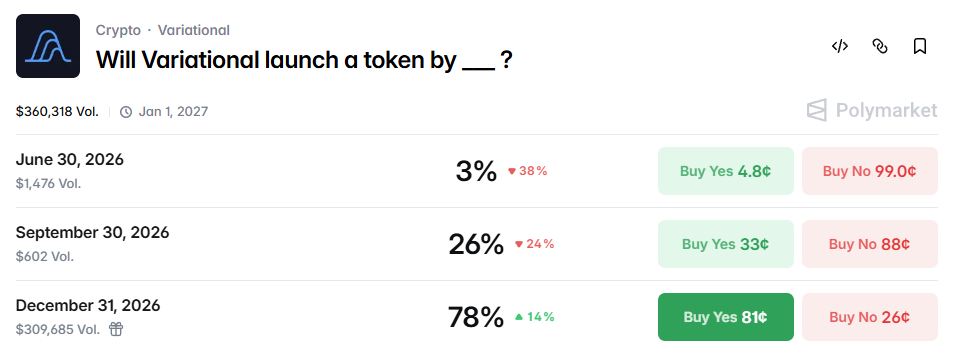
Polymarket prediction event "When will Variational TGE?"


Preguntas relacionadas

QWhat is the key news that caused a stir in the airdrop farming community regarding Variational?

AThe key news is that Variational announced the completion of a $50 million Series A funding round, led by Dragonfly Capital, with participation from Bain Capital Crypto and CoinBase Ventures.

QWhat is Variational, and what is its most distinctive feature as a Perp DEX?

AVariational is a perpetual decentralized exchange (Perp DEX) deployed on Arbitrum. Its most distinctive feature is that it charges zero trading fees to users. Costs for traders mainly come from the bid-ask spread, slippage, funding rates, and deposit/withdrawal fees.

QHow does Variational's 'Omni' points program work, and what is a key consideration for users farming points?

AThe Omni points program rewards users based on their trading activity on the platform. Points are distributed weekly. A key consideration is that the system is designed to favor 'organic' trading behavior, meaning users should focus on trading frequency and capital efficiency rather than simply high-volume, low-risk arbitrage trades, as such behavior risks having points reduced or invalidated.

QWhat is the current market expectation for Variational's Token Generation Event (TGE) timeline based on the article?

ABased on the article, there is no official TGE date. However, official documentation states the points program will run at least until the end of Q3 2026. Community expectations and prediction market data (e.g., on Polymarket) suggest the TGE is more likely to occur in Q4 2026, with a 78% probability of happening before December 31, 2026.

QAccording to the article, what percentage of the VAR token supply is promised to be allocated to the community, and what is planned for protocol revenue?

AThe project has promised to allocate approximately 50% of the token supply to the community through mechanisms like points and revenue sharing. Furthermore, it plans to use at least 30% of protocol revenue to buy back and burn VAR tokens.

Lecturas Relacionadas

ByteDance Adopts Arm CPUs, Jensen Huang: So Sad I Didn't Buy Arm

**Summary:** At Computex 2026, Arm CEO Rene Haas announced that ByteDance and Oracle have adopted Arm's self-designed Arm AGI data center CPU. The company expects significant revenue growth from this product, projecting $20 billion in demand for the 2027/2028 fiscal years. Haas noted that restricting AI-capable CPUs from the US to China is nearly impossible due to their widespread applications. Arm's stock has surged dramatically this year, notably rising 16% after NVIDIA's Arm-based Vera CPU and RTX Spark announcements. A highlight was the informal, humorous on-stage conversation between Haas and NVIDIA CEO Jensen Huang. Huang joked about NVIDIA's failed attempt to acquire Arm and playfully lamented selling his Arm shares. Both executives showed a clear sense of camaraderie and shared regret over the missed merger. Key technical topics were discussed: 1. **AI PC Design:** Huang explained NVIDIA's RTX Spark superchip (with a 20-core Arm CPU) is designed for future AI agents that will autonomously run and use tools on PCs, blending local and cloud processing. 2. **Agent vs. OS:** Huang emphasized the operating system remains crucial, as AI agents rely on its APIs and tools to function. 3. **Growth Constraints:** He identified the shift to "useful AI" that generates profitable tokens as a primary driver for immense, almost limitless, computational demand. Haas outlined Arm's strategy across PC and data centers. For PCs, Arm collaborates with partners like NVIDIA and MediaTek, offering its compute subsystem (CSS) for custom SoCs. In data centers, its Arm AGI CPU (built on TSMC's 3nm process) has gained major partners including OpenAI, Meta, and now ByteDance and Oracle. Arm presented a multi-year roadmap for its in-house CPU line. The article concludes that while GPUs dominated the AI training race, the explosion of AI agents is shifting significant focus to CPUs for inference, state management, and tool orchestration. The industry is trending towards vertical integration, with companies like cloud providers designing chips and chip/IP firms offering full solutions, all competing to deliver more efficient computing per watt.

marsbitHace 5 min(s)

ByteDance Adopts Arm CPUs, Jensen Huang: So Sad I Didn't Buy Arm

marsbitHace 5 min(s)

New Wall Street Play: Yen Shorts Still Adding, But Japan Stocks Don't Rely on Carry Trade Unwinding

On June 3rd, USD/JPY hit 160.44, its highest level since July 2024, while the Nikkei 225 surged past 68,000 points. Contrary to popular narratives of an imminent "carry trade unwind" akin to August 2024, data reveals a more complex picture. Speculative net short positions in yen futures have actually increased, reaching -114,667 contracts by late May, suggesting traders are doubling down rather than retreating. Meanwhile, Japan's Finance Ministry conducted its largest-ever single-round FX intervention (11.73 trillion yen) in April-May but failed to hold the 160 yen line. The Nikkei's rally is not driven by carry trade dynamics. Foreign investors are aggressively buying Japanese stocks, with net purchases in 2026 running nearly 16 times higher than 2025 levels. This inflow is concentrated in AI and semiconductor-related stocks like SoftBank and Socionext, fueled by positive sector outlooks, rather than being a flight from unwinding yen shorts. Furthermore, the Nikkei has continued climbing despite the Bank of Japan's (BOJ) rate hikes to 0.75%. This disconnect exists because the current equity boom is fueled by AI-driven foreign investment, not reliant on cheap yen funding. However, this relationship remains fragile. Should the BOJ hike rates further (e.g., to 1.0%) while dollar weakness increases carry trade costs, the trajectories of the yen and Japanese stocks could reconverge, potentially triggering volatility.

marsbitHace 10 min(s)

New Wall Street Play: Yen Shorts Still Adding, But Japan Stocks Don't Rely on Carry Trade Unwinding

marsbitHace 10 min(s)

Broadcom's Q3 Guidance Misses Expectations by $12 Billion, After-Hours Trading Plummets Over 13%, AI Narrative "Cooling"?

On June 3, Broadcom released record Q2 FY26 results with revenue of $22.19B, up 48% YoY, and AI chip sales of $10.8B, up 143%. Adjusted EPS of $2.44 beat estimates. However, its Q3 AI semiconductor revenue guidance of $16B, while up over 200% YoY, fell roughly $1.2B (7%) short of analyst consensus expectations of $17.2B. This miss, coupled with slightly weaker-than-expected software revenue, triggered a severe market reaction. CEO Hock Tan maintained the FY26 AI revenue outlook of over $100B but did not raise it, disappointing investors who had priced in more robust growth. The stock plummeted over 13% in after-hours trading, erasing roughly $270B in market cap. The sell-off extended to peers like Marvell. A key concern for markets, particularly for Chinese optical module suppliers, was Tan's comment that the contribution of AI networking (e.g., Ethernet switches, optical interconnect chips) to AI revenue, currently near 40%, is expected to normalize to around 30% over time, signaling a potential peak in growth for that segment. Despite the guidance shortfall, Tan reiterated that AI demand remains "insatiable" and reaffirmed the long-term target of exceeding $100B in AI revenue by FY27. The reaction highlights the heightened sensitivity and premium valuation placed on AI-exposed stocks, where anything less than stellar guidance can prompt significant profit-taking. The broader question is whether this represents a cooling AI narrative or a correction in overstretched valuations.

marsbitHace 10 min(s)

Broadcom's Q3 Guidance Misses Expectations by $12 Billion, After-Hours Trading Plummets Over 13%, AI Narrative "Cooling"?

marsbitHace 10 min(s)

Trading

Spot
Futuros
活动图片