Insights On Solana, Youniverze Finance, and Hedera

zycryptoPublicado a 2022-09-04Actualizado a 2022-09-04

Resumen

Investors must always be attentive to market trends to know what project is best for long-term crypto investment.

Blockchain technology has transformed financial transactions as well as recreational and gaming services. The cryptocurrency market is a rapidly expanding industry that has produced several projects utilizing blockchain technology to develop alternative approaches to managing finance. However, the crypto market is notoriously unstable, and investors must always be attentive to market trends to know what project is best for long-term crypto investment.

Although Youniverze Finance (YUNI) is a new cryptocurrency still on presale, the project has gained traction because of its innovative approach to secure, low-cost, and efficient trading. In this article, you will learn about the incentives, long-term strategies, and competitive advantage of Youniverze Finance.

The Permissionless Network – Solana

The Solana Foundation launched the layer one blockchain Solana (SOL) in 2020. The goal of the project, which started in 2017, is to develop a blockchain with larger blocks that is quick, affordable, and scalable.

Developers like the Solana blockchain because it can be used to create DeFi projects and smart contracts. Decentralized applications (dApps) created by developers can also be hosted by Solana on its blockchain. A blockchain called Solana was created to address problems plaguing other Layer 1s in the cryptocurrency market.

A fork of the proof-of-stake (PoS) consensus mechanism called proof-of-history (PoH) is used by Solana. The Solana blockchain’s utility token, SOL, is used to stake for network security and validate transactions. Solana is a community that supports developers and offers them the tools they require to build and scale their projects.

Solana is a highly functional open-source cryptocurrency network that uses the permissionless features of blockchain technology to offer decentralised banking solutions. Unlike most other cryptocurrencies, Solana is run by its own blockchain.

The Sustainable Network – Hedera

The cryptocurrency Hedera (HBAR) runs on a hashgraph blockchain. The Hedera Hashgraph is compatible with D’apps, smart contracts, and cryptocurrency. In contrast to other cryptocurrencies, Hedera is supported by some of the most prestigious companies in the world. It offers quicker transaction times, lower transaction fees, and less energy consumption through a modified proof-of-stake consensus method.

Hedera uses a governing protocol akin to the Ethereum blockchain and a particular communication protocol that sets it apart from proof-of-work blockchains like Bitcoin. Hedera’s main goal is to give users the ability to perform countless transactions per second while maintaining a high-security level. It is challenging to claim that Hedera is a decentralised cryptocurrency with only 39 management companies. But they all enjoy a distinguished reputation. They are less likely to take actions that could harm the network.

A unique blockchain called the Hedera Hashgraph makes it possible to use cryptocurrencies, smart contracts, and decentralised applications (DApps). The platform also supports solidity, an object-oriented programming language primarily used for smart contracts. Decentralized applications (dApps), which can be used for gaming, Defi, and other things, will be made easier with its help.

The Multichain Network – Youniverze Finance
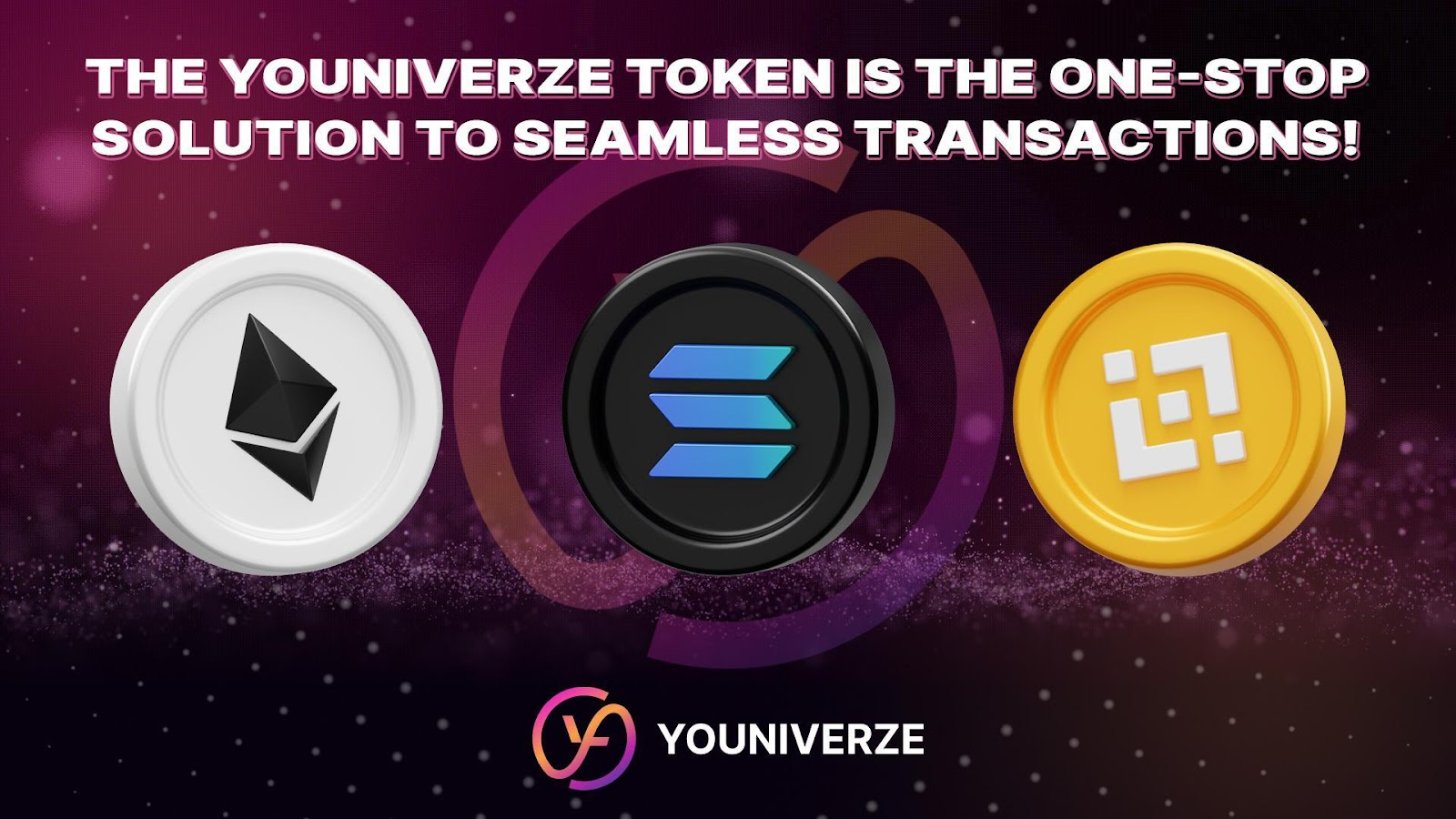
Youniverze Finance (YUNI) is the finest multichain go-to platform for global crypto trading, sourcing, and bridging. It makes no difference where the user is or where he or she wishes to go. Youniverze Finance will be able to locate the most efficient, cost-effective, and secure route for every user.

Youniverse is the coin used in the Youniverze Finance ecosystem.

The Youniverze token, which serves as the foundation of the ecosystem, has a range of applications. The network’s main goal is to establish a well-balanced method that will assure Youniverze’s sustained good health in the coming years and decades.Youniverze Finance is more than just an exchange platform because it will find the most cost-effective bridge or DEX with the lowest swap rate. It also entails calculating arbitrages in real time and routing users through less expensive channels.

Criptos en tendencia

Lecturas Relacionadas

The "Impossible Triad" Is Fundamentally a Pseudo-Problem

The article argues that blockchain's fundamental limitation is not the scalability trilemma (decentralization, scalability, security), which has been largely solved, but the lack of **privacy** and, until recently, clear **legitimacy**. Blockchain is described as a slow, expensive, globally shared computer whose core value is censorship resistance and verifiability. While ideal for native digital assets like money (e.g., stablecoins), its default transparency acts as a **tax**, exposing all transactions and enabling MEV extraction, which deters serious institutional capital. Simultaneously, its permissionless nature created regulatory ambiguity. The piece contends that **privacy** is the missing critical feature. It rejects the false choice between total transparency and complete anonymity. Modern cryptography (like zero-knowledge proofs) enables **compliant privacy**: users can prove facts (solvency, KYC status, compliance) without revealing the underlying sensitive data (specific holdings, identities). This preserves auditability for regulators and eliminates the leak of financial information. With recent regulatory progress (e.g., the GENIUS Act) addressing legitimacy, adding default, provably compliant privacy becomes a pure upgrade. It transforms blockchain from a costly, public ledger into a confidential settlement layer, finally bridging the gap to mainstream institutional and individual adoption of on-chain finance.

链捕手Hace 12 hora(s)

The "Impossible Triad" Is Fundamentally a Pseudo-Problem

链捕手Hace 12 hora(s)

Optical Chips: Collective Capacity Expansion

The global optical chip industry is experiencing a massive wave of expansion driven by surging AI data center demand. Major players across the US, Japan, Europe, and China are aggressively investing to ramp up production capacity. In the US, Coherent is expanding its 6-inch Indium Phosphide (InP) semiconductor fab in Texas, supported by CHIPS Act funding and a $2 billion strategic investment from NVIDIA. Lumentum is building a new factory for InP optical devices, and Nokia is scaling its advanced photonic chip packaging and testing capabilities. NVIDIA's investments aim to secure future supply of critical lasers and optical interconnect products for AI infrastructure. Japan's JX Advanced Metals, a leading InP substrate supplier, plans a multi-billion yen investment to increase its capacity 7-10 times, strengthening its grip on the crucial upstream materials market. In Europe, IQE and Tower Semiconductor settled a patent dispute and signed a multi-year InP epitaxial wafer supply agreement, highlighting that next-generation silicon photonics platforms will integrate high-performance InP components. STMicroelectronics and Sivers Semiconductors are also expanding silicon photonics production and partnerships. China is rapidly building out its domestic supply chain. Dongshan Precision's subsidiary, Source Photonics, announced a $12 billion project to expand optical chip and module production. Companies like Sanan Optoelectronics and Yunnan Germanium are scaling up InP chip manufacturing and substrate production, moving towards vertical integration from materials to modules. While debate continues around the exact future architecture—whether CPO (Co-Packaged Optics), NPO, or pluggables will dominate—analysts like Morgan Stanley argue the underlying driver is unchangeable: the explosive growth in bandwidth demand. This will inevitably increase the volume of optical engines, lasers, and related content per GPU, regardless of the final technical path. The competition for "more light" in the AI era has intensified into a global, full-chain capacity race.

marsbitHace 14 hora(s)

Optical Chips: Collective Capacity Expansion

marsbitHace 14 hora(s)

Trading

Spot
Futuros

Artículos destacados

Cómo comprar HBAR

¡Bienvenido a HTX.com! Hemos hecho que comprar Hedera Hashgraph (HBAR) sea simple y conveniente. Sigue nuestra guía paso a paso para iniciar tu viaje de criptos.Paso 1: crea tu cuenta HTXUtiliza tu correo electrónico o número de teléfono para registrarte y obtener una cuenta gratuita en HTX. Experimenta un proceso de registro sin complicaciones y desbloquea todas las funciones.Obtener mi cuentaPaso 2: ve a Comprar cripto y elige tu método de pagoTarjeta de crédito/débito: usa tu Visa o Mastercard para comprar Hedera Hashgraph (HBAR) al instante.Saldo: utiliza fondos del saldo de tu cuenta HTX para tradear sin problemas.Terceros: hemos agregado métodos de pago populares como Google Pay y Apple Pay para mejorar la comodidad.P2P: tradear directamente con otros usuarios en HTX.Over-the-Counter (OTC): ofrecemos servicios personalizados y tipos de cambio competitivos para los traders.Paso 3: guarda tu Hedera Hashgraph (HBAR)Después de comprar tu Hedera Hashgraph (HBAR), guárdalo en tu cuenta HTX. Alternativamente, puedes enviarlo a otro lugar mediante transferencia blockchain o utilizarlo para tradear otras criptomonedas.Paso 4: tradear Hedera Hashgraph (HBAR)Tradear fácilmente con Hedera Hashgraph (HBAR) en HTX's mercado spot. Simplemente accede a tu cuenta, selecciona tu par de trading, ejecuta tus trades y monitorea en tiempo real. Ofrecemos una experiencia fácil de usar tanto para principiantes como para traders experimentados.

406 Vistas totalesPublicado en 2024.12.11Actualizado en 2026.06.02

Cómo comprar HBAR

Discusiones

Bienvenido a la comunidad de HTX. Aquí puedes mantenerte informado sobre los últimos desarrollos de la plataforma y acceder a análisis profesionales del mercado. A continuación se presentan las opiniones de los usuarios sobre el precio de HBAR (HBAR).

活动图片