a16z's Latest Discovery: The Capital Winds Have Shifted, Blowing from 'Bits' to 'Atoms'

marsbitPublicado a 2026-08-24Actualizado a 2026-08-24

Resumen

In its "Charts of the Week," a16z highlights three structural shifts in the U.S. economy indicating capital and labor are moving from digital ("bits") to physical ("atoms"). First, ETF themes have rotated from clean energy and healthcare in 2020 to AI, nuclear energy, space, defense, and infrastructure by 2026. Second, data center construction is a major economic driver, creating high-wage blue-collar jobs with significant wage premiums (up to 50% for construction workers) and reshaping local economies. Third, ride-hailing prices are rising (Uber fares up ~20% since 2024), while the gig economy sees explosive growth in social commerce. Meanwhile, AI agents, though early-stage, are consuming nearly 5x more tokens than humans and beginning to displace traditional automation tools like Zapier.

Author: Moses Sternstein, a16z

Compiled by: Deep Tide TechFlow

Deep Tide Introduction: This week, a16z's 'Charts of the Week' outlines three forming structural forces in the U.S. economy. Firstly, the themes of ETFs have completely changed in just a few years—from clean energy, emerging market technology, and healthcare in 2020, to AI, nuclear power, space, defense, and infrastructure dominating by 2026. Secondly, data centers are not only behemoths of capital expenditure but are also quietly reshaping blue-collar employment and wages: offering construction workers an hourly wage approximately 50% higher than the market rate. Thirdly, ride-hailing prices are rising, with 'social commerce' emerging strongly in the gig economy. Meanwhile, AI Agents, though in their infancy, are consuming nearly 5 times more tokens than humans and beginning to encroach on traditional automation tools. These three scenarios point to the same conclusion: the winds of capital and labor are shifting from 'bits' back to 'atoms'.

The Wind of Thematic Rotation

ETFs have become an increasingly prominent presence in public markets, especially for retail investors. Beyond thematic ETFs, there are active and passive ETFs, index-tracking ETFs, credit ETFs—a wide variety, with varying degrees of leverage. The surge of ETFs owes much to low fees, low barriers to entry, easier distribution, and excellent marketing (and, of course, an overall increase in retail participation).

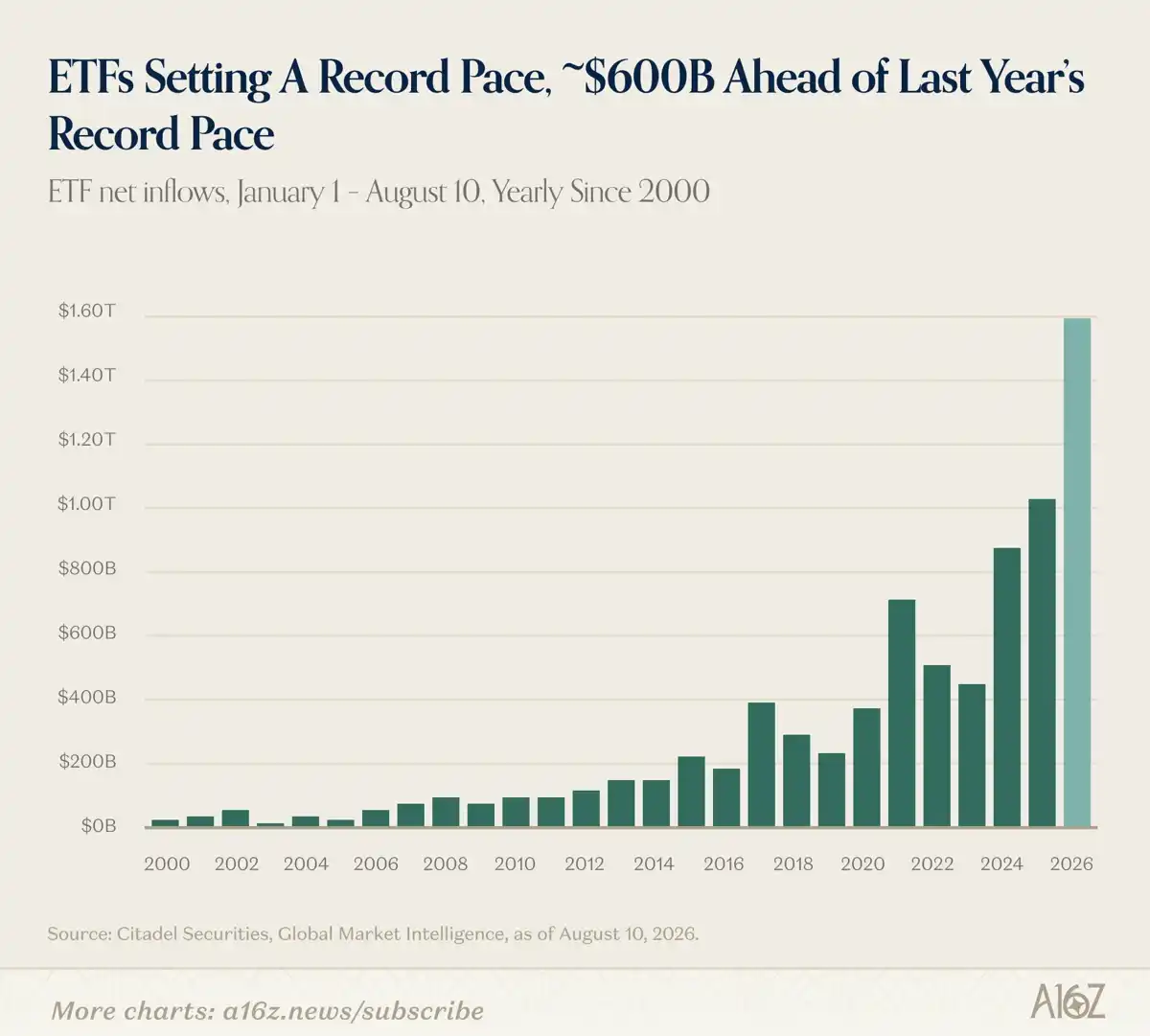
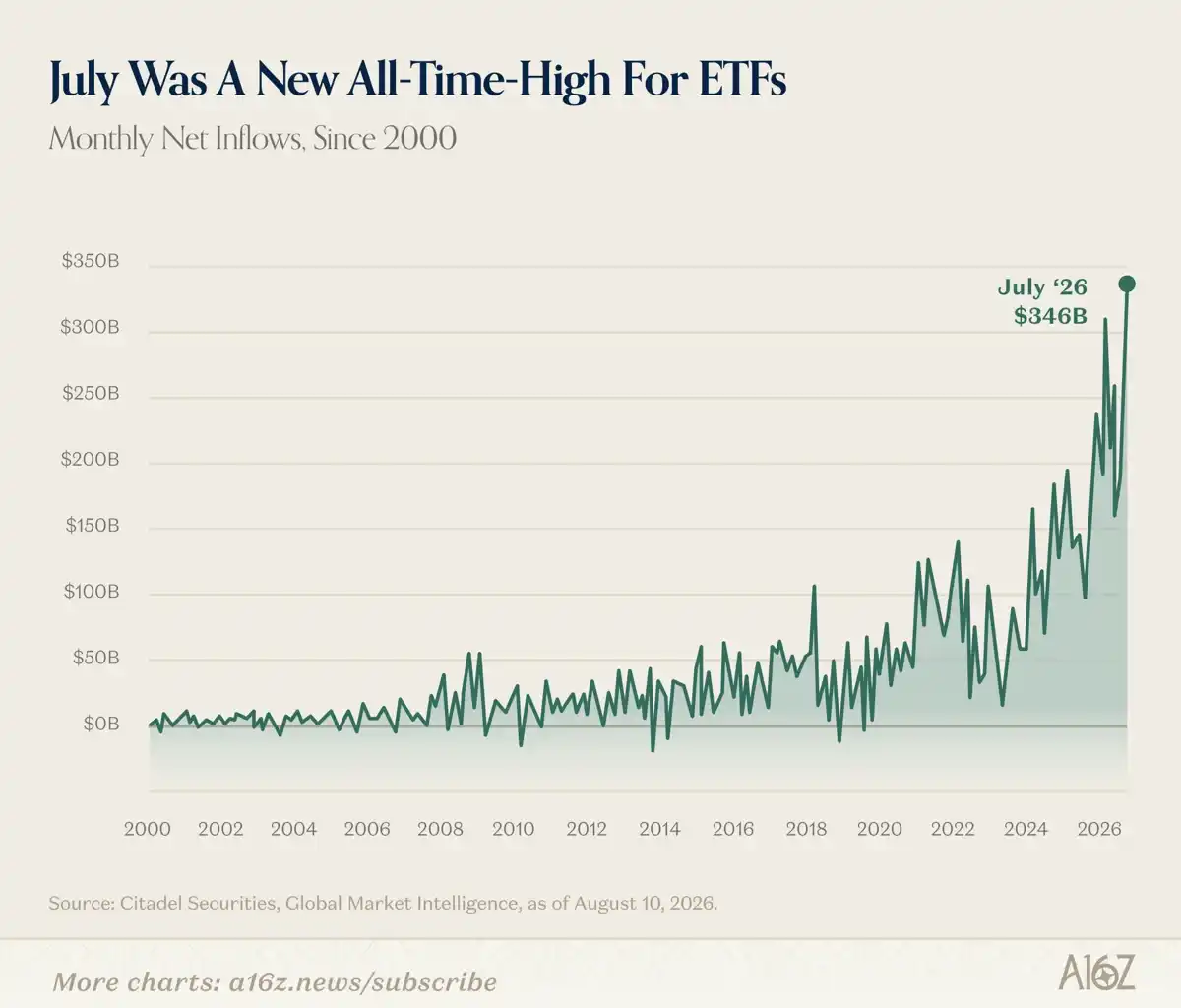
According to Citadel data, ETF net inflows are heading towards their strongest year on record, with July hitting an all-time high.
One thing ETFs excel at is latching onto any hot theme of the moment. "Oh, you think robotics is the next big opportunity? We have an ETF for that. Want to ride the memory chip rocket? You'll love the taste of DRAM. Looking for something spicier? Try our latest photonics product PHOX; it pairs nicely."

That statement is interesting in itself, but perhaps more intriguing is how dramatically the 'themes' of ETFs have rotated in a relatively short period—
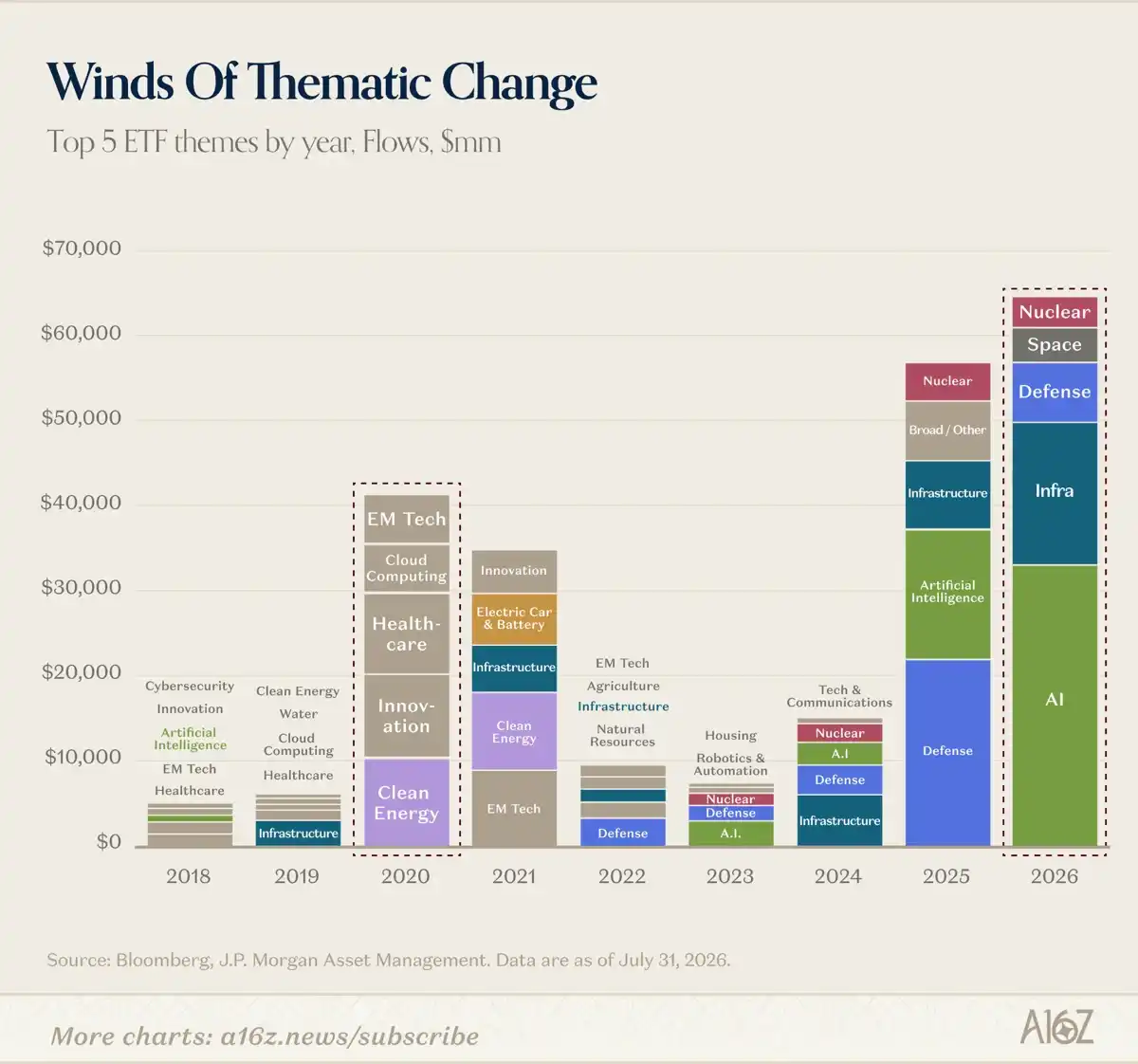
In 2020, the top five themes included clean energy, emerging market technology, and healthcare. By 2026, the thematic narrative has been completely rewritten: AI, nuclear power, space, defense, and infrastructure dominate the rankings.

For capital-intensive, ambitious businesses where 'atoms matter more than bits,' this amounts to an ETF blitz. As for the outcome, the charts cannot predict, but it must be said: 2026 is indeed far more interesting than before.

Data Centers Are a Boon for Blue-Collar Workers

People might love putting data centers into their ETFs, but somehow, they increasingly dislike seeing data centers near their homes.

I don't intend to jump into that debate prematurely (at least not yet). I'll just say this: whether you like it or not, data centers are economically significant, and in some cases, they are the most important thing locally.

For states that are actually building data centers, this construction represents a significant portion of all non-residential building expenditures:
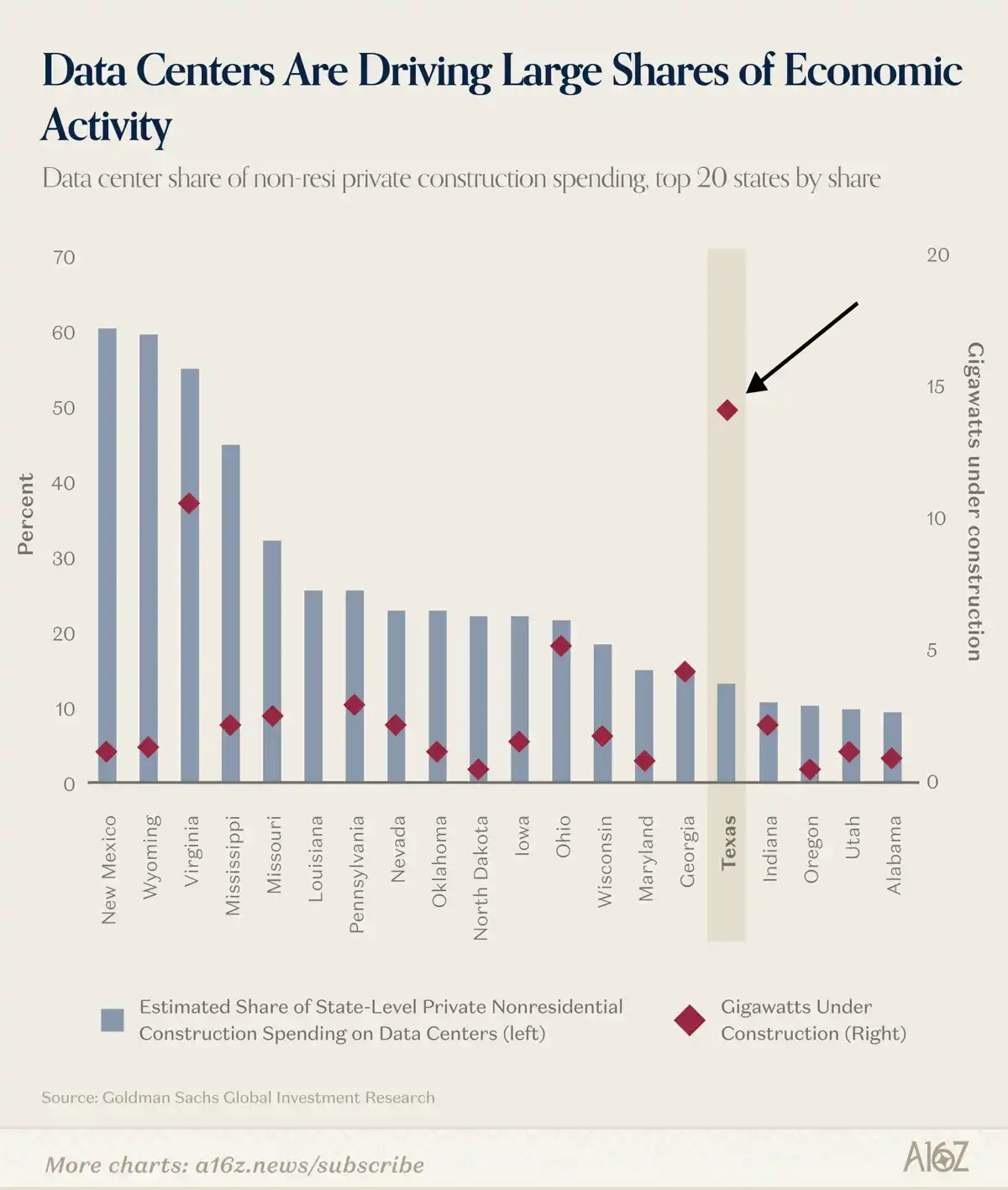
New Mexico and Wyoming aren't building much—under 3 gigawatts under construction—but because these states don't have much construction activity to begin with, data centers account for about 60%(!) of private non-residential building spending. Even in a much larger state like Pennsylvania, a mere ~3 GW of data centers approaches 30% of non-residential spending. In contrast, Texas, with much more capacity under construction, only accounts for 10% of total spending—still substantial but far less dramatic than 60%.

Regardless, no matter your view on data centers, one fact remains unchanged: they are one of the most important (if not *the* most important) economic pulses at present.

Wells Fargo attempted to parse the 'notable economic benefits' accompanying data centers (whether operational or under construction):
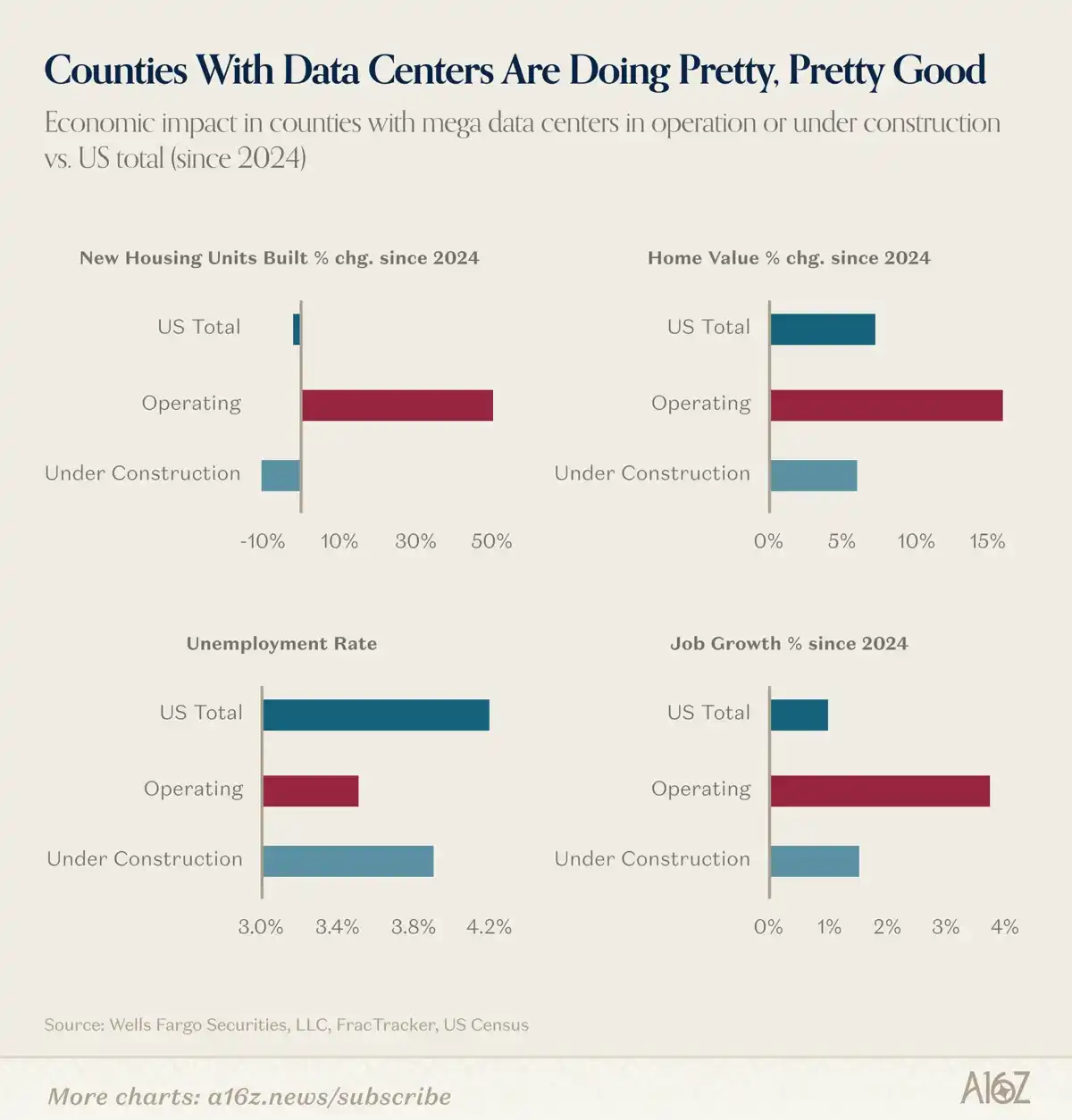
Since 2024, counties with operational data centers have uniformly better metrics: more housing, higher home prices, lower unemployment, faster employment growth. For counties building data centers, employment conditions are indeed better, but new housing construction has seen a more noticeable decline, and home price increases aren't as high.

To be fair, causality here isn't clear-cut. Many existing (and new) data centers are in Loudoun County, Virginia—one of the wealthiest counties in the U.S. Similarly, many new data centers are in Texas, which experienced historic residential construction (and home price increases) before 2024, so the housing decline starts from a much higher base.

But back to the point above: building a data center is almost certainly good for employment. Beyond the hundreds of hard-hat jobs being created, data centers offer significantly better pay than comparable employers:

According to Indeed data, data centers offer wage premiums as high as 64% (facility manager), and even the lowest-paid electrical engineers see a 10% premium.
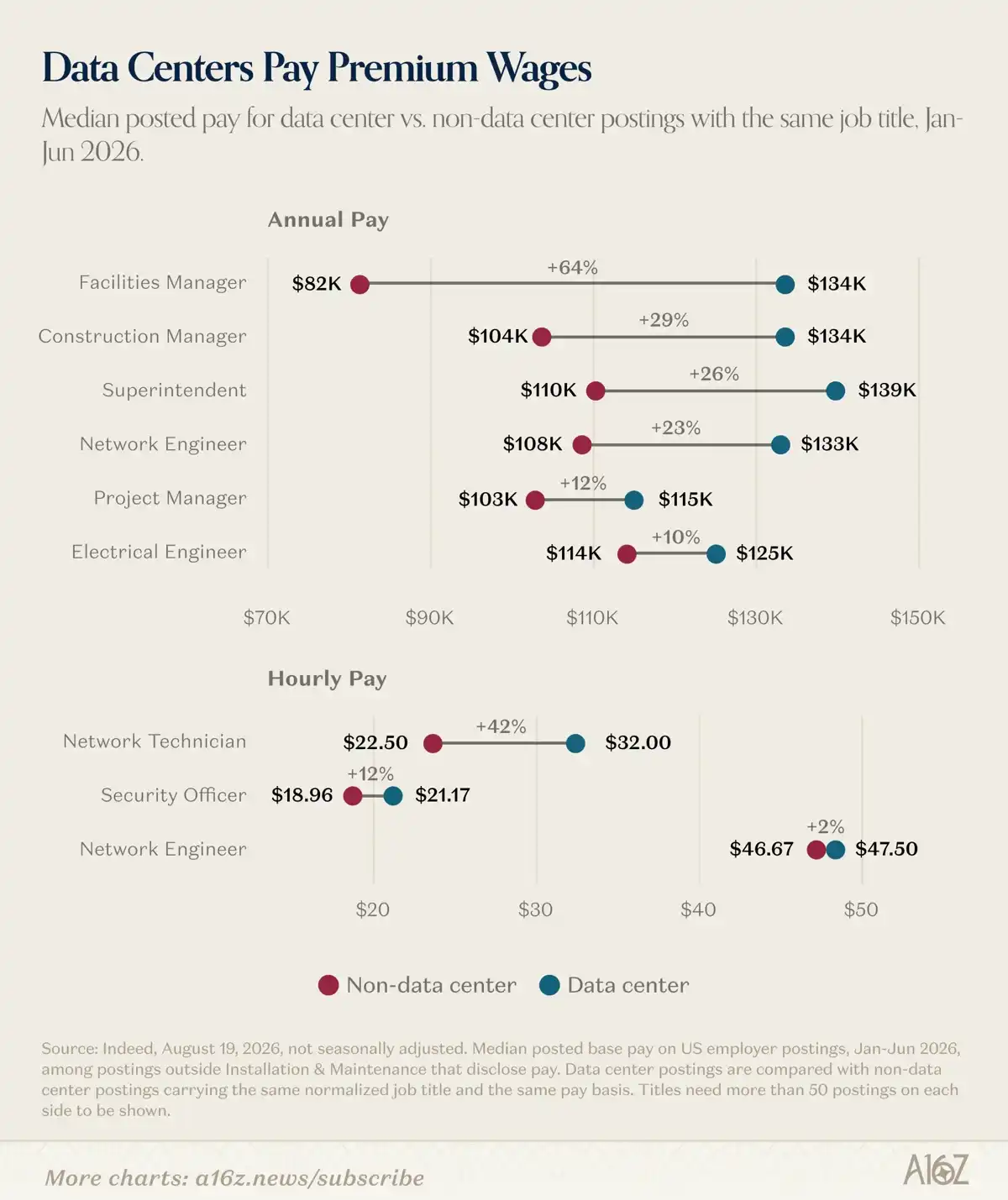
Data centers are making good times even brighter for skilled trades. A recent commentary from a Dallas Fed report hits the nail on the head:

A heavy industrial construction contractor stated: "We've been offering what we thought were competitive wages for skilled concrete workers, $28–$32 per hour. Data centers are offering $45 per hour, plus a $150 per day per diem."

For concrete workers on data centers, that's about a 50% wage premium—a life-changing raise.

ADP data tells a similar story. Looking at wage premiums for job switchers—a proxy for 'where demand is hot,' since a raise is needed to induce someone to change jobs—premiums for data-center-related categories are simply 'sizzling':
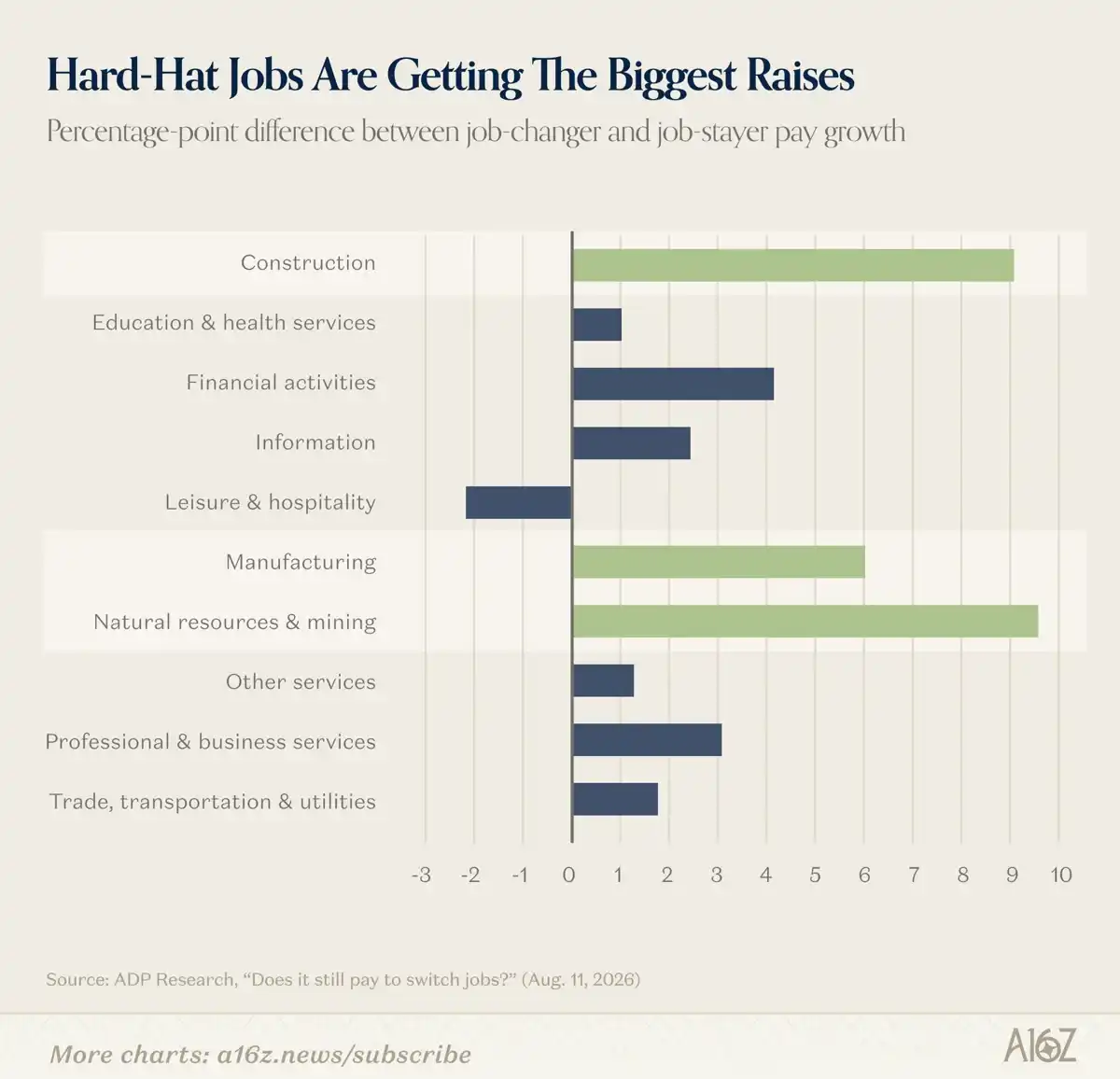
Wage growth for job switchers in construction, manufacturing, and natural resources/mining is 6–9.5 percentage points higher than for those who stay. This switching premium far exceeds that of any other industry.

Again, the point here is not to deliver a definitive defense of data centers. The point is to note: saying 'no' to data centers almost certainly means saying 'no' to higher wages for blue-collar workers (and the surrounding most substantial investment pulse).

Ride-Hailing Is Indeed More Expensive—It's Not Your Imagination

If you feel Uber rides have been more expensive lately, it's probably because—they are. At least, that's what Gridwise Analytics data suggests.

Since 2024, both the average and median Uber fares have increased by about 20% (and seem to keep climbing):
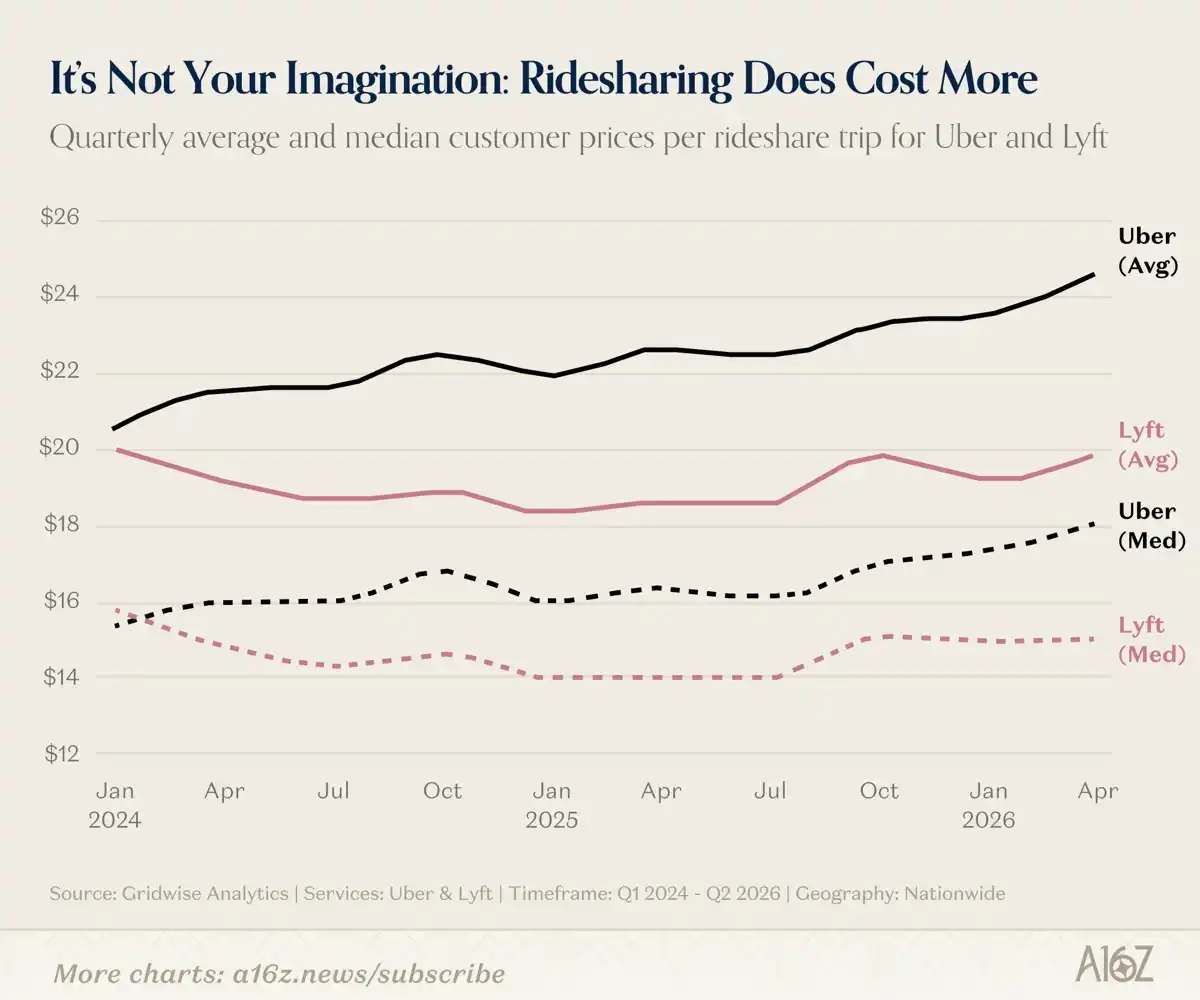
Notably, during this period, only Uber has increased prices—Lyft's median and average fares are actually slightly cheaper than at the start of 2024 (overall about 24% lower than Uber), although they have also risen recently.

A significant source of the price increase seems to be rising platform fees, especially for Uber:
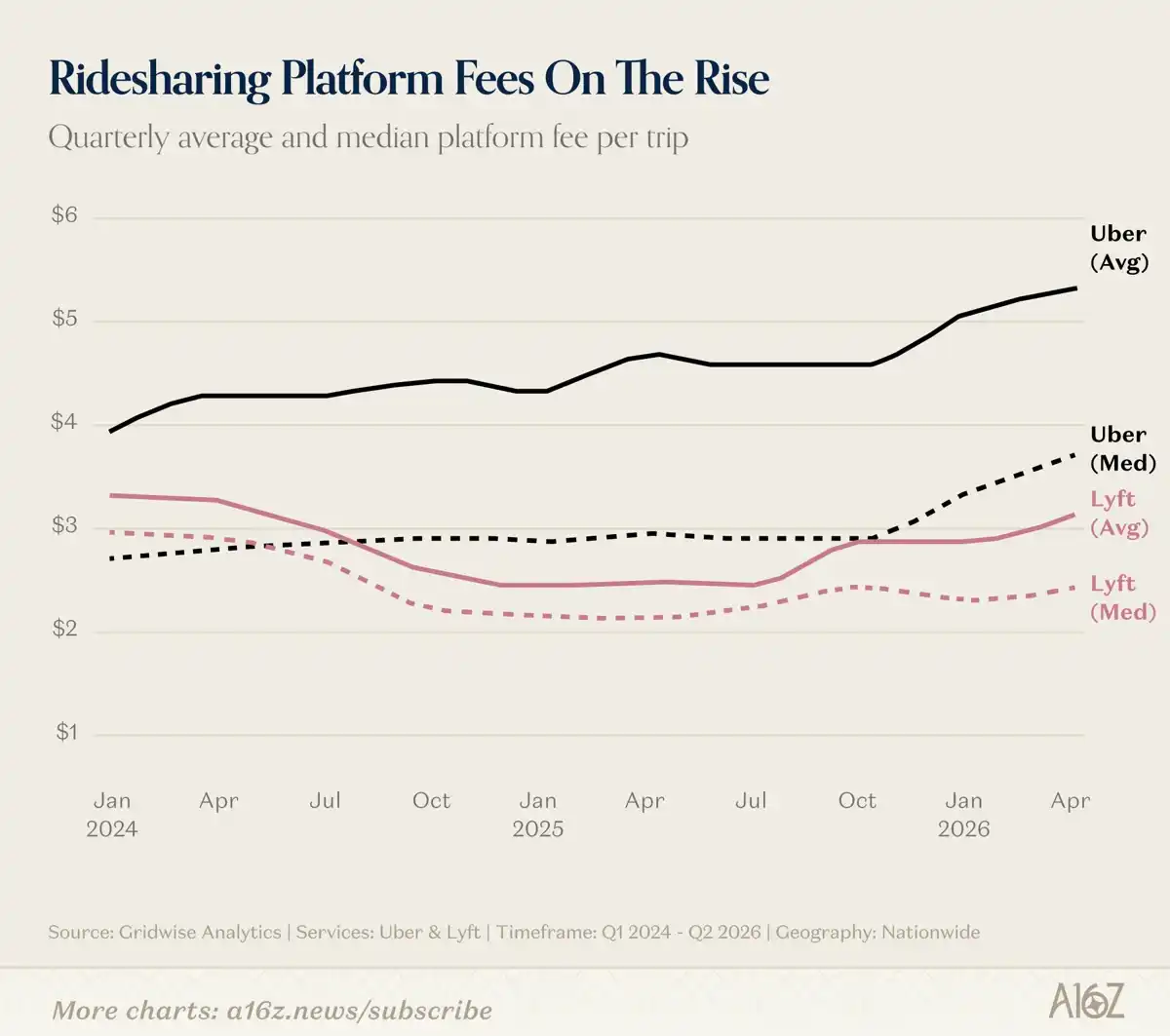
Uber's platform fees have been steadily rising over the past year (median fees jumped noticeably in October), while Lyft's platform fees, after a period of significant decline, have only just started to rise.

This is good for Uber and good for Lyft.

To be fair, it's not just the platforms benefiting—Uber/Lyft drivers are also getting a share:

Average gross driver earnings per trip have also been rising continuously since 2024, recently hitting an all-time high.

In the long term, whether higher ride-hailing prices will put downward pressure on demand remains to be seen; but for now, fares are getting more expensive, and the gains are flowing to both platforms and drivers.

Another interesting aside: despite the overall weak hiring market, besides more people starting their own businesses, more are also turning to 'gig' work—likely partly attracted by rising earnings.

However, while ride-hailing gigs are growing in popularity, they are far from the fastest-growing type of gig. The hottest new thing in the gig space is undoubtedly 'social commerce,' the QVC of the social media era:

In Bank of America's client accounts, all categories of gig work grew except vacation rentals, but social commerce surged over 30%, far outpacing any other category—despite a smaller base.

Exactly why social commerce is exploding is anyone's guess. Perhaps it's the shift of media consumption from TV to social, combined with the broader e-commerce boom; it's also likely that AI has lowered the cost of all other aspects of running a social-media version of QVC, making social commerce a more sustainable livelihood for more people. Or maybe Instagram's ad targeting is just too precise to resist. Or perhaps all of the above.

AI Agents Are Early, But Already Changing the Game (And Other Stories from the Frontier)

Charts previously observed: although overall AI demand is rising, growth is far from normally distributed. There's a massive divergence in usage between median and heavy users, and recent data from OpenAI (OAI) suggests this divergence is widening further.

Output tokens for the typical enterprise roughly doubled, but the top 10% are pulling further away:
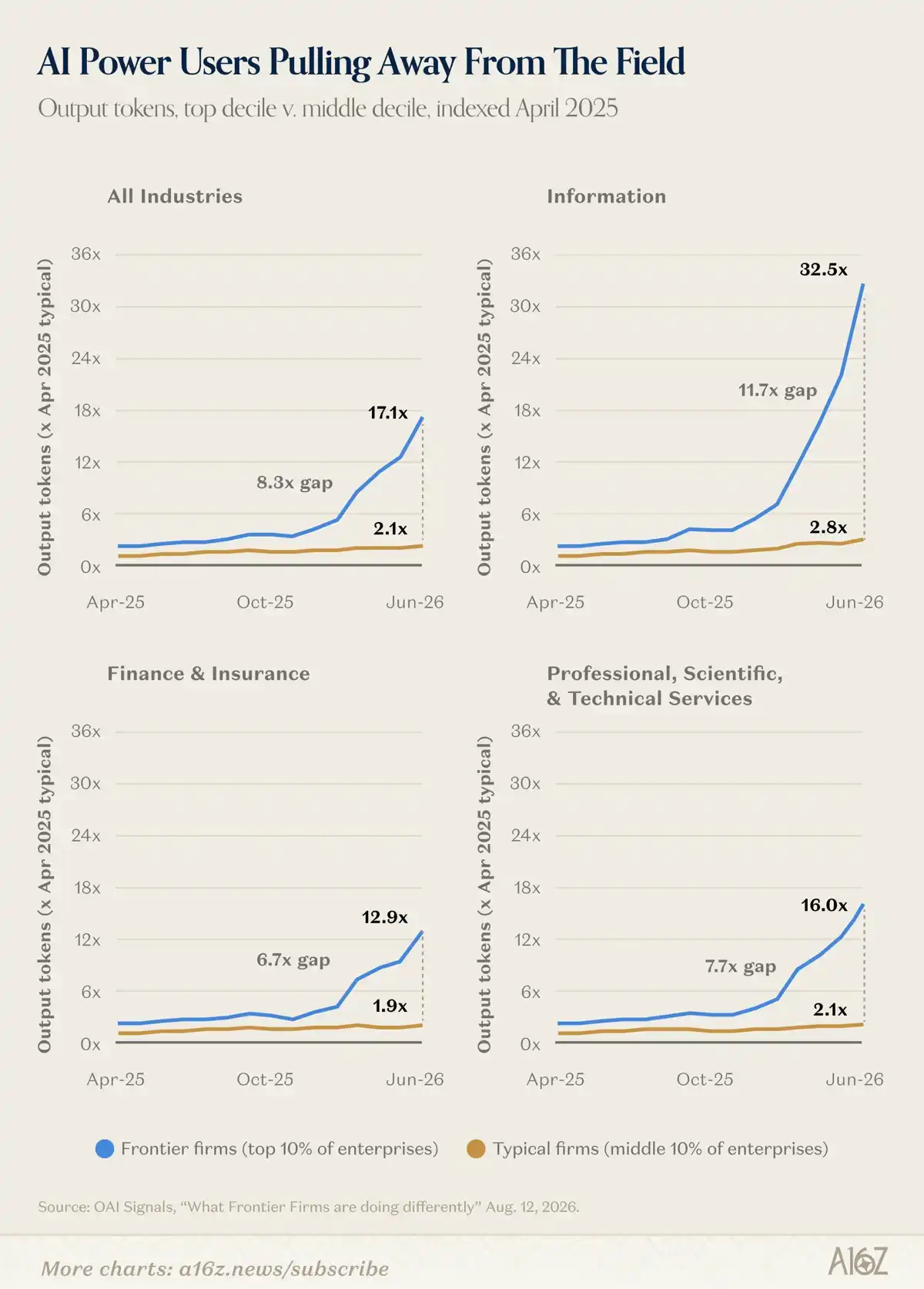
Across all industries, the token output gap between the typical enterprise and the top 10% is about 8x, with the latter's output growing over 17x since April 2025. In certain specific industries, the gap is larger—close to 12x in the Information (i.e., tech) sector, where the top 10%'s token output is 32.5x(!) higher than over a year ago.

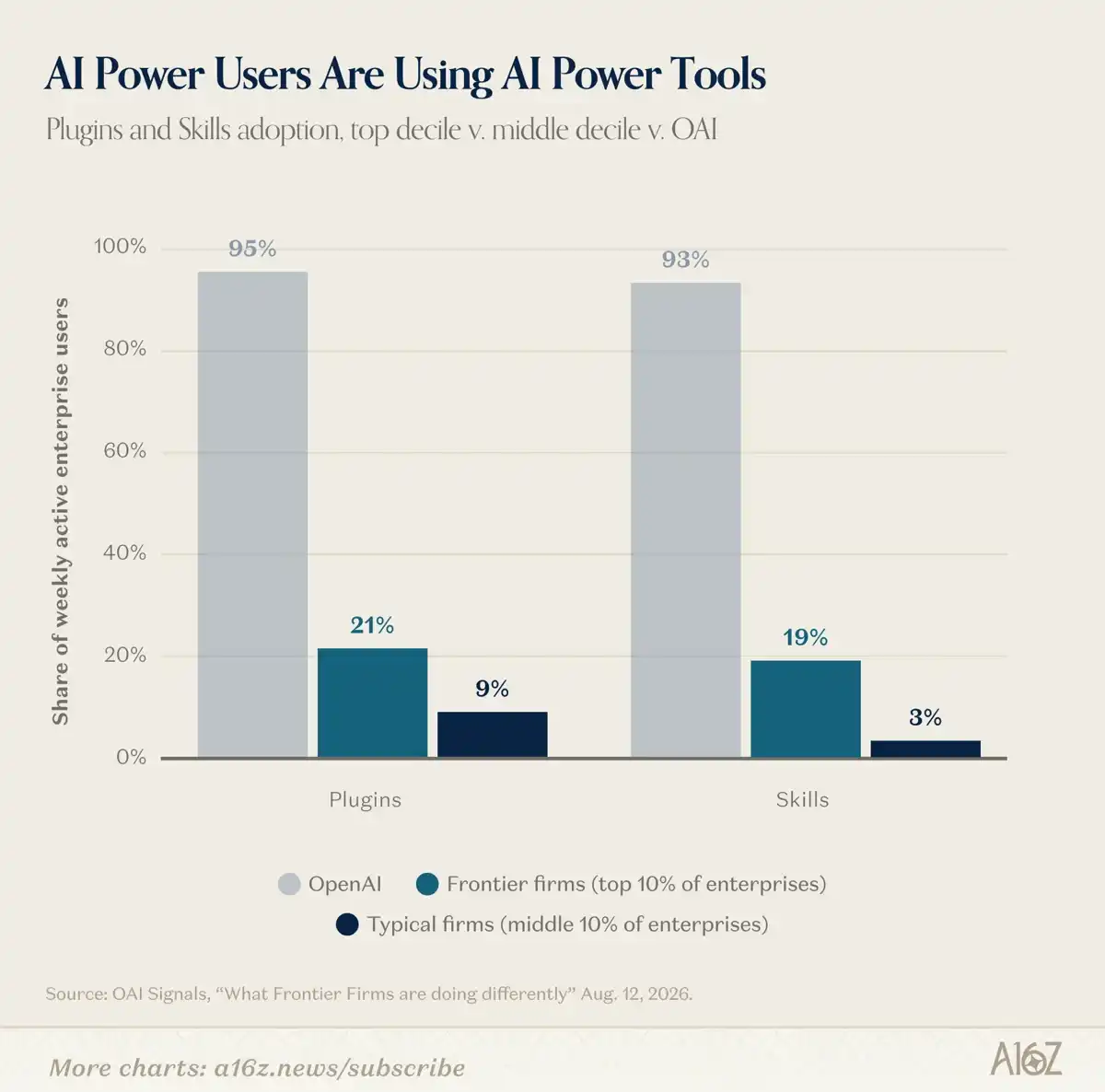
Unsurprisingly, heavy users aren't generating more tokens by chatting with AI companions. They have largely moved beyond chatting toward more advanced AI tools:

The adoption rate of plugins and Skills among the top 10% is about 2x and 6x that of the typical enterprise, respectively, although even heavy users have a long way to go compared to OAI's internal adoption levels.
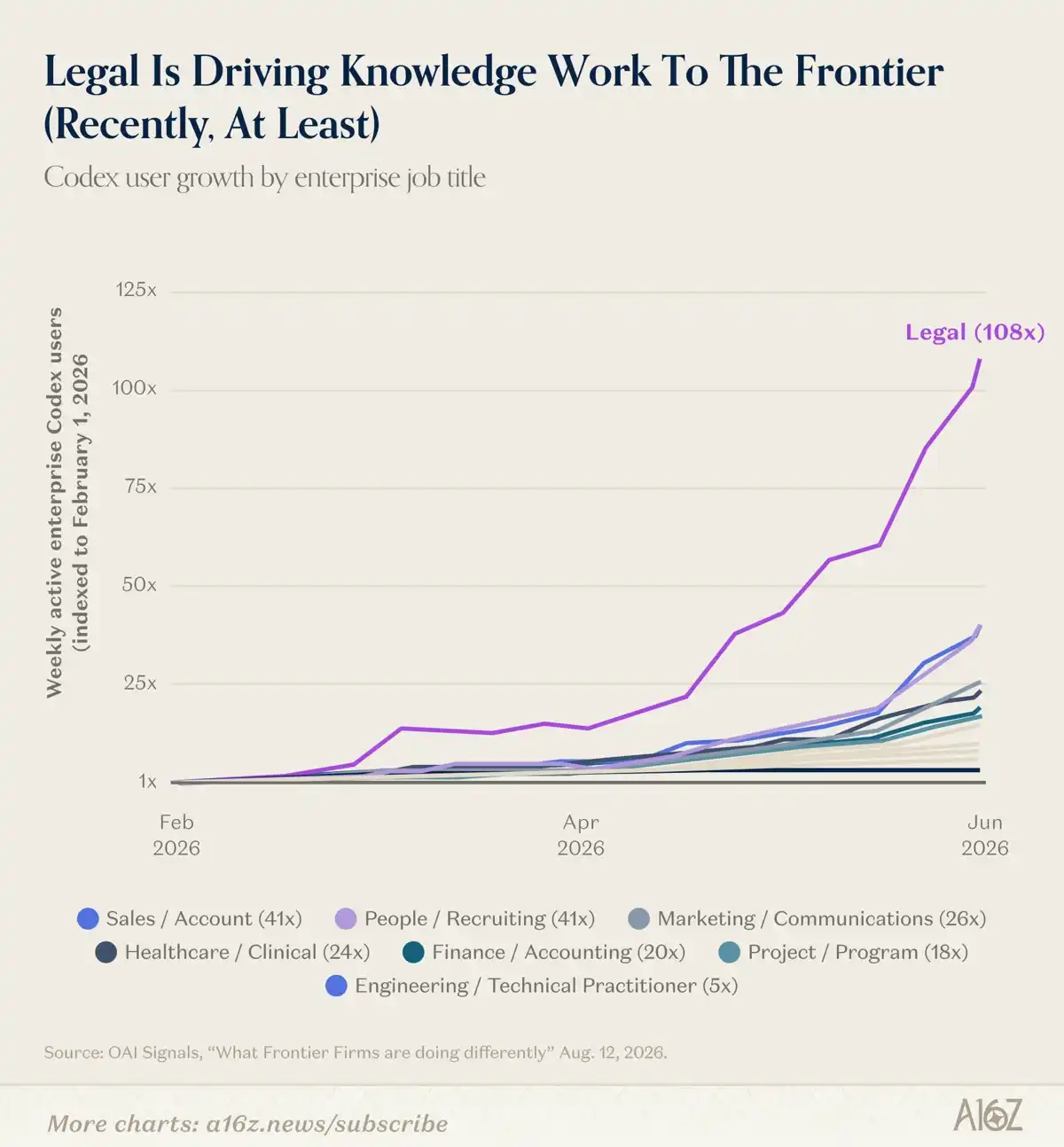
However, interestingly, tech is not the sector with the fastest recent growth in adopting more powerful tools. If Codex adoption is used as a measure of maturity, then overall knowledge worker maturity is increasing, but no group stands out more than legal professionals:

Codex adoption among legal practitioners has skyrocketed 108x since February 2026. How much of this is driven by broader Codex rollouts is debatable, but regardless, the legal field stands out.
Another implication of this shift towards more sophisticated AI adoption is that it is dramatically changing the growth and composition of token consumption.

Although only a tiny fraction of AI adopters have deployed full Agents, Agents contribute a massive share of tokens:

According to OpenRouter (and chart author Peter Walker), Agents use almost 5x more tokens than humans, and Agent usage has grown about 14x since February.
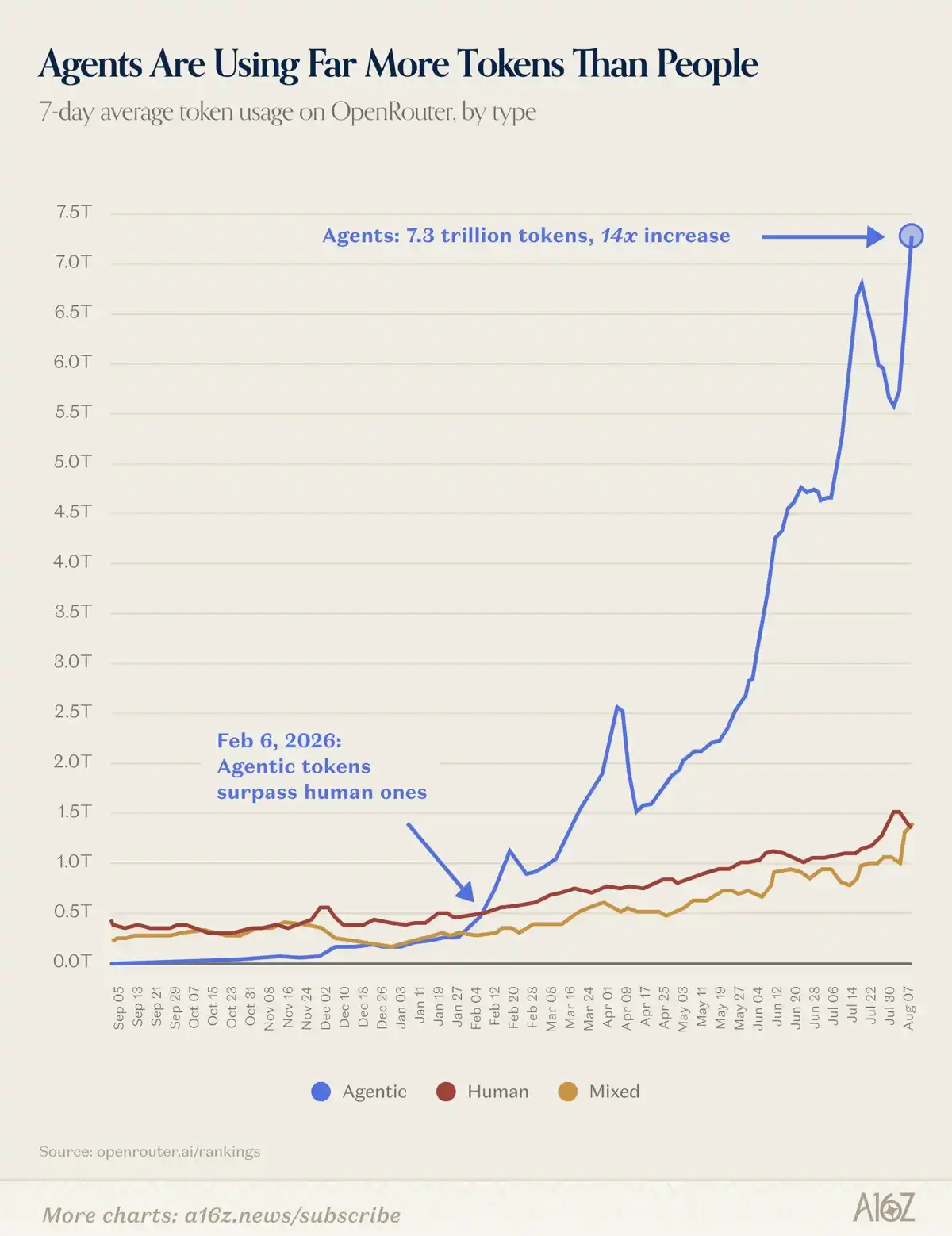
Agents not only use far more tokens than humans but also use them in a fundamentally different way. Agents do much more work with cached tokens than humans do:

Also according to OpenRouter, over 85% of Agent token consumption comes from cached prompts—and cached tokens constitute almost all of the relative growth in token usage.
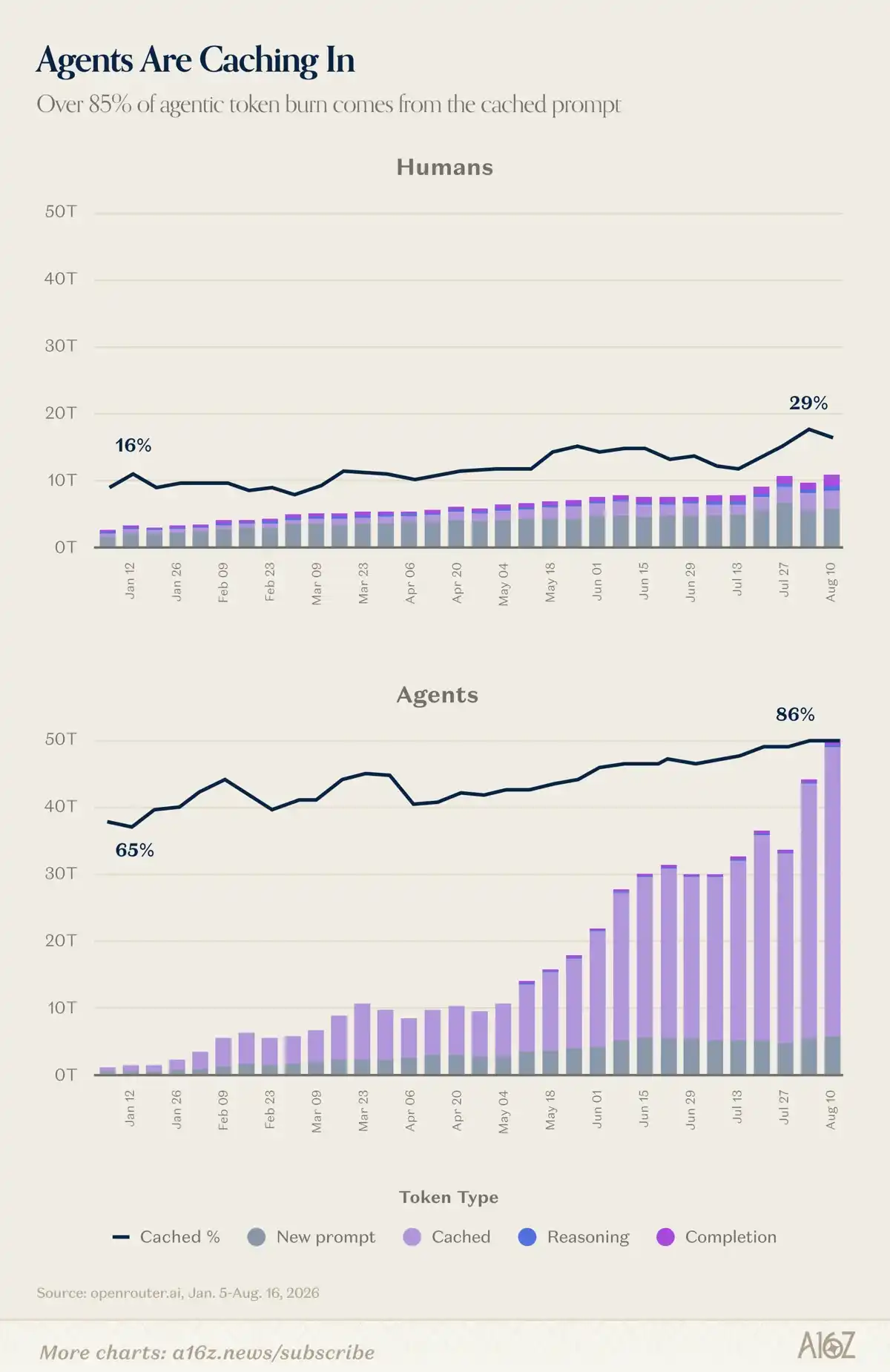
The reason is fairly straightforward: humans tend toward 'question-answer' dialogues, while Agents are designed to iterate repeatedly toward a goal. The initial prompt contains token-dense 'pre-fill' (i.e., core context around the goal, be it policy processes, code specifications, etc.), then the Agent incrementally reads and writes—progressively adding content to the cache as it moves toward a final result.

Cached tokens are far cheaper than pre-fill—this is good, making Agent economics increasingly viable—but (by definition) are also extremely memory-intensive. Now you understand why high-bandwidth memory is especially sought after—all those busy Agents (which don't need to start from scratch each cycle) need memory to 'fire.' And though overall development remains very early, Agents are proliferating rapidly.

Another notable potential second-order effect of Agents: they may be undermining demand for traditional automation and workflow tools.

According to Similarweb data, traffic to automation tool websites is consistently declining, except for Gumloop:

N8N, Zapier, and Make all predate LLMs, and although they dominate the entire automation segment (by visits), each has seen double-digit declines on a rolling 12-week basis. In contrast, Gumloop, launched in 2023 as an 'AI-native Agent builder,' is the only automation platform still gaining momentum (per Similarweb).

It's too early to pronounce death on the Zapiers—they have AI too—but Agents have just arrived and are already substantively changing the game.

To be continued.

Criptos en tendencia

Preguntas relacionadas

QWhat is the main conclusion of the a16z report regarding capital and labor trends?

AThe main conclusion is that the direction of capital and labor is shifting from the digital ('bits') back towards the physical ('atoms'). This is evidenced by changes in ETF themes, significant investment in data centers impacting blue-collar jobs, and rising prices in services like ride-hailing.

QHow have the themes of top-performing ETFs changed from 2020 to 2026 according to the article?

AIn 2020, the top themes were clean energy, emerging market tech, and healthcare. By 2026, the leading themes have completely shifted to AI, nuclear energy, space, defense, and infrastructure, reflecting a move towards capital-intensive 'atoms'-focused industries.

QWhat economic impact do data centers have on local employment and wages?

AData centers create a significant number of construction jobs and offer substantial wage premiums. For example, concrete workers for data centers can earn about a 50% higher hourly wage compared to the market rate. Data center-related roles, such as facility managers, can command wage premiums as high as 64%, significantly boosting local blue-collar employment and income.

QWhat is the trend in Uber and Lyft pricing as described in the article?

ASince 2024, Uber's average and median fares have increased by about 20% and continue to rise, largely due to increasing platform fees. In contrast, Lyft's fares were slightly cheaper than at the start of 2024 and about 24% lower than Uber's on average, though they have recently started to increase as well. Drivers for both platforms have also seen their gross earnings per trip rise to record highs.

QWhat role do AI Agents play in the current AI landscape according to the report?

AAI Agents, though still in early stages, are consuming nearly 5 times more tokens than human users and are growing rapidly. They operate differently, heavily utilizing cached tokens for iterative tasks, which is more memory-intensive. Their rise is also potentially disrupting demand for traditional automation and workflow tools like Zapier, as seen with the growth of AI-native platforms like Gumloop.

Lecturas Relacionadas

Altcoin Hacked, Leading to Sharp Price Drop! Also Listed on Major Exchanges!

The price of the NES token plummeted significantly following suspicious activity and large sell-offs detected on the network. Blockchain observers suggested that one wallet minted approximately $55 million worth of NES tokens and began selling them on decentralized exchanges. This selling pressure caused the price of NES to drop by up to 40%. According to the data, the address in question still holds around $18 million worth of NES, indicating that market sell-off pressure may continue. Prior to the incident, it was reported that about $12.35 million worth (62.9 million NES tokens) were transferred to the Ethereum mainnet in the morning (Turkish time), with claims that liquidity was withdrawn and tokens were sold on the market later that evening. However, data regarding the $55 million token mint and the transfer of 62.9 million NES tokens has not been independently confirmed. The NESA team confirmed in a statement that they detected malicious activity exploiting a vulnerability in their Layer 1 network originating from Cosmos EVM. They stated they are working to contain the impact, responded promptly, and will restore services after implementing a software patch and additional measures to ensure secure network operation. Nesa also notified all cryptocurrency exchanges and stated deposit operations will resume after necessary work is completed. The article includes a chart showing the NES price decline following the exploit and concludes with a standard disclaimer that this is not investment advice.

cryptonews.ruHace 26 min(s)

Altcoin Hacked, Leading to Sharp Price Drop! Also Listed on Major Exchanges!

cryptonews.ruHace 26 min(s)

PeaqOS and World ID Integrate ZK Proofs into Autonomous Robots

The integration of PeaqOS and World ID now allows autonomous machines to verify they are interacting with real, unique individuals without collecting names, photos, or other personal data. This update, available via robotic.sh, enables connected devices to directly request and verify World ID proofs. The system leverages zero-knowledge technology, letting a person prove they are human while maintaining the privacy of their identity. This addresses a key challenge for operators of delivery robots, shared machines, and autonomous systems: how to authenticate a user as genuine without relying on insecure PINs, pickup codes, or traditional identity checks that require personal data collection. Instead of obtaining identifying information, a device receives a cryptographic proof that the user is a real person. PeaqOS acts as a coordination layer, allowing devices to utilize World ID via decentralized identifiers and a device marketplace. A robot can request verification, receive a zero-knowledge proof, and register an auditable record of the interaction—all without exposing underlying personal data. The system also supports uniqueness verification, enabling machines to enforce rules like "one item per person" without maintaining user identity databases. A demonstrated use case involves autonomous medicine delivery: a patient verifies via the World App when placing an order, a pharmacist verifies before loading the medication, and the patient verifies again upon delivery so the robot can confirm the recipient is linked to the order before unlocking the compartment. Similarly, promotional robots could ensure one item per person, and shared vending machines could grant access to verified individuals without requiring accounts or personal data. This integration for PeaqOS-powered robots and devices minimizes the identity information collected or stored while allowing autonomous systems to confirm they are interacting with real humans.

cryptonews.ruHace 1 hora(s)

PeaqOS and World ID Integrate ZK Proofs into Autonomous Robots

cryptonews.ruHace 1 hora(s)

Trading

Spot

Artículos destacados

Qué es $S$

Entendiendo SPERO: Una Visión General Completa Introducción a SPERO A medida que el panorama de la innovación continúa evolucionando, la aparición de tecnologías web3 y proyectos de criptomonedas juega un papel fundamental en la configuración del futuro digital. Un proyecto que ha atraído la atención en este campo dinámico es SPERO, denotado como SPERO,$$s$. Este artículo tiene como objetivo reunir y presentar información detallada sobre SPERO, para ayudar a entusiastas e inversores a comprender sus fundamentos, objetivos e innovaciones dentro de los dominios web3 y cripto. ¿Qué es SPERO,$$s$? SPERO,$$s$ es un proyecto único dentro del espacio cripto que busca aprovechar los principios de descentralización y tecnología blockchain para crear un ecosistema que promueva la participación, la utilidad y la inclusión financiera. El proyecto está diseñado para facilitar interacciones de igual a igual de nuevas maneras, proporcionando a los usuarios soluciones y servicios financieros innovadores. En su esencia, SPERO,$$s$ tiene como objetivo empoderar a los individuos al proporcionar herramientas y plataformas que mejoren la experiencia del usuario en el espacio de las criptomonedas. Esto incluye habilitar métodos de transacción más flexibles, fomentar iniciativas impulsadas por la comunidad y crear caminos para oportunidades financieras a través de aplicaciones descentralizadas (dApps). La visión subyacente de SPERO,$$s$ gira en torno a la inclusividad, buscando cerrar brechas dentro de las finanzas tradicionales mientras aprovecha los beneficios de la tecnología blockchain. ¿Quién es el Creador de SPERO,$$s$? La identidad del creador de SPERO,$$s$ sigue siendo algo oscura, ya que hay recursos públicos limitados que proporcionan información de fondo detallada sobre su(s) fundador(es). Esta falta de transparencia puede derivarse del compromiso del proyecto con la descentralización, una ética que muchos proyectos web3 comparten, priorizando las contribuciones colectivas sobre el reconocimiento individual. Al centrar las discusiones en torno a la comunidad y sus objetivos colectivos, SPERO,$$s$ encarna la esencia del empoderamiento sin señalar a individuos específicos. Como tal, comprender la ética y la misión de SPERO sigue siendo más importante que identificar a un creador singular. ¿Quiénes son los Inversores de SPERO,$$s$? SPERO,$$s$ cuenta con el apoyo de una diversa gama de inversores que van desde capitalistas de riesgo hasta inversores ángeles dedicados a fomentar la innovación en el sector cripto. El enfoque de estos inversores generalmente se alinea con la misión de SPERO, priorizando proyectos que prometen avances tecnológicos sociales, inclusión financiera y gobernanza descentralizada. Estas fundaciones de inversores suelen estar interesadas en proyectos que no solo ofrecen productos innovadores, sino que también contribuyen positivamente a la comunidad blockchain y sus ecosistemas. El respaldo de estos inversores refuerza a SPERO,$$s$ como un contendiente notable en el dominio de proyectos cripto que evoluciona rápidamente. ¿Cómo Funciona SPERO,$$s$? SPERO,$$s$ emplea un marco multifacético que lo distingue de los proyectos de criptomonedas convencionales. Aquí hay algunas de las características clave que subrayan su singularidad e innovación: Gobernanza Descentralizada: SPERO,$$s$ integra modelos de gobernanza descentralizada, empoderando a los usuarios para participar activamente en los procesos de toma de decisiones sobre el futuro del proyecto. Este enfoque fomenta un sentido de propiedad y responsabilidad entre los miembros de la comunidad. Utilidad del Token: SPERO,$$s$ utiliza su propio token de criptomoneda, diseñado para servir diversas funciones dentro del ecosistema. Estos tokens permiten transacciones, recompensas y la facilitación de servicios ofrecidos en la plataforma, mejorando la participación y la utilidad general. Arquitectura en Capas: La arquitectura técnica de SPERO,$$s$ apoya la modularidad y escalabilidad, permitiendo la integración fluida de características y aplicaciones adicionales a medida que el proyecto evoluciona. Esta adaptabilidad es fundamental para mantener la relevancia en el cambiante paisaje cripto. Participación de la Comunidad: El proyecto enfatiza iniciativas impulsadas por la comunidad, empleando mecanismos que incentivan la colaboración y la retroalimentación. Al nutrir una comunidad sólida, SPERO,$$s$ puede abordar mejor las necesidades de los usuarios y adaptarse a las tendencias del mercado. Enfoque en la Inclusión: Al ofrecer tarifas de transacción bajas e interfaces amigables para el usuario, SPERO,$$s$ busca atraer a una base de usuarios diversa, incluyendo a individuos que anteriormente pueden no haber participado en el espacio cripto. Este compromiso con la inclusión se alinea con su misión general de empoderamiento a través de la accesibilidad. Cronología de SPERO,$$s$ Entender la historia de un proyecto proporciona información crucial sobre su trayectoria de desarrollo y hitos. A continuación se presenta una cronología sugerida que mapea eventos significativos en la evolución de SPERO,$$s$: Fase de Conceptualización e Ideación: Las ideas iniciales que forman la base de SPERO,$$s$ fueron concebidas, alineándose estrechamente con los principios de descentralización y enfoque comunitario dentro de la industria blockchain. Lanzamiento del Whitepaper del Proyecto: Tras la fase conceptual, se lanzó un whitepaper completo que detalla la visión, los objetivos y la infraestructura tecnológica de SPERO,$$s$ para generar interés y retroalimentación de la comunidad. Construcción de Comunidad y Primeras Interacciones: Se realizaron esfuerzos de divulgación activa para construir una comunidad de primeros adoptantes y posibles inversores, facilitando discusiones en torno a los objetivos del proyecto y obteniendo apoyo. Evento de Generación de Tokens: SPERO,$$s$ llevó a cabo un evento de generación de tokens (TGE) para distribuir sus tokens nativos a los primeros seguidores y establecer liquidez inicial dentro del ecosistema. Lanzamiento de la dApp Inicial: La primera aplicación descentralizada (dApp) asociada con SPERO,$$s$ se puso en marcha, permitiendo a los usuarios interactuar con las funcionalidades centrales de la plataforma. Desarrollo Continuo y Alianzas: Actualizaciones y mejoras continuas a las ofertas del proyecto, incluyendo alianzas estratégicas con otros actores en el espacio blockchain, han moldeado a SPERO,$$s$ en un jugador competitivo y en evolución en el mercado cripto. Conclusión SPERO,$$s$ se erige como un testimonio del potencial de web3 y las criptomonedas para revolucionar los sistemas financieros y empoderar a los individuos. Con un compromiso con la gobernanza descentralizada, la participación comunitaria y funcionalidades diseñadas de manera innovadora, allana el camino hacia un paisaje financiero más inclusivo. Como con cualquier inversión en el espacio cripto que evoluciona rápidamente, se anima a los posibles inversores y usuarios a investigar a fondo y participar de manera reflexiva con los desarrollos en curso dentro de SPERO,$$s$. El proyecto muestra el espíritu innovador de la industria cripto, invitando a una mayor exploración de sus innumerables posibilidades. Mientras el viaje de SPERO,$$s$ aún se desarrolla, sus principios fundamentales pueden, de hecho, influir en el futuro de cómo interactuamos con la tecnología, las finanzas y entre nosotros en ecosistemas digitales interconectados.

450 Vistas totalesPublicado en 2024.12.17Actualizado en 2024.12.17

Qué es $S$

Qué es AGENT S

Agent S: El Futuro de la Interacción Autónoma en Web3 Introducción En el paisaje en constante evolución de Web3 y las criptomonedas, las innovaciones están redefiniendo constantemente cómo los individuos interactúan con las plataformas digitales. Uno de estos proyectos pioneros, Agent S, promete revolucionar la interacción humano-computadora a través de su marco agente abierto. Al allanar el camino para interacciones autónomas, Agent S busca simplificar tareas complejas, ofreciendo aplicaciones transformadoras en inteligencia artificial (IA). Esta exploración detallada profundizará en las complejidades del proyecto, sus características únicas y las implicaciones para el dominio de las criptomonedas. ¿Qué es Agent S? Agent S se presenta como un marco agente abierto innovador, diseñado específicamente para abordar tres desafíos fundamentales en la automatización de tareas informáticas: Adquisición de Conocimiento Específico del Dominio: El marco aprende inteligentemente de diversas fuentes de conocimiento externas y experiencias internas. Este enfoque dual le permite construir un rico repositorio de conocimiento específico del dominio, mejorando su rendimiento en la ejecución de tareas. Planificación a Largo Plazo de Tareas: Agent S emplea planificación jerárquica aumentada por la experiencia, un enfoque estratégico que facilita la descomposición y ejecución eficiente de tareas complejas. Esta característica mejora significativamente su capacidad para gestionar múltiples subtareas de manera eficiente y efectiva. Manejo de Interfaces Dinámicas y No Uniformes: El proyecto introduce la Interfaz Agente-Computadora (ACI), una solución innovadora que mejora la interacción entre agentes y usuarios. Utilizando Modelos de Lenguaje Multimodal de Gran Escala (MLLMs), Agent S puede navegar y manipular diversas interfaces gráficas de usuario sin problemas. A través de estas características pioneras, Agent S proporciona un marco robusto que aborda las complejidades involucradas en la automatización de la interacción humana con las máquinas, preparando el terreno para una multitud de aplicaciones en IA y más allá. ¿Quién es el Creador de Agent S? Si bien el concepto de Agent S es fundamentalmente innovador, la información específica sobre su creador sigue siendo elusiva. El creador es actualmente desconocido, lo que resalta ya sea la etapa incipiente del proyecto o la elección estratégica de mantener a los miembros fundadores en el anonimato. Independientemente de la anonimidad, el enfoque sigue siendo en las capacidades y el potencial del marco. ¿Quiénes son los Inversores de Agent S? Dado que Agent S es relativamente nuevo en el ecosistema criptográfico, la información detallada sobre sus inversores y patrocinadores financieros no está documentada explícitamente. La falta de información disponible públicamente sobre las bases de inversión u organizaciones que apoyan el proyecto plantea preguntas sobre su estructura de financiamiento y hoja de ruta de desarrollo. Comprender el respaldo es crucial para evaluar la sostenibilidad del proyecto y su posible impacto en el mercado. ¿Cómo Funciona Agent S? En el núcleo de Agent S se encuentra una tecnología de vanguardia que le permite funcionar de manera efectiva en diversos entornos. Su modelo operativo se basa en varias características clave: Interacción Humano-Computadora Similar a la Humana: El marco ofrece planificación avanzada de IA, esforzándose por hacer que las interacciones con las computadoras sean más intuitivas. Al imitar el comportamiento humano en la ejecución de tareas, promete elevar las experiencias de los usuarios. Memoria Narrativa: Empleada para aprovechar experiencias de alto nivel, Agent S utiliza memoria narrativa para hacer un seguimiento de las historias de tareas, mejorando así sus procesos de toma de decisiones. Memoria Episódica: Esta característica proporciona a los usuarios una guía paso a paso, permitiendo que el marco ofrezca apoyo contextual a medida que se desarrollan las tareas. Soporte para OpenACI: Con la capacidad de ejecutarse localmente, Agent S permite a los usuarios mantener el control sobre sus interacciones y flujos de trabajo, alineándose con la ética descentralizada de Web3. Fácil Integración con APIs Externas: Su versatilidad y compatibilidad con varias plataformas de IA aseguran que Agent S pueda encajar sin problemas en ecosistemas tecnológicos existentes, convirtiéndolo en una opción atractiva para desarrolladores y organizaciones. Estas funcionalidades contribuyen colectivamente a la posición única de Agent S dentro del espacio cripto, ya que automatiza tareas complejas y de múltiples pasos con una intervención humana mínima. A medida que el proyecto evoluciona, sus posibles aplicaciones en Web3 podrían redefinir cómo se desarrollan las interacciones digitales. Cronología de Agent S El desarrollo y los hitos de Agent S pueden encapsularse en una cronología que resalta sus eventos significativos: 27 de septiembre de 2024: El concepto de Agent S fue lanzado en un documento de investigación integral titulado “Un Marco Agente Abierto que Usa Computadoras Como un Humano”, mostrando las bases del proyecto. 10 de octubre de 2024: El documento de investigación fue puesto a disposición del público en arXiv, ofreciendo una exploración profunda del marco y su evaluación de rendimiento basada en el benchmark OSWorld. 12 de octubre de 2024: Se lanzó una presentación en video, proporcionando una visión visual de las capacidades y características de Agent S, involucrando aún más a posibles usuarios e inversores. Estos marcadores en la cronología no solo ilustran el progreso de Agent S, sino que también indican su compromiso con la transparencia y la participación comunitaria. Puntos Clave Sobre Agent S A medida que el marco Agent S continúa evolucionando, varios atributos clave destacan, subrayando su naturaleza innovadora y potencial: Marco Innovador: Diseñado para proporcionar un uso intuitivo de las computadoras similar a la interacción humana, Agent S aporta un enfoque novedoso a la automatización de tareas. Interacción Autónoma: La capacidad de interactuar de manera autónoma con las computadoras a través de GUI significa un salto hacia soluciones informáticas más inteligentes y eficientes. Automatización de Tareas Complejas: Con su metodología robusta, puede automatizar tareas complejas y de múltiples pasos, haciendo que los procesos sean más rápidos y menos propensos a errores. Mejora Continua: Los mecanismos de aprendizaje permiten a Agent S mejorar a partir de experiencias pasadas, mejorando continuamente su rendimiento y eficacia. Versatilidad: Su adaptabilidad en diferentes entornos operativos como OSWorld y WindowsAgentArena asegura que pueda servir a una amplia gama de aplicaciones. A medida que Agent S se posiciona en el paisaje de Web3 y criptomonedas, su potencial para mejorar las capacidades de interacción y automatizar procesos significa un avance significativo en las tecnologías de IA. A través de su marco innovador, Agent S ejemplifica el futuro de las interacciones digitales, prometiendo una experiencia más fluida y eficiente para los usuarios en diversas industrias. Conclusión Agent S representa un audaz avance en la unión de la IA y Web3, con la capacidad de redefinir cómo interactuamos con la tecnología. Aunque aún se encuentra en sus primeras etapas, las posibilidades para su aplicación son vastas y atractivas. A través de su marco integral que aborda desafíos críticos, Agent S busca llevar las interacciones autónomas al primer plano de la experiencia digital. A medida que nos adentramos más en los reinos de las criptomonedas y la descentralización, proyectos como Agent S sin duda desempeñarán un papel crucial en la configuración del futuro de la tecnología y la colaboración humano-computadora.

837 Vistas totalesPublicado en 2025.01.14Actualizado en 2025.01.14

Qué es AGENT S

Cómo comprar S

¡Bienvenido a HTX.com! Hemos hecho que comprar Sonic (S) sea simple y conveniente. Sigue nuestra guía paso a paso para iniciar tu viaje de criptos.Paso 1: crea tu cuenta HTXUtiliza tu correo electrónico o número de teléfono para registrarte y obtener una cuenta gratuita en HTX. Experimenta un proceso de registro sin complicaciones y desbloquea todas las funciones.Obtener mi cuentaPaso 2: ve a Comprar cripto y elige tu método de pagoTarjeta de crédito/débito: usa tu Visa o Mastercard para comprar Sonic (S) al instante.Saldo: utiliza fondos del saldo de tu cuenta HTX para tradear sin problemas.Terceros: hemos agregado métodos de pago populares como Google Pay y Apple Pay para mejorar la comodidad.P2P: tradear directamente con otros usuarios en HTX.Over-the-Counter (OTC): ofrecemos servicios personalizados y tipos de cambio competitivos para los traders.Paso 3: guarda tu Sonic (S)Después de comprar tu Sonic (S), guárdalo en tu cuenta HTX. Alternativamente, puedes enviarlo a otro lugar mediante transferencia blockchain o utilizarlo para tradear otras criptomonedas.Paso 4: tradear Sonic (S)Tradear fácilmente con Sonic (S) en HTX's mercado spot. Simplemente accede a tu cuenta, selecciona tu par de trading, ejecuta tus trades y monitorea en tiempo real. Ofrecemos una experiencia fácil de usar tanto para principiantes como para traders experimentados.

1.6k Vistas totalesPublicado en 2025.01.15Actualizado en 2026.06.02

Cómo comprar S

Discusiones

Bienvenido a la comunidad de HTX. Aquí puedes mantenerte informado sobre los últimos desarrollos de la plataforma y acceder a análisis profesionales del mercado. A continuación se presentan las opiniones de los usuarios sobre el precio de S (S).

活动图片