MSX US Stock Daily Observation: Walmart FY2027 Q2 Earnings Report: Revenue and Profit Beat Expectations, US Same-Store Growth Hits Over Six-Year Low

Odaily星球日报Publicado a 2026-08-21Actualizado a 2026-08-21

Resumen

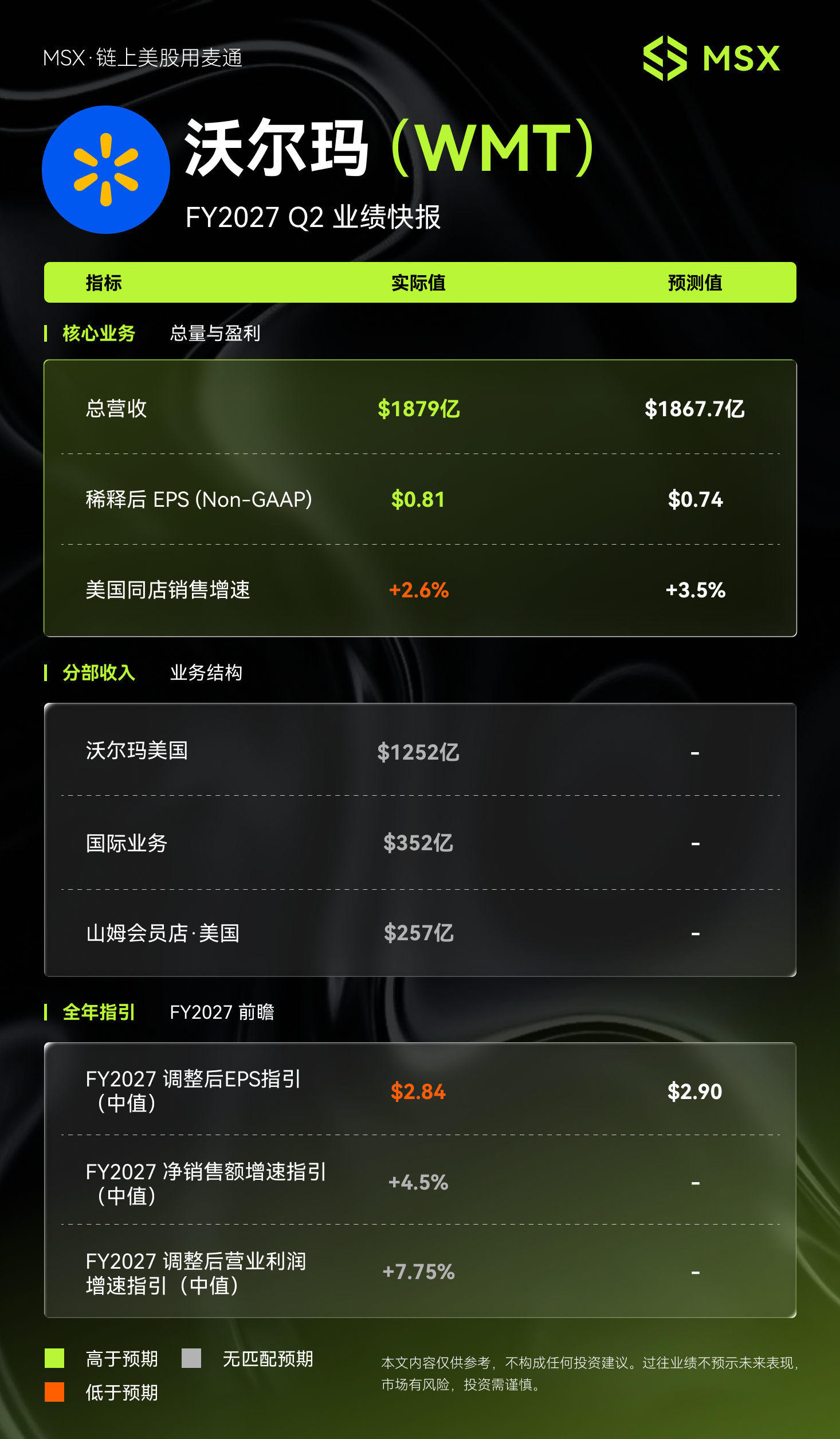
Walmart's FY2027 Q2 earnings report presents a mixed picture. While revenue of $187.9B and adjusted EPS of $0.81 both surpassed consensus estimates, a significant slowdown in the core U.S. business dominated the narrative. U.S. comparable store sales grew only 2.6%, the lowest rate in over six years, missing expectations of 3.5%. The company attributed approximately 125 basis points of this drag to pharmacy price deflation. Despite the weak comps, high-margin segments showed robust growth: global e-commerce rose 23%, global advertising jumped 38%, and the U.S. third-party marketplace surged 52%. Adjusted operating profit growth of 17.4% also outpaced revenue growth, indicating improving profitability. The company raised its full-year guidance for net sales and adjusted EPS. However, the upper end of the new EPS guidance range ($2.87) remains below the market consensus ($2.90). This, coupled with the slowing U.S. comps, signals that growth momentum may be easing. The report highlights a shift in consumer behavior towards more cautious spending, even as transaction volumes remain stable. The key question going forward is whether the rapid expansion of high-margin, non-retail businesses can sufficiently offset the deceleration in core retail growth.

【MSX Research Institute · US Stock RWA Daily Observation】 is a flagship daily report produced by MSX, a leading RWA trading platform. Leveraging our robust macroeconomic research capabilities, we capture the core pulse of the global traditional US stock market, liquidity changes, and the RWA tokenization market to help you strategically position in quality assets.

Today's Observation

Walmart's revenue and adjusted earnings per share (EPS) both beat expectations for the quarter. However, same-store sales growth in its core US market decelerated to its slowest pace in over six years, with pharmacy price deflation being the primary drag. The company raised its full-year sales and profit guidance, but the upper limit of the revised EPS guidance still fell short of market consensus, with signals of slowing growth momentum overshadowing the quarterly beat.

Data at a Glance

FY2027 Q2 total revenue reached $187.9 billion, up 5.9% year-over-year, beating the consensus estimate of $186.77 billion.

Adjusted EPS was $0.81, up 19% year-over-year, beating the consensus of $0.74; but GAAP net income attributable to Walmart was $6.37 billion, down 9% year-over-year, showing divergence between the two measures.

US same-store sales grew only 2.6%, missing the consensus of 3.5% and marking the slowest growth in over six years; the company attributed pharmacy price deflation as a drag of approximately 125 basis points.

By segment: Walmart US net sales were $125.2 billion, up 3.5% YoY; International net sales were $35.2 billion, up 13% YoY; Sam's Club (US) net sales were $25.7 billion, up 8.8% YoY, with comparable sales excluding fuel up 4.4%.

High-margin businesses maintained strong growth: Global e-commerce grew 23% (US +24%); Global advertising grew 38% (Walmart Connect +43%); US third-party marketplace sales grew 52%.

Adjusted operating income was $9.2 billion, up 17.4% on a constant currency basis, outpacing revenue growth.

Full-year guidance was raised across the board: Net sales growth guidance raised from 3.5%-4.5% to 4.0%-5.0%; Adjusted EPS guidance raised to $2.80-$2.87 (from $2.75-$2.85 previously); Adjusted operating income growth guidance is 7.0%-8.5%.

However, the raised EPS guidance upper limit of $2.87 still falls short of the consensus of $2.90. The company noted it has begun receiving tariff refunds this quarter and committed to using these funds to lower product prices.

MSX View

The contradiction in this earnings report lies in the fact that almost every quarterly figure exceeded expectations, while the issues lie in the structure and forward outlook. Revenue, adjusted profit, and operational efficiency all showed improvement: adjusted operating profit growth outpaced revenue growth, and high-margin businesses like advertising, third-party marketplace, and e-commerce all grew at double-digit or higher rates, indicating an improvement in Walmart's profit quality.

US same-store sales growth slowing to a more than six-year low of 2.6% brings the narrative back to a fundamental question: As the broadest-coverage US retailer, its same-store data is a thermometer for consumer health. Pharmacy price deflation explains about 125 basis points, with the remainder pointing to actual changes in consumer behavior. Stable transaction counts but declining average ticket size mean shoppers are still coming, but spending more cautiously.

The fact that full-year guidance was raised across the board yet still fell short of expectations precisely illustrates that market growth expectations for this company have run ahead of the company's own projections. The key going forward is whether the expansion pace of high-margin, non-retail businesses can remain sufficiently strong to offset the slowdown in core retail growth.
About MSX

MSX is a leading RWA trading platform committed to providing secure, efficient, and transparent access to global financial markets. As one of the world's earliest on-chain US stock trading platforms, MSX has consistently been at the forefront of the industry, driving market evolution through continuous innovation.

The platform deeply integrates blockchain technology with compliance frameworks, offering comprehensive trading in spot and derivatives for nearly 400 tokenized stocks and Pre-IPO assets, perfectly bridging the gap between traditional finance and the digital asset industry.

Centered around the core mission of "enabling the free flow of quality assets," MSX has now built a diversified digital financial services ecosystem encompassing US stock spot & perpetual contracts, crypto-to-crypto trading, Pre-IPO, and the MSX Research Institute, aiming to provide global investors with a round-the-clock, high-performance gateway to quality assets.

Official Website: https://msx.com/

Chinese TG:https://t.me/MSXOfficial

Global TG:https://t.me/MSXGlobal

X:https://x.com/MSX_CN

Now available globally on App Store and Google Play.
Risk Warning: Macroeconomic and US stock market volatility is intense. The content of this article is for academic and research observation reference by the MSX Research Institute only and does not constitute any investment advice.


Criptos en tendencia

Preguntas relacionadas

QDid Walmart's revenue and adjusted earnings exceed or fall short of expectations in FY2027 Q2?

AIn FY2027 Q2, Walmart's revenue and adjusted earnings per share both exceeded market expectations.

QWhat was the key disappointing metric in Walmart's US performance for the quarter, and what was cited as the primary reason for it?

AThe key disappointing metric was US comparable store sales growth, which was only 2.6%, its lowest level in over six years. The company cited pharmacy price deflation as the primary reason, dragging it down by approximately 125 basis points.

QWhich high-margin segments of Walmart's business continued to show strong growth according to the report?

AHigh-margin segments showing strong growth included global e-commerce (up 23%), global advertising business (up 38%), and US third-party marketplace sales (up 52%).

QHow did Walmart revise its full-year guidance following the Q2 results, and did it meet market expectations?

AWalmart revised its full-year guidance upwards for net sales growth and adjusted EPS. However, the upper end of the adjusted EPS guidance ($2.87) still fell short of the market consensus expectation of $2.90.

QAccording to the MSX View analysis, what is the fundamental concern about Walmart's future growth despite the strong quarterly numbers?

AThe fundamental concern is the slowdown in core retail growth, as indicated by the multi-year low in US comparable sales. The future key is whether the expansion speed of high-margin non-retail businesses can continue to be fast enough to offset this core retail slowdown.

Lecturas Relacionadas

The Biggest Political Economy Question in the AI Era: As Robots Become More Capable, How Do Humans Share the Value?

In the AI era, the most pressing political economy question is: as machines become increasingly capable, how can humanity share in the value they create? An article originally critiquing China's tech focus has sparked a deeper debate on this global challenge. Historically, industrial progress improved efficiency but still relied on human labor for wealth creation and distribution. AI is fundamentally different—it is now replacing cognitive and knowledge work. As AI and robots take over more tasks, economic growth may continue while direct human participation in value creation shrinks, creating a core tension between productivity gains and widespread income generation. The issue is not unique to China. While leading tech companies amass enormous wealth, labor's share of income is declining globally. The core problem is a broken link: technological innovation and corporate profits are not translating into sufficient consumer income and demand. Three potential paths forward are outlined: a traditional capitalist model where profits primarily go to capital owners; a state-capitalist approach with public investment in AI; and more innovative models like digital sovereign wealth funds, universal shareholding, or AI-era basic income schemes to directly distribute AI-generated value. The future competitive advantage may lie not just in technological supremacy, but in which society can build a new, inclusive distribution system for the intelligent economy. The ultimate challenge is ensuring that as AI creates value, humans have a means to obtain income and share in the resulting widespread social benefits.

marsbitHace 10 min(s)

The Biggest Political Economy Question in the AI Era: As Robots Become More Capable, How Do Humans Share the Value?

marsbitHace 10 min(s)

Generating Profits for Seven Consecutive Quarters, Emerging Markets Carry Trade Outperforms Everything

For the seventh consecutive quarter, dollar-funded emerging market carry trades have delivered positive returns, marking the longest winning streak since 2008. According to Bloomberg's index, this strategy has gained approximately 22% since late 2024, outperforming U.S. Treasuries, emerging market sovereign, and corporate dollar debt. The core of the trade involves borrowing low-interest currencies like the U.S. dollar, euro, or yen to invest in high-yielding emerging market assets, such as Turkish lira bonds offering over 40% returns. Returns were amplified by favorable currency moves, with the dollar weakening against most emerging market currencies and other traditional funding currencies. For instance, the trade gained 48% on the Colombian peso in the past year. A key test came in August 2024 with a historic joint U.S.-Japan currency intervention, which caused only a modest 1% dip in the carry trade risk premium as investors shifted funding from the yen to the euro and Swiss franc. Looking ahead, the primary risk is the timing of Federal Reserve policy changes. While persistent inflation allows the Fed to hold rates, a rapid rise in long-term U.S. yields could threaten the trade. Another concern is crowding, as massive inflows increase vulnerability to a sudden reversal. High interest rates in regions like Latin America and Eastern Europe, supported by external factors like Middle East tensions and energy prices, continue to sustain the opportunity. Major investors remain engaged, favoring currencies like the Mexican peso, South African rand, and Turkish lira.

marsbitHace 24 min(s)

Generating Profits for Seven Consecutive Quarters, Emerging Markets Carry Trade Outperforms Everything

marsbitHace 24 min(s)

Unpacking the Truth Behind On-chain Assets: Leverage, Liquidity, and Risk

The article analyzes the concept of "real-world asset" (RWA) tokenization, arguing that while tokenizing assets on-chain is a useful step, it is far from transformative on its own. The author compares it to placing a barcode on a shipping container—it enables identification but does not build the necessary market infrastructure. The core argument is that true value emerges not from tokenization, but from integrating these tokens into DeFi systems where they can be valued, financed, hedged, traded, and liquidated under stress. Key challenges identified include: 1. **Multiple Time Clocks**: A fundamental tension exists between blockchain's 24/7 settlement and the slower, business-hour-dependent processes of traditional markets, custody, and redemption. This "duration mismatch" can create dangerous liquidity gaps during crises. 2. **Liquidity Misconceptions**: True liquidity is not measured by Total Value Locked (TVL) or trading pairs, but by the ability to exit a position within a required timeframe at an acceptable price. It requires analyzing multiple exit paths and stress-testing scenarios. 3. **Leverage and Risk**: Leverage unlocks economic utility (e.g., using tokenized assets as collateral) but also introduces fragility. Risk models must account for more than asset volatility, incorporating factors like legal enforceability, oracle freshness, and market structure. Paradoxically, a "safer" asset like tokenized Treasury bonds could require a higher collateral discount than ETH due to slower, less-proven liquidation mechanisms. 4. **A Risk Graph**: RWA risk should be modeled as a network of interconnected dependencies (e.g., issuers, custodians, oracles, stablecoin pools), not a single score. Failures can propagate through this graph, turning operational issues into systemic liquidity crises. The article states that tokenized government bonds are merely an entry point, while more complex frontiers like computing power and energy assets present greater challenges and opportunities. It also examines the interplay and risks between tokenized stocks and perpetual futures contracts. The conclusion is that the future lies not in "tokenizing everything," but in building robust market layers where tokenized rights become resilient financial primitives within a programmable capital system. The token is just the barcode; the market is the machine.

marsbitHace 49 min(s)

Unpacking the Truth Behind On-chain Assets: Leverage, Liquidity, and Risk

marsbitHace 49 min(s)

Trading

Spot

Artículos destacados

Cómo comprar BEAT

¡Bienvenido a HTX.com! Hemos hecho que comprar Audiera (BEAT) sea simple y conveniente. Sigue nuestra guía paso a paso para iniciar tu viaje de criptos.Paso 1: crea tu cuenta HTXUtiliza tu correo electrónico o número de teléfono para registrarte y obtener una cuenta gratuita en HTX. Experimenta un proceso de registro sin complicaciones y desbloquea todas las funciones.Obtener mi cuentaPaso 2: ve a Comprar cripto y elige tu método de pagoTarjeta de crédito/débito: usa tu Visa o Mastercard para comprar Audiera (BEAT) al instante.Saldo: utiliza fondos del saldo de tu cuenta HTX para tradear sin problemas.Terceros: hemos agregado métodos de pago populares como Google Pay y Apple Pay para mejorar la comodidad.P2P: tradear directamente con otros usuarios en HTX.Over-the-Counter (OTC): ofrecemos servicios personalizados y tipos de cambio competitivos para los traders.Paso 3: guarda tu Audiera (BEAT)Después de comprar tu Audiera (BEAT), guárdalo en tu cuenta HTX. Alternativamente, puedes enviarlo a otro lugar mediante transferencia blockchain o utilizarlo para tradear otras criptomonedas.Paso 4: tradear Audiera (BEAT)Tradear fácilmente con Audiera (BEAT) en HTX's mercado spot. Simplemente accede a tu cuenta, selecciona tu par de trading, ejecuta tus trades y monitorea en tiempo real. Ofrecemos una experiencia fácil de usar tanto para principiantes como para traders experimentados.

927 Vistas totalesPublicado en 2026.01.22Actualizado en 2026.06.02

Cómo comprar BEAT

Discusiones

Bienvenido a la comunidad de HTX. Aquí puedes mantenerte informado sobre los últimos desarrollos de la plataforma y acceder a análisis profesionales del mercado. A continuación se presentan las opiniones de los usuarios sobre el precio de BEAT (BEAT).

活动图片