Staking Inflation Reforms Trap Ethereum and Solana

marsbitPublicado a 2026-08-14Actualizado a 2026-08-14

Resumen

The article discusses the "Morton's Fork" dilemma facing both Ethereum and Solana, where both blockchains must choose between two paths that lead to the same outcome: increased centralization of their validator networks. Ethereum researchers have proposed EIP-8363, a "Progressive Issuance Burn" plan. It would gradually increase the proportion of validator rewards burned as the total staked ETH rises, aiming to reduce new token issuance. If staking reaches 50% of the supply, rewards would drop to zero. This proposal has faced strong opposition from major staking service providers and DeFi platforms (e.g., Aave, ether.fi), as staking yields form a crucial base rate for DeFi leverage strategies. Critics argue slashing rewards would first hurt small, individual node operators due to fixed operational costs, accelerating centralization. Solana faces a similar challenge. Its validators have fixed costs but rely heavily on token issuance for rewards (only ~13% of validator income comes from fees). Two current proposals, SIMD-0550 and SIMD-0553, aim to accelerate the reduction of its inflation rate and increase fee burns, respectively. A vote concludes on August 18th. The core conflict is between large token holders (whose assets are diluted by issuance) and the concentrated staking industry that depends on high yields. While reducing issuance could curb the influx of capital into centralized staking services, it could also force out smaller validators first. The article concludes...

Original Author: Thejaswini M A

Original Compilation: Chopper, Foresight News

In 1487, King Henry VII of England was in urgent need of funds. Having won the English throne two years earlier at the Battle of Bosworth Field, maintaining his rule incurred immense costs. The task of taxation fell to his Chancellor, John Morton.

Legend has it that Morton had his own methods. Visiting the estates of nobles, he observed their lifestyles: if a noble lived in luxury, Morton deemed him wealthy and thus obligated to pay tribute to the king; if a noble lived frugally, Morton judged him to be skilled at saving and equally capable of paying.

There was no third scenario. Regardless of what Morton witnessed, the outcome was always the same: the noble had to pay.

This anecdote is a secondhand account. Francis Bacon recorded it in 1622 when the story was still widely circulated. The term "Morton's Fork" was not widely used until the 19th century, but its logic endures due to its relevance. The "fork" refers to two choices that ultimately lead to the same unfavorable outcome, the opposite of a win-win situation.

Today, Ethereum and Solana find themselves trapped in a similar dilemma.

Both blockchains reward validators by issuing new tokens (inflation), and both are attempting to reduce these issuance subsidies. Relevant adjustment proposals for Ethereum have faced strong opposition; Solana's proposal is currently under vote, with the decision deadline set for August 18th.

On one hand, maintaining the current staking rewards for validators further advantages large, well-capitalized institutional service providers. On the other hand, reducing rewards places immediate pressure on smaller node operators, who face fixed operational costs and already operate on thin profit margins.

Regardless of the path chosen, the ultimate result is a contraction in the number of validators. This article analyzes the inflation policy debates on both chains: they are forced to make a choice, essentially deciding which form of centralization to move towards.

Ethereum: EIP-8363 Proposal for Progressive Issuance Burning

On August 4th, Ethereum researchers including Justin Drake and Jérôme de Tychey released a draft proposal titled "A Progressive Issuance Burn," known as EIP-8363. Its core mechanism involves increasing the proportion of validator rewards burned by the protocol as the total amount of staked ETH rises.

Once the total staked amount reaches 60.25 million ETH (approximately half the total supply), the reward burn rate would hit 100%, reducing the staking issuance yield to zero.

Currently, about 41.4 million ETH is staked, representing 34% of the total supply, corresponding to roughly 890,000 validators with an average staking yield of 2.67%. A calculation by Aave founder Stani Kulechov suggests that under this proposal, the validator yield would drop from 2.862% to 1.476%, nearly halving it.
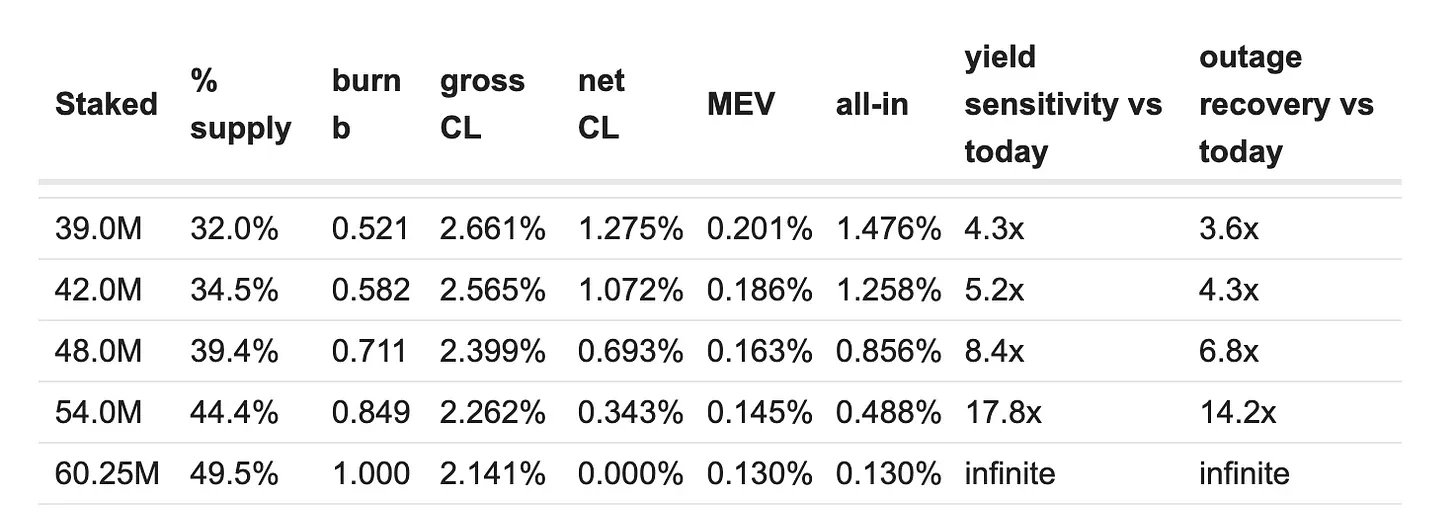
The proposal faced public opposition within three days from figures like Stani Kulechov, SharpLink CEO Joseph Chalom, and ether.fi's Mike Silagadze.

EIP-8363 is currently in the early draft stage, undergoing preliminary review on GitHub. It is far from finalization and implementation and is not included in Ethereum's upcoming Hegotá upgrade; however, it may still be submitted for consideration in future network upgrades.

To understand the strong resistance from the staking community to reward cuts, one must look at the size of this revenue pie. Ethereum incentivizes participants to secure the network by issuing new tokens, minting approximately 1.1 million ETH annually for validators. At a price of $1,921, this constitutes an annual salary pool worth $21 billion.
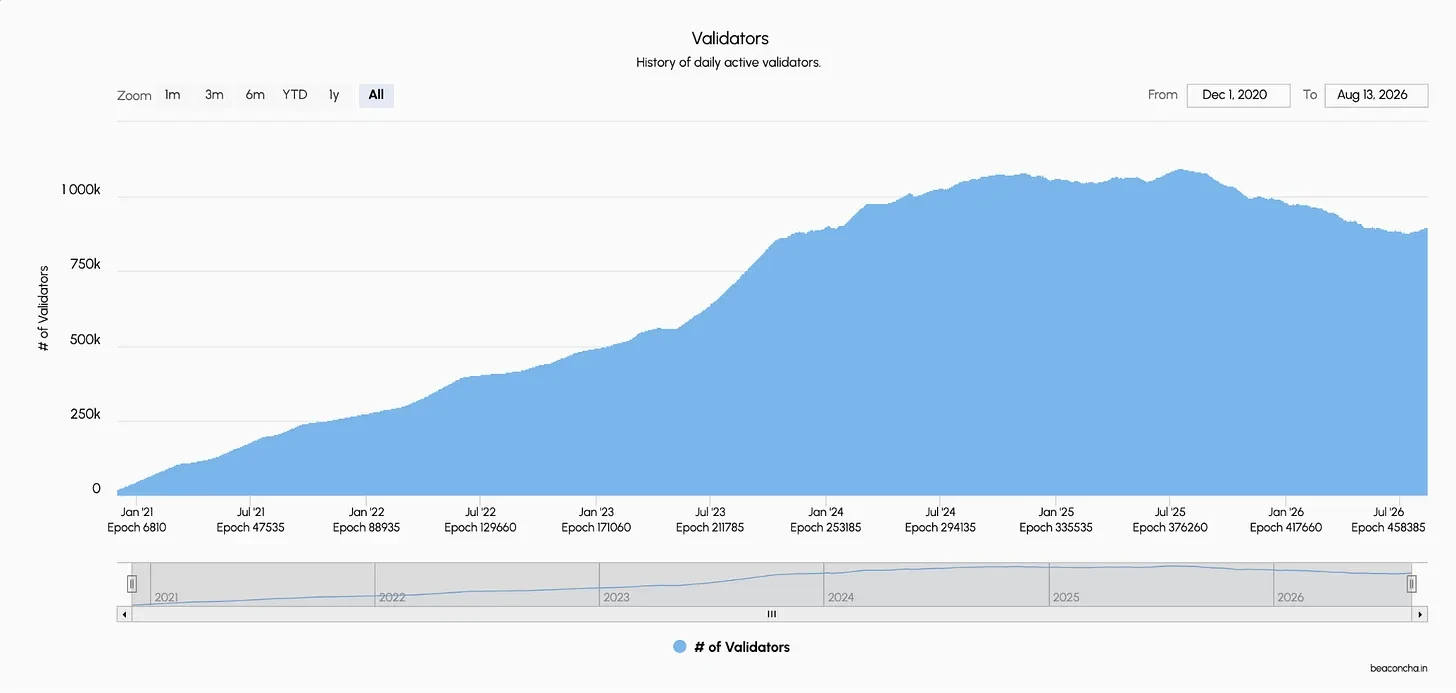
Number of Active Ethereum Validators

Solana has a similar mechanism, but its issuance is larger relative to its economic size. Solana issues approximately 19 to 22 million SOL annually, valued at around $1.5 billion at current prices. Users pay about 6,400–9,600 SOL daily in transaction fees and Jito tips, totaling about $225 million annually. This means user fees cover only about 13% of validator income, with the rest funded by token issuance. The situation is similar on Ethereum, where Chalom estimates tips and fees constitute about 15% of staking rewards, with the remaining 85% coming from issuance.

Solana's annual inflation rate is 3.7%, while Ethereum's is just 0.85%. Non-staking SOL holders see their assets diluted at more than four times the rate of equivalent ETH holders.

In traditional finance, the National Securities Clearing Corporation (NSCC) participates in nearly all stock and bond transactions in the United States. Its parent company, DTCC, processed $4.7 quadrillion in securities transactions in 2025 and custodied assets worth $115 trillion. NSCC maintains a Member's Clearing Fund, sized at $19.7 billion, funded by its members, with NSCC itself contributing only $130 million.

To attack the Ethereum network, an attacker would need to control 41.4 million staked ETH, representing a capital barrier of $79.6 billion—four times the size of the NSCC's fund. This is just the minimum; any large-scale ETH purchase would rapidly drive up the price. Additionally, the attacker would need to deploy a massive global server infrastructure to utilize these tokens. Ethereum has built-in defenses: malicious actions can trigger the network to directly slash (destroy) the attacker's entire staked assets, meaning a failed attack results in a total loss.

However, the operational logic of the two systems remains vastly different.

NSCC members contribute $19.7 billion as a collateral requirement for participation; this capital generates no yield, and members want this amount to be as low as possible. In contrast, Ethereum provides a 2.67% annual yield on equivalent staked capital, while Solana's staking yield is 5%–8%.

Years of stable staking yields have fostered a complete commercial ecosystem built upon them. Currently, about $35 billion worth of liquid staking tokens (LSTs) like stETH are used as collateral across various crypto lending platforms. Traders build leveraged loop strategies with these tokens: deposit LSTs into Aave, Morpho, borrow WETH to stake again, and repeat. This strategy hinges on the staking yield being higher than the borrowing rate. Pendle has built fixed-rate markets based on staking yields; Curve establishes trading pools for investors to exit; SharpLink holds $3 billion in ETH reserves, much of it staked through Coinbase, Anchorage, Figment, Galaxy.

Staking yield has become the benchmark interest rate for the entire DeFi market. If the consensus layer reward were halved, leveraged loop strategies would turn unprofitable, forcing Pendle to reprice fixed rates, and lending platforms would have to comprehensively reassess the collateral value of all liquid staking tokens.

The Key Difference Pre- and Post-Merge: Miners and Stakers Are Not the Same

Before the Ethereum Merge, the protocol issued about 13,000 ETH daily to miners; after the Merge, daily issuance dropped to about 1,700, an 88% reduction. Miners, who had invested tens of billions in hardware over years, strongly resisted the change, leading to a fork that created ETHW, a token now worth less than 1% of ETH's value.

But the mining ecosystem and the DeFi financial system were largely independent. Miners provided hash power for rewards; no one built complex financial products around mining revenue. Their income was not used as collateral for chain-wide lending, so even if their rewards went to zero overnight, the lending markets would remain unaffected. When miners left, the rest of the system could continue without adjustment.

Stakers play a dual role. On one hand, they secure the network; on the other, the staked tokens they receive serve as the underlying collateral for about half of DeFi lending. Therefore, cutting staking rewards impacts the entire financial ecosystem built on top of it.

Mancur Olson proposed a theory in 1965: small groups with significant potential gains often have more motivation and effectiveness in collective action than large groups where individual stakes are small. Small groups have stronger incentives to voice opinions and engage in political processes.

Running a validator node incurs fixed costs: servers, electricity, internet, etc., regardless of profitability. Currently, staking 32 ETH yields about 0.92 ETH annually (~$1,760). Under the new progressive proposal, annual income would drop to 0.47 ETH (~$900). With operational costs unchanged, expenses that were 20% of revenue would suddenly approach half of it. Slashing penalties for attestation mistakes would represent double the proportion of earnings lost for the same absolute amount.

Following Olson's theory, general token holders constitute a large group: Ethereum mints new tokens annually for stakers, continuously diluting the holdings of non-stakers. But this dilution is minuscule per individual—only fractions of a percent annually—which most people barely perceive, giving them little incentive to protest.

Large staking service providers constitute a small group: a significant portion of all newly issued tokens flows to them, representing tens of billions in revenue, which their businesses rely on entirely. If the network cuts rewards, these companies would face massive losses.

The argument from those supporting reduced issuance is that current staking rewards are too high, continuously attracting ETH inflows, and these rewards are concentrated among top exchanges and staking services. Institutional capital drove a ~15% increase in staked ETH in the first half of 2026. The proposal's logic is to raise the marginal cost of staking, making new staking unprofitable, thereby curbing centralization.

The opposing view is that cutting rewards directly would first bankrupt ordinary individual operators running nodes from home. In fact, both sides share the same goal—preventing a few capital giants from controlling Ethereum. The disagreement lies in which approach—reducing rewards or maintaining them—would harm network decentralization faster.

Solana Faces the Same Dilemma

Solana validators must pay about 389 SOL annually in voting fees, a cost incurred regardless of node profitability, market conditions, or whether they receive delegated stakes. The current staking yield is around 6.5%, with the break-even point for a node requiring about 200,000 SOL in delegated stake. The number of active Solana validators has dropped from a peak of 2,500 to 683; however, the total staked SOL has climbed to 430 million, representing nearly 68% of the stakeable supply.
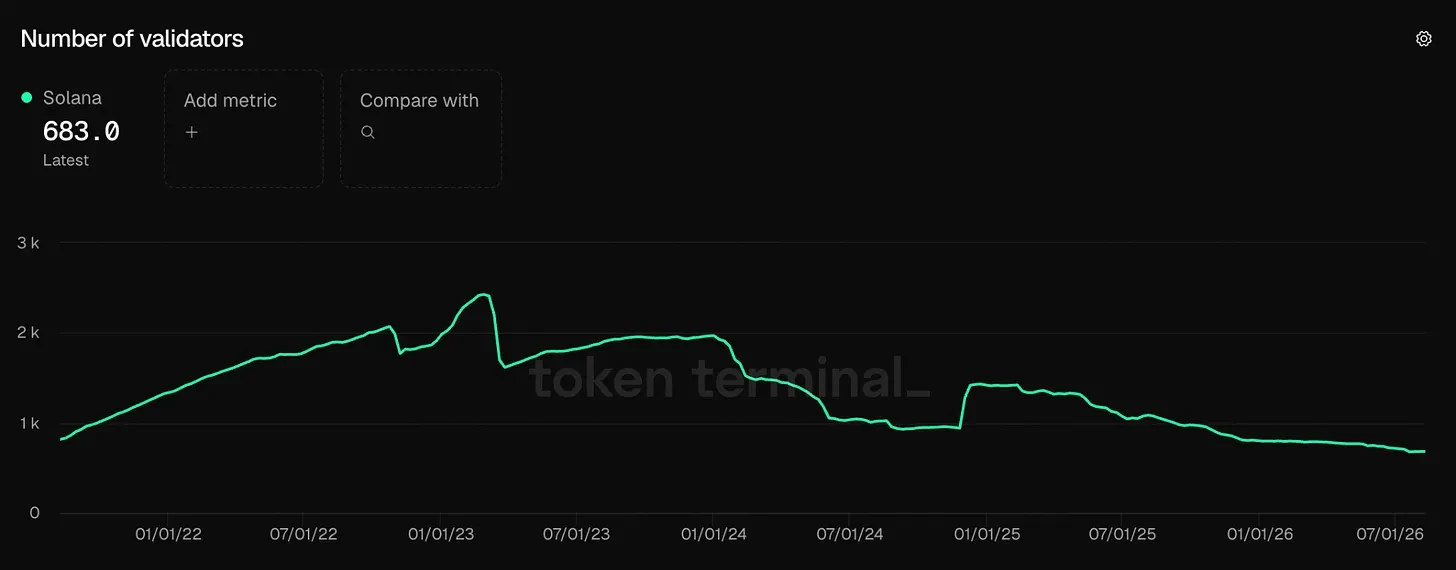
Change in Number of Solana Validator Nodes

Solana is currently voting on reward reforms. Proposal SIMD-0550 would increase the annual disinflation ramp from 15% to 30%, accelerating the achievement of the long-term 1.5% inflation target from 2032 to 2029, aiming to reduce future issuance by 18.9 million SOL. Proposal SIMD-0553 redesigns the fee mechanism based on resource usage, increasing daily burns from 648 SOL to 7,500–9,000 SOL. Even at the upper limit, the burn volume remains far below the daily issuance of ~60,000 SOL in rewards.

The vote concludes on August 18th. Proposals require an absolute majority of over 66.67% of the total staked supply to pass.

We are accustomed to viewing blockchain governance as a practice of autonomous decision-making, where code and community voting shape the future of digital economies. But Ethereum and Solana show a similar trend: protocol rules are ultimately constrained by real-world financial principles. Early architects designed economic models hoping markets would spontaneously maintain decentralization. Yet once a public chain's assets grow into a cornerstone of global liquidity and a target for institutional asset allocation, the underlying economic forces of yield, leverage, and corporate operational costs eventually override the original design vision.

If a blockchain relies on distributing yields to attract users to lock assets for expansion, it will inevitably hit this wall. Regardless of Solana's voting outcome next Monday, and regardless of Ethereum's future decisions on related proposals, they are merely choosing: how soon will we reach the endpoint, how soon will we hit the barrier.


Criptos en tendencia

Preguntas relacionadas

QWhat is the 'Morton's Fork' dilemma that Ethereum and Solana are currently facing, as described in the article?

ABoth Ethereum and Solana face the 'Morton's Fork' dilemma regarding staking rewards. On one path, maintaining high staking rewards encourages centralization by benefiting large, well-capitalized institutional staking services. On the other path, drastically cutting staking rewards would pressure small, independent node operators with fixed costs, forcing them out of the network. Both choices ultimately lead to increased centralization, making it a 'lose-lose' situation akin to the historical 'Morton's Fork'.

QWhat is the core mechanism of Ethereum's proposed EIP-8363, and why is it facing significant opposition?

AEIP-8363, the 'Progressive Issuance Burn' proposal for Ethereum, introduces a mechanism where the proportion of validator rewards burned by the protocol increases as the total amount of staked ETH rises. It would reach a 100% burn rate (effectively zero issuance yield) when staked ETH hits 60.25 million. It faces opposition because major staking service providers and DeFi platforms (like Aave, ether.fi, and SharpLink) argue that slashing rewards by nearly half would severely impact the profitability of validators, especially small operators, and destabilize the DeFi ecosystem where staked ETH derivatives are used as critical collateral.

QHow does the role and impact of stakers in Ethereum's current system differ from that of miners before 'The Merge'?

ABefore 'The Merge', Ethereum miners were compensated for computational work (Proof-of-Work) but were largely separate from the DeFi financial system. Their rewards weren't used as collateral. Post-Merge, stakers in Ethereum's Proof-of-Stake system have a dual role: they secure the network and their staked assets (and liquid staking derivatives) form the backbone of a significant portion of DeFi lending markets. Therefore, cutting staking rewards doesn't just affect validators' income; it risks destabilizing the entire interconnected DeFi ecosystem built upon that staking yield, unlike the isolated impact on miners.

QAccording to the article, what key economic force ultimately constrains the governance and design of major blockchains like Ethereum and Solana?

AThe article argues that underlying economic forces—specifically yield, leverage, and corporate operational costs—ultimately constrain blockchain governance and design. Once a blockchain's native asset becomes a cornerstone of global liquidity and an institutional asset, the financial realities and interests of large capital holders and service providers (who depend on staking yields for profit) override the original design visions of decentralization. The system becomes subject to the same financial imperatives as traditional economies.

QWhat are the main proposals Solana is voting on (SIMD-0550 and SIMD-0553), and what is their combined goal?

ASolana is voting on two main proposals: SIMD-0550 aims to accelerate the reduction of its issuance (inflation) by increasing the annual disinflation rate from 15% to 30%, targeting the long-term inflation goal of 1.5% by 2029 instead of 2032. SIMD-0553 proposes a new resource-based fee mechanism designed to increase the daily burn of SOL from 648 to between 7500–9000. Their combined goal is to reduce the overall net supply expansion (inflation) of SOL more quickly by cutting new issuance and increasing token burns, though the burn would still be less than the daily rewards issued.

Lecturas Relacionadas

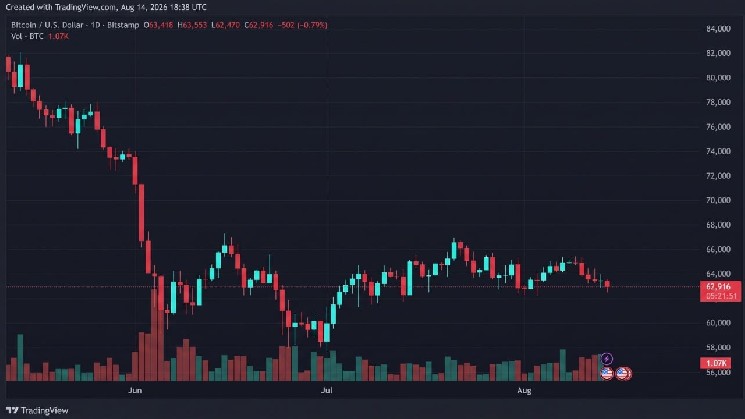
Bitcoin Price Drops to $62,470 as Sellers Retest $63,000 Support Level

Bitcoin's price fell below $63,000 for a second consecutive day on Friday, hitting an intraday low of $62,470. The cryptocurrency later recovered to trade just above $63,000, leaving it nearly flat for the past 24 hours and for August overall, with a weekly loss of 2.6%. The volatility triggered significant liquidations, with $26 million of leveraged long Bitcoin positions liquidated over 24 hours. Market sentiment was further dampened by data showing over $131 million in outflows from spot Bitcoin ETFs for a second straight day, signaling a potential pullback by institutional investors. Adding to the negative pressure, index provider MSCI has proposed new criteria for "non-operating companies" in its global indexes, which could lead to the exclusion of firms holding significant digital assets like Bitcoin on their balance sheets. Companies such as Strategy and Metaplanet could be affected, potentially forcing index-tracking funds to sell their shares. Strategy publicly criticized the proposal, arguing digital assets are legitimate assets and index providers should not dictate what companies can own. Public consultations on MSCI's proposal end September 30, with a final decision expected by October 16. If approved, exclusions could begin in November, potentially triggering sustained institutional selling and damaging a key bridge for Bitcoin adoption in the corporate sector.

cryptonews.ruHace 1 hora(s)

Bitcoin Price Drops to $62,470 as Sellers Retest $63,000 Support Level

cryptonews.ruHace 1 hora(s)

Trading

Spot

Artículos destacados

Qué es ETH 2.0

ETH 2.0: Una Nueva Era para Ethereum Introducción ETH 2.0, conocido ampliamente como Ethereum 2.0, marca una actualización monumental para la blockchain de Ethereum. Esta transición no es solo una mejora superficial; busca mejorar fundamentalmente la escalabilidad, seguridad y sostenibilidad de la red. Con un cambio del mecanismo de consenso intensivo en energía Prueba de Trabajo (PoW) a una Prueba de Participación (PoS) más eficiente, ETH 2.0 promete un enfoque transformador para el ecosistema blockchain. ¿Qué es ETH 2.0? ETH 2.0 es un conjunto de actualizaciones interconectadas y distintivas centradas en optimizar las capacidades y el rendimiento de Ethereum. La reestructuración está diseñada para abordar desafíos críticos que el mecanismo actual de Ethereum ha enfrentado, particularmente en lo que respecta a la velocidad de transacción y la congestión de la red. Objetivos de ETH 2.0 Los objetivos principales de ETH 2.0 giran en torno a mejorar tres aspectos clave: Escalabilidad: Con el objetivo de aumentar significativamente el número de transacciones que la red puede manejar por segundo, ETH 2.0 busca superar la limitación actual de aproximadamente 15 transacciones por segundo, potencialmente alcanzando miles. Seguridad: Las medidas de seguridad mejoradas son fundamentales para ETH 2.0, particularmente a través de una mejor resistencia contra ciberataques y la preservación del ethos descentralizado de Ethereum. Sostenibilidad: El nuevo mecanismo PoS está diseñado no solo para mejorar la eficiencia, sino también para reducir drásticamente el consumo de energía, alineando el marco operativo de Ethereum con consideraciones ambientales. ¿Quién es el Creador de ETH 2.0? La creación de ETH 2.0 se puede atribuir a la Fundación Ethereum. Esta organización sin fines de lucro, que desempeña un papel crucial en el apoyo al desarrollo de Ethereum, es liderada por el notable cofundador Vitalik Buterin. Su visión de un Ethereum más escalable y sostenible ha sido la fuerza motriz detrás de esta actualización, involucrando contribuciones de una comunidad global de desarrolladores y entusiastas dedicados a mejorar el protocolo. ¿Quiénes son los Inversores de ETH 2.0? Si bien los detalles sobre los inversores de ETH 2.0 no se han hecho públicos, se sabe que la Fundación Ethereum recibe apoyo de varias organizaciones e individuos en el ámbito de blockchain y tecnología. Estos socios incluyen firmas de capital de riesgo, compañías tecnológicas y organizaciones filantrópicas que comparten un interés mutuo en apoyar el desarrollo de tecnologías descentralizadas e infraestructura blockchain. ¿Cómo Funciona ETH 2.0? ETH 2.0 se distingue por introducir una serie de características clave que lo diferencian de su predecesor. Prueba de Participación (PoS) La transición a un mecanismo de consenso PoS es uno de los cambios más destacados de ETH 2.0. A diferencia de PoW, que se basa en la minería intensiva en energía para la verificación de transacciones, PoS permite a los usuarios validar transacciones y crear nuevos bloques de acuerdo con la cantidad de ETH que apuestan en la red. Esto conduce a una mayor eficiencia energética, reduciendo el consumo en aproximadamente un 99.95%, convirtiendo a Ethereum 2.0 en una alternativa considerablemente más verde. Cadenas Shard Las cadenas shard son otra innovación crítica de ETH 2.0. Estas cadenas más pequeñas operan en paralelo con la cadena principal de Ethereum, lo que permite que múltiples transacciones sean procesadas simultáneamente. Este enfoque mejora la capacidad general de la red, abordando las preocupaciones de escalabilidad que han afectado a Ethereum. Cadena Beacon En el núcleo de ETH 2.0 se encuentra la Cadena Beacon, que coordina la red y gestiona el protocolo PoS. Funciona como un organizador de cierta manera: supervisa a los validadores, asegura que los shards permanezcan conectados a la red y monitorea la salud general del ecosistema blockchain. Cronología de ETH 2.0 El viaje de ETH 2.0 ha estado marcado por varios hitos clave que trazan la evolución de esta importante actualización: Diciembre 2020: El lanzamiento de la Cadena Beacon marcó la introducción de PoS, preparándose para la migración hacia ETH 2.0. Septiembre 2022: La finalización de “La Fusión” representa un momento crucial en el que la red Ethereum se trasladó exitosamente de un marco PoW a uno PoS, anunciando una nueva era para Ethereum. 2023: El lanzamiento esperado de cadenas shard tiene como objetivo mejorar aún más la escalabilidad de la red Ethereum, consolidando a ETH 2.0 como una plataforma robusta para aplicaciones y servicios descentralizados. Características Clave y Beneficios Escalabilidad Mejorada Una de las ventajas más significativas de ETH 2.0 es su escalabilidad mejorada. La combinación de PoS y cadenas shard permite que la red expanda su capacidad, permitiendo acomodar un volumen mucho mayor de transacciones en comparación con el sistema heredado. Eficiencia Energética La implementación de PoS representa un gran paso hacia la eficiencia energética en la tecnología blockchain. Al reducir drásticamente el consumo de energía, ETH 2.0 no solo disminuye los costos operativos, sino que también se alinea más estrechamente con los objetivos de sostenibilidad global. Seguridad Mejorada Los mecanismos actualizados de ETH 2.0 contribuyen a mejorar la seguridad en toda la red. El despliegue de PoS, junto con las medidas de control innovadoras establecidas a través de cadenas shard y la Cadena Beacon, asegura un mayor grado de protección contra posibles amenazas. Costos Más Bajos para los Usuarios A medida que la escalabilidad mejora, los efectos sobre los costos de transacción también serán evidentes. Se espera que una mayor capacidad y una menor congestión se traduzcan en tarifas más bajas para los usuarios, haciendo que Ethereum sea más accesible para transacciones cotidianas. Conclusión ETH 2.0 marca una evolución significativa en el ecosistema blockchain de Ethereum. A medida que aborda problemas fundamentales como la escalabilidad, el consumo de energía, la eficiencia en las transacciones y la seguridad general, la importancia de esta actualización no puede ser subestimada. La transición a la Prueba de Participación, la introducción de cadenas shard y el trabajo fundamental de la Cadena Beacon son indicativos de un futuro donde Ethereum puede satisfacer las crecientes demandas del mercado descentralizado. En una industria impulsada por la innovación y el progreso, ETH 2.0 se erige como un testimonio de las capacidades de la tecnología blockchain para allanar el camino hacia una economía digital más sostenible y eficiente.

323 Vistas totalesPublicado en 2024.04.04Actualizado en 2024.12.03

Qué es ETH 2.0

Qué es ETH 3.0

ETH3.0 y $eth 3.0: Un Examen Profundo del Futuro de Ethereum Introducción En el paisaje en rápida evolución de las criptomonedas y la tecnología blockchain, ETH3.0, a menudo denotado como $eth 3.0, ha surgido como un tema de considerable interés y especulación. El término abarca dos conceptos principales que merecen aclaración: Ethereum 3.0: Esto representa una posible actualización futura destinada a aumentar las capacidades de la blockchain existente de Ethereum, enfocándose particularmente en mejorar la escalabilidad y el rendimiento. ETH3.0 Meme Token: Este proyecto de criptomoneda distinto busca aprovechar la blockchain de Ethereum para crear un ecosistema centrado en memes, promoviendo la participación dentro de la comunidad de criptomonedas. Comprender estos aspectos de ETH3.0 es esencial no solo para los entusiastas de las criptomonedas, sino también para aquellos que observan tendencias tecnológicas más amplias en el espacio digital. ¿Qué es ETH3.0? Ethereum 3.0 Ethereum 3.0 se presenta como una actualización propuesta para la red de Ethereum ya establecida, que ha sido la columna vertebral de muchas aplicaciones descentralizadas (dApps) y contratos inteligentes desde su inicio. Las mejoras previstas se concentran principalmente en la escalabilidad, integrando tecnologías avanzadas como sharding y pruebas de conocimiento cero (zk-proofs). Estas innovaciones tecnológicas tienen como objetivo facilitar un número sin precedentes de transacciones por segundo (TPS), potencialmente alcanzando millones, abordando así una de las limitaciones más significativas que enfrenta la tecnología blockchain actual. La mejora no es meramente técnica, sino también estratégica; está destinada a preparar la red de Ethereum para su adopción generalizada y utilidad en un futuro marcado por una mayor demanda de soluciones descentralizadas. ETH3.0 Meme Token En contraste con Ethereum 3.0, el ETH3.0 Meme Token se aventura en un ámbito más ligero y juguetón al combinar la cultura de memes de internet con la dinámica de las criptomonedas. Este proyecto permite a los usuarios comprar, vender e intercambiar memes en la blockchain de Ethereum, proporcionando una plataforma que fomenta la participación comunitaria a través de la creatividad y los intereses compartidos. El ETH3.0 Meme Token tiene como objetivo demostrar cómo la tecnología blockchain puede intersectarse con la cultura digital, creando casos de uso que son tanto entretenidos como financieramente viables. ¿Quién es el Creador de ETH3.0? Ethereum 3.0 La iniciativa hacia Ethereum 3.0 es impulsada principalmente por un consorcio de desarrolladores e investigadores dentro de la comunidad de Ethereum, incluyendo notablemente a Justin Drake. Conocido por sus ideas y contribuciones a la evolución de Ethereum, Drake ha sido una figura prominente en las discusiones sobre la transición de Ethereum a una nueva capa de consenso, denominada “Beam Chain.” Este enfoque colaborativo para el desarrollo significa que Ethereum 3.0 no es el producto de un creador singular, sino más bien una manifestación de ingenio colectivo centrado en avanzar la tecnología blockchain. ETH3.0 Meme Token Los detalles sobre el creador del ETH3.0 Meme Token son actualmente inidentificables. La naturaleza de los tokens de memes a menudo conduce a una estructura más descentralizada y dirigida por la comunidad, lo que podría explicar la falta de atribución específica. Esto se alinea con la ética de la comunidad cripto más amplia, donde la innovación a menudo surge de esfuerzos colaborativos en lugar de individuales. ¿Quiénes son los Inversores de ETH3.0? Ethereum 3.0 El apoyo a Ethereum 3.0 proviene principalmente de la Fundación Ethereum junto con una entusiasta comunidad de desarrolladores e inversores. Esta asociación fundamental proporciona un grado significativo de legitimidad y mejora la perspectiva de una implementación exitosa, ya que aprovecha la confianza y credibilidad construidas a lo largo de años de operaciones en la red. En el clima cambiando rápidamente de las criptomonedas, el apoyo de la comunidad juega un papel crucial en impulsar el desarrollo y la adopción, posicionando a Ethereum 3.0 como un contendiente serio para futuros avances en blockchain. ETH3.0 Meme Token Si bien las fuentes actualmente disponibles no proporcionan información explícita sobre las fundaciones o organizaciones de inversión que respaldan el ETH3.0 Meme Token, es indicativo del modelo de financiamiento típico para tokens de memes, que a menudo depende del apoyo de base y la participación comunitaria. Los inversores en tales proyectos suelen consistir en individuos motivados por el potencial de innovación impulsada por la comunidad y el espíritu de cooperación que se encuentra dentro de la comunidad cripto. ¿Cómo Funciona ETH3.0? Ethereum 3.0 Las características distintivas de Ethereum 3.0 radican en su implementación propuesta de sharding y tecnología zk-proof. Sharding es un método de particionamiento de la blockchain en piezas más pequeñas y manejables o “shards,” que pueden procesar transacciones de manera concurrente en lugar de secuencial. Esta descentralización del procesamiento ayuda a prevenir la congestión y asegura que la red permanezca receptiva incluso bajo una carga pesada. La tecnología de prueba de conocimiento cero (zk-proof) contribuye con otra capa de sofisticación al permitir la validación de transacciones sin revelar los datos subyacentes involucrados. Este aspecto no solo mejora la privacidad, sino que también aumenta la eficiencia general de la red. También se habla de incorporar una Máquina Virtual de Ethereum de conocimiento cero (zkEVM) en esta actualización, amplificando aún más las capacidades y utilidad de la red. ETH3.0 Meme Token El ETH3.0 Meme Token se distingue al capitalizar la popularidad de la cultura de memes. Establece un mercado para que los usuarios participen en el comercio de memes, no solo por entretenimiento sino también por el posible beneficio económico. Al integrar características como staking, provisión de liquidez y mecanismos de gobernanza, el proyecto fomenta un entorno que incentiva la interacción y participación de la comunidad. Al ofrecer una mezcla única de entretenimiento y oportunidad económica, el ETH3.0 Meme Token tiene como objetivo atraer a una audiencia diversa, que abarca desde entusiastas de las criptomonedas hasta conocedores casuales de memes. Línea de Tiempo de ETH3.0 Ethereum 3.0 11 de noviembre de 2024: Justin Drake insinúa la próxima actualización de ETH 3.0, centrada en mejoras de escalabilidad. Este anuncio significa el comienzo de las discusiones formales sobre la futura arquitectura de Ethereum. 12 de noviembre de 2024: Se espera que la propuesta anticipada para Ethereum 3.0 se desvele en Devcon en Bangkok, preparando el escenario para una mayor retroalimentación de la comunidad y posibles próximos pasos en el desarrollo. ETH3.0 Meme Token 21 de marzo de 2024: El ETH3.0 Meme Token se lista oficialmente en CoinMarketCap, marcando su incursión en el dominio público de las criptomonedas y mejorando la visibilidad de su ecosistema basado en memes. Puntos Clave En conclusión, Ethereum 3.0 representa una evolución significativa dentro de la red de Ethereum, enfocándose en superar las limitaciones en términos de escalabilidad y rendimiento a través de tecnologías avanzadas. Sus actualizaciones propuestas reflejan un enfoque proactivo hacia las demandas y la usabilidad futura. Por otro lado, el ETH3.0 Meme Token encapsula la esencia de la cultura impulsada por la comunidad en el espacio de las criptomonedas, aprovechando la cultura de memes para crear plataformas atractivas que fomentan la creatividad y participación del usuario. Comprender los distintos propósitos y funcionalidades de ETH3.0 y $eth 3.0 es fundamental para cualquiera interesado en los desarrollos en curso dentro del espacio cripto. Con ambas iniciativas abriendo caminos únicos, subrayan colectivamente la naturaleza dinámica y multifacética de la innovación en blockchain.

341 Vistas totalesPublicado en 2024.04.04Actualizado en 2024.12.03

Qué es ETH 3.0

Cómo comprar ETH

¡Bienvenido a HTX.com! Hemos hecho que comprar Ethereum (ETH) sea simple y conveniente. Sigue nuestra guía paso a paso para iniciar tu viaje de criptos.Paso 1: crea tu cuenta HTXUtiliza tu correo electrónico o número de teléfono para registrarte y obtener una cuenta gratuita en HTX. Experimenta un proceso de registro sin complicaciones y desbloquea todas las funciones.Obtener mi cuentaPaso 2: ve a Comprar cripto y elige tu método de pagoTarjeta de crédito/débito: usa tu Visa o Mastercard para comprar Ethereum (ETH) al instante.Saldo: utiliza fondos del saldo de tu cuenta HTX para tradear sin problemas.Terceros: hemos agregado métodos de pago populares como Google Pay y Apple Pay para mejorar la comodidad.P2P: tradear directamente con otros usuarios en HTX.Over-the-Counter (OTC): ofrecemos servicios personalizados y tipos de cambio competitivos para los traders.Paso 3: guarda tu Ethereum (ETH)Después de comprar tu Ethereum (ETH), guárdalo en tu cuenta HTX. Alternativamente, puedes enviarlo a otro lugar mediante transferencia blockchain o utilizarlo para tradear otras criptomonedas.Paso 4: tradear Ethereum (ETH)Tradear fácilmente con Ethereum (ETH) en HTX's mercado spot. Simplemente accede a tu cuenta, selecciona tu par de trading, ejecuta tus trades y monitorea en tiempo real. Ofrecemos una experiencia fácil de usar tanto para principiantes como para traders experimentados.

4.6k Vistas totalesPublicado en 2024.12.10Actualizado en 2026.06.02

Cómo comprar ETH

Discusiones

Bienvenido a la comunidad de HTX. Aquí puedes mantenerte informado sobre los últimos desarrollos de la plataforma y acceder a análisis profesionales del mercado. A continuación se presentan las opiniones de los usuarios sobre el precio de ETH (ETH).

活动图片