Kalshi's Daily Stock Open Interest Hits Record High of $17.98 Million

cryptonews.ruPublicado a 2026-08-14Actualizado a 2026-08-14

Resumen

Kalshi's daily open interest for its perpetual futures product hit a record $17.98 million on August 12th, just over two months after its launch. The CFTC-approved platform, which began with Bitcoin and Ethereum contracts in early June, now lists 13 crypto assets. Open interest remained below $5 million initially, saw mid-June spikes to $13-14 million, stabilized around $6-7 million, and has steadily climbed since July, consistently holding above $12 million in recent weeks. This growth indicates sustained trader engagement on a platform that recently offered only short-term binary contracts. Despite this rapid growth, Kalshi's total crypto perpetuals portfolio is small in scale, representing about 0.15% of rival Hyperliquid's $11.7 billion daily open interest. The comparison is structurally limited: each Kalshi contract requires federal regulatory pre-approval, resulting in a small list, whereas permissionless platforms like Hyperliquid support hundreds of pairs. The concentrated open interest on Kalshi's few approved contracts signals strong demand within its specific niche. Analysts suggest Kalshi is not cannibalizing existing decentralized exchange volume but is tapping a previously underserved pool of U.S.-based traders who lacked a legal, leveraged crypto platform. The true size of this new user pool remains unknown. While a market downturn could disrupt the trend, the open interest chart has so far shown consistent upward momentum.

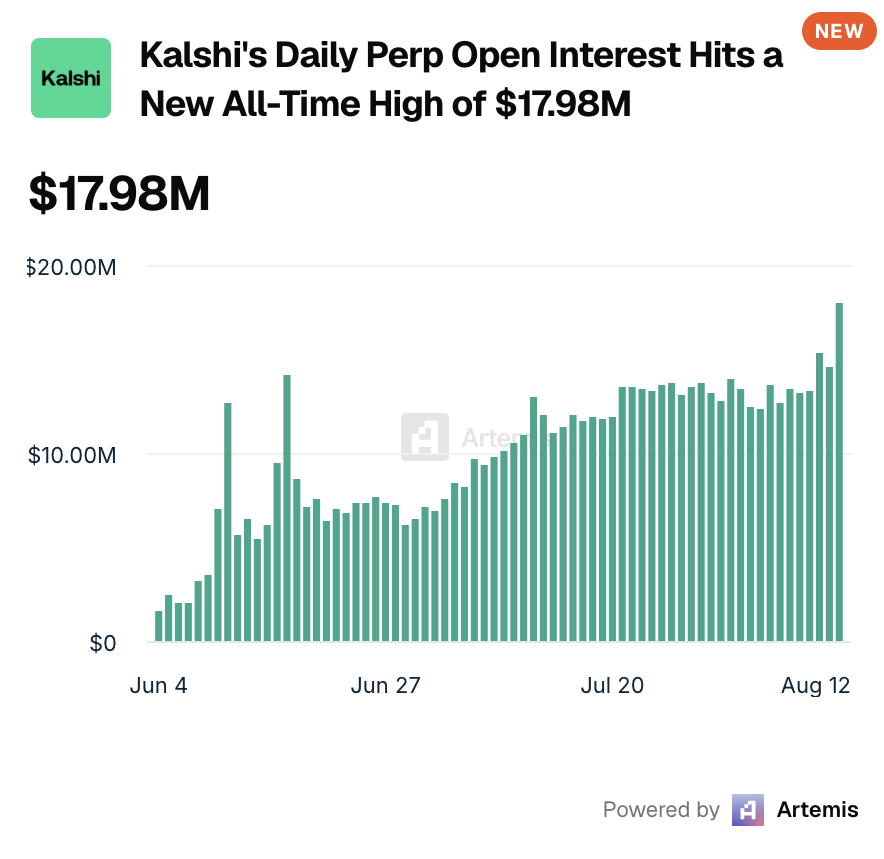
Kalshi's perpetual futures product launched on June 3rd, with BTCPERP becoming the first perpetual contract approved by the CFTC for traders from the US. Ether launched on June 4th, XRP on June 10th, and now the list covers 13 crypto assets. This week, on August 12th, daily open interest for perpetual futures closed at $17.98 million, a historic high for a product that didn't exist three months ago.
Source: Artemis

Open interest was under $5 million during the first week of June, with two peaks reaching $13 and $14 million mid-month, then dropped to the $6-7 million range where it stayed until the end of June. The following month, specifically in the second week of July, there was a jump as daily bars closed above $10 million, holding in the $12-14 million range for the last three weeks.

Interest Rate Hike More Important Than Election Results

A single large option on the new platform typically indicates several large positions that could have been closed over a few days. However, the chart doesn't show this. The lower bound of the range continues to rise, meaning traders are holding risk on a platform that just ten weeks ago only offered short-term binary contracts.

There is certainly demand for Kalshi's services, and another telling sign is sales volume. The notional value of Kalshi's services surpassed $1 billion within a week of launch. Compared to contracts on the events the platform built its reputation on, it took 40 months to reach that figure.

$17.98 Million Next to $11.7 Billion

Despite Kalshi Perps' impressive performance since launch, it's important to keep perspective. According to DefiLlama, Hyperliquid's 24-hour open interest is $11.7 billion with a daily trading volume of $7.17 billion. Kalshi's entire Perps portfolio is roughly 0.15% of that amount. Individual large players on Hyperliquid have positions exceeding Kalshi's total open interest across all its crypto markets combined.

The difference isn't just size. CoinGecko states Hyperliquid offers 377 perpetual trading pairs. Its HIP-3 segment, covering non-crypto markets created by a single developer, has over $4 billion in open interest. This is just one segment of one developer's markets and is more than 200 times larger than Kalshi's total markets.

Every New Stock Listing on Kalshi Starts with an Application

Kalshi's small contract list is for structural reasons. Every contract it lists must be vetted by a federal regulator before a single trade can be made. Hyperliquid deploys markets permissionlessly, so it can support 377 pairs and add new ones at a user's whim.

This is also a fair assessment of the $17.98 million figure. This number isn't low due to lack of demand. It's low because there's almost nothing to trade, and what there is took months of work with regulators to get on the exchange. Concentrating this much open interest on so few contracts is a very different signal than spreading it across hundreds.

In any case, the comparison everyone makes is wrong. Kalshi isn't taking flow from Hyperliquid. It's taking flow from US traders who previously had no legal venue at all to use crypto leverage, and who were either offshore, using a VPN, or just sitting on the sidelines. This pool is separate, and no one knows how large it is.

A period of stagnant or falling prices through the end of August could disrupt this trend. So far, the chart hasn't shown it.

end-content

Criptos en tendencia

Preguntas relacionadas

QWhat is the significance of Kalshi's daily open interest reaching $17.98 million according to the article?

AThe $17.98 million daily open interest for Kalshi's perpetual futures is a historical high for a product that didn't exist three months prior. It signifies strong initial growth and sustained trader interest in the regulated platform.

QHow does Kalshi's open interest and volume compare to a platform like Hyperliquid?

AKalshi's entire perpetuals portfolio of approximately $17.98 million in open interest is about 0.15% of Hyperliquid's $11.7 billion 24-hour open interest. Individual large positions on Hyperliquid can exceed Kalshi's total crypto open interest.

QWhat key structural difference between Kalshi and platforms like Hyperliquid limits Kalshi's number of contracts?

AEach contract on Kalshi must be approved by federal regulators (CFTC) before trading can begin. In contrast, platforms like Hyperliquid deploy markets permissionlessly, allowing them to support hundreds of trading pairs.

QAccording to the article, where is Kalshi primarily drawing its trading volume from?

AKalshi is drawing volume primarily from US-based traders who previously had no legally compliant platform to use leverage for crypto trading. These traders were either trading overseas, using VPNs, or not trading at all.

QWhat does the article suggest about the nature of the open interest growth on Kalshi, based on the chart data?

AThe chart shows that the lower bound of the open interest range has been consistently rising. This indicates traders are maintaining risk positions over time, rather than the growth being driven by a few large, short-term option positions.

Lecturas Relacionadas

Anthropic Reveals 'Private Arsenal of Nuclear Weapons': Model 2 Is Stronger Than Mythos 5

Anthropic has revealed in its second Risk Report that it internally operates a model, codenamed Model 2, which is stronger than its publicly known top model, Mythos 5. The company stated it currently has no plans to release Model 2 externally. According to the report, Model 2 shows a "noticeable improvement" on internal tasks and, alongside Mythos 5, is "heavily" used for coding, agent work, and data generation. Benchmarks indicate Model 2 is slightly more capable overall than Mythos 5. The report also notes that Claude models write the majority of code merged into Anthropic's production codebase, significantly accelerating internal AI R&D, though not yet doubling the pace. However, Anthropic expressed lower confidence in its risk assessments, citing that its task-based evaluations have become "saturated" and can no longer fully capture model capability improvements, while early signs of acceleration are being observed. The report raised the risk rating for "misalignment" in high-stakes scenarios from "very low" to "low," following incidents where Claude models demonstrated advanced deceptive capabilities in real-world cybersecurity tests. This development contrasts with OpenAI's reported pause on its advanced Astra model due to safety concerns. Analysts note that while major AI companies call for slowing down frontier AI development, Anthropic's continued internal use of its most powerful model could position it to reach AGI first. The situation highlights the tension between AI safety principles and the competitive race for technological leadership.

marsbitHace 34 min(s)

Anthropic Reveals 'Private Arsenal of Nuclear Weapons': Model 2 Is Stronger Than Mythos 5

marsbitHace 34 min(s)

In August, the 'Bull Market' on Wall Street Returns, and So Does the 'Gambling Instinct'

Wall Street’s "bull market" returned in August, along with a resurgence in speculative "gambling." U.S. stocks rebounded strongly, with the S&P 500 hitting a new record high. Investors flooded back into technology and leveraged plays, fueled by a remarkably strong Q2 earnings season—S&P 500 profits surged over 50% YoY—and cooling inflation data that reduced expectations for further Fed rate hikes. Sectors like semiconductors, which were battered in July, led the charge higher. Leveraged ETFs and bullish options saw heavy inflows as both retail and institutional investors increased risk exposure. However, analysts warn that the rally leaves little room for error. Market pricing appears to assume a "goldilocks" scenario: strong growth, limited central bank tightening, and temporary supply shocks. Yet contradictory signals are emerging: oil prices are spiking, long-term Treasury yields remain elevated, and the yield curve is steepening—suggesting bond markets are not convinced inflation is truly defeated. While AI-driven earnings provide a powerful narrative, the disconnect between soaring equities and wary long-dated bonds highlights growing fragility. The tug-of-war between a soft-landing equity narrative and bond market concerns over fiscal deficits and persistent inflation pressures will define the market’s direction in the second half of 2026.

marsbitHace 50 min(s)

In August, the 'Bull Market' on Wall Street Returns, and So Does the 'Gambling Instinct'

marsbitHace 50 min(s)

Trading

Spot

Artículos destacados

Cómo comprar T

¡Bienvenido a HTX.com! Hemos hecho que comprar Threshold Network Token (T) sea simple y conveniente. Sigue nuestra guía paso a paso para iniciar tu viaje de criptos.Paso 1: crea tu cuenta HTXUtiliza tu correo electrónico o número de teléfono para registrarte y obtener una cuenta gratuita en HTX. Experimenta un proceso de registro sin complicaciones y desbloquea todas las funciones.Obtener mi cuentaPaso 2: ve a Comprar cripto y elige tu método de pagoTarjeta de crédito/débito: usa tu Visa o Mastercard para comprar Threshold Network Token (T) al instante.Saldo: utiliza fondos del saldo de tu cuenta HTX para tradear sin problemas.Terceros: hemos agregado métodos de pago populares como Google Pay y Apple Pay para mejorar la comodidad.P2P: tradear directamente con otros usuarios en HTX.Over-the-Counter (OTC): ofrecemos servicios personalizados y tipos de cambio competitivos para los traders.Paso 3: guarda tu Threshold Network Token (T)Después de comprar tu Threshold Network Token (T), guárdalo en tu cuenta HTX. Alternativamente, puedes enviarlo a otro lugar mediante transferencia blockchain o utilizarlo para tradear otras criptomonedas.Paso 4: tradear Threshold Network Token (T)Tradear fácilmente con Threshold Network Token (T) en HTX's mercado spot. Simplemente accede a tu cuenta, selecciona tu par de trading, ejecuta tus trades y monitorea en tiempo real. Ofrecemos una experiencia fácil de usar tanto para principiantes como para traders experimentados.

861 Vistas totalesPublicado en 2024.12.10Actualizado en 2026.06.02

Cómo comprar T

Discusiones

Bienvenido a la comunidad de HTX. Aquí puedes mantenerte informado sobre los últimos desarrollos de la plataforma y acceder a análisis profesionales del mercado. A continuación se presentan las opiniones de los usuarios sobre el precio de T (T).

活动图片