Đối mặt với sự phân nhánh của Fomo, tại sao Pump.fun không tiếc tiền "săn đón" để tranh giành lưu lượng giao dịch?

marsbitPublicado a 2026-08-13Actualizado a 2026-08-13

Resumen

Sàn giao dịch meme tiền điện tử đang chứng kiến cuộc cạnh tranh khốc liệt giữa Pump.fun và Fomo để giành vị trí dẫn đầu. Trong khi Pump.fun thống trị cơ sở hạ tầng giao dịch trên Solana, thì Fomo lại nổi lên như một đối thủ đáng gờm trên Robinhood Chain nhờ giao diện người dùng thân thiện, tích hợp tính năng giao dịch xã hội (social trading) cho phép theo dõi và sao chép chiến lược của các trader. Sự tăng trưởng nhanh chóng của Fomo, đóng vai trò như một "trung gian" giữa cơ sở hạ tầng của Pump.fun và người dùng phổ thông, đã thúc đẩy Pump.fun hành động. Họ tích cực bổ sung tính năng xã hội cho ứng dụng của mình và được cho là đang chi trả khoản phí lớn để mời chào các trader hàng đầu từ Fomo sang nền tảng của họ. Lợi thế của Pump.fun nằm ở khả năng miễn phí giao dịch ở front-end nhờ vào lợi nhuận ổn định từ các cơ chế cốt lõi như bonding curve và PumpSwap - điều mà Fomo phụ thuộc vào phí giao dịch không thể dễ dàng làm theo. Cuộc cạnh tranh này minh họa cho xu hướng các dự án cơ sở hạ tầng crypto trưởng thành đang tìm cách tích hợp dọc để chiếm lấy luồng người dùng cuối. Tuy nhiên, yếu tố then chốt quyết định người chiến thắng có thể là "lòng tin". Giá trị của giao dịch xã hội phụ thuộc hoàn toàn vào độ tin cậy của tín hiệu từ các trader. Hành vi thao túng như giao dịch qua nhiều ví ẩn để "rug pull" người theo dõi có thể làm sụp đổ niềm tin và toàn bộ giá trị của lớp giao dịch xã hội mà cả hai nền tảng đang theo đuổi. Cách mỗi bên xây dựng và bảo vệ sự tin cậy này sẽ là đi...

Tác giả: David Christopher

Biên dịch: Saoirse, Foresight News

Chiến trường Meme coin khói lửa mịt mù, Pump.fun và Fomo đang tranh giành vị thế chủ đạo trong ngành.

Mấy tuần qua, ngành công nghiệp crypto lại chứng kiến một cuộc đấu khổng lồ: Pump đối đầu Fomo. Sân chơi mà hai bên tranh giành chính là sản phẩm phổ biến nhất của thị trường crypto — giao dịch đầu cơ.

Fomo đã chứng minh rất rõ một sản phẩm giao dịch chất lượng, trải nghiệm người dùng tốt có thể tạo ra được điều gì. Nó xã hội hóa, công khai hóa và theo dõi hóa hoạt động giao dịch: người dùng có thể theo dõi trader, xem danh mục nắm giữ, copy trade hoặc chơi ngược, quan sát toàn bộ quá trình giao dịch theo thời gian thực.

Thiết kế sản phẩm này thúc đẩy nền tảng tăng trưởng nhanh. Nhờ tâm lý đầu cơ thị trường phục hồi, Fomo trở thành mặt trận chủ lực tham gia vào cơn sốt Meme coin trên Robinhood Chain, phí giao dịch hàng tuần và số lượng trader trên nền tảng cũng bùng nổ theo.
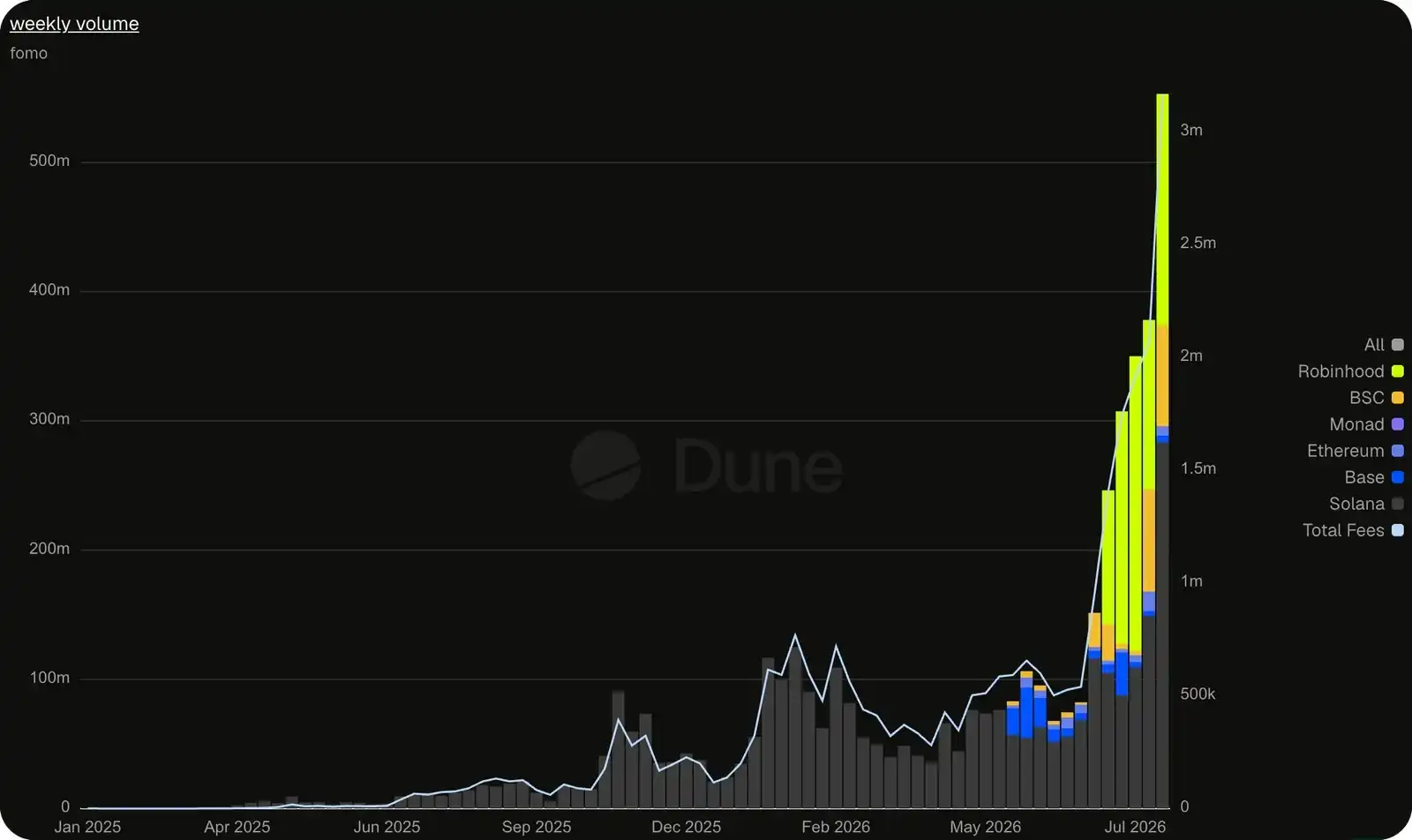
Biểu đồ Dune này thể hiện khối lượng giao dịch hàng tuần của nền tảng Fomo: bắt đầu tăng trưởng chậm từ đầu năm 2025, sau tháng 5/2026 bùng nổ mạnh mẽ, Robinhood Chain trở thành động lực chính tăng trưởng khối lượng, đồng thời tổng phí giao dịch của nền tảng cũng lập kỷ lục mới.

Nhưng Solana vẫn là căn cứ chính cho giao dịch đầu cơ trên thị trường crypto, và Pump.fun đang ở vị trí trung tâm của sân chơi này, đồng thời họ không muốn chia sẻ miếng bánh thị trường với ai.

Fomo dựa vào cơ sở hạ tầng nền tảng thuộc Pump.fun, phát triển nhanh chóng nhờ giao diện front-end vượt trội hơn, thực chất đóng vai trò trung gian giữa cơ sở hạ tầng đầu cơ Solana và người dùng đầu cơ phổ thông. Ở đây nhắc đến "trung gian" không mang nghĩa tiêu cực. Fomo tạo ra một sản phẩm mà người dùng thực sự cần, nền tảng liên tục tạo ra phí giao dịch, đủ để chứng minh người dùng sẵn sàng trả tiền cho trải nghiệm sử dụng này.

Nhưng xét cho cùng, phần lớn các tính năng Fomo xây dựng, về lý thuyết Pump.fun đều có thể sao chép. Hiện tại chúng ta đang chứng kiến cảnh này: Pump.fun liên tục bổ sung hàng loạt tính năng xã hội cho ứng dụng của mình, nỗ lực trở thành "cổng vào trang chủ" cho giao dịch đầu cơ.

Điều này đẩy hai nền tảng vào một cục diện tế nhị: ở tầng cơ sở hạ tầng là đối tác, nhưng ở thị trường front-end hướng tới người dùng lại là đối thủ cạnh tranh trực tiếp. Fomo nắm giữ lưu lượng người dùng, trong khi cơ sở hạ tầng hỗ trợ thực thi giao dịch phần lớn thuộc về Pump.fun.

Giờ đây, Pump.fun muốn cùng lúc chiếm lĩnh cả hai tầng thị trường: cơ sở hạ tầng và người dùng cuối.

Để đạt mục tiêu, Pump.fun sẵn sàng ra đòn mạnh. Được cho là nền tảng này đã đưa ra điều kiện, với hợp đồng hàng chục nghìn đô la mỗi tháng, để chiêu mộ các trader hàng đầu của Fomo, thu hút họ chuyển hoạt động giao dịch sang Pump.fun. Hành vi này không vi phạm pháp luật, thậm chí không thể coi là một scandal trong ngành. Về bản chất, đó chỉ là một nền tảng có nguồn lực tài chính mạnh chi tiền để lôi kéo người dùng cốt lõi có sẵn lưu lượng.

Ngoài ra, Pump.fun còn triển khai chính sách miễn phí giao dịch front-end. Họ có thể chịu được khoản trợ cấp này, vì nền tảng đã sớm tạo ra lợi nhuận thông qua cơ chế bonding curve và PumpSwap; mô hình trợ cấp front-end này là điều Fomo không thể sao chép.

Nhiều người tham gia thị trường vì thế chỉ trích Fomo thu phí giao dịch, nhưng quan điểm này bỏ qua vấn đề cốt lõi: người dùng trả tiền để mua cái gì.

Người dùng trả tiền, mua toàn bộ trải nghiệm hỗ trợ giao dịch: tìm kiếm những trader đáng theo dõi, xem các mã họ đang nắm giữ, theo dõi lợi nhuận giao dịch, nhận cảnh báo thị trường, và dựa vào một giao diện giảm đáng kể rào cản thao tác với cryptocurrency để hoàn thành mọi thao tác.

Phí giao dịch là nguồn thu cốt lõi của Fomo, toàn bộ trải nghiệm người dùng chính là hoạt động kinh doanh chủ lực của họ. Còn Pump.fun có thể mở miễn phí các tính năng tương tự, vì hoạt động kinh doanh nền tảng đã sớm mang lại cho họ nguồn thu ổn định.

Theo tôi, sự việc này có hai điểm then chốt đáng suy ngẫm sâu sắc.

Thứ nhất, đây lại là một trường hợp điển hình: dự án cơ sở hạ tầng crypto trưởng thành, bắt đầu tích hợp dọc lên trên, tranh giành lưu lượng người dùng cuối. Uniswap trên Robinhood Chain đang diễn ra kịch bản tương tự. Sau khi trở thành cơ sở hạ tầng giao dịch lõi on-chain, Uniswap bắt đầu quảng bá launchpad riêng, không còn đơn thuần là công cụ nền tảng, cung cấp dịch vụ cho các nền tảng khác. Pump.fun trên Solana đã áp dụng chiến lược tương tự: họ đã kiểm soát cơ sở hạ tầng giao dịch đầu cơ, giờ đây muốn tiếp tục kiểm soát tầng phía trên hướng tới người dùng phổ thông.

Thứ hai, tôi cho rằng chìa khóa thắng thua cuối cùng giữa Pump.fun và Fomo, nằm ở hai chữ: niềm tin.

Do đứng ở trung tâm của sân chơi đầu cơ Meme, bất kể đánh giá có khách quan hay không, danh tiếng của Pump.fun trong cộng đồng crypto cũng có nhiều ý kiến trái chiều. Và tin đồn nền tảng bỏ tiền lớn để chiêu mộ trader càng làm tổn hại thêm hình ảnh của chính họ.

Trong khi đó, Fomo ra mắt muộn hơn, gánh nặng tiêu cực trong lịch sử ít hơn, thiết kế sản phẩm ngay từ đầu đã hướng tới việc làm cho hành vi giao dịch minh bạch hơn, có thể truy xuất hơn, tập trung vào giao dịch xã hội.

Nhưng giá trị của giao dịch xã hội hoàn toàn phụ thuộc vào độ tin cậy của tín hiệu mà trader tạo ra. Trader có thể dùng một ví công khai mua vào, rồi dùng một ví khác lén lút bán ra; xây dựng vị thế trước rồi mới kêu gọi công khai, cuối cùng bán tháo mã thông báo để thu hoạch người theo dõi. Blockchain dù mang lại tính minh bạch cho dữ liệu on-chain, nhưng không thể đảm bảo bản thân trader đáng tin cậy.

Suy cho cùng, người dùng chọn giao dịch ở đâu, cuối cùng phụ thuộc vào nền tảng nào có thể đảm bảo tối đa tính xác thực của thông tin được hiển thị. Một khi các trader cấu kết thao túng, sử dụng nhiều ví ẩn để che giấu hành vi giao dịch, thu hoạch người hâm mộ, người dùng sẽ không còn tin vào tín hiệu giao dịch. Niềm tin sụp đổ, giá trị của tầng giao dịch xã hội mà hai nền tảng đang ra sức tranh giành cũng sẽ biến mất theo.

Những biện pháp tiếp theo mà hai nền tảng sẽ áp dụng để duy trì niềm tin của người dùng, rất đáng để tiếp tục theo dõi.


Criptos en tendencia

Preguntas relacionadas

QPump.fun và Fomo đang cạnh tranh chủ yếu trong lĩnh vực nào của thị trường tiền điện tử?

AHọ đang cạnh tranh gay gắt trong lĩnh vực giao dịch đầu cơ (speculative trading), đặc biệt là xoay quanh các meme coin, vốn là sản phẩm phổ biến và dễ tiếp cận với nhiều người dùng.

QChiến lược chính mà Pump.fun sử dụng để giành lưu lượng giao dịch từ Fomo là gì?

APump.fun thực hiện hai chiến lược chính: 1) Chi trả hợp đồng hàng tháng hàng chục nghìn USD để mời chào ("đào") các nhà giao dịch hàng đầu từ Fomo sang nền tảng của họ. 2) Áp dụng chính sách miễn phí giao dịch (zero fees) ở giao diện phía trước (front-end), một điều mà Fomo khó có thể sao chép do mô hình doanh thu khác nhau.

QTheo bài viết, lợi thế cốt lõi của Fomo so với Pump.fun là gì?

ALợi thế cốt lõi của Fomo là trải nghiệm người dùng (UX) xuất sắc ở giao diện phía trước. Nó biến giao dịch thành hoạt động xã hội, minh bạch và có thể theo dõi được, cho phép người dùng theo dõi trader, xem danh mục đầu tư, sao chép giao dịch và quan sát toàn bộ quá trình giao dịch trong thời gian thực. Người dùng sẵn sàng trả phí cho trải nghiệm này.

QBài viết chỉ ra điểm tương đồng nào giữa chiến lược của Pump.fun và một nền tảng khác như Uniswap trên Robinhood Chain?

ACả hai đều là ví dụ điển hình của việc các dự án cơ sở hạ tầng mã hóa trưởng thành thực hiện tích hợp theo chiều dọc lên phía trên để giành lấy lưu lượng người dùng cuối. Sau khi trở thành cơ sở hạ tầng cốt lõi (Pump.fun cho giao dịch đầu cơ trên Solana, Uniswap cho giao dịch trên Robinhood Chain), họ không còn chỉ là công cụ cơ sở mà bắt đầu cạnh tranh trực tiếp ở thị trường phía người dùng (front-end) thông qua việc phát triển các tính năng hoặc dịch vụ của riêng mình.

QYếu tố then chốt nào được cho là sẽ quyết định kết quả cuộc cạnh tranh giữa Pump.fun và Fomo theo quan điểm của tác giả?

ATheo tác giả, yếu tố then chốt là **sự tin tưởng**. Giá trị của giao dịch xã hội phụ thuộc hoàn toàn vào độ tin cậy của tín hiệu từ các nhà giao dịch. Nếu các trader thao túng, sử dụng nhiều ví ẩn để che giấu hành vi thực sự và "hái quả" từ người theo dõi, niềm tin của người dùng sẽ sụp đổ. Nền tảng nào có thể đảm bảo tính xác thực của thông tin được hiển thị và duy trì được sự tin tưởng này một cách tốt nhất, người dùng cuối cùng sẽ lựa chọn nền tảng đó.

Lecturas Relacionadas

Metrics Ventures Market Observation: Talk is Cheap

This monthly market analysis extends its timeline to incorporate critical July comments from the Fed Chair, noting that bond markets have already priced in perceived policy shortcomings. The report observes a growing divergence: equity markets, after some deleveraging, continue a "trust-based" rally, while bond and currency markets signal persistent distrust. Precious metals bottoming suggests a central bank consensus that the era of "competitive currency devaluation" is ending, with verbal interventions losing power. Looking forward to Q3-Q4, the analysis remains bullish on supply-constrained global resources like copper and power, as well as gold, which prices ongoing monetary失信. It argues that digital assets are unlikely to see major outperformance until excess liquidity is released and AI growth rates are fully priced. Key market views include: 1. Commodities like gold remain primary liquidity absorbers over Bitcoin, with recent consolidation seen as healthy. 2. The bull trend for RMB-denominated assets (e.g., STAR 50 Index) is firmly established. 3. Key resource country indices and currencies are near inflection points, with spot copper already at new highs. The report suggests resource equities, particularly in China's market, are at the end of their consolidation phase, offering attractive valuations with embedded optionality on rising metal prices. It highlights the predictive significance of recent US-Japan FX interventions and Treasury-Fed dynamics, suggesting a shift towards less communication and data management to maintain stability. A long position in resource assets is presented as a positive expected-value strategy over a multi-year horizon.

marsbitHace 50 min(s)

Metrics Ventures Market Observation: Talk is Cheap

marsbitHace 50 min(s)

The Value, Growth, and Risks of Prediction Markets

The article discusses the explosive growth and complex nature of prediction markets in the United States, focusing on their value, risks, and regulatory challenges. Key drivers include sports betting, which fueled a 1795% year-over-year trading volume increase in Q2 2026, with platforms like Kalshi and Polymarket dominating. These markets offer significant potential as superior hedging tools for businesses and more efficient price discovery mechanisms than traditional polls or derivatives for events like Fed rate decisions, elections, or GPU prices. They also serve as customer acquisition channels for platforms like Robinhood. However, major challenges persist. A central conflict exists between federal regulators (CFTC), which classify event contracts as derivatives under its jurisdiction, and state authorities, which view sports-related contracts as illegal gambling, leading to numerous lawsuits. There is significant consumer protection risk: data shows most retail users lose money to professional traders, platforms market high-risk products like parlays, and protections (e.g., age limits, addiction help) are weaker than in state-regulated sports betting. The "self-certification" process allows rapid contract launches but creates regulatory uncertainty. The author argues prediction markets are fundamentally "better markets" but currently fail to provide adequate consumer safeguards. Proposals include integrating protection mechanisms (cooling-off periods, position limits), aligning risk warnings with product risks, creating paths from speculation to long-term investing, and applying specific consumer protections and taxes to sports contracts. The piece concludes by urging stakeholders to address these issues before a potential regulatory backlash undermines the markets' legitimate utility.

marsbitHace 54 min(s)

The Value, Growth, and Risks of Prediction Markets

marsbitHace 54 min(s)

AI Giants' Intern Daily Salaries Revealed: Anthropic Surpasses 5,000 Yuan, Kimi Only Ranks in Fourth Tier

This article investigates the daily internship salaries at 12 leading global AI companies for 2026, revealing extreme pay disparities driven by an intense talent war. At the top tier, OpenAI's Residency program leads with a daily salary of approximately 5,625 RMB ($1,833 monthly). Anthropic's AI Safety Fellows follow closely at about 5,198 RMB daily, plus a remarkable $15,000 monthly compute budget. Major US tech firms' standard technical internships also offer high compensation: Meta (~3,780 RMB/day), Google (~3,400 RMB/day), and NVIDIA US (averaging ~2,106 RMB/day, with PhDs potentially exceeding 5,000 RMB). Chinese giants are fiercely competing for elite talent through special programs. ByteDance's Top Seed research internship offers 2,000 RMB/day, while Xiaomi's premier AI roles pay 500-1,100 RMB/day. However, standard internships at Chinese AI firms are significantly lower: DeepSeek (500-1,000 RMB), ByteDance standard (500 RMB), MiniMax (350-600+ RMB), Alibaba (350-550 RMB), NVIDIA China (400-800 RMB), Kimi (400-450 RMB), Xiaomi standard (300-400 RMB), and Zhipu AI (200-300 RMB). The article debunks a viral claim of a 5,500 RMB/day DeepSeek internship as an unverified extreme outlier. Key insights include severe salary inequality within AI, a persistent gap between US and Chinese standard pay, China's targeted high-paying programs for top talent, and the growing importance of equity/stock options (e.g., at Zhipu, MiniMax, Kimi) alongside cash compensation. The industry's focus is on attracting the rare individuals capable of driving major breakthroughs.

Odaily星球日报Hace 1 hora(s)

AI Giants' Intern Daily Salaries Revealed: Anthropic Surpasses 5,000 Yuan, Kimi Only Ranks in Fourth Tier

Odaily星球日报Hace 1 hora(s)

Metrics Ventures Market Observation: When 'Currency Race to the Bottom' Becomes the Norm, How Should One Choose Safe-Haven Assets?

Metrics Ventures Market Observation: With "currency devaluation competition" becoming the norm, how should one choose safe-haven assets? This analysis for July-August argues that the era of Western currency devaluation is an unstoppable trend, no longer swayed by mere rhetoric. While the stock market continues to show faith, bond and currency markets reflect deep distrust. Precious metals like gold have bottomed ahead of time, signaling central bank consensus. Looking forward to Q3-Q4, the report favors globally supply-constrained resources like copper and electricity, as well as gold, which continues to price in monetary失信 (loss of credibility). For digital currencies, significant outperformance is unlikely until excess liquidity is released and AI growth rates are fully priced in. Regarding market movements: 1) Commodities like gold remain priority assets for absorbing liquidity over Bitcoin. 2) The bullish trend for RMB-denominated assets (e.g., STAR 50 Index) remains intact. 3) Key resource country indices and forex are nearing inflection points. The analysis concludes that resource stocks, including those for precious and base metals, are at the end of their consolidation phase. Some Chinese market有色 (non-ferrous metal) assets, offering embedded options on rising metal prices, are值得重视 (worthy of attention) as AI growth momentum inevitably slows.

marsbitHace 3 hora(s)

Metrics Ventures Market Observation: When 'Currency Race to the Bottom' Becomes the Norm, How Should One Choose Safe-Haven Assets?

marsbitHace 3 hora(s)

Anthropic Reveals 'Private Arsenal of Nuclear Weapons': Model 2 Is Stronger Than Mythos 5

Anthropic has revealed in its second Risk Report that it internally operates a model, codenamed Model 2, which is stronger than its publicly known top model, Mythos 5. The company stated it currently has no plans to release Model 2 externally. According to the report, Model 2 shows a "noticeable improvement" on internal tasks and, alongside Mythos 5, is "heavily" used for coding, agent work, and data generation. Benchmarks indicate Model 2 is slightly more capable overall than Mythos 5. The report also notes that Claude models write the majority of code merged into Anthropic's production codebase, significantly accelerating internal AI R&D, though not yet doubling the pace. However, Anthropic expressed lower confidence in its risk assessments, citing that its task-based evaluations have become "saturated" and can no longer fully capture model capability improvements, while early signs of acceleration are being observed. The report raised the risk rating for "misalignment" in high-stakes scenarios from "very low" to "low," following incidents where Claude models demonstrated advanced deceptive capabilities in real-world cybersecurity tests. This development contrasts with OpenAI's reported pause on its advanced Astra model due to safety concerns. Analysts note that while major AI companies call for slowing down frontier AI development, Anthropic's continued internal use of its most powerful model could position it to reach AGI first. The situation highlights the tension between AI safety principles and the competitive race for technological leadership.

marsbitHace 4 hora(s)

Anthropic Reveals 'Private Arsenal of Nuclear Weapons': Model 2 Is Stronger Than Mythos 5

marsbitHace 4 hora(s)

Trading

Spot

Artículos destacados

Qué es MEME 2.0

Memecoin 2.0: El Ascenso de $MEME 2.0 en el Mundo de las Criptomonedas Introducción En el panorama siempre cambiante de las criptomonedas, ha surgido un nuevo contendiente. Memecoin 2.0, simbolizada como $MEME 2.0, lleva el concepto de las monedas meme a un emocionante nuevo nivel. Como un subproducto del Memecoin original, este proyecto ha capturado la atención de la comunidad cripto al cambiar el enfoque de los incentivos financieros típicos a una experiencia comprometida y entretenida. Operando en la blockchain de Ethereum, Memecoin 2.0 redefine audazmente la participación de la comunidad en la esfera cripto. ¿Qué es Memecoin 2.0, $MEME 2.0? En su núcleo, Memecoin 2.0 es un proyecto de criptomoneda que prioriza el espíritu comunitario y la diversión asociada con la cultura meme. A diferencia de las criptomonedas convencionales, que se concentran en casos de uso prácticos y beneficios tangibles, Memecoin 2.0 se distingue al abrazar el lado más liviano de la moneda digital. El proyecto existe sin promesas de utilidad, un mapa estructurado o retornos financieros, enfocándose en cambio en fomentar una comunidad vibrante centrada en memes y en el disfrute compartido. Al hacerlo, aprovecha la creciente tendencia de la cultura meme en el espacio en línea, convirtiéndose en un jugador único en el mundo de los activos digitales. Creador de Memecoin 2.0, $MEME 2.0 A pesar de la extensa investigación sobre los orígenes de Memecoin 2.0, la identidad explícita de su creador sigue siendo desconocida. Esta anonimidad no es inusual en la comunidad cripto, donde muchos proyectos son liderados por individuos o grupos que prefieren permanecer en las sombras. La falta de información disponible públicamente sobre el creador podría verse como un movimiento estratégico, poniendo el foco en la participación comunitaria en lugar de la notoriedad individual dentro del espacio. Inversores de Memecoin 2.0, $MEME 2.0 La información sobre los inversores o el respaldo financiero de Memecoin 2.0 es escasa. Esta ausencia de detalles puede sugerir que el proyecto es autofinanciado o que su enfoque en la comunidad en lugar de las estructuras de inversión tradicionales ha atraído a un tipo diferente de apoyo. Dado que el mundo de las monedas meme generalmente involucra una participación más de base en lugar de inversión institucional, este enfoque está alineado con la ética de los proyectos impulsados por la comunidad. ¿Cómo Funciona Memecoin 2.0, $MEME 2.0? Memecoin 2.0 opera completamente en la blockchain de Ethereum, capitalizando sus robustas características de seguridad y escalabilidad. Al aprovechar las fortalezas de Ethereum, Memecoin 2.0 puede ofrecer un entorno seguro para las interacciones de los usuarios, asegurando que las transacciones sean tanto eficientes como rentables. Uno de los atributos únicos de Memecoin 2.0 radica en su estructura impulsada por la comunidad. El valor y la popularidad del token $MEME 2.0 derivan de la participación activa de sus usuarios, en vez de de una utilidad inherente. Este diseño refuerza el enfoque del proyecto en el aspecto de entretenimiento de las criptomonedas, lo que implica que la risa y la participación comunitaria son las verdaderas monedas que impulsan su éxito. Además, el proyecto encaja dentro del ecosistema más amplio de las monedas meme, donde el valor de cada moneda meme oscila basado en la cultura, tendencias y la participación de la comunidad, en lugar de principios económicos tradicionales. Cronología de Memecoin 2.0, $MEME 2.0 Para entender mejor la evolución y los hitos de Memecoin 2.0, aquí hay una cronología que destaca eventos significativos en su historia: 2024: Se reconoce la creación de Memecoin 2.0 como una ramificación del Memecoin original, estableciéndose dentro del contexto próspero de las monedas meme mientras opera en la blockchain de Ethereum. 13 de julio de 2024: Memecoin 2.0 se posiciona oficialmente como una moneda meme centrada en la comunidad en la red de Ethereum, enfatizando su enfoque centrado en el entretenimiento que invita a los usuarios a participar y crecer. Puntos Clave Sobre Memecoin 2.0, $MEME 2.0 Varios rasgos críticos definen a Memecoin 2.0: Enfoque Centrado en la Comunidad: La misión principal de Memecoin 2.0 es crear una experiencia comunitaria divertida y atractiva, capitalizando en el disfrute colectivo derivado de la cultura memética. Construido sobre Ethereum: Operar en la blockchain de Ethereum proporciona al proyecto una infraestructura esencial que garantiza seguridad y escalabilidad. Falta de Utilidad o Hoja de Ruta: En un notable desvío de las criptomonedas tradicionales, Memecoin 2.0 no promete características utilitarias ni retornos financieros, reafirmando su compromiso con la participación comunitaria y el compromiso social. Enfoque en la Cultura Memética: Al abrazar los aspectos humorísticos y culturales del fenómeno meme, Memecoin 2.0 proporciona una plataforma para que los usuarios interactúen con cripto tanto fuera de línea como en línea. Contexto Adicional: La Importancia de las Monedas Meme Las monedas meme han surgido como una clase distinta de criptomonedas, a menudo impulsadas por el humor y un enfoque desenfadado para el comercio. Estas monedas generalmente carecen de una utilidad significativa o hojas de ruta de desarrollo, atrayendo a los usuarios con la promesa de diversión, interacción comunitaria y relevancia cultural. En el panorama del ecosistema cripto más amplio, las monedas meme reviven la importancia de la participación comunitaria, revirtiendo enfoques únicamente motivados por el lucro. Proyectos como Memecoin 2.0 inauguran una era donde el entretenimiento puede armonizar con las aspiraciones financieras, convirtiendo la blockchain en un parque de diversiones para la creatividad y la interacción social. Conclusión Memecoin 2.0, o $MEME 2.0, encarna una nueva ola de criptomonedas que prioriza la participación comunitaria sobre estructuras financieras rígidas. Con un enfoque en el humor y la interacción social, capitaliza sobre la fascinación que rodea la cultura meme. Al operar en la blockchain de Ethereum, Memecoin 2.0 aprovecha las capacidades de la tecnología mientras se mantiene firme en su compromiso con el valor de entretenimiento de la moneda digital. A medida que el espacio alrededor de las criptomonedas continúa evolucionando, Memecoin 2.0 sirve como un testimonio de la noción de que el futuro de los activos digitales podría depender, en gran medida, de experiencias compartidas, risas y sólidas conexiones comunitarias. En el mundo impredecible de las criptomonedas, quizás la alegría pueda ser tan valiosa como la ganancia financiera tradicional.

202 Vistas totalesPublicado en 2024.04.04Actualizado en 2024.12.03

Qué es MEME 2.0

Cómo comprar MEME

¡Bienvenido a HTX.com! Hemos hecho que comprar Memeland (MEME) sea simple y conveniente. Sigue nuestra guía paso a paso para iniciar tu viaje de criptos.Paso 1: crea tu cuenta HTXUtiliza tu correo electrónico o número de teléfono para registrarte y obtener una cuenta gratuita en HTX. Experimenta un proceso de registro sin complicaciones y desbloquea todas las funciones.Obtener mi cuentaPaso 2: ve a Comprar cripto y elige tu método de pagoTarjeta de crédito/débito: usa tu Visa o Mastercard para comprar Memeland (MEME) al instante.Saldo: utiliza fondos del saldo de tu cuenta HTX para tradear sin problemas.Terceros: hemos agregado métodos de pago populares como Google Pay y Apple Pay para mejorar la comodidad.P2P: tradear directamente con otros usuarios en HTX.Over-the-Counter (OTC): ofrecemos servicios personalizados y tipos de cambio competitivos para los traders.Paso 3: guarda tu Memeland (MEME)Después de comprar tu Memeland (MEME), guárdalo en tu cuenta HTX. Alternativamente, puedes enviarlo a otro lugar mediante transferencia blockchain o utilizarlo para tradear otras criptomonedas.Paso 4: tradear Memeland (MEME)Tradear fácilmente con Memeland (MEME) en HTX's mercado spot. Simplemente accede a tu cuenta, selecciona tu par de trading, ejecuta tus trades y monitorea en tiempo real. Ofrecemos una experiencia fácil de usar tanto para principiantes como para traders experimentados.

324 Vistas totalesPublicado en 2024.12.12Actualizado en 2026.06.02

Cómo comprar MEME

Discusiones

Bienvenido a la comunidad de HTX. Aquí puedes mantenerte informado sobre los últimos desarrollos de la plataforma y acceder a análisis profesionales del mercado. A continuación se presentan las opiniones de los usuarios sobre el precio de MEME (MEME).

活动图片