Hang Seng TECH Index Launches Largest Reform in History

marsbitPublicado a 2026-08-12Actualizado a 2026-08-12

Resumen

The Hang Seng Tech Index is undergoing its most significant reform since its launch in 2020. In a consultation paper, Hang Seng Indexes proposed major changes to enhance the index's market representation, reflecting the evolution of Hong Kong's tech sector. Key proposed revisions include completely removing industry classification restrictions, updating six key technology themes (e.g., Digital Platforms, AI, Advanced Hardware), and implementing a dual-track selection mechanism. This new mechanism will pick 40 constituents based on market capitalization and 10 based on revenue growth, expanding the total number of constituents from 30 to 50. The reform aims to address the index's historical concentration in large internet platforms like Tencent and Alibaba, which has caused it to miss gains from newer, high-growth tech areas such as AI and semiconductors. Many of these newer companies are smaller in market cap but show stronger revenue growth. The proposed changes would significantly increase exposure to themes like Advanced Hardware (from 5 to 15 simulated constituents) and AI (from 3 to 6). Simulated results show the reform would slightly reduce the index's concentration in its top ten holdings, diversify its thematic exposure, and incorporate faster-growing companies. The "revenue growth" subset of new constituents shows a median growth rate of 82%, far exceeding the current index's 13.8%. Final revisions are expected by late September, with changes taking effect in Dec...

The Hang Seng TECH Index is actively embracing hard technology.

On the evening of August 10, Hang Seng Indexes Company issued a consultation paper stating that the composition of Hong Kong's technology sector continues to expand, with faster-growing revenue companies often having smaller market capitalizations. To enhance the market representation of the Hang Seng TECH Index, they are seeking market opinions on the index revision proposal.

The key points of this reform include: fully removing industry restrictions; revising six technology themes; introducing a dual-track stock selection mechanism based on market capitalization and revenue growth; and expanding the number of constituent stocks from 30 to 50.

"The Hang Seng Index has been under significant pressure over the past six months, missing out on the gains brought by the global AI (Artificial Intelligence) surge," a source close to Hang Seng Indexes Company told Caijing. "This is just the first step of the reform, starting with the consultation paper. We will see how the market responds next."

According to simulation calculations by Hang Seng Indexes Company, among the 50 constituent stocks of the revised Hang Seng TECH Index, the number of stocks related to advanced hardware and artificial intelligence would increase from the current 5 and 3 to 15 and 6, respectively.

The results of this revision are expected to be announced by the end of September, with changes to the constituent stocks taking effect on the official index adjustment date in December. If the plan is ultimately approved, this would be the most significant and systematic structural reform of the Hang Seng TECH Index since its launch in 2020.

As of the end of June 2026, the global fund assets tracking this index have reached US$40.4 billion. Any changes to the constituent list and weights will trigger large-scale passive fund rebalancing, and its impact on Hong Kong's technology sector extends far beyond technical adjustments to index compilation.

1

Changes in Hong Kong's Tech Ecosystem

Looking back to July 2020, the Hang Seng TECH Index was officially launched, with the original intention of providing global investors with a tool to track the overall performance of Hong Kong-listed technology companies, selecting the 30 largest technology firms by market capitalization. Today, the Hang Seng TECH Index has grown into one of the most influential flagship indices in the Hong Kong stock market, with tracking assets increasing from an initial US$1.5 billion to US$40.4 billion, a nearly 26-fold increase.

Although the index's market status has grown, its representative capacity has not kept pace with the dramatic changes in Hong Kong's technology ecosystem. In the past, because the Hang Seng TECH Index has been highly concentrated in the Network and E-commerce themes since its inception, the weights of internet platform companies such as Tencent, Meituan, and Alibaba have long dominated. The index's fluctuations were largely tied to the outcomes of food delivery subsidy wars, e-commerce promotional season data, and even the approval rhythm of game licenses.

The scope of technology investment in Hong Kong continues to expand. Over the past few years, Hong Kong has welcomed a batch of companies in artificial intelligence, semiconductors, robotics, and specialized technology, with enterprises listed under the HKEX's new Chapter 18C rules also increasing. However, these companies generally have short listing histories and small market capitalizations, systematically excluded by the market capitalization threshold.

According to Hang Seng Indexes Company data, at the end of 2021, the Network theme had the highest share among Hong Kong tech stocks, accounting for 37.3%. By the first half of 2026, Network's share had dropped to 25.0%, surpassed by Intelligent Transformation at 32.1%.

Furthermore, within Hong Kong's technology sector, companies with stronger revenue growth tend to have smaller market capitalizations. Hang Seng Indexes Company data shows that the median revenue growth of current Hang Seng TECH Index constituents is significantly lower than that of smaller-cap, non-constituent companies.

Currently, the Hang Seng TECH Index has included two major AI listed companies, but this has not impacted the heavyweight stocks. The latest Hang Seng TECH Index changes effective on June 8 included MiniMax and Zhipu AI, with a combined weighting of less than 1%.

2

What Impact Will the Two Major Revision Proposals Have?

The revision proposals for the Hang Seng TECH Index involve structural adjustments around two dimensions.

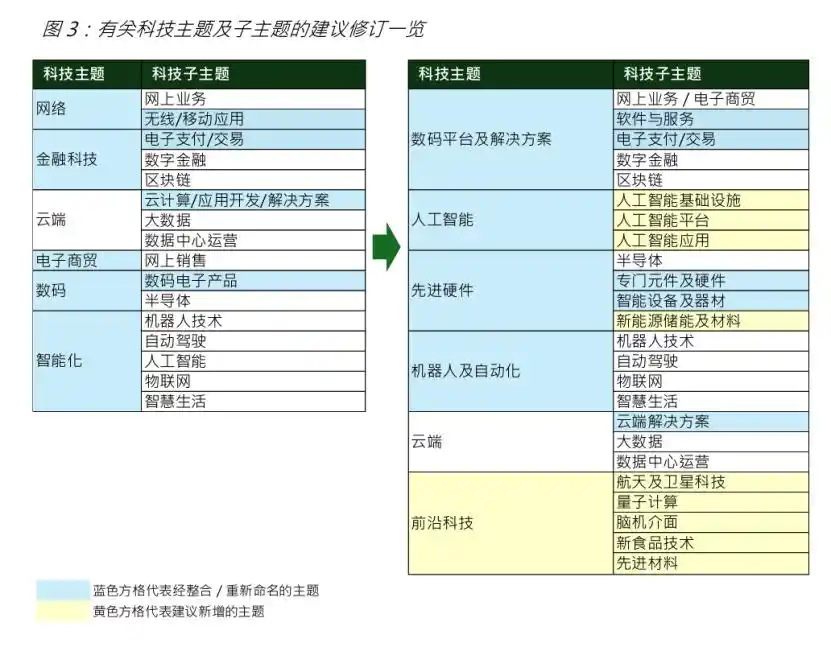
The first is expanding the coverage of technology themes. Specific suggestions include: removing industry requirements, as technological innovation has integrated into all industries and is not limited by traditional sector classifications; revising six major technology themes to cover Digital Platforms & Solutions, Artificial Intelligence, Advanced Hardware, Robotics & Automation, Cloud, and Frontier Technology. Additionally, expanding the number of technology sub-themes under the six major themes from 16 to 24.
Source: Hang Seng Indexes Company website

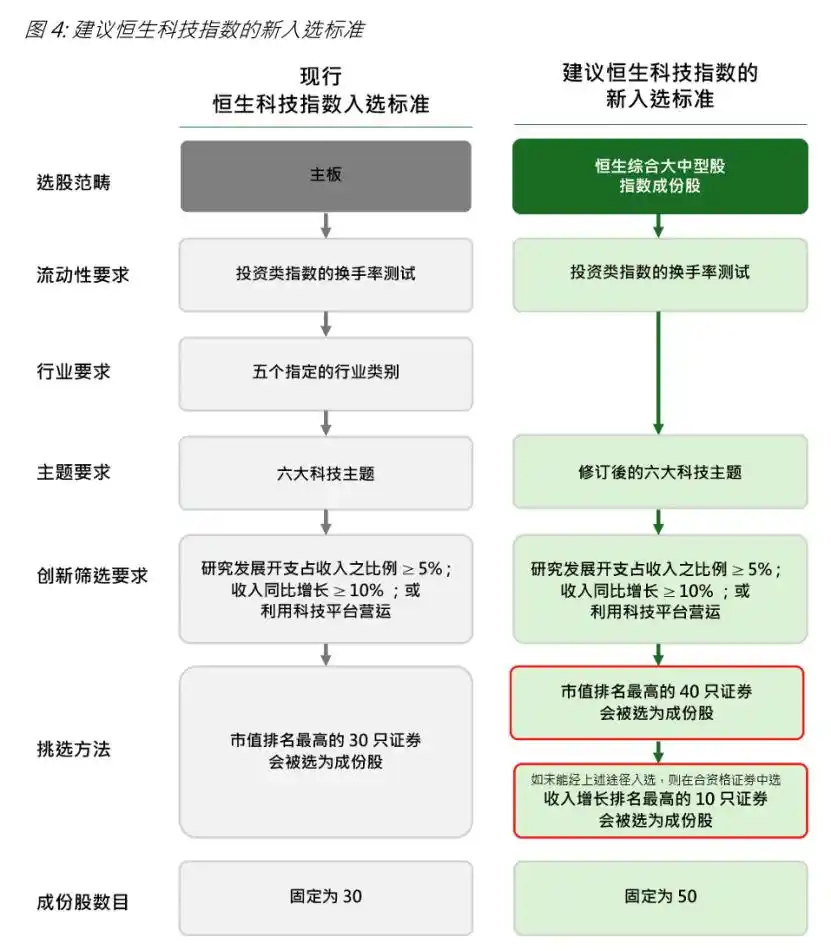
The second is introducing a grouping selection mechanism. Hang Seng Indexes Company proposes that the stock selection scope for the Hang Seng TECH Index be limited to constituents of the Hang Seng Composite LargeCap & MidCap Index, while introducing a grouping selection mechanism. Selection will proceed via a dual-track system based on "Market Capitalization Group" and "Revenue Growth Group," and the number of constituent stocks will increase from 30 to 50. Specifically, the top 40 will be selected by market capitalization ranking, and the top 10 will be selected by revenue growth ranking.
Source: Hang Seng Indexes Company website

According to simulation results released by Hang Seng Indexes Company, the revision will bring three major impacts on index characteristics.

First, index concentration will decrease slightly. Hang Seng Indexes Company simulation results show that the weight of the top ten constituents will drop from the current 70.6% to 66.3%, dispersing the index's exposure to leading companies somewhat.

Second, the distribution of technology themes will become more diverse. Under the new thematic framework, the number of constituents related to "Advanced Hardware" will increase from 5 to 15, and those related to "Artificial Intelligence" will increase from 3 to 6. Newly added themes like "Frontier Technology" will also gain inclusion space, significantly broadening the index's coverage of technology attributes.

Finally, the Revenue Growth Group will introduce high-growth targets. Simulation results show that the 10 new constituent stocks added via the "Revenue Growth Group" have a median revenue growth rate as high as 82%, higher than the 23.4% for those added via the "Market Capitalization Group," and far exceeding the 13.8% revenue growth rate of existing constituents.

This article is from the WeChat public account "Read One Insight" (ID: dushuyizhi007), author: Cheng Mengqi, editor: Guo Nan.


Criptos en tendencia

Preguntas relacionadas

QWhat are the main objectives of the proposed reforms to the Hang Seng TECH Index?

AThe main objectives are to enhance the index's market representation by adapting to the evolving Hong Kong tech ecosystem. Key changes include removing industry restrictions, revising the six tech themes, introducing a dual-track selection mechanism based on market cap and revenue growth, and expanding the number of constituent stocks from 30 to 50.

QHow does the proposed dual-track selection mechanism for the Hang Seng TECH Index work?

AThe dual-track selection mechanism involves selecting constituents based on two criteria: market capitalization and revenue growth. The top 40 stocks will be chosen by market cap ranking, and the top 10 stocks will be chosen by revenue growth ranking, resulting in a total of 50 constituent companies.

QWhat changes are expected in the thematic composition of the Hang Seng TECH Index based on the reform proposal?

AThe thematic composition will become more diversified. The number of constituents related to 'Advanced Hardware' is projected to increase from 5 to 15, and those related to 'Artificial Intelligence' from 3 to 6. New themes like 'Frontier Technology' will also gain representation.

QAccording to the article, how has the focus of Hong Kong's listed tech stocks shifted between 2021 and 2026?

AThe focus has shifted from internet-centric to intelligence-centric. In 2021, the 'Network' theme comprised 37.3% of listed tech stocks. By H1 2026, its share had fallen to 25.0%, while the 'Intelligent Implementation' theme had become the largest, accounting for 32.1%.

QWhat is the significance of the Hang Seng TECH Index's asset under management (AUM) growth mentioned in the article?

AThe article highlights that the global assets tracking the Hang Seng TECH Index have grown from $1.5 billion at launch to $40.4 billion as of June 2026. This 26-fold increase signifies the index's status as a major flagship index. Consequently, any changes to its constituents or weights will trigger significant passive fund reallocations, impacting the broader Hong Kong tech sector.

Lecturas Relacionadas

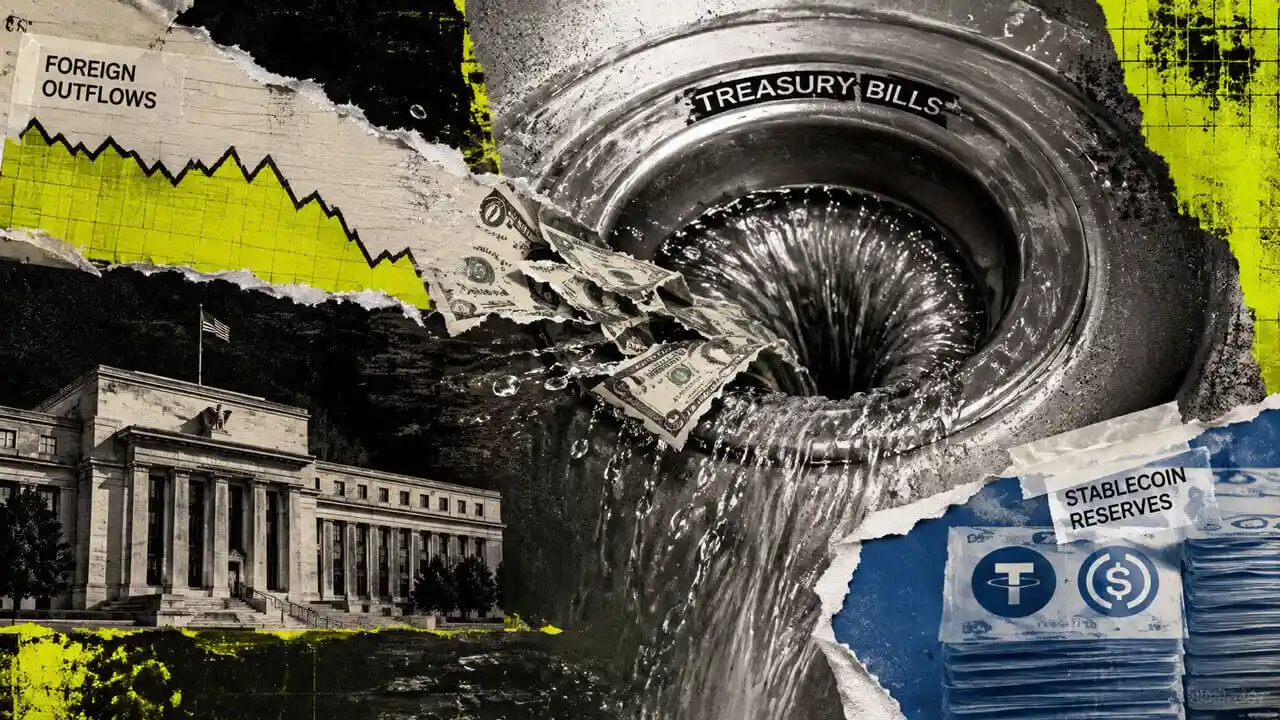
Foreign Capital Sells Off $29 Billion in Short-Term US Treasuries, Why is the US Betting on Stablecoins to "Take Over"?

In June, foreign investors netted $133.5 billion into U.S. financial markets but simultaneously sold $29 billion in short-term U.S. Treasury bills. This divergence highlights a strong preference for U.S. equities over government debt. While overseas buyers purchased $181.4 billion in stocks, demand for Treasuries weakened significantly. This trend explains why the U.S. is looking to stablecoins as a potential new source of demand for its debt. Stablecoin issuers like Tether and Circle back their tokens primarily with highly liquid assets, including short-term Treasuries. As users buy stablecoins, issuers convert that dollar demand into Treasury purchases. Recent U.S. legislative efforts, such as the proposed rules under the *GENIUS Act*, formalize this by mandating stablecoin reserves be held in assets like cash and short-term Treasuries. Currently, stablecoins represent a substantial existing buyer base. For instance, Tether alone held nearly $115 billion in direct T-bill exposure in Q2. However, recent stablecoin supply growth has been minimal and does not account for the $29 billion sell-off by foreign investors in June. For stablecoins to act as a meaningful counterbalance to waning foreign demand, their circulating supply would need to expand significantly. The next TIC report will be crucial to monitor whether foreign selling continues and if stablecoin growth begins to fill the demand gap. Ultimately, the U.S. is strategically positioning the regulated stablecoin sector as a potential new pillar of demand for its government debt.

marsbitHace 1 min(s)

Foreign Capital Sells Off $29 Billion in Short-Term US Treasuries, Why is the US Betting on Stablecoins to "Take Over"?

marsbitHace 1 min(s)

Unitree Investors Jointly Heavy Bet on an Embodied Team

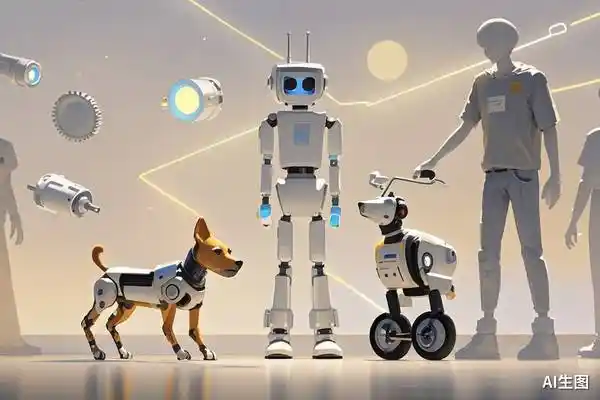
Unibot's early investors, including Meituan, Sequoia Capital, and Matrix Partners, have jointly invested in MiaoDong Technology, another humanoid robotics startup. Founded by former DJI employees—CEO Gao Jianrong, a 9-year DJI veteran who led multiple core business units, and CTO Yang Shuo, who previously worked in Tesla's Optimus team—MiaoDong is known for its combined expertise in hardware productization and advanced robotics cognition. Their core strategy centers on in-house motor R&D and full-stack software-hardware capabilities. The company recently made headlines with its first product, Beni, a wheel-legged "camera robot" designed for low-angle, ground-level filming and personal companionship. Successfully launched on Kickstarter, Beni set a record for the highest fundraising amount in the platform's robotics category. It received a perfect 10/10 rating from influential tech reviewer Marques Brownlee (MKBHD). Beni features capabilities like autonomous obstacle avoidance, the ability to jump 25cm, and self-righting after a fall. MiaoDong plans to leverage the technological and user data feedback from Beni's consumer launch to inform the development of future home-use humanoid robots. The company emphasizes a product-first, user-centric approach, prioritizing real-world applications and reliability over rapid, demo-focused scaling. With Beni set for global release in October and an internal target to sell millions of units, MiaoDong aims to establish itself as a significant player in the embodied AI space through steady, product-driven growth.

marsbitHace 16 min(s)

Unitree Investors Jointly Heavy Bet on an Embodied Team

marsbitHace 16 min(s)

Interview with Robinhood CEO: Memecoin Boom was Unplanned, My Portfolio is Quite Diversified

In an interview with The Iced Coffee Hour podcast, Robinhood CEO Vlad Tenev discussed the company's initiatives, market views, and personal insights. He highlighted the unexpected success of meme coins on the newly launched Robinhood Chain, which he described as a key part of the financial future. The chain supports tokenized stocks tradable globally and enables innovative DeFi activities not initially anticipated by the team. Regarding market concerns, Tenev noted signs of potential bubbles, specifically in AI and semiconductor stocks, but expressed confidence in Robinhood's younger user base, who often view market downturns as opportunities. He identified optimizing the unified user experience across Robinhood's expanding product lines as the company's current major challenge. Addressing criticism over the prediction markets feature, which some equate to gambling, Tenev emphasized the company's focus on personalization, allowing users to hide the feature or access it more easily. On a personal note, Tenev shared that he enjoys cryptocurrency trading and holds a diversified portfolio. He is optimistic about Bitcoin's long-term prospects due to its unique status as the first crypto asset. Outside work, he focuses on teaching his children math and has adopted wellness routines like sauna, cold baths, and a pre-sleep journaling habit to curb screen time.

marsbitHace 33 min(s)

Interview with Robinhood CEO: Memecoin Boom was Unplanned, My Portfolio is Quite Diversified

marsbitHace 33 min(s)

Trading

Spot

Artículos destacados

Qué es ₿O₿

Bitcoin Bob ($₿o₿): Pionero en DeFi Centrado en Bitcoin a Través de la Innovación Híbrida de Capa 2 En una era donde la economía digital está evolucionando rápidamente, Bitcoin Bob ($₿o₿) surge como un proyecto revolucionario que busca mejorar la utilidad de Bitcoin en el sector de las finanzas descentralizadas (DeFi). Lanzado oficialmente en mayo de 2024, Bitcoin Bob, también conocido como Build on Bitcoin (BOB), representa una solución híbrida de blockchain de Capa 2 que combina la reconocida seguridad e inmutabilidad de Bitcoin con la programabilidad de Ethereum. Esta iniciativa busca llenar un vacío crucial en el ecosistema de Bitcoin al facilitar la integración de contratos inteligentes y aplicaciones descentralizadas, manteniendo al mismo tiempo los principios fundamentales de confianza y seguridad inherentes a Bitcoin. Con un respaldo significativo de destacados capitalistas de riesgo, Bitcoin Bob está posicionado para redefinir el papel de Bitcoin en el paisaje DeFi, convirtiéndolo en una piedra angular de las operaciones financieras descentralizadas a nivel global. ¿Qué es Bitcoin Bob, $₿o₿? En su esencia, Bitcoin Bob es una solución de blockchain híbrida diseñada para mejorar la funcionalidad de Bitcoin. El objetivo principal del proyecto es habilitar las finanzas descentralizadas en Bitcoin, facilitando transacciones rápidas y sin problemas mientras se asegura altos niveles de seguridad. Bitcoin Bob emplea tecnología avanzada, específicamente una arquitectura híbrida de capa 2 que combina los atributos de seguridad de Bitcoin con la programabilidad y flexibilidad de la Máquina Virtual de Ethereum (EVM). Este enfoque pragmático permite que el proyecto opere de manera efectiva sin comprometer los valores fundamentales de Bitcoin, convirtiéndolo en un paso monumental para cerrar la brecha entre los tenedores tradicionales de Bitcoin y el emergente ecosistema DeFi. Una de las características destacadas de Bitcoin Bob es su papel en proporcionar un entorno minimizado en confianza a través de mecanismos innovadores, como los rollups optimistas que inicialmente dependen de Ethereum, y que eventualmente transicionan a una integración completa con Bitcoin. Este sistema híbrido está diseñado para asegurar que la vasta liquidez presente en Bitcoin no solo se preserve, sino que también se utilice de manera efectiva en varios protocolos DeFi. ¿Quién es el Creador de Bitcoin Bob, $₿o₿? La fuerza creativa detrás de Bitcoin Bob es el cofundador y CEO Alexei Zamyatin, quien aporta una gran experiencia y conocimiento de su extensa trayectoria en el espacio de las criptomonedas. Zamyatin tiene un doctorado en Ciencias de la Computación y ha estado involucrado activamente en el desarrollo de Bitcoin desde 2015. Su profundo entendimiento de los ecosistemas de Bitcoin y Ethereum juega un papel crucial en la formación de la visión y los fundamentos tecnológicos de Bitcoin Bob. Junto a Zamyatin está el cofundador Dominik Harz, quien se desempeña como Director de Tecnología (CTO). Juntos, el dúo ha cultivado un equipo de individuos talentosos con una pasión compartida por empujar los límites de la tecnología blockchain, asegurando el estatus innovador de Bitcoin Bob en el mercado. ¿Quiénes son los Inversores de Bitcoin Bob, $₿o₿? Bitcoin Bob ha logrado obtener apoyo de una variedad de inversores prominentes y firmas de capital de riesgo que reconocen su potencial para transformar el paisaje de Bitcoin. En marzo de 2024, el proyecto completó una robusta ronda de financiamiento inicial de $10 millones, liderada por Castle Island Ventures, con la notable participación de firmas como Coinbase Ventures y Bankless Ventures. Poco después, en julio de 2024, Bitcoin Bob aseguró un adicional de $1.6 millones en financiamiento estratégico. Esta ronda fue co-liderada por Ledger Ventures y contó con ángeles de varias firmas prominentes como BlackRock, Aave y Curve. El fuerte respaldo financiero refleja un reconocimiento en toda la industria del enfoque innovador de Bitcoin Bob para desbloquear el potencial de Bitcoin en el espacio DeFi. Este financiamiento es crucial no solo para el desarrollo continuo del proyecto, sino también para establecer un incubador que fomente aplicaciones descentralizadas (dApps) nativas de Bitcoin, dirigidas específicamente a satisfacer las necesidades de una base de usuarios en crecimiento. ¿Cómo Funciona Bitcoin Bob, $₿o₿? La mecánica operativa de Bitcoin Bob se basa en su arquitectura de rollup híbrido, que está diseñada para combinar los beneficios de la seguridad de Bitcoin con la versatilidad de la EVM de Ethereum. El proyecto emplea un modelo de seguridad por fases que describe su interacción con usuarios y desarrolladores de la siguiente manera: Fase 1 – La fase inicial opera como un rollup optimista en Ethereum, donde las transacciones se procesan con una expectativa prometedora de validez, allanando el camino para futuros desarrollos en Bitcoin. Fase 2 – A medida que el proyecto transiciona, integrará la finalización de Bitcoin a través de Staking de Bitcoin, aprovechando la Red Babylon para mejorar la seguridad. Este mecanismo requiere que los validadores bloqueen Bitcoin, verificando así las transacciones de BOB, lo que no solo mejora la seguridad, sino que también crea perspectivas de rendimiento para los participantes. Fase 3 – La visión a futuro para Bitcoin Bob es integrarse completamente con Bitcoin, utilizando tecnologías innovadoras como BitVM y pruebas de conocimiento cero para facilitar la computación fuera de la cadena mientras se mantiene la integridad de seguridad de Bitcoin. Innovaciones clave como BitVM2, un protocolo de puente minimizado en confianza co-autorado por Zamyatin, son críticas para la funcionalidad del proyecto, permitiendo depósitos y retiros de Bitcoin sin necesidad de una extensa dependencia de la red. Esto permite que el ecosistema se conecte de manera eficiente con Ethereum y otras cadenas compatibles, creando un modelo de interacción fluido y efectivo para usuarios y desarrolladores. Cronología de Bitcoin Bob, $₿o₿ Entender la evolución de Bitcoin Bob implica rastrear sus hitos importantes: 2019: Alexei Zamyatin y Dominik Harz establecen una firma de investigación enfocada en soluciones blockchain, sentando las bases para futuros proyectos. Marzo 2024: Bitcoin Bob recauda exitosamente $10 millones en una ronda de financiamiento inicial, marcando su entrada en el competitivo paisaje de blockchain. 1 de mayo de 2024: Ocurre el lanzamiento oficial de la mainnet, mostrando las capacidades del proyecto con una adopción significativa de usuarios y valor total bloqueado (TVL). Julio 2024: El proyecto atrae un adicional de $1.6 millones en financiamiento estratégico para establecer su incubadora, destinada a fomentar innovaciones impulsadas por Bitcoin. Octubre 2024: Bitcoin Bob publica un “Documento de Visión”, detallando su diseño de capa 2 híbrida y estrategias a futuro. 2025: Se espera el lanzamiento de las características de la Fase 2, enfocándose en la finalización de Bitcoin y puentes BitVM destinados a mejorar la funcionalidad general. Conclusión: Redefiniendo el Papel de Bitcoin en las Finanzas Descentralizadas Bitcoin Bob ($₿o₿) no es solo otro proyecto de blockchain; representa un cambio de paradigma en la forma en que Bitcoin puede interactuar con aplicaciones financieras más amplias. Al combinar meticulosamente la seguridad de Bitcoin con la flexibilidad de Ethereum, Bitcoin Bob busca remodelar el paisaje DeFi, cerrando la brecha entre la moneda digital y las aplicaciones descentralizadas. Con un robusto marco tecnológico, un liderazgo fuerte y financiamiento estratégico, Bitcoin Bob está bien posicionado para establecerse como un jugador fundamental en el ecosistema de criptomonedas, desbloqueando nuevas dimensiones de liquidez y utilidad para Bitcoin. A medida que el proyecto continúa evolucionando y expandiéndose, promete inaugurar una nueva era de innovación, demostrando que el potencial de Bitcoin se extiende mucho más allá de ser un mero almacén de valor, sino más bien como una piedra angular del futuro paisaje financiero. A medida que el proyecto avanza a través de sus fases anticipadas, todas las miradas estarán puestas en Bitcoin Bob, particularmente en lo que respecta a su compromiso de incorporar principios descentralizados y asegurar que los usuarios puedan disfrutar de todos los beneficios de DeFi anclados en Bitcoin.

123 Vistas totalesPublicado en 2025.06.30Actualizado en 2025.06.30

Qué es ₿O₿

Cómo comprar O

¡Bienvenido a HTX.com! Hemos hecho que comprar O1 exchange (O) sea simple y conveniente. Sigue nuestra guía paso a paso para iniciar tu viaje de criptos.Paso 1: crea tu cuenta HTXUtiliza tu correo electrónico o número de teléfono para registrarte y obtener una cuenta gratuita en HTX. Experimenta un proceso de registro sin complicaciones y desbloquea todas las funciones.Obtener mi cuentaPaso 2: ve a Comprar cripto y elige tu método de pagoTarjeta de crédito/débito: usa tu Visa o Mastercard para comprar O1 exchange (O) al instante.Saldo: utiliza fondos del saldo de tu cuenta HTX para tradear sin problemas.Terceros: hemos agregado métodos de pago populares como Google Pay y Apple Pay para mejorar la comodidad.P2P: tradear directamente con otros usuarios en HTX.Over-the-Counter (OTC): ofrecemos servicios personalizados y tipos de cambio competitivos para los traders.Paso 3: guarda tu O1 exchange (O)Después de comprar tu O1 exchange (O), guárdalo en tu cuenta HTX. Alternativamente, puedes enviarlo a otro lugar mediante transferencia blockchain o utilizarlo para tradear otras criptomonedas.Paso 4: tradear O1 exchange (O)Tradear fácilmente con O1 exchange (O) en HTX's mercado spot. Simplemente accede a tu cuenta, selecciona tu par de trading, ejecuta tus trades y monitorea en tiempo real. Ofrecemos una experiencia fácil de usar tanto para principiantes como para traders experimentados.

657 Vistas totalesPublicado en 2026.06.19Actualizado en 2026.06.29

Cómo comprar O

Discusiones

Bienvenido a la comunidad de HTX. Aquí puedes mantenerte informado sobre los últimos desarrollos de la plataforma y acceder a análisis profesionales del mercado. A continuación se presentan las opiniones de los usuarios sobre el precio de O (O).

活动图片