Cosmos Labs and Zeeve enter into a partnership

cryptonews.ruPublicado a 2026-08-06Actualizado a 2026-08-06

Resumen

Cosmos Labs, the developer behind the Cosmos blockchain, has partnered with Zeeve, an enterprise blockchain infrastructure platform. This collaboration aims to assist financial institutions in launching tokenized deposits and digital assets. Cosmos will serve as the foundational layer for ledger management and asset issuance, while Zeeve will handle network deployment and management, data migration support, industrial-grade architecture creation, node and validator operations, and privacy tools via its Privacy Layer. The partnership focuses on simplifying the issuance of tokenized assets and the development of distributed ledger applications, specifically designed to meet the reliability, security, and privacy requirements of major financial institutions.

Cosmos Labs, the company developing the Cosmos blockchain, has entered into a partnership with Zeeve, a platform for enterprise blockchain infrastructure. The companies will help financial institutions launch tokenized deposits and digital assets based on blockchain.

Cosmos will be used as a foundational layer for ledger management and asset issuance, while Zeeve will handle network deployment and management, support for data migration, creation of architecture for industrial use, operation of nodes and validators, as well as privacy tools through the Zeeve Privacy Layer.

The partnership aims to simplify the issuance of tokenized assets and the creation of distributed ledger-based applications, taking into account the reliability, security, and privacy requirements of large financial organizations.

Image: Magnific

end-content

Criptos en tendencia

Preguntas relacionadas

QWhat is the purpose of the partnership between Cosmos Labs and Zeeve?

AThe purpose of the partnership is to help financial institutions launch tokenized deposits and digital assets on the blockchain, simplifying the issuance of tokenized assets and the creation of distributed ledger-based applications.

QWhat specific role will the Cosmos blockchain play in this collaboration?

ACosmos will be used as the foundational layer for ledger-keeping and asset issuance within the partnership.

QWhat are the primary responsibilities of Zeeve in this partnership?

AZeeve will be responsible for deploying and managing networks, supporting data transfer, creating industrial-use architecture, operating nodes and validators, and providing privacy tools via the Zeeve Privacy Layer.

QWhich key requirements of large financial institutions does this partnership aim to address?

AThe partnership aims to address the key requirements of large financial institutions for reliability, security, and privacy in their blockchain operations.

QWhat type of financial products are Cosmos Labs and Zeeve aiming to help launch?

AThey are aiming to help launch tokenized deposits and digital assets for financial institutions.

Lecturas Relacionadas

EIP-8363 Quantitative Review: Cutting Staking 'Subsidies' – What Does Ethereum Hope to Gain?

**EIP-8363 Quantitative Review: Reducing Staking "Subsidies" – What Does Ethereum Want in Return?** EIP-8363 proposes burning an increasing portion of validator rewards as the staking rate rises, reaching 100% burn when 50% of ETH is staked. This analysis models its impact on issuance, yield, and staking equilibrium, examines whether ETH's yield explains its price, quantifies the chain economy's reliance on this yield, and presents conclusions. Key findings: 1. **EIP-1559 Burns Are Ineffective:** Post-merge, burning (via base fees) has collapsed by 98% and now offsets only 2.4% of new ETH issuance, making issuance policy Ethereum's sole remaining supply lever. 2. **EIP-8363's Real Impact:** At the current ~42.2M ETH staked, the proposal would cut issuance by ~58.6% and staking APR by ~56.4%, removing ~633k ETH ($1.55B) in annual dilution (0.53% of market cap). It's not zero issuance; that would require 43% more ETH staked. 3. **Self-Limiting Mechanism:** The design has a built-in equilibrium. At reasonable required returns (e.g., 2%), the system stabilizes at ~26% staking rate and ~0.48% annual inflation. 4. **Yield vs. Price:** No detectable statistical relationship exists between changes in staking yield and ETH price returns over 43 months. The natural 37% yield decline since 2023 did not drive price action. 5. **Chain Economy Dependence:** While LSTs like wstETH form ~34% of collateral in major lending markets, their utility as collateral remains if yield is positive. The direct revenue hit to protocols like Lido is significant (~50% of fee income) but not systemic. Staking-focused ETFs represent only 0.19% of ETH supply. 6. **Core Conflict:** The debate masks a zero-sum redistribution: cutting ~$1.55B in annual issuance transfers value from concentrated staking intermediaries (LST/LRT protocols, leverage players) to the dispersed majority of non-staking ETH holders. 7. **Outlook:** The proposal is economically sound for ETH's scarcity but politically difficult due to concentrated opposition. It is unlikely to pass in its current form.

marsbitHace 12 min(s)

EIP-8363 Quantitative Review: Cutting Staking 'Subsidies' – What Does Ethereum Hope to Gain?

marsbitHace 12 min(s)

Pharos Introduces On-Chain Institutional-Grade U.S. Corporate Bond Credit, Expanding Its RealFi Asset Portfolio

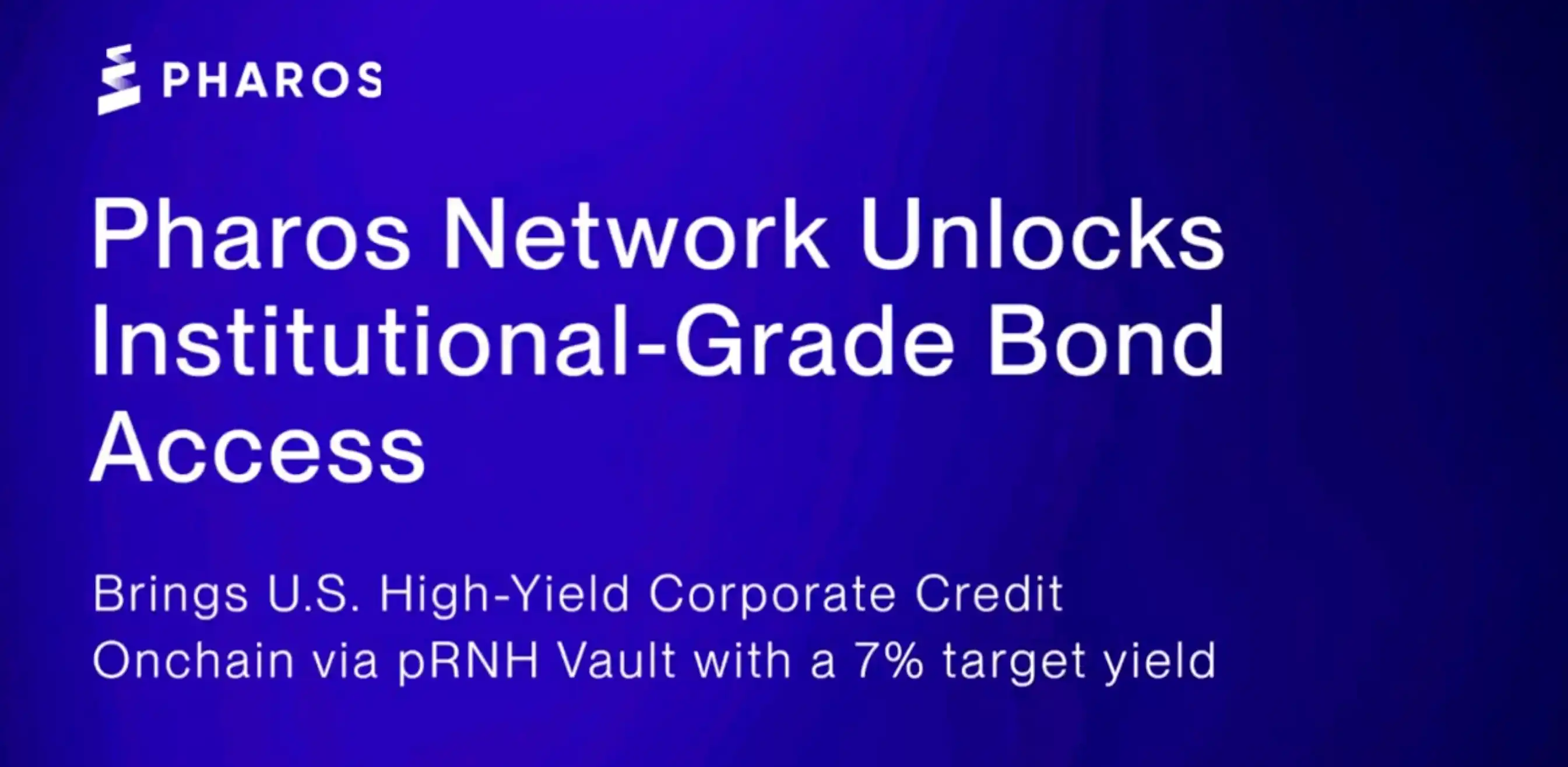
Pharos Network has launched the pRNH Vault, introducing institutional-grade US corporate high-yield bond exposure to its on-chain RealFi (Real World Finance) ecosystem. Developed by the R25 protocol, the vault provides qualified users access to a tokenized portfolio of high-yield corporate debt, broadening Pharos's asset offerings beyond stablecoins and cash-equivalents. The vault's underlying asset is the NYLIM Anemoy US High Yield Corporate Bond separate account (HYB), managed by New York Life Investment Management (NYLIM) and tokenized in collaboration with Anemoy and Centrifuge. Users can deposit USDC into the vault to receive pRNH tokens, representing indirect ownership of the HYB portfolio, which targets an annualized yield of approximately 7%. The structure offers programmability and composability for on-chain financial applications. Pharos views this move as a key evolution from basic asset tokenization towards building a dynamic marketplace where institutional assets can be actively discovered, evaluated, and utilized programmatically. The pRNH Vault architecture incorporates agent-assisted functionalities for credit screening, liquidity monitoring, and on-chain operations, signaling tighter integration between real-world finance and intelligent on-chain systems. To support this vision, Pharos employs a technical stack including the SALI engine for parallel execution, modular SPNs, protocol-level compliance, ZK-KYC/AML, and native AI agent support. The network positions itself as the "value discovery layer" for the agent economy, aiming to make real-world value, smart agents, and institutional assets widely accessible. The pRNH launch adds a core credit asset to this ecosystem and serves as a practical test case for its infrastructure.

marsbitHace 28 min(s)

Pharos Introduces On-Chain Institutional-Grade U.S. Corporate Bond Credit, Expanding Its RealFi Asset Portfolio

marsbitHace 28 min(s)

Trading

Spot

Artículos destacados

Cómo comprar ATOM

¡Bienvenido a HTX.com! Hemos hecho que comprar Cosmos (ATOM) sea simple y conveniente. Sigue nuestra guía paso a paso para iniciar tu viaje de criptos.Paso 1: crea tu cuenta HTXUtiliza tu correo electrónico o número de teléfono para registrarte y obtener una cuenta gratuita en HTX. Experimenta un proceso de registro sin complicaciones y desbloquea todas las funciones.Obtener mi cuentaPaso 2: ve a Comprar cripto y elige tu método de pagoTarjeta de crédito/débito: usa tu Visa o Mastercard para comprar Cosmos (ATOM) al instante.Saldo: utiliza fondos del saldo de tu cuenta HTX para tradear sin problemas.Terceros: hemos agregado métodos de pago populares como Google Pay y Apple Pay para mejorar la comodidad.P2P: tradear directamente con otros usuarios en HTX.Over-the-Counter (OTC): ofrecemos servicios personalizados y tipos de cambio competitivos para los traders.Paso 3: guarda tu Cosmos (ATOM)Después de comprar tu Cosmos (ATOM), guárdalo en tu cuenta HTX. Alternativamente, puedes enviarlo a otro lugar mediante transferencia blockchain o utilizarlo para tradear otras criptomonedas.Paso 4: tradear Cosmos (ATOM)Tradear fácilmente con Cosmos (ATOM) en HTX's mercado spot. Simplemente accede a tu cuenta, selecciona tu par de trading, ejecuta tus trades y monitorea en tiempo real. Ofrecemos una experiencia fácil de usar tanto para principiantes como para traders experimentados.

461 Vistas totalesPublicado en 2024.12.10Actualizado en 2026.06.02

Cómo comprar ATOM

Discusiones

Bienvenido a la comunidad de HTX. Aquí puedes mantenerte informado sobre los últimos desarrollos de la plataforma y acceder a análisis profesionales del mercado. A continuación se presentan las opiniones de los usuarios sobre el precio de ATOM (ATOM).

活动图片