Avalanche Price Forecast for August 2026: Can AVAX Break Above $7 When Kenya Launches on the Network?

cryptonews.ruPublicado a 2026-08-05Actualizado a 2026-08-05

Resumen

Avalanche (AVAX) Price Forecast for August 2026: Key Factors and Levels Avalanche (AVAX) is trading at $6.782 on August 4, showing signs of a potential breakout after consolidating between $5.50 and $7 since June. The price has recently moved above its 20-day and 50-day EMAs, with the Parabolic SAR turning bullish for the first time in months. Key resistance levels are $7 (range top), $7.483 (100-day EMA), and $9.368 (200-day EMA). Support lies at $6.775 (50-day EMA), $6.532 (20-day EMA), $6.040 (Parabolic SAR), and $5.50 (range bottom). Historically, August is AVAX's strongest month with an average return of +25.1%, though median returns are more modest. The token enters August from a low base after a significant June sell-off. Fundamentally, the network is seeing increased institutional adoption. Kenya's National Examinations Council (KNEC) has placed over 15 million academic records on Avalanche. Other developments include Securitize tokenizing ~$300M, Progmat migrating $2.7B+ in securities, Aave V4 expanding to Avalanche, and Hyundai launching a stablecoin payment pilot. The Avalanche Payments Collective has also launched with 29 members. The weekly forecast suggests a range between $6.60-$8.50 for the month, with a close above the 100-day EMA at $7.483 being a key bullish target. The bearish risk involves a rejection at $7 and a fall back towards the $5.50 range low. The progress of the U.S. CLARITY Act by August 7 is noted as a potential macro catalyst.

$AVAX is trading at $6.782 on August 4th, up 3.23% on the day, having broken above its 20-day and 50-day EMAs for the first time in several months as a packed summer of institutional adoption sets the stage for what is historically the strongest calendar month for the token.

$AVAX to Break Above Range Midpoint in Early August
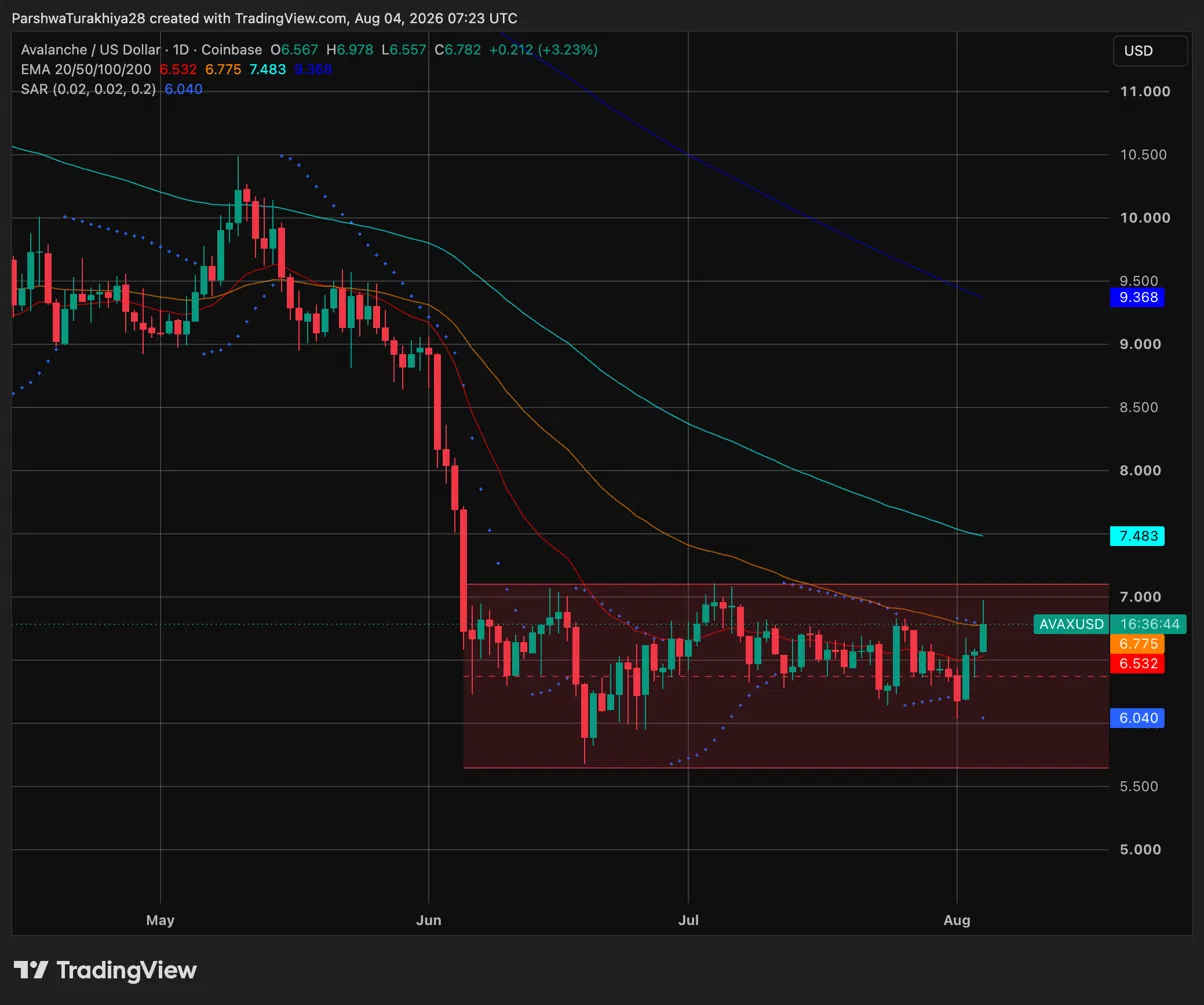
$AVAX Price Dynamics (Source: TradingView)

The daily chart shows $AVAX has consolidated roughly between $5.50 and $7 since the June sell-off, which dropped the price by 27.2% in one month. The August opening session breached the upper half of this range, reaching a high of $6,978 before settling at $6,782. The Parabolic SAR at $6.040 has dropped below price and is now bullish—the first time such a reading has occurred in several months.

The 20-day EMA at $6,532 and the 50-day at $6,775 were reclaimed in the same session, giving bulls a meaningful foothold for the first time since May. The 100-day EMA at $7.483 is the next test higher and sits just above the current consolidation range. The 200-day at $9.368 reflects the long-term ceiling. The round number $7 and the range top are the immediate resistance zone, while the SAR at $6.040 and the range low around $5.50 define the downside.

$AVAX Support and Resistance Levels, August 2026

Type Price Level
Resistance $7 Range Top and Round Number
Resistance $7.483 100-day EMA, First Major Target Above Range
Resistance $9.368 200-day EMA, Long-Term Ceiling
Support $6.775 50-day EMA, Need to Hold on Pullback
Support $6.532 20-day EMA
Support $6.040 Parabolic SAR, Bullish Level Below Price
Support $5.50 Range Floor and Last Major Support

August Seasonality: Historically Strongest Month, with Caveats
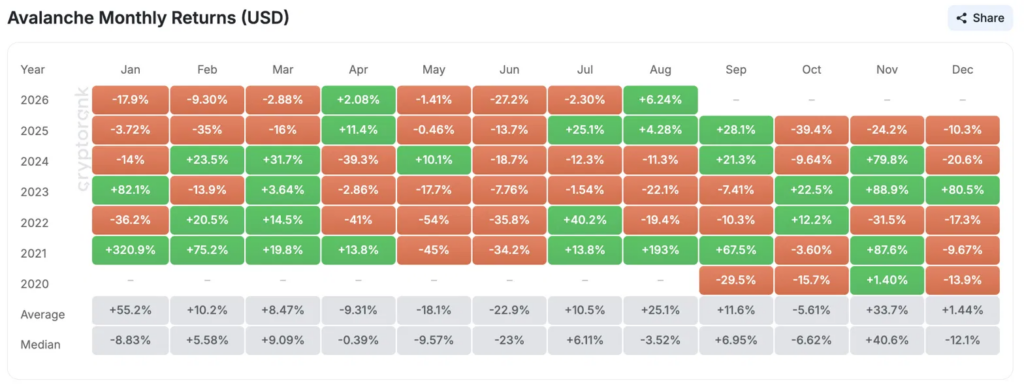
$AVAX Monthly Returns (Source: CryptoRank)

August is the highest-returning month for $AVAX on record, averaging +25.1% across all years with available data. The +193% performance in 2021 significantly skews this average, but even excluding that, August showed gains in 2025 (+4.28%), while losses in 2024 (-11.3%) and 2023 (-22.1%) show volatility on both sides. The median August return is -3.52%, a more cautious figure than the average suggests.

Related: SkyAI Price Forecast: SKYAI Price Surges Over 100% as Bulls Aim for New Breakout

What distinguishes 2026 is the starting point. $AVAX enters August from a low base after one of its worst-performing Junes on record (-27.2%), which historically lowers downside risk in the following month. The shallow -2.30% decline in July suggests sellers have largely exhausted the June momentum, and the early August breakout above both short-term EMAs adds technical confirmation that the seasonal setup lacked in previous years.

Kenya Stores 15 Million Academic Records on Avalanche

Kenya's National Examinations Council (KNEC) has placed over 15 million academic records on the Avalanche C-Chain, dating back to 1989. The 2025 KCSE certificates for nearly one million students are now issued exclusively through this platform. What used to take up to six months for manual institutional requests now requires a few seconds for verification.

This is not the first governmental deployment for Avalanche. The same LegitDoc platform digitized 700,000 land records in India's Dantewada district, the California Department of Motor Vehicles migrated 42 million vehicle titles, and Bergen County, New Jersey, is tokenizing 370,000 property deeds worth $240 billion. Kenya is the latest and largest addition to this list.

Packed Summer of Institutional Adoption

Summer on Avalanche, where much was built 🔺

Hyundai together with @Tether and @AxiymFinance, launches Stablecoin payment pilot on Avalanche.@AvalancheFDN publishes research on blockchain tokenomics@AvaxTeam1 launches their Builder Grants program with up to $30,000 in... pic.twitter.com/4XhEITLZBx

— Avalanche🔺 (@avax) August 3, 2026

Beyond Kenya, Avalanche's summer recap points to a broad base of institutional activity that has been quietly building while prices ranged. Securitize tokenized roughly $300M on the network, Progmat completed a $2.7B+ securities migration onto its Avalanche L1, and RWAs on Avalanche hit all-time highs.

Aave V4 expanded to Avalanche as the first network post-Ethereum. Hyundai launched a stablecoin payment pilot with Tether and Axiym Finance, and the Avalanche Payments Collective launched with 29 participants including WisdomTree and VanEck.

Related: Meme Coin Price Forecast: Dogecoin, Shiba Inu, MemeCore

The pattern across all this is consistent: institutions are choosing Avalanche for real settlement infrastructure, not experiments, giving August's technical breakout a fundamental underpinning that previous recovery attempts lacked.

Catalyst Details
Securitize ~$300M tokenized on Avalanche
Progmat $2.7B+ securities migrated to Avalanche L1
Aave V4 First chain post-Ethereum to get expansion
Hyundai Pilot Stablecoin payments with Tether & Axiym Finance
RWAs Reached all-time highs on Avalanche over summer
Payments Collective 29 participants including WisdomTree & VanEck

Weekly Forecast for August 2026

Week Price Range Key Level to Watch Scenario
Aug 1-8 $6.60–$7.20 Break or Rejection at $7 CLARITY Act deadline Aug 7th could be macro catalyst; Holding above 50-day EMA is key
Aug 11-15 $6.80–$7.50 100-day EMA at $7.483 If $7 holds, next test is 100-day EMA; Failure sends price back to 20-day at $6.532
Aug 18-22 $7–$8 Zone from $7.483 to $8 Mid-month consolidation above 100-day EMA leads to push toward $8 area; Failure keeps price range-bound
Aug 25-31 $6.50–$8.50 Monthly Close Above $7.483 Monthly close above 100-day EMA would be most constructive for September continuation

Avalanche Price Forecast August 2026: Upside Targets & Downside Risk

Bull Case, Target: $7.483 (100-day EMA)

$AVAX holds the reclaimed 50-day EMA at $6.775 and confirms the range breakout above $7 on a weekly close. Progress on the CLARITY Act ahead of the Aug 7th recess deadline adds macro catalyst, and summer institutional adoption news continues to attract new capital. Maintaining the Parabolic SAR's bullish price reading throughout the month keeps momentum in buyers' favor, and price advances towards the 100-day EMA at $7.483, aligning with August's historical average return.

Bear Risk, Risk Level: $5.50 (Range Low)

Rejection at $7 persists, and $AVAX loses the 50-day EMA at $6,775 within the first two weeks, invalidating the early August breakout. The CLARITY Act stalls post-recess without a vote, removing the near-term regulatory catalyst. Price retreats to the 20-day EMA at $6,532, and upon failure, to the SAR at $6,040 and the range bottom around $5.50, repeating the failed recovery pattern seen throughout July.

end-content

Criptos en tendencia

Preguntas relacionadas

QBased on the technical analysis provided, what are the key immediate support and resistance levels for AVAX price in August 2026?

AThe key immediate resistance level is the round number $7, which coincides with the top of its recent consolidation range. The key immediate support levels are the 50-day EMA at $6.775 and the 20-day EMA at $6.532. The Parabolic SAR at $6.040 and the range floor at ~$5.50 represent major support levels below the EMAs.

QAccording to the article, what historical seasonal trend does August show for AVAX, and what is the critical nuance in this data?

AHistorically, August is AVAX's strongest calendar month with an average return of +25.1%. However, the median return is -3.52%, indicating that the average is heavily skewed by an extreme outlier year (like 2021's +193%). The data shows mixed results, with gains in 2025 but losses in 2024 and 2023.

QWhat are some of the major institutional adoption milestones for Avalanche mentioned in the article from the summer of 2026?

AMajor milestones include: Kenya's KNEC placing over 15 million academic records on Avalanche; Securitize tokenizing ~$300M on the network; Progmat migrating $2.7B+ of securities to Avalanche L1; Aave V4 expanding to Avalanche as its first chain post-Ethereum; Hyundai's stablecoin payment pilot with Tether and Axiym Finance; and the launch of the Avalanche Payments Collective with 29 participants like WisdomTree and VanEck.

QWhat are the price target scenarios (Bull Case and Bear Case) presented for AVAX in August 2026, and their respective conditions?

AThe Bull Case target is the 100-day EMA at $7.483. Conditions include holding above the 50-day EMA ($6.775), a weekly close above $7, progress on the CLARITY Act, and continued institutional adoption news. The Bear Case risk level is the range floor at $5.50. This would occur if AVAX faces rejection at $7, loses the 50-day EMA, and sees the CLARITY Act stall, invalidating the early August breakout.

QAccording to the weekly forecast table, what is the key event and level to watch in the week of August 1-8, 2026?

AThe key event is the CLARITY Act deadline on August 7, which is identified as a potential macro catalyst. The key level to watch is a breakout or rejection at the $7 resistance level. Holding above the 50-day EMA at $6.775 is cited as crucial for the bullish scenario during this period.

Lecturas Relacionadas

Crypto Funding Halves in Q1, Why Is Stablecoin Payment Still Attracting Money Against the Trend?

Crypto venture capital funding fell roughly 50% quarter-over-quarter in Q1 2026, yet the stablecoin payments sector was a notable exception, continuing to secure significant funding rounds. This shift signals that capital is moving away from speculative "token narratives" toward companies generating real revenue, as stablecoins evolve from a trading tool into payment infrastructure. Despite the overall funding slowdown, companies like Rain, OpenFX, and RedotPay completed major raises, focusing on areas such as card issuance, cross-border payments, and banking connectivity. Investors are attracted to the sector's potential to address long-standing inefficiencies in traditional cross-border payments through 24/7 settlement and clearer revenue models like transaction fees and FX spreads. However, the momentum may be overstated. On-chain stablecoin transaction volume does not equate to real-world payments for goods and services, and funding is concentrated in a few leading firms with reported volumes and customers. Key challenges remain, including compliance, fiat on/off-ramps, local banking relationships, and the risk of core services becoming commoditized. Looking ahead, capital is likely to flow into areas like cross-border B2B payments, bank-to-stablecoin connectivity, stablecoin-linked cards, multi-chain payment orchestration, and payments for AI agents. Ultimately, the investor interest reflects a bet on the necessary infrastructure to integrate stablecoins into the traditional financial system, with future valuations hinging on demonstrable payment volume, real revenue, and profitable market expansion.

marsbitHace 9 min(s)

Crypto Funding Halves in Q1, Why Is Stablecoin Payment Still Attracting Money Against the Trend?

marsbitHace 9 min(s)

South Korean Retail Investors 'Move from Seoul to Wall Street': Buying SK Hynix ADR, Betting on Triple-Leverage ETF

A surge of Korean retail investors is shifting funds from the volatile Seoul market to Wall Street, intensifying their bets on the AI theme through unconventional and high-risk instruments. Data shows Korean investors were net buyers of about $4.5 billion in US stocks in July, nearing a yearly peak. A notable trend is their purchase of approximately $840 million worth of SK Hynix American Depositary Receipts (ADRs), despite a significant 10% premium over the company's domestic shares, leading analysts to label the move as speculative and irrational. Simultaneously, Korean traders are heavily favoring leveraged ETFs. The triple-leveraged semiconductor ETF SOXL was the most-bought US product in July, with leveraged products occupying four of the top ten spots. Experts note that this shift in geography does not represent a diversification of risk; instead, investors are merely expressing the same concentrated bet on AI hardware through different, often riskier, US-listed vehicles. Analysts warn that while this capital inflow is unlikely to systemically impact the vast US institutional market, it risks creating localized distortions and amplifying volatility, particularly in the targeted sectors and instruments. The move follows a sharp correction in the Korean market, where high leverage in semiconductor stocks and related ETFs had previously led to significant losses, prompting this search for alternative avenues to chase the AI narrative.

marsbitHace 1 hora(s)

South Korean Retail Investors 'Move from Seoul to Wall Street': Buying SK Hynix ADR, Betting on Triple-Leverage ETF

marsbitHace 1 hora(s)

Bithumb's First Half Report: Net Loss Exceeds $76 Million, Where Did the Profits Go?

**Title: Bithumb H1 2026 Report: Net Loss Exceeds $76M – Where Did the Profits Go?** Despite a headline net loss of approximately 108.7 billion KRW (~$76.44 million) for the first half of 2026, a detailed breakdown reveals Bithumb's core exchange business remained profitable. The significant loss was primarily driven by two major non-operating items: substantial losses on the disposal and valuation of the company's own cryptocurrency holdings (net loss ~$48.21 million) and a sharp increase in litigation provisions (~$25.93 million), largely linked to a regulatory fine. Operating revenue fell 48.7% year-on-year to ~$119 million, almost entirely from transaction fees, as market activity cooled. While the company drastically cut marketing and subsidy expenses by ~70% to protect margins, more rigid costs like payment processing and salaries declined only modestly. This highlights the vulnerability of its highly fee-dependent revenue model in a down market. Total assets decreased by ~$584 million, but this was largely attributable to an ~86% drop in client KRW deposits. The market value of client crypto assets under custody also fell (~32.7%), partly influenced by declining cryptocurrency prices rather than solely client withdrawals. In summary, the report indicates underlying exchange profitability was eroded by significant crypto asset losses and mounting regulatory/legal costs, against a backdrop of declining trading revenue. Future focus should be on revenue recovery, managing crypto-related损益, and the ongoing impact of regulatory challenges.

marsbitHace 1 hora(s)

Bithumb's First Half Report: Net Loss Exceeds $76 Million, Where Did the Profits Go?

marsbitHace 1 hora(s)

BitMart's Final 9 Days: A True Exchange Crisis Is Never About Shutting Down

BitMart's Final 9 Days: A True Exchange Crisis Is Not About Shutting Down On August 17, 2026, with just 9 days until BitMart's scheduled cessation of trading, the focus shifted from the platform's orderly closure to serious questions about user withdrawals, platform solvency, employee payments, and reserve transparency. Stakeholders, claiming to represent users and staff, publicly demanded asset/liability disclosures, explanations for withdrawal delays, a user repayment plan, and an independent audit, setting an August 19 deadline. While BitMart CEO Sheldon Lee denied allegations of insolvency or wrongdoing, the controversy highlighted a core vulnerability of centralized exchanges (CEXs). When an exchange announces its shutdown, normal user behavior changes dramatically, triggering a mass withdrawal event—the ultimate stress test for its liquidity and custodial integrity. The key question becomes not whether the platform has assets, but whether it holds sufficient *liquid* assets to cover all user liabilities on demand. The article argues that the trust placed in CEXs is based on the convenience they provide, abstracting users from direct control of their private keys. This trust is rarely questioned during normal operations but becomes critically exposed during a wind-down. The situation underscores the limitations of simple Proof of Reserves, which shows "what we have" but not the crucial "what we owe." True financial credibility requires transparent, auditable data on assets, liabilities, and segregated user funds. BitMart's situation reflects a broader, often overlooked issue in the crypto industry: while there is extensive focus on growth mechanisms for exchanges, there is little discussion or established protocol for a safe and transparent "exit mechanism." The final measure of an exchange's integrity, the article concludes, is not its user count or trading volume during a bull market, but its ability to ensure every last user can successfully withdraw their assets when the doors are closing. The outcome will be determined not by statements, but by whether the final user's funds securely leave the platform.

marsbitHace 2 hora(s)

BitMart's Final 9 Days: A True Exchange Crisis Is Never About Shutting Down

marsbitHace 2 hora(s)

Don't Speculate on 100x Coins, Just Bet on 'Cash Cows': Which Projects Are Worth Dollar-Cost Averaging in the Bear Market?

In a bearish crypto market, finding sustainable investments is more prudent than chasing speculative meme coins. This article analyzes projects generating consistent revenue, highlighting them as potential "cash cows" for long-term dollar-cost averaging (DCA). The top performers are "picks-and-shovels" plays. **Pump.fun**, a Solana-based meme coin launchpad, leads with $415.3M in monthly revenue, profiting from a 1.25% fee on token transactions. Despite market volatility, it has averaged tens of millions in monthly income in 2024. Perpetual DEX **Hyperliquid** stands out as a "bear market star," accumulating ~$352M in revenue over seven months. Its model funnels ~99% of fees into buying back and permanently burning its HYPE token. Established giants are also adapting. **Uniswap**, after enabling its fee switch, now earns protocol revenue (e.g., $5.6M recently), which is used to buy back and burn UNI, giving the token direct value accrual. Similarly, oracle provider **Chainlink** generates stable monthly revenue (~$4.57M recently) from its essential data, cross-chain, and automation services. Its new Payment Abstraction feature automatically converts service fees into LINK, accruing value in its treasury. The core thesis is clear: in a downturn, focus on projects with proven, resilient business models—those acting as essential infrastructure or capturing consistent transaction fees—rather than speculative narratives.

marsbitHace 2 hora(s)

Don't Speculate on 100x Coins, Just Bet on 'Cash Cows': Which Projects Are Worth Dollar-Cost Averaging in the Bear Market?

marsbitHace 2 hora(s)

Trading

Spot

Artículos destacados

Cómo comprar AVAX

¡Bienvenido a HTX.com! Hemos hecho que comprar Avalanche (AVAX) sea simple y conveniente. Sigue nuestra guía paso a paso para iniciar tu viaje de criptos.Paso 1: crea tu cuenta HTXUtiliza tu correo electrónico o número de teléfono para registrarte y obtener una cuenta gratuita en HTX. Experimenta un proceso de registro sin complicaciones y desbloquea todas las funciones.Obtener mi cuentaPaso 2: ve a Comprar cripto y elige tu método de pagoTarjeta de crédito/débito: usa tu Visa o Mastercard para comprar Avalanche (AVAX) al instante.Saldo: utiliza fondos del saldo de tu cuenta HTX para tradear sin problemas.Terceros: hemos agregado métodos de pago populares como Google Pay y Apple Pay para mejorar la comodidad.P2P: tradear directamente con otros usuarios en HTX.Over-the-Counter (OTC): ofrecemos servicios personalizados y tipos de cambio competitivos para los traders.Paso 3: guarda tu Avalanche (AVAX)Después de comprar tu Avalanche (AVAX), guárdalo en tu cuenta HTX. Alternativamente, puedes enviarlo a otro lugar mediante transferencia blockchain o utilizarlo para tradear otras criptomonedas.Paso 4: tradear Avalanche (AVAX)Tradear fácilmente con Avalanche (AVAX) en HTX's mercado spot. Simplemente accede a tu cuenta, selecciona tu par de trading, ejecuta tus trades y monitorea en tiempo real. Ofrecemos una experiencia fácil de usar tanto para principiantes como para traders experimentados.

722 Vistas totalesPublicado en 2024.12.12Actualizado en 2026.06.02

Cómo comprar AVAX

Discusiones

Bienvenido a la comunidad de HTX. Aquí puedes mantenerte informado sobre los últimos desarrollos de la plataforma y acceder a análisis profesionales del mercado. A continuación se presentan las opiniones de los usuarios sobre el precio de AVAX (AVAX).

活动图片