China's 'Bio DeepSeek' Emerges: 4 Oxford Prodigies Let AI Take Over Life Science

marsbitPublicado a 2026-08-04Actualizado a 2026-08-04

Resumen

China's 'Biology DeepSeek' Emerges: Four Oxford Alumni Aim to Let AI Take Over Life Sciences Following DeepSeek-V4-Flash's global impact, a Chinese counterpart for life sciences has arrived. Jindu Bio, founded by four Oxford University alumni, has developed GeneLLM, a multi-omics large language model. Published in top journals *Nature Communications* and *Advanced Science*, GeneLLM is the first model pre-trained directly on raw omics data, aiming to understand the "language" and "system" of life. GeneLLM treats the four RNA bases (A, U, G, C) as fundamental tokens, learning from raw sequencing data without relying on pre-defined annotations. It uses a Transformer architecture to predict the next base, processing trillions of RNA reads. With versions ranging from 1.5 billion to 30 billion parameters, it achieves high accuracy in disease prediction with significantly lower-cost, shallow-depth sequencing, making precision medicine more accessible. Beyond the model, Jindu Bio is building BioFord Harness, an infrastructure to connect AI with physical labs. This system translates scientific intent into executable commands for various lab equipment, manages scheduling, and creates a data feedback loop. Its platform features five collaborative AI agents for literature review, experimental design, scientific reasoning, lab scheduling, and data analysis, drastically speeding up research cycles. Crucially, it turns all experimental data—including failures—into valuable learning mater...

Just as DeepSeek-V4-Flash's official release shook the global general-purpose large model community, China's life science version of DeepSeek followed closely behind.

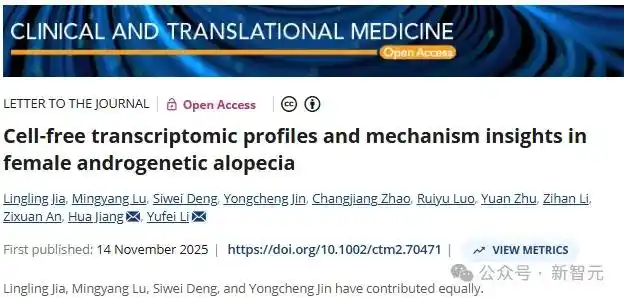
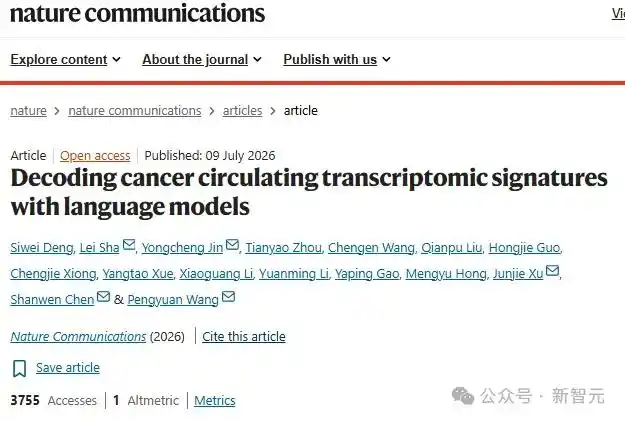
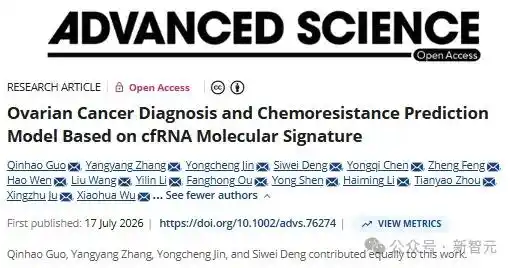
Recently, GeneLLM, a life science vertical multi-omics large model independently developed by Kindu Biology (founded by 4 Oxford University returnees), has been successively published in top-tier international academic journals – Nature Communications and Advanced Science.

As the world's first multi-omics large model pre-trained directly on raw omics data, GeneLLM is another heavyweight model following Google's AlphaFold and Stanford's EVO 2, filling the gap in China's life science foundational large models. It can be called China's life science version of DeepSeek, allowing AI to begin understanding the multiple 'languages' and the entire 'system' of life.
Predicting the Next Piece of Life Information Like Predicting the Next Token

Disease recognition is just one application scenario for GeneLLM. What Kindu Biology truly aims to do is build the "Claude Code" for the life science field.

The core of large language models like ChatGPT, Claude, and DeepSeek is next-token prediction.

GeneLLM adopts a similar approach, but what it predicts is not text, but life information.

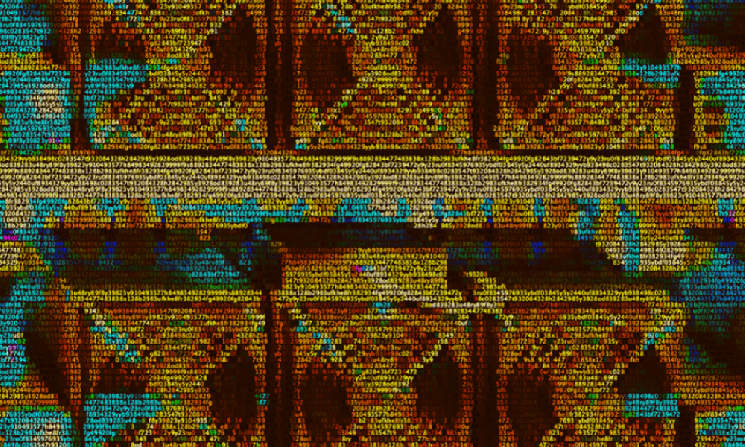
The four bases in RNA sequences – Adenine (A), Uracil (U), Guanine (G), and Cytosine (C) – become the basic tokens for GeneLLM to understand the language of life.

Traditional bioinformatics analysis typically relies on gene annotation, sequence alignment, and manually defined labels. While accurate, this method prematurely limits the model's cognitive scope and may lose vast amounts of unknown biological signals hidden in raw data.

GeneLLM, however, charts a different path, learning life's patterns directly from unprocessed raw sequencing data.

It uses multi-omics raw data such as RNA-seq, proteomics, and metabolomics as training data, allowing the model to autonomously discover disease-related patterns.

Currently, GeneLLM has completed pre-training of a 1.5 billion parameter model with 3.5 trillion base sequences, and the XLarge version has achieved pre-training of a 30 billion parameter model, continuously expanding the technological barrier.

As the world's first multi-omics large model pre-trained on raw sequencing data, GeneLLM includes two main stages:

(1) Unsupervised Pre-training & Prototype Discovery

(2) Patient-level Disease Fine-tuning (Disease Tuning)
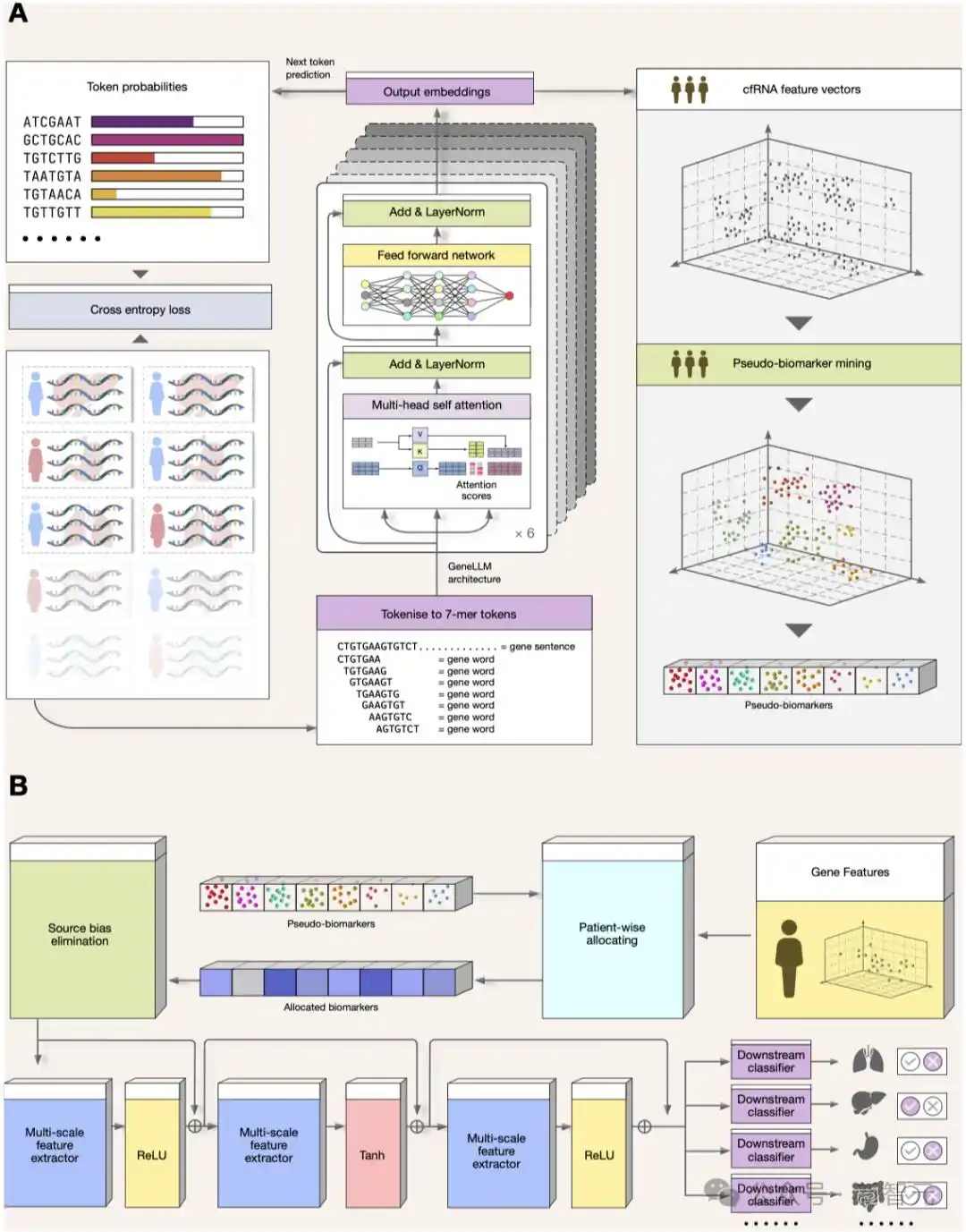
GeneLLM first needs to solve a problem:

How to transform complex life data into a language AI can understand?

In natural language processing, the BPE algorithm splits sentences into Tokens; GeneLLM, however, splits RNA sequencing fragments of about 150bp length into life Tokens using a sliding window of 7 bases (7-mer).

Subsequently, the model utilizes the Transformer architecture to directly predict the next base without gene annotation or human labels.

This means the AI is not first consulting a human-compiled "dictionary," but learning directly from the raw signals of life.

During training, GeneLLM processed approximately tens of trillions of RNA reads, trained on a hundred-card cluster of NVIDIA A100 GPUs.

At this point, GeneLLM's generalization and other capabilities began to "emerge."

As a major innovative breakthrough in the life science field, this domestically produced life science model, GeneLLM, can be applied to various fields including new drug R&D, precision medicine, synthetic biology, environmental monitoring, microbiology & bio-agriculture, and protein & molecule design. It is one of the few large models globally that has achieved real-world scenario deployment.
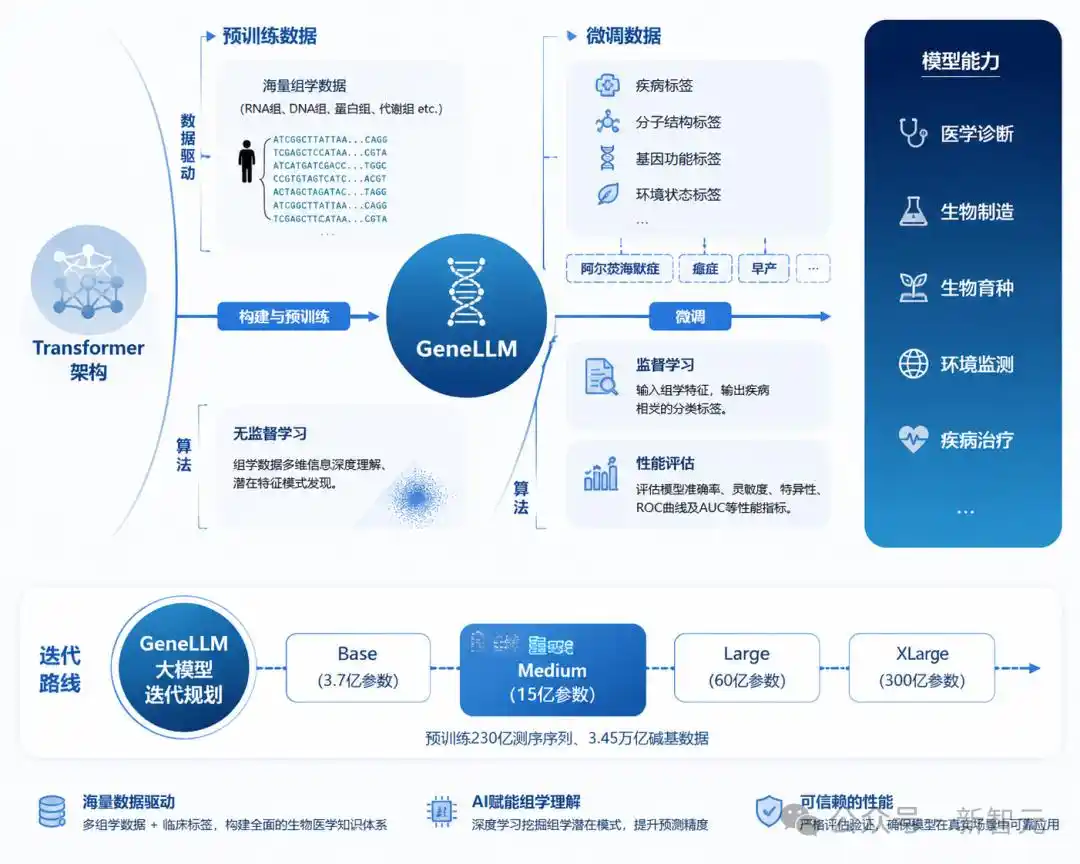
Only after examining the underlying innovations of GeneLLM in "data, architecture, training," can we truly understand: why it represents China's "Bio Version of DeepSeek."

Silicon Valley stacks tens of thousands of H100s for trillion-parameter models, DeepSeek improves computing efficiency through algorithmic innovation, and GeneLLM similarly moves massive life science data with a deft touch.

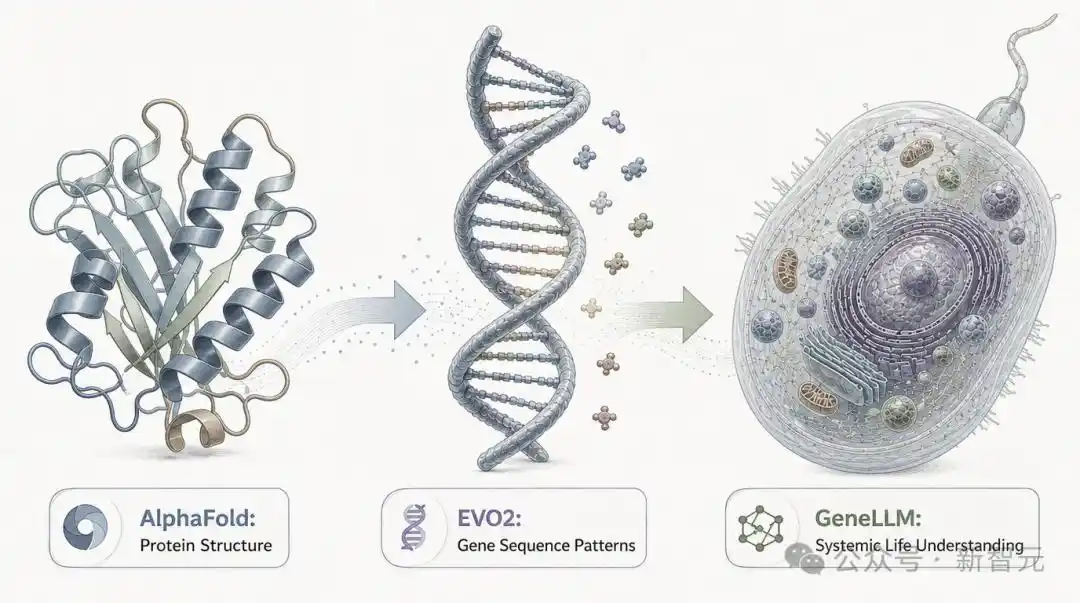
If AlphaFold allowed AI to see life's "structure" for the first time, and EVO2 allowed AI to begin understanding life's "code," then GeneLLM attempts to further understand life's "system."
What's more remarkable is efficiency. Traditional methods rely on 6Gb deep sequencing, with high costs making deployment difficult. GeneLLM maintains AUC > 0.8 even at an extremely shallow depth of 1Gb (cost reduced by 83%).

This truly holds the promise of making affordable precision medicine a reality.

A new research paradigm begins to emerge: letting AI learn from life data, bringing life science into a new stage of predictable, computable, and scalable exploration.

Not Just a Model, but the "Last Mile" Intelligent Infrastructure

But Kindu Biology's strategy extends beyond the foundational model.

Using the GeneLLM multi-omics large model as the life cognition base, Kindu Biology further constructs an execution system connecting AI intelligence with the physical world. Through the Harness intelligent experiment execution layer and the DBTL (Design-Build-Test-Learn) data feedback loop, it achieves a complete AI for Science closed loop—from understanding life patterns and generating scientific hypotheses, to automated experimental validation and continuous iterative optimization.

As Liam Fedus, former OpenAI VP and head of post-training, said, current LLMs have exhausted the limited text and code on the internet. The next major advance in scientific discovery must rely on experimental iteration.
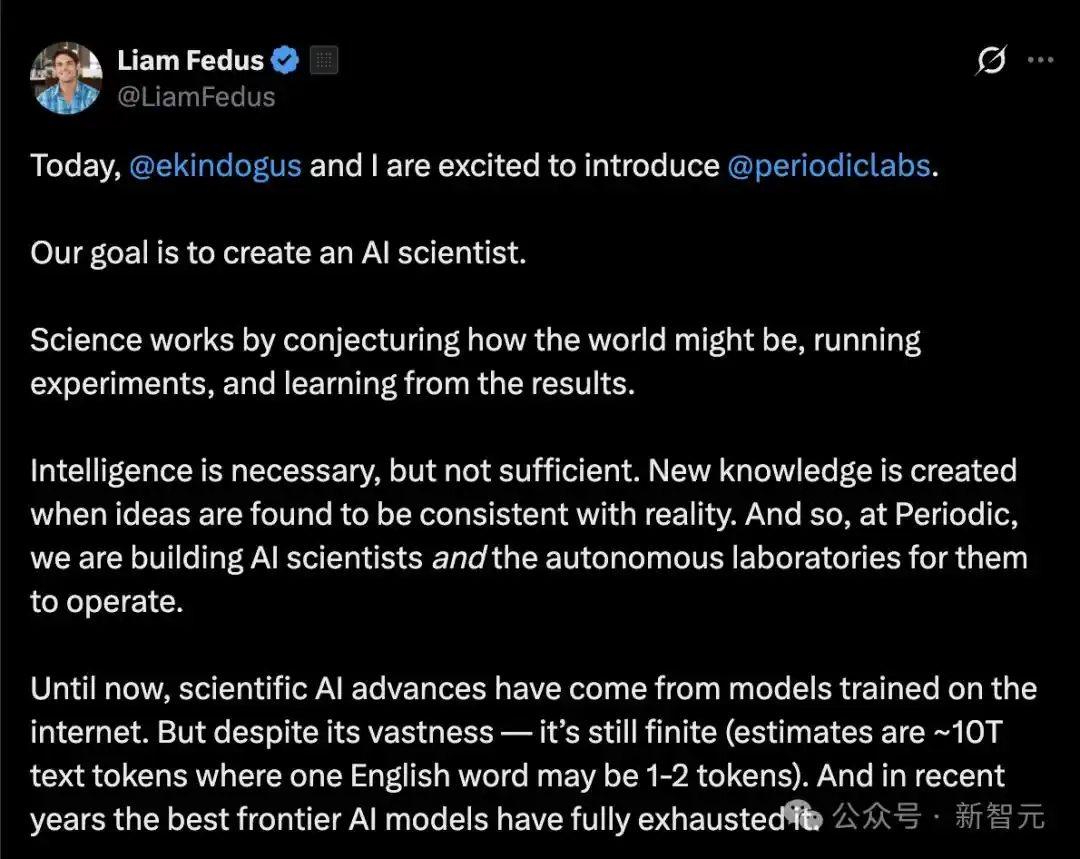
In other words, AI cannot discover new knowledge solely by reading what humans have already written; it must conduct experiments itself.

But here's the problem—

Internet services inherently have APIs; network information is inherently digital. But research equipment comes from different vendors with varying protocols, complex and expensive. No one can rebuild everything from scratch in a few months.

Most labs today are designed for humans: instrument panels, pipetting actions, sample states, on-the-spot judgments—the vast majority are not translated into machine-readable signals.

For AI to enter the lab, the current challenge is not just model capability; it requires a new set of infrastructure.

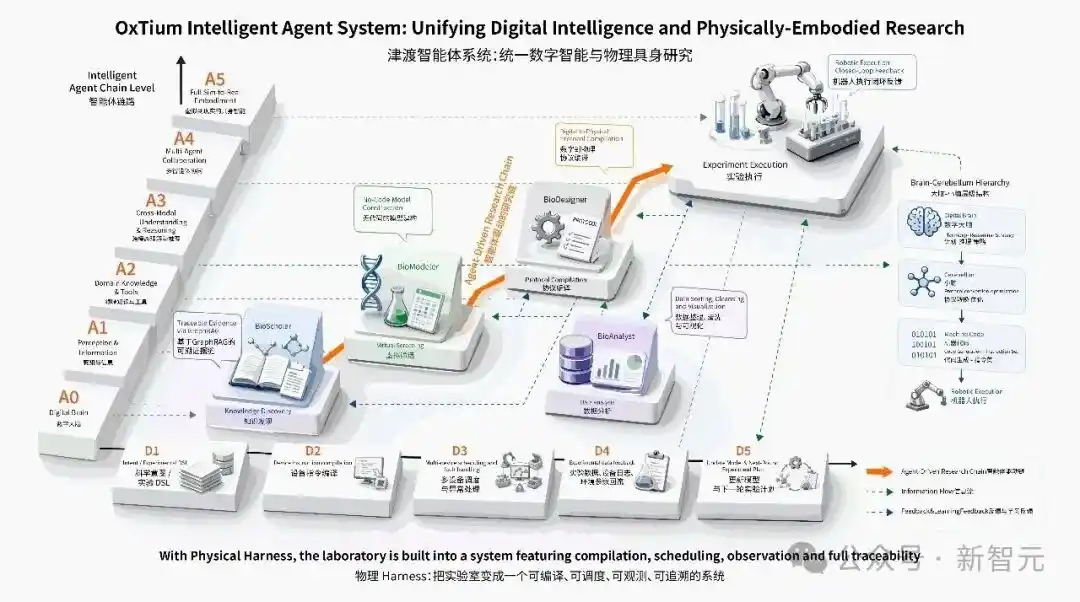
Therefore, for AI to enter the lab, the current issue is not just a model capability problem; it also requires a physical Harness: turning the lab into a system that can be compiled, scheduled, monitored, and traced.

This is the true last mile of AI4S.

BioFord Harness, Making the Lab Start "Running Itself"

For this purpose, Kindu developed a system called BioFord Harness.

This is an infrastructure that connects AI with the physical lab.

They are not making robotic arms imitate human hands, but transforming the lab into a system that can be compiled, scheduled, monitored, and traced.

In this process, the physical Harness must accomplish at least three things:

1. Compile scientific intent or experimental DSL into instructions executable by different devices;

2. Complete scheduling, resource and safety constraint management among multiple devices, and handle exceptions;

3. Let experimental results, device logs, and environmental parameters flow back, becoming inputs for the next round of model and experimental design.

Scientific question → AI understanding → experimental plan → device scheduling → execution → data feedback → model optimization → next round.

A flywheel for scientific experimental data is thus set in motion.
Five Intelligent Agents, Turning Research Workflow into an Assembly Line

The BioFord Agent embodied intelligent research platform connects downward to the physical lab layer and upward to the scientist's cognitive layer, bridging the gap between reasoning and execution with physical AI.

At the cognitive layer, BioFord Agent consists of a collaborative network of five intelligent agents, spanning the entire life science research workflow, potentially multiplying research efficiency.

Literature Retrieval Agent

Experimental Design Agent

Science Agent

Experiment Scheduling Agent

Data Analysis Agent

For example, the Literature Retrieval Agent can quickly help you search and read vast amounts of literature, complete literature reviews, and assist in hypothesis generation.
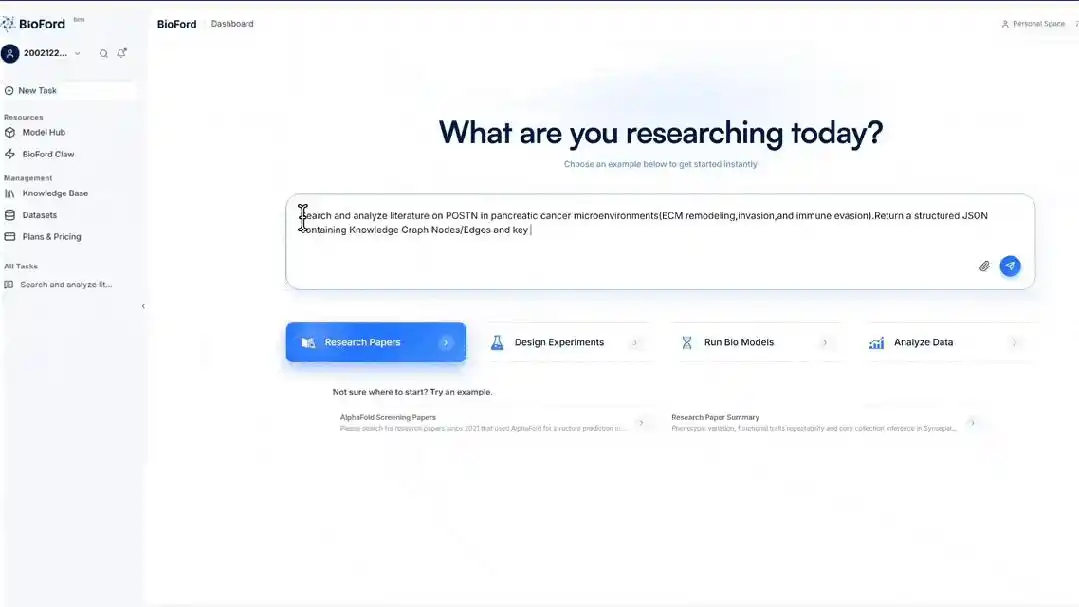
The Experimental Design Agent enabled the research team to shorten the experimental design cycle from several months to one week.

The Experiment Scheduling Agent launched by Kindu Biology, relying on the Universal Instrument Abstraction Layer, breaks protocol barriers between various heterogeneous devices.

Whether it's PCR machines, microplate readers, flow cytometers, or automated liquid handling workstations, they can all achieve unified management and scheduling. The system has built-in dynamic scheduling algorithms, enabling automatic batch scheduling, real-time conflict avoidance, and full recording of experimental parameters, forming a traceable audit trail.
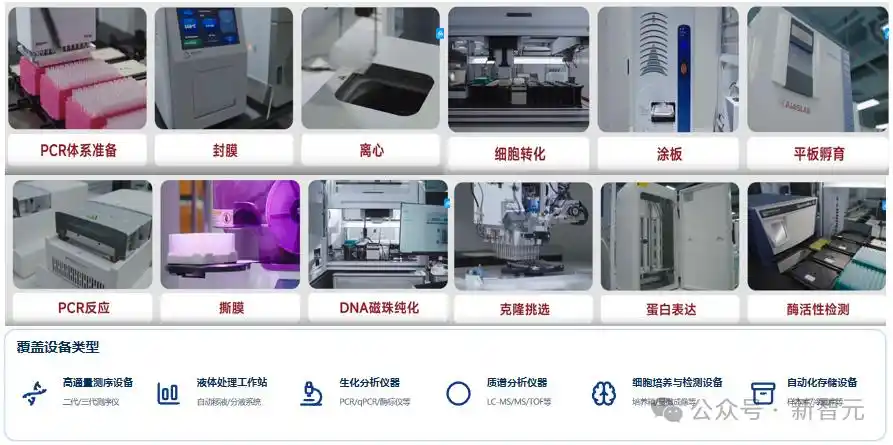
This means AI is no longer stuck in the "suggestions" stage, but truly enters the lab, operates equipment, executes tasks, and becomes a trustworthy "research assistant."

Failure Data Might Be More Valuable Than Success Data

The deeper value this system addresses is: making every experiment—whether successful or failed—data that the system can digest.

In a traditional lab, a failed record might just be a line saying "results not as expected." The experience resides in people's minds; when they leave, the experience is gone.

But in the BioFord system, every failure is valuable training data—the logic of parameter selection, records of environmental conditions, proofs of erroneous paths... all are deposited, becoming part of the system's "experience."

Next time, AI knows: this path is blocked.

Interestingly, in this field, it's not the one with the strongest computing power that wins, nor the one with the largest model.

Computing power can be bought, but research data cannot.

Jin Yongcheng, Founder & CEO of Kindu Biology, stated: "During the R&D process, we gradually realized that AI for BioScience is not simply about stacking models and data. For those doing experiments, the ultimate problem to solve remains the dilemma of not knowing how to proceed after calculation, and not getting it right when proceeding."

This is the most important, and hardest-to-replicate, moat in the AI4S field.

Four Oxford People, Including a Senior Fellow of Luo Fuli

In 2022, when Jin Yongcheng received his PhD in Bioengineering from the University of Oxford, he faced a choice.

His supervisor was Hagan Bayley, a Fellow of the Royal Society and founder of the UK-listed third-generation sequencing giant Oxford Nanopore. The lab had a strong tradition of "translating research into practice." Staying in the UK was a clear, smooth path.

But he chose another path—packing a "prototype technology" from the lab into his suitcase and bringing it back to China. Accompanying him were three Oxford alumni: Biology PhD Deng Siwei, Computer Science Associate Researcher Sha Lei (PhD in Computer Science from Peking University, senior fellow of Luo Fuli, head of Xiaomi's large model), and Zhou Tianyao, skilled in product commercialization. The four possess complementary backgrounds in bioengineering, AI, computational biology, and business operations, forming a perfect team for highly interdisciplinary research. They had previously collaborated on joint research projects, achieving disease prediction and detection by combining AI and transcriptomics technology.

The company name "Kindu Biology": "Kin" is taken from "Oxford," symbolizing their starting point from top-tier academic institutions like Oxford labs; "du" (渡) signifies ferrying or helping others, representing the destination they believe AI for Science should reach.

Currently, Kindu Biology's BioFord Agent physical AI research platform has been deployed in several prestigious domestic universities with significant results, reducing research cycles from several months to one week.

The Wind Rises: 4 Funding Rounds in 1 Year, A Capital "Enchantment" Scene

However, walking a path "untrodden by predecessors" inevitably comes with solitude.

The early days of entrepreneurship were full of difficulties. At that time, AI startups were booming, but "AI+" attempts in the biological sciences were rare. "Those who understand AI may not understand biological science, and most who understand biological science don't understand AI."

Jin Yongcheng admitted: "Investors once couldn't understand what we were doing."

The team chose the "hardest path": starting from a biological foundational large model, a direction pursued by only a handful of companies globally.

In 2025, a turning point emerged.

That year, the State Council issued the "Opinions on Deepening the Implementation of the 'AI+' Initiative," listing AI for Science among the key areas. The field began to gain momentum.

Kindu Biology achieved the feat of "completing 4 funding rounds in one year." The company's main funding timeline is a benchmark for the industry.

Angel+ Round: Led by Sequoia Capital China Seed Fund;

Pre-A+ Round: Led by Chuangdongfang Investment with tens of millions;

Pre-A+ Round: Received tens of millions in investment from Nanshan Zhanxintou;

Series A Round: Led by Gaotejia Investment with nearly 100 million RMB.

Teng Yuhang, Executive Partner at Gaotejia Investment, stated: "Kindu Biology has transformed life science basic research into a subscribable, scalable 'computing power + experiment' infrastructure."

Jin Yongcheng's goal is even more ambitious: "We are not satisfied with just selling software; we want to build the intelligent operating system for the life science field. Just as Intel defined computing power in the PC era, we hope to define the new R&D paradigm for life science in the AI era."

From Oxford labs to Shenzhen, from being misunderstood to receiving heavy investment from top-tier capital, the story of the four Oxford graduates is not just a startup legend, but a soul-searching inquiry about "what we can do for humanity."

When AI learns to "stay up all night" doing research on its own, scientific discovery may no longer rely on the serendipitous inspiration of geniuses, but become a predictable inevitability. This journey has just begun for them.

Industry Landscape: Kindu Charts a Lightweight Physical AI Path

In the broader AI for BioScience landscape, Kindu is not alone, but its entry point is distinctly different.

The first category is Digital AI Scientists.

Stanford-incubated Biomni (commercialized as Phylo) possesses over 150 specialized tools, capable of automatically performing literature review, hypothesis generation, and bioinformatics analysis.

FutureHouse, backed by Eric Schmidt, is dedicated to building AI scientists that can autonomously generate hypotheses and write papers.

However, while powerful, they remain confined to the digital world.

The second category is the Full-stack Autonomous route.

XtalPi deploys over 300 "AI + robotics" workstations globally.

Lila Sciences, incubated by Flagship Pioneering, with $550 million in funding, attempts to let AI completely take over the design, execution, and redesign of experiments, aiming for "scientific superintelligence."

But these approaches are extremely capital-intensive.

The third category is the End-to-end Pipeline route.

Insilico Medicine pushes AI directly into its own innovative drug pipelines, with its first AI-discovered drug entering Phase III clinical trials, but they are "car builders" rather than "road pavers."

Kindu Biology's choice is: focus on building the physical Harness, creating the "last mile" infrastructure between models and physical experimental systems.

Not engaging in the foundational model race, not pursuing end-to-end pipelines, not creating pure digital AI scientists. Focusing only on that last mile is undoubtedly a more lightweight approach.

Jin Yongcheng articulated this judgment clearly: "The true watershed for AI for Science is not how well the model mimics a scientist's answers, but whether the lab can start functioning like a continuously learning system."

Moreover, in the global AI for Science field, Kindu is not simply "only doing the last mile."

More accurately, it uses the last mile as an entry point to compete for the orchestration rights of the entire scientific workflow.

Compared to pure digital AI scientists, it can interact with the physical world; compared to building heavy-asset science factories from scratch, it has the opportunity to take over clients' existing labs; compared to end-to-end AI drug discovery companies, it doesn't have to bet its fate on a single clinical pipeline.
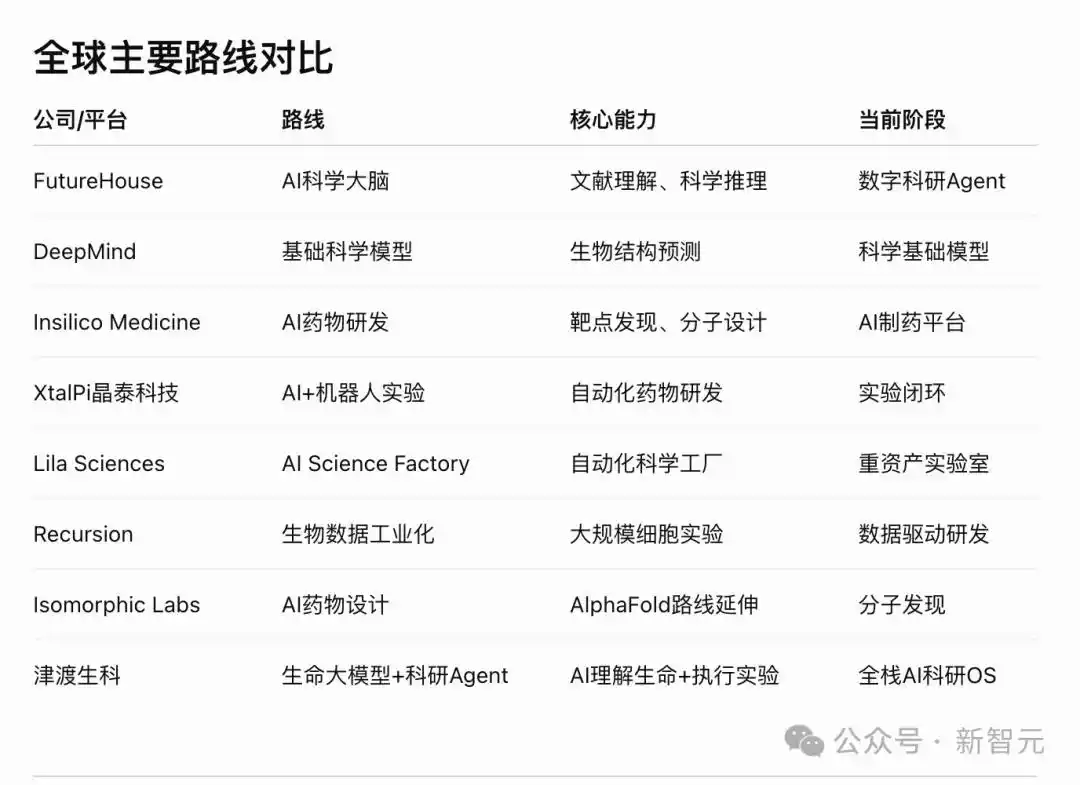
Its true moat will not be parameter count, but the continuously accumulated experimental trajectories, device interfaces, failure experiences, and cross-laboratory execution network.

As Jin Yongcheng said, the myriad signaling pathways within organisms and the reaction mechanisms full of unknowns are fascinating. "As rich as biology is, so is the prospect of AI for Science."

Exploring the mysteries of life with AI's intelligence—the vast universe for these Oxford prodigies has just begun to unfold.

This article is from the WeChat public account "Xinzhiyuan", author: Xinzhiyuan; Editor: Aeneas KingHZ


Criptos en tendencia

Preguntas relacionadas

QWhat is GeneLLM, and how does it represent a significant advancement in China's life science AI field?

AGeneLLM is a multi-omics foundation model developed by Jindu Biotechnology, created by four Oxford University returnees. It is hailed as China's 'DeepSeek for Life Sciences.' Its significance lies in being the first multi-omics foundation model in the world trained directly on raw omics data (like RNA, proteomics, metabolomics) without relying on pre-defined gene annotations or labels. This allows it to autonomously learn patterns and 'understand' the language and systems of life from primary biological signals, filling a key gap in China's life science foundation model landscape. It has been published in top journals like Nature Communications and Advanced Science.

QHow does GeneLLM's core training approach mimic Large Language Models (LLMs) like ChatGPT?

AGeneLLM's core approach mirrors that of text-based LLMs. Just as LLMs predict the next 'token' (word piece) in a sequence, GeneLLM predicts the next 'life information token.' It treats the four RNA bases (A, U, G, C) as fundamental tokens. The model processes raw RNA sequencing data by splitting it into fragments using a sliding 7-mer window, creating these biological tokens. It then uses a Transformer architecture to predict the next base in a sequence, learning directly from the raw data without human-curated 'dictionaries' of biological knowledge.

QWhat is BioFord Harness, and what role does it play in the AI for Science (AI4S) ecosystem according to the article?

ABioFord Harness is a physical infrastructure system developed by Jindu Biotech. Its role is to bridge the gap between AI models and the physical laboratory—solving the 'last-mile' problem in AI4S. It transforms a lab into a 'compilable, schedulable, observable, and traceable' system. It does this by 1) compiling scientific intent into executable instructions for diverse lab equipment, 2) managing scheduling, resources, and safety constraints across multiple devices, and 3) ensuring experimental results, logs, and environmental data flow back to optimize the next round of AI models and experimental designs, creating a continuous learning loop.

QWhat distinguishes Jindu Biotech's strategic approach from other major players in the AI for BioScience field?

AJindu Biotech carves out a distinct, 'lightweight' strategic niche by focusing on the 'last mile' infrastructure (BioFord Harness) rather than competing directly in other established approaches. It does not aim to be a pure 'digital AI scientist' (like Biomni), build capital-intensive fully autonomous labs (like Lila Sciences or XtalPi), or develop end-to-end proprietary drug pipelines (like Insilico Medicine). Instead, it specializes in building the physical harness that connects AI models to existing laboratory equipment, allowing it to orchestrate the entire scientific workflow without the massive capital expenditure of rebuilding labs from scratch.

QHow did the founding team's background and the 2025 policy shift contribute to Jindu Biotech's development?

AThe founding team comprised four Oxford alumni with complementary expertise in bioengineering (CEO Jin Yongcheng), biology, computer science (a former colleague of DeepSeek's Luo Fuli), and business operations. This interdisciplinary 'puzzle' was crucial for tackling the highly cross-disciplinary AI for Science challenge. Despite initial investor skepticism, a major turning point came in 2025 when the Chinese State Council issued guidelines prioritizing 'AI+', including AI for Science. This policy tailwind helped validate the field, leading Jindu Biotech to secure an impressive four rounds of funding in one year from top-tier investors like Sequoia Capital China and Gaotejia Investment, fueling its rapid growth.

Lecturas Relacionadas

Trading

Spot

Artículos destacados

Qué es $S$

Entendiendo SPERO: Una Visión General Completa Introducción a SPERO A medida que el panorama de la innovación continúa evolucionando, la aparición de tecnologías web3 y proyectos de criptomonedas juega un papel fundamental en la configuración del futuro digital. Un proyecto que ha atraído la atención en este campo dinámico es SPERO, denotado como SPERO,$$s$. Este artículo tiene como objetivo reunir y presentar información detallada sobre SPERO, para ayudar a entusiastas e inversores a comprender sus fundamentos, objetivos e innovaciones dentro de los dominios web3 y cripto. ¿Qué es SPERO,$$s$? SPERO,$$s$ es un proyecto único dentro del espacio cripto que busca aprovechar los principios de descentralización y tecnología blockchain para crear un ecosistema que promueva la participación, la utilidad y la inclusión financiera. El proyecto está diseñado para facilitar interacciones de igual a igual de nuevas maneras, proporcionando a los usuarios soluciones y servicios financieros innovadores. En su esencia, SPERO,$$s$ tiene como objetivo empoderar a los individuos al proporcionar herramientas y plataformas que mejoren la experiencia del usuario en el espacio de las criptomonedas. Esto incluye habilitar métodos de transacción más flexibles, fomentar iniciativas impulsadas por la comunidad y crear caminos para oportunidades financieras a través de aplicaciones descentralizadas (dApps). La visión subyacente de SPERO,$$s$ gira en torno a la inclusividad, buscando cerrar brechas dentro de las finanzas tradicionales mientras aprovecha los beneficios de la tecnología blockchain. ¿Quién es el Creador de SPERO,$$s$? La identidad del creador de SPERO,$$s$ sigue siendo algo oscura, ya que hay recursos públicos limitados que proporcionan información de fondo detallada sobre su(s) fundador(es). Esta falta de transparencia puede derivarse del compromiso del proyecto con la descentralización, una ética que muchos proyectos web3 comparten, priorizando las contribuciones colectivas sobre el reconocimiento individual. Al centrar las discusiones en torno a la comunidad y sus objetivos colectivos, SPERO,$$s$ encarna la esencia del empoderamiento sin señalar a individuos específicos. Como tal, comprender la ética y la misión de SPERO sigue siendo más importante que identificar a un creador singular. ¿Quiénes son los Inversores de SPERO,$$s$? SPERO,$$s$ cuenta con el apoyo de una diversa gama de inversores que van desde capitalistas de riesgo hasta inversores ángeles dedicados a fomentar la innovación en el sector cripto. El enfoque de estos inversores generalmente se alinea con la misión de SPERO, priorizando proyectos que prometen avances tecnológicos sociales, inclusión financiera y gobernanza descentralizada. Estas fundaciones de inversores suelen estar interesadas en proyectos que no solo ofrecen productos innovadores, sino que también contribuyen positivamente a la comunidad blockchain y sus ecosistemas. El respaldo de estos inversores refuerza a SPERO,$$s$ como un contendiente notable en el dominio de proyectos cripto que evoluciona rápidamente. ¿Cómo Funciona SPERO,$$s$? SPERO,$$s$ emplea un marco multifacético que lo distingue de los proyectos de criptomonedas convencionales. Aquí hay algunas de las características clave que subrayan su singularidad e innovación: Gobernanza Descentralizada: SPERO,$$s$ integra modelos de gobernanza descentralizada, empoderando a los usuarios para participar activamente en los procesos de toma de decisiones sobre el futuro del proyecto. Este enfoque fomenta un sentido de propiedad y responsabilidad entre los miembros de la comunidad. Utilidad del Token: SPERO,$$s$ utiliza su propio token de criptomoneda, diseñado para servir diversas funciones dentro del ecosistema. Estos tokens permiten transacciones, recompensas y la facilitación de servicios ofrecidos en la plataforma, mejorando la participación y la utilidad general. Arquitectura en Capas: La arquitectura técnica de SPERO,$$s$ apoya la modularidad y escalabilidad, permitiendo la integración fluida de características y aplicaciones adicionales a medida que el proyecto evoluciona. Esta adaptabilidad es fundamental para mantener la relevancia en el cambiante paisaje cripto. Participación de la Comunidad: El proyecto enfatiza iniciativas impulsadas por la comunidad, empleando mecanismos que incentivan la colaboración y la retroalimentación. Al nutrir una comunidad sólida, SPERO,$$s$ puede abordar mejor las necesidades de los usuarios y adaptarse a las tendencias del mercado. Enfoque en la Inclusión: Al ofrecer tarifas de transacción bajas e interfaces amigables para el usuario, SPERO,$$s$ busca atraer a una base de usuarios diversa, incluyendo a individuos que anteriormente pueden no haber participado en el espacio cripto. Este compromiso con la inclusión se alinea con su misión general de empoderamiento a través de la accesibilidad. Cronología de SPERO,$$s$ Entender la historia de un proyecto proporciona información crucial sobre su trayectoria de desarrollo y hitos. A continuación se presenta una cronología sugerida que mapea eventos significativos en la evolución de SPERO,$$s$: Fase de Conceptualización e Ideación: Las ideas iniciales que forman la base de SPERO,$$s$ fueron concebidas, alineándose estrechamente con los principios de descentralización y enfoque comunitario dentro de la industria blockchain. Lanzamiento del Whitepaper del Proyecto: Tras la fase conceptual, se lanzó un whitepaper completo que detalla la visión, los objetivos y la infraestructura tecnológica de SPERO,$$s$ para generar interés y retroalimentación de la comunidad. Construcción de Comunidad y Primeras Interacciones: Se realizaron esfuerzos de divulgación activa para construir una comunidad de primeros adoptantes y posibles inversores, facilitando discusiones en torno a los objetivos del proyecto y obteniendo apoyo. Evento de Generación de Tokens: SPERO,$$s$ llevó a cabo un evento de generación de tokens (TGE) para distribuir sus tokens nativos a los primeros seguidores y establecer liquidez inicial dentro del ecosistema. Lanzamiento de la dApp Inicial: La primera aplicación descentralizada (dApp) asociada con SPERO,$$s$ se puso en marcha, permitiendo a los usuarios interactuar con las funcionalidades centrales de la plataforma. Desarrollo Continuo y Alianzas: Actualizaciones y mejoras continuas a las ofertas del proyecto, incluyendo alianzas estratégicas con otros actores en el espacio blockchain, han moldeado a SPERO,$$s$ en un jugador competitivo y en evolución en el mercado cripto. Conclusión SPERO,$$s$ se erige como un testimonio del potencial de web3 y las criptomonedas para revolucionar los sistemas financieros y empoderar a los individuos. Con un compromiso con la gobernanza descentralizada, la participación comunitaria y funcionalidades diseñadas de manera innovadora, allana el camino hacia un paisaje financiero más inclusivo. Como con cualquier inversión en el espacio cripto que evoluciona rápidamente, se anima a los posibles inversores y usuarios a investigar a fondo y participar de manera reflexiva con los desarrollos en curso dentro de SPERO,$$s$. El proyecto muestra el espíritu innovador de la industria cripto, invitando a una mayor exploración de sus innumerables posibilidades. Mientras el viaje de SPERO,$$s$ aún se desarrolla, sus principios fundamentales pueden, de hecho, influir en el futuro de cómo interactuamos con la tecnología, las finanzas y entre nosotros en ecosistemas digitales interconectados.

252 Vistas totalesPublicado en 2024.12.17Actualizado en 2024.12.17

Qué es $S$

Qué es AGENT S

Agent S: El Futuro de la Interacción Autónoma en Web3 Introducción En el paisaje en constante evolución de Web3 y las criptomonedas, las innovaciones están redefiniendo constantemente cómo los individuos interactúan con las plataformas digitales. Uno de estos proyectos pioneros, Agent S, promete revolucionar la interacción humano-computadora a través de su marco agente abierto. Al allanar el camino para interacciones autónomas, Agent S busca simplificar tareas complejas, ofreciendo aplicaciones transformadoras en inteligencia artificial (IA). Esta exploración detallada profundizará en las complejidades del proyecto, sus características únicas y las implicaciones para el dominio de las criptomonedas. ¿Qué es Agent S? Agent S se presenta como un marco agente abierto innovador, diseñado específicamente para abordar tres desafíos fundamentales en la automatización de tareas informáticas: Adquisición de Conocimiento Específico del Dominio: El marco aprende inteligentemente de diversas fuentes de conocimiento externas y experiencias internas. Este enfoque dual le permite construir un rico repositorio de conocimiento específico del dominio, mejorando su rendimiento en la ejecución de tareas. Planificación a Largo Plazo de Tareas: Agent S emplea planificación jerárquica aumentada por la experiencia, un enfoque estratégico que facilita la descomposición y ejecución eficiente de tareas complejas. Esta característica mejora significativamente su capacidad para gestionar múltiples subtareas de manera eficiente y efectiva. Manejo de Interfaces Dinámicas y No Uniformes: El proyecto introduce la Interfaz Agente-Computadora (ACI), una solución innovadora que mejora la interacción entre agentes y usuarios. Utilizando Modelos de Lenguaje Multimodal de Gran Escala (MLLMs), Agent S puede navegar y manipular diversas interfaces gráficas de usuario sin problemas. A través de estas características pioneras, Agent S proporciona un marco robusto que aborda las complejidades involucradas en la automatización de la interacción humana con las máquinas, preparando el terreno para una multitud de aplicaciones en IA y más allá. ¿Quién es el Creador de Agent S? Si bien el concepto de Agent S es fundamentalmente innovador, la información específica sobre su creador sigue siendo elusiva. El creador es actualmente desconocido, lo que resalta ya sea la etapa incipiente del proyecto o la elección estratégica de mantener a los miembros fundadores en el anonimato. Independientemente de la anonimidad, el enfoque sigue siendo en las capacidades y el potencial del marco. ¿Quiénes son los Inversores de Agent S? Dado que Agent S es relativamente nuevo en el ecosistema criptográfico, la información detallada sobre sus inversores y patrocinadores financieros no está documentada explícitamente. La falta de información disponible públicamente sobre las bases de inversión u organizaciones que apoyan el proyecto plantea preguntas sobre su estructura de financiamiento y hoja de ruta de desarrollo. Comprender el respaldo es crucial para evaluar la sostenibilidad del proyecto y su posible impacto en el mercado. ¿Cómo Funciona Agent S? En el núcleo de Agent S se encuentra una tecnología de vanguardia que le permite funcionar de manera efectiva en diversos entornos. Su modelo operativo se basa en varias características clave: Interacción Humano-Computadora Similar a la Humana: El marco ofrece planificación avanzada de IA, esforzándose por hacer que las interacciones con las computadoras sean más intuitivas. Al imitar el comportamiento humano en la ejecución de tareas, promete elevar las experiencias de los usuarios. Memoria Narrativa: Empleada para aprovechar experiencias de alto nivel, Agent S utiliza memoria narrativa para hacer un seguimiento de las historias de tareas, mejorando así sus procesos de toma de decisiones. Memoria Episódica: Esta característica proporciona a los usuarios una guía paso a paso, permitiendo que el marco ofrezca apoyo contextual a medida que se desarrollan las tareas. Soporte para OpenACI: Con la capacidad de ejecutarse localmente, Agent S permite a los usuarios mantener el control sobre sus interacciones y flujos de trabajo, alineándose con la ética descentralizada de Web3. Fácil Integración con APIs Externas: Su versatilidad y compatibilidad con varias plataformas de IA aseguran que Agent S pueda encajar sin problemas en ecosistemas tecnológicos existentes, convirtiéndolo en una opción atractiva para desarrolladores y organizaciones. Estas funcionalidades contribuyen colectivamente a la posición única de Agent S dentro del espacio cripto, ya que automatiza tareas complejas y de múltiples pasos con una intervención humana mínima. A medida que el proyecto evoluciona, sus posibles aplicaciones en Web3 podrían redefinir cómo se desarrollan las interacciones digitales. Cronología de Agent S El desarrollo y los hitos de Agent S pueden encapsularse en una cronología que resalta sus eventos significativos: 27 de septiembre de 2024: El concepto de Agent S fue lanzado en un documento de investigación integral titulado “Un Marco Agente Abierto que Usa Computadoras Como un Humano”, mostrando las bases del proyecto. 10 de octubre de 2024: El documento de investigación fue puesto a disposición del público en arXiv, ofreciendo una exploración profunda del marco y su evaluación de rendimiento basada en el benchmark OSWorld. 12 de octubre de 2024: Se lanzó una presentación en video, proporcionando una visión visual de las capacidades y características de Agent S, involucrando aún más a posibles usuarios e inversores. Estos marcadores en la cronología no solo ilustran el progreso de Agent S, sino que también indican su compromiso con la transparencia y la participación comunitaria. Puntos Clave Sobre Agent S A medida que el marco Agent S continúa evolucionando, varios atributos clave destacan, subrayando su naturaleza innovadora y potencial: Marco Innovador: Diseñado para proporcionar un uso intuitivo de las computadoras similar a la interacción humana, Agent S aporta un enfoque novedoso a la automatización de tareas. Interacción Autónoma: La capacidad de interactuar de manera autónoma con las computadoras a través de GUI significa un salto hacia soluciones informáticas más inteligentes y eficientes. Automatización de Tareas Complejas: Con su metodología robusta, puede automatizar tareas complejas y de múltiples pasos, haciendo que los procesos sean más rápidos y menos propensos a errores. Mejora Continua: Los mecanismos de aprendizaje permiten a Agent S mejorar a partir de experiencias pasadas, mejorando continuamente su rendimiento y eficacia. Versatilidad: Su adaptabilidad en diferentes entornos operativos como OSWorld y WindowsAgentArena asegura que pueda servir a una amplia gama de aplicaciones. A medida que Agent S se posiciona en el paisaje de Web3 y criptomonedas, su potencial para mejorar las capacidades de interacción y automatizar procesos significa un avance significativo en las tecnologías de IA. A través de su marco innovador, Agent S ejemplifica el futuro de las interacciones digitales, prometiendo una experiencia más fluida y eficiente para los usuarios en diversas industrias. Conclusión Agent S representa un audaz avance en la unión de la IA y Web3, con la capacidad de redefinir cómo interactuamos con la tecnología. Aunque aún se encuentra en sus primeras etapas, las posibilidades para su aplicación son vastas y atractivas. A través de su marco integral que aborda desafíos críticos, Agent S busca llevar las interacciones autónomas al primer plano de la experiencia digital. A medida que nos adentramos más en los reinos de las criptomonedas y la descentralización, proyectos como Agent S sin duda desempeñarán un papel crucial en la configuración del futuro de la tecnología y la colaboración humano-computadora.

651 Vistas totalesPublicado en 2025.01.14Actualizado en 2025.01.14

Qué es AGENT S

Cómo comprar S

¡Bienvenido a HTX.com! Hemos hecho que comprar Sonic (S) sea simple y conveniente. Sigue nuestra guía paso a paso para iniciar tu viaje de criptos.Paso 1: crea tu cuenta HTXUtiliza tu correo electrónico o número de teléfono para registrarte y obtener una cuenta gratuita en HTX. Experimenta un proceso de registro sin complicaciones y desbloquea todas las funciones.Obtener mi cuentaPaso 2: ve a Comprar cripto y elige tu método de pagoTarjeta de crédito/débito: usa tu Visa o Mastercard para comprar Sonic (S) al instante.Saldo: utiliza fondos del saldo de tu cuenta HTX para tradear sin problemas.Terceros: hemos agregado métodos de pago populares como Google Pay y Apple Pay para mejorar la comodidad.P2P: tradear directamente con otros usuarios en HTX.Over-the-Counter (OTC): ofrecemos servicios personalizados y tipos de cambio competitivos para los traders.Paso 3: guarda tu Sonic (S)Después de comprar tu Sonic (S), guárdalo en tu cuenta HTX. Alternativamente, puedes enviarlo a otro lugar mediante transferencia blockchain o utilizarlo para tradear otras criptomonedas.Paso 4: tradear Sonic (S)Tradear fácilmente con Sonic (S) en HTX's mercado spot. Simplemente accede a tu cuenta, selecciona tu par de trading, ejecuta tus trades y monitorea en tiempo real. Ofrecemos una experiencia fácil de usar tanto para principiantes como para traders experimentados.

1.3k Vistas totalesPublicado en 2025.01.15Actualizado en 2026.06.02

Cómo comprar S

Discusiones

Bienvenido a la comunidad de HTX. Aquí puedes mantenerte informado sobre los últimos desarrollos de la plataforma y acceder a análisis profesionales del mercado. A continuación se presentan las opiniones de los usuarios sobre el precio de S (S).

活动图片