Only 153 Venture Capital Firms Invested in July: Is the Crypto VC Industry Experiencing a 'Mass Extinction'?

marsbitPublicado a 2026-07-31Actualizado a 2026-07-31

Resumen

In July 2026, only 153 unique venture capital firms participated in disclosed crypto funding rounds, marking the lowest monthly count since November 2020. This figure represents an 87% decline from the peak of 1,177 firms in 2022. Overall, the first seven months of 2026 saw crypto projects raise approximately $11.78 billion across 481 rounds. This crypto VC contraction contrasts sharply with the broader venture capital landscape, where global VC investment reached a record $560.4 billion in H1 2026, heavily fueled by major AI company financings. This shift in capital allocation has drawn funds away from the crypto sector. Within crypto, funding is highly concentrated. Trading platforms, prediction markets, and payment sectors absorbed 53% of the total capital. While early-stage deals remain frequent, the largest sums flow to a few late-stage rounds and mergers & acquisitions, which surged to $7.23 billion in Q2 2026. The market is consolidating around top funds like a16z crypto and Dragonfly, which successfully raised new multi-billion dollar funds, while many smaller firms have retreated. Analysts describe this as a "great extinction" for crypto VCs, where capital is becoming more selective, favoring proven business models and assets over early-stage speculation. This raises the bar for project quality, funding efficiency, and viable exit paths.

CryptoRank recorded 153 distinct venture capital firms participating in crypto funding rounds for the month up to July 31, the lowest monthly level since November 2020. This statistic counts the number of unique, deduplicated institutions that participated in at least one disclosed crypto funding round; it does not mean only 153 VC firms remain in the market.

This number peaked at 1,177 firms monthly in 2022, subsequently decreasing by about 87%. A total of 651 institutions participated in crypto funding in Q2 2026, a drop of roughly 75% compared to the 2,564 firms in Q2 2022.

CryptoRank data shows this metric reached 395 firms in March 2026, briefly rebounded to 314 in May, and then fell again to 244 in June.
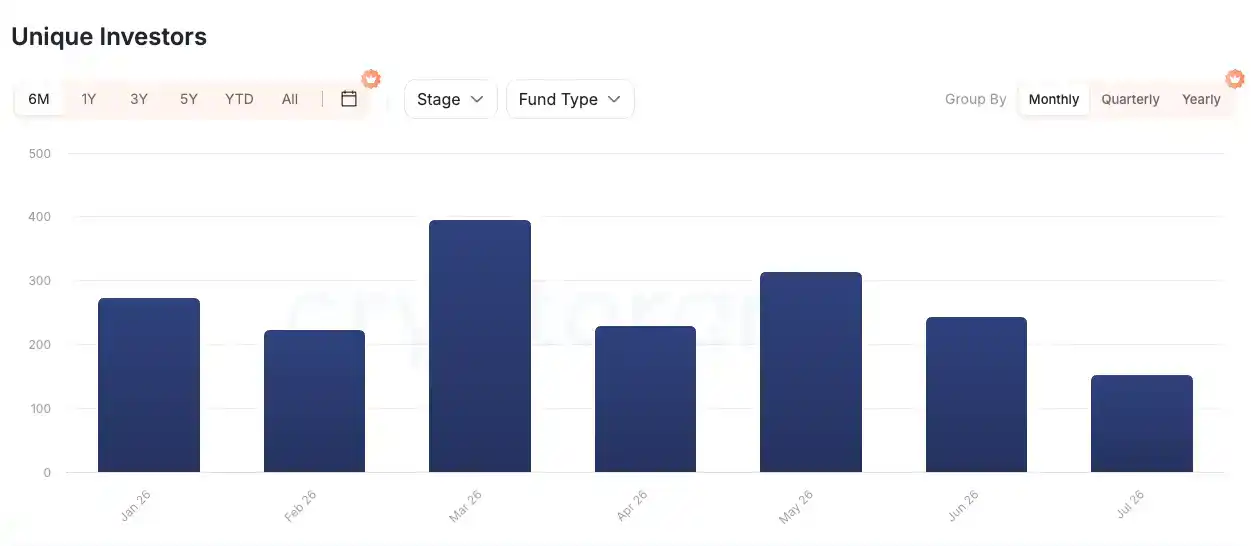
CryptoRank: Monthly Deduplicated Investor Count in 2026

On the other hand, this reduction in crypto venture capital activity is occurring during a phase of expansion in the global venture capital landscape. Global venture capital investment reached $227.4 billion across 8,440 deals in Q2 2026, marking the second-highest quarter on record; the total for the first half of the year reached $560.4 billion, second only to the same period in 2021. Large funding rounds for AI companies like Anthropic, Prometheus, and DeepSeek were the primary drivers.

According to KPMG statistics, by the end of Q2, global VC funds had raised approximately $98.8 billion in the year to date, involving 727 funds. Among these, 19 funds that raised over $1 billion each collectively absorbed $53.2 billion, accounting for more than half of the total. The number of deals remains relatively weak, with large sums primarily flowing to AI and mature companies with proven business models.

Bleeding off this enthusiasm, both capital and deal count in the crypto market have retreated simultaneously. Galaxy Research statistics show that in Q1 2026, crypto and blockchain startups completed 355 funding rounds, raising approximately $4.0 billion, representing quarterly declines of 16% and about 50%, respectively. Only 8 new crypto VC funds completed fundraising in that quarter, raising a total of around $1.1 billion, the lowest since Q3 2020.

Galaxy attributed the fundraising difficulties to multiple factors, including pressure from historical returns due to industry turbulence in 2022-2023, the macro environment, competition for limited partner funds from AI, and the availability of more liquid crypto exposure through spot crypto ETFs and digital asset treasury companies. Global capital remains abundant, but the focus of allocation and the list of favored managers are narrowing.

First 7 Months Funding: $11.778 Billion, May Alone Contributed One-Third

According to CryptoRank's public dashboard as of July 31, crypto projects completed 481 funding rounds in the first 7 months of 2026, with a disclosed total of approximately $11.778 billion.
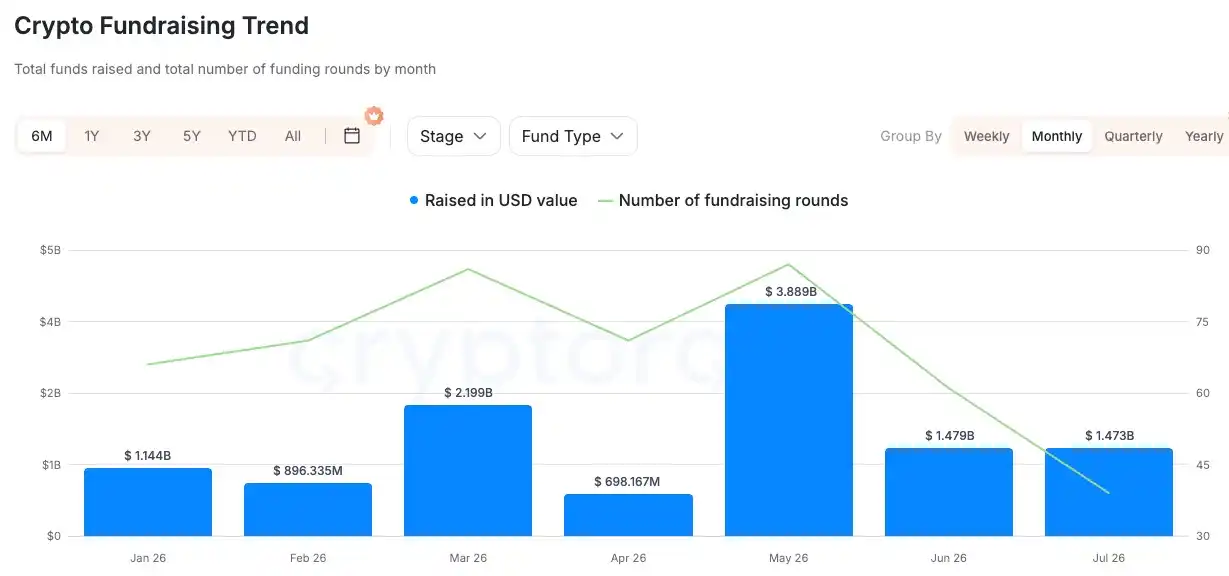
CryptoRank: Monthly Crypto Funding Amount and Number of Rounds in 2026

May, with $3.889 billion across 87 rounds, was the year's high point, accounting for about 33% of the total for the first 7 months. April saw only $698 million across 71 rounds. May's funding amount surged to 5.6 times that of the previous month, while the number of rounds increased by only about 23%. Projects of a similar quantity scale can correspond to vastly different total funding amounts, indicating that a few large deals still dominate the monthly curves.

March and May together absorbed approximately $6.088 billion, accounting for about 52% of the year-to-date total. Funding amounts fell to $1.479 billion in June and $1.473 billion in July, while the number of publicly disclosed rounds dropped from 61 to 39.

Trading Platforms, Prediction Markets, and Payments Absorb 53% of Capital

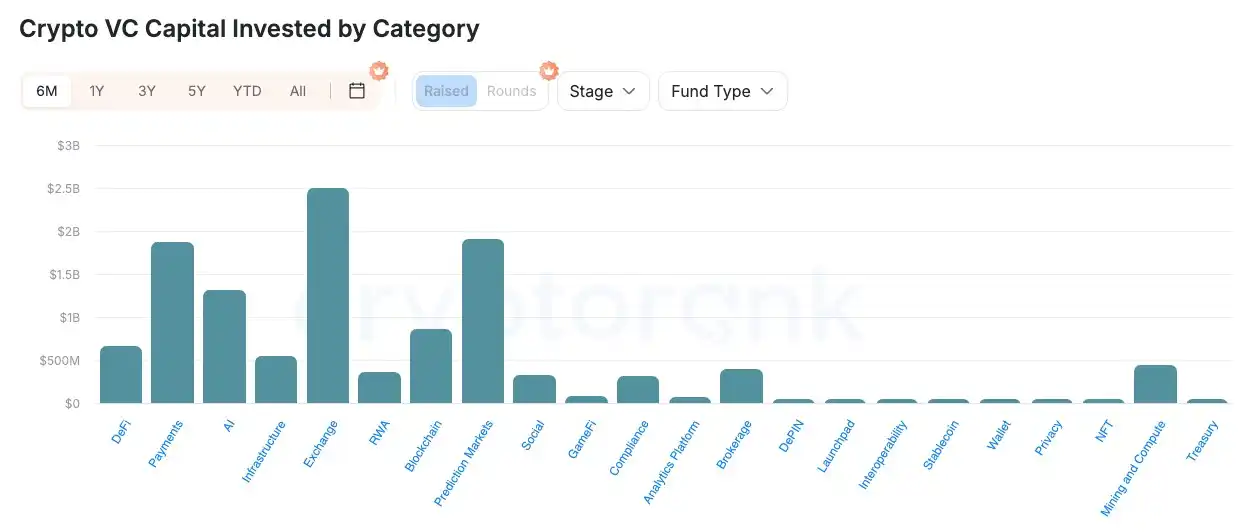
According to CryptoRank's project category classification, Trading Platforms, Prediction Markets, and Payments ranked top three in terms of funding amount for the year to date, raising $2.490 billion, $1.897 billion, and $1.861 billion respectively. Combined, this totals approximately $6.247 billion, representing 53% of the funding for the first 7 months. AI ranked fourth with $1.305 billion.
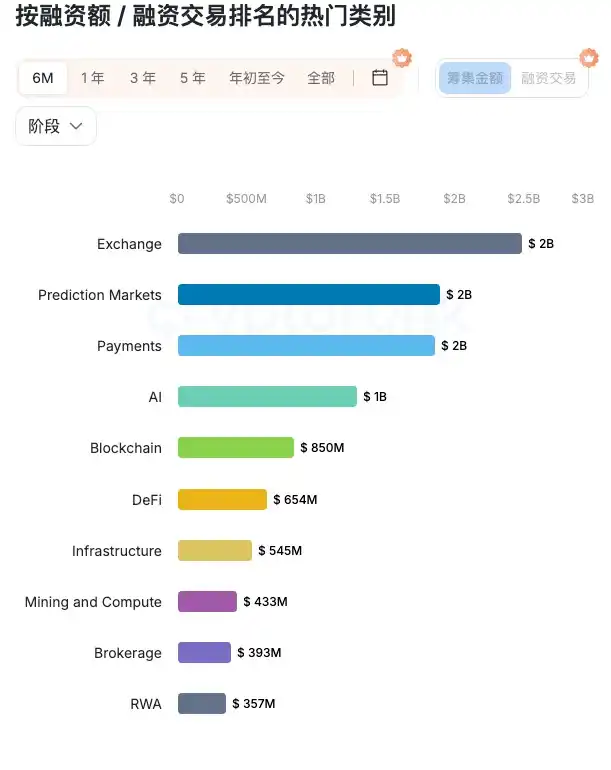
Interestingly, DeFi ranked first with 78 rounds but secured only about $654 million; Payments and AI completed 73 and 65 rounds respectively. High-frequency early-stage funding still exists, but capital is more concentrated in sectors like trading platforms and prediction markets, which can accommodate large later-stage transactions.
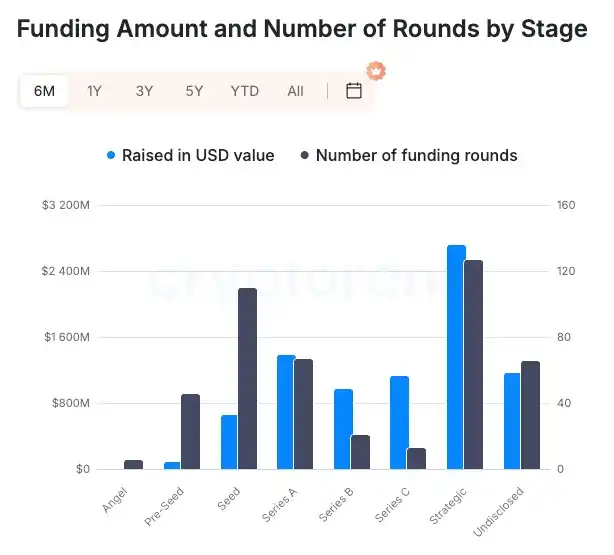
The funding stage further amplifies this disparity. CryptoRank recorded only 20 Series C and later rounds, but they absorbed approximately $3.333 billion. The seed stage, including Pre-Seed and extension rounds, comprised 156 rounds with a disclosed amount of about $750 million. Strategic funding rounds totaled 127, raising about $2.718 billion. Rounds are mainly distributed across early-stage and strategic funding, while the peaks in amount are driven by a handful of late-stage projects.
The value of mergers and acquisitions (M&A) in the crypto industry surged from $272 million in Q4 2025 to $7.23 billion in Q2 2026, expanding over 26-fold in six months. This amount is not included in the aforementioned $11.778 billion funding figure but indicates that capital is also flowing through M&A to companies that have already established business operations and assets.

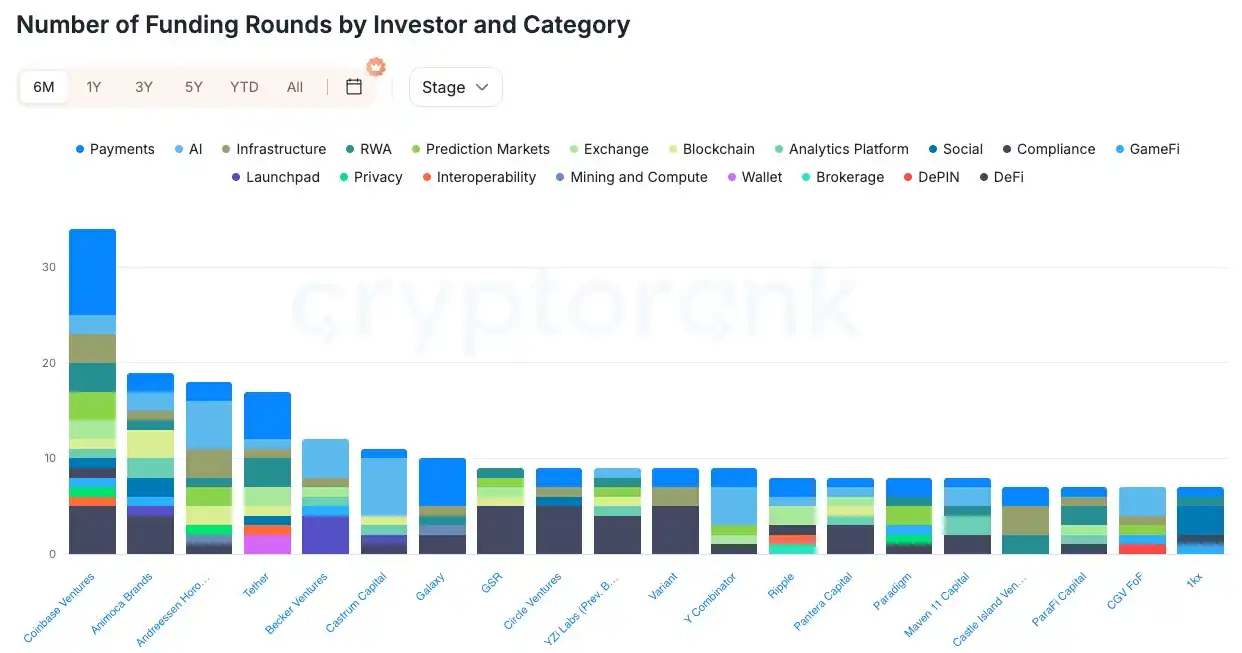
The investor leaderboard also shows a concentration trend. Coinbase Ventures participated in 34 rounds year-to-date, while Animoca Brands, a16z crypto, and Tether participated in 19, 18, and 17 rounds respectively. Repeated investments by a single institution increase the transaction count but do not increase the deduplicated investor metric, explaining the concurrent state where funding activity continues while the total number of active institutions keeps declining.
Top Funds Can Still Raise Capital; Long-Tail Institutions Exiting Reduces Project Options

Dragonfly completed its $650 million fourth fund in February, and a16z crypto announced raising a $2.2 billion fifth fund in June. In contrast, Galaxy Research statistics show that in Q1 2026, only 8 new crypto VC funds completed fundraising, raising a total of approximately $1.1 billion, the lowest since Q3 2020. Top-tier managers can still secure substantial capital, but the list of institutions capable of sustainable fundraising is shrinking.

Rob Hadick, a partner at Dragonfly, previously described in an interview with Fortune magazine that the crypto VC industry is experiencing a "mass extinction." The number of active institutions has shrunk by nearly 90% from its peak, diverging from the concurrent expansion of the global venture capital total. This indicates that this contraction is more a shift in capital allocation. The AI sector and secondary market instruments are simultaneously diverting capital that would have otherwise flowed into primary crypto projects, a trend unlikely to reverse in the short term.

However, early-stage projects can still maintain a certain frequency of transactions, albeit with limited individual deal sizes; large sums of capital are concentrated in a few later-stage sectors like trading platforms and prediction markets, as well as in M&A transactions. This means the crypto primary market has not vanished, but risk appetite has clearly converged, favoring projects with proven business models and accumulated assets.

While top funds complete large fundraises, numerous small and medium-sized institutions are no longer participating in new funding rounds. This landscape has practical implications for startup teams: the pool of potential investors is shrinking, negotiation space on terms is narrowing, and project selection criteria are rising. The decline in the number of institutions, capital scale, and transaction frequency may not necessarily be a negative signal, but it does signify rising industry barriers, with stricter requirements on project quality, capital efficiency, and exit paths than before.


Criptos en tendencia

Preguntas relacionadas

QAccording to the article, what was the lowest monthly number of unique venture capital firms participating in crypto funding since November 2020?

AAccording to the article, in July, 153 different venture capital firms participated in crypto funding, which was the lowest monthly level since November 2020.

QWhat are the top three project categories in terms of funding received in the first seven months of 2026 according to CryptoRank's data?

AAccording to CryptoRank's data, the top three project categories for funding in the first seven months of 2026 were Trading Platforms, Prediction Markets, and Payments. They received $2.49 billion, $1.897 billion, and $1.861 billion respectively, accounting for 53% of the total.

QHow does the article explain the concurrent situation of decreasing unique crypto investors while the number of funding deals is still ongoing?

AThe article explains this by pointing out that top-tier firms like Coinbase Ventures, Animoca Brands, a16z crypto, and Tether are repeatedly participating in multiple funding rounds. This increases the deal count but does not increase the unique investor count, as the same firms are counted multiple times in deal statistics but only once in the unique investor metric.

QWhat major factor is identified as diverting capital away from the crypto venture sector, according to the analysis in the article?

AThe article identifies the AI sector as a major factor diverting capital. It states that large-scale funding for AI companies like Anthropic, Prometheus, and DeepSeek, along with the expansion of global venture capital, has created significant competition for limited partner funds, drawing investment away from crypto projects.

QWhat term does Dragonfly partner Rob Hadick use to describe the current state of the crypto venture capital industry, and what key evidence supports this description?

ADragonfly partner Rob Hadick describes the current state as a 'mass extinction' for the crypto venture capital industry. The key evidence supporting this is that the number of active investing institutions has shrunk by nearly 90% from its peak of 1,177 in 2022 to just 153 in July, even while global venture capital as a whole is expanding.

Lecturas Relacionadas

When the Market Begins to Question AI Capex: A Full Analysis of Q2 Earnings Reports from Five Tech Giants

In late July 2026, five major US tech giants—Alphabet, Intel, Microsoft, Meta, and Apple—released their Q2 earnings reports. While all companies exceeded revenue and profit expectations, driven by strong AI-related business growth, investor reactions diverged sharply due to concerns over escalating AI capital expenditures (capex) and their impact on free cash flow. Alphabet reported strong revenue growth and a surging cloud business, but its stock fell after announcing a doubled year-on-year capex and negative quarterly free cash flow for the first time. Intel posted its strongest revenue growth in over 15 years, but its stock experienced volatile trading after significantly raising its full-year capex guidance. Microsoft saw its stock surge after beating estimates and, crucially, lowering its capex forecast while projecting positive free cash flow. Meta faced the most severe sell-off as its profits declined despite revenue beats, with free cash flow plunging over 90% and its capex guidance raised. Apple reported record June-quarter results, but its stock plummeted after providing Q4 revenue guidance that fell short of expectations, citing supply chain constraints and forex headwinds. The overall takeaway is that the market's focus has shifted from validating AI demand to scrutinizing the timeline for returns on massive AI investments. Companies demonstrating a clearer path to managing capex and preserving free cash flow, like Microsoft, were rewarded, while those signaling continued aggressive spending faced investor skepticism.

Odaily星球日报Hace 5 min(s)

When the Market Begins to Question AI Capex: A Full Analysis of Q2 Earnings Reports from Five Tech Giants

Odaily星球日报Hace 5 min(s)

a16z: From Companies to DAOs, DUNA May Become the Next Generation Organizational Form

This article, "From Companies to DAOs: How DUNA Could Become the Next Organizational Form," traces the 500-year evolution of business collaboration. It begins with medieval structures like the *commenda* and Florentine *compagnia*, which exposed partners to personal risk. The modern corporation, exemplified by the Dutch East India Company (VOC), was a revolutionary leap, enabling large-scale, capital-intensive ventures by offering limited liability and reducing coordination costs. However, corporations introduced new challenges like principal-agent problems and bureaucratic overhead. The piece argues that software and internet-native protocols are now reducing these traditional overheads. Decentralized Autonomous Organizations (DAOs) emerged as a new model for coordination without centralized management. Yet, DAOs face a significant legal vacuum: they lack legal recognition, leaving members exposed to unlimited personal liability, and their tokens are vulnerable to being classified as securities under unclear regulations (e.g., the Howey Test). This has forced projects into suboptimal workarounds like offshore foundations. The article identifies the Decentralized Unincorporated Nonprofit Association (DUNA) as a potential solution. Recently legalized in states like Wyoming, the DUNA provides a legal wrapper for decentralized networks. It grants key protections—legal personality, limited liability, and perpetual existence—to a group without imposing a traditional hierarchical management structure. This allows token-holder communities to govern, hold assets, and contract as a single legal entity, aligning with their decentralized nature. While DUNA doesn't solve all governance challenges or magically resolve securities law questions, it represents a crucial step. It fills the legal recognition gap, offering a native legal form for internet-scale, decentralized collaboration and extending the separation of personal risk from organizational venture into a new domain.

marsbitHace 51 min(s)

a16z: From Companies to DAOs, DUNA May Become the Next Generation Organizational Form

marsbitHace 51 min(s)

2026 Mid-Year Report On-Chain RWA: Tokenized Stock Market Cap Doubles in a Year, But 90% of Rights Are Hollow Shells

The 2026 Mid-Year Report on On-Chain RWA highlights a significant growth in tokenized stock market capitalization, which nearly doubled from $951 million in March to $1.89 billion by July. However, the report reveals a fundamental contradiction in this "layer 2.5" ecosystem: products with the strongest legal foundation (like regulated U.S. infrastructure) lack liquidity and distribution, while freely tradable offshored wrapper products often lack substantive ownership rights. The increase is driven largely by a few products (SECZ, FGRS, STRCx) and platforms (Ondo, xStocks, Securitize collectively hold over 85% share). While distributed value across networks like Ethereum, Solana, and BNB Chain has grown, the market remains fragmented. Products referencing the same underlying asset (e.g., Apple stock) are distinct legal liabilities with different intermediaries and jurisdictional rules, offering varying degrees of legal claim. The report cautions that headline numbers are misleading, as they reflect changes in distributed token value—driven by issuance, conversions, and price movements—not pure investor inflows. True "canonical shares" with legal ownership, wide wallet distribution, institutional liquidity, and independent on-chain price discovery do not yet exist at scale. Tokenized treasuries show stronger product-market fit, and ETFs may be easier to scale than single stocks. The core takeaway is a trade-off: legal certainty versus liquidity and composability.

marsbitHace 1 hora(s)

2026 Mid-Year Report On-Chain RWA: Tokenized Stock Market Cap Doubles in a Year, But 90% of Rights Are Hollow Shells

marsbitHace 1 hora(s)

Trading

Spot

Artículos destacados

Cómo comprar F

¡Bienvenido a HTX.com! Hemos hecho que comprar Synfutures (F) sea simple y conveniente. Sigue nuestra guía paso a paso para iniciar tu viaje de criptos.Paso 1: crea tu cuenta HTXUtiliza tu correo electrónico o número de teléfono para registrarte y obtener una cuenta gratuita en HTX. Experimenta un proceso de registro sin complicaciones y desbloquea todas las funciones.Obtener mi cuentaPaso 2: ve a Comprar cripto y elige tu método de pagoTarjeta de crédito/débito: usa tu Visa o Mastercard para comprar Synfutures (F) al instante.Saldo: utiliza fondos del saldo de tu cuenta HTX para tradear sin problemas.Terceros: hemos agregado métodos de pago populares como Google Pay y Apple Pay para mejorar la comodidad.P2P: tradear directamente con otros usuarios en HTX.Over-the-Counter (OTC): ofrecemos servicios personalizados y tipos de cambio competitivos para los traders.Paso 3: guarda tu Synfutures (F)Después de comprar tu Synfutures (F), guárdalo en tu cuenta HTX. Alternativamente, puedes enviarlo a otro lugar mediante transferencia blockchain o utilizarlo para tradear otras criptomonedas.Paso 4: tradear Synfutures (F)Tradear fácilmente con Synfutures (F) en HTX's mercado spot. Simplemente accede a tu cuenta, selecciona tu par de trading, ejecuta tus trades y monitorea en tiempo real. Ofrecemos una experiencia fácil de usar tanto para principiantes como para traders experimentados.

242 Vistas totalesPublicado en 2024.12.21Actualizado en 2026.06.02

Cómo comprar F

Discusiones

Bienvenido a la comunidad de HTX. Aquí puedes mantenerte informado sobre los últimos desarrollos de la plataforma y acceder a análisis profesionales del mercado. A continuación se presentan las opiniones de los usuarios sobre el precio de F (F).

活动图片