Blackrock Bantu Pemulihan ETF Bitcoin senilai $32 Juta Setelah Penurunan 4 Hari Berturut-turut

cryptonews.ruPublicado a 2026-07-30Actualizado a 2026-07-30

Resumen

Pasar ETF kripto menunjukkan perubahan arah pada Rabu, 29 Juli. Bitcoin ETF kembali menarik minat investor setelah empat hari mengalami arus keluar dana, dengan BlackRock's IBIT menjadi pendorong utama dengan masuknya dana sebesar $89,83 juta. Secara bersih, kategori Bitcoin ETF mencatat aliran masuk sebesar $32,11 juta, mengakhiri tren penurunan. Sebaliknya, ETF Ethereum mengalami arus keluar bersih $18,65 juta, meski ada produk baru dari Morgan Stanley. ETF Solana berhasil pulih dengan aliran masuk $19,06 juta, didominasi oleh ETF staking baru MSOL dari Morgan Stanley. ETF XRP juga mencatat pertumbuhan kecil. Data terbaru menunjukkan pasar kripto tetap terbuka terhadap risiko tetapi semakin selektif. Bitcoin mendapatkan kembali dukungan, Solana pulih, dan produk staking menarik minat. Namun, Ethereum dan ETF $HYPE masih menghadapi tekanan penjualan.

Pasar dana yang diperdagangkan di bursa (ETF) kripto kembali berubah arah pada Rabu, 29 Juli. Bitcoin menemukan pembeli setelah empat sesi berturut-turut yang ditandai dengan arus keluar dana, sementara Solana mengimbangi kerugian besar hari sebelumnya dengan arus masuk dana yang hampir sama besarnya.

Dana yang berbasis Ethereum kurang beruntung. Setelah dua sesi kenaikan, mereka kembali mengalami arus keluar, dan dana ETF $HYPE memperpanjang rangkaian kerugiannya menjadi lima hari.

Blackrock Dukung Bitcoin di Tengah Penarikan Dana Ethereum

ETF IBIT milik Blackrock menjadi pendorong utama pemulihan ETF Bitcoin, menarik arus masuk dana sebesar $89,83 juta. Kenaikan ini mengimbangi arus keluar sebesar $43,08 juta dari FBTC milik Fidelity dan arus keluar sebesar $14,64 juta dari ARKB milik ARK 21Shares. Hasilnya, kategori ini menutup periode tersebut dengan arus masuk bersih sebesar $32,11 juta.

Volume perdagangan keseluruhan ETF Bitcoin mencapai $1,88 miliar, dan aset bersih gabungan pada penutupan hari itu adalah $77,46 miliar.
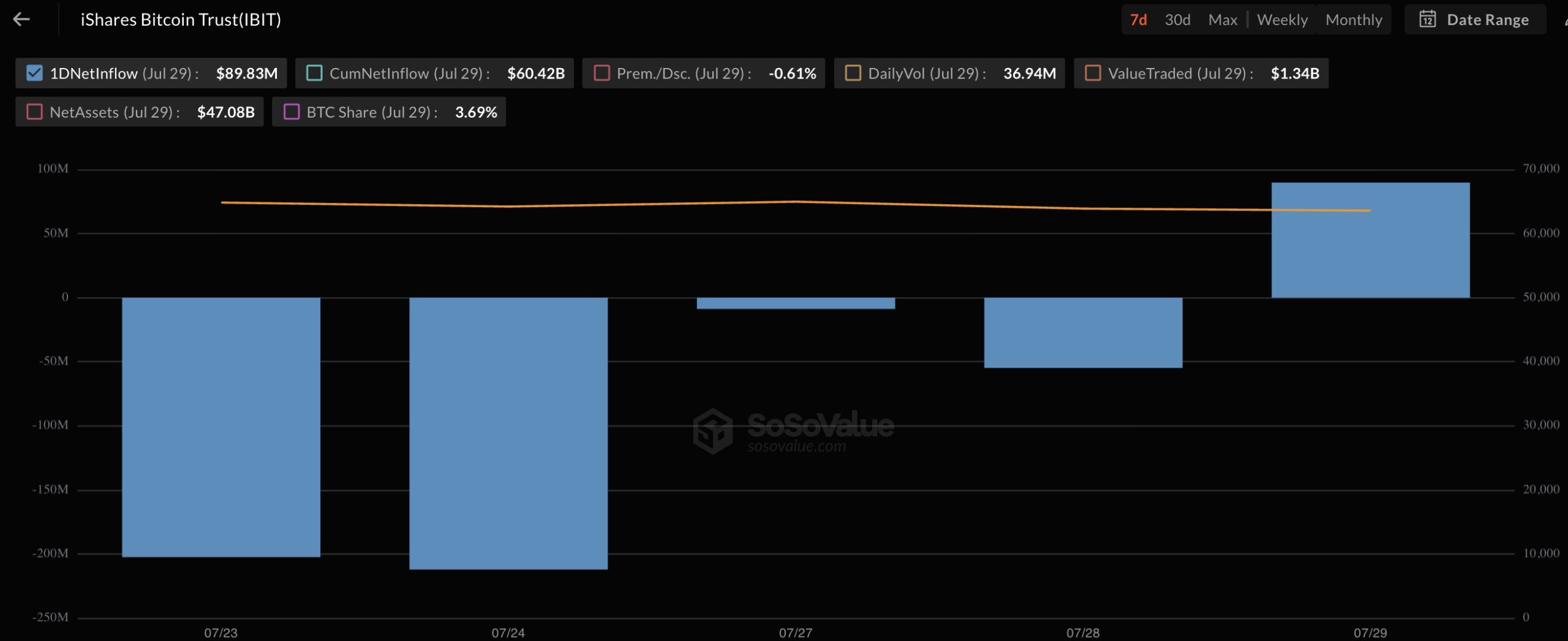
Aliran dana ke ETF Bitcoin tampaknya sebagian besar ditentukan oleh dana IBIT milik Blackrock, dengan laba/rugi bersih ETF Bitcoin mencerminkan dinamika aliran dana IBIT. Sumber: Sosovalue

ETF berbasis Ethereum menunjukkan dinamika yang lebih beragam. Dana staking Morgan Stanley yang baru diluncurkan, MSSE, menarik $14,30 juta, sedangkan ETF ETHA milik Blackrock menarik $5,16 juta.

Arus masuk ini terimbangi oleh penjualan pada lima produk. Dana FETH dari Fidelity kehilangan $16,07 juta. Dana ETHE dan Ether Mini Trust milik Grayscale mencatat arus keluar masing-masing sebesar $9,74 juta dan $8,09 juta.

Dana TETH dari 21Shares kehilangan $2,85 juta, dan ETHW dari Bitwise kehilangan $1,36 juta. Pada akhir periode, arus keluar bersih dalam kategori ini adalah $18,65 juta. Volume perdagangan ETF Ethereum adalah $563,79 juta, dan aset bersih pada penutupan adalah $10,37 miliar.

Solana Pulih di Tengah Akselerasi Penjualan karena Hype

ETF berbasis Solana menarik $19,06 juta, mengimbangi arus keluar $18,07 juta yang tercatat pada sesi sebelumnya.

Semua modal baru masuk ke ETF Morgan Stanley MSOL yang baru diluncurkan — ETF Solana dengan dukungan staking. Volume perdagangan keseluruhan mencapai $60,21 juta, dan aset bersih meningkat menjadi $862,98 juta.

Permintaan untuk produk baru Morgan Stanley yang terkait dengan staking cukup menonjol. Dana MSSE menarik $19,45 juta dalam dua hari, dan MSOL menarik $19 juta pada hari pertama arus masuk, menunjukkan bahwa investor merespons positif produk yang menggabungkan investasi token dengan pendapatan dari staking.

ETF berbasis $XRP juga kembali ke zona positif, meskipun kenaikannya sederhana. XRPZ dari Franklin Templeton menarik $584.710, sehingga total aset kategori meningkat menjadi $988,70 juta. Volume perdagangan mencapai $10,35 juta.

Dana ETF $HYPE masih berada di bawah tekanan. Dana BHYP dari Bitwise mencatat arus keluar sebesar $8,78 juta, yang merupakan hari kelima berturut-turut penurunan untuk kategori ini. Volume perdagangan dana ETF $HYPE adalah $6,92 juta, dan aset bersih menyusut menjadi $252,38 juta.

Data aliran dana terbaru menunjukkan bahwa pasar masih bersedia menerima risiko kripto, tetapi menjadi semakin selektif. Bitcoin mendapatkan kembali dukungan, Solana rebound, dan produk staking menarik minat. Namun, Ethereum dan $HYPE menghadapi gelombang penjualan lagi.

end-content


Criptos en tendencia

Preguntas relacionadas

QApa yang menyebabkan pemulihan aliran dana bersih untuk ETF Bitcoin setelah empat hari penurunan?

APemulihan aliran dana bersih ETF Bitcoin sebesar $32,11 juta didorong terutama oleh masuknya dana sebesar $89,83 juta ke ETF IBIT milik Blackrock, yang lebih dari mengimbangi arus keluar dari produk Fidelity dan ARK 21Shares.

QBagaimana kinerja ETF Ethereum pada periode yang sama?

AETF Ethereum mengalami arus keluar bersih sebesar $18,65 juta. Meskipun ada masuknya dana ke produk baru Morgan Stanley (MSSE) dan Blackrock (ETHA), penjualan dari lima produk lain, terutama dari Fidelity (FETH) dan Grayscale (ETHE, Ether Mini Trust), menyebabkan hasil bersih negatif.

QProduk ETF kripto baru Morgan Stanley apa yang mendapat sambutan baik dari investor, dan mengapa?

AETF dengan dukungan staking dari Morgan Stanley, yaitu MSSE (untuk Ethereum) dan MSOL (untuk Solana), mendapat sambutan baik. MSSE menarik $14,30 juta dan MSOL menarik $19,06 juta, menunjukkan minat investor pada produk yang menggabungkan investasi token dengan pendapatan dari staking.

QApa yang terjadi dengan ETF Solana ($SOL) berdasarkan data aliran dana?

AETF Solana mengalami pemulihan dengan masuknya dana bersih sebesar $19,06 juta, mengimbangi sepenuhnya arus keluar $18,07 juta dari sesi sebelumnya. Semua modal baru masuk ke ETF MSOL milik Morgan Stanley yang mendukung staking.

QApa tren umum yang dapat disimpulkan dari data aliran dana ETF kripto terbaru menurut artikel?

APasar menunjukkan kesediaan untuk mengambil risiko kripto namun semakin selektif. Bitcoin mendapatkan dukungan kembali, Solana pulih, dan produk staking menarik minat. Namun, Ethereum dan ETF $HYPE masih menghadapi tekanan penjualan atau arus keluar dana.

Lecturas Relacionadas

PA Graphics Explanation | One Chart to Understand the Major Web3 Events in August 2026

**PANews Crypto Calendar: Key Web3 Events in August 2026** PANews introduces its revamped crypto calendar, featuring comprehensive coverage, flexible filtering, and easy export options. The market in August will be shaped by multiple key events across macroeconomics, regulation, tokenomics, and project developments: * **Macro & Policy:** Key US economic data releases (July Non-Farm Payrolls, CPI), the Federal Reserve meeting minutes, and the Jackson Hole Economic Symposium will be in focus. On the regulatory front, the US Senate plans to release a new draft of the *CLARITY Act*, while the EU's expanded crypto ban against Belarus comes into effect. * **Token Unlocks:** Significant token unlocks are scheduled for assets including ENA, AVAX, CONX, ZRO, and KAITO, which may influence market volatility. * **Project Updates & Shutdowns:** Several services, including Exchange Art, Ctrl Wallet, Zapper, NFTfi, and Summer.fi, are set to cease operations or undergo major adjustments. Users are advised to manage their assets accordingly. * **Corporate Activity:** Q2 earnings reports from companies like SpaceX, Circle, and Nvidia are due. Unitree Robotics will initiate its IPO subscription on the STAR Market, and Moonshot AI plans to begin a Pre-IPO financing round. * **Industry Events:** Major conferences such as Bitcoin Asia 2026 and the 2026 Digital Expo will take place. The overarching market narrative for August will revolve around macroeconomic expectations, regulatory developments, token unlock schedules, and ongoing industry consolidation.

marsbitHace 7 min(s)

PA Graphics Explanation | One Chart to Understand the Major Web3 Events in August 2026

marsbitHace 7 min(s)

Wall Street's Most Famous 'Cassandra' Now Has His Sights Set on Nvidia

Michael Burry, the famed "Big Short" investor, has once again captured Wall Street's attention with a series of short positions against major tech and semiconductor stocks, most notably Nvidia. In late June and July, through his "Cassandra Unchained" newsletter, Burry disclosed short bets against Nvidia, Tesla, Applied Materials, Caterpillar, the SOXX semiconductor ETF, and later, Micron Technology. His core thesis revolves around potential distortions in the AI infrastructure boom, specifically questioning whether extended depreciation schedules (e.g., 6 years vs. a realistic 2-3 years for AI chips) by cloud giants like Microsoft and Google artificially inflate profits. He also raises concerns about possible "off-balance-sheet circular financing," where chip demand might be propped up by vendor-backed funding to clients. Nvidia's stock experienced volatility following these disclosures, briefly dipping but largely holding near Burry's reported entry points, leaving his positions roughly flat or slightly underwater as of late July. This move is part of a pattern for Burry, whose track record since his legendary 2008 bet is mixed. He has faced notable losses, such as on Tesla in 2021, while scoring on broader market turns like the 2020 pandemic crash. His methodology focuses intensely on free cash flow and scrutinizing original financial documents to spot overvaluation and structural risks, but it often struggles with timing the market. The article contrasts Burry's stance with other prominent investors. Steve Eisman, another "Big Short" figure, is not shorting Nvidia, citing strong fundamentals but expressing nervousness about sustainability. Jim Chanos agrees with the broad "accounting mismatch" concern—comparing it to the dot-com bubble—but targets financial leverage in private equity firms rather than the chip stocks themselves. While Nvidia's short interest remains relatively low at 1.3-1.4% of float, the massive stock size means absolute short losses have been significant, exceeding $5 billion earlier this year. The piece concludes that for ordinary investors, the key takeaway is not replicating specific short bets but learning from the critical frameworks these investors use: questioning rosy accounting, identifying structural vulnerabilities, and maintaining skepticism during market euphoria, even if pinpointing the exact catalyst for a downturn remains elusive.

marsbitHace 32 min(s)

Wall Street's Most Famous 'Cassandra' Now Has His Sights Set on Nvidia

marsbitHace 32 min(s)

Weekly Selection丨Epic Stock Market Volatility, Changxin Tech's IPO Reshapes Storage Landscape, Saylor Aims to Re-Anchor STRC Around September 8th

PANews Weekly Digest: Market Turmoil, Tech Breakthroughs, and Crypto Developments. The week saw significant volatility across global markets. South Korea's KOSPI index experienced extreme turbulence, including multiple trading halts, largely driven by sharp declines in AI hardware stocks like SK Hynix. In contrast, China's Changxin Xinqiao (CXC) achieved a landmark IPO with a market cap surpassing 4 trillion yuan, marking a major success for the domestic DRAM industry after a decade of losses. In the crypto and Web3 space, several key narratives emerged. AI is driving demand for new infrastructure, with projects like AI agent wallets and programmable payments gaining traction, attracting interest from firms like Coinbase. The Bitcoin mining sector is pivoting, with companies like MARA focusing on energy management as electricity becomes a core AI-era asset. Meanwhile, the RWA (Real World Assets) sector faces a "utilization puzzle," with hundreds of billions in on-chain assets remaining dormant. Notable market movements included a historic single-day surge of over 17% for the KOSPI index and a significant migration of $16.5 billion in staked ETH within the Lido ecosystem. Michael Saylor announced a target to re-peg the STRC stablecoin around September 8th. Other highlights include discussions on Ethereum's ambitious 2030 roadmap for scaling and privacy, analysis showing high protocol revenues not always translating to token price gains, and warnings from Citi about potential extreme commodity price shocks by late 2026.

marsbitHace 37 min(s)

Weekly Selection丨Epic Stock Market Volatility, Changxin Tech's IPO Reshapes Storage Landscape, Saylor Aims to Re-Anchor STRC Around September 8th

marsbitHace 37 min(s)

When the Market Begins to Question AI Capex: A Full Analysis of Q2 Earnings Reports from Five Tech Giants

In late July 2026, five major US tech giants—Alphabet, Intel, Microsoft, Meta, and Apple—released their Q2 earnings reports. While all companies exceeded revenue and profit expectations, driven by strong AI-related business growth, investor reactions diverged sharply due to concerns over escalating AI capital expenditures (capex) and their impact on free cash flow. Alphabet reported strong revenue growth and a surging cloud business, but its stock fell after announcing a doubled year-on-year capex and negative quarterly free cash flow for the first time. Intel posted its strongest revenue growth in over 15 years, but its stock experienced volatile trading after significantly raising its full-year capex guidance. Microsoft saw its stock surge after beating estimates and, crucially, lowering its capex forecast while projecting positive free cash flow. Meta faced the most severe sell-off as its profits declined despite revenue beats, with free cash flow plunging over 90% and its capex guidance raised. Apple reported record June-quarter results, but its stock plummeted after providing Q4 revenue guidance that fell short of expectations, citing supply chain constraints and forex headwinds. The overall takeaway is that the market's focus has shifted from validating AI demand to scrutinizing the timeline for returns on massive AI investments. Companies demonstrating a clearer path to managing capex and preserving free cash flow, like Microsoft, were rewarded, while those signaling continued aggressive spending faced investor skepticism.

Odaily星球日报Hace 46 min(s)

When the Market Begins to Question AI Capex: A Full Analysis of Q2 Earnings Reports from Five Tech Giants

Odaily星球日报Hace 46 min(s)

a16z: From Companies to DAOs, DUNA May Become the Next Generation Organizational Form

This article, "From Companies to DAOs: How DUNA Could Become the Next Organizational Form," traces the 500-year evolution of business collaboration. It begins with medieval structures like the *commenda* and Florentine *compagnia*, which exposed partners to personal risk. The modern corporation, exemplified by the Dutch East India Company (VOC), was a revolutionary leap, enabling large-scale, capital-intensive ventures by offering limited liability and reducing coordination costs. However, corporations introduced new challenges like principal-agent problems and bureaucratic overhead. The piece argues that software and internet-native protocols are now reducing these traditional overheads. Decentralized Autonomous Organizations (DAOs) emerged as a new model for coordination without centralized management. Yet, DAOs face a significant legal vacuum: they lack legal recognition, leaving members exposed to unlimited personal liability, and their tokens are vulnerable to being classified as securities under unclear regulations (e.g., the Howey Test). This has forced projects into suboptimal workarounds like offshore foundations. The article identifies the Decentralized Unincorporated Nonprofit Association (DUNA) as a potential solution. Recently legalized in states like Wyoming, the DUNA provides a legal wrapper for decentralized networks. It grants key protections—legal personality, limited liability, and perpetual existence—to a group without imposing a traditional hierarchical management structure. This allows token-holder communities to govern, hold assets, and contract as a single legal entity, aligning with their decentralized nature. While DUNA doesn't solve all governance challenges or magically resolve securities law questions, it represents a crucial step. It fills the legal recognition gap, offering a native legal form for internet-scale, decentralized collaboration and extending the separation of personal risk from organizational venture into a new domain.

marsbitHace 1 hora(s)

a16z: From Companies to DAOs, DUNA May Become the Next Generation Organizational Form

marsbitHace 1 hora(s)

Trading

Spot

Artículos destacados

Cómo comprar 4

¡Bienvenido a HTX.com! Hemos hecho que comprar 4 (4) sea simple y conveniente. Sigue nuestra guía paso a paso para iniciar tu viaje de criptos.Paso 1: crea tu cuenta HTXUtiliza tu correo electrónico o número de teléfono para registrarte y obtener una cuenta gratuita en HTX. Experimenta un proceso de registro sin complicaciones y desbloquea todas las funciones.Obtener mi cuentaPaso 2: ve a Comprar cripto y elige tu método de pagoTarjeta de crédito/débito: usa tu Visa o Mastercard para comprar 4 (4) al instante.Saldo: utiliza fondos del saldo de tu cuenta HTX para tradear sin problemas.Terceros: hemos agregado métodos de pago populares como Google Pay y Apple Pay para mejorar la comodidad.P2P: tradear directamente con otros usuarios en HTX.Over-the-Counter (OTC): ofrecemos servicios personalizados y tipos de cambio competitivos para los traders.Paso 3: guarda tu 4 (4)Después de comprar tu 4 (4), guárdalo en tu cuenta HTX. Alternativamente, puedes enviarlo a otro lugar mediante transferencia blockchain o utilizarlo para tradear otras criptomonedas.Paso 4: tradear 4 (4)Tradear fácilmente con 4 (4) en HTX's mercado spot. Simplemente accede a tu cuenta, selecciona tu par de trading, ejecuta tus trades y monitorea en tiempo real. Ofrecemos una experiencia fácil de usar tanto para principiantes como para traders experimentados.

840 Vistas totalesPublicado en 2025.10.20Actualizado en 2026.06.02

Cómo comprar 4

Discusiones

Bienvenido a la comunidad de HTX. Aquí puedes mantenerte informado sobre los últimos desarrollos de la plataforma y acceder a análisis profesionales del mercado. A continuación se presentan las opiniones de los usuarios sobre el precio de 4 (4).

活动图片