Blackrock Contributes to Bitcoin ETF Recovery of $32 Million After 4-Day Slump

cryptonews.ruPublicado a 2026-07-30Actualizado a 2026-07-30

Resumen

The cryptocurrency ETF market saw a reversal on July 29th. Bitcoin ETFs ended a four-day outflow streak, posting a net inflow of $32.11 million, largely driven by BlackRock's IBIT fund which attracted $89.83 million. This offset outflows from other major Bitcoin ETFs. Meanwhile, Solana ETFs rebounded with a $19.06 million inflow, primarily into Morgan Stanley's new staking-supported MSOL ETF, after significant outflows the previous day. Ethereum ETFs faced renewed pressure, however, with a net outflow of $18.65 million despite some inflows to new staking products. XRP ETFs saw a modest recovery. Conversely, $HYPE ETFs extended their losing streak to five days with further outflows. The data suggests a selective market: Bitcoin regaining support, Solana rebounding, and staking products attracting interest, while Ethereum and $HYPE faced continued selling pressure.

The cryptocurrency exchange-traded fund (ETF) market shifted direction again on Wednesday, July 29. Bitcoin found buyers after four consecutive sessions characterized by outflows, while Solana offset significant losses from the previous day with nearly equal inflows.

Ether funds were less fortunate. After two sessions of growth, they returned to outflows, and $HYPE ETF funds extended their losing streak to five days.

Blackrock Supported Bitcoin Amid Ether Fund Pullback

Blackrock's IBIT ETF became the driving force behind the Bitcoin ETF recovery, attracting an inflow of $89.83 million. This increase offset outflows of $43.08 million from Fidelity's FBTC and $14.64 million from ARK 21Shares' ARKB. As a result, the category ended the period with a net inflow of $32.11 million.

The total trading volume for Bitcoin ETFs reached $1.88 billion, and the aggregate net assets at the day's close stood at $77.46 billion.
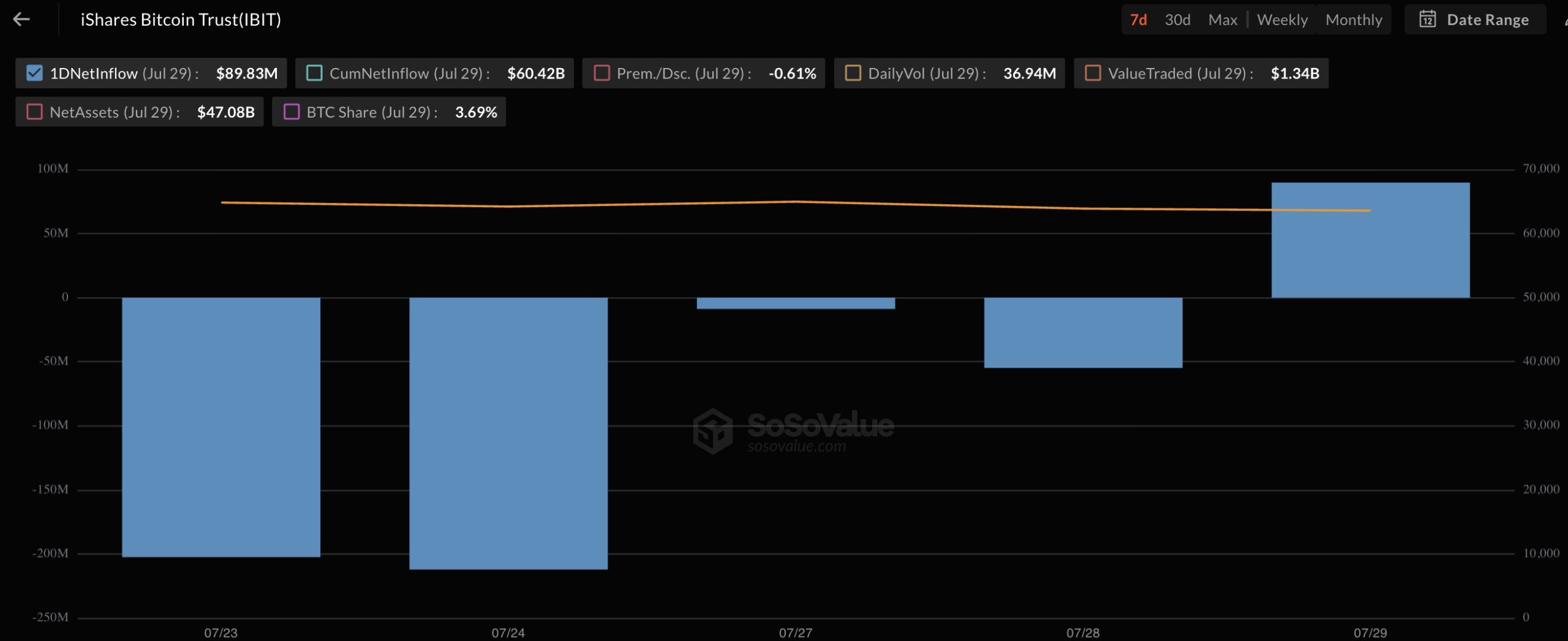
Bitcoin ETF fund flows appear to be largely dictated by Blackrock's IBIT fund, with Bitcoin ETFs' net gains/losses mirroring IBIT's flow dynamics. Source: Sosovalue

Ether ETFs displayed more mixed dynamics. The recently launched Morgan Stanley staking fund, MSSE, attracted $14.30 million, and Blackrock's ETHA ETF attracted $5.16 million.

These inflows were outweighed by outflows from five products. Fidelity's FETH fund lost $16.07 million. Grayscale's ETHE and Ether Mini Trust funds recorded outflows of $9.74 million and $8.09 million, respectively.

The 21Shares TETH fund lost $2.85 million, and Bitwise's ETHW lost $1.36 million. For the period, the net outflow for this category amounted to $18.65 million. Ether ETF trading volume was $563.79 million, with net assets at closing at $10.37 billion.

Solana Recovers Amid Accelerated Selling on Hype Wave

Solana ETFs attracted $19.06 million, offsetting the outflow of $18.07 million recorded during the previous session.

All new capital flowed into the recently launched Morgan Stanley MSOL ETF—a Solana ETF with staking support. The total trading volume reached $60.21 million, and net assets rose to $862.98 million.

Demand for new Morgan Stanley products related to staking was noticeable. The MSSE fund attracted $19.45 million over two days, and MSOL attracted $19 million on its first day of inflows, indicating that investors are responding positively to products that combine token investments with staking yield.

$XRP ETFs also returned to positive territory, though the growth was modest. Franklin Templeton's XRPZ attracted $584,710, bringing the total assets for the category to $988.70 million. Trading volume reached $10.35 million.

$HYPE ETF funds remained under pressure. Bitwise's BHYP fund recorded an outflow of $8.78 million, marking the fifth consecutive day of decline for this category. The trading volume for $HYPE ETF funds was $6.92 million, and net assets decreased to $252.38 million.

The latest fund flow data indicates that the market remains willing to take on cryptocurrency risk but is becoming increasingly selective. Bitcoin regained support, Solana bounced back, and staking products attracted interest. Ether and $HYPE, however, faced another wave of selling.

end-content


Criptos en tendencia

Preguntas relacionadas

QWhat was the main reason for the Bitcoin ETF market reversing its four-day outflow streak on July 29?

AThe main reason was a significant influx of $89.83 million into BlackRock's IBIT ETF, which offset outflows from other major Bitcoin ETFs, resulting in a net inflow of $32.11 million for the category.

QWhich newly launched product categories from Morgan Stanley attracted significant investor interest and capital?

AMorgan Stanley's newly launched staking-enabled ETFs attracted significant interest. The Ethereum staking fund (MSSE) attracted $14.30 million, and the Solana staking fund (MSOL) attracted $19.06 million, indicating positive investor reception for products combining token exposure with staking yield.

QHow did the performance of Ethereum ETFs compare to Bitcoin ETFs on the reported day?

AEthereum ETFs underperformed compared to Bitcoin ETFs. While Bitcoin ETFs saw a net inflow of $32.11 million, Ethereum ETFs experienced a net outflow of $18.65 million, with outflows from products like Fidelity's FETH and Grayscale's ETHE outweighing inflows.

QWhat happened to the $HYPE ETF funds during the reported period?

AThe $HYPE ETF funds continued to face selling pressure, with Bitwise's BHYP fund experiencing an $8.78 million outflow. This marked the fifth consecutive day of losses for the category, reducing its total net assets to $252.38 million.

QWhat does the latest fund flow data suggest about the overall sentiment in the cryptocurrency ETF market?

AThe data suggests the market is still willing to take on crypto risk but is becoming increasingly selective. Support returned for Bitcoin, Solana rebounded, and staking products attracted interest, while Ethereum and $HYPE faced continued selling pressure.

Lecturas Relacionadas

Goldman Sachs: July Smashes Through Crowded Trades, U.S. Stock Bull Market Not Broken but Harder to Navigate

Goldman Sachs: July Sees Crowded Trades Unwound, U.S. Bull Market Intact but Getting Tougher. The U.S. stock market in July did not see an index-level crash, but rather a significant unwinding of speculative positions. While the S&P 500 remained stable—trading within a narrow 3.5% range and staying within 2% of its high—underlying market dynamics were volatile. Heavily crowded trades, particularly in high-momentum tech, AI-linked stocks, and Asian strategies, faced severe pressure and forced deleveraging. Data indicates this was a meaningful cleanse, not a minor adjustment. Global tech exposure saw its largest sell-off in over five years, leverage in Korean equity ETFs plummeted, and Goldman's prime brokerage recorded the largest gross exposure reduction since late 2022. Leverage on momentum factors among fundamental long/short clients fell to the 28th percentile of its one-year range. The AI trade narrative shifted from pure potential to a focus on tangible returns. While Meta failed to show clear AI monetization, Microsoft and Amazon provided evidence that massive capital expenditure is translating into scalable revenue and product growth, preventing a blanket sell-off of the AI sector. The Federal Reserve's more opaque communication style and volatility in long-end Treasury yields have introduced new friction, particularly for rate-sensitive growth and tech stocks. The broader outlook for U.S. equities remains favorable, supported by a strong economy, robust earnings, and substantial AI capital expenditure. However, risk/reward is no longer cheap, and the market's upward elasticity has weakened. The Nasdaq 100's trajectory—up 12% year-to-date despite significant pullbacks—illustrates that the bull trend persists but the path is becoming more difficult. The key lesson from July is that the market no longer rewards crowded, highly leveraged trades, requiring more disciplined and liquid portfolio approaches.

marsbitHace 1 hora(s)

Goldman Sachs: July Smashes Through Crowded Trades, U.S. Stock Bull Market Not Broken but Harder to Navigate

marsbitHace 1 hora(s)

Interview with Robinhood Executive: Meme + Tokenized US Stocks as "Barbell" Customer Acquisition Strategy, All Business Lines Achieve Hundreds of Millions in Revenue

Interview with Robinhood executive Johann Kerbrat reveals the company's "barbell" customer acquisition strategy for its new Robinhood Chain, combining meme tokens with tokenized stocks. Three weeks after mainnet launch, the chain has seen over $3B in weekly DEX volume and 105M transactions. Kerbrat explains the logic behind the permissionless chain: meme tokens attract DeFi users, while tokenized real-world assets (RWA), currently over 90 US stocks and ETFs accessible in 120+ countries, serve global users. The goal is to bring Robinhood's 27 million funded accounts on-chain by simplifying DeFi with a user-friendly interface, exemplified by features like Robinhood Earn which offers yield without requiring wallet management. Built on Arbitrum's technology stack for its speed, low cost, and Ethereum's security, the chain focuses on financial products like Earn, spot trading, and perpetuals. Kerbrat downplays direct competition with platforms like Base, emphasizing the goal of expanding the overall market for on-chain assets. He details selective partnerships (e.g., Morpho, Lighter) based on compliance, unique UX, and differentiation. While regulatory clarity is pending for US perpetuals, the expansion continues via Bitstamp in Europe. Finally, Kerbrat positions Robinhood as a "super app" integrating stocks, options, crypto, banking, and AI trading, with all major business lines generating hundreds of millions in revenue. For the chain, current priority is driving adoption over maximizing gas fee revenue.

marsbitHace 3 hora(s)

Interview with Robinhood Executive: Meme + Tokenized US Stocks as "Barbell" Customer Acquisition Strategy, All Business Lines Achieve Hundreds of Millions in Revenue

marsbitHace 3 hora(s)

Trading

Spot

Artículos destacados

Cómo comprar 4

¡Bienvenido a HTX.com! Hemos hecho que comprar 4 (4) sea simple y conveniente. Sigue nuestra guía paso a paso para iniciar tu viaje de criptos.Paso 1: crea tu cuenta HTXUtiliza tu correo electrónico o número de teléfono para registrarte y obtener una cuenta gratuita en HTX. Experimenta un proceso de registro sin complicaciones y desbloquea todas las funciones.Obtener mi cuentaPaso 2: ve a Comprar cripto y elige tu método de pagoTarjeta de crédito/débito: usa tu Visa o Mastercard para comprar 4 (4) al instante.Saldo: utiliza fondos del saldo de tu cuenta HTX para tradear sin problemas.Terceros: hemos agregado métodos de pago populares como Google Pay y Apple Pay para mejorar la comodidad.P2P: tradear directamente con otros usuarios en HTX.Over-the-Counter (OTC): ofrecemos servicios personalizados y tipos de cambio competitivos para los traders.Paso 3: guarda tu 4 (4)Después de comprar tu 4 (4), guárdalo en tu cuenta HTX. Alternativamente, puedes enviarlo a otro lugar mediante transferencia blockchain o utilizarlo para tradear otras criptomonedas.Paso 4: tradear 4 (4)Tradear fácilmente con 4 (4) en HTX's mercado spot. Simplemente accede a tu cuenta, selecciona tu par de trading, ejecuta tus trades y monitorea en tiempo real. Ofrecemos una experiencia fácil de usar tanto para principiantes como para traders experimentados.

844 Vistas totalesPublicado en 2025.10.20Actualizado en 2026.06.02

Cómo comprar 4

Discusiones

Bienvenido a la comunidad de HTX. Aquí puedes mantenerte informado sobre los últimos desarrollos de la plataforma y acceder a análisis profesionales del mercado. A continuación se presentan las opiniones de los usuarios sobre el precio de 4 (4).

活动图片