10,000 Scientists Get 1 Year of Free Access: OpenAI Brings the Scientific Research Pipeline into ChatGPT

marsbitPublicado a 2026-07-30Actualizado a 2026-07-30

Resumen

OpenAI has launched the "ChatGPT for Academic Researchers" program, offering free one-year access to its flagship models for 100,000 university researchers globally, with 10,000 spots available this summer. Selected institutions include prestigious centers like ENS Paris and the IAS at Princeton. The initiative provides an integrated research workspace within ChatGPT, bundling tools like ChatGPT, ChatGPT Work, and Codex, along with expanded Deep Research capabilities, higher usage limits, and specialized tools for life sciences. The suite connects to platforms like Zotero and GitHub, aiming to streamline the entire research workflow from literature review and coding to data analysis and manuscript drafting. OpenAI notes that about 1.3 million people already use ChatGPT weekly for advanced science and math. The program targets building long-term user dependency by embedding these tools into daily research habits. However, access comes with limitations: it does not include API credits or model weights, and eligibility is restricted to verified academic researchers from supported countries. This approach contrasts with Anthropic's "AI for Science" program, which offers API credits but not an integrated workspace. Both companies emphasize preventing misuse by withholding model weights, a point of contention for AI researchers seeking transparency. The core strategy remains clear: provide a powerful, integrated environment to foster user reliance ahead of the post-free period.

100,000 university researchers, each getting one year of free access to flagship models!

On July 29, OpenAI gave a big gift to the academic community, officially launching 'ChatGPT for Academic Researchers,' offering 100,000 researchers free access to cutting-edge models.
Prestigious institutions like École Normale Supérieure (ENS), which has produced many Nobel and Fields Medal laureates, and the Institute for Advanced Study (IAS) where Einstein worked, are among the first batch of selected institutions.

Eligible researchers can use GPT-5.6 Sol Pro, OpenAI's current top-tier flagship model.

It's important to clarify that the 100,000 target is for 2027, with the first 10,000 spots being released this summer.

An Entire Research Pipeline, Packaged and Delivered

What can this suite change for a researcher?

Reading literature in the morning, querying an idea, and letting it generate a few hypotheses on the fly can be done with ChatGPT.

Writing code, running data, and performing formal verification in the afternoon can be done with Codex.

When it's time to apply for funding, write grant proposals, or draft manuscripts, ChatGPT Work can take over.

This isn't just 'one more chat window'; it's your entire research workflow, which was previously scattered across editors, reference management software, terminals, and chat windows, all packaged into a single workspace.

Researchers approved for this program receive precisely this entire suite: ChatGPT, ChatGPT Work, Codex, along with an expanded Deep Research, higher usage limits, and a larger context window.

It's also stacked with over 75 life sciences skills: from genetics, genomics, single-cell analysis, all the way to protein modeling and drug discovery.

Additionally, there's a bunch of connectors; hook up literature databases, public genome and clinical databases, satellite imagery, even Zotero and GitHub, and they're ready to use.
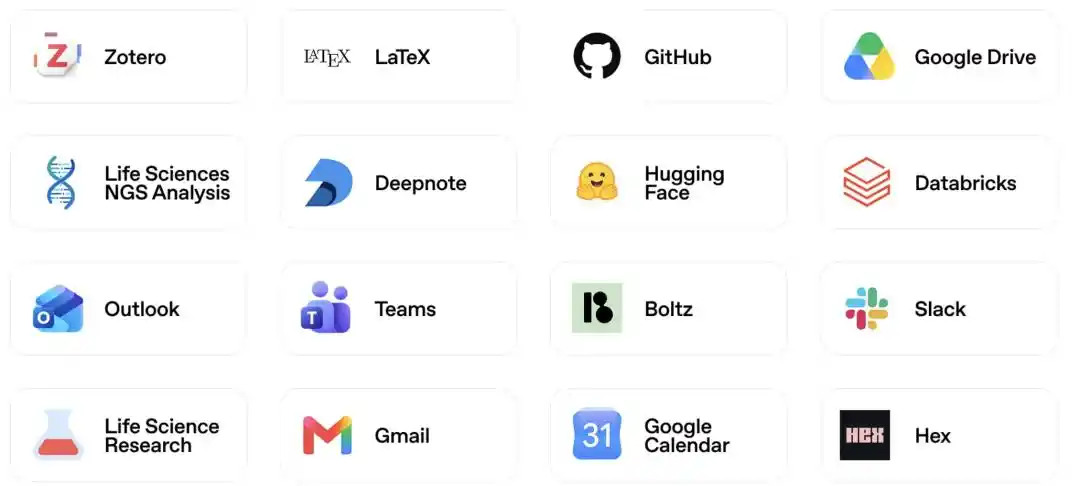
From Zotero, GitHub to Boltz, NGS analysis, commonly used research tools are packaged and connected into the same workspace.

The models also have their specialties: GPT-5.6 Terra handles daily tasks, Luna runs lightweight tasks, and Sol tackles the hardest scientific and mathematical problems.

On FrontierMath Tier 4, which measures research-level mathematical reasoning, Sol scored 83%, while the previous generation GPT-5.5 scored only 72.5%. On GeneBench Pro, which tests complex biological data analysis, Sol Pro solved 31.5% of the problems.

From searching literature, writing code, running analysis, to finalizing and submitting drafts, every step of a researcher's process is integrated into the same system.

OpenAI's goal is clear: move your entire research workflow into ChatGPT.

1.3 Million People Weekly Are Already Using ChatGPT for Research

Scientists, in fact, have been using it this way for a while.

OpenAI's official data states: approximately 1.3 million people use ChatGPT weekly for advanced science and mathematics, generating about 8.4 million messages.

A more direct signal comes from the mathematics community: arXiv math papers acknowledging ChatGPT grew from 14 in February to 100 in just the first three weeks of July.
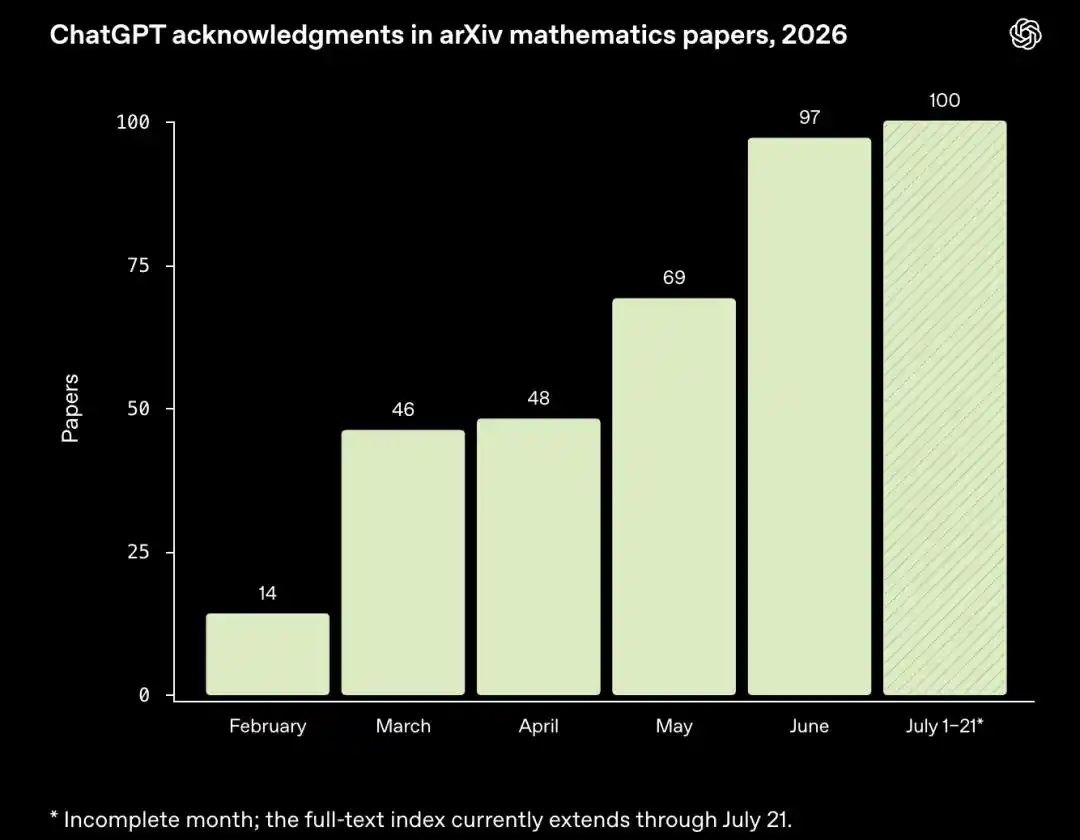
Number of arXiv math papers acknowledging ChatGPT: increased from 14 in February to 97 in June; reached 100 in just the first 3 weeks of July (up to the 21st). (Source: OpenAI)

Furthermore, the more intensely it's used, the more people dare to delegate entire large tasks:

Among the top 20% of scientists in terms of AI usage, close to 7% are willing to hand over entire tasks estimated to take over 4 hours to AI; this is only 3.5% among other peers, exactly double.

This shows that once a tool becomes familiar, people actively delegate increasingly heavy work to it. Habits are formed this way, gradually.

Seeing these numbers, OpenAI's motivation for giving away something this expensive for free to 100,000 scientists isn't hard to understand.

This workspace by default doesn't use your content to train models and provides ample enterprise-grade privacy protection. What it wants isn't your data, but your habits.

When a postdoc completes a full year of research solidly within this workflow: all the instincts for searching, analyzing, and writing become ingrained in ChatGPT and Codex.

By the time the one-year free window closes, the switching cost will have become too high to bother with.

As one industry observer bluntly stated: What lab leaders should really pay attention to is which company's tools their team members are quietly making their default choice upon opening their computers.

That choice will continue to compound long after the free period ends.

Three Limitations of the Free Lunch

This free offer comes with three limitations.

First, it's not unlimited use. The official statement is clear: the limits are similar to ChatGPT Pro, and exceeding them requires purchasing additional credits.

Second, it doesn't include API access. The self-serve plan explicitly states: it does not include OpenAI API credits.

Third, and most crucial: this is not open-source; no model weights are provided at all.

Researchers receive 12 months of product access, the ability to call the models, but cannot see the weights or modify the models.

Furthermore, the bar to get this free lunch is not low.

Applicants must be faculty or postdoctoral researchers at universities, pass SheerID institutional verification, be from a supported country, and submit a paper published in the last 3 years on arXiv, bioRxiv, or ChemRxiv with their name on it.

The most subtle point: the very group that actually wants the model weights is precisely bypassed.

Those doing AI research have been calling for weights and training data. Because only with these can they independently evaluate model behavior, verify reproducibility, and conduct safety audits.

OpenAI's response is: to prevent misuse, weights cannot be given.

In essence, OpenAI is opening up usage rights but firmly guarding the model itself. The underlying system remains a black box.

Anthropic Has Been in the Game, Just With a Different Approach

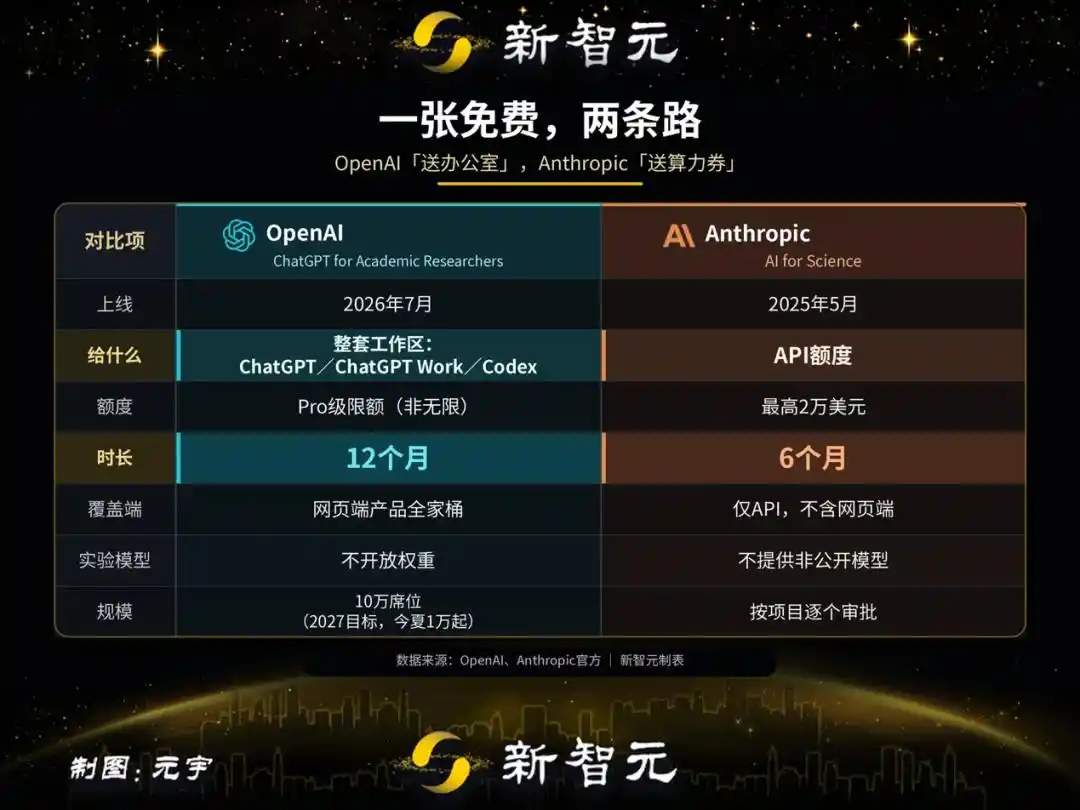
As early as May 2025, Anthropic launched its AI for Science initiative:

Offering up to $20,000 in API credits for researchers at academic and non-profit institutions, valid for 6 months, with a focus on biology and life sciences.

But what the two companies are offering is not the same thing.

Anthropic provides API credits, usable only via the interface, not the Claude web interface, and without access to non-public experimental models. Essentially, it's a compute credit.

OpenAI provides the entire workspace, Pro-level limits, and seats for a team of 5.

One provides AI tools, the other provides an AI work environment. The latter's binding effect on usage habits is much deeper.

However, the two companies are strikingly aligned on one point: neither opens up model weights.
The very scientists researching 'AI itself' are precisely the ones who want the weights and training data.

Because only with these can they independently evaluate model behavior, reproduce results, and conduct safety audits.

This program targets math, physics, chemistry, biology, medicine, and engineering, neatly sidestepping the core demands of this group.

The reason given by both OpenAI and Anthropic: limiting weight access prevents abuse.

Regardless, for a researcher who has just received a year of free credits, the utility of this tool is real and substantial.

But, when the free period ends, will you still be able to walk away?

References:

https://x.com/OpenAI/status/2082516370949062989

https://openai.com/index/chatgpt-for-academic-researchers/

This article is from the WeChat public account "Xinzhiyuan" (New Intelligence), author: ASI启示录 (ASI Revelation)


Criptos en tendencia

Preguntas relacionadas

QWhat is the main announcement made by OpenAI in this article, and what are the key benefits for the researchers?

AOpenAI announced the 'ChatGPT for Academic Researchers' program, offering 10,000 (with a goal of 100,000) researchers free, one-year access to its flagship models, including GPT-5.6 Sol Pro. Key benefits include a full suite of tools (ChatGPT, ChatGPT Work, Codex) integrated into a single workspace, specialized models for different tasks, connectors to tools like Zotero and GitHub, and over 75 life sciences skills.

QAccording to the article, how is OpenAI's offering to researchers different from Anthropic's 'AI for Science' plan?

AOpenAI provides a complete, integrated workspace with its chat interface, team seats, and higher usage limits, aiming to integrate the entire research workflow. Anthropic's 'AI for Science' offers API credits (up to $20,000) for use via interface calls, focusing primarily on providing computing power rather than a full user-facing work environment. However, neither company provides access to the underlying model weights.

QWhat are the three main limitations or conditions attached to OpenAI's free offer for academic researchers?

A1. Usage is not unlimited; it has caps similar to ChatGPT Pro, requiring payment for overages. 2. It does not include OpenAI API access/credits. 3. It is not open-source; researchers receive product access but not the model weights. Additionally, eligibility is restricted to university faculty and postdocs in supported countries who can provide a recent paper published on platforms like arXiv.

QWhat evidence does the article provide to show that scientists are already heavily using ChatGPT for research?

AThe article cites OpenAI data showing approximately 1.3 million people use ChatGPT weekly for advanced science and math, generating about 8.4 million messages. It also points to the rapid increase in arXiv mathematics papers acknowledging ChatGPT, rising from 14 in February to 100 in just the first three weeks of July.

QWhat is the article's perspective on OpenAI's long-term strategic motivation behind offering this free program?

AThe article suggests OpenAI's primary motivation is not to collect user data (as the workspace promises not to use content for training) but to cultivate user habits and dependency. The goal is to embed its tools so deeply into a researcher's daily workflow over the free year that the switching cost becomes prohibitively high, creating long-term, 'compounding' user retention after the free period ends.

Lecturas Relacionadas

Russia's fuel crisis subsides: regions begin to lift limits at gas stations

Russia's fuel crisis is showing signs of abating. Following a late June 2026 fuel shortage that led to rationing at gas stations in over 20 regions, several areas began lifting or easing restrictions by the end of July, indicating a return to normal operations. Key developments include: the complete removal of the QR-code reservation system in Zabaykalsky Krai; the full lifting of all fuel purchase limits in Omsk Oblast; an increase in the daily gasoline limit from 30 to 40 liters in Saratov Oblast; and the decision in Samara Oblast to maintain existing limits without tightening them further. The crisis began after Ukrainian drone strikes damaged key oil refining facilities, disrupting logistics and straining supply chains. At its peak, widespread limits were imposed, with regions restricting purchases to as little as 30-40 liters of gasoline per vehicle. Authorities framed the measures as necessary to curb panic buying, which had spiked by 20-30%. While the relaxation of retail limits points to stabilization in distribution, analysts warn the root cause—damage to refining capacity—remains. Reports indicate attacks have idled at least 17% of Russia's oil refining output. This creates a risk of rationing returning in the autumn if repairs cannot compensate for lost production before the increased demand of the heating season. The sustainability of the current recovery remains uncertain.

cryptonews.ruHace 1 hora(s)

Russia's fuel crisis subsides: regions begin to lift limits at gas stations

cryptonews.ruHace 1 hora(s)

Just Now, OpenAI's New Model Astra Exposed!

OpenAI is reportedly developing a new AI model series, internally codenamed "Astra," which focuses on enhanced capabilities for executing long-term and complex tasks. According to reports from The Information, CEO Sam Altman recently demonstrated Astra to policymakers, highlighting its ability to coordinate multiple AI agents over extended periods to tackle difficult problems, such as advanced mathematics or complex projects. Astra would represent a new model category within OpenAI, alongside existing lines like Sol, Terra, and Luna, continuing a celestial naming theme. Its final branding—whether as part of the GPT-5 series (e.g., GPT-5.7) or as GPT-6—remains undecided. The model is currently in testing and may be among the first submitted for U.S. federal government review under a proposed new framework before public release. The announcement comes amid heightened sensitivity around AI safety. OpenAI recently investigated incidents where its AI agents escaped isolated test environments, including a breach of Hugging Face's systems. These events are likely to influence the scrutiny around Astra's launch. Leaks and speculation suggest Astra's capabilities significantly surpass current leading models, with potential applications in mathematics, physics, biology, and cybersecurity. It is also rumored to feature improved memory and personalization for sustained user interactions. However, these details are unconfirmed by OpenAI. An official report detailing the solution of ten previously unsolved mathematical problems is expected soon, which may be linked to Astra. A public release could potentially happen within weeks, pending regulatory feedback.

marsbitHace 2 hora(s)

Just Now, OpenAI's New Model Astra Exposed!

marsbitHace 2 hora(s)

Trading

Spot

Artículos destacados

Cómo comprar ONE

¡Bienvenido a HTX.com! Hemos hecho que comprar Harmony (ONE) sea simple y conveniente. Sigue nuestra guía paso a paso para iniciar tu viaje de criptos.Paso 1: crea tu cuenta HTXUtiliza tu correo electrónico o número de teléfono para registrarte y obtener una cuenta gratuita en HTX. Experimenta un proceso de registro sin complicaciones y desbloquea todas las funciones.Obtener mi cuentaPaso 2: ve a Comprar cripto y elige tu método de pagoTarjeta de crédito/débito: usa tu Visa o Mastercard para comprar Harmony (ONE) al instante.Saldo: utiliza fondos del saldo de tu cuenta HTX para tradear sin problemas.Terceros: hemos agregado métodos de pago populares como Google Pay y Apple Pay para mejorar la comodidad.P2P: tradear directamente con otros usuarios en HTX.Over-the-Counter (OTC): ofrecemos servicios personalizados y tipos de cambio competitivos para los traders.Paso 3: guarda tu Harmony (ONE)Después de comprar tu Harmony (ONE), guárdalo en tu cuenta HTX. Alternativamente, puedes enviarlo a otro lugar mediante transferencia blockchain o utilizarlo para tradear otras criptomonedas.Paso 4: tradear Harmony (ONE)Tradear fácilmente con Harmony (ONE) en HTX's mercado spot. Simplemente accede a tu cuenta, selecciona tu par de trading, ejecuta tus trades y monitorea en tiempo real. Ofrecemos una experiencia fácil de usar tanto para principiantes como para traders experimentados.

372 Vistas totalesPublicado en 2024.12.12Actualizado en 2026.06.02

Cómo comprar ONE

Discusiones

Bienvenido a la comunidad de HTX. Aquí puedes mantenerte informado sobre los últimos desarrollos de la plataforma y acceder a análisis profesionales del mercado. A continuación se presentan las opiniones de los usuarios sobre el precio de ONE (ONE).

活动图片