Robinhood Crypto Chief Reveals: 'Barbell' Customer Acquisition Strategy with Meme + Tokenized U.S. Stocks, Each Business Line Already Generates Billions in Revenue

marsbitPublicado a 2026-07-28Actualizado a 2026-07-28

Resumen

Robinhood's Crypto Strategy: Leveraging Memes and Tokenized Stocks as a Dual-Pronged User Acquisition Strategy Robinhood Crypto GM Johann Kerbrat outlines the platform's "barbell" strategy for its new chain, launched three weeks ago. This approach targets two distinct user bases simultaneously: meme coin traders and those seeking exposure to tokenized real-world assets (RWAs), particularly U.S. stocks. The chain, built on Arbitrum technology, prioritizes accessibility and aims to onboard Robinhood's 27 million funded accounts. The vision is to fuse DeFi's benefits (like 24/7 trading and yield) with CeFi's user-friendly experience, eliminating wallet complexities. Key products like "Robinhood Earn" (for stablecoin yields) and tokenized stocks (available in 120+ countries) exemplify this hybrid model. Kerbrat downplays direct competition with Coinbase's Base, emphasizing growing the overall market for tokenized assets instead. Future plans include expanding RWA offerings to international stocks and private markets, positioning Robinhood's app as a comprehensive "super app" for diverse financial needs, from trading and banking to financial education. While all business lines currently generate significant revenue, the chain's immediate focus is on optimizing user adoption over maximizing direct revenue from transaction fees.

Original Title: Johann Kerbrat: Inside Robinhood's Crypto Strategy (Full Explanation)
Original Source: TheRollup
Compiled by: Deep Tide TechFlow

Conflict of Interest Statement

Johann Kerbrat is a Robinhood executive responsible for all crypto business product lines (including Robinhood Chain, tokenized stocks, staking services, perpetual contracts). His salary and equity incentives are directly tied to the $HOOD stock price. All discussions about Robinhood Chain in this episode involve business he directly oversees. The title uses 'Inside Perspective' rather than 'Analysis' to reflect this relationship.

Summary

Robinhood Chain has been live on mainnet for three weeks, with weekly DEX trading volume exceeding $3 billion, transaction count over 105 million, and TVL surpassing $300 million. Johann Kerbrat explains the chain's strategic logic for the first time on a podcast: why choose a 'barbell' layout (parallel development of meme tokens and real-world assets), why use the Arbitrum tech stack instead of building its own L1, and how to gradually migrate Robinhood's 27 million funded accounts onto the chain. He clearly states the focus of competition is 'growing the pie' rather than taking share from Base, and reveals tokenized stocks are now available in 120+ countries, covering 90+ assets, with future expansion planned for international stocks and private markets.

Key Quotes

"Our philosophy is to make the chain permissionless and open to everything. Memes, RWAs, and many other products are welcome. We are deeply integrating with the chain."

"Robinhood has 27 million funded accounts. For these users, DeFi is still too complex, requiring too much technical knowledge. We think about how to bring the good products of DeFi, while making them easy to use and accessible, without needing to create a wallet or manage private keys."

"I think competition is ultimately good for customers. When we launched crypto trading, we slashed fees dramatically. It's still too early on-chain, and discussing market share is premature."

"We've only been live for three weeks. If you're thinking about bringing tens of millions of users onto the chain, adding more utility, bringing things people actually use (not just temporary volatility), then you're thinking about a long-term revenue stream."

"We don't expect to see all of Robinhood's trading activity migrate to the chain next year. That's a bit of a pipe dream. But if we can find things that aren't possible traditionally, like international stocks, 24/7 trading, the chain can become the solution."

I. Three Weeks After Launch: $3B Weekly Volume Is Just the Starting Point

The host opens with numbers: After the Robinhood Chain mainnet launch, weekly DEX trading volume reached $3 billion, with over 50 million transactions, over 1 million addresses, and TVL exceeding $300 million.

Kerbrat responds directly: those numbers have already been surpassed. He said the transaction count that morning had exceeded 105 million. He described the team's mood as 'very excited,' with the core point being these numbers reflect strong market demand for on-chain products.

He particularly emphasized the ecosystem was ready to onboard developers from day one, not built first and then waiting for people to come. This differs from many L2 paths that launch empty and then slowly attract traffic.

II. 'Barbell' Strategy: Why Memes and RWAs in Parallel

The host mentions an interesting observation: Robinhood CEO Vlad Tenev described the on-chain ecosystem on social media as a 'barbell' structure, with meme tokens on one end and real-world assets (RWAs) on the other, saying 'you have two wolves inside you.'

Kerbrat explains the internal thinking. The chain was set to be permissionless from day one, open to all types of applications. Meme tokens bring market makers and DeFi users, while RWAs serve users globally who cannot conveniently buy U.S. stocks and ETFs. They are not contradictory but attract different groups.

He also mentions several integrated products already live: Robinhood Earn (earning stablecoin yields via on-chain protocols within the main App) and tokenized stocks (tradable via Robinhood Wallet in 120+ countries).

The host probes into differences from traditional financial products. Kerbrat lists traditional system problems: wire transfers only possible between 9:30 and 4:00, commission-free brokers only operate during weekday market hours, options and futures contracts expire. The on-chain version is a better solution from a product perspective.

III. How to Migrate 27 Million Accounts On-Chain: The Fusion of DeFi and CeFi

Kerbrat shares a key number: Robinhood has 27 million funded accounts. Most of these users haven't touched DeFi because it's still complex, requiring significant technical knowledge.

His solution is 'the best of both worlds': use DeFi's underlying technology to provide yields, and use Robinhood's frontend to provide simple UX/UI and security. Robinhood Earn is an example; users can earn on-chain yields within the main App without creating a wallet or managing private keys.

He defines this trend as the 'fusion of CeFi and DeFi': centralized platforms leveraging blockchain technology to build better products while maintaining user-friendly experiences.

Regarding the technical implementation of tokenized stocks, Kerbrat reveals a 'just-in-time tokenization' mechanism. Traditional DEX listing requires pre-built liquidity pools, but because Robinhood is already a broker and holds these stocks, it can quickly tokenize them on-chain when users need to trade. Underneath, it uses a combination of prop AMM, standard AMM, RFQ, and classic pools to ensure good prices at any moment.

There are currently 90+ stock tokens on-chain, but he sees this as just the starting point, with future expansion to more asset classes like international stocks, private markets.

IV. Why Choose Arbitrum: The Logic Behind Not Building Its Own L1

The host asks a technical architecture question: why use the Arbitrum tech stack instead of building its own chain.

Kerbrat's answer is pragmatic. Robinhood wants to focus on what it's good at: making good UX/UI, building good financial products, not reinventing something that already exists. Achieving Ethereum-level security and decentralization takes a long time and involves many decisions (transition from PoW to PoS, collaboration of multiple foundations). Leveraging Ethereum's security and the EVM ecosystem's liquidity is the more sensible choice.

Reasons for choosing Arbitrum as the L2 tech stack include: Stylus (allows writing smart contracts in any programming language), extremely fast block times (financial products demand speed), low gas fees (can remain low even during high-volume periods). He also mentions proactively lowering gas fees during the chain's activity surge last week to ensure user experience wasn't affected.

Regarding the Ethereum 'rent' controversy (Robinhood Chain earned over $1M in revenue but only paid 1-2% to Ethereum), Kerbrat believes this is Ethereum's default mechanism setup, not about fairness. His perspective is long-term: if Robinhood can bring tens of millions of users on-chain, bring real use cases, this will ultimately become a long-term revenue stream for the Ethereum ecosystem.

V. Competition with Base: Growing the Pie, Not Grabbing Share

The host mentions the 'artificial competition' on social media between Robinhood Chain and Coinbase's Base. Base recently acknowledged its social experiments failed and is pivoting elsewhere, while Robinhood is also exploring possibilities for on-chain social trading.

Kerbrat's attitude towards competition is clear: competition is good for customers. When Robinhood launched crypto trading, it slashed fees dramatically, ultimately benefiting users. But it's too early to discuss market share now; Robinhood Chain is only three weeks old, Base has been running for a year or two.

He uses a number for comparison: currently, only a tiny fraction of the global population holds tokenized assets. His goal is to grow the pie, enabling more people globally to own assets, not fight for share in the existing small pie. Regarding Base's social experiments, he comments, 'It's normal to try new things; sometimes they fail, sometimes they succeed.'

Robinhood's focus is on financial products: Earn, spot trading, perpetual contracts. These are areas they are good at and can bring value.

VI. Logic for Choosing DeFi Partners

The host lists partners announced at Robinhood Chain's launch: Morpho (lending vaults), Lighter (perpetual contracts), 0x (aggregation & quote API), Chainlink (oracles), LayerZero (cross-chain).

Kerbrat explains three criteria for choosing partners. First, Robinhood is a public company holding multiple licenses globally; partners must understand compliance requirements and cooperate. Second, they must be able to build unique experiences. For example, the partnership with Morpho went far beyond simple API integration, requiring customized stable rates, insurance mechanisms, and dedicated UX, involving extensive deep discussions and joint development. Third, they must differentiate from competitors.

Regarding the timeline for perpetual contracts (perps) entering the U.S. main App, Kerbrat says they are still waiting for regulatory clarity; even if the CLARITY Act passes, perpetual contracts are another big issue. Currently, through the partnership with Lighter in Robinhood Wallet, users can experience perpetual contract trading. He also reveals Bitstamp (a European trading platform acquired by Robinhood) is already expanding perpetual contracts from crypto to commodities and ETF contracts.

VII. From Broker to Super App: The $HOOD Investment Thesis

The final topic returns to the investment perspective. The host asks: What does holding $HOOD stock mean now?

Kerbrat outlines Robinhood's 'super app' vision: stocks, options, futures, prediction markets, crypto, credit cards (just launched a platinum card that day), banking services, AI agent trading (MCP already available). The core is to make one App meet all financial needs at different life stages.

He particularly mentions the lack of financial education: young people don't learn about finance in school but need to start thinking about retirement planning after high school. Robinhood wants to push financial education, with IRA accounts as an example.

From a business model perspective, each business line is now generating nine-figure (hundreds of millions of dollars) revenue, with diversified income sources, no longer just a pure trading platform. Regarding the chain's own revenue, Kerbrat admits adoption rate is currently prioritized over pure revenue. Gas fee setting is a balancing act: too low invites spam and bot abuse, too high hinders adoption. Currently in a stage of 'optimizing for adoption' rather than 'optimizing for revenue.'


Criptos en tendencia

Preguntas relacionadas

QAccording to Johann Kerbrat, what is Robinhood's 'barbell' customer acquisition strategy for its crypto business?

AThe 'barbell' strategy involves two parallel approaches: attracting users through meme tokens and through Real-World Assets (RWA), specifically tokenized stocks. This dual approach is designed to bring in different user groups: meme coins attract DeFi users and market makers, while tokenized stocks serve global users who cannot easily access U.S. stocks and ETFs.

QWhat is the core user-friendly concept Robinhood employs to bring its 27 million funded accounts onto the blockchain?

AThe core concept is the fusion of CeFi and DeFi. Robinhood leverages DeFi's underlying technology (like earning protocols) but presents it through the simple, familiar UX/UI of the main Robinhood app. This eliminates the need for users to create wallets or manage private keys, as exemplified by the 'Robinhood Earn' feature within the main app.

QWhy did Robinhood choose to build on the Arbitrum tech stack instead of creating its own Layer 1 blockchain?

ARobinhood chose the Arbitrum stack to focus on its strengths—building a great user experience and financial products—rather than reinventing foundational blockchain technology. Utilizing Ethereum's security and the EVM ecosystem's liquidity was seen as more practical. Key reasons for choosing Arbitrum included the Stylus feature, extremely fast block times crucial for financial products, and consistently low gas fees.

QHow does Johann Kerbrat view the competitive landscape with Coinbase's Base, especially regarding market share?

AKerbrat believes competition is ultimately beneficial for customers. He argues that it's too early to focus on market share, as Robinhood Chain is only three weeks old. His primary goal is to 'make the cake bigger' by onboarding more global users to tokenized assets, rather than competing for a share of the existing, relatively small market.

QWhat are Robinhood's current priorities regarding revenue generation from its blockchain, according to Kerbrat?

AThe current priority is optimizing for adoption and user growth, not pure revenue maximization. While the blockchain has generated significant income (over $1 million), gas fees are carefully balanced: set too low risks spam and bot attacks, while too high hinders adoption. The long-term view is that bringing millions of users and real utility to the chain will create a sustainable revenue source.

Lecturas Relacionadas

Wall Street's Most Famous 'Cassandra' Now Has His Sights Set on Nvidia

Michael Burry, the famed "Big Short" investor, has once again captured Wall Street's attention with a series of short positions against major tech and semiconductor stocks, most notably Nvidia. In late June and July, through his "Cassandra Unchained" newsletter, Burry disclosed short bets against Nvidia, Tesla, Applied Materials, Caterpillar, the SOXX semiconductor ETF, and later, Micron Technology. His core thesis revolves around potential distortions in the AI infrastructure boom, specifically questioning whether extended depreciation schedules (e.g., 6 years vs. a realistic 2-3 years for AI chips) by cloud giants like Microsoft and Google artificially inflate profits. He also raises concerns about possible "off-balance-sheet circular financing," where chip demand might be propped up by vendor-backed funding to clients. Nvidia's stock experienced volatility following these disclosures, briefly dipping but largely holding near Burry's reported entry points, leaving his positions roughly flat or slightly underwater as of late July. This move is part of a pattern for Burry, whose track record since his legendary 2008 bet is mixed. He has faced notable losses, such as on Tesla in 2021, while scoring on broader market turns like the 2020 pandemic crash. His methodology focuses intensely on free cash flow and scrutinizing original financial documents to spot overvaluation and structural risks, but it often struggles with timing the market. The article contrasts Burry's stance with other prominent investors. Steve Eisman, another "Big Short" figure, is not shorting Nvidia, citing strong fundamentals but expressing nervousness about sustainability. Jim Chanos agrees with the broad "accounting mismatch" concern—comparing it to the dot-com bubble—but targets financial leverage in private equity firms rather than the chip stocks themselves. While Nvidia's short interest remains relatively low at 1.3-1.4% of float, the massive stock size means absolute short losses have been significant, exceeding $5 billion earlier this year. The piece concludes that for ordinary investors, the key takeaway is not replicating specific short bets but learning from the critical frameworks these investors use: questioning rosy accounting, identifying structural vulnerabilities, and maintaining skepticism during market euphoria, even if pinpointing the exact catalyst for a downturn remains elusive.

marsbitHace 11 min(s)

Wall Street's Most Famous 'Cassandra' Now Has His Sights Set on Nvidia

marsbitHace 11 min(s)

Weekly Selection丨Epic Stock Market Volatility, Changxin Tech's IPO Reshapes Storage Landscape, Saylor Aims to Re-Anchor STRC Around September 8th

PANews Weekly Digest: Market Turmoil, Tech Breakthroughs, and Crypto Developments. The week saw significant volatility across global markets. South Korea's KOSPI index experienced extreme turbulence, including multiple trading halts, largely driven by sharp declines in AI hardware stocks like SK Hynix. In contrast, China's Changxin Xinqiao (CXC) achieved a landmark IPO with a market cap surpassing 4 trillion yuan, marking a major success for the domestic DRAM industry after a decade of losses. In the crypto and Web3 space, several key narratives emerged. AI is driving demand for new infrastructure, with projects like AI agent wallets and programmable payments gaining traction, attracting interest from firms like Coinbase. The Bitcoin mining sector is pivoting, with companies like MARA focusing on energy management as electricity becomes a core AI-era asset. Meanwhile, the RWA (Real World Assets) sector faces a "utilization puzzle," with hundreds of billions in on-chain assets remaining dormant. Notable market movements included a historic single-day surge of over 17% for the KOSPI index and a significant migration of $16.5 billion in staked ETH within the Lido ecosystem. Michael Saylor announced a target to re-peg the STRC stablecoin around September 8th. Other highlights include discussions on Ethereum's ambitious 2030 roadmap for scaling and privacy, analysis showing high protocol revenues not always translating to token price gains, and warnings from Citi about potential extreme commodity price shocks by late 2026.

marsbitHace 16 min(s)

Weekly Selection丨Epic Stock Market Volatility, Changxin Tech's IPO Reshapes Storage Landscape, Saylor Aims to Re-Anchor STRC Around September 8th

marsbitHace 16 min(s)

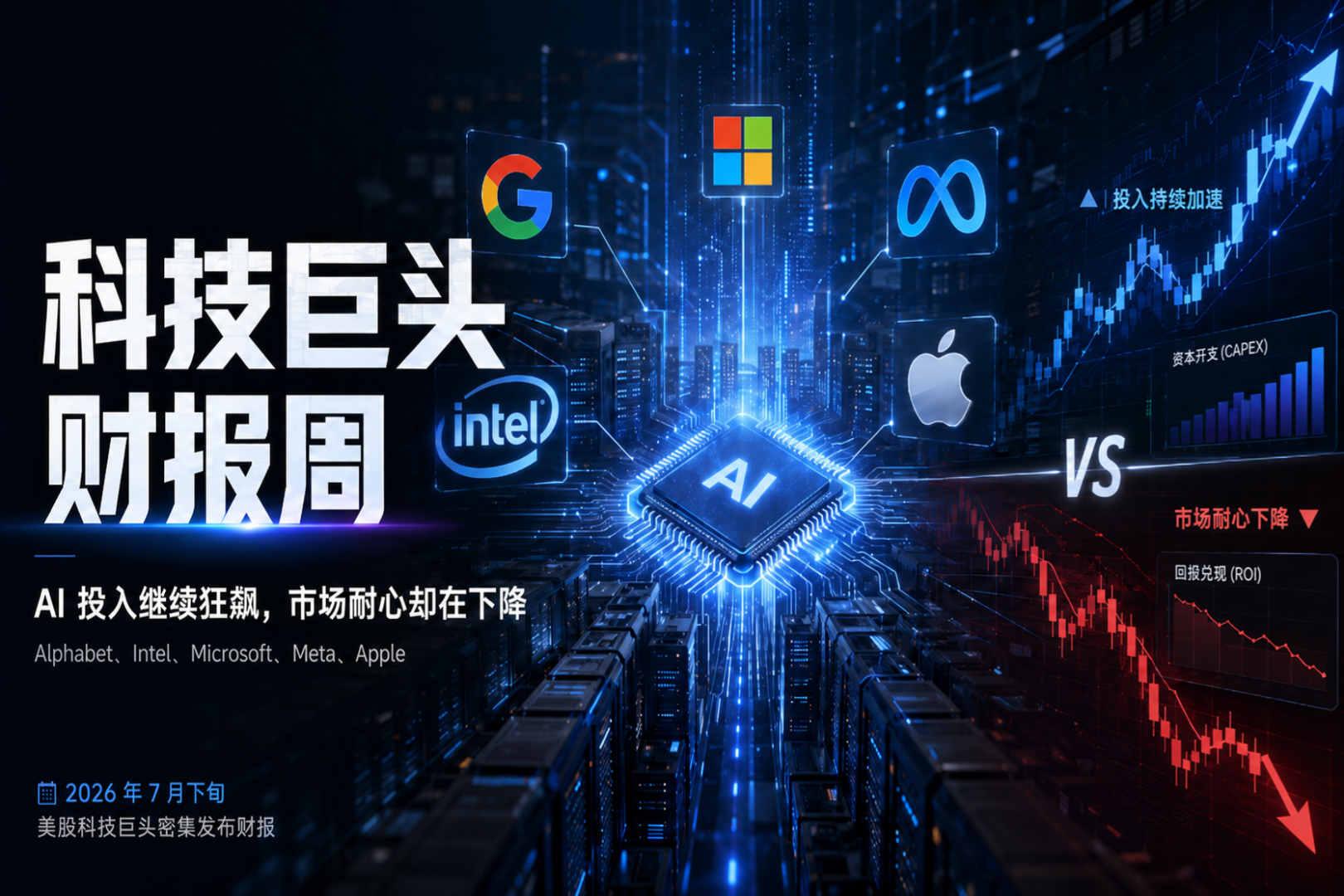
When the Market Begins to Question AI Capex: A Full Analysis of Q2 Earnings Reports from Five Tech Giants

In late July 2026, five major US tech giants—Alphabet, Intel, Microsoft, Meta, and Apple—released their Q2 earnings reports. While all companies exceeded revenue and profit expectations, driven by strong AI-related business growth, investor reactions diverged sharply due to concerns over escalating AI capital expenditures (capex) and their impact on free cash flow. Alphabet reported strong revenue growth and a surging cloud business, but its stock fell after announcing a doubled year-on-year capex and negative quarterly free cash flow for the first time. Intel posted its strongest revenue growth in over 15 years, but its stock experienced volatile trading after significantly raising its full-year capex guidance. Microsoft saw its stock surge after beating estimates and, crucially, lowering its capex forecast while projecting positive free cash flow. Meta faced the most severe sell-off as its profits declined despite revenue beats, with free cash flow plunging over 90% and its capex guidance raised. Apple reported record June-quarter results, but its stock plummeted after providing Q4 revenue guidance that fell short of expectations, citing supply chain constraints and forex headwinds. The overall takeaway is that the market's focus has shifted from validating AI demand to scrutinizing the timeline for returns on massive AI investments. Companies demonstrating a clearer path to managing capex and preserving free cash flow, like Microsoft, were rewarded, while those signaling continued aggressive spending faced investor skepticism.

Odaily星球日报Hace 25 min(s)

When the Market Begins to Question AI Capex: A Full Analysis of Q2 Earnings Reports from Five Tech Giants

Odaily星球日报Hace 25 min(s)

a16z: From Companies to DAOs, DUNA May Become the Next Generation Organizational Form

This article, "From Companies to DAOs: How DUNA Could Become the Next Organizational Form," traces the 500-year evolution of business collaboration. It begins with medieval structures like the *commenda* and Florentine *compagnia*, which exposed partners to personal risk. The modern corporation, exemplified by the Dutch East India Company (VOC), was a revolutionary leap, enabling large-scale, capital-intensive ventures by offering limited liability and reducing coordination costs. However, corporations introduced new challenges like principal-agent problems and bureaucratic overhead. The piece argues that software and internet-native protocols are now reducing these traditional overheads. Decentralized Autonomous Organizations (DAOs) emerged as a new model for coordination without centralized management. Yet, DAOs face a significant legal vacuum: they lack legal recognition, leaving members exposed to unlimited personal liability, and their tokens are vulnerable to being classified as securities under unclear regulations (e.g., the Howey Test). This has forced projects into suboptimal workarounds like offshore foundations. The article identifies the Decentralized Unincorporated Nonprofit Association (DUNA) as a potential solution. Recently legalized in states like Wyoming, the DUNA provides a legal wrapper for decentralized networks. It grants key protections—legal personality, limited liability, and perpetual existence—to a group without imposing a traditional hierarchical management structure. This allows token-holder communities to govern, hold assets, and contract as a single legal entity, aligning with their decentralized nature. While DUNA doesn't solve all governance challenges or magically resolve securities law questions, it represents a crucial step. It fills the legal recognition gap, offering a native legal form for internet-scale, decentralized collaboration and extending the separation of personal risk from organizational venture into a new domain.

marsbitHace 1 hora(s)

a16z: From Companies to DAOs, DUNA May Become the Next Generation Organizational Form

marsbitHace 1 hora(s)

2026 Mid-Year Report On-Chain RWA: Tokenized Stock Market Cap Doubles in a Year, But 90% of Rights Are Hollow Shells

The 2026 Mid-Year Report on On-Chain RWA highlights a significant growth in tokenized stock market capitalization, which nearly doubled from $951 million in March to $1.89 billion by July. However, the report reveals a fundamental contradiction in this "layer 2.5" ecosystem: products with the strongest legal foundation (like regulated U.S. infrastructure) lack liquidity and distribution, while freely tradable offshored wrapper products often lack substantive ownership rights. The increase is driven largely by a few products (SECZ, FGRS, STRCx) and platforms (Ondo, xStocks, Securitize collectively hold over 85% share). While distributed value across networks like Ethereum, Solana, and BNB Chain has grown, the market remains fragmented. Products referencing the same underlying asset (e.g., Apple stock) are distinct legal liabilities with different intermediaries and jurisdictional rules, offering varying degrees of legal claim. The report cautions that headline numbers are misleading, as they reflect changes in distributed token value—driven by issuance, conversions, and price movements—not pure investor inflows. True "canonical shares" with legal ownership, wide wallet distribution, institutional liquidity, and independent on-chain price discovery do not yet exist at scale. Tokenized treasuries show stronger product-market fit, and ETFs may be easier to scale than single stocks. The core takeaway is a trade-off: legal certainty versus liquidity and composability.

marsbitHace 2 hora(s)

2026 Mid-Year Report On-Chain RWA: Tokenized Stock Market Cap Doubles in a Year, But 90% of Rights Are Hollow Shells

marsbitHace 2 hora(s)

Trading

Spot

Artículos destacados

Qué es MEME 2.0

Memecoin 2.0: El Ascenso de $MEME 2.0 en el Mundo de las Criptomonedas Introducción En el panorama siempre cambiante de las criptomonedas, ha surgido un nuevo contendiente. Memecoin 2.0, simbolizada como $MEME 2.0, lleva el concepto de las monedas meme a un emocionante nuevo nivel. Como un subproducto del Memecoin original, este proyecto ha capturado la atención de la comunidad cripto al cambiar el enfoque de los incentivos financieros típicos a una experiencia comprometida y entretenida. Operando en la blockchain de Ethereum, Memecoin 2.0 redefine audazmente la participación de la comunidad en la esfera cripto. ¿Qué es Memecoin 2.0, $MEME 2.0? En su núcleo, Memecoin 2.0 es un proyecto de criptomoneda que prioriza el espíritu comunitario y la diversión asociada con la cultura meme. A diferencia de las criptomonedas convencionales, que se concentran en casos de uso prácticos y beneficios tangibles, Memecoin 2.0 se distingue al abrazar el lado más liviano de la moneda digital. El proyecto existe sin promesas de utilidad, un mapa estructurado o retornos financieros, enfocándose en cambio en fomentar una comunidad vibrante centrada en memes y en el disfrute compartido. Al hacerlo, aprovecha la creciente tendencia de la cultura meme en el espacio en línea, convirtiéndose en un jugador único en el mundo de los activos digitales. Creador de Memecoin 2.0, $MEME 2.0 A pesar de la extensa investigación sobre los orígenes de Memecoin 2.0, la identidad explícita de su creador sigue siendo desconocida. Esta anonimidad no es inusual en la comunidad cripto, donde muchos proyectos son liderados por individuos o grupos que prefieren permanecer en las sombras. La falta de información disponible públicamente sobre el creador podría verse como un movimiento estratégico, poniendo el foco en la participación comunitaria en lugar de la notoriedad individual dentro del espacio. Inversores de Memecoin 2.0, $MEME 2.0 La información sobre los inversores o el respaldo financiero de Memecoin 2.0 es escasa. Esta ausencia de detalles puede sugerir que el proyecto es autofinanciado o que su enfoque en la comunidad en lugar de las estructuras de inversión tradicionales ha atraído a un tipo diferente de apoyo. Dado que el mundo de las monedas meme generalmente involucra una participación más de base en lugar de inversión institucional, este enfoque está alineado con la ética de los proyectos impulsados por la comunidad. ¿Cómo Funciona Memecoin 2.0, $MEME 2.0? Memecoin 2.0 opera completamente en la blockchain de Ethereum, capitalizando sus robustas características de seguridad y escalabilidad. Al aprovechar las fortalezas de Ethereum, Memecoin 2.0 puede ofrecer un entorno seguro para las interacciones de los usuarios, asegurando que las transacciones sean tanto eficientes como rentables. Uno de los atributos únicos de Memecoin 2.0 radica en su estructura impulsada por la comunidad. El valor y la popularidad del token $MEME 2.0 derivan de la participación activa de sus usuarios, en vez de de una utilidad inherente. Este diseño refuerza el enfoque del proyecto en el aspecto de entretenimiento de las criptomonedas, lo que implica que la risa y la participación comunitaria son las verdaderas monedas que impulsan su éxito. Además, el proyecto encaja dentro del ecosistema más amplio de las monedas meme, donde el valor de cada moneda meme oscila basado en la cultura, tendencias y la participación de la comunidad, en lugar de principios económicos tradicionales. Cronología de Memecoin 2.0, $MEME 2.0 Para entender mejor la evolución y los hitos de Memecoin 2.0, aquí hay una cronología que destaca eventos significativos en su historia: 2024: Se reconoce la creación de Memecoin 2.0 como una ramificación del Memecoin original, estableciéndose dentro del contexto próspero de las monedas meme mientras opera en la blockchain de Ethereum. 13 de julio de 2024: Memecoin 2.0 se posiciona oficialmente como una moneda meme centrada en la comunidad en la red de Ethereum, enfatizando su enfoque centrado en el entretenimiento que invita a los usuarios a participar y crecer. Puntos Clave Sobre Memecoin 2.0, $MEME 2.0 Varios rasgos críticos definen a Memecoin 2.0: Enfoque Centrado en la Comunidad: La misión principal de Memecoin 2.0 es crear una experiencia comunitaria divertida y atractiva, capitalizando en el disfrute colectivo derivado de la cultura memética. Construido sobre Ethereum: Operar en la blockchain de Ethereum proporciona al proyecto una infraestructura esencial que garantiza seguridad y escalabilidad. Falta de Utilidad o Hoja de Ruta: En un notable desvío de las criptomonedas tradicionales, Memecoin 2.0 no promete características utilitarias ni retornos financieros, reafirmando su compromiso con la participación comunitaria y el compromiso social. Enfoque en la Cultura Memética: Al abrazar los aspectos humorísticos y culturales del fenómeno meme, Memecoin 2.0 proporciona una plataforma para que los usuarios interactúen con cripto tanto fuera de línea como en línea. Contexto Adicional: La Importancia de las Monedas Meme Las monedas meme han surgido como una clase distinta de criptomonedas, a menudo impulsadas por el humor y un enfoque desenfadado para el comercio. Estas monedas generalmente carecen de una utilidad significativa o hojas de ruta de desarrollo, atrayendo a los usuarios con la promesa de diversión, interacción comunitaria y relevancia cultural. En el panorama del ecosistema cripto más amplio, las monedas meme reviven la importancia de la participación comunitaria, revirtiendo enfoques únicamente motivados por el lucro. Proyectos como Memecoin 2.0 inauguran una era donde el entretenimiento puede armonizar con las aspiraciones financieras, convirtiendo la blockchain en un parque de diversiones para la creatividad y la interacción social. Conclusión Memecoin 2.0, o $MEME 2.0, encarna una nueva ola de criptomonedas que prioriza la participación comunitaria sobre estructuras financieras rígidas. Con un enfoque en el humor y la interacción social, capitaliza sobre la fascinación que rodea la cultura meme. Al operar en la blockchain de Ethereum, Memecoin 2.0 aprovecha las capacidades de la tecnología mientras se mantiene firme en su compromiso con el valor de entretenimiento de la moneda digital. A medida que el espacio alrededor de las criptomonedas continúa evolucionando, Memecoin 2.0 sirve como un testimonio de la noción de que el futuro de los activos digitales podría depender, en gran medida, de experiencias compartidas, risas y sólidas conexiones comunitarias. En el mundo impredecible de las criptomonedas, quizás la alegría pueda ser tan valiosa como la ganancia financiera tradicional.

152 Vistas totalesPublicado en 2024.04.04Actualizado en 2024.12.03

Qué es MEME 2.0

Cómo comprar MEME

¡Bienvenido a HTX.com! Hemos hecho que comprar Memeland (MEME) sea simple y conveniente. Sigue nuestra guía paso a paso para iniciar tu viaje de criptos.Paso 1: crea tu cuenta HTXUtiliza tu correo electrónico o número de teléfono para registrarte y obtener una cuenta gratuita en HTX. Experimenta un proceso de registro sin complicaciones y desbloquea todas las funciones.Obtener mi cuentaPaso 2: ve a Comprar cripto y elige tu método de pagoTarjeta de crédito/débito: usa tu Visa o Mastercard para comprar Memeland (MEME) al instante.Saldo: utiliza fondos del saldo de tu cuenta HTX para tradear sin problemas.Terceros: hemos agregado métodos de pago populares como Google Pay y Apple Pay para mejorar la comodidad.P2P: tradear directamente con otros usuarios en HTX.Over-the-Counter (OTC): ofrecemos servicios personalizados y tipos de cambio competitivos para los traders.Paso 3: guarda tu Memeland (MEME)Después de comprar tu Memeland (MEME), guárdalo en tu cuenta HTX. Alternativamente, puedes enviarlo a otro lugar mediante transferencia blockchain o utilizarlo para tradear otras criptomonedas.Paso 4: tradear Memeland (MEME)Tradear fácilmente con Memeland (MEME) en HTX's mercado spot. Simplemente accede a tu cuenta, selecciona tu par de trading, ejecuta tus trades y monitorea en tiempo real. Ofrecemos una experiencia fácil de usar tanto para principiantes como para traders experimentados.

264 Vistas totalesPublicado en 2024.12.12Actualizado en 2026.06.02

Cómo comprar MEME

Discusiones

Bienvenido a la comunidad de HTX. Aquí puedes mantenerte informado sobre los últimos desarrollos de la plataforma y acceder a análisis profesionales del mercado. A continuación se presentan las opiniones de los usuarios sobre el precio de MEME (MEME).

活动图片