BONK meledak 11% namun bear bersiap: Data INI ungkap rally ini adalah jebakan

ambcryptoPublicado a 2026-07-21Actualizado a 2026-07-21

Resumen

BONK mengalami lonjakan harga lebih dari 11% dalam 24 jam terakhir, menjadi satu-satunya memecoin yang mencetak keuntungan signifikan. Kenaikan ini didorong oleh peningkatan perhatian di media sosial (social mindshare) sebesar 32%. Namun, secara lebih luas, BONK masih turun 31% dalam sebulan dan 58% sejak awal tahun. Data pasar memberikan sinyal bertentangan. Di satu sisi, **Funding Rate** telah berubah menjadi negatif (-0.0009%) untuk posisi terbuka senilai $7.82 juta, yang mengindikasikan tekanan jual meningkat di pasar derivatif dan sentimen keseluruhan masih bearish. Di sisi lain, aktivitas di **pasar spot** justru menunjukkan kekuatan beli. Aliran bersih (netflow) ke bursa negatif sekitar $880.000, dengan akumulasi sekitar $4.24 juta BONK ditarik dari bursa ke dompet pribadi, membalikkan tren jual tiga hari sebelumnya. Secara keseluruhan, rally ini diwarnai oleh kewaspadaan. Teknikal derivatif dan sentimen yang masih negatif menunjukkan bahwa kenaikan harga bisa jadi merupakan "jebakan" (trap), sementara akumulasi di spot market memberikan sedikit harapan untuk pertahanan harga.

Bonk [BONK] telah memimpin pasar memecoin dalam satu hari terakhir, mencatatkan keuntangan dua digit lebih dari 11%.

Saat ini, Bonk menjadi satu-satunya memecoin yang mencatat lonjakan seperti ini karena sentimen pasar yang lebih luas pulih dan Bitcoin mendekati level $66.000.

Sebagian besar pergerakan ini berasal dari lonjakan dalam social mindshare, metrik yang menangkap seberapa banyak perhatian yang didapatkan suatu token di berbagai platform media sosial. Mindshare Bonk telah naik menjadi 8.680 pada saat penulisan, peningkatan 32% dari hari sebelumnya.

Hari bullish yang lalu hanya menceritakan sebagian dari kisah. Dalam 30 hari terakhir, Bonk telah turun 31%, dan dalam basis year-to-date, posisinya turun 58% – kerugian yang telah mendorong memecoin ini keluar dari 100 besar token berdasarkan kapitalisasi pasar.

Apakah Bonk sebenarnya sedang dalam pasar bull?

Rally ini telah memicu perdebatan tentang apakah Bonk telah memasuki pasar bull, dan jawabannya belum jelas ya.

Data Funding Rate mengarah pada peningkatan tekanan jual, dengan tingkatnya berbalik menjadi negatif. Funding Rate mengukur apakah kontrak long atau short mendominasi pasar perpetual, berdasarkan sisi mana yang membayar biaya pendanaan.

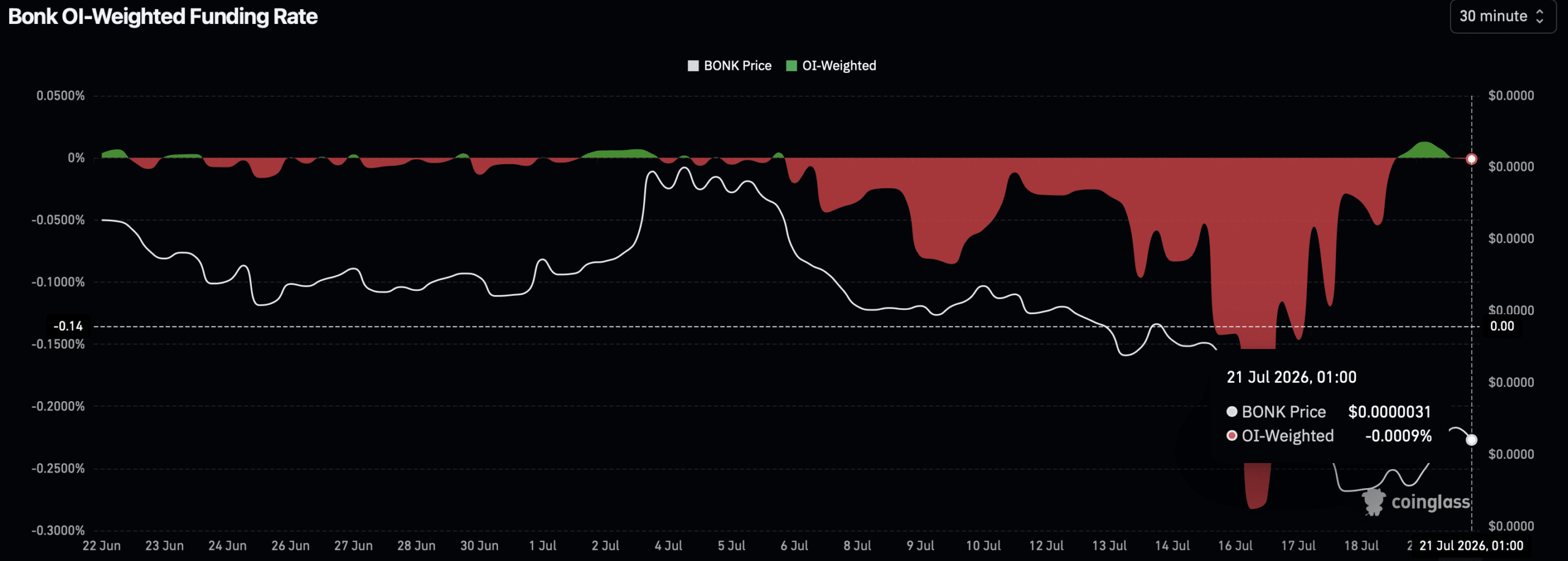
Funding Rate kini telah turun menjadi -0,0009%, menunjukkan pasar di mana sebagian besar dari $7,82 juta posisi terbuka condong ke arah penjualan.
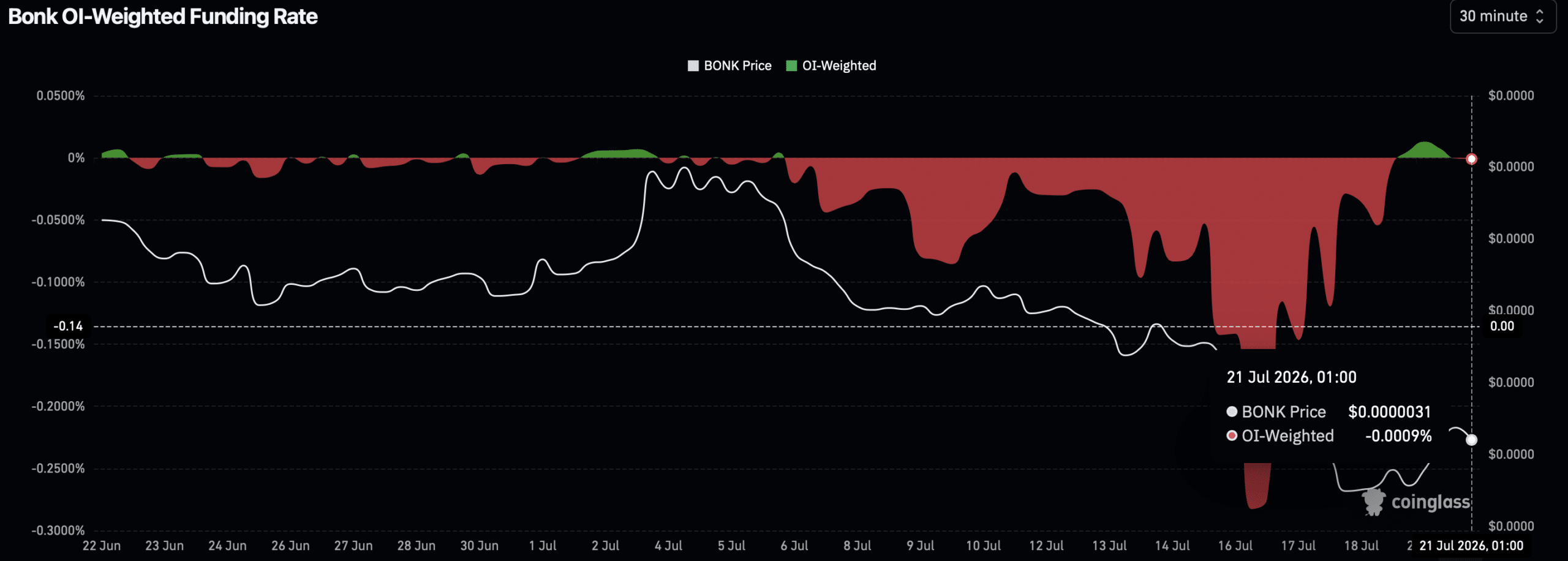
Sumber: CoinGlass

Analisis sentimen menambahkan pandangan yang hati-hati karena masih menunjukkan bahwa bear yang mengendalikan. Sentimen negatif sedikit membantu narasi bullish untuk bertahan, terutama untuk memecoin yang tidak memiliki produk dasar untuk menopang sebuah rally.

Sentimen telah jatuh ke wilayah negatif pada -2,42, dan penurunan lebih lanjut dapat menggerus momentum bullish yang terbangun dalam beberapa jam terakhir dan menarik aset lebih rendah.

Pasar spot bertahan

Meskipun sentimen condong ke arah bear dan Funding Rate perpetual berubah menjadi negatif, pasar spot menceritakan kisah yang lebih bullish.

Pada saat pers, kekuatan pembelian telah meningkat, dengan lebih banyak investor menarik BONK dari bursa ke dalam wallet pribadi untuk ditahan daripada memindahkannya ke bursa untuk dijual.
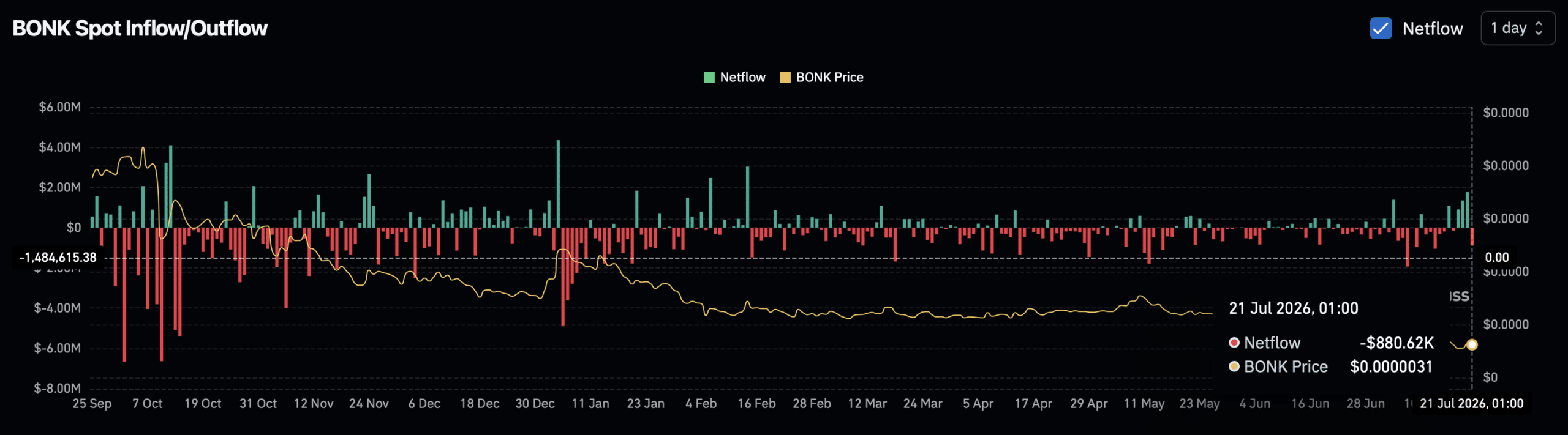
Sumber: CoinGlass

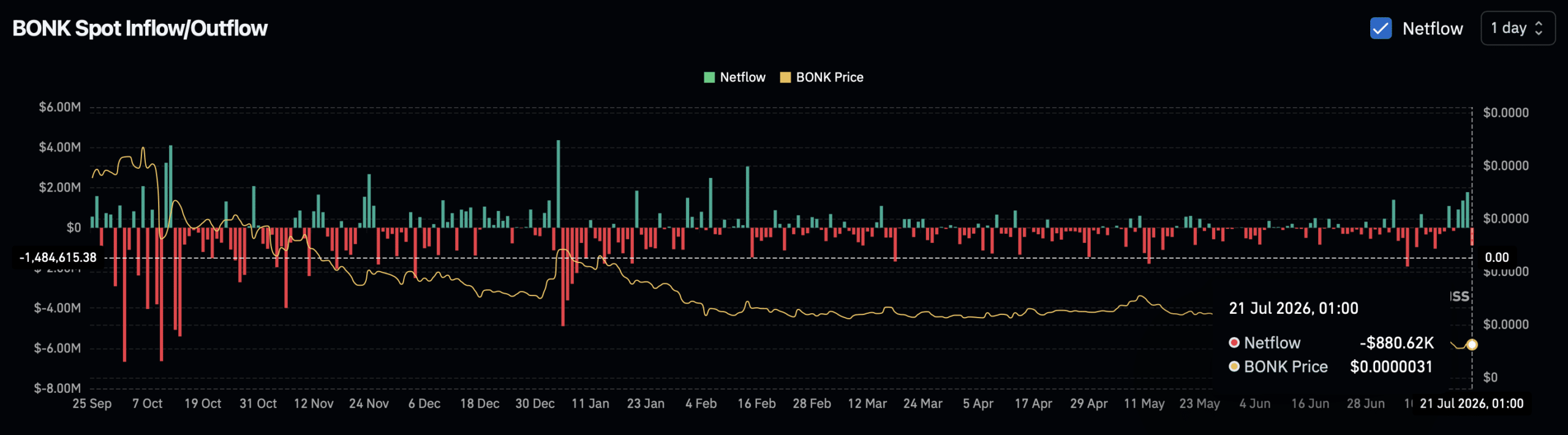
Total Bonk yang diakumulasikan melalui rute ini berjumlah sekitar $4,24 juta, dan netflow—selisih antara koin yang masuk dan keluar bursa—telah turun menjadi sekitar negatif $880.000.

Itu menandai pembalikan yang signifikan, mengingat penjualan mendominasi tiga hari sebelumnya. Pembelian yang berkelanjutan akan memberikan memecoin ini peluang yang lebih baik untuk mempertahankan harganya, dan dengan pergeseran Funding Rate yang masih dangkal daripada secara pasti bearish, BONK masih memiliki ruang untuk melanjutkan kenaikannya.


Ringkasan Akhir

  • Funding Rate Bonk telah mendingin menjadi 0,0009% di seluruh $7,82 juta posisi terbuka, menandakan tekanan jual sedang membangun.
  • Akumulasi spot menceritakan kisah sebaliknya, dengan sekitar $4,24 juta dalam Bonk ditarik dari bursa – sebuah pembalikan dari tiga hari penjualan.


Criptos en tendencia

Preguntas relacionadas

QApa yang menyebabkan kenaikan harga BONK sebesar 11% menurut artikel?

AMenurut artikel, kenaikan harga BONK sebesar 11% dalam satu hari terakhir banyak ditelusuri kembali ke lonjakan 'social mindshare' (bagian pikiran sosial), yaitu metrik yang menangkap seberapa banyak perhatian yang didapatkan token tersebut di platform media sosial. 'Social mindshare' BONK telah meningkat 32% dari hari sebelumnya.

QApa indikasi data Funding Rate negatif (-0.0009%) untuk BONK?

AData Funding Rate yang negatif untuk BONK menunjukkan tekanan jual yang meningkat di pasar perpetual/berjangka. Funding Rate mengukur apakah kontrak long (beli) atau short (jual) yang mendominasi pasar. Nilai negatif berarti sebagian besar posisi terbuka senilai $7,82 juta condong ke arah penjualan, dan pihak yang long (beli) membayar fee kepada pihak yang short (jual).

QMengapa sentimen pasar masih dianggap hati-hati atau bearish terhadap BONK meskipun harganya naik?

ASentimen pasar masih dianggap hati-hati atau bearish karena analisis sentimen menunjukkan skor negatif pada -2,42. Sentimen negatif ini menyulitkan narasi bullish untuk bertahan, terutama untuk memecoin seperti BONK yang tidak memiliki produk dasar untuk menopang reli harga. Penurunan sentimen lebih lanjut dapat mengikis momentum bullish.

QApa yang ditunjukkan oleh data pasar spot (spot market) untuk BONK yang berbeda dengan pasar berjangka?

AData pasar spot untuk BONK menunjukkan cerita yang lebih bullish. Kekuatan beli meningkat, dengan lebih banyak investor menarik BONK dari pertukaran (exchange) ke dompet pribadi untuk ditahan (akumulasi) daripada memindahkannya ke pertukaran untuk dijual. Total akumulasi diperkirakan mencapai $4,24 juta, dan netflow (selisih koin masuk dan keluar bursa) negatif sekitar $880.000, yang menandai pembalikan dari tiga hari sebelumnya yang didominasi penjualan.

QSecara keseluruhan, apa kesimpulan artikel tentang reli harga BONK saat ini?

AArtikel menyimpulkan bahwa reli harga BONK saat ini mungkin bersifat sementara atau 'jebakan' (trap). Meskipun ada kenaikan harga dan akumulasi di pasar spot, tekanan jual terbangun di pasar berjangka (Funding Rate negatif) dan sentimen pasar secara keseluruhan masih bearish. Dengan latar belakang penurunan 31% dalam 30 hari dan 58% sejak awal tahun, reli ini belum jelas menandai dimulainya pasar bull untuk BONK. Namun, karena pergeseran Funding Rate masih dangkal dan akumulasi spot berlanjut, BONK masih memiliki ruang untuk melanjutkan kenaikannya.

Lecturas Relacionadas

Wall Street's Most Famous 'Cassandra' Now Has His Sights Set on Nvidia

Michael Burry, the famed "Big Short" investor, has once again captured Wall Street's attention with a series of short positions against major tech and semiconductor stocks, most notably Nvidia. In late June and July, through his "Cassandra Unchained" newsletter, Burry disclosed short bets against Nvidia, Tesla, Applied Materials, Caterpillar, the SOXX semiconductor ETF, and later, Micron Technology. His core thesis revolves around potential distortions in the AI infrastructure boom, specifically questioning whether extended depreciation schedules (e.g., 6 years vs. a realistic 2-3 years for AI chips) by cloud giants like Microsoft and Google artificially inflate profits. He also raises concerns about possible "off-balance-sheet circular financing," where chip demand might be propped up by vendor-backed funding to clients. Nvidia's stock experienced volatility following these disclosures, briefly dipping but largely holding near Burry's reported entry points, leaving his positions roughly flat or slightly underwater as of late July. This move is part of a pattern for Burry, whose track record since his legendary 2008 bet is mixed. He has faced notable losses, such as on Tesla in 2021, while scoring on broader market turns like the 2020 pandemic crash. His methodology focuses intensely on free cash flow and scrutinizing original financial documents to spot overvaluation and structural risks, but it often struggles with timing the market. The article contrasts Burry's stance with other prominent investors. Steve Eisman, another "Big Short" figure, is not shorting Nvidia, citing strong fundamentals but expressing nervousness about sustainability. Jim Chanos agrees with the broad "accounting mismatch" concern—comparing it to the dot-com bubble—but targets financial leverage in private equity firms rather than the chip stocks themselves. While Nvidia's short interest remains relatively low at 1.3-1.4% of float, the massive stock size means absolute short losses have been significant, exceeding $5 billion earlier this year. The piece concludes that for ordinary investors, the key takeaway is not replicating specific short bets but learning from the critical frameworks these investors use: questioning rosy accounting, identifying structural vulnerabilities, and maintaining skepticism during market euphoria, even if pinpointing the exact catalyst for a downturn remains elusive.

marsbitHace 10 min(s)

Wall Street's Most Famous 'Cassandra' Now Has His Sights Set on Nvidia

marsbitHace 10 min(s)

Weekly Selection丨Epic Stock Market Volatility, Changxin Tech's IPO Reshapes Storage Landscape, Saylor Aims to Re-Anchor STRC Around September 8th

PANews Weekly Digest: Market Turmoil, Tech Breakthroughs, and Crypto Developments. The week saw significant volatility across global markets. South Korea's KOSPI index experienced extreme turbulence, including multiple trading halts, largely driven by sharp declines in AI hardware stocks like SK Hynix. In contrast, China's Changxin Xinqiao (CXC) achieved a landmark IPO with a market cap surpassing 4 trillion yuan, marking a major success for the domestic DRAM industry after a decade of losses. In the crypto and Web3 space, several key narratives emerged. AI is driving demand for new infrastructure, with projects like AI agent wallets and programmable payments gaining traction, attracting interest from firms like Coinbase. The Bitcoin mining sector is pivoting, with companies like MARA focusing on energy management as electricity becomes a core AI-era asset. Meanwhile, the RWA (Real World Assets) sector faces a "utilization puzzle," with hundreds of billions in on-chain assets remaining dormant. Notable market movements included a historic single-day surge of over 17% for the KOSPI index and a significant migration of $16.5 billion in staked ETH within the Lido ecosystem. Michael Saylor announced a target to re-peg the STRC stablecoin around September 8th. Other highlights include discussions on Ethereum's ambitious 2030 roadmap for scaling and privacy, analysis showing high protocol revenues not always translating to token price gains, and warnings from Citi about potential extreme commodity price shocks by late 2026.

marsbitHace 15 min(s)

Weekly Selection丨Epic Stock Market Volatility, Changxin Tech's IPO Reshapes Storage Landscape, Saylor Aims to Re-Anchor STRC Around September 8th

marsbitHace 15 min(s)

When the Market Begins to Question AI Capex: A Full Analysis of Q2 Earnings Reports from Five Tech Giants

In late July 2026, five major US tech giants—Alphabet, Intel, Microsoft, Meta, and Apple—released their Q2 earnings reports. While all companies exceeded revenue and profit expectations, driven by strong AI-related business growth, investor reactions diverged sharply due to concerns over escalating AI capital expenditures (capex) and their impact on free cash flow. Alphabet reported strong revenue growth and a surging cloud business, but its stock fell after announcing a doubled year-on-year capex and negative quarterly free cash flow for the first time. Intel posted its strongest revenue growth in over 15 years, but its stock experienced volatile trading after significantly raising its full-year capex guidance. Microsoft saw its stock surge after beating estimates and, crucially, lowering its capex forecast while projecting positive free cash flow. Meta faced the most severe sell-off as its profits declined despite revenue beats, with free cash flow plunging over 90% and its capex guidance raised. Apple reported record June-quarter results, but its stock plummeted after providing Q4 revenue guidance that fell short of expectations, citing supply chain constraints and forex headwinds. The overall takeaway is that the market's focus has shifted from validating AI demand to scrutinizing the timeline for returns on massive AI investments. Companies demonstrating a clearer path to managing capex and preserving free cash flow, like Microsoft, were rewarded, while those signaling continued aggressive spending faced investor skepticism.

Odaily星球日报Hace 25 min(s)

When the Market Begins to Question AI Capex: A Full Analysis of Q2 Earnings Reports from Five Tech Giants

Odaily星球日报Hace 25 min(s)

a16z: From Companies to DAOs, DUNA May Become the Next Generation Organizational Form

This article, "From Companies to DAOs: How DUNA Could Become the Next Organizational Form," traces the 500-year evolution of business collaboration. It begins with medieval structures like the *commenda* and Florentine *compagnia*, which exposed partners to personal risk. The modern corporation, exemplified by the Dutch East India Company (VOC), was a revolutionary leap, enabling large-scale, capital-intensive ventures by offering limited liability and reducing coordination costs. However, corporations introduced new challenges like principal-agent problems and bureaucratic overhead. The piece argues that software and internet-native protocols are now reducing these traditional overheads. Decentralized Autonomous Organizations (DAOs) emerged as a new model for coordination without centralized management. Yet, DAOs face a significant legal vacuum: they lack legal recognition, leaving members exposed to unlimited personal liability, and their tokens are vulnerable to being classified as securities under unclear regulations (e.g., the Howey Test). This has forced projects into suboptimal workarounds like offshore foundations. The article identifies the Decentralized Unincorporated Nonprofit Association (DUNA) as a potential solution. Recently legalized in states like Wyoming, the DUNA provides a legal wrapper for decentralized networks. It grants key protections—legal personality, limited liability, and perpetual existence—to a group without imposing a traditional hierarchical management structure. This allows token-holder communities to govern, hold assets, and contract as a single legal entity, aligning with their decentralized nature. While DUNA doesn't solve all governance challenges or magically resolve securities law questions, it represents a crucial step. It fills the legal recognition gap, offering a native legal form for internet-scale, decentralized collaboration and extending the separation of personal risk from organizational venture into a new domain.

marsbitHace 1 hora(s)

a16z: From Companies to DAOs, DUNA May Become the Next Generation Organizational Form

marsbitHace 1 hora(s)

2026 Mid-Year Report On-Chain RWA: Tokenized Stock Market Cap Doubles in a Year, But 90% of Rights Are Hollow Shells

The 2026 Mid-Year Report on On-Chain RWA highlights a significant growth in tokenized stock market capitalization, which nearly doubled from $951 million in March to $1.89 billion by July. However, the report reveals a fundamental contradiction in this "layer 2.5" ecosystem: products with the strongest legal foundation (like regulated U.S. infrastructure) lack liquidity and distribution, while freely tradable offshored wrapper products often lack substantive ownership rights. The increase is driven largely by a few products (SECZ, FGRS, STRCx) and platforms (Ondo, xStocks, Securitize collectively hold over 85% share). While distributed value across networks like Ethereum, Solana, and BNB Chain has grown, the market remains fragmented. Products referencing the same underlying asset (e.g., Apple stock) are distinct legal liabilities with different intermediaries and jurisdictional rules, offering varying degrees of legal claim. The report cautions that headline numbers are misleading, as they reflect changes in distributed token value—driven by issuance, conversions, and price movements—not pure investor inflows. True "canonical shares" with legal ownership, wide wallet distribution, institutional liquidity, and independent on-chain price discovery do not yet exist at scale. Tokenized treasuries show stronger product-market fit, and ETFs may be easier to scale than single stocks. The core takeaway is a trade-off: legal certainty versus liquidity and composability.

marsbitHace 1 hora(s)

2026 Mid-Year Report On-Chain RWA: Tokenized Stock Market Cap Doubles in a Year, But 90% of Rights Are Hollow Shells

marsbitHace 1 hora(s)

Trading

Spot

Artículos destacados

Cómo comprar BONK

¡Bienvenido a HTX.com! Hemos hecho que comprar Bonk (BONK) sea simple y conveniente. Sigue nuestra guía paso a paso para iniciar tu viaje de criptos.Paso 1: crea tu cuenta HTXUtiliza tu correo electrónico o número de teléfono para registrarte y obtener una cuenta gratuita en HTX. Experimenta un proceso de registro sin complicaciones y desbloquea todas las funciones.Obtener mi cuentaPaso 2: ve a Comprar cripto y elige tu método de pagoTarjeta de crédito/débito: usa tu Visa o Mastercard para comprar Bonk (BONK) al instante.Saldo: utiliza fondos del saldo de tu cuenta HTX para tradear sin problemas.Terceros: hemos agregado métodos de pago populares como Google Pay y Apple Pay para mejorar la comodidad.P2P: tradear directamente con otros usuarios en HTX.Over-the-Counter (OTC): ofrecemos servicios personalizados y tipos de cambio competitivos para los traders.Paso 3: guarda tu Bonk (BONK)Después de comprar tu Bonk (BONK), guárdalo en tu cuenta HTX. Alternativamente, puedes enviarlo a otro lugar mediante transferencia blockchain o utilizarlo para tradear otras criptomonedas.Paso 4: tradear Bonk (BONK)Tradear fácilmente con Bonk (BONK) en HTX's mercado spot. Simplemente accede a tu cuenta, selecciona tu par de trading, ejecuta tus trades y monitorea en tiempo real. Ofrecemos una experiencia fácil de usar tanto para principiantes como para traders experimentados.

399 Vistas totalesPublicado en 2024.12.11Actualizado en 2026.06.02

Cómo comprar BONK

Discusiones

Bienvenido a la comunidad de HTX. Aquí puedes mantenerte informado sobre los últimos desarrollos de la plataforma y acceder a análisis profesionales del mercado. A continuación se presentan las opiniones de los usuarios sobre el precio de BONK (BONK).

活动图片