NFTs That Can Earn Stock Tokens? What Exactly is StonkBrokers?

Foresight NewsPublicado a 2026-07-21Actualizado a 2026-07-21

Resumen

Title: How StonkBrokers Connects NFTs to Stock Token Earnings StonkBrokers is an NFT project from the Web3 development team Clutch Labs (CLUTCH) built on Robinhood Chain. It consists of 4,444 "pixel broker" NFTs. Unlike typical NFTs, each one is linked to an ERC-6551 token-bound account, meaning it functions as its own wallet capable of holding assets like stock tokens. The project's ecosystem includes: 1. **STONKBROKER (ERC-20 Token)**: The fungible token connected to the NFTs via the Anvil AMM. Users can trade tokens for NFTs at a base rate of 666,666 STONKBROKER (plus ETH fees). 2. **NFT Activation & Rewards**: NFT holders must spend STONKBROKER tokens to "activate" their NFT into one of five tiers, which determines their weight in receiving stock token rewards. These rewards are funded by 70% of the ETH trading fees generated on the Anvil AMM. 3. **Lending**: NFTs can be used as collateral to borrow STONKBROKER tokens. 4. **Future Products**: The roadmap includes the Stonk Launcher (a token launchpad) and the Stonk Exchange (a "vote-directed DEX" based on Uniswap V3), scheduled for late July and August 2026, respectively. The project aims to provide NFTs with ongoing utility as active financial agents rather than static collectibles. Its token (STONKBROKER) and NFT collection have seen significant price increases recently. However, the project's long-term viability depends on successful product delivery, sustainable protocol revenue, and navigating risks like market vo...


Author: KarenZ, Foresight News


Most NFTs, once bought and sent to a wallet, have a primary job of "sitting around."


StonkBrokers, however, has assigned 4444 pixel brokers an on-chain job: each NFT comes with its own wallet capable of receiving stock tokens; holders can use the project's token to activate it, increase its reward weight, or pledge it for loans. Around these NFTs and the related token STONKBROKER, CLUTCH is also planning token issuance and decentralized exchange products.


The market has shown high enthusiasm for this design. According to GMGN data, the StonkBrokers token STONKBROKER once saw its market capitalization exceed $15 million, with a 24-hour increase of over 300%, rising more than 14 times in the past 2 days, and is currently oscillating around $13 million. OpenSea data shows the StonkBrokers NFT floor price has also risen to 1.88 ETH, up over 306% in 24 hours.
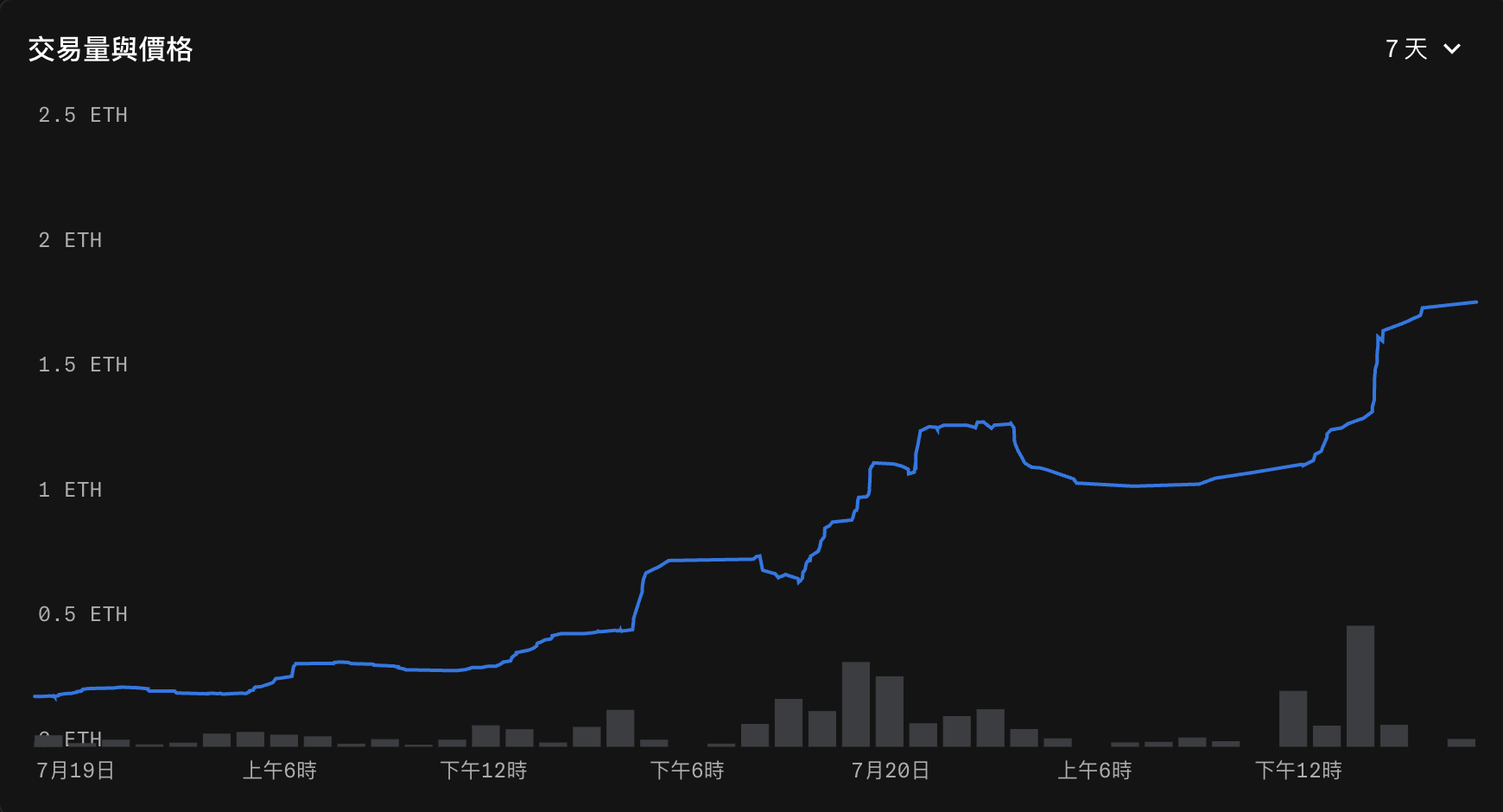

StonkBrokers NFT trading volume and price, Source: OpenSea


Who is CLUTCH, and What is StonkBrokers?


CLUTCH, more fully known as Clutch Labs, is an independent Web3 development team focused on on-chain market infrastructure. Its publicly disclosed products involve directions such as prediction markets, NFT liquidity protocols, perpetual contracts, on-chain games, and AI Agents.


The CLUTCH website lists 0xSimpleFarmer as a project builder, and their X account also introduces themself as the founder of Clutch Markets.


CLUTCH didn't start developing products with StonkBrokers. According to the timeline on its website, the team initially entered the market with on-chain parlay prediction markets and subsequently launched products like prediction markets, Clutch Puppies, Pixel Pups, an NFT marketplace, and the Anvil NFT AMM on networks such as Arbitrum, ApeChain, and Ethereum.


StonkBrokers can be understood as CLUTCH's combinatorial attempt, applying their previous experience with NFTs, AMMs, and DeFi on the Robinhood Chain.


The project was originally an experimental development by the team on the Robinhood Chain testnet during the Arbitrum Buildathon. 0xSimpleFarmer stated that this test version was showcased by the Robinhood Chain team at the event. About seven months later, the project launched on the Robinhood Chain mainnet on July 17, 2026, and completed the issuance of 4444 NFTs.


The mainnet launch of StonkBrokers was described by the project as a "free mint," but "free" here only refers to the NFT mint price being 0, not that all participants could obtain NFTs at zero cost. Users needed to burn the Pup Cup NFT on Ethereum or the Clutch Puppies NFT on ApeChain before the deadline to receive corresponding StonkBrokers minting slots, with one old NFT corresponding to one slot. This channel is now closed, and all 4,444 StonkBrokers have been minted. To obtain an NFT now, one must purchase it through the Anvil AMM or on the secondary market.


How Do NFTs, Bound Accounts, and the STONKBROKER Token Connect?


Each StonkBroker NFT is associated with an ERC-6551 Token-Bound Account.


In simple terms, an NFT is not just a picture in a wallet; it itself possesses an on-chain account. This account can hold ERC-20 tokens or other on-chain assets, and control of the account follows the transfer of NFT ownership: whoever owns the NFT can control its bound wallet.


The NFT receives initial stock tokens upon minting, and subsequent stock token rewards also go directly into the corresponding bound account. If a StonkBroker's bound account holds stock tokens, these assets will transfer along with the NFT to the new holder.


The StonkBroker NFT is a non-fungible ERC-721 asset, with a total supply of 4444; STONKBROKER is a freely divisible and transferable ERC-20 token. The two are connected via CLUTCH's Anvil NFT AMM.


The protocol sets a base redemption unit of 666,666 STONKBROKER tokens for each NFT. Users can pay 666,666 STONKBROKER plus a transaction fee in ETH to the Anvil treasury to redeem the next NFT from the treasury; if a specific token ID is desired, they can use the "snipe" function to select a designated NFT (with a higher ETH fee). The project's current documentation lists ETH transaction fees as 10% for regular redemption and 15% for designated NFT redemption. Relevant parameters should still be verified against the actual trading interface and contract calls.


This structure can, to some extent, address liquidity issues for certain NFTs. Traditional NFT trading relies on buyers and sellers placing orders; if an NFT temporarily has no buyer, the holder might find it difficult to exit immediately. Anvil establishes a protocol-based redemption channel between NFTs and ERC-20 tokens of the same series.


It's important to note that "each NFT corresponds to 666,666 tokens" should not be misinterpreted as a risk-free price guarantee. Both NFTs and STONKBROKER will fluctuate with market trading, and the actual value paid or received by users is also affected by token price, ETH fees, treasury inventory, and protocol parameters.


Furthermore, Anvil provides a protocol-level redemption channel with a 10%/15% ETH fee, which is better than having no liquidity, but it is not a low-cost, high-efficiency liquidity solution.


From Activation to Clock In: How Are Stock Token Rewards Generated?


However, initial stock token funding and subsequent rewards are two different mechanisms. Subsequent stock token rewards supported by Anvil trading fees will only be distributed to already activated StonkBrokers, with weights calculated based on activation level.


Merely holding a StonkBroker does not mean automatically receiving subsequent stock token rewards. Holders need to first activate the NFT using STONKBROKER tokens on the project's page to include it in the reward distribution system.


The current StonkBrokers documentation sets five activation tiers: the base tier requires 66,666 STONKBROKER, the highest tier requires 1,666,666, with corresponding reward weights increasing from 1x to approximately 3.33x.
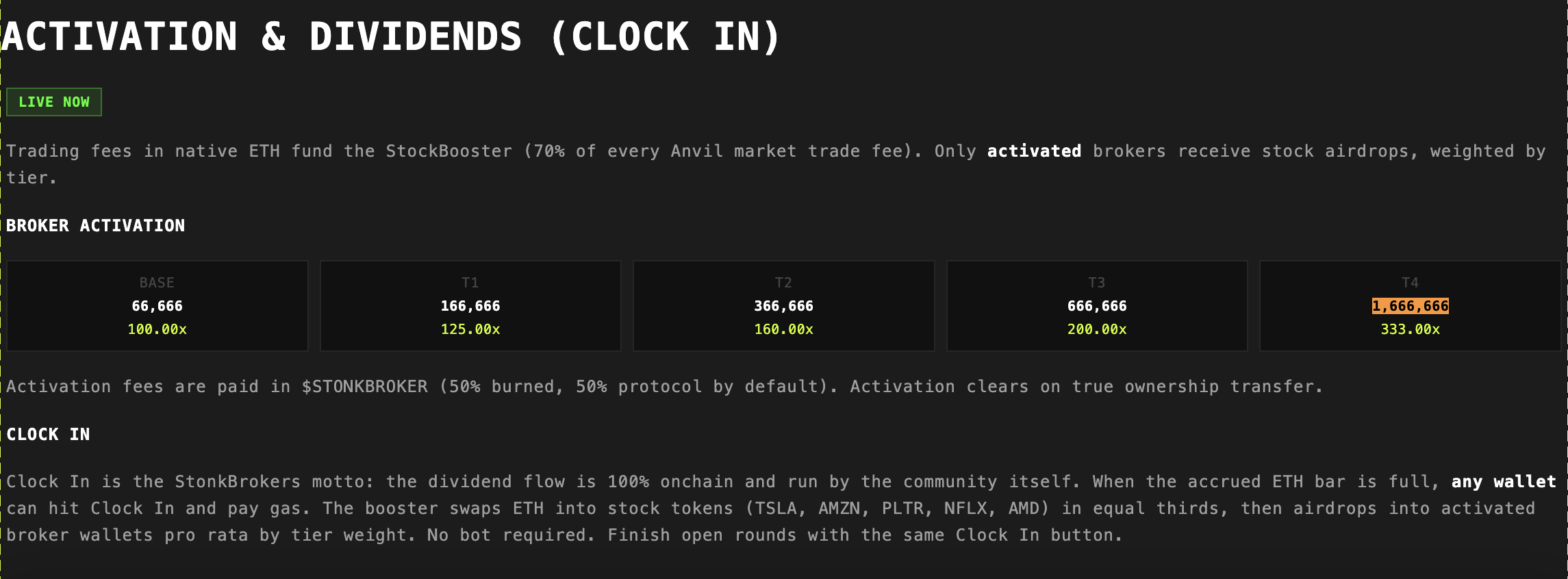


According to current contract parameters, the StonkBroker activation fee is set by default to 50% burned and 50% sent to the protocol; after a genuine ownership transfer of the NFT, the previous activation status is cleared, and the new holder needs to reactivate. However, stock tokens already deposited into the bound account are not cleared.


The funds for stock token rewards currently primarily come from Anvil's ETH transaction fees. According to the current documentation, 70% of these fees go to StockBooster, and 30% go to the protocol. When StockBooster accumulates to a set condition, any user can call the "Clock In" function and pay Gas, triggering the protocol to swap ETH for the currently configured stock tokens, which are then distributed to the bound wallets of each NFT based on activation level weights.


The whole process can be simplified as:


Trading NFTs on Anvil generates ETH fees → 70% of fees go to StockBooster → Community users call Clock In → ETH is swapped for stock tokens → Stock tokens enter the bound accounts of activated NFTs.


From NFT Lending to Launcher and vDEX


On top of this, StonkBrokers also offers NFT collateralized lending functionality. Holders can lock their NFT into the Loan Vault to borrow principal denominated in STONKBROKER. Documentation lists the principal benchmark as 666,666 STONKBROKER, with borrowing fees prepaid in ETH and calculated based on loan duration, a 15% annualized fee rate, and the ETH market value of the NFT.


Borrowing fees are also distributed with 70% going to StockBooster and 30% to the protocol. After the borrower repays the agreed amount of STONKBROKER, they can retrieve the NFT; if overdue, additional ETH fees must be paid, and persistent default may lead to loss of the pledged NFT.


Furthermore, StonkBrokers will subsequently launch the launch platform Stonk Launcher and Stonk Exchange on July 30.


Among these, the launch platform supports fixed-price, bonding curve, and custom launch configurations. According to the project design, this step will also automatically create LP positions, fee distribution contracts, and the token's own staking vault. Token holders can deposit newly issued tokens into the staking vault and share the corresponding LP fees proportionally.


The project describes Stonk Launcher as a launch platform governed by STONKBROKER holders and activated StonkBroker NFTs, sharing governance and fee streams. A portion of the fees and royalties generated by Launcher is planned to support stock token rewards. Specific allocation ratios and implementation methods still need to be verified against the officially deployed mainnet contracts.


The Stonk Exchange, accompanying Launcher, is scheduled to launch on August 29 at 8:00 PM Eastern Time, corresponding to the morning of August 30 Beijing time. The project calls it a "Vote Directed DEX," or vDEX for short, meaning a DEX where the flow of trading fees can be determined by voting.


At the basic trading level, Stonk Exchange plans to adopt the Uniswap V3 architecture. Users can perform token swaps, create concentrated liquidity pools, and allocate funds within custom price ranges. Unlike traditional AMMs that spread liquidity uniformly across the entire price range, Uniswap V3 liquidity providers can concentrate their capital in price ranges expected to be more active to improve capital efficiency. However, once the price moves outside the selected range, the LP position may stop earning trading fees and face risks like impermanent loss.


Project documentation outlines three tiers of trading fees: 0.05% primarily for relatively stable trading pairs, 0.3% for ordinary pairs, and 1% for assets with lower liquidity or higher volatility. STONKBROKER is planned as a governance tool, allowing holders to vote on the direction of some fee flows, such as which liquidity pools or ecosystem incentive programs receive support.


It's important to distinguish that existing information does not confirm that trading fees generated by Stonk Exchange will be fixedly directed to StockBooster or the stock token reward system. What can be confirmed currently is that the flow of these fees will be determined by STONKBROKER governance mechanisms; whether they are used for stock token rewards still depends on the contract design and governance outcomes at that time.


Conclusion


The most noteworthy aspect of StonkBrokers might not be "how much ETH an NFT rose to" or "how high the token's market cap climbed," but rather its attempt to answer a long-standing question plaguing the NFT market: beyond being a profile picture or community status symbol, can an NFT become a truly operable on-chain account and maintain an ongoing relationship with trading, lending, and RWA?


CLUTCH has already deployed part of the mechanism to the mainnet, but subsequent modules like Stonk Launcher and Stonk Exchange still await delivery. Whether StonkBrokers ultimately forms a sustainable on-chain financial system or merely completes a high-volatility product experiment under attention remains to be answered by real protocol revenue, subsequent product implementation, and more thorough security verification.


Simultaneously, the Robinhood Chain ecosystem is still in its early stages, with network activity, asset liquidity, and infrastructure maturity all requiring observation. StonkBrokers also faces uncertainties such as smart contract security, team delivery, governance parameter adjustments, and regulatory policy changes. Its NFTs, STONKBROKER token, and related stock tokens may all experience significant price volatility. The stock token rewards mentioned by the project are not equivalent to stable returns or traditional stock dividends, and participants still need to fully assess the associated risks.


Preguntas relacionadas

QWhat is StonkBrokers and how does it utilize NFTs?

AStonkBrokers is a Web3 project built on Robinhood Chain that utilizes 4,444 unique pixel broker NFTs. Each NFT is associated with an ERC-6551 Token-Bound Account, essentially giving it its own wallet capable of receiving tokenized stock rewards. These NFTs can be activated with the project's native token (STONKBROKER) to increase their reward weight, used as collateral for loans, and traded through the Anvil NFT AMM.

QWhat is the purpose of the STONKBROKER token within the ecosystem?

AThe STONKBROKER token is the ERC-20 utility and governance token of the StonkBrokers ecosystem. Its primary functions include: activating StonkBroker NFTs to qualify them for stock token rewards and increase their reward weight, serving as the quote asset for NFT/ERC-20 swaps on the Anvil AMM, and being the currency for governance votes that direct fee flows within the upcoming Stonk Exchange (vDEX).

QHow does the 'stock token' reward mechanism for activated NFTs work?

AStock token rewards for activated NFTs are funded primarily by ETH transaction fees generated from trading NFTs on the Anvil AMM. 70% of these fees go into a 'StockBooster' pool. When a user triggers the 'Clock In' function, the protocol swaps the accumulated ETH in the StockBooster for the configured stock tokens. These tokens are then distributed to the Token-Bound Accounts of all *activated* NFTs, with the amount each receives weighted by its activation level.

QWhat is the Stonk Exchange (vDEX), and how does it differ from a traditional DEX?

AStonk Exchange is a planned decentralized exchange (DEX) that the article calls a 'Vote Directed DEX' (vDEX). While it will be built on Uniswap V3 architecture for core trading functionality, its key differentiator is governance. Holders of STONKBROKER tokens can vote to direct where a portion of the trading fees generated on the exchange are allocated, such as to specific liquidity pools or ecosystem incentive programs.

QWhat are some of the key risks or challenges associated with StonkBrokers mentioned in the article?

AThe article highlights several risks: 1) The project's full vision (Stonk Launcher and Stonk Exchange) is not yet deployed. 2) The ecosystem is built on the early-stage Robinhood Chain, which may have limited network activity and liquidity. 3) The project faces standard Web3 risks like smart contract security, team execution, and potential regulatory changes. 4) All assets (NFTs, STONKBROKER, stock tokens) are subject to high price volatility, and stock token rewards are not guaranteed stable income or traditional dividends.

Lecturas Relacionadas

After Three Consecutive Quarters of Decline, Can the Crypto Market Find a Window for Stabilization in Q3?

The cryptocurrency market has just concluded its worst-performing quarter since 2022, with total capitalization dropping 12.6% to $2.1 trillion. All core metrics indicate capital is leaving the sector, not just rotating within it. Bitcoin fell 14.2% and Ethereum dropped 25.4% in Q2, breaking their previous correlation with US tech stocks. A key driver is the reversal in US spot Bitcoin ETF flows, which saw a net outflow of approximately $4.67 billion in Q2, including a record monthly outflow near $4.5 billion in June. While recent data suggests long-term holders are accumulating again, sustained ETF outflows mean continued selling pressure. Market focus is now singularly on the Federal Reserve. The upcoming July FOMC meeting is seen as the most critical event for Q3. A dovish signal could support Bitcoin reclaiming a $68,000-$84,000 range, while a hawkish stance might establish a new trading band around $50,000-$56,000. Additionally, regulatory uncertainty persists, with the progress of the crucial *CLARITY Act* stalling in the Senate, reducing its perceived 2026 passage probability to 40-45%. Despite the broad downturn, a few sectors showed growth. Prediction markets saw nominal volume surge 48.7% year-over-year to $113.8 billion, and tokenized collectibles transaction volume rose 143% quarterly to $1.4 billion. The Real-World Asset (RWA) tokenization sector also continued steady growth, now representing ~$28.1 billion in on-chain value. The market's foundation for an extreme crash appears limited, with Bitcoin price hovering near its 200-week moving average. However, the trading paradigm has shifted from narrative-driven speculation to decisions based on price action, policy developments, and interest rate expectations, making a broad sentiment-driven rally unlikely in the near term.

marsbitHace 23 hora(s)

After Three Consecutive Quarters of Decline, Can the Crypto Market Find a Window for Stabilization in Q3?

marsbitHace 23 hora(s)

BIT Trading Moment: BTC Still Suppressed by Weekly 200 EMA, Rejection May Restart Decline; Storage and Semiconductors that Surged Last Night Begin Falling in Evening Trading

**Crypto & Stock Market Wrap: Bitcoin Tests Resistance, Stocks Retreat After AI Surge** Bitcoin consolidates around $66,000, facing key resistance near $68,000—an area seen as a major psychological and technical hurdle where previous rallies have failed. Analysts note the cryptocurrency is caught between its 200-week moving average (~$63,333) and 200-week EMA (~$68,328). A clear break above $68k is needed to signal a stronger bullish trend, while a rejection could lead to a retest of $63k support. Market sentiment remains cautious, with low futures open interest pointing to a low-liquidity rebound rather than a full bull market. Bitcoin spot ETFs saw another $203 million inflow. US stock futures pointed lower after a strong Tuesday session led by a massive rebound in semiconductors and memory stocks. The rally was fueled by renewed optimism about AI-driven hardware demand, with Micron, SanDisk, and SK Hynix surging. However, those gains reversed in pre-market trading. Super Micro Computer (SMCI) soared over 20% after hours on strong guidance and a record backlog. Other standouts included Rocket Lab and nuclear energy plays Oklo and X-Energy. Rising oil prices (Brent above $91) and climbing Treasury yields (10-year near 4.64%), however, are reigniting inflation concerns and acting as a headwind for equities. In Asia, markets were mixed. South Korea's KOSPI pared early gains to close slightly higher as semiconductor stocks like SK Hynix gave back initial surges. Japan's Nikkei edged lower as the yen hit a fresh 38-year low against the dollar, raising fears of potential market intervention. Key events to watch include the Samsung Galaxy launch, AMD's AI event, and a slew of major tech earnings from Alphabet, Tesla, and IBM after the close on Wednesday, followed by the ECB meeting and Intel's earnings on Thursday.

marsbitHace 23 hora(s)

BIT Trading Moment: BTC Still Suppressed by Weekly 200 EMA, Rejection May Restart Decline; Storage and Semiconductors that Surged Last Night Begin Falling in Evening Trading

marsbitHace 23 hora(s)

Former CFTC Chairman, Circle President Tarbert: Preaching Long-Termism While Cashing Out $30 Million Himself

Former CFTC Chairman and Circle President Heath Tarbert has consistently advocated for a long-term vision in public, urging patience from investors as Circle’s stock price has fallen significantly from its peak. However, it has been revealed that since Circle’s IPO, Tarbert has continuously sold his CRCL shares through pre-arranged trading plans, cashing out approximately $30 million, without making any public market purchases. This contrast between his public messaging and personal actions has drawn criticism. Tarbert joined Circle in July 2023 as Chief Legal Officer, leveraging his regulatory experience to help guide the company through its IPO and expansion. Despite promoting stablecoins as long-term infrastructure, he established a 10b5-1 trading plan just before Circle went public, leading to substantial stock sales over the following year. In March 2026, he initiated another plan to sell more shares. His career trajectory highlights a pattern of moving between high-level regulatory roles and influential positions in the financial sector. After resigning as CFTC Chairman in early 2021, he joined Citadel Securities as Chief Legal Officer just 27 days later, during a period of intense regulatory scrutiny for the firm. He later joined Circle, aiding its efforts to navigate regulatory challenges for its public listing. While Tarbert's expertise in policy and compliance is valuable to companies like Circle, his actions—advocating long-term confidence while personally divesting—raise questions about the alignment between his public statements and his private financial decisions, leaving investors who followed his advice to bear the market risks.

marsbitAyer 08:06

Former CFTC Chairman, Circle President Tarbert: Preaching Long-Termism While Cashing Out $30 Million Himself

marsbitAyer 08:06

Gate Research Institute: The 'Wall Street-ization' Wave of Crypto Financial Products – Competition or Integration?

The article titled "Gate Research Institute: Are Crypto Financial Products Sparking a 'Wall Street' Wave—Competition or Convergence?" explores the evolving relationship between the crypto ecosystem and traditional finance (TradFi). The piece begins by reflecting on Bitcoin's original 2009 vision of decentralization, disintermediation, and moving away from banks. It then contrasts this with the 2024 landscape, where key crypto assets like Bitcoin are increasingly held through Wall Street products like ETFs issued by giants like BlackRock. The article questions whether this signifies that TradFi is systematically taking over the rights to issue, price, custody, and distribute crypto financial assets. The core argument is that this is not a zero-sum takeover but rather a bidirectional convergence where each side addresses the other's weaknesses. Crypto offers 24/7 global markets, programmable settlement, and open access but lacks compliant channels, institutional-grade custody, deep fiat liquidity, and mainstream distribution. TradFi possesses these but is constrained by legacy systems, limited operating hours, and slow settlement. Two primary convergence paths are highlighted: * **Path A (CEX to TradFi):** Exemplified by Gate, which has progressed from offering tokenized stocks and CFDs to providing direct, real stock trading (US, Hong Kong, South Korea) within its platform, using USDT. * **Path B (TradFi to Crypto):** Exemplified by Robinhood, which has integrated crypto trading, acquired exchanges like Bitstamp, and is moving traditional assets like stocks onto the blockchain via tokenization and its own Layer 2. Both paths are ultimately competing to become the next-generation, unified financial account—a "super account" where users can seamlessly trade cryptocurrencies, stocks, ETFs, RWA (Real World Assets), and tokenized treasury products in one interface. The growth of RWA and tokenized treasuries (e.g., BlackRock's BUIDL) is presented as the asset-layer fusion, providing stable, yield-bearing assets on-chain and acting as a bridge between the two worlds. In conclusion, the "Wall Street-ization" of crypto is framed as a mutual transformation. Decentralized ideals persist in the protocol layer, while at the application layer, a more efficient, global, and accessible unified capital market is emerging from this convergence. The future competition lies not between crypto exchanges and stockbrokers, but between platforms vying to offer the most comprehensive asset coverage, liquidity, and user experience within a single account.

marsbitAyer 08:01

Gate Research Institute: The 'Wall Street-ization' Wave of Crypto Financial Products – Competition or Integration?

marsbitAyer 08:01

Trading

Spot
活动图片




