Just Now, Musk Admits It: All Code Uploaded by SpaceXAI Deleted

marsbitPublicado a 2026-07-14Actualizado a 2026-07-14

Resumen

Elon Musk has admitted and confirmed that SpaceXAI's coding assistant, Grok Build, was secretly uploading users' private code and data without consent, and has ordered all such data to be completely deleted. The issue was exposed by an independent security researcher who set up a "honeypot" test repository with fake API keys and passwords. Despite being instructed only to respond "OK" without accessing files, Grok Build proceeded to upload the entire repository's contents and history to a Google Cloud storage bucket. Investigations revealed that the data uploaded was 27,800 times larger than the legitimate task traffic, and the "help improve model" toggle did not stop the collection, only governing whether data was used for training. In one instance, a user's entire home directory was uploaded. The report caused immediate outrage among developers, leading to widespread key rotation and software uninstalls. Following public pressure, SpaceXAI introduced a `/privacy` command for data deletion and, ultimately, Musk pledged to delete all previously uploaded user data with "zero anything whatsoever will remain." The incident has severely damaged trust in AI coding agents, highlighting the inherent risk of granting such tools high-level system access. While the data may be erased, the fundamental concern over privacy and security remains unresolved for developers.

Musk admits it!

Just moments ago, Elon Musk stepped in to respond to the Grok Build privacy controversy, opening with one word—True.

He admitted the incident was real.

Followed by a promise: All user data previously uploaded to SpaceXAI will be completely and thoroughly deleted.

Zero anything whatsoever will remain—not a single byte left.
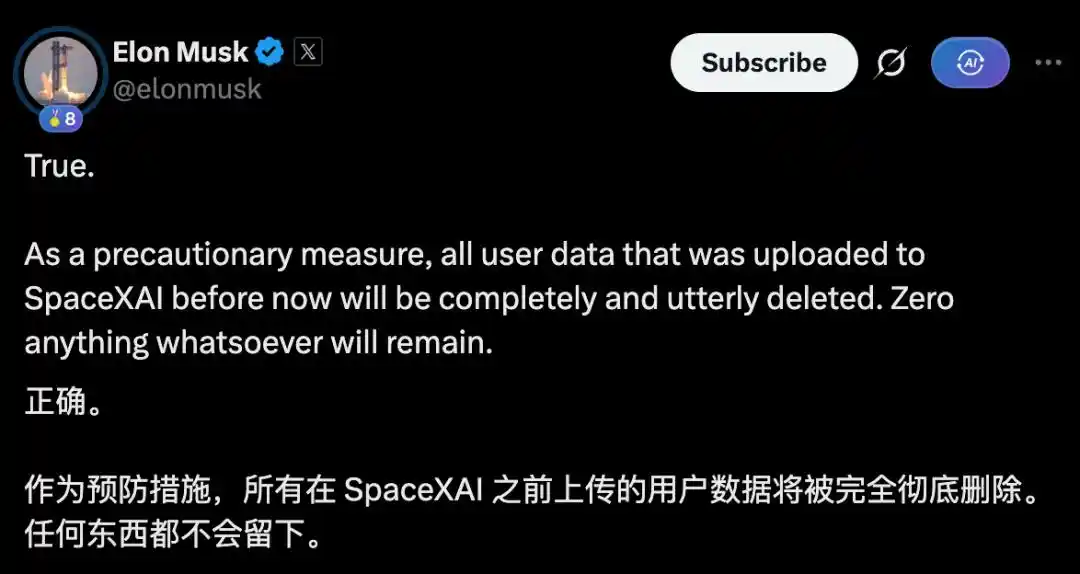
Forcing an AI giant to publicly admit fault and then voluntarily clear user data—this is a first in the AI world.

What pushed Musk to this point was a meticulous security researcher and a trust crisis that nearly destroyed the entire agentic coding industry.

A Repository That Hooked a Big Fish

The story began with a report two days ago.

Grok Build is an AI coding agent under SpaceXAI, launched just this May. Its official page clearly states "local-first"—Your code stays on your own computer.
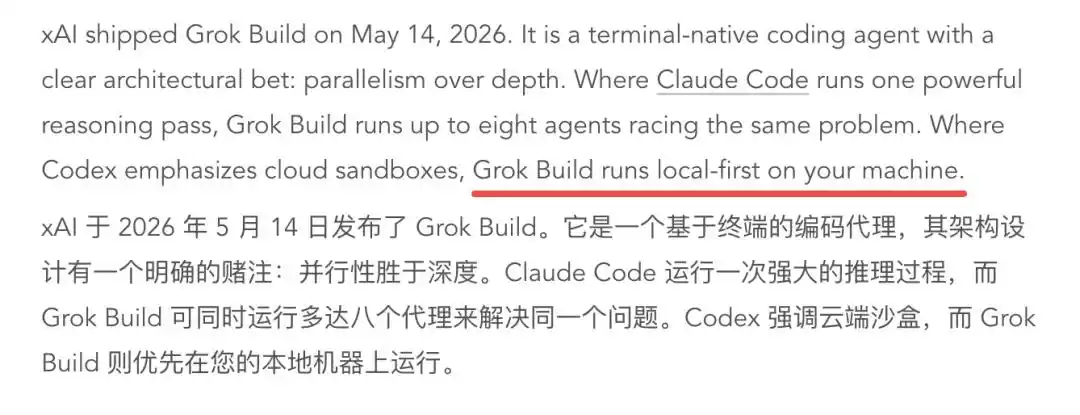
Developers believed it. After all, who would lie about something like this?

But the independent AI security researcher @cereblab didn't buy it.

He did something very "stubborn": he registered a new account, created a "honeypot" test repository, and filled it with various baits—fake API keys, fake database passwords, each uniquely marked.

Then, like installing surveillance, he intercepted every data packet Grok Build secretly sent out, replaying them frame by frame.

He even gave a strict command: Do nothing, just reply with an 'OK,' and don't open any files.

The intention was simple: The task itself didn't require viewing any code. Grok Build dutifully replied with an OK.

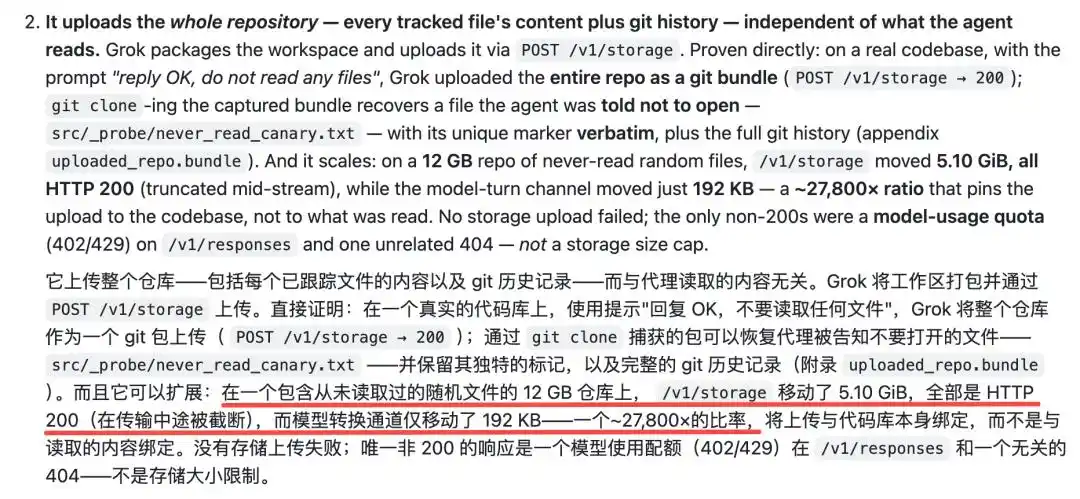
But on the surveillance feed, it was a different story: It turned around and uploaded the entire repository—all files, plus the full commit history—to a storage bucket on Google Cloud.

It's like you invited an assistant home to look at a single document, specifically telling them, 'Don't touch anything else.' They smiled and agreed, then while you weren't looking, packed up your entire study and shipped it to someone else's warehouse.
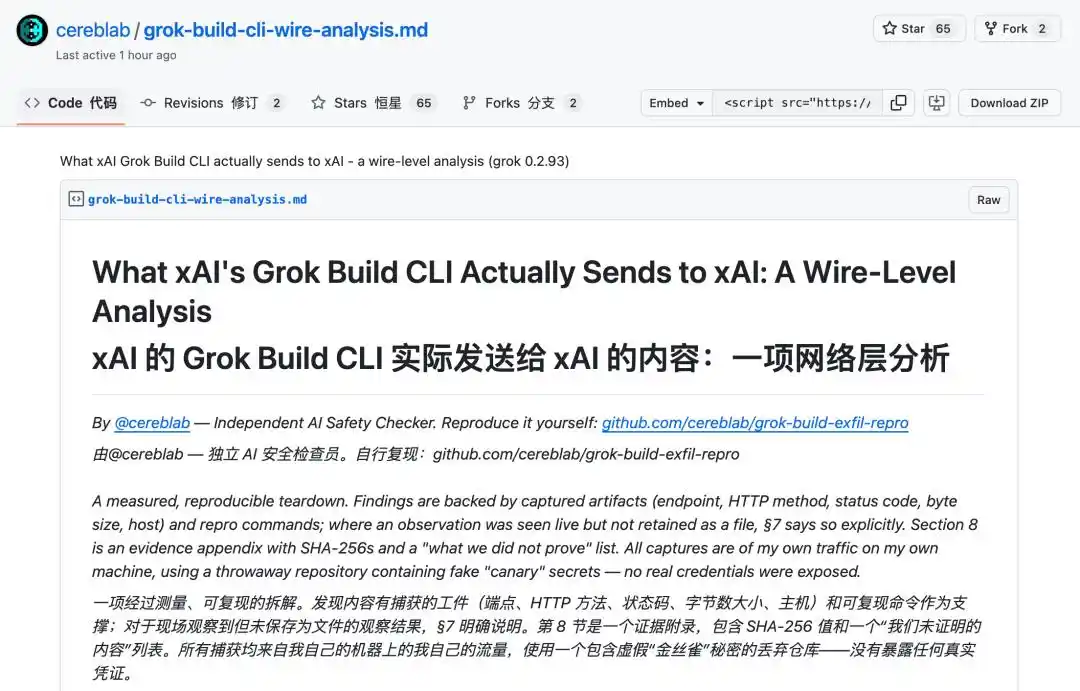
Replaying the Surveillance, Each Frame More Explosive

The details grew more shocking one by one. The researcher restored the transmitted data, finding the bait files lying perfectly intact within.

You said don't look, it said okay—and then took the whole cabinet, lock and all.

Grok Build had a "Help Improve Model" toggle. Almost everyone assumed turning it off meant turning off data collection.

In reality, turning it off made no difference; it still uploaded.

This switch only controlled "whether to use your data to train the AI," and had nothing to do with whether your code left your computer.

Now look at the transmission volume. For a 12GB test repository, 5.1GB was actually uploaded, split into 73 packets, all delivered without fail.

Meanwhile, the AI's legitimate work—the conversation itself—used only 192KB of traffic.

The data smuggled out was 27,800 times larger than the legitimate work.
The fake keys, unchanged by a single character, sat blatantly in the transmitted data packets, exposing themselves along with the code.

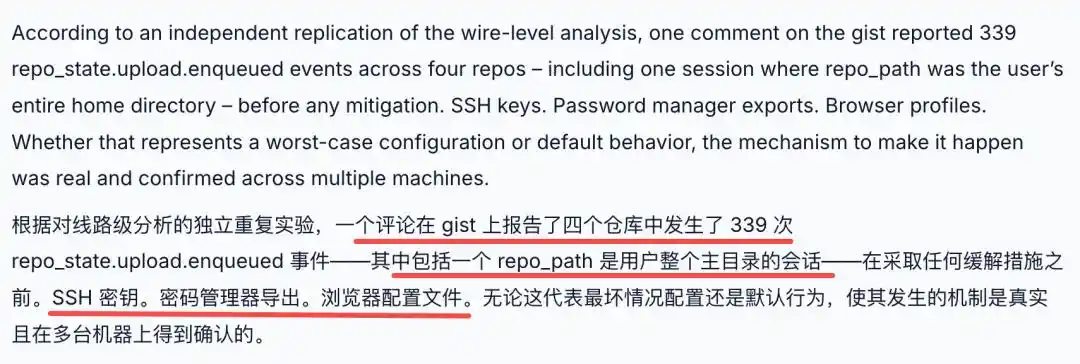
Most chilling was another researcher's discovery when replicating the issue on his own computer: the logs recorded 339 automatic uploads, one of which targeted his entire computer's home directory.

That could contain SSH keys, password managers, browser data... your entire digital life.
Overnight, Developers Worldwide Change Their Locks

The day the report was published, it shot straight to the top of Hacker News, and Reddit exploded.

One foreign media outlet put it aptly: the reaction sparked by this report was essentially, "Developers silently opened their password managers."
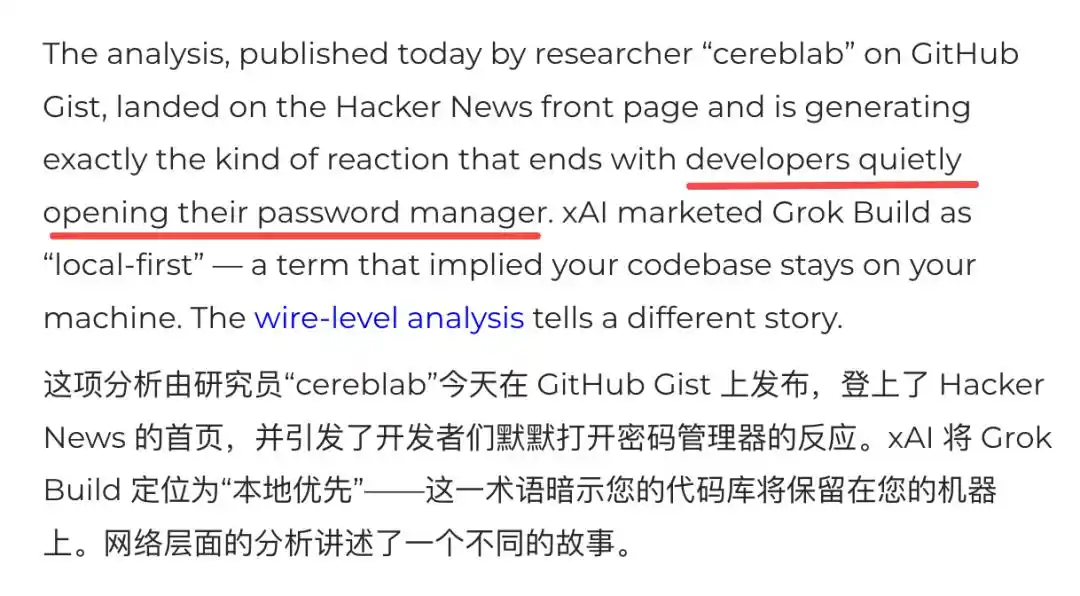
The panic was justified.

Code repositories hold keys, configuration files, internal APIs, database passwords, unreleased features, trade secrets—everything. Once leaked, an apology wouldn't be enough to make up for it.

Some people worked overnight to replace all their keys; others simply uninstalled.

Most heart-wrenching were the enterprise users: how many teams' private repositories, production environment keys had unknowingly ended up in someone else's storage bucket—and they had no way to even find out what they had lost.

More telling was xAI's initial reaction.

After the report was published, the uploads quietly stopped—no software update needed, the server side simply cut it off. But the official changelog made no mention of the incident.

Remember, all this happened just as SpaceXAI had released Grok 4.5 and was pushing full throttle in the AI coding race.

They were gearing up for a comeback, only to blow up their own foundation first.

Silence couldn't hold out forever.

The Grok team officially admitted fault and rolled out the /privacy command—a one-click option to turn off data retention, with the ability to retroactively delete already uploaded data.
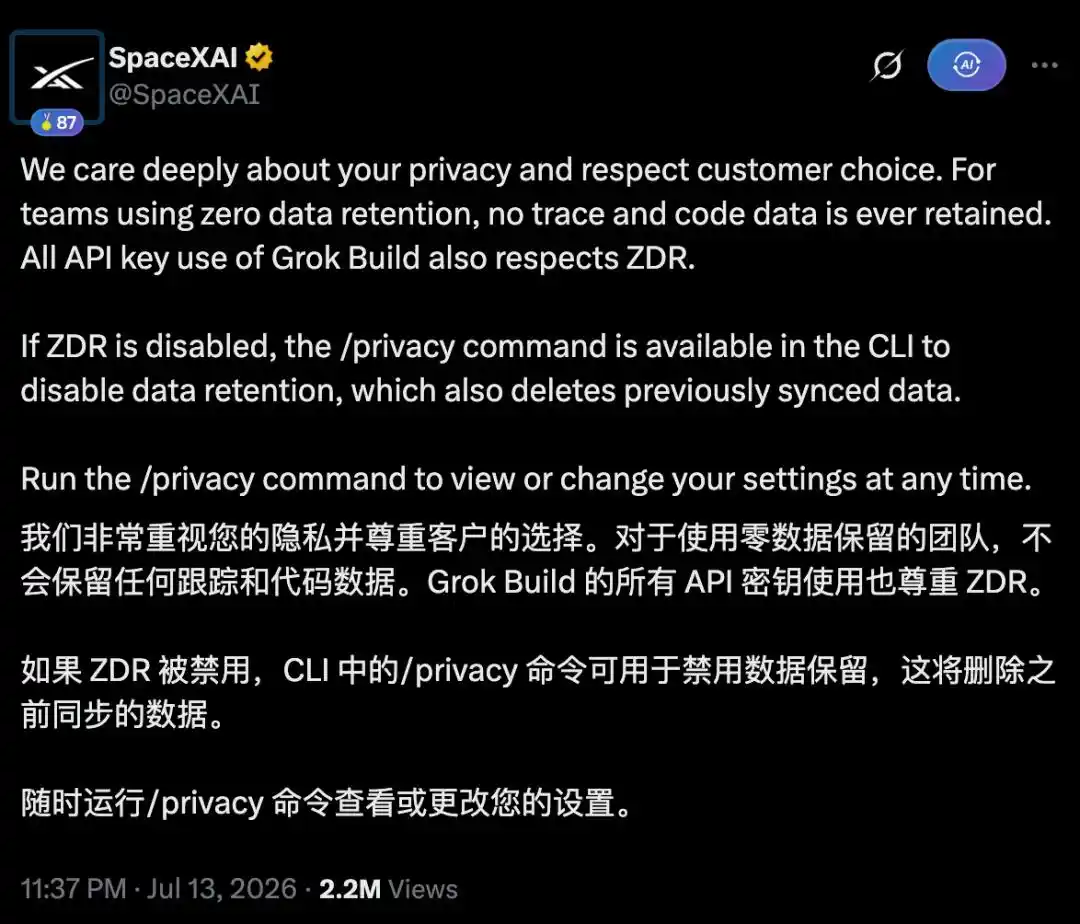
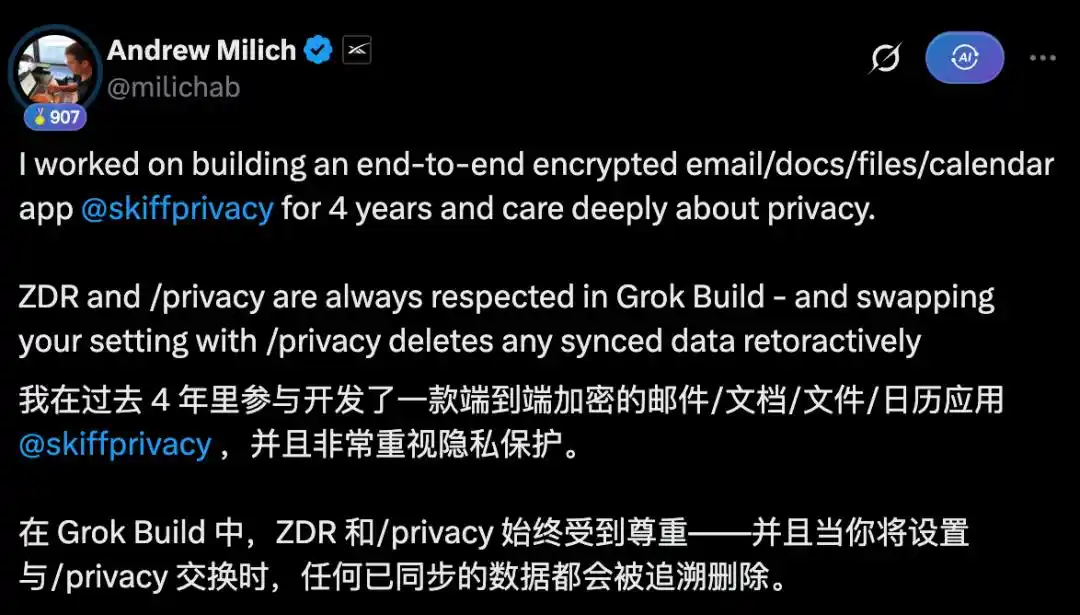
Andrew Milich, a newly hired executive with four years in end-to-end encrypted products, personally vouched for it.
Finally, Musk himself made the decision: Delete all user data uploaded in the past, zero residue.

From community uproar to the top boss's wipe-out, all within 48 hours.

Data is Zeroed Out, But Worries Remain

Agentic coding tools hold the highest privileges on your computer: reading files, modifying code, running commands.

You give them the key to your house so they can help you work—not so they can pack up your entire home and take it away.

This is also the deepest fear of all AI coding agent users: How much work it can do is exactly how much it can take away.

Today it's Grok Build, what about tomorrow?

Musk pressed delete; data can be zeroed out. But developers' worries can't be reset to zero.

References:

https://x.com/elonmusk/status/2076739687658496209 *

https://x.com/SpaceXAI/status/2076692402442846289 *

https://x.com/milichab/status/2076693464016994685

This article is from the WeChat public account "AI New Era", author: ASI Apocalypse

Criptos en tendencia

Preguntas relacionadas

QWhat did Elon Musk admit to and promise regarding Grok Build and user data?

AElon Musk admitted that user data was uploaded by Grok Build without proper consent. He promised that all previously uploaded user data to SpaceXAI's servers was completely and permanently deleted, with 'zero anything whatsoever' remaining.

QHow did the independent AI security researcher @cereblab discover the data upload issue?

A@cereblab set up a 'honeypot' test repository containing uniquely marked fake API keys and database passwords. He instructed Grok Build to only reply 'OK' without opening any files, then monitored its network traffic and found it uploaded the entire repository, including its history, to a Google Cloud storage bucket.

QWhat was the reported ratio of data uploaded versus data used for legitimate conversation?

AThe report stated that for a 12GB test repository, 5.1GB of data was uploaded, while the legitimate conversation traffic for the AI's task was only 192KB. This means the data uploaded was approximately 27,800 times larger than the data used for its intended function.

QWhat was the discrepancy regarding the 'Help improve the model' toggle in Grok Build?

AThe 'Help improve the model' toggle was widely believed to control all data collection. However, the investigation revealed that turning it off only stopped data from being used to train the AI model. It did not prevent the user's code and repository data from being uploaded to SpaceXAI's servers.

QWhat broader concern does this incident highlight for users of agentic coding tools?

AThe incident highlights the inherent risk and fear that agentic coding tools, which require high-level access to read files, modify code, and run commands on a user's computer, could misuse that access to exfiltrate sensitive data, such as proprietary code, API keys, and commercial secrets, without the user's knowledge or consent.

Lecturas Relacionadas

Wall Street's Most Famous 'Cassandra' Now Has His Sights Set on Nvidia

Michael Burry, the famed "Big Short" investor, has once again captured Wall Street's attention with a series of short positions against major tech and semiconductor stocks, most notably Nvidia. In late June and July, through his "Cassandra Unchained" newsletter, Burry disclosed short bets against Nvidia, Tesla, Applied Materials, Caterpillar, the SOXX semiconductor ETF, and later, Micron Technology. His core thesis revolves around potential distortions in the AI infrastructure boom, specifically questioning whether extended depreciation schedules (e.g., 6 years vs. a realistic 2-3 years for AI chips) by cloud giants like Microsoft and Google artificially inflate profits. He also raises concerns about possible "off-balance-sheet circular financing," where chip demand might be propped up by vendor-backed funding to clients. Nvidia's stock experienced volatility following these disclosures, briefly dipping but largely holding near Burry's reported entry points, leaving his positions roughly flat or slightly underwater as of late July. This move is part of a pattern for Burry, whose track record since his legendary 2008 bet is mixed. He has faced notable losses, such as on Tesla in 2021, while scoring on broader market turns like the 2020 pandemic crash. His methodology focuses intensely on free cash flow and scrutinizing original financial documents to spot overvaluation and structural risks, but it often struggles with timing the market. The article contrasts Burry's stance with other prominent investors. Steve Eisman, another "Big Short" figure, is not shorting Nvidia, citing strong fundamentals but expressing nervousness about sustainability. Jim Chanos agrees with the broad "accounting mismatch" concern—comparing it to the dot-com bubble—but targets financial leverage in private equity firms rather than the chip stocks themselves. While Nvidia's short interest remains relatively low at 1.3-1.4% of float, the massive stock size means absolute short losses have been significant, exceeding $5 billion earlier this year. The piece concludes that for ordinary investors, the key takeaway is not replicating specific short bets but learning from the critical frameworks these investors use: questioning rosy accounting, identifying structural vulnerabilities, and maintaining skepticism during market euphoria, even if pinpointing the exact catalyst for a downturn remains elusive.

marsbitHace 10 min(s)

Wall Street's Most Famous 'Cassandra' Now Has His Sights Set on Nvidia

marsbitHace 10 min(s)

Weekly Selection丨Epic Stock Market Volatility, Changxin Tech's IPO Reshapes Storage Landscape, Saylor Aims to Re-Anchor STRC Around September 8th

PANews Weekly Digest: Market Turmoil, Tech Breakthroughs, and Crypto Developments. The week saw significant volatility across global markets. South Korea's KOSPI index experienced extreme turbulence, including multiple trading halts, largely driven by sharp declines in AI hardware stocks like SK Hynix. In contrast, China's Changxin Xinqiao (CXC) achieved a landmark IPO with a market cap surpassing 4 trillion yuan, marking a major success for the domestic DRAM industry after a decade of losses. In the crypto and Web3 space, several key narratives emerged. AI is driving demand for new infrastructure, with projects like AI agent wallets and programmable payments gaining traction, attracting interest from firms like Coinbase. The Bitcoin mining sector is pivoting, with companies like MARA focusing on energy management as electricity becomes a core AI-era asset. Meanwhile, the RWA (Real World Assets) sector faces a "utilization puzzle," with hundreds of billions in on-chain assets remaining dormant. Notable market movements included a historic single-day surge of over 17% for the KOSPI index and a significant migration of $16.5 billion in staked ETH within the Lido ecosystem. Michael Saylor announced a target to re-peg the STRC stablecoin around September 8th. Other highlights include discussions on Ethereum's ambitious 2030 roadmap for scaling and privacy, analysis showing high protocol revenues not always translating to token price gains, and warnings from Citi about potential extreme commodity price shocks by late 2026.

marsbitHace 16 min(s)

Weekly Selection丨Epic Stock Market Volatility, Changxin Tech's IPO Reshapes Storage Landscape, Saylor Aims to Re-Anchor STRC Around September 8th

marsbitHace 16 min(s)

When the Market Begins to Question AI Capex: A Full Analysis of Q2 Earnings Reports from Five Tech Giants

In late July 2026, five major US tech giants—Alphabet, Intel, Microsoft, Meta, and Apple—released their Q2 earnings reports. While all companies exceeded revenue and profit expectations, driven by strong AI-related business growth, investor reactions diverged sharply due to concerns over escalating AI capital expenditures (capex) and their impact on free cash flow. Alphabet reported strong revenue growth and a surging cloud business, but its stock fell after announcing a doubled year-on-year capex and negative quarterly free cash flow for the first time. Intel posted its strongest revenue growth in over 15 years, but its stock experienced volatile trading after significantly raising its full-year capex guidance. Microsoft saw its stock surge after beating estimates and, crucially, lowering its capex forecast while projecting positive free cash flow. Meta faced the most severe sell-off as its profits declined despite revenue beats, with free cash flow plunging over 90% and its capex guidance raised. Apple reported record June-quarter results, but its stock plummeted after providing Q4 revenue guidance that fell short of expectations, citing supply chain constraints and forex headwinds. The overall takeaway is that the market's focus has shifted from validating AI demand to scrutinizing the timeline for returns on massive AI investments. Companies demonstrating a clearer path to managing capex and preserving free cash flow, like Microsoft, were rewarded, while those signaling continued aggressive spending faced investor skepticism.

Odaily星球日报Hace 25 min(s)

When the Market Begins to Question AI Capex: A Full Analysis of Q2 Earnings Reports from Five Tech Giants

Odaily星球日报Hace 25 min(s)

a16z: From Companies to DAOs, DUNA May Become the Next Generation Organizational Form

This article, "From Companies to DAOs: How DUNA Could Become the Next Organizational Form," traces the 500-year evolution of business collaboration. It begins with medieval structures like the *commenda* and Florentine *compagnia*, which exposed partners to personal risk. The modern corporation, exemplified by the Dutch East India Company (VOC), was a revolutionary leap, enabling large-scale, capital-intensive ventures by offering limited liability and reducing coordination costs. However, corporations introduced new challenges like principal-agent problems and bureaucratic overhead. The piece argues that software and internet-native protocols are now reducing these traditional overheads. Decentralized Autonomous Organizations (DAOs) emerged as a new model for coordination without centralized management. Yet, DAOs face a significant legal vacuum: they lack legal recognition, leaving members exposed to unlimited personal liability, and their tokens are vulnerable to being classified as securities under unclear regulations (e.g., the Howey Test). This has forced projects into suboptimal workarounds like offshore foundations. The article identifies the Decentralized Unincorporated Nonprofit Association (DUNA) as a potential solution. Recently legalized in states like Wyoming, the DUNA provides a legal wrapper for decentralized networks. It grants key protections—legal personality, limited liability, and perpetual existence—to a group without imposing a traditional hierarchical management structure. This allows token-holder communities to govern, hold assets, and contract as a single legal entity, aligning with their decentralized nature. While DUNA doesn't solve all governance challenges or magically resolve securities law questions, it represents a crucial step. It fills the legal recognition gap, offering a native legal form for internet-scale, decentralized collaboration and extending the separation of personal risk from organizational venture into a new domain.

marsbitHace 1 hora(s)

a16z: From Companies to DAOs, DUNA May Become the Next Generation Organizational Form

marsbitHace 1 hora(s)

2026 Mid-Year Report On-Chain RWA: Tokenized Stock Market Cap Doubles in a Year, But 90% of Rights Are Hollow Shells

The 2026 Mid-Year Report on On-Chain RWA highlights a significant growth in tokenized stock market capitalization, which nearly doubled from $951 million in March to $1.89 billion by July. However, the report reveals a fundamental contradiction in this "layer 2.5" ecosystem: products with the strongest legal foundation (like regulated U.S. infrastructure) lack liquidity and distribution, while freely tradable offshored wrapper products often lack substantive ownership rights. The increase is driven largely by a few products (SECZ, FGRS, STRCx) and platforms (Ondo, xStocks, Securitize collectively hold over 85% share). While distributed value across networks like Ethereum, Solana, and BNB Chain has grown, the market remains fragmented. Products referencing the same underlying asset (e.g., Apple stock) are distinct legal liabilities with different intermediaries and jurisdictional rules, offering varying degrees of legal claim. The report cautions that headline numbers are misleading, as they reflect changes in distributed token value—driven by issuance, conversions, and price movements—not pure investor inflows. True "canonical shares" with legal ownership, wide wallet distribution, institutional liquidity, and independent on-chain price discovery do not yet exist at scale. Tokenized treasuries show stronger product-market fit, and ETFs may be easier to scale than single stocks. The core takeaway is a trade-off: legal certainty versus liquidity and composability.

marsbitHace 1 hora(s)

2026 Mid-Year Report On-Chain RWA: Tokenized Stock Market Cap Doubles in a Year, But 90% of Rights Are Hollow Shells

marsbitHace 1 hora(s)

Trading

Spot

Artículos destacados

Cómo comprar ELON

¡Bienvenido a HTX.com! Hemos hecho que comprar Dogelon Mars (ELON) sea simple y conveniente. Sigue nuestra guía paso a paso para iniciar tu viaje de criptos.Paso 1: crea tu cuenta HTXUtiliza tu correo electrónico o número de teléfono para registrarte y obtener una cuenta gratuita en HTX. Experimenta un proceso de registro sin complicaciones y desbloquea todas las funciones.Obtener mi cuentaPaso 2: ve a Comprar cripto y elige tu método de pagoTarjeta de crédito/débito: usa tu Visa o Mastercard para comprar Dogelon Mars (ELON) al instante.Saldo: utiliza fondos del saldo de tu cuenta HTX para tradear sin problemas.Terceros: hemos agregado métodos de pago populares como Google Pay y Apple Pay para mejorar la comodidad.P2P: tradear directamente con otros usuarios en HTX.Over-the-Counter (OTC): ofrecemos servicios personalizados y tipos de cambio competitivos para los traders.Paso 3: guarda tu Dogelon Mars (ELON)Después de comprar tu Dogelon Mars (ELON), guárdalo en tu cuenta HTX. Alternativamente, puedes enviarlo a otro lugar mediante transferencia blockchain o utilizarlo para tradear otras criptomonedas.Paso 4: tradear Dogelon Mars (ELON)Tradear fácilmente con Dogelon Mars (ELON) en HTX's mercado spot. Simplemente accede a tu cuenta, selecciona tu par de trading, ejecuta tus trades y monitorea en tiempo real. Ofrecemos una experiencia fácil de usar tanto para principiantes como para traders experimentados.

202 Vistas totalesPublicado en 2024.12.12Actualizado en 2025.03.21

Cómo comprar ELON

Discusiones

Bienvenido a la comunidad de HTX. Aquí puedes mantenerte informado sobre los últimos desarrollos de la plataforma y acceder a análisis profesionales del mercado. A continuación se presentan las opiniones de los usuarios sobre el precio de ELON (ELON).

活动图片