摩根大通代币化基金一个月 TVL 暴涨 250%,机构资金正把以太坊当成默认底层

marsbitPublicado a 2026-07-07Actualizado a 2026-07-07

Resumen

摩根大通旗下代币化货币基金JLTXX在以太坊上运行,七周内链上管理规模从2亿美元增至近7亿美元,月涨幅约250%。该基金主要投资短期美债等低风险资产,并被用于满足稳定币储备的合规需求。与此同时,由Tom Lee执掌的BitMine公司近期单周增持约7300万美元ETH,使其ETH总持仓接近以太坊流通量的5%。 尽管ETH价格自2025年高点已下跌超50%,且市场活跃度下降,但以摩根大通、贝莱德为代表的传统金融机构正加速将以太坊作为代币化合规金融产品的底层基础设施进行布局。机构资金的入场主要基于长期叙事,如稳定币储备和资产代币化,这与二级市场短期的价格走势和情绪形成背离。分析认为,机构行为是重要的基本面变化,但并非直接的短期价格看涨信号。

作者:克洛德,深潮 TechFlow

深潮导读:如果你手里还攥着以太坊,价格今年跌了一半多,你可能想知道谁还在这个位置进场。

答案是华尔街最保守的那批钱。摩根大通一只叫 JLTXX 的代币化货币基金,上线七周链上规模从 2 亿美元冲到近 7 亿美元,一个月涨约 250%,而且只跑在以太坊上。同一周,Tom Lee 掌舵的 BitMine 单周又买入约 7300 万美元 ETH,总持仓摸到以太坊流通量的 4.8%。ETH 币价在跌,但机构在囤,这两件事同时发生。
摩根大通没怎么声张,就把一只代币化基金做成了近年增长最快的产品之一。

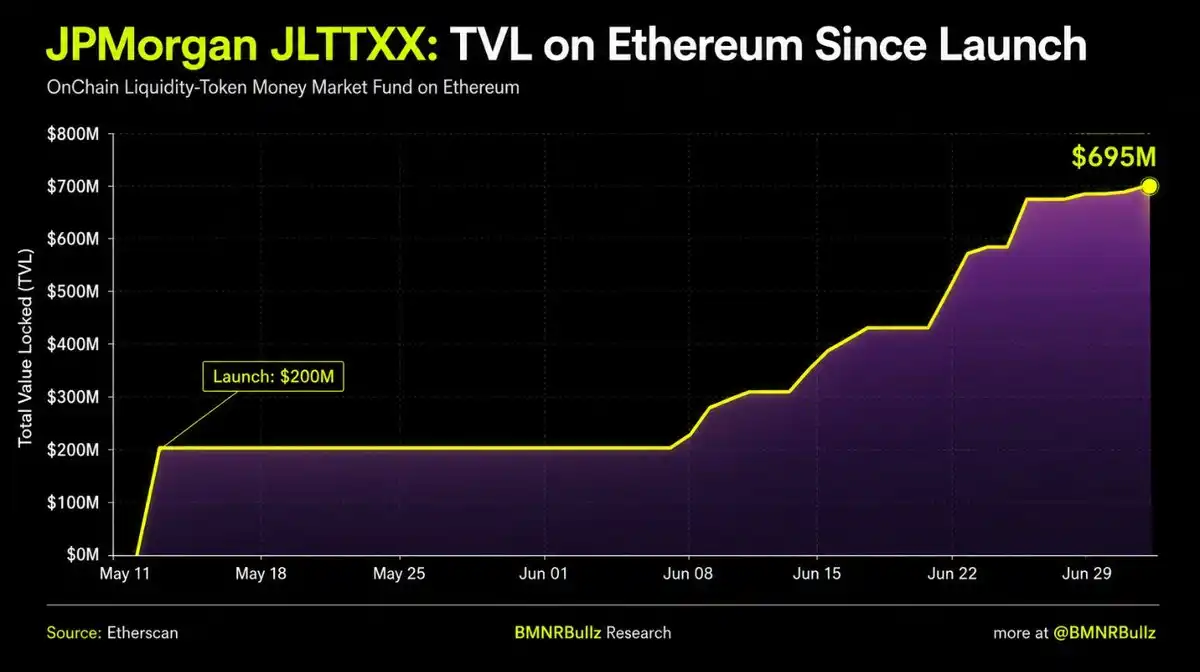
据加密财经媒体 The Defiant 报道,摩根大通的链上流动性代币货币市场基金(OnChain Liquidity Token Money Market Fund,代码 JLTXX)过去一个月链上管理规模增长约 250%,数据来自区块链分析平台 Token Terminal。这只基金只在以太坊上运行。

七周从 2 亿冲到近 7 亿,摩根大通用自有资金开的头

JLTXX 于 5 月 13 日上线,摩根大通先用自有资金投了 1 亿美元做种子,托管机构 Anchorage Digital 也参与了首发认购,上线首日的链上锁仓总量约为 2 亿美元。据一份来自 ethereuminsti 的推文梳理,七周之后这个数字到了 6.95 亿美元,涨幅 248%,和 Token Terminal 给出的约 250%基本对得上。

这只基金投的东西一点都不激进,全是短期美国国债和以国债或现金做全额抵押的隔夜回购协议,跟传统货币基金里最稳的那类资产一模一样。真正不一样的是它跑在哪儿。摩根大通自己有一套叫 Kinexys 的私有结算网络,但 JLTXX 和该行去年 12 月上线的第一只代币化基金 MONY 一样,都选了公开的以太坊主网,而不是自家链。一家有自己区块链基础设施的银行,把产品放到公链上,这个选择本身就是信号。

对手里持有 ETH 的人来说,这里的含义是:以太坊正在从一个投机资产,慢慢变成机构眼里跑合规金融产品的底层账本。这类需求跟币价短期涨跌关系不大,但会沉淀成长期的网络使用量。

增长背后是稳定币的储备需求

JLTXX 涨得快,一部分原因是它被拿去给稳定币做储备。

据 Dune 分析账号披露,这只基金被加入了 USDG 稳定币的储备资产池,同池的还有贝莱德的 BUIDL 和 Superstate 的 STBXX。这一动作指向一个正在变大的需求:稳定币发行方需要符合《GENIUS 法案》规则的、能在链上持有的美债敞口。《GENIUS 法案》是美国 2025 年通过的稳定币立法,它规定了稳定币的储备资产必须满足哪些条件,而代币化的美债货币基金正好卡在这个位置上。

摩根大通把 JLTXX 设计成既能用现金认购、也能用稳定币认购,等于把这只基金直接架在了受监管金融和加密原生基础设施的交界处。这个赛道上它不是一个人在跑,贝莱德已就两只代币化货币产品向 SEC 递交文件,其中一只把该行现有的、规模 61 亿美元的精选国债流动性基金的一个份额类别拿到以太坊上代币化。贝莱德旗下的 BUIDL 是目前全球最大的代币化基金,2026 年初管理规模已越过 28 亿美元,横跨八条链。

想入场的人可以从这里读出方向:稳定币储备是一块确定在长大的蛋糕,而机构几乎一致地把以太坊选成了这块蛋糕的承载层。

BitMine 单周再买 7300 万美元,持仓逼近流通量 5%

传统金融从资产端靠近以太坊的同时,链上的囤币盘也没停。

据 BitMine Immersion Technologies(纽交所代码 BMNR)周一发布的持仓更新,这家由 Fundstrat 的 Tom Lee 担任董事长的以太坊财库公司,过去一周买入 42,197 枚 ETH,按当时约 7300 万美元计。这笔买入把 BitMine 的 ETH 总持仓推到 5,742,237 枚,约占以太坊流通量的 4.8%。BitMine 自己的账目把加密及其他资产总值列为 111 亿美元,其中 ETH 仓位按每枚 1800 美元计价,另有 206 枚 BTC、对 Beast Industries 的 1.8 亿美元持股和对 Eightco Holdings 的 7100 万美元持股,以及 5.27 亿美元的现金和有价证券。
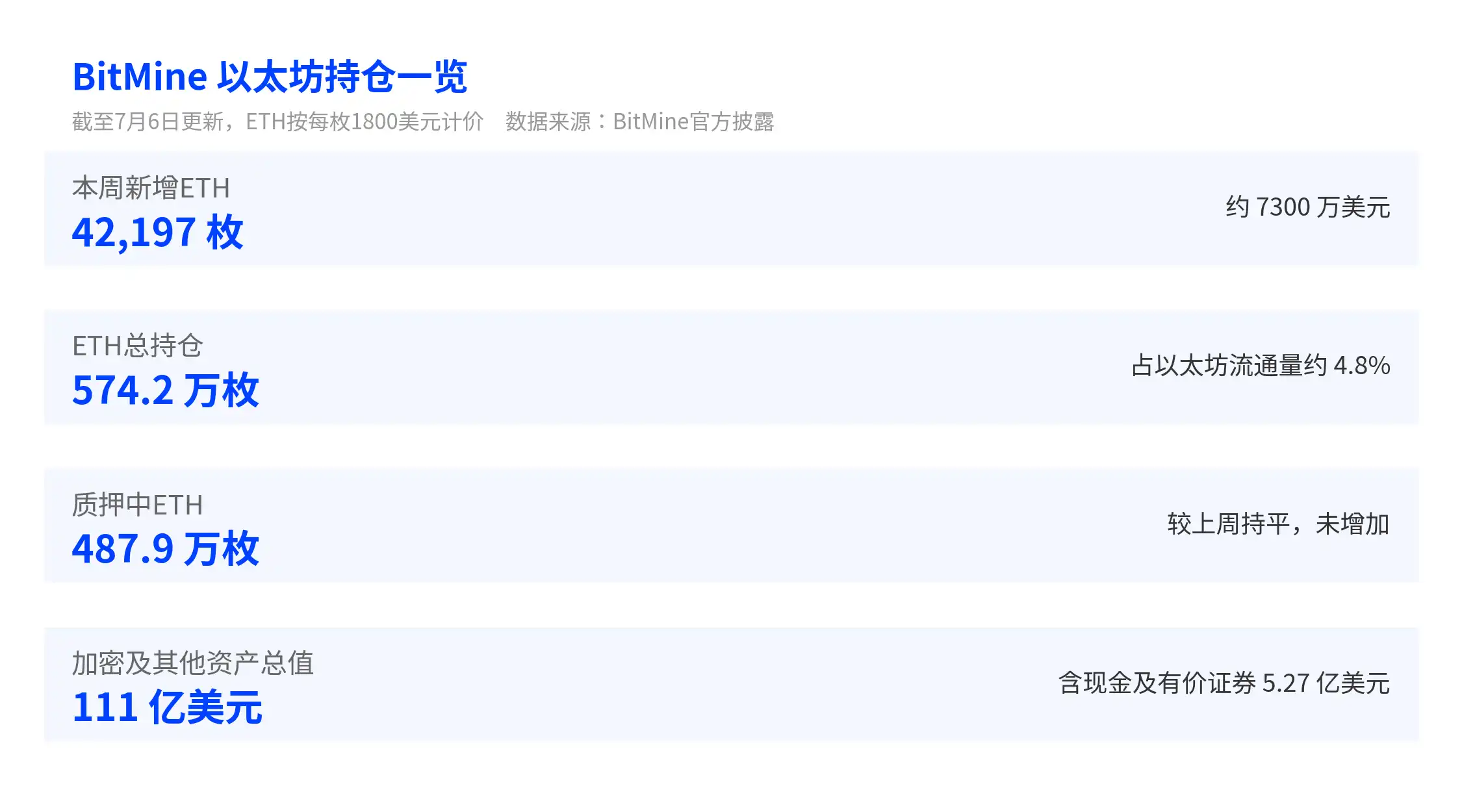
有一个细节值得持仓者留意:BitMine 的质押 ETH 数量停在 4,879,157 枚,和上一周持平,也就是说这一周新增的币没有拿去质押。这家公司公开的目标是控制以太坊总供应量的 5%,按周累积的买法正在朝这个门槛靠近。

这里要给一句风险提示:BitMine 的持仓价值高度依赖币价,其账目里 ETH 按 1800 美元计价,而截至 7 月 6 日 ETH 现货价格约为 1747 美元,已低于其计价基准。今年 6 月还有内部人士警告过该公司存在约 3000 万美元的现金缺口,Tom Lee 当时公开否认了融资危机的说法。对跟着这类财库公司做多 ETH 的人而言,公司股价和币价的双重杠杆是把双刃剑。

价格在跌,机构在买,这个背离怎么读

把两条线索拼在一起,会看到一个别扭的画面:机构在加速进场,币价却在往下走。

以太坊今年过得很难。据多家行情数据,ETH 自 2025 年 8 月约 4900 美元的历史高点已回落超过五成,2026 年前三个季度连收三根季度阴线,是有记录以来第一次出现三连阴。现货以太坊 ETF 在 6 月还录得净流出。链上活跃度也在掉,据 Glassnode 数据,活跃地址的 14 日均值从 2 月初约 79.5 万跌到 6 月的约 42 万,降幅约 46%。

所以摩根大通的基金规模、BitMine 的持仓增长,和二级市场的币价,讲的是两个不同的故事。机构买的是以太坊作为结算层和合规资产底座的长期位置,赌的是稳定币储备和代币化资产这条线;二级市场卖的是短期的流动性、情绪和 ETF 资金面。这两件事可以长期背离,谁先兑现没有定论。

对持仓或想入场的人,这里的操作含义是:机构囤币和代币化叙事是真实发生的基本面变化,但它不构成短期价格的托底。历史上大额持有者集中买入并不总是干净的买入信号,2 月那轮巨鲸增持之后就跟着一个局部顶。把机构进场当成长期逻辑可以,当成抄底时点的依据要谨慎。

Criptos en tendencia

Preguntas relacionadas

Q摩根大通的代币化基金JLTXX在过去一个月实现了多少链上管理规模增长?

A摩根大通的代币化基金JLTXX在过去一个月链上管理规模增长约250%。

Q摩根大通为什么选择将代币化基金JLTXX部署在以太坊主网上,而不是其自有网络?

A摩根大通将JLTXX部署在公开的以太坊主网上,这一选择本身被视为一个重要信号,表明以太坊正在从一个投机资产,转变为机构眼中运行合规金融产品的底层账本或结算层。

QJLTXX基金规模快速增长的一个重要原因是什么?

AJLTXX基金规模快速增长的一个重要原因是被用作稳定币的储备资产。它被加入了USDG稳定币的储备资产池,以满足如《GENIUS法案》等监管要求下的、能在链上持有的美债敞口需求。

QBitMine公司当前持有多少枚ETH,占以太坊流通量的比例是多少?

A据文章所述,BitMine公司当前持有约5,742,237枚ETH,约占以太坊流通量的4.8%,并正在向控制总供应量5%的目标靠近。

Q文章如何看待当前ETH价格下跌与机构资金(如摩根大通、BitMine)加速买入之间的背离现象?

A文章认为,机构资金(如摩根大通的代币化基金和BitMine的囤积)与ETH价格下跌的背离,源于两者投资逻辑的不同。机构看中的是以太坊作为稳定币储备和代币化资产底层结算层的长期价值,属于基本面变化;而二级市场价格则受短期流动性、市场情绪和ETF资金面等因素驱动。这种背离可能长期存在,因此机构进场可作为长期投资逻辑参考,但不宜作为短期抄底的直接依据。

Lecturas Relacionadas

Tiger Research: Three Strategies for Financial Institutions to Keep Up with the Tokenization Wave

Tiger Research's in-depth report analyzes the strategic choices for financial institutions entering the rapidly growing Real-World Asset (RWA) tokenization market. With the market projected to be worth $25-36 billion and a lack of complete regulatory frameworks in many jurisdictions, institutions face three options: waiting for domestic legislation, using regulatory sandboxes for limited experiments, or moving first into established overseas markets to gain a competitive edge. Tokenization is not magic; it requires meticulous preparation. Before entry, institutions must strategically plan across six core areas: choosing a jurisdiction, obtaining necessary licenses, defining the asset type, targeting the appropriate investor base, selecting settlement currencies, and designing operational requirements like custody and governance. The report outlines two main operational paths. The first is a direct jurisdictional path, establishing a legal presence in mature markets like Hong Kong, Singapore, or the U.S., often leveraging local licensed platforms to accelerate market entry. The second is a chain-native path, using platforms like Ondo or Plume that are built with regulatory compliance embedded, allowing for faster, more flexible market access without being tied to a specific jurisdiction. Ultimately, the report advises against waiting for perfect regulation. The preparation process can take 6-12 months and requires thorough legal review. Using the example of a mid-sized securities firm, it details steps from evaluating existing entities to final execution. The core message is that accumulating real-world operational experience is paramount, as the market is moving ahead and will not wait for latecomers.

Foresight NewsHace 20 min(s)

Tiger Research: Three Strategies for Financial Institutions to Keep Up with the Tokenization Wave

Foresight NewsHace 20 min(s)

Unitree's IPO Frenzy: The Real Mystery is How It Will Spend the 42 Billion Raised

Unitree, a Chinese robotics company, is set for a public listing after its IPO registration was approved by regulators. The company, which started with quadruped robots and has expanded into humanoids, plans to raise approximately 4.2 billion yuan through its offering. The article traces Unitree's rapid growth from its founding in 2016 to its current status. It highlights key milestones like the 2021 CCTV Spring Festival Gala performance, the 2023 launch of its affordable Go2 robot dog and the H1 humanoid robot, and a series of subsequent product launches. By 2025, the company reported revenue of 1.71 billion yuan, profitability, and sales exceeding 5,500 humanoid robots. As the first publicly-listed humanoid robot company on China's STAR Market, Unitree's main challenges are sustaining growth and deploying its newly raised capital effectively. The humanoid robot sector in China is crowded, with over 140 companies. Competitors include UBTech (focusing on industrial and consumer markets), Fourier, and international players like Tesla Optimus and 1X NEO. The article outlines three critical challenges for Unitree: establishing a strong second product line beyond its quadruped robots, maintaining its price advantage while ensuring quality, and successfully advancing its embodied AI capabilities through partnerships like the one with NVIDIA for the H2 Plus platform. Unitree's likely strategy involves a "developer tools + industry benchmarks" approach: using low-cost models like the R1 and G1 to build developer adoption and volume, leveraging high-end platforms for AI training, and securing pilot projects in sectors like logistics and manufacturing to build case studies. The company's future success hinges on converting its current momentum in shipments and pilot programs into sustainable, large-scale commercial contracts as the broader market evolves.

marsbitHace 1 hora(s)

Unitree's IPO Frenzy: The Real Mystery is How It Will Spend the 42 Billion Raised

marsbitHace 1 hora(s)

Examining the Open USD Partner Lineup: Follow Who's Joining to See Where the Money Flows

**Title: Deciphering the Open USD Partner Roster: Following the Money** The launch of Open USD is notable less for the stablecoin itself and more for its expansive list of over 140 founding partners, which reads like a "who's who" of global finance and tech. This coalition, including asset managers like BlackRock, card networks Visa and Mastercard, banks (BNY Mellon, Standard Chartered, etc.), tech giants (Google, IBM), merchants (Shopify), and crypto firms (Coinbase, Ripple, Aave, MetaMask), signals a strategic shift. The diverse membership reveals that stablecoins are increasingly viewed not as products to compete over, but as shared infrastructure too critical to be left to any single entity. Each partner category has distinct motives. Asset managers like BlackRock seek to manage the large, sticky cash reserves, a lucrative fee-generating opportunity. Merchants like Shopify aim for lower-cost settlement and potential yield on balances. Banks join defensively to retain custody and settlement roles, fearing deposit outflows to stablecoins. Tech companies bet on programmable money for future machine-to-machine commerce. Crypto firms gain mainstream legitimacy and distribution channels. Remarkably, the consortium includes direct competitors (Visa vs. Mastercard, Coinbase vs. Ripple), indicating that the fear of exclusion from this emerging financial layer outweighs competitive rivalries. However, this shared governance could also lead to slow decision-making. The roster's composition is the real message: it represents a collective bet that a widely accepted, consortium-owned stablecoin is preferable to proprietary versions or having none at all. For incumbents like Circle and Tether, this alliance poses a significant threat, as potential clients have collectively chosen to build their own alternative. The absence of major U.S. retail banks (busy with their own tokenized deposit networks) is equally telling. In essence, the partner list maps where the industry believes value and risk will flow in a tokenized dollar future, marking stablecoin's evolution from a product to a utility.

Foresight NewsHace 2 hora(s)

Examining the Open USD Partner Lineup: Follow Who's Joining to See Where the Money Flows

Foresight NewsHace 2 hora(s)

Trading

Spot

Artículos destacados

Cómo comprar LAYER

¡Bienvenido a HTX.com! Hemos hecho que comprar Solayer (LAYER) sea simple y conveniente. Sigue nuestra guía paso a paso para iniciar tu viaje de criptos.Paso 1: crea tu cuenta HTXUtiliza tu correo electrónico o número de teléfono para registrarte y obtener una cuenta gratuita en HTX. Experimenta un proceso de registro sin complicaciones y desbloquea todas las funciones.Obtener mi cuentaPaso 2: ve a Comprar cripto y elige tu método de pagoTarjeta de crédito/débito: usa tu Visa o Mastercard para comprar Solayer (LAYER) al instante.Saldo: utiliza fondos del saldo de tu cuenta HTX para tradear sin problemas.Terceros: hemos agregado métodos de pago populares como Google Pay y Apple Pay para mejorar la comodidad.P2P: tradear directamente con otros usuarios en HTX.Over-the-Counter (OTC): ofrecemos servicios personalizados y tipos de cambio competitivos para los traders.Paso 3: guarda tu Solayer (LAYER)Después de comprar tu Solayer (LAYER), guárdalo en tu cuenta HTX. Alternativamente, puedes enviarlo a otro lugar mediante transferencia blockchain o utilizarlo para tradear otras criptomonedas.Paso 4: tradear Solayer (LAYER)Tradear fácilmente con Solayer (LAYER) en HTX's mercado spot. Simplemente accede a tu cuenta, selecciona tu par de trading, ejecuta tus trades y monitorea en tiempo real. Ofrecemos una experiencia fácil de usar tanto para principiantes como para traders experimentados.

303 Vistas totalesPublicado en 2025.02.11Actualizado en 2026.06.02

Cómo comprar LAYER

Discusiones

Bienvenido a la comunidad de HTX. Aquí puedes mantenerte informado sobre los últimos desarrollos de la plataforma y acceder a análisis profesionales del mercado. A continuación se presentan las opiniones de los usuarios sobre el precio de LAYER (LAYER).

活动图片