Giải mã báo cáo Goldman Sachs: Circle và USDC đang vượt ra khỏi thế giới tiền điện tử, thanh toán xuyên biên giới và AI Agent trở thành chiến trường mới

marsbitPublicado a 2026-07-07Actualizado a 2026-07-07

Resumen

Báo cáo phân tích của Goldman Sachs: Circle và USDC đang vươn ra ngoài thế giới tiền mã hóa, thanh toán xuyên biên giới và AI Agent thành mặt trận mới. Ngày 5/7, Goldman Sachs công bố biên bản cuộc họp với ban lãnh đạo Circle Internet Group (CRCL.US). Thông điệp chính là stablecoin đang chuyển từ công cụ ngoại vi của crypto thành cơ sở hạ tầng cho tài chính truyền thống và nền kinh tế AI. Các trường hợp sử dụng USDC đang mở rộng nhanh chóng, từ giao dịch crypto sang thanh toán xuyên biên giới, thương mại điện tử tiêu dùng, thanh toán thị trường vốn, và thậm chí là thanh toán cho AI Agent. Circle nhấn mạnh sự tăng trưởng của stablecoin đã tách khỏi chu kỳ thị trường crypto, nhờ vào sự đa dạng hóa các trường hợp sử dụng, bao gồm: (1) hệ sinh thái crypto, (2) thanh toán xuyên biên giới & quản lý ngân quỹ, (3) thương mại điện tử tiêu dùng, (4) thị trường vốn (làm tài sản thế chấp, thanh toán), và (5) thanh toán cho AI Agent (ví dụ: chiếm ~99% giao dịch trên giao thức x402). Lợi thế cạnh tranh chính của USDC là hiệu ứng mạng lưới từ hệ thống phân phối rộng, tính thanh khoản toàn cầu sâu và cơ sở hạ tầng tuân thủ quy định. Circle phân biệt USDC với tiền gửi được mã hóa (tokenized deposit), coi stablecoin là hệ thống mở, không có rủi ro tín dụng ngân hàng. Ba sản phẩm chiến lược của Circle nhằm biến stablecoin thành hệ điều hành tài chính: Arc (L1 blockchain), Circle Payments Network (thanh toán xuyên biên giới) và Agentic Stack (dành cho AI Agent). Circle coi quy định là chất ...

Tác giả: Rita

Hướng dẫn của Tides

Vào ngày 5 tháng 7, Goldman Sachs đã công bố biên bản cuộc họp với Ban lãnh đạo của Circle Internet Group (CRCL.US). Circle là tổ chức phát hành USDC, và thông tin cốt lõi từ cuộc họp này là: stablecoin đang từ một công cụ ngoại vi của thế giới tiền điện tử, trở thành cơ sở hạ tầng cho tài chính truyền thống và nền kinh tế AI. Các trường hợp sử dụng USDC đang mở rộng nhanh chóng, từ giao dịch tiền điện tử sang thanh toán xuyên biên giới, thương mại điện tử tiêu dùng, thanh toán thị trường vốn, và thậm chí là thanh toán cho AI Agent. Goldman Sachs xếp hạng Circle là Trung lập, với mục tiêu giá 96 USD, trong khi giá hiện tại là 64,62 USD, tương ứng với tiềm năng tăng trưởng khoảng 48,6%.

Sự tăng trưởng của Stablecoin đã thoát khỏi chu kỳ thị trường tiền điện tử

Ban lãnh đạo Circle nhiều lần nhấn mạnh một nhận định trong cuộc họp: sự tăng trưởng của stablecoin đã tách biệt với sự lên xuống của thị trường tiền điện tử. Trong vài quý gần đây, khối lượng giao dịch và giá cả trên thị trường tiền điện tử đang đi xuống, nhưng vốn hóa thị trường và khối lượng giao dịch của stablecoin vẫn tiếp tục tăng.

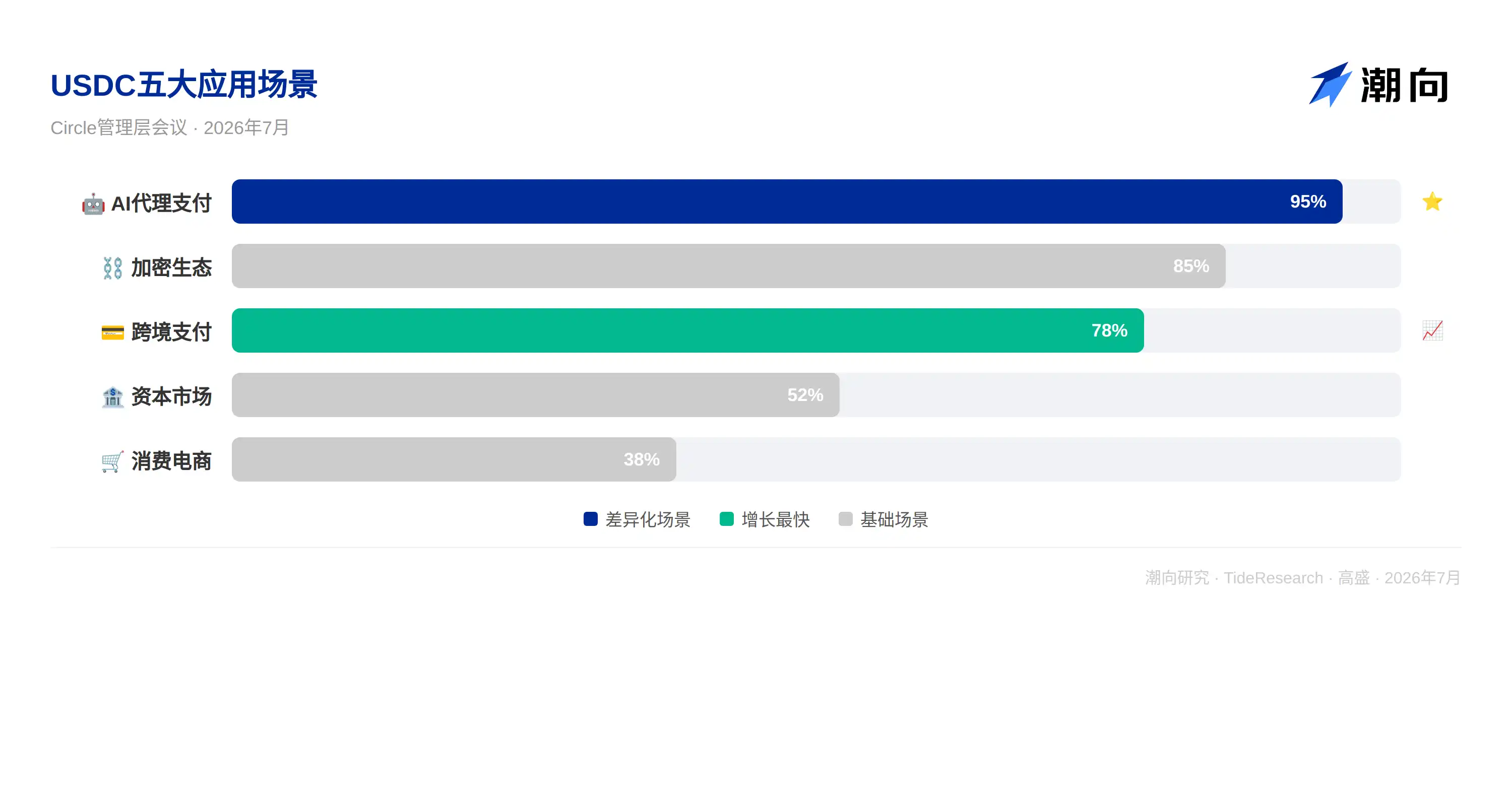
Nguyên nhân nằm ở sự đa dạng hóa các trường hợp sử dụng. Circle chia các kịch bản ứng dụng của USDC thành năm cấp độ, bao phủ toàn bộ quang phổ từ hệ sinh thái tiền điện tử đến thanh toán cho AI Agent.

Hệ sinh thái tiền điện tử là nền tảng cơ bản của USDC, hợp tác với các nền tảng tăng trưởng nhanh như Hyperliquid để liên tục mở rộng tính thanh khoản.

Thanh toán xuyên biên giới và quản lý ngân quỹ hiện là phân khúc tăng trưởng nhanh nhất. Khả năng thanh toán tức thì và chi phí giao dịch cực thấp của USDC đang thay đổi quy trình thanh toán xuyên biên giới truyền thống theo hình thức song phương. Circle đề cập rằng nhu cầu về stablecoin đô la Mỹ tại các thị trường mới nổi đặc biệt mạnh, đây là một xu hướng "số hóa đồng đô la", khi người dân sử dụng USDC để thay thế tiền tệ địa phương hoặc hệ thống ngân hàng không đáng tin cậy.

Trường hợp sử dụng trong thương mại điện tử tiêu dùng cũng bắt đầu hình thành. Các nền tảng thương mại điện tử chủ đạo như Stripe và Shopify đã bắt đầu hỗ trợ thanh toán bằng USDC, người dùng có thể chọn thanh toán trực tiếp bằng USDC khi kết thúc đơn hàng. Thẻ tín dụng liên kết với stablecoin cũng đang nổi lên, cho phép người dùng nắm giữ và chi tiêu stablecoin.

Đột phá trong thị trường vốn càng quan trọng hơn. Circle nhìn thấy tiềm năng của USDC với tư cách là tài sản thế chấp cho phái sinh và tiền tệ thanh toán. Gần đây, CFTC đã phê duyệt cho các nhà môi giới hợp đồng tương lai coi các stablecoin cụ thể là tài sản thế chấp có thể chuyển đổi ngay lập tức, đây là một chất xúc tác quan trọng về mặt thể chế. Việc mã hóa tài sản thế giới thực cũng đang mở rộng phạm vi ứng dụng của USDC, stablecoin là công cụ thanh toán tiền mặt tự nhiên cho các giao dịch trên chuỗi.

Và kịch bản khác biệt nhất mà Circle nhấn mạnh là thanh toán cho AI Agent. Các AI Agent đang tự chủ thực hiện các hoạt động kinh tế, x402 hiện là giao thức thanh toán cho Agent hàng đầu, với USDC chiếm khoảng 99% tổng số giao dịch trên giao thức này. AI Agent yêu cầu thanh toán nguyên tử và chi phí giao dịch cực thấp, stablecoin là công cụ thanh toán phù hợp nhất.
Rào cản cạnh tranh của USDC là hiệu ứng mạng

Ban lãnh đạo cho rằng, stablecoin là một doanh nghiệp điển hình dựa trên hiệu ứng mạng. Mạng lưới của USDC là cơ sở hạ tầng tài chính internet công khai, bất kỳ ai cũng có thể kết nối, cá nhân, doanh nghiệp, nhà phát triển đều có thể sử dụng.

Circle liệt kê ba lợi thế cạnh tranh chính của USDC.
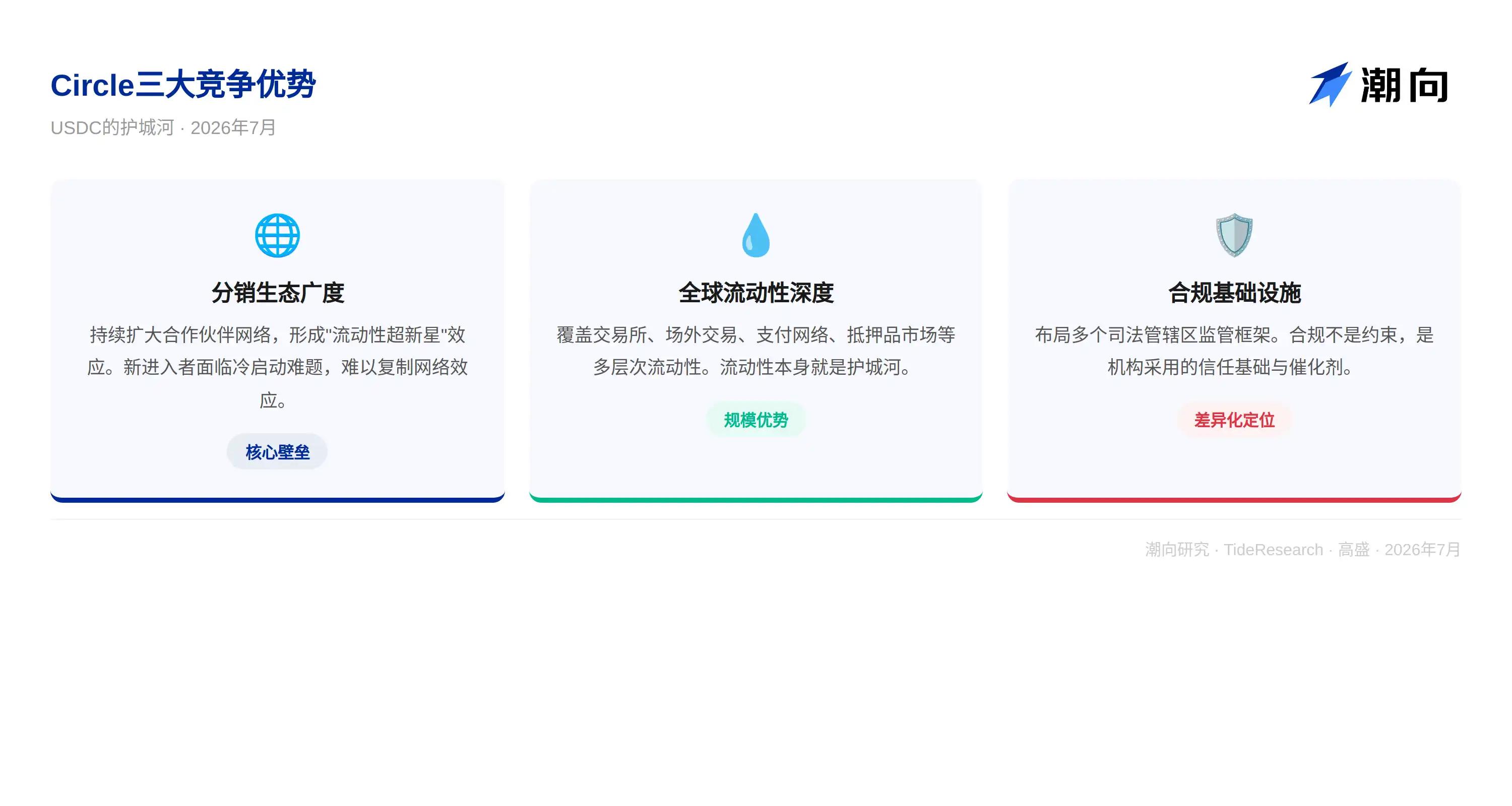
Thứ nhất là phạm vi phân phối và hệ sinh thái nền tảng. USDC tăng cường tính thanh khoản thông qua việc liên tục bổ sung các đối tác, tạo ra hiệu ứng "siêu tân tinh thanh khoản". Các stablecoin mới gia nhập khó có thể sao chép hiệu ứng mạng này vì vấn đề khởi động lạnh: không có thanh khoản thì không có người dùng, không có người dùng thì không có thanh khoản.

Thứ hai là độ sâu thanh khoản toàn cầu. USDC có tính thanh khoản sâu rộng trên các sàn giao dịch, thị trường giao dịch OTC, mạng lưới thanh toán và thị trường tài sản thế chấp, bản thân độ sâu này đã là một hào rào bảo vệ.

Thứ ba là cơ sở hạ tầng tuân thủ quy định. USDC có bố trí quản lý tại nhiều khu vực pháp lý, ban lãnh đạo cho rằng đây chính là động lực then chốt cho việc các tổ chức áp dụng, chứ không phải là một ràng buộc.

Về cạnh tranh, Circle phân biệt hai loại đối thủ. Một là tiền gửi được mã hóa (tokenized deposits), là chứng chỉ tiền gửi kỹ thuật số do ngân hàng phát hành. Circle cho rằng stablecoin có lợi thế hơn tiền gửi được mã hóa vì stablecoin là mở, có thể tương tác, không có rủi ro tín dụng ngân hàng, và được đảm bảo toàn bộ bằng dự trữ. Loại đối thủ khác là các đối thủ stablecoin mới, Circle dự đoán sẽ có nhiều stablecoin mới xuất hiện, nhưng chúng thiếu hiệu ứng mạng mà Circle đã tích lũy trong hơn một thập kỷ qua.

Sự khác biệt giữa Tiền gửi được mã hóa và Stablecoin là có tính cấu trúc

Circle cho rằng sự khác biệt giữa stablecoin và tiền gửi được mã hóa là có tính cấu trúc, không chỉ là vấn đề ai có trước ai có sau.

Stablecoin là một hệ thống tài chính internet công khai, mở, bất kỳ ai cũng có thể kết nối, tính thanh khoản có thể tự do di chuyển xuyên suốt các nền tảng. Trong khi đó, tiền gửi được mã hóa giống như một phần mở rộng của hệ thống ngân hàng, vẫn bị giới hạn trong hệ sinh thái của một ngân hàng riêng lẻ hoặc một liên minh. Đây là hai kiến trúc hoàn toàn khác nhau: stablecoin là bản địa của internet, còn tiền gửi được mã hóa là bản nâng cấp kỹ thuật số của hệ thống ngân hàng.

Một điểm khác biệt then chốt khác là rủi ro tín dụng. Stablecoin là tiền mặt kỹ thuật số được đảm bảo toàn bộ bằng dự trữ, không có rủi ro tín dụng. Tiền gửi được mã hóa về bản chất là nghĩa vụ nợ của ngân hàng, mang theo rủi ro tín dụng ngân hàng. Theo quan điểm của Circle, sự khác biệt này là căn bản.

Ba sản phẩm chiến lược của Circle, mục tiêu biến stablecoin thành hệ điều hành

Circle không chỉ là một tổ chức phát hành stablecoin, họ đang tự định vị mình là một nền tảng tài chính internet. Ban lãnh đạo đã nhấn mạnh ba sản phẩm chiến lược trong cuộc họp.

Arc là blockchain lớp 1 (Layer 1) do Circle tự nghiên cứu phát triển, được định vị là một hệ điều hành tài chính tổng hợp, với mục tiêu nâng cao tính thanh khoản và khả năng tương tác, đặc biệt thu hút các tổ chức tài chính truyền thống.

Circle Payments Network (CPN) là sản phẩm thanh toán xuyên biên giới, thực hiện thanh toán xuyên biên giới nhanh hơn và hiệu quả hơn thông qua việc thanh toán trên blockchain, tỷ lệ chấp nhận của các tổ chức đang tăng.

Agentic Stack là dòng sản phẩm hướng đến AI Agent, mục tiêu duy trì thị phần thống trị của USDC trong các hoạt động kinh tế liên quan đến AI. Xét rằng USDC đã chiếm khoảng 99% khối lượng giao dịch trên giao thức x402, lợi thế tiên phong trong lĩnh vực này là rõ ràng.

Quy định là chất xúc tác, không phải ràng buộc

Thị trường luôn lo ngại rằng quy định về stablecoin sẽ hạn chế mô hình kinh doanh của Circle, nhưng ban lãnh đạo Circle đã đưa ra một cách diễn giải hoàn toàn trái ngược. Nếu Đạo luật Cấu trúc Thị trường CLARITY được thông qua, Circle cho rằng điều này sẽ là chất xúc tác cho sự tăng trưởng của USDC, chứ không trở thành ràng buộc kinh doanh. Lý do có ba điểm: Đạo luật cho phép tổ chức phát hành tiếp tục khuyến khích phân phối thông qua chia sẻ doanh thu, Circle có thể tiếp tục mở rộng đối tác; Đạo luật có thể mở khóa việc áp dụng tiền điện tử ở cấp độ tổ chức, mang lại khối lượng sử dụng stablecoin lớn hơn; Đạo luật khuyến khích cơ chế thưởng dựa trên sử dụng, thay vì nắm giữ thụ động, điều này sẽ thúc đẩy việc sử dụng USDC một cách tích cực, giảm bớt tình trạng tích trữ nhàn rỗi.

Góc nhìn Tides

Goldman Sachs xếp hạng Circle là Trung lập, nhưng chính bản biên bản này đã nói lên nhiều điều. Circle đang mở rộng USDC từ một công cụ giao dịch tiền điện tử thành cơ sở hạ tầng tài chính internet, và hướng đi này là đúng đắn.

Điều đáng đặt câu hỏi là, hào rào bảo vệ của Circle sâu đến mức nào? Hiệu ứng mạng thực sự tồn tại, nhưng đối thủ cạnh tranh lớn nhất của USDC là USDT vẫn dẫn đầu về vốn hóa stablecoin. Lợi thế tuân thủ quy định mà Circle dựa vào, trong mắt những người theo chủ nghĩa thuần túy tiền điện tử, lại chính là điểm yếu: minh bạch có nghĩa là có thể bị giám sát, có thể bị giám sát có nghĩa là có thể bị đóng băng. Định vị thiên về tổ chức của USDC là một con dao hai lưỡi.

Một điểm đáng lưu ý khác là khuôn khổ định giá của Goldman Sachs. Mục tiêu giá 96 USD tương ứng với tỷ lệ P/E 35 lần, nhưng khả năng sinh lời hiện tại của Circle phụ thuộc nhiều vào thu nhập lãi từ tài sản dự trữ. Nếu lãi suất giảm, lợi nhuận của Circle sẽ chịu áp lực trực tiếp, rủi ro này trong biên bản chỉ được đề cập nhẹ nhàng, nhưng tác động thực tế của nó đến định giá còn lớn hơn cả quy định.
Từ chối trách nhiệm

Bài viết này là bản tổng hợp và giải thích của Tides Research về báo cáo nghiên cứu của bên thứ ba (công ty chứng khoán). Các xếp hạng, mục tiêu giá, dự báo lợi nhuận và nhận định liên quan được trích dẫn trong bài đều là quan điểm của nhà phân tích công ty chứng khoán đó, chỉ đại diện cho lập trường của tổ chức mà họ thuộc về, không đại diện cho quan điểm của Tides Research và cũng không cấu thành bất kỳ đề xuất đầu tư nào.

Thị trường có rủi ro, quyết định cần độc lập. Bài viết này không nên được sử dụng làm cơ sở để mua bán bất kỳ chứng khoán nào.

Criptos en tendencia

Preguntas relacionadas

QBáo cáo của Goldman Sachs về Circle Internet Group và USDC nhấn mạnh xu hướng chính nào?

ABáo cáo nhấn mạnh rằng stablecoin, đặc biệt là USDC, đang chuyển đổi từ một công cụ biên trong thế giới tiền mã hóa trở thành cơ sở hạ tầng cho tài chính truyền thống và nền kinh tế AI. Các trường hợp sử dụng của USDC đang mở rộng nhanh chóng sang thanh toán xuyên biên giới, thương mại điện tử tiêu dùng, giải ngân thị trường vốn và thanh toán cho đại lý AI.

QTại sao tăng trưởng stablecoin hiện nay được cho là đã tách khỏi chu kỳ thị trường tiền mã hóa?

AVì trong khi khối lượng giao dịch và giá cả thị trường tiền mã hóa giảm trong vài quý gần đây, tổng vốn hóa thị trường và khối lượng giao dịch của stablecoin vẫn tiếp tục tăng. Điều này được thúc đẩy bởi sự đa dạng hóa các trường hợp sử dụng, vượt ra ngoài giao dịch tiền mã hóa để đi vào các ứng dụng tài chính thực tế như thanh toán xuyên biên giới, thương mại điện tử và giải ngân tài sản thế giới thực.

QCircle liệt kê ba lợi thế cạnh tranh chính của USDC là gì?

ABa lợi thế cạnh tranh chính của USDC là: 1) Tính rộng lớn của hệ sinh thái phân phối và nền tảng, tạo ra hiệu ứng 'Siêu tân tinh thanh khoản' và hiệu ứng mạng. 2) Độ sâu thanh khoản toàn cầu trên các sàn giao dịch, thị trường OTC, mạng thanh toán và thị trường tài sản thế chấp. 3) Cơ sở hạ tầng tuân thủ quy định mạnh mẽ tại nhiều khu vực pháp lý, điều mà Circle tin rằng là chất xúc tác cho việc áp dụng của các tổ chức.

QSự khác biệt cấu trúc giữa stablecoin (như USDC) và tiền gửi được mã hóa (tokenized deposit) là gì?

ASự khác biệt cấu trúc chính là: 1) Stablecoin là một hệ thống tài chính internet công khai, mở, nơi bất kỳ ai cũng có thể truy cập và thanh khoản có thể tự do di chuyển giữa các nền tảng. Trong khi đó, tiền gửi được mã hóa là phần mở rộng của hệ thống ngân hàng, thường bị giới hạn trong một ngân hàng hoặc liên minh cụ thể. 2) Stablecoin được hậu thuẫn hoàn toàn bằng dự trữ, không có rủi ro tín dụng, trong khi tiền gửi được mã hóa là nghĩa vụ của ngân hàng và mang rủi ro tín dụng của ngân hàng đó.

QTheo bài viết, cách tiếp cận của Circle đối với quy định (regulatory landscape) như thế nào?

ACircle xem quy định là chất xúc tác cho sự tăng trưởng chứ không phải ràng buộc. Công ty tin rằng các đạo luật như CLARITY Act, nếu được thông qua, sẽ thúc đẩy tăng trưởng cho USDC bằng cách: cho phép chia sẻ doanh thu để khuyến khích phân phối, mở khóa việc áp dụng tiền mã hóa ở cấp độ tổ chức nhiều hơn, và khuyến khích các cơ chế phần thưởng dựa trên việc sử dụng thực tế thay vì chỉ nắm giữ thụ động.

Lecturas Relacionadas

After Three Consecutive Quarters of Decline, Can the Crypto Market Find a Window for Stabilization in Q3?

The cryptocurrency market has just concluded its worst-performing quarter since 2022, with total capitalization dropping 12.6% to $2.1 trillion. All core metrics indicate capital is leaving the sector, not just rotating within it. Bitcoin fell 14.2% and Ethereum dropped 25.4% in Q2, breaking their previous correlation with US tech stocks. A key driver is the reversal in US spot Bitcoin ETF flows, which saw a net outflow of approximately $4.67 billion in Q2, including a record monthly outflow near $4.5 billion in June. While recent data suggests long-term holders are accumulating again, sustained ETF outflows mean continued selling pressure. Market focus is now singularly on the Federal Reserve. The upcoming July FOMC meeting is seen as the most critical event for Q3. A dovish signal could support Bitcoin reclaiming a $68,000-$84,000 range, while a hawkish stance might establish a new trading band around $50,000-$56,000. Additionally, regulatory uncertainty persists, with the progress of the crucial *CLARITY Act* stalling in the Senate, reducing its perceived 2026 passage probability to 40-45%. Despite the broad downturn, a few sectors showed growth. Prediction markets saw nominal volume surge 48.7% year-over-year to $113.8 billion, and tokenized collectibles transaction volume rose 143% quarterly to $1.4 billion. The Real-World Asset (RWA) tokenization sector also continued steady growth, now representing ~$28.1 billion in on-chain value. The market's foundation for an extreme crash appears limited, with Bitcoin price hovering near its 200-week moving average. However, the trading paradigm has shifted from narrative-driven speculation to decisions based on price action, policy developments, and interest rate expectations, making a broad sentiment-driven rally unlikely in the near term.

marsbitAyer 08:36

After Three Consecutive Quarters of Decline, Can the Crypto Market Find a Window for Stabilization in Q3?

marsbitAyer 08:36

BIT Trading Moment: BTC Still Suppressed by Weekly 200 EMA, Rejection May Restart Decline; Storage and Semiconductors that Surged Last Night Begin Falling in Evening Trading

**Crypto & Stock Market Wrap: Bitcoin Tests Resistance, Stocks Retreat After AI Surge** Bitcoin consolidates around $66,000, facing key resistance near $68,000—an area seen as a major psychological and technical hurdle where previous rallies have failed. Analysts note the cryptocurrency is caught between its 200-week moving average (~$63,333) and 200-week EMA (~$68,328). A clear break above $68k is needed to signal a stronger bullish trend, while a rejection could lead to a retest of $63k support. Market sentiment remains cautious, with low futures open interest pointing to a low-liquidity rebound rather than a full bull market. Bitcoin spot ETFs saw another $203 million inflow. US stock futures pointed lower after a strong Tuesday session led by a massive rebound in semiconductors and memory stocks. The rally was fueled by renewed optimism about AI-driven hardware demand, with Micron, SanDisk, and SK Hynix surging. However, those gains reversed in pre-market trading. Super Micro Computer (SMCI) soared over 20% after hours on strong guidance and a record backlog. Other standouts included Rocket Lab and nuclear energy plays Oklo and X-Energy. Rising oil prices (Brent above $91) and climbing Treasury yields (10-year near 4.64%), however, are reigniting inflation concerns and acting as a headwind for equities. In Asia, markets were mixed. South Korea's KOSPI pared early gains to close slightly higher as semiconductor stocks like SK Hynix gave back initial surges. Japan's Nikkei edged lower as the yen hit a fresh 38-year low against the dollar, raising fears of potential market intervention. Key events to watch include the Samsung Galaxy launch, AMD's AI event, and a slew of major tech earnings from Alphabet, Tesla, and IBM after the close on Wednesday, followed by the ECB meeting and Intel's earnings on Thursday.

marsbitAyer 08:28

BIT Trading Moment: BTC Still Suppressed by Weekly 200 EMA, Rejection May Restart Decline; Storage and Semiconductors that Surged Last Night Begin Falling in Evening Trading

marsbitAyer 08:28

Former CFTC Chairman, Circle President Tarbert: Preaching Long-Termism While Cashing Out $30 Million Himself

Former CFTC Chairman and Circle President Heath Tarbert has consistently advocated for a long-term vision in public, urging patience from investors as Circle’s stock price has fallen significantly from its peak. However, it has been revealed that since Circle’s IPO, Tarbert has continuously sold his CRCL shares through pre-arranged trading plans, cashing out approximately $30 million, without making any public market purchases. This contrast between his public messaging and personal actions has drawn criticism. Tarbert joined Circle in July 2023 as Chief Legal Officer, leveraging his regulatory experience to help guide the company through its IPO and expansion. Despite promoting stablecoins as long-term infrastructure, he established a 10b5-1 trading plan just before Circle went public, leading to substantial stock sales over the following year. In March 2026, he initiated another plan to sell more shares. His career trajectory highlights a pattern of moving between high-level regulatory roles and influential positions in the financial sector. After resigning as CFTC Chairman in early 2021, he joined Citadel Securities as Chief Legal Officer just 27 days later, during a period of intense regulatory scrutiny for the firm. He later joined Circle, aiding its efforts to navigate regulatory challenges for its public listing. While Tarbert's expertise in policy and compliance is valuable to companies like Circle, his actions—advocating long-term confidence while personally divesting—raise questions about the alignment between his public statements and his private financial decisions, leaving investors who followed his advice to bear the market risks.

marsbitAyer 08:06

Former CFTC Chairman, Circle President Tarbert: Preaching Long-Termism While Cashing Out $30 Million Himself

marsbitAyer 08:06

Gate Research Institute: The 'Wall Street-ization' Wave of Crypto Financial Products – Competition or Integration?

The article titled "Gate Research Institute: Are Crypto Financial Products Sparking a 'Wall Street' Wave—Competition or Convergence?" explores the evolving relationship between the crypto ecosystem and traditional finance (TradFi). The piece begins by reflecting on Bitcoin's original 2009 vision of decentralization, disintermediation, and moving away from banks. It then contrasts this with the 2024 landscape, where key crypto assets like Bitcoin are increasingly held through Wall Street products like ETFs issued by giants like BlackRock. The article questions whether this signifies that TradFi is systematically taking over the rights to issue, price, custody, and distribute crypto financial assets. The core argument is that this is not a zero-sum takeover but rather a bidirectional convergence where each side addresses the other's weaknesses. Crypto offers 24/7 global markets, programmable settlement, and open access but lacks compliant channels, institutional-grade custody, deep fiat liquidity, and mainstream distribution. TradFi possesses these but is constrained by legacy systems, limited operating hours, and slow settlement. Two primary convergence paths are highlighted: * **Path A (CEX to TradFi):** Exemplified by Gate, which has progressed from offering tokenized stocks and CFDs to providing direct, real stock trading (US, Hong Kong, South Korea) within its platform, using USDT. * **Path B (TradFi to Crypto):** Exemplified by Robinhood, which has integrated crypto trading, acquired exchanges like Bitstamp, and is moving traditional assets like stocks onto the blockchain via tokenization and its own Layer 2. Both paths are ultimately competing to become the next-generation, unified financial account—a "super account" where users can seamlessly trade cryptocurrencies, stocks, ETFs, RWA (Real World Assets), and tokenized treasury products in one interface. The growth of RWA and tokenized treasuries (e.g., BlackRock's BUIDL) is presented as the asset-layer fusion, providing stable, yield-bearing assets on-chain and acting as a bridge between the two worlds. In conclusion, the "Wall Street-ization" of crypto is framed as a mutual transformation. Decentralized ideals persist in the protocol layer, while at the application layer, a more efficient, global, and accessible unified capital market is emerging from this convergence. The future competition lies not between crypto exchanges and stockbrokers, but between platforms vying to offer the most comprehensive asset coverage, liquidity, and user experience within a single account.

marsbitAyer 08:01

Gate Research Institute: The 'Wall Street-ization' Wave of Crypto Financial Products – Competition or Integration?

marsbitAyer 08:01

Trading

Spot

Artículos destacados

Qué es USDC(WORMHOLE)

USD Coin (Wormhole): Un Resumen Completo Introducción En el mundo en rápida evolución de las criptomonedas, USD Coin (Wormhole), conocido como $USDC(Wormhole), se destaca como una solución pionera dentro del paisaje de las finanzas descentralizadas (DeFi). Operando en varias plataformas blockchain, incluido Solana, USD Coin (Wormhole) es más que solo una representación digital del dólar estadounidense. Encapsula el espíritu innovador de las finanzas modernas, habilitando transacciones cruzadas sin problemas y mejorando la interoperabilidad entre diversos ecosistemas blockchain a través del avanzado protocolo Wormhole. ¿Qué es USD Coin (Wormhole)? USD Coin (Wormhole) es una versión tokenizada del dólar estadounidense diseñada para facilitar transacciones sin fricciones a través de diferentes redes blockchain. Su objetivo principal es aumentar la liquidez y mejorar la funcionalidad del ecosistema DeFi. Al aprovechar el protocolo Wormhole, que establece una robusta red de comunicación entre cadenas, los usuarios pueden transferir tokens USDC sin esfuerzo a través de varias plataformas. Esta capacidad entre cadenas marca un avance significativo en el uso de criptomonedas, promoviendo un ecosistema más interconectado y eficiente donde los activos pueden fluir libremente entre diferentes blockchains. La propuesta de valor de USD Coin (Wormhole) radica no solo en su estabilidad, al estar vinculado al dólar estadounidense, sino también en su capacidad para conectar ambientes blockchain dispares. Este enfoque innovador fomenta un mayor nivel de participación entre usuarios y desarrolladores, allanando el camino para nuevas y emocionantes aplicaciones dentro de las finanzas descentralizadas. ¿Quién es el creador de USD Coin (Wormhole)? Los orígenes de USD Coin (Wormhole) están intrínsecamente ligados a la red Wormhole, que fue desarrollada por Jump Crypto. Si bien no se documentan de manera prominente creadores individuales específicos, Jump Crypto es notable por su participación en el avance de la tecnología blockchain y en el apoyo de sus aplicaciones en finanzas. Al crear la red Wormhole, Jump Crypto ha desempeñado un papel vital en la promoción de transferencias de activos inter cadenas, mejorando la eficiencia y diversidad en el uso de criptomonedas. ¿Quiénes son los inversores de USD Coin (Wormhole)? El éxito de USD Coin (Wormhole) cuenta con el apoyo de inversiones de varios fondos y organizaciones notables dentro del ámbito de las criptomonedas. Los inversores clave incluyen: Coinbase Ventures: Un prominente brazo de capital de riesgo respaldado por uno de los intercambios de criptomonedas líderes en la industria, Coinbase Ventures proporciona capital esencial y apoyo estratégico a proyectos blockchain prometedores. Arrington XRP Capital: Especializándose en activos digitales, Arrington XRP Capital reconoce el potencial de proyectos innovadores como USD Coin (Wormhole) y ha invertido en consecuencia para respaldar su desarrollo. Jump Trading: Como la organización matriz de Jump Crypto, Jump Trading aporta no solo inversión, sino también una gran experiencia en tecnología de trading y dinámicas de mercado para fortalecer el proyecto Wormhole. ¿Cómo funciona USD Coin (Wormhole)? El marco operativo de USD Coin (Wormhole) está intrincadamente diseñado para facilitar transacciones efectivas entre cadenas, maximizando la seguridad y eficiencia. Aquí hay un resumen simplificado de cómo funciona: Bloqueo de Activos: Cuando un usuario desea transferir USDC de una blockchain a otra, primero bloquea sus tokens en la blockchain de origen. Este proceso asegura que los activos estén seguros y se preparen para ser quemados o movidos más tarde. Acabado de Tokens: Después de que los tokens se bloquean, se acuña una cantidad equivalente de USDC en la blockchain de destino. Esto proporciona al usuario acceso a sus fondos en una nueva plataforma, reflejando la flexibilidad que permite el protocolo Wormhole. Transferencia entre Cadenas: El protocolo Wormhole facilita eficientemente todo el proceso de transferencia. Asegura que, una vez que se acuñan los USDC en la cadena de destino, los tokens equivalentes se quemen en la cadena de origen. El resultado es una transferencia fluida de valor entre dos entornos blockchain distintos. Esta metodología entre cadenas asegura que las transacciones permanezcan seguras y transparentes, mejorando significativamente la liquidez dentro de los diferentes ecosistemas DeFi. Línea de Tiempo de USD Coin (Wormhole) Comprender la evolución de USD Coin (Wormhole) proporciona un contexto vital para su importancia en el ámbito de las criptomonedas. Aquí hay una línea de tiempo que destaca hitos importantes en la historia del proyecto: 2021: Se lanza el proyecto Wormhole, estableciendo un marco para las transferencias de activos entre cadenas y sentando las bases para el desarrollo de USD Coin (Wormhole). 2022: La red Wormhole experimenta un desafío significativo con una violación de seguridad que resulta en un robo de $325 millones. Sin embargo, el incidente es posteriormente abordado y reembolsado por Jump Crypto, mostrando el compromiso del proyecto con la seguridad y la transparencia. 2023: USD Coin (Wormhole) se integra con el Protocolo de Transferencia entre Cadenas de Circle (CCTP), mejorando sus capacidades para transferencias entre cadenas y solidificando aún más su lugar dentro del ecosistema DeFi. 2024: El desarrollo y expansión continuos de la red Wormhole prosiguen, con el objetivo de aumentar la utilidad y el alcance de USD Coin (Wormhole) así como mejorar su marco operativo. Características Clave El éxito de USD Coin (Wormhole) se puede atribuir a varias características clave que lo diferencian de otras ofertas de criptomonedas: Interoperabilidad entre Cadenas En el núcleo de USD Coin (Wormhole) está su capacidad para facilitar transferencias sin problemas a través de múltiples redes blockchain. Esta interoperabilidad sirve como una piedra angular para las finanzas descentralizadas, permitiendo que varias plataformas interactúen entre sí, acelerando así la evolución de los servicios financieros. Seguridad Wormhole emplea una Red de Guardianes bien diseñada compuesta por validadores de nodos que aseguran transacciones seguras entre cadenas. Esta supervisión colectiva minimiza el riesgo de fraude y proporciona a los usuarios la confianza de que sus activos están protegidos durante las transferencias entre cadenas. Mejora de Liquidez Al permitir que el USDC circule libremente a través de diferentes blockchains, USD Coin (Wormhole) mejora la liquidez en el ecosistema DeFi. Esta mayor liquidez puede fomentar un comercio más eficiente, contribuir a mejores estrategias de precios y mejorar la dinámica del mercado general que abarca varios activos digitales. Conclusión USD Coin (Wormhole) es una innovación pivotal en el espacio blockchain, reforzando las capacidades de las finanzas descentralizadas (DeFi) y estableciendo un ecosistema financiero más conectado. Con su robusto marco para transacciones entre cadenas, características de seguridad y fuerte respaldo de inversores reputados, USD Coin (Wormhole) está posicionado para desempeñar un papel clave en el futuro de las criptomonedas. Conforme el panorama de las finanzas digitales continúa evolucionando, USD Coin (Wormhole) no solo abraza el futuro de la interconectividad entre redes blockchain, sino que también reafirma el poder de la tokenización y la tecnología blockchain en transformar cómo percibimos y utilizamos el valor en un mundo digital. Al navegar las complejidades de la funcionalidad entre cadenas, demuestra un enfoque sofisticado para habilitar la inclusividad financiera y la innovación en el mundo de las criptomonedas.

189 Vistas totalesPublicado en 2024.04.03Actualizado en 2024.12.03

Qué es USDC(WORMHOLE)

Qué es $USDC

Classic USDC: Una Visión General Completa Introducción a Classic USDC En el panorama en rápida evolución del mercado de criptomonedas, las stablecoins han emergido como componentes críticos, particularmente en la provisión de estabilidad en medio de la volatilidad que caracteriza a los activos digitales. Un proyecto de este tipo es Classic USDC, una iniciativa de moneda digital que busca ofrecer un medio de intercambio estable y confiable. Al mantener un valor ajustado 1:1 con el dólar estadounidense, Classic USDC se esfuerza por ofrecer a los usuarios un activo digital confiable, equipado para varias aplicaciones dentro de los ecosistemas web3 y de criptomonedas. ¿Qué es Classic USDC? Classic USDC es fundamentalmente una stablecoin, que es un tipo de criptomoneda diseñada para minimizar la volatilidad del precio típicamente observada en el mercado de activos digitales. Específicamente, Classic USDC aspira a representar estrechamente el valor del dólar estadounidense, asegurando que los usuarios puedan aprovechar esta moneda digital para transacciones, ahorros y otras actividades financieras sin el temor de fluctuaciones de precios repentinas que podrían afectar a muchas criptomonedas. El objetivo principal de Classic USDC es proporcionar un equivalente digital confiable y digno de confianza del dólar estadounidense, diseñado para una integración fluida en una amplia gama de aplicaciones web3, plataformas de finanzas descentralizadas (DeFi) y otros sistemas financieros relacionados con criptomonedas. Al ofrecer una moneda digital estable, Classic USDC busca facilitar el comercio diario, hacer que la tecnología blockchain sea más accesible y fomentar la adopción de criptomonedas para su uso generalizado. Creador de Classic USDC La identidad del creador o del equipo de desarrollo detrás de Classic USDC sigue siendo en gran parte desconocida, y la falta de transparencia ha llevado a un grado de incertidumbre sobre los orígenes del proyecto. Mientras que muchas iniciativas de criptomonedas muestran de manera prominente a sus fundadores y equipos de desarrollo, Classic USDC no proporciona información clara sobre sus creadores, lo que plantea desafíos para los posibles usuarios o inversores que evalúan la credibilidad y fiabilidad del proyecto. Inversores de Classic USDC Junto con la ambigüedad que rodea a sus creadores, Classic USDC también carece de especificidad en relación con sus inversores. El respaldo financiero de un proyecto puede otorgarle credibilidad y estabilizar sus operaciones; sin embargo, la ausencia de fundamentos de inversión documentados o de organizaciones que apoyen a Classic USDC plantea preguntas sobre su estructura de financiamiento. Esta falta de claridad podría, potencialmente, obstaculizar la confianza de los interesados en el proyecto. ¿Cómo Funciona Classic USDC? La mecánica operativa de Classic USDC depende en gran medida de su sistema de reservas, que es fundamental para los cimientos de cualquier stablecoin. Classic USDC se compromete a mantener una reserva de activos que corresponden directamente al valor de la moneda digital en circulación. Específicamente, por cada token de Classic USDC emitido, se retiene una cantidad equivalente de activos en reserva, ya sea en efectivo o equivalentes de efectivo. Esta estrategia está diseñada para mantener el valor de Classic USDC, ofreciendo tranquilidad a los usuarios de que canjear sus tokens por dólares estadounidenses es factible en cualquier momento. Esta estructura de reserva busca mejorar la estabilidad y fiabilidad de Classic USDC, posicionándolo como una alternativa segura en el mercado de criptomonedas. Al asegurar que el valor de Classic USDC esté correlacionado de manera consistente con el dólar estadounidense, el proyecto aspira a generar confianza entre los usuarios que pueden ser cautelosos respecto a las dinámicas del mercado en general. Cronología de Classic USDC La historia de Classic USDC está marcada por varios hitos clave que reflejan su trayectoria y evolución dentro del ecosistema de criptomonedas: 2021: Se destaca la creación de Classic USDC, introduciendo una nueva opción de moneda digital diseñada para la estabilidad. Durante este año, surgieron los primeros registros de la actividad del token y se establecieron sus niveles de precios iniciales. 2024: Classic USDC comienza a experimentar fluctuaciones de precios notables, mientras el mercado de criptomonedas en general lidia con varias tendencias y el sentimiento de los usuarios. Surgen predicciones sobre su potencial futuro, indicando un fuerte interés de parte de observadores y analistas del mercado que prevén oportunidades de crecimiento. Proyecciones Futuras Los expertos especulan que Classic USDC puede alcanzar niveles más altos de adopción y estabilidad en los próximos años, con posibles desarrollos adicionales anticipados alrededor de 2025 y 2026. Sin embargo, estas proyecciones deben ser abordadas con optimismo cauteloso, ya que el mercado de criptomonedas es inherentemente impredecible y varios factores externos pueden influir en la trayectoria de Classic USDC. Puntos Clave Sobre Classic USDC Estabilidad: La propuesta central de Classic USDC gira en torno a proporcionar una moneda digital que esté en paralelo con el valor del dólar estadounidense, asegurando así estabilidad en un mercado a menudo volátil. Sistema de Reserva: El compromiso del proyecto de mantener una reserva de activos para respaldar su valor subraya su fiabilidad y solidez operativa. Integración Web3 y Cripto: Classic USDC está diseñado para facilitar una integración sencilla dentro de diversas aplicaciones, con el objetivo de mejorar la experiencia del usuario y ampliar la aceptación de criptomonedas en transacciones cotidianas. Potencial de Crecimiento Futuro: Aunque aún está en fase emergente, Classic USDC posee avenidas prospectivas para el crecimiento a medida que aumenta la conciencia y utilización de las stablecoins en los contextos de web3 y criptografía. Conclusión Classic USDC se presenta como una notable iniciativa de stablecoin dentro de la esfera de las criptomonedas, esforzándose por proporcionar a los usuarios una moneda digital confiable que encarne la estabilidad del dólar estadounidense. A pesar de las incertidumbres respecto a sus creadores y respaldo financiero, los principios subyacentes de Classic USDC—centrados en las garantías respaldadas por reservas—se esfuerzan por posicionarlo como una opción digna de confianza para individuos y empresas que navegan por la economía digital. Con la vista puesta en el futuro, los analistas del mercado están atentos a cómo Classic USDC evoluciona en respuesta a las dinámicas cambiantes del paisaje de criptomonedas, estableciéndose potencialmente como un jugador significativo en el ámbito de las stablecoins.

76 Vistas totalesPublicado en 2024.05.01Actualizado en 2024.12.03

Qué es $USDC

Cómo comprar USDC

¡Bienvenido a HTX.com! Hemos hecho que comprar USD Coin (USDC) sea simple y conveniente. Sigue nuestra guía paso a paso para iniciar tu viaje de criptos.Paso 1: crea tu cuenta HTXUtiliza tu correo electrónico o número de teléfono para registrarte y obtener una cuenta gratuita en HTX. Experimenta un proceso de registro sin complicaciones y desbloquea todas las funciones.Obtener mi cuentaPaso 2: ve a Comprar cripto y elige tu método de pagoTarjeta de crédito/débito: usa tu Visa o Mastercard para comprar USD Coin (USDC) al instante.Saldo: utiliza fondos del saldo de tu cuenta HTX para tradear sin problemas.Terceros: hemos agregado métodos de pago populares como Google Pay y Apple Pay para mejorar la comodidad.P2P: tradear directamente con otros usuarios en HTX.Over-the-Counter (OTC): ofrecemos servicios personalizados y tipos de cambio competitivos para los traders.Paso 3: guarda tu USD Coin (USDC)Después de comprar tu USD Coin (USDC), guárdalo en tu cuenta HTX. Alternativamente, puedes enviarlo a otro lugar mediante transferencia blockchain o utilizarlo para tradear otras criptomonedas.Paso 4: tradear USD Coin (USDC)Tradear fácilmente con USD Coin (USDC) en HTX's mercado spot. Simplemente accede a tu cuenta, selecciona tu par de trading, ejecuta tus trades y monitorea en tiempo real. Ofrecemos una experiencia fácil de usar tanto para principiantes como para traders experimentados.

281 Vistas totalesPublicado en 2024.12.11Actualizado en 2026.06.02

Cómo comprar USDC

Discusiones

Bienvenido a la comunidad de HTX. Aquí puedes mantenerte informado sobre los últimos desarrollos de la plataforma y acceder a análisis profesionales del mercado. A continuación se presentan las opiniones de los usuarios sobre el precio de USDC (USDC).

活动图片