AI Folding: Fable 5 and GPT-5.6 Are Becoming the Privilege of a Few

marsbitPublicado a 2026-07-06Actualizado a 2026-07-06

Resumen

【AI Accessibility Gap Widens: Elite Tools Like Fable 5 and GPT-5.6 Are Becoming Privileged】 We are witnessing a growing "AI divide." A stark reality is emerging: a tiny fraction of elites, primarily in tech, are using powerful next-generation models like Fable 5 or the upcoming GPT-5.6, while the vast majority of the public only has access to "toys" - free, limited models equivalent to ChatGPT's basic versions (8B to 30B parameters). This creates a massive experiential chasm and cognitive dissonance. Industry outsiders see AI as overhyped and ineffective, unable to grasp its transformative potential, while insiders leverage these advanced models for a decisive competitive edge. The gap isn't just about model quality but product functionality. Free users get a simple chatbot. Paying elites get integrated workflow systems—capable of creating specialized agents, processing complex data, and handling real-world tasks like management, coding, and planning. Demos showcasing AI planning weddings or building apps feel disconnected from everyday needs like managing bills, groceries, or health. The cost barrier is immense, with reports of engineers spending $1000 daily on Fable 5 inference. Elite users employ sophisticated multi-model workflows, combining different AIs for ideation, architecture, execution, and review, completing complex projects in minutes instead of weeks. This divide extends to critical areas like healthcare, where free models are dangerously unreliable for medical ...

【Introduction】 This statement from the LMArena lead has been trending recently: The masses only get to play with AI toys, while a select few are using GPT-5.6 and Fable 5 to sweep everything before them. A vast experience gap is forming a new chasm. Have you been quietly "folded" too?

We are living in a world of AI folding.

Just yesterday, Altman was up to new antics on X again.
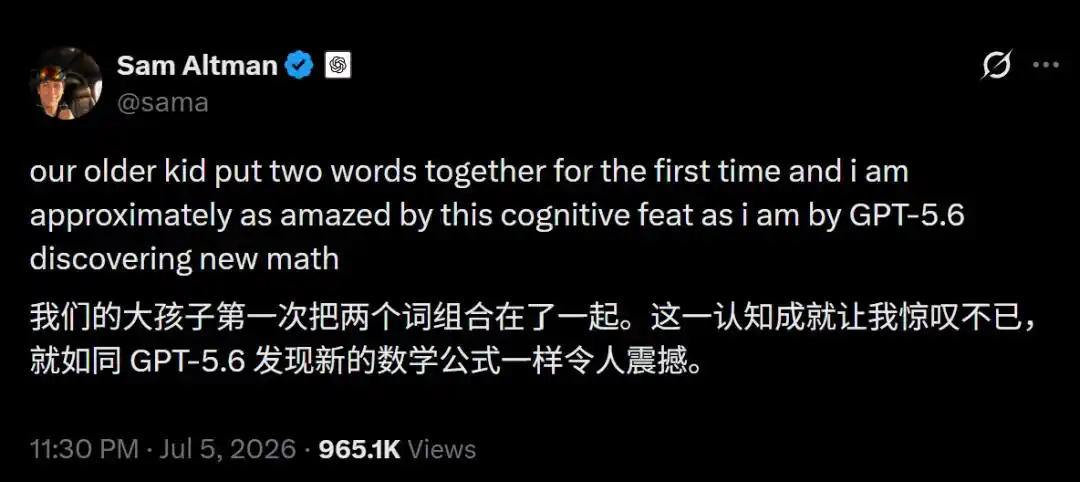
He posted this X.

Our eldest child combined two words for the first time. This cognitive achievement left me in awe, just as astonishing as GPT-5.6 discovering a new mathematical formula.

Same old formula, familiar taste.

Under this X, there were all sorts of comments.

However, behind this seemingly heartwarming X lies a harsh reality—

The current AI experience has seen a severe "class folding."

A very small number of people are using top-tier large models like Fable or the upcoming GPT-5.6, while the vast majority of the general public only has access to mediocre products with 8B to 30B parameters.

The benefits of technology are becoming the exclusive domain of a few, while the masses only feel the clamor of the bubble. Inside and outside the tech circle, we are in two completely different parallel universes.

A survey shows that 84% of the global population has never interacted with AI, 16% stubbornly use free chatbots, and only 0.3% pay for premium services.
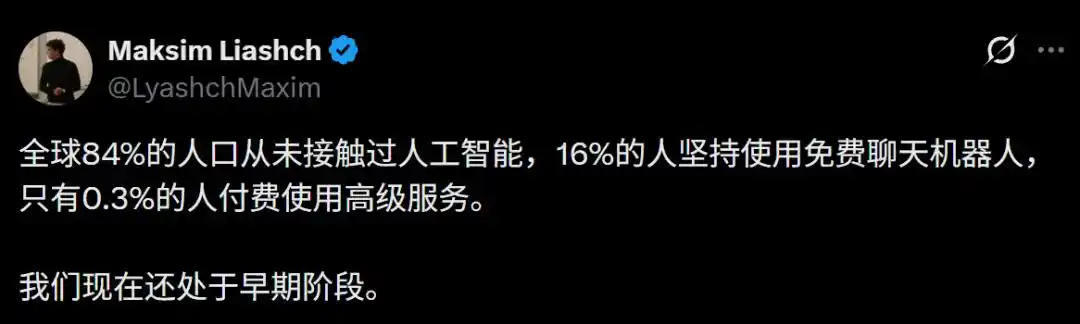
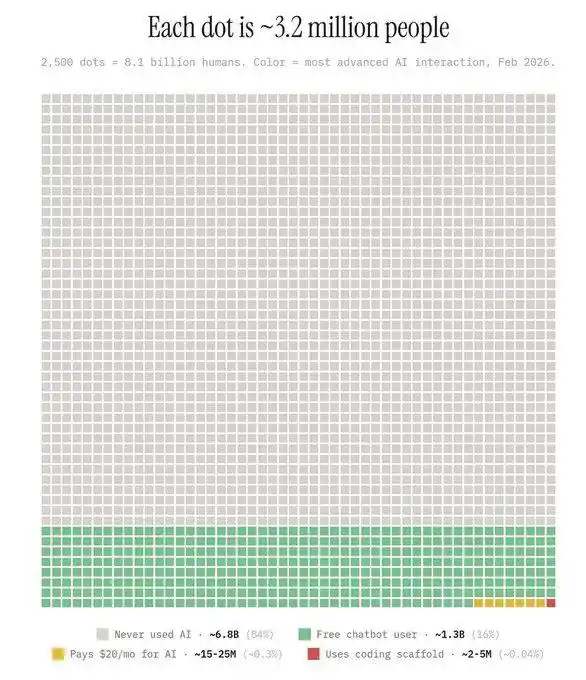
Fable 5 and GPT-5.6: The Chasm Between the Masses and the Elite

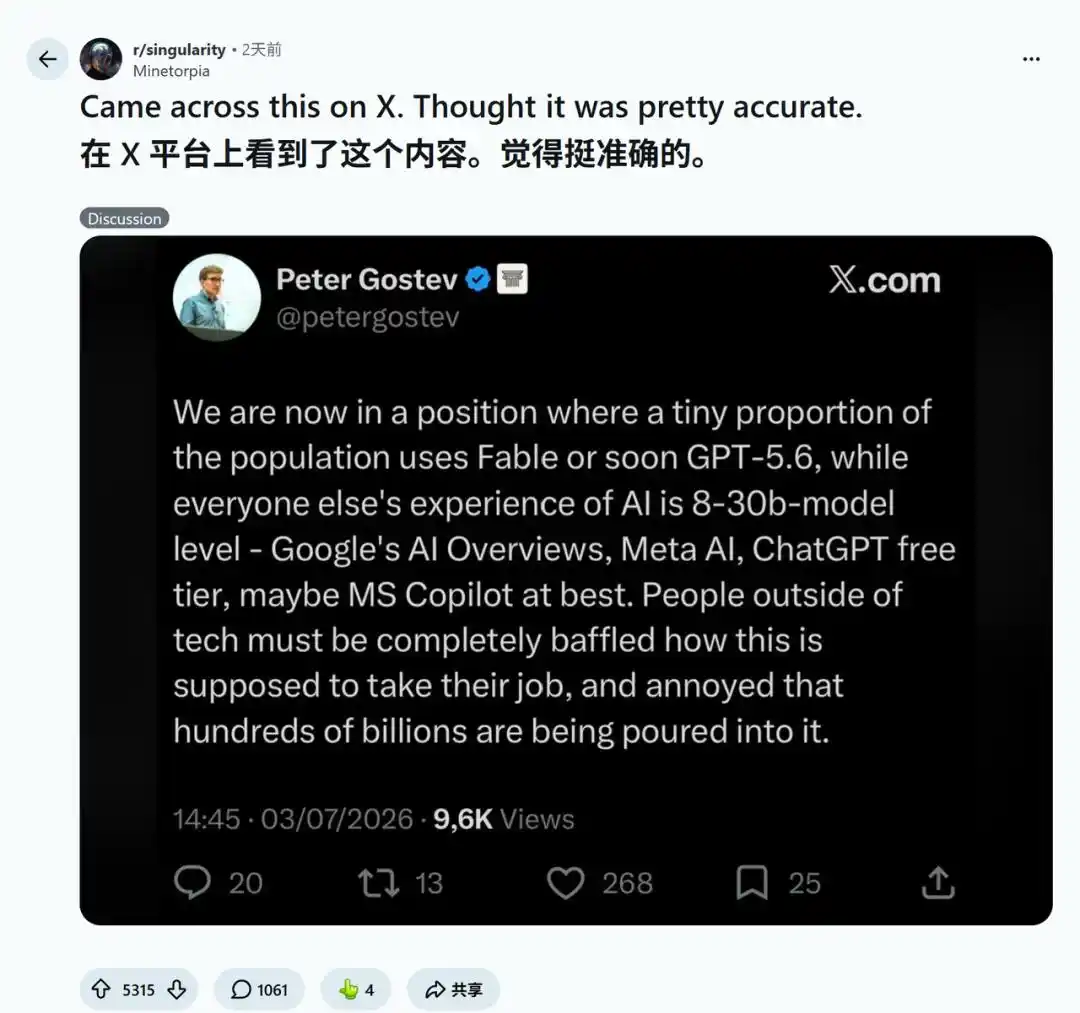
The above viewpoint comes from Peter Gostev, core lead at LMArena.

He stated: Fable 5 and GPT-5.6 are becoming the privilege of a few!
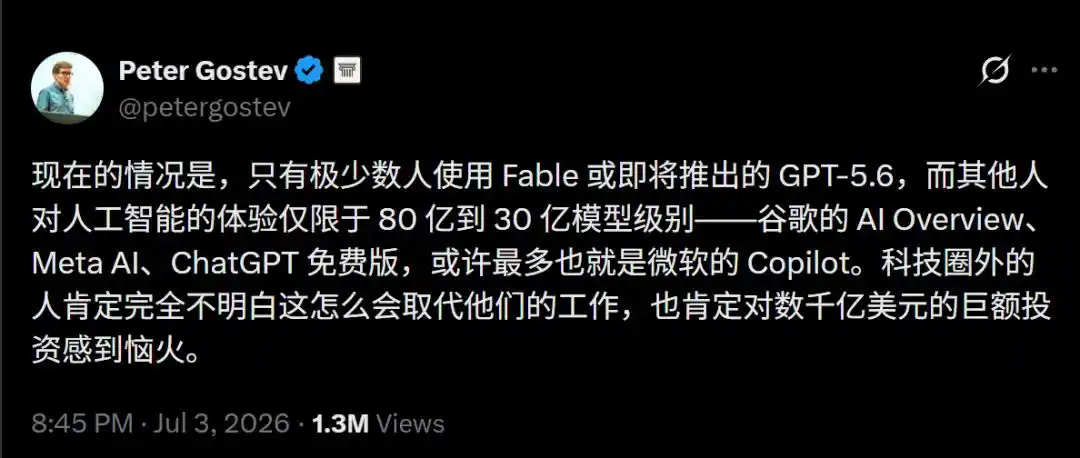
This perspective, once raised, sparked widespread discussion among netizens and has become a hot topic recently.
If you are an ordinary person outside the tech industry, you might be puzzled—

The news is filled with tech giants burning through hundreds of billions of dollars investing in large models, experts constantly warn that "AI will steal jobs," but why are free models like ChatGPT so underwhelming to use?

The answer is simple: because you are using a castrated, inferior product.

Peter Gostev pointed out bluntly:

We are now in a situation where a tiny fraction of the population is using top-tier models like Fable or the upcoming GPT-5.6, while the AI experience for everyone else is stuck at the level of 8B to 30B (8 billion to 30 billion) parameter models—at best, that's the free version of ChatGPT or basic Microsoft Copilot.

This vast experience gap leads to a strong cognitive divide.

The general public outside the circle completely fails to understand how AI can replace some human jobs. They are confused or even angry about the tech industry's insane spending.

On the other side, the privileged tech elite are enjoying a dimension-lowering strike.

The dividends of technology are quietly becoming the exclusive property of a few.
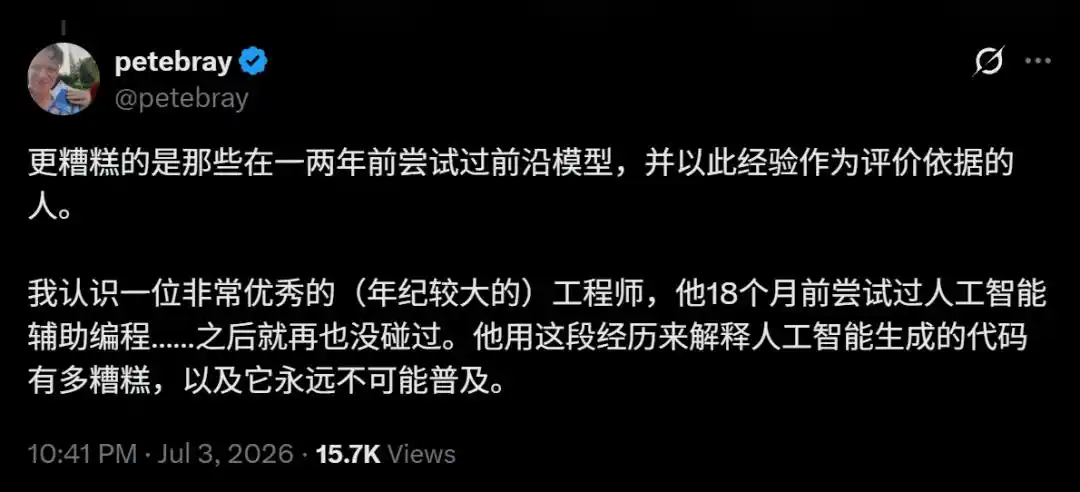
Current AI is Too Far from Ordinary People

Why do ordinary people think AI is useless?

AI influencer Kol Tregaskes used his brother, a park groundskeeper, as an example.
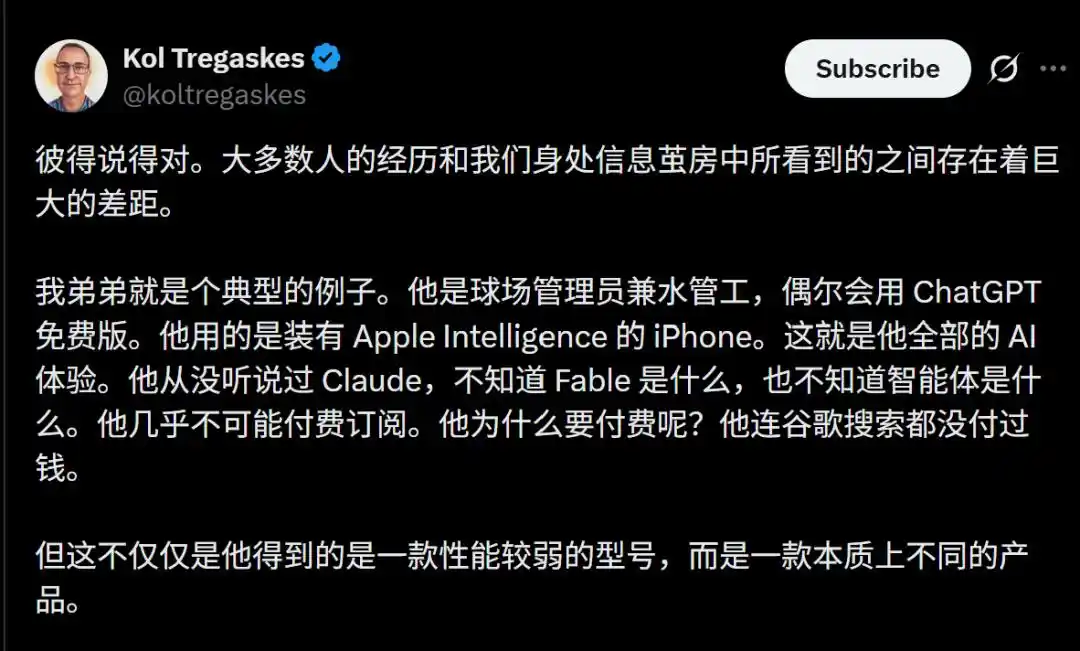
His brother occasionally uses the free ChatGPT and has an iPhone with basic Apple Intelligence. That's his entire "AI experience."

He hasn't heard of Anthropic's Claude, doesn't know what Fable is, and has no idea what an Agent is. He would never pay for an AI subscription, just as he would never pay to use Google Search.

This isn't just about "model quality"; they are using two completely different product forms.

Free users get a chatbot. You can ask it quick questions, upload a file, or do some shallow internet research.

But the paying elite get a complete work system.
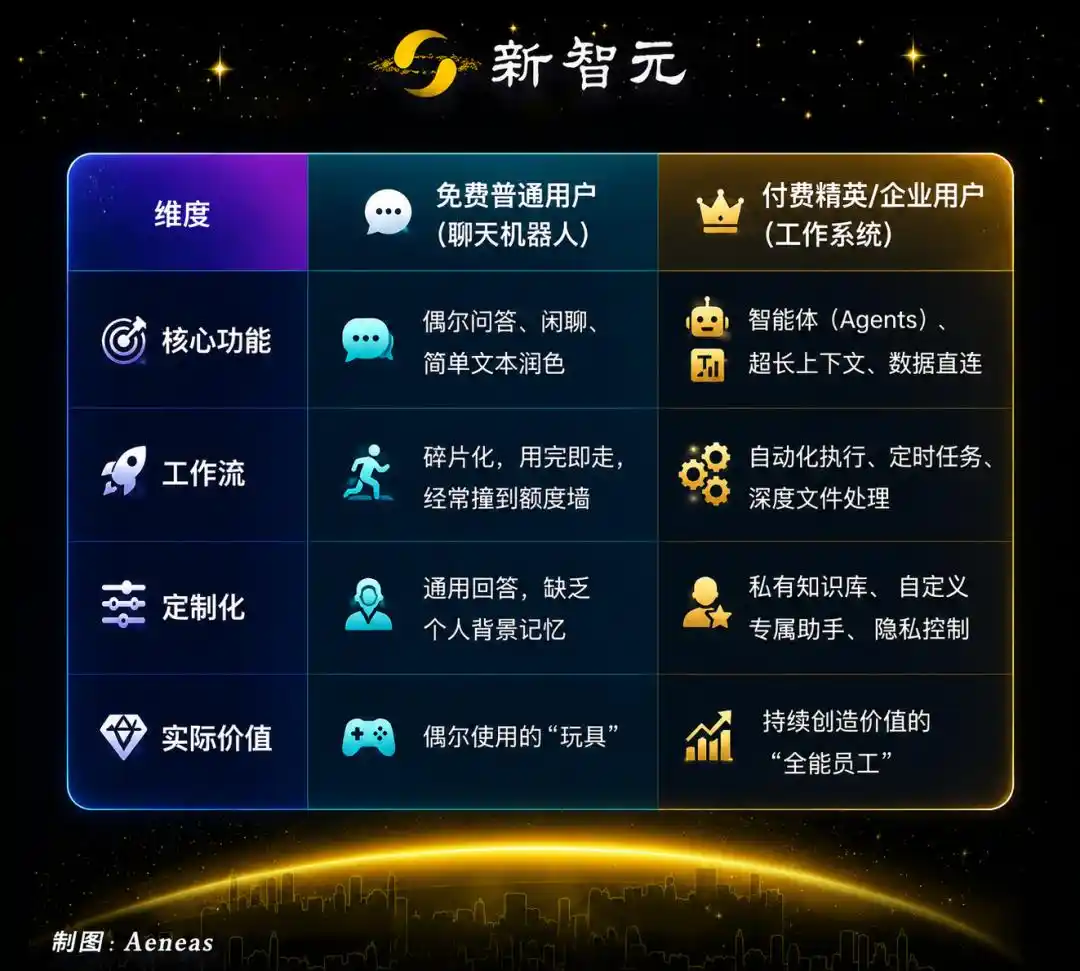
Kol pointed out that his brother cannot create a specialized "Lawn Management GPT" for UK turf species, common diseases, and seasonal maintenance schedules; he cannot throw a thick equipment manual at AI and expect it to get it right; he doesn't have Agent mode, no connected data, and cannot turn AI into a real assistant that handles quotes, supplier emails, and maintenance plans.

This is also the biggest deficiency in the current AI product layer: a severe disconnect between the lab and real life.
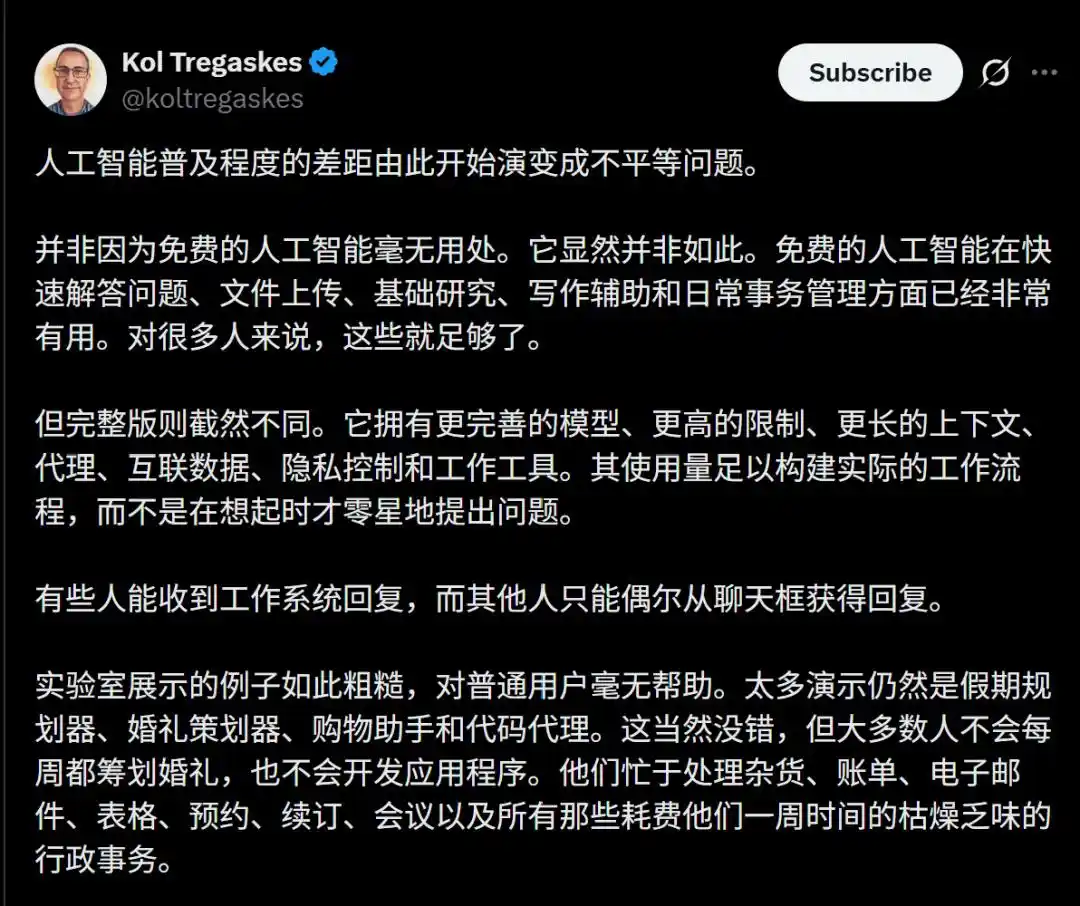
The demos at tech giant launch events mostly involve AI helping you plan a luxurious wedding or AI developing a cool app from scratch.

But what does that have to do with ordinary people?

What ordinary people actually face are the daily headaches: weekly grocery shopping, complicated bills, endless emails, forms to fill out, medical appointments, and car insurance renewals.

A true AI assistant should understand your living habits, your family's allergies, your budget, supermarket sales, and even what's left in your fridge.

It should automatically compare prices, generate lists, warn you when the total cost exceeds your budget, and ultimately turn into an automation program on your phone that silently handles all of this for you every week.

As long as AI stays in a dialog box answering questions, what the masses see will always be demos, not life-changing products.


What Does a $1000-a-Day AI Look Like?

Meanwhile, what best illustrates the fold is how top engineers on Reddit use super AI.

First, what most distinguishes the elite from ordinary people is the staggering cost of computing power.

A netizen revealed a figure that would stun ordinary people: "Yesterday, I spent $1000 on a Fable inference project. Even in large corporations, only a handful have such freedom. Things will only get worse."
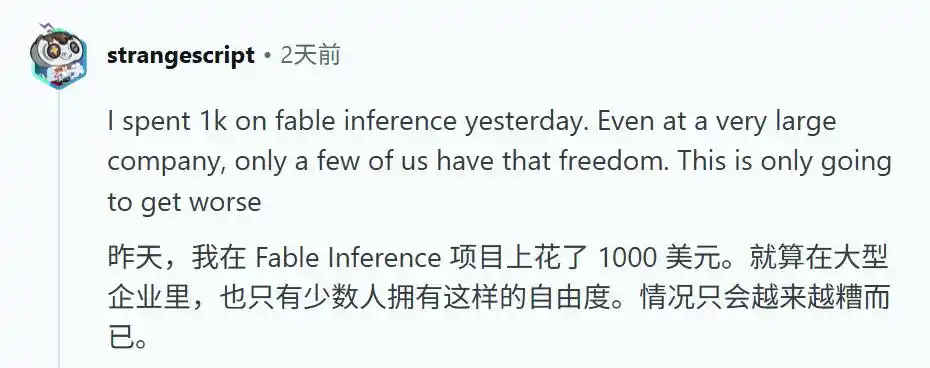
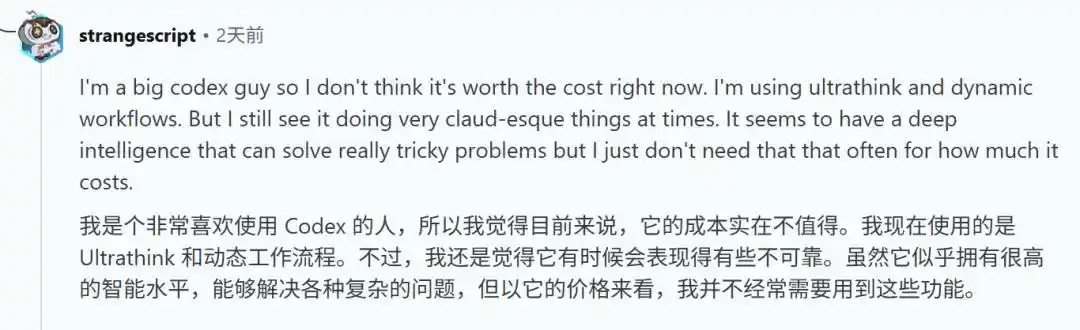
This exorbitant cost is like a chasm separating ordinary people from top-tier AI.

And Fable 5's power is indeed awe-inspiring for those in the industry.

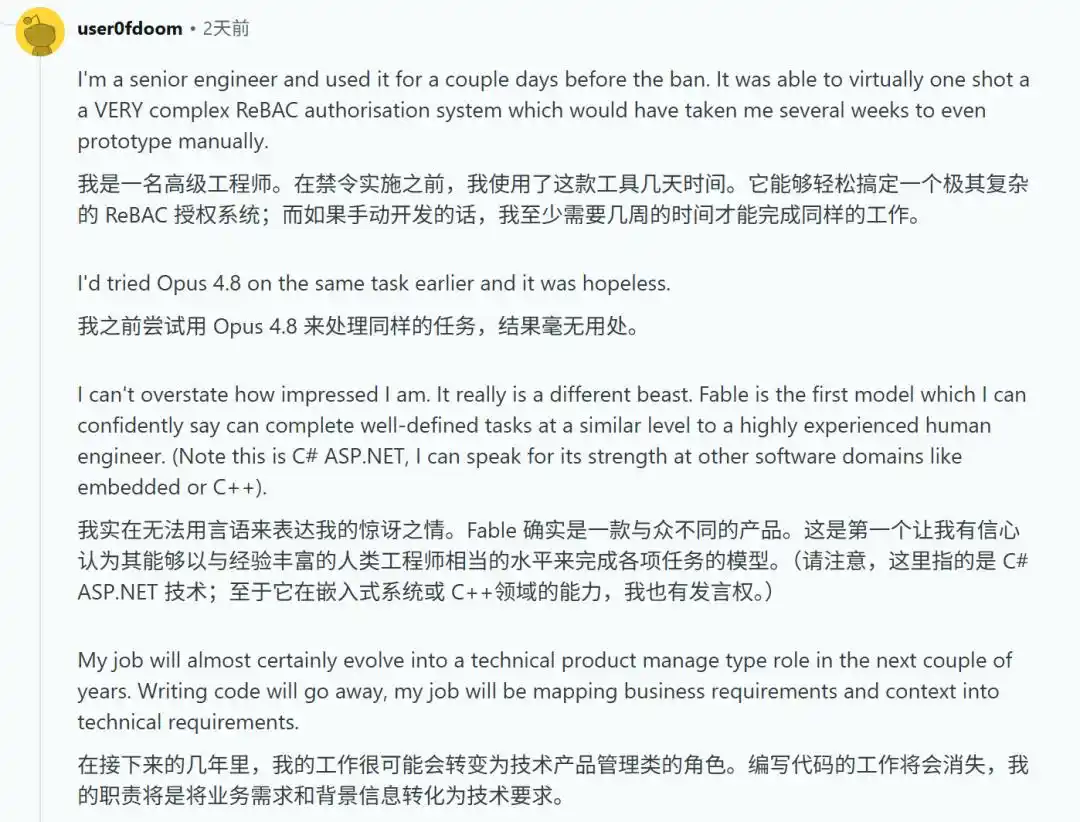
A senior engineer shared his震撼 experience before Fable was restricted.

Faced with an extremely complex ReBAC authorization system, manually developing a prototype would take him weeks. But Fable almost perfectly handled it all in one go.

He described it: "I genuinely lack the words to express my shock. Fable is indeed a completely different beast. It's the first model that convinced me AI can reach the level of an experienced, senior human engineer."
Most impressively, the top elite no longer rely on a single model but have built a multi-model collaborative matrix.

Based on the practical experience of several netizens, the current cutting-edge workflow looks like this.

Creativity & Requirements Layer (ChatGPT 5.5): Acts as the product manager, responsible for brainstorming, providing ideas, and writing complex prompt instructions.

Architecture & Planning Layer (Fable): Acts as the architect. Doesn't write low-level code directly, but designs the macro architecture of the entire system, plans specific operational steps, and verifies logic (because it's extremely smart, but costly to use and occasionally unstable).

Heavy Execution Layer (Opus 4.8): Acts as the senior programmer. Executes medium-to-high difficulty coding tasks under Fable's strict process orchestration.

Finalization & Review Layer (Sonnet 5): Acts as the code reviewer and junior programmer. Handles repetitive, pattern-fixed code writing and performs final reviews.

Another developer working on native mobile apps was even more blunt: "Hand a complex feature that would take an expert a week to this system, and it can run through it in 30 minutes."

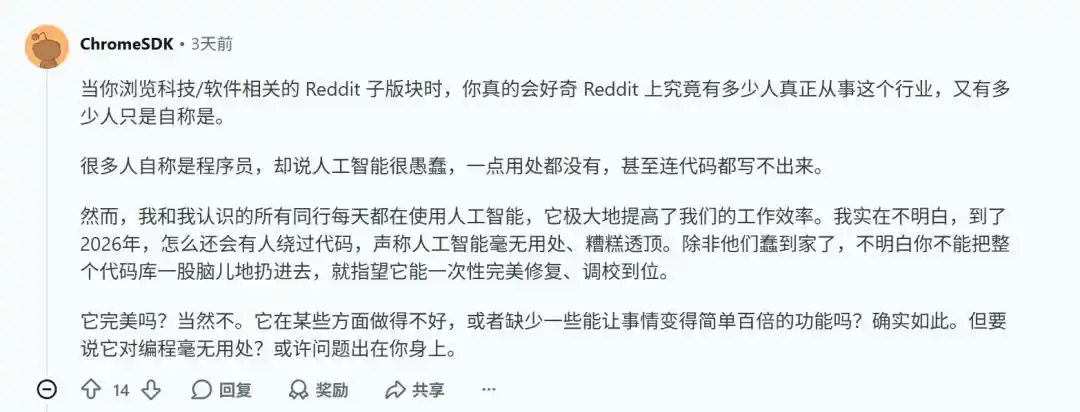
In his view, "Many people online say they can't see the difference in AI. Sometimes I really wonder what kind of incompetent people I'm talking to. Our traditional work might be completely over within a year."
The Invisible Barrier in Healthcare and Wellness

This divide isn't just about programmers writing code; it's even more evident in healthcare and wellness, a field crucial to everyone.

A netizen mentioned, "Any elderly person (or young person with serious health issues) should at least have a Pro subscription to answer their medical questions. But unfortunately, the elderly use AI the least."

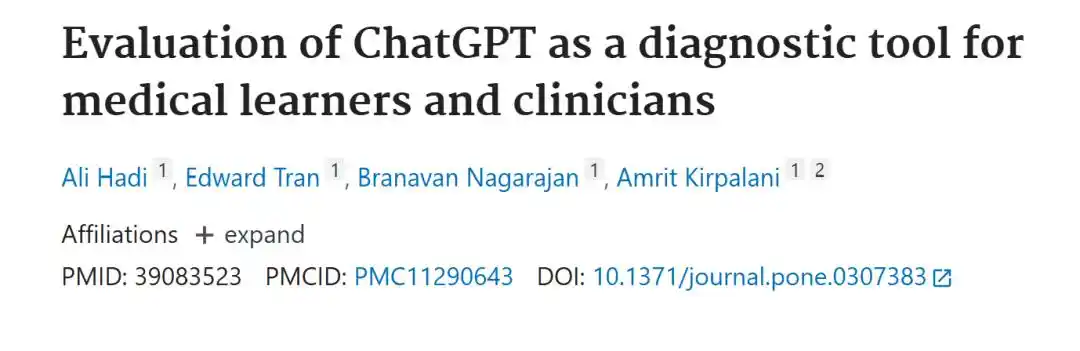
Ordinary people, unwilling to pay, can only use the free GPT to inquire about symptoms. But this netizen revealed a brutal statistic: "Asking medical questions with the free GPT is like flipping a coin. Actually worse than a coin flip, because it's wrong 51% of the time."

In fields requiring absolute trust, data privacy, and deep contextual support—like health, finance, and private contracts—free AI is often incompetent or even dangerous.

Only those who can afford Pro subscriptions or have employers providing enterprise-level Copilot support can let AI touch high-value, real work data.

Opposing Voices: Does Your Job Really Need Fable?

Of course, amid this fervor, there were also sober voices of opposition.

Netizen [Name redacted for privacy, placeholder used] proposed a classic argument: "Most ordinary corporate business logic doesn't involve incredibly complex algorithms. It's situationally complex, not intellectually complex.

In their view, for 90% of corporate employees and ordinary white-collar workers, their jobs simply don't require god-tier models like Fable or GPT-5.6 that can "discover new mathematics."

ChatGPT 5.4/5.5 has reached the perfect sweet spot—reasonably priced and good enough.

Often, when you feel AI can't solve your problem, it's not because AI isn't smart enough, but because you haven't provided enough context.

You haven't fed it your historical data, connected it to your company's API, or embedded it into your workflow, which is why it seems useless.

The Folded Future: Which Side Are You On?

In this summer of 2026, access to different AIs is becoming a profound crisis of inequality.

It's not happening in a storm, but quietly.

When giants demonstrate how AI can reconstruct the entire logic of human society, please don't laugh at AI being an idiot just because a free chatbot miscalculated an addition or subtraction.

Because in this new folded world, AI hasn't gotten dumber; it's just that the truly powerful ASI is moving further and further away from ordinary people.

References:

https://x.com/sama/status/2073791666553844074

https://x.com/koltregaskes/status/2073381804736926116

https://x.com/petergostev/status/2073025360749355049

This article is from the WeChat public account "Xinzhiyuan," author: ASI Apocalypse; editor: Aeneas


Preguntas relacionadas

QAccording to the article, what is the 'AI folding' phenomenon, and what does it mean for the general public?

AThe 'AI folding' phenomenon refers to the severe stratification in AI experience, where a tiny elite has access to and uses top-tier models like Fable 5 and GPT-5.6, while the vast majority of the public is limited to much less powerful, often free, 'AI toys' like basic chatbots. This creates a significant 'experience gap' or chasm, meaning the general public is excluded from the real power and productivity gains of advanced AI, seeing only the hype and superficial applications.

QWhat key limitation of current mainstream (free/accessible) AI products does the article highlight as causing a disconnect with ordinary people's lives?

AThe article highlights that current mainstream AI products are severely disconnected from the practical, mundane needs of ordinary people. They are presented as tools for creating apps or planning weddings, while people's real daily challenges involve tedious tasks like grocery shopping, managing bills, scheduling appointments, and handling forms. The missing element is a true 'AI butler' integrated with personal data, habits, and local context to automate these routine aspects of life.

QWhat staggering cost example is given to illustrate the financial barrier preventing most people from using top-tier AI like Fable 5?

AThe article cites a Reddit user's example of spending $1,000 in a single day on a Fable inference project. This exorbitant cost represents a massive financial barrier, making such powerful AI tools accessible only to a privileged few within large corporations or with significant personal resources, thereby creating an 'unbridgeable chasm' between elites and the public.

QDescribe the multi-model 'collaboration matrix' workflow used by elite engineers as outlined in the article.

AElite engineers use a sophisticated multi-model workflow: 1) ChatGPT 5.5 acts as the 'Product Manager' for brainstorming and creating complex prompts. 2) Fable acts as the 'Architect,' designing the overall system architecture and planning steps. 3) Claude Opus 4.8 acts as the 'Senior Programmer,' executing medium to high-difficulty coding tasks under Fable's guidance. 4) Claude Sonnet 5 acts as the 'Code Reviewer/Junior Programmer,' handling repetitive coding and final reviews. This system allows complex projects to be completed in drastically reduced time.

QWhat serious risk does the article associate with using free AI models for critical areas like healthcare advice?

AThe article warns that using free AI models for healthcare advice is highly dangerous. It references data suggesting such models are wrong more than 51% of the time on medical questions—worse than a coin flip. This creates a significant hidden barrier where only those who can afford paid Pro subscriptions or have enterprise access can leverage reliable, context-aware AI for high-stakes areas like health, finance, and legal matters, potentially exacerbating inequalities in critical life outcomes.

Lecturas Relacionadas

Q-Day Countdown: Will Quantum Computing End Cryptocurrencies?

Quantum Computing's Threat to Cryptocurrency: A Countdown to Q-Day Quantum computing, specifically Shor's algorithm, poses a fundamental threat to the public-key cryptography (e.g., ECDSA, RSA) that secures blockchain networks like Bitcoin and Ethereum. This critical juncture, known as Q-Day, is estimated to occur potentially within the next 5-15 years. The core vulnerability stems from the public and immutable nature of blockchains. Assets in addresses where the public key is already exposed on-chain (e.g., spent outputs) are at direct risk, as a sufficiently powerful quantum computer could derive the private key. This threatens the very trust model of cryptocurrencies. The response lies in Post-Quantum Cryptography (PQC)—algorithms like lattice-based ML-DSA and hash-based SLH-DSA, which are resistant to quantum attacks. NIST has standardized key PQC algorithms (FIPS 203, 204, 205), providing a migration path. However, the primary challenge is not technical but socio-economic and involves complex governance: * **Bitcoin's** path is constrained by its conservative ethos. Migrating requires a soft-fork to new address types, facing hurdles like significantly larger signature sizes and, most critically, the divisive governance question of how to handle at-risk legacy UTXOs without violating core principles. * **Ethereum** is pursuing a "cryptographic agility" strategy, with a multi-layered roadmap. It leverages account abstraction for user accounts and is developing compressed hash-based signatures (e.g., leanXMSS) for its consensus layer, aiming for a full-stack upgrade over time. In conclusion, quantum computing does not spell an instant end for cryptocurrency but initiates a critical countdown. The industry has a limited "engineering comfort window" to orchestrate a coordinated, ecosystem-wide migration to PQC. The ultimate bottlenecks are the immense coordination efforts and governance decisions required for this foundational transition.

marsbitHace 47 min(s)

Q-Day Countdown: Will Quantum Computing End Cryptocurrencies?

marsbitHace 47 min(s)

Trump, the President Who Knows Best How to 'Trade Stocks'

Former US President Donald Trump reported a record-breaking $2.2 billion in personal income for 2025, the highest annual income ever disclosed by a sitting president. This figure, from a 927-page government ethics filing, represented a 3.5-fold increase from his $600 million income in 2024 and boosted his net worth to $6.5 billion. The primary drivers were cryptocurrency (64% of income, approximately $1.4 billion) and real estate (26%, approximately $575 million). His crypto earnings stemmed largely from the launch of his personal meme coin, $TRUMP, generating over $600 million in licensing fees, and substantial profits from the WLFI token and its parent company. Despite a sluggish property market, his Mar-a-Lago resort and associated golf clubs saw revenue surges of 50% and 27%, respectively, attributed to their use as venues for presidential events. Trump's financial disclosure also revealed an unprecedented level of stock market activity, with over 22,000 trades executed in 2025, averaging 87 trades per market day. Media analyses noted several instances where significant trading coincided with major policy announcements, such as proposed tariffs, raising questions about potential conflicts of interest. While the White House stated these trades were handled by a family-managed trust fund and not Trump directly, critics highlighted this as a departure from the blind trusts traditionally used by presidents post-Watergate. The report has intensified debate over the commercialization of the presidency. Supporters view it as a success story of a businessman-president, while critics argue it demonstrates an unprecedented conversion of public influence into private wealth, with policy decisions potentially linked to personal financial gains. The controversy centers on whether Trump's earnings represent innovative entrepreneurship or a fundamental conflict of interest, sparking renewed calls for stricter ethics reforms in US governance.

marsbitHace 56 min(s)

Trump, the President Who Knows Best How to 'Trade Stocks'

marsbitHace 56 min(s)

Countdown to Q-Day: Will Quantum Computing End Cryptocurrencies?

The article explores the existential threat quantum computing poses to cryptocurrencies and the urgent need for "post-quantum" migration. It outlines that quantum computers, through Shor's algorithm, could break the elliptic-curve cryptography (ECC) underlying blockchain security, potentially allowing private keys to be derived from public keys. The core challenge is not a lack of post-quantum cryptography (PQC) standards—like NIST's ML-KEM and ML-DSA—but the immense complexity of upgrading entire ecosystems before "Q-Day" (when quantum computers become capable of such attacks, estimated around 2035-2045). Key points include: * **Bitcoin's** risk is concentrated in legacy UTXOs with exposed public keys (e.g., early P2PK outputs). Migration faces massive hurdles: PQC signatures are much larger, increasing transaction size and cost, and the governance dilemma of handling un-migrated assets threatens its "code is law" ethos. * **Ethereum's** strategy focuses on "cryptographic agility," using Account Abstraction for user accounts and developing compressed hash-based signatures (like leanXMSS with SNARK aggregation) for consensus. Its migration is a complex, full-stack overhaul of execution, consensus, and data layers. * The "security debt" is enormous. The comfortable engineering window for a coordinated, ecosystem-wide upgrade is only 5-8 years. High-value infrastructure (exchanges, bridges) may face pressure before mainnet protocols. In conclusion, quantum computing is not an instant "doomsday" event but a forcing function for systemic change. Bitcoin's ultimate test is social consensus and property rights governance, while Ethereum's is technical complexity. Failure to migrate in time could lead to a fundamental re-pricing of crypto assets.

链捕手Hace 1 hora(s)

Countdown to Q-Day: Will Quantum Computing End Cryptocurrencies?

链捕手Hace 1 hora(s)

Losing $55 Million to Sell Bitcoin, MicroStrategy's Faith Reaches Its Interest Payment Day

On July 6th, Michael Saylor's MicroStrategy announced the sale of 3,588 BTC for approximately $216 million, incurring a realized loss of around $55.45 million compared to its average cost basis. This move, contradicting Saylor's long-standing "never sell" Bitcoin philosophy, was executed to pay dividends on its digital credit securities. The article traces this shift from a small "desensitization test" sale of 32 BTC in late May to the board's authorization on June 30th to sell up to $1.25 billion in Bitcoin for corporate purposes like dividends and buybacks. Analysis reveals that MicroStrategy's previous growth "flywheel"—using stock premiums to fund more Bitcoin purchases—has stalled. With its stock trading near a critical threshold (1.22x its Bitcoin NAV), issuing new shares would dilute value. Simultaneously, its financing channels (preferred stock, common stock ATM, convertible notes) are constrained while facing rigid annual dividend/interest obligations of roughly $1.76 billion. Consequently, selling Bitcoin became the calculated "optimal solution" under its own financial model. This transforms MicroStrategy from crypto's most prominent steady buyer into a predictable seller, creating a potential overhead of ~2,400 BTC in monthly selling pressure if obligations are fully covered by sales. This shift challenges the valuation models of the entire Digital Asset Treasury (DAT) sector that emulated MicroStrategy. The company's path forward now hinges on Bitcoin's price recovery, which would allow its preferred stock to trade at par and reopen its financing flywheel, creating a cyclical dependency between the firm's financial model and the asset it holds.

链捕手Hace 1 hora(s)

Losing $55 Million to Sell Bitcoin, MicroStrategy's Faith Reaches Its Interest Payment Day

链捕手Hace 1 hora(s)

Trading

Spot
活动图片