Robinhood Chain Ecosystem Overview: Which Projects Are Worth Early Attention?

marsbitPublicado a 2026-07-06Actualizado a 2026-07-06

Resumen

This article provides an overview of the emerging Robinhood Chain ecosystem, a Layer-2 network launched by Robinhood. As of July 6, 2026, the ecosystem's TVL stands at approximately $76.73 million. Key projects highlighted for potential opportunities include: * **Arcus**: A DEX for stock tokens and crypto, co-built by dYdX Labs and Robinhood Crypto, focusing on spot and perpetual trading. Future token distribution is expected to prioritize the dYdX community. * **Lighter**: A ZK-powered DEX for perpetuals and spot trading on Robinhood Chain, offering an incentive program for users. * **Morpho**: Supports Robinhood Earn, a feature allowing US users to lend stablecoin USDG for an estimated 7% APY. * **Rialto**: An on-chain spot exchange supporting crypto, stocks, ETFs, and commodities, utilizing a propAMM model for liquidity. * **Arrakis**: A non-custodial on-chain market maker protocol for token issuers. * **Meridian**: A platform for RWA perpetual contracts and prediction markets, settled in USDe. * **Native**: An on-chain price discovery and execution system now deployed on Robinhood Chain. The article concludes with a disclaimer, advising readers to conduct their own research (DYOR) and assess risks.

Original Author: KarenZ, Foresight News

As the core "battleground" for Robinhood's entry into Layer2, Robinhood Chain is rapidly building a comprehensive ecosystem covering stock tokens, RWA, perpetual contracts, and spot trading.

On July 2, 2026, while launching its mainnet, Robinhood Chain also simultaneously initiated a 90-day gas fee waiver activity, covering scenarios such as swaps, cross-chain transfers, and Perp trading.

As of July 6, 2026, just 4 days after its launch, the ecosystem TVL of Robinhood Chain is still not high, approximately $76.73 million. This article will outline the projects worth focused attention and potential opportunities.
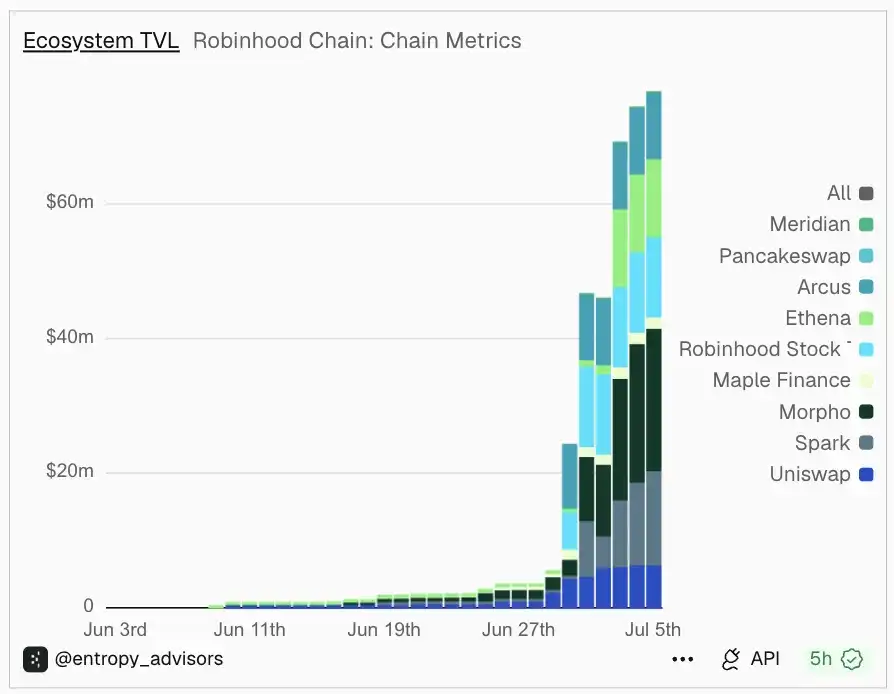
Source: Dune dashboard (Entropy Advisors)

It is important to note that this article does not constitute any investment or interaction advice. All participants should conduct their own research, DYOR, and fully assess their own risk tolerance before taking any action.

Arcus

Arcus is a stock token and cryptocurrency DEX jointly built by dYdX Labs and Robinhood Crypto, focusing on spot and perpetual contracts, facilitating peer-to-peer trading of stock tokens on Robinhood Chain.

When announcing Arcus, dYdX stated that a portion of Arcus tokens would be distributed to the dYdX community in the future. The Defiant also reported that Arcus tokens will be prioritized for users who trade, stake, or validate on the dYdX platform, prioritizing existing dYdX community members at the time of token issuance.

Extended Reading: dYdX Changes Its Skin and Starts Anew, Can It Succeed This Time Teaming Up with Robinhood?

Lighter

Lighter is a ZK-powered decentralized perpetual and spot exchange, already deployed on Robinhood Chain. Robinhood Wallet users can now trade perpetual contracts and stock tokens directly through Lighter.

According to a Bankless report, Lighter has committed $11 million worth of LIT to the Robinhood community: users trading perpetual contracts on Lighter can earn points (2x points for trading via the Robinhood wallet, 1x points via the Lighter web app), and points can be directly converted into LIT (subject to Lighter's terms).

Extended Reading: Carving Out Territory with Robinhood, Is Lighter Playing a Big Game?

Morpho

Robinhood is gradually rolling out Robinhood Earn to eligible US users, allowing them to lend the stablecoin USDG via self-custody wallets. Robinhood estimates an annualized yield of 7%.

The USDG provided through Robinhood Earn is deposited into Morpho vaults and allocated across Morpho markets. Borrowers provide collateral from protocols like Spark, Ethena, and Maple to borrow USDG, with the yield coming from the interest they pay.

Rialto

Rialto came to the forefront in collaboration with Robinhood Crypto, Offchain, and Arbitrum. It is an on-chain spot exchange supporting asset types such as crypto assets, stocks, ETFs, and commodities.

Initially, Rialto will list over 90 Robinhood stock tokens and major crypto assets on Robinhood Chain.

After a user places an order, Rialto requests real-time quotes for the order size from all candidate liquidity sources, including propAMM and traditional DEX pools, then sorts them by net output after deducting network costs. The core here is propAMM. Rialto defines propAMM as: an on-chain market maker that uses its own inventory and proprietary pricing logic to quote.

Arrakis

Arrakis is a non-custodial, on-chain market maker protocol for token issuers, managing concentrated liquidity on DEXs through self-custody treasuries: the issuer owns the vault and its assets, while Arrakis runs market-making strategies within parameters set by the issuer.

In December 2022, Arrakis Finance raised a $4 million seed round via a SAFT (Simple Agreement for Future Tokens), with participation from Uniswap Labs Ventures, Accel, Polygon Ventures, and Robot Ventures, among others.

Meridian

Meridian is a Robinhood Chain ecosystem platform focused on RWA perpetual contracts and prediction markets, with USDe as the settlement asset.

Notably, Meridian was formerly Ethereal, rebranded to Meridian in May 2026, gradually shifting its focus from possibly more general derivatives/trading infrastructure early on to RWA + prediction markets + perpetual contracts.

In November 2024, Ethereal stated at the time that it would allocate 15% of all future Ethereal governance tokens to ENA (sENA) stakers.

Native

Native is an on-chain price discovery and execution system, deployed to Robinhood Chain on July 2. Native previously supported networks like Ethereum, BNB Chain, Arbitrum, and Base.

On July 2, Native responded to community questions stating, "There are currently no plans for a token launch, but we value every supporter."

Criptos en tendencia

Preguntas relacionadas

QWhat is the core role of Robinhood Chain in Robinhood's strategy, and what ecosystem is it building?

ARobinhood Chain is the core 'battlefield' for Robinhood's entry into Layer2. It is rapidly building a comprehensive ecosystem covering stock tokens, RWA (Real World Assets), perpetual contracts, and spot trading.

QWhich project on Robinhood Chain is a DEX co-built by dYdX Labs and Robinhood Crypto, and what is its focus?

AThe project is Arcus. It is a DEX focused on stock tokens and cryptocurrencies, specializing in spot and perpetual contract trading to facilitate peer-to-peer trading of stock tokens on Robinhood Chain.

QWhat special incentive program does Lighter offer to Robinhood community users, and what is the reward?

ALighter has committed $11 million worth of LIT tokens to the Robinhood community. Users can earn points by trading perpetual contracts on Lighter (2x points via Robinhood Wallet, 1x via Lighter web app). These points can be directly converted to LIT tokens, subject to Lighter's terms.

QHow does the Robinhood Earn program work in relation to the Morpho protocol?

ARobinhood Earn allows eligible U.S. users to lend stablecoin USDG via self-custody wallets. The provided USDG is deposited into Morpho vaults and allocated across Morpho markets. Borrowers provide collateral from protocols like Spark, Ethena, and Maple to borrow USDG, and the yield comes from the interest they pay.

QWhat are the main asset types supported by the Rialto exchange, and what is a key component of its order routing mechanism?

ARialto is an on-chain spot exchange supporting asset types like cryptocurrencies, stocks, ETFs, and commodities. A key component of its order routing mechanism is the 'propAMM' (proprietary AMM), which refers to on-chain market makers that use their own inventory and pricing logic to provide quotes.

Lecturas Relacionadas

AI Folding: Fable 5 and GPT-5.6 Are Becoming the Privilege of a Few

【AI Accessibility Gap Widens: Elite Tools Like Fable 5 and GPT-5.6 Are Becoming Privileged】 We are witnessing a growing "AI divide." A stark reality is emerging: a tiny fraction of elites, primarily in tech, are using powerful next-generation models like Fable 5 or the upcoming GPT-5.6, while the vast majority of the public only has access to "toys" - free, limited models equivalent to ChatGPT's basic versions (8B to 30B parameters). This creates a massive experiential chasm and cognitive dissonance. Industry outsiders see AI as overhyped and ineffective, unable to grasp its transformative potential, while insiders leverage these advanced models for a decisive competitive edge. The gap isn't just about model quality but product functionality. Free users get a simple chatbot. Paying elites get integrated workflow systems—capable of creating specialized agents, processing complex data, and handling real-world tasks like management, coding, and planning. Demos showcasing AI planning weddings or building apps feel disconnected from everyday needs like managing bills, groceries, or health. The cost barrier is immense, with reports of engineers spending $1000 daily on Fable 5 inference. Elite users employ sophisticated multi-model workflows, combining different AIs for ideation, architecture, execution, and review, completing complex projects in minutes instead of weeks. This divide extends to critical areas like healthcare, where free models are dangerously unreliable for medical queries. However, some argue that for 90% of common business tasks, mid-tier models like GPT-5.5 are sufficient; the perceived limitation often stems from poor integration and lack of context, not model intelligence. Ultimately, unequal access to cutting-edge AI is creating a new form of social stratification, where the most powerful tools are becoming the exclusive privilege of a few.

marsbitHace 19 min(s)

AI Folding: Fable 5 and GPT-5.6 Are Becoming the Privilege of a Few

marsbitHace 19 min(s)

Cathie Wood's June $77M Investment: Are Crypto Stocks a True 'Substitute' for Bitcoin?

In June, Cathie Wood's ARK Invest purchased $77 million worth of publicly traded crypto-related stocks, including Coinbase, Circle, and Bullish, during Bitcoin's worst monthly performance in four years. This aligns with the investment thesis that such stocks offer a compliant way to gain exposure to the crypto cycle without directly holding Bitcoin. However, data analysis reveals significant drawbacks. A group of nine U.S.-listed crypto companies showed 30-day annualized realized volatility between 68% and 90%, nearly double Bitcoin's 37.6%. Over 90 days, Circle's volatility reached 103.6% versus Bitcoin's 37.8%. Drawdowns were also more severe for stocks like Circle (-51.4%) and MicroStrategy (-48.6%) compared to Bitcoin's -36.4% from its January high. Correlation analysis shows most stocks share only a moderate link to Bitcoin. For example, Circle, Robinhood, and Bullish have a 90-day correlation coefficient of just 0.55–0.58 with BTC, meaning only about one-third of their price movement is explained by Bitcoin's action. The rest stems from company-specific risks: earnings, competition, fundraising, and equity dilution. MicroStrategy (MSTR) is the notable exception, acting as a leveraged Bitcoin proxy with a beta of 1.59 and 0.85 correlation. Coinbase offers relatively balanced exposure. Circle exemplifies "crypto-wrapped" corporate risk, with its recent crash tied to stablecoin competition, not Bitcoin. Robinhood's diversified business insulates it from crypto downturns but also limits upside. Bitcoin miners like RIOT and MARA have posted significant gains year-to-date, driven primarily by their pivot to AI compute services, not Bitcoin's price. The article highlights that investing in crypto stocks often means accepting amplified volatility or layering on business-specific risks absent from direct Bitcoin ownership. For instance, MicroStrategy's recent challenges—its market value falling below its Bitcoin holdings (mNAV <1) and facing potential Bitcoin sales for liquidity—demonstrate equity-specific hazards like dilution and financing pressures not faced by a direct Bitcoin holder. ARK's buying spree represents a bet on a basket of different business models with varying crypto exposure, not a simple, lower-risk substitute for holding Bitcoin.

marsbitHace 19 min(s)

Cathie Wood's June $77M Investment: Are Crypto Stocks a True 'Substitute' for Bitcoin?

marsbitHace 19 min(s)

Crypto Welcomes the 'July Rebound'? On-Chain Bottom Signals Align, Reversal Still Requires Breakthrough Above $70k

The cryptocurrency market is showing signs of a potential "July rebound," with Bitcoin leading a recovery above $63,000 and total market cap rising. This bounce is attributed to improved macro expectations (weaker US jobs data easing Fed hike fears), a short squeeze in derivatives, and signs of whale accumulation. Key on-chain metrics signal a potential bottom, including the Sharpe Ratio hitting extreme lows, the AHR999 index nearing historic buy zones, and miner pressure reaching significant levels. However, analysts caution this is likely a corrective rebound rather than a confirmed trend reversal. Persistent challenges include weak spot demand, negative Coinbase Premium indicating institutional caution, and ongoing selling pressure in the altcoin market. Market sentiment remains in "extreme fear" territory, and the AVIV ratio suggests the average active Bitcoin investor is still at a loss. For a true bullish reversal, Bitcoin needs to convincingly break above the key $70,000 level (aligned with the Short-Term Holder Realized Price). The path to a new parabolic bull market is seen as dependent on attracting substantially more capital, as capital efficiency has declined. While prices may be approaching a cyclical bottom zone (with estimates between $37k-$60k), the market requires more sustained positive signals for a definitive uptrend.

marsbitHace 49 min(s)

Crypto Welcomes the 'July Rebound'? On-Chain Bottom Signals Align, Reversal Still Requires Breakthrough Above $70k

marsbitHace 49 min(s)

Trading

Spot

Artículos destacados

Cómo comprar CORE

¡Bienvenido a HTX.com! Hemos hecho que comprar CORE (CORE) sea simple y conveniente. Sigue nuestra guía paso a paso para iniciar tu viaje de criptos.Paso 1: crea tu cuenta HTXUtiliza tu correo electrónico o número de teléfono para registrarte y obtener una cuenta gratuita en HTX. Experimenta un proceso de registro sin complicaciones y desbloquea todas las funciones.Obtener mi cuentaPaso 2: ve a Comprar cripto y elige tu método de pagoTarjeta de crédito/débito: usa tu Visa o Mastercard para comprar CORE (CORE) al instante.Saldo: utiliza fondos del saldo de tu cuenta HTX para tradear sin problemas.Terceros: hemos agregado métodos de pago populares como Google Pay y Apple Pay para mejorar la comodidad.P2P: tradear directamente con otros usuarios en HTX.Over-the-Counter (OTC): ofrecemos servicios personalizados y tipos de cambio competitivos para los traders.Paso 3: guarda tu CORE (CORE)Después de comprar tu CORE (CORE), guárdalo en tu cuenta HTX. Alternativamente, puedes enviarlo a otro lugar mediante transferencia blockchain o utilizarlo para tradear otras criptomonedas.Paso 4: tradear CORE (CORE)Tradear fácilmente con CORE (CORE) en HTX's mercado spot. Simplemente accede a tu cuenta, selecciona tu par de trading, ejecuta tus trades y monitorea en tiempo real. Ofrecemos una experiencia fácil de usar tanto para principiantes como para traders experimentados.

256 Vistas totalesPublicado en 2024.12.13Actualizado en 2026.06.02

Cómo comprar CORE

Discusiones

Bienvenido a la comunidad de HTX. Aquí puedes mantenerte informado sobre los últimos desarrollos de la plataforma y acceder a análisis profesionales del mercado. A continuación se presentan las opiniones de los usuarios sobre el precio de CORE (CORE).

活动图片