ether.fi [ETHFI] eyes $0.40 next after an 11% rally – More gains ahead IF…

ambcryptoPublicado a 2026-07-04Actualizado a 2026-07-04

Resumen

The article discusses a recent price rally for the ether.fi (ETHFI) token, which surged over 11% to trade at $0.37. Key technical indicators, including the reclaiming of the 20- and 50-day Exponential Moving Averages (EMAs), suggest strengthening bullish momentum. The uptrend is supported by strong spot market demand, evidenced by consecutive days of negative Spot Netflow, indicating more tokens are being withdrawn from exchanges than deposited—a sign of accumulation. A bullish crossover in the Directional Movement Index (DMI) further supports this positive outlook, with the potential for ETHFI to target the 100-day EMA near $0.40. However, the article notes caution in the derivatives market. Despite the spot rally, data shows significant outflows from futures positions and elevated perpetual sell volume, suggesting traders are using price strength to reduce exposure rather than open new long positions. This persistent selling pressure in derivatives poses a risk to the rally's sustainability. If it continues, ETHFI could potentially fall back to retest the $0.30 support level. The overall picture is one of conflicting signals: bullish momentum in the spot market versus cautious, selling behavior among derivative traders.

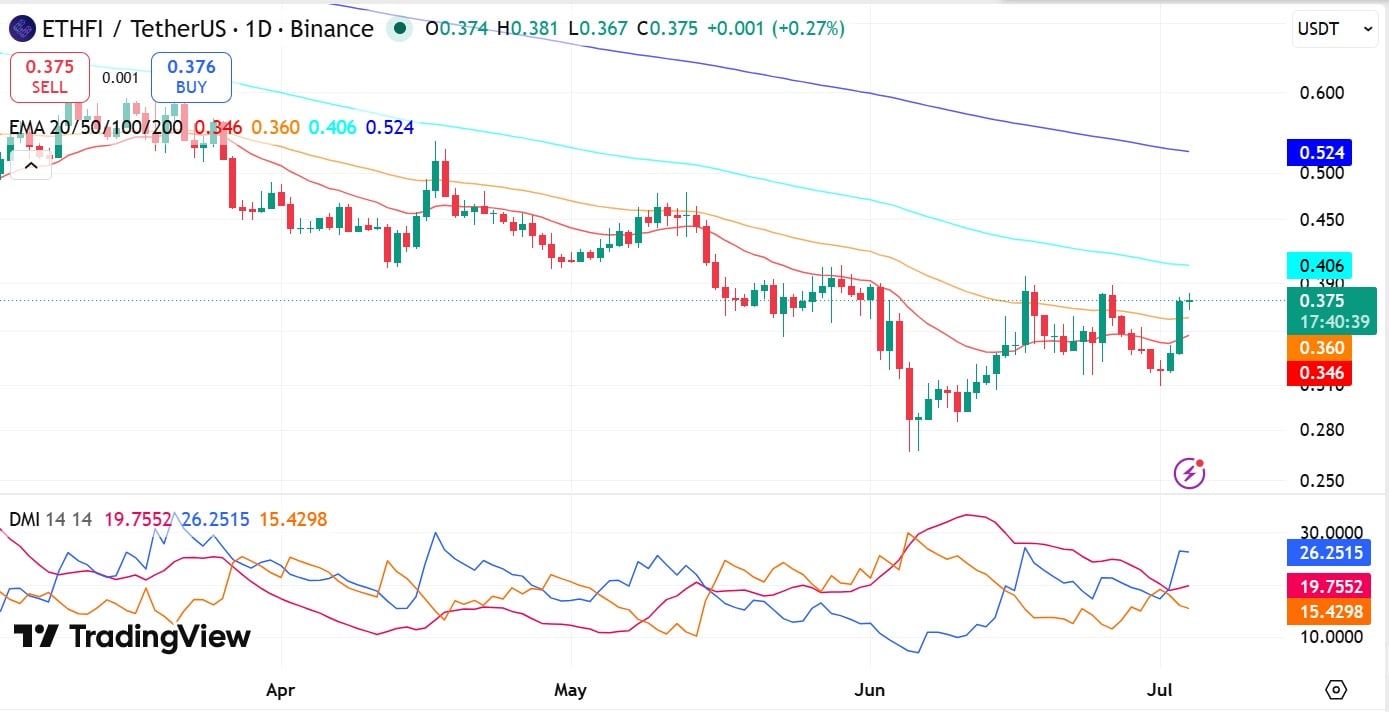
ETHFI is experiencing strong upward momentum. Since holding the $0.30 support earlier this week, the altcoin has posted consecutive higher highs, touching a local high of $0.38.

As of this writing, ether.fi [ETHFI] traded at $0.37, up 11.24% on the daily charts. At the same time, trading volume rose 72% to $58 million, while market cap climbed 12% to $346 million.

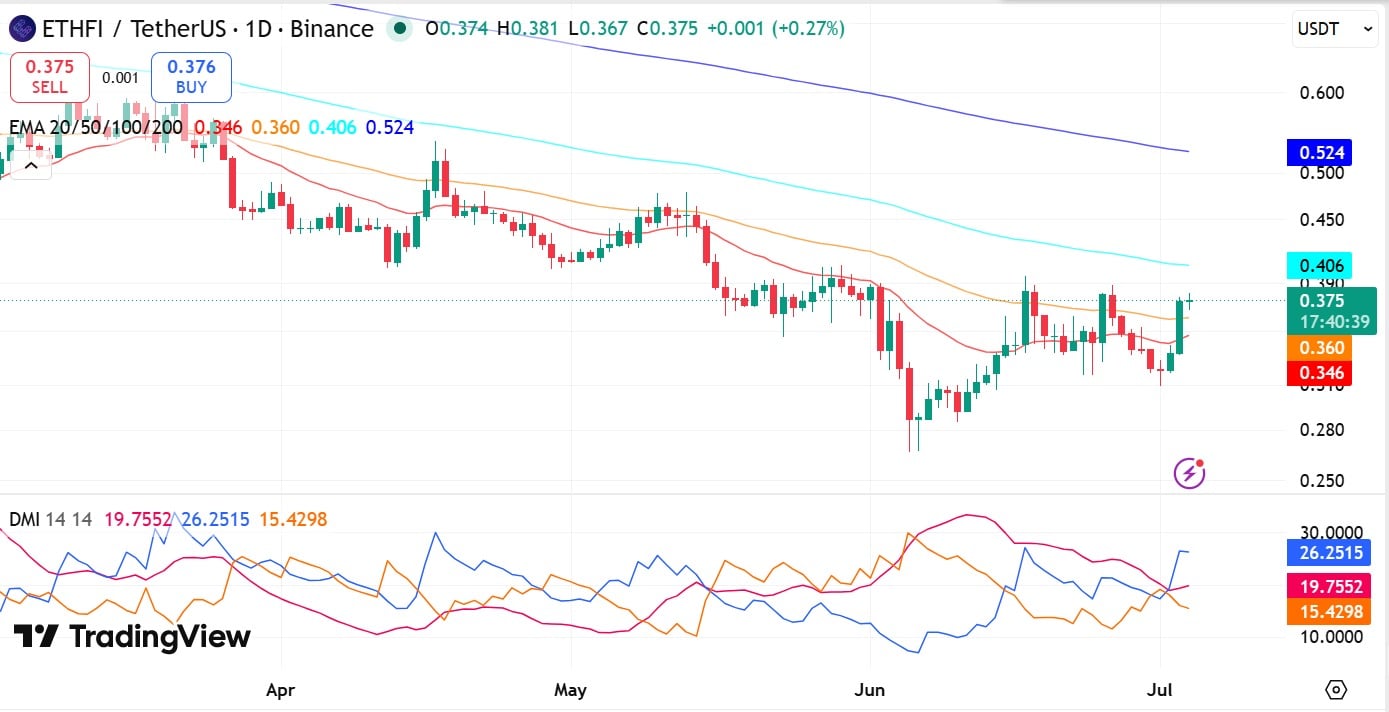
With the latest rally, the altcoin reclaimed the 20- and 50-day Exponential Moving Averages (EMAs) at $0.34 and $0.36, indicating strengthening upside momentum.

Why is THIS demand improving?

As June came to an end, ether.fi sellers showed signs of exhaustion after dominating the market during the final week of the month. That shift allowed buyers to defend the $0.30 support successfully.

Since then, buyers have outpaced sellers. According to CoinGlass data, Spot Netflow remained negative for four consecutive days.
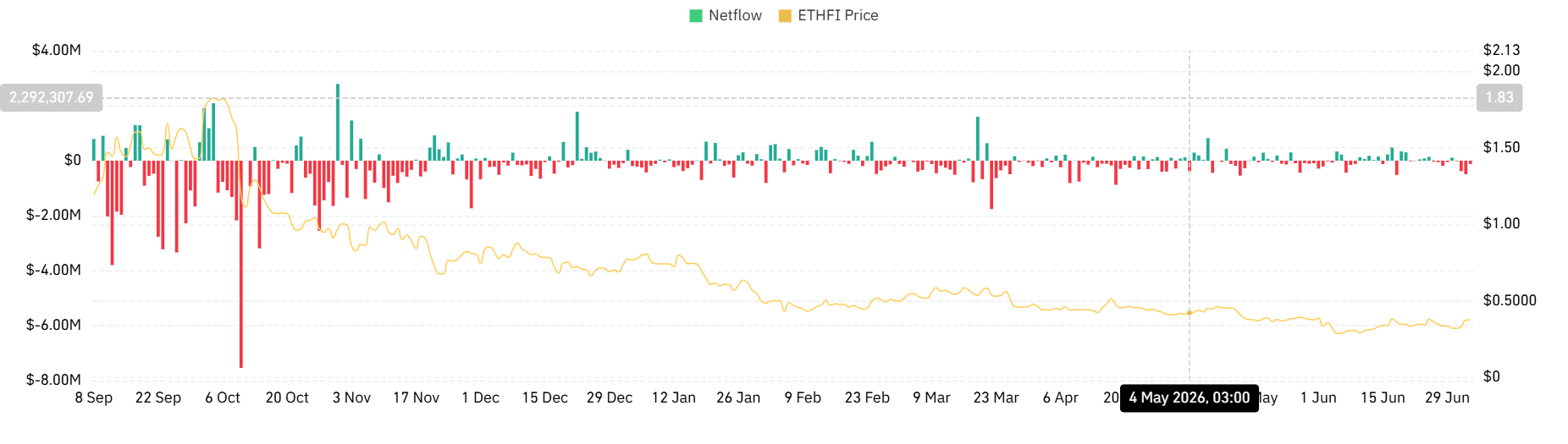
Source: CoinGlass

At press time, Spot Netflow stood at -$188k, improving from -$492k the previous day.

A sustained period of negative Spot Netflow suggested demand remained strong across the market. Historically, stronger Spot demand has supported better price performance.

In fact, momentum strengthened further over the past day.
Source: TradingView

The Directional Movement Index (DMI) formed a bullish crossover, with the positive index climbing to 26.

Meanwhile, the negative index dropped to 15, while the Average Directional Index (ADX) rose to 19. That setup indicated strengthening bullish momentum as selling pressure weakened.

If buyers maintain control, ETHFI could reclaim the 100-day Exponential Moving Average (EMA) near $0.40.

Why are derivatives traders staying cautious?

While the Spot market showed strong demand, derivatives traders continued to reduce exposure.

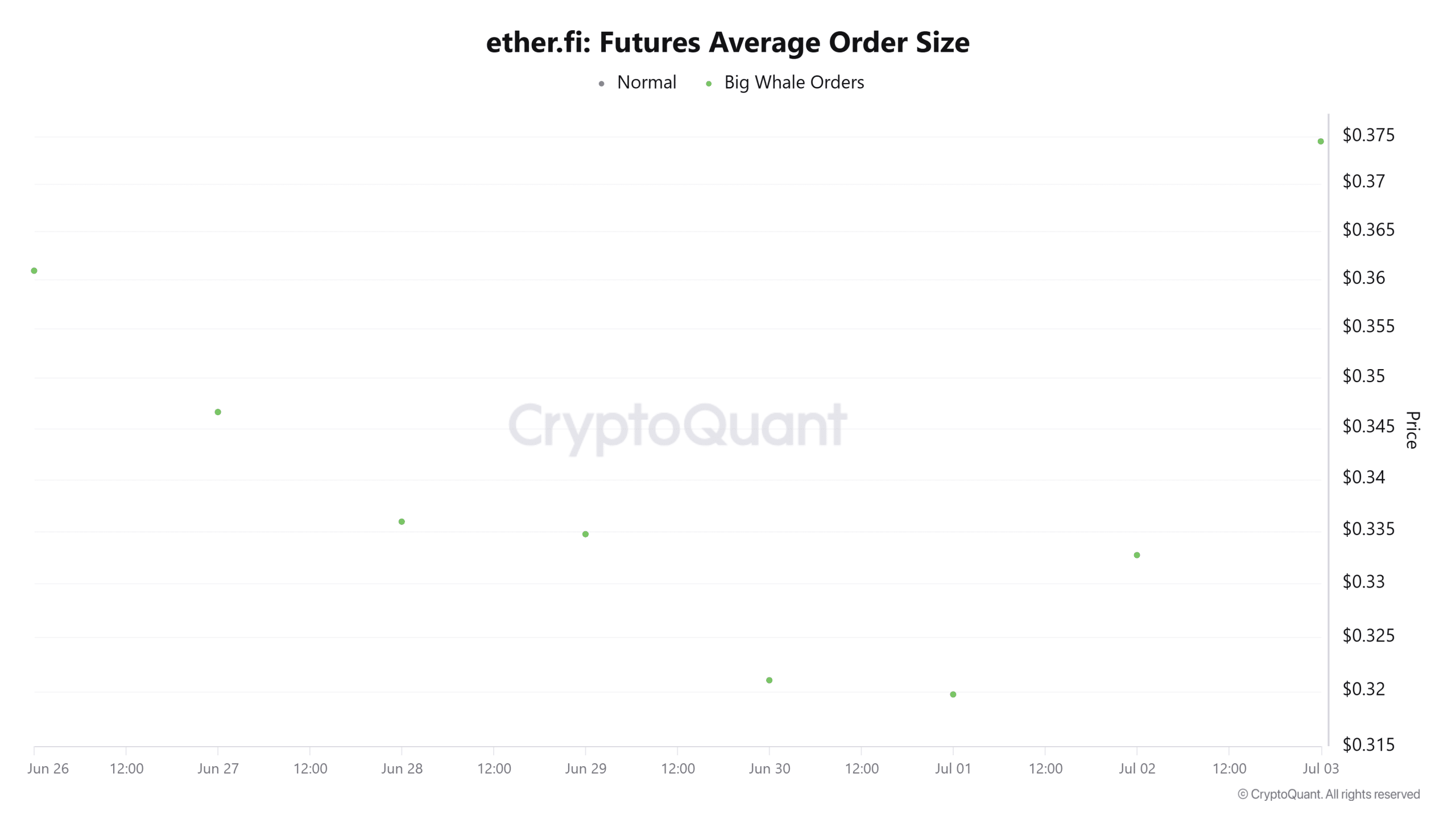
For starters, Futures Average Order Size data from CryptoQuant showed whales remained active throughout the recent downturn.
Source: CryptoQuant

Large orders suggested whales continued participating in the Futures market. However, selling pressure remained elevated.

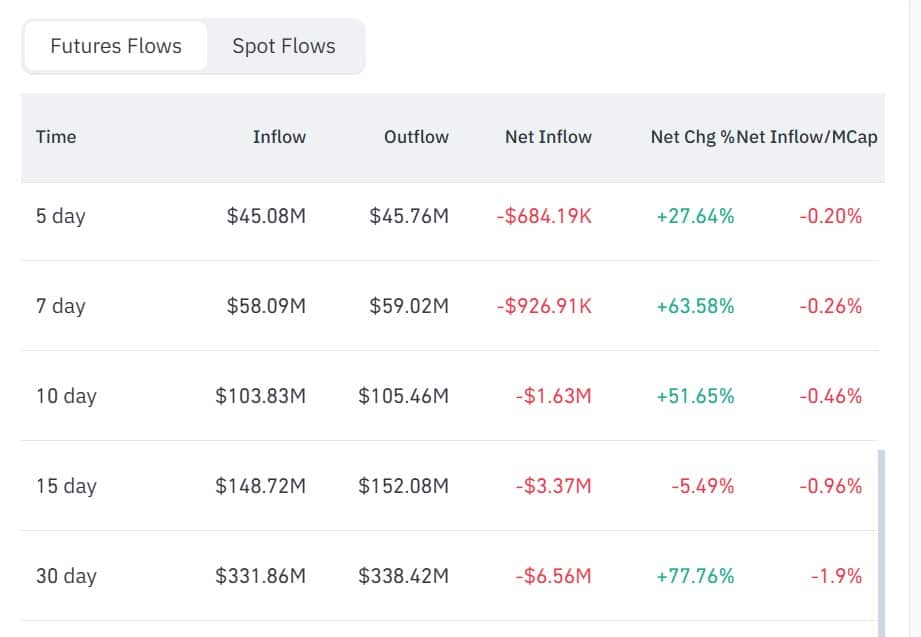
Over the past week, $59 million worth of Futures positions closed, while $338 million flowed out over the last month.
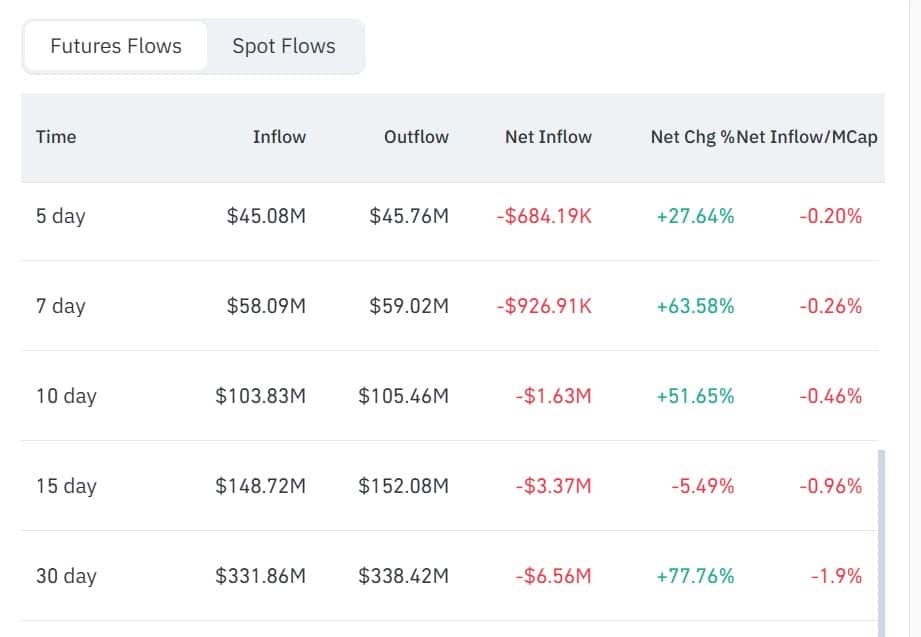
Source: CoinGlass

The same trend appeared in perpetual Futures.

Perpetual sell volume climbed to $88 million over the past week. Seller dominance across derivatives suggested traders remained unconvinced about a sustained recovery. Instead, many appeared to reduce exposure to strength.
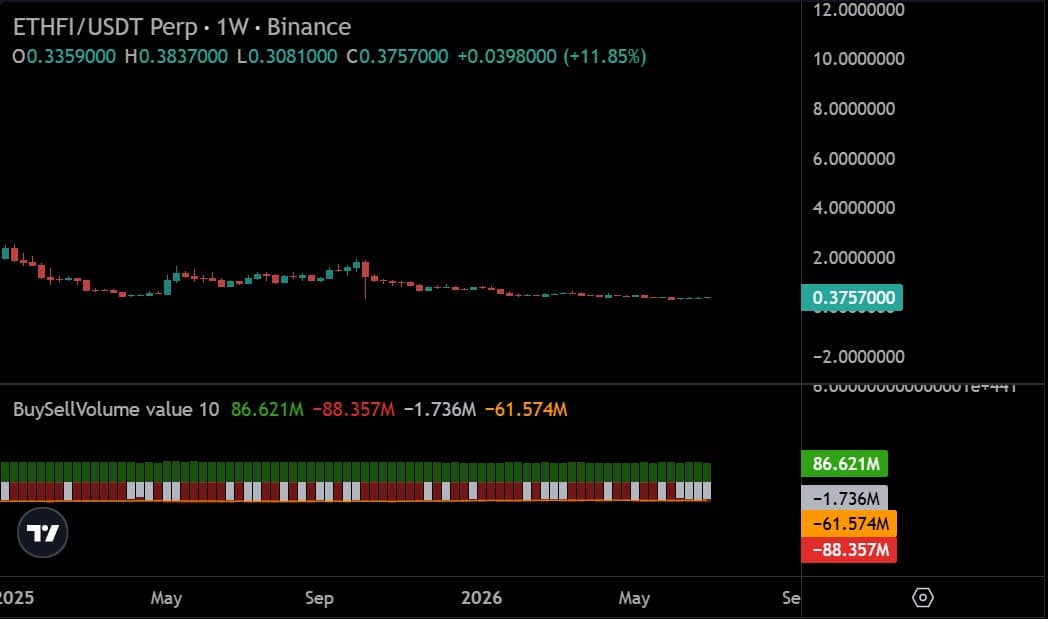
Source: Coinalyze

This continued caution posed a risk to the rally’s sustainability. If selling pressure persists, Ether.fi could revisit the $0.30 support.


Final Summary

  • ETHFI gained 11% as buyers defended $0.30 and reclaimed key short-term EMAs.
  • Negative Spot Netflow signaled sustained buyer demand despite recent market volatility.

Criptos en tendencia

Preguntas relacionadas

QWhat are the key price levels mentioned for ETHFI in the article, and what is the significance of the $0.30 level?

AThe article mentions ETHFI holding the $0.30 support level and its price aiming for the $0.40 level next. The $0.30 level is significant as it served as a key support that buyers successfully defended, which was a turning point that allowed the upward momentum to begin.

QWhat technical indicators are cited in the article to support the strengthening bullish momentum for ETHFI?

AThe article cites the reclaiming of the 20-day and 50-day Exponential Moving Averages (EMAs) and a bullish crossover on the Directional Movement Index (DMI) as indicators of strengthening bullish momentum. Specifically, the positive DMI index rose to 26 while the negative index dropped to 15.

QAccording to the article, what does a sustained negative Spot Netflow indicate for ETHFI's market?

AAccording to the article, a sustained period of negative Spot Netflow indicates that demand for ETHFI remains strong across the spot market. Historically, stronger spot demand has supported better price performance for the asset.

QWhat contrasting signal is presented from the derivatives market, and why does it pose a risk to the rally?

AThe contrasting signal from the derivatives market is that traders are reducing their exposure, as evidenced by significant outflows from futures positions and high perpetual sell volume. This caution poses a risk to the rally's sustainability because persistent selling pressure could cause the price to fall back to the $0.30 support level.

QWhat is the article's final conditional outlook for ETHFI's price movement?

AThe article's final outlook is conditional. It states that if buyers maintain control, ETHFI could reclaim the 100-day EMA near $0.40. However, if selling pressure from the derivatives market persists, the price could revisit the $0.30 support level instead.

Lecturas Relacionadas

MSTR Discloses Sale of 3,588 Bitcoins, Stock Price Drops Over 5% at One Point During Trading

MicroStrategy, the world's largest corporate holder of Bitcoin, has significantly shifted its business model. Between June 29 and July 5, the company sold 3,588 bitcoins for approximately $216 million to fund quarterly dividends for its preferred stock. This marks its largest-ever Bitcoin sale and signals a strategic pivot: Bitcoin is transitioning from a "buy-and-hold" reserve asset to a liquidity management tool for the company. This move follows a recent authorization allowing Bitcoin sales when equity fundraising is less attractive. The announcement contributed to a more than 5% intraday drop in MicroStrategy's stock price, while Bitcoin fell to around $61,800—below the company's average holding cost of roughly $75,700. The sale represents a major departure from MicroStrategy's long-standing "never sell" commitment, which saw its first minor breach in May with a $2.5 million sale. The latest, hundred-times-larger transaction underscores growing financial pressures. Analysts note the company faces about $1.5 billion in annual preferred dividend obligations, far exceeding cash flow from its software business. As of July 5, MicroStrategy holds 843,775 bitcoins. Its current operational logic involves buying Bitcoin during favorable financing conditions and selling portions to cover dividends when needed, creating a flexible capital management cycle amidst a challenging market environment.

华尔街日报Hace 6 hora(s)

MSTR Discloses Sale of 3,588 Bitcoins, Stock Price Drops Over 5% at One Point During Trading

华尔街日报Hace 6 hora(s)

Q-Day Countdown: Will Quantum Computing End Cryptocurrencies?

Quantum Computing's Threat to Cryptocurrency: A Countdown to Q-Day Quantum computing, specifically Shor's algorithm, poses a fundamental threat to the public-key cryptography (e.g., ECDSA, RSA) that secures blockchain networks like Bitcoin and Ethereum. This critical juncture, known as Q-Day, is estimated to occur potentially within the next 5-15 years. The core vulnerability stems from the public and immutable nature of blockchains. Assets in addresses where the public key is already exposed on-chain (e.g., spent outputs) are at direct risk, as a sufficiently powerful quantum computer could derive the private key. This threatens the very trust model of cryptocurrencies. The response lies in Post-Quantum Cryptography (PQC)—algorithms like lattice-based ML-DSA and hash-based SLH-DSA, which are resistant to quantum attacks. NIST has standardized key PQC algorithms (FIPS 203, 204, 205), providing a migration path. However, the primary challenge is not technical but socio-economic and involves complex governance: * **Bitcoin's** path is constrained by its conservative ethos. Migrating requires a soft-fork to new address types, facing hurdles like significantly larger signature sizes and, most critically, the divisive governance question of how to handle at-risk legacy UTXOs without violating core principles. * **Ethereum** is pursuing a "cryptographic agility" strategy, with a multi-layered roadmap. It leverages account abstraction for user accounts and is developing compressed hash-based signatures (e.g., leanXMSS) for its consensus layer, aiming for a full-stack upgrade over time. In conclusion, quantum computing does not spell an instant end for cryptocurrency but initiates a critical countdown. The industry has a limited "engineering comfort window" to orchestrate a coordinated, ecosystem-wide migration to PQC. The ultimate bottlenecks are the immense coordination efforts and governance decisions required for this foundational transition.

marsbitHace 7 hora(s)

Q-Day Countdown: Will Quantum Computing End Cryptocurrencies?

marsbitHace 7 hora(s)

Trump, the President Who Knows Best How to 'Trade Stocks'

Former US President Donald Trump reported a record-breaking $2.2 billion in personal income for 2025, the highest annual income ever disclosed by a sitting president. This figure, from a 927-page government ethics filing, represented a 3.5-fold increase from his $600 million income in 2024 and boosted his net worth to $6.5 billion. The primary drivers were cryptocurrency (64% of income, approximately $1.4 billion) and real estate (26%, approximately $575 million). His crypto earnings stemmed largely from the launch of his personal meme coin, $TRUMP, generating over $600 million in licensing fees, and substantial profits from the WLFI token and its parent company. Despite a sluggish property market, his Mar-a-Lago resort and associated golf clubs saw revenue surges of 50% and 27%, respectively, attributed to their use as venues for presidential events. Trump's financial disclosure also revealed an unprecedented level of stock market activity, with over 22,000 trades executed in 2025, averaging 87 trades per market day. Media analyses noted several instances where significant trading coincided with major policy announcements, such as proposed tariffs, raising questions about potential conflicts of interest. While the White House stated these trades were handled by a family-managed trust fund and not Trump directly, critics highlighted this as a departure from the blind trusts traditionally used by presidents post-Watergate. The report has intensified debate over the commercialization of the presidency. Supporters view it as a success story of a businessman-president, while critics argue it demonstrates an unprecedented conversion of public influence into private wealth, with policy decisions potentially linked to personal financial gains. The controversy centers on whether Trump's earnings represent innovative entrepreneurship or a fundamental conflict of interest, sparking renewed calls for stricter ethics reforms in US governance.

marsbitHace 7 hora(s)

Trump, the President Who Knows Best How to 'Trade Stocks'

marsbitHace 7 hora(s)

Trading

Spot

Artículos destacados

Cómo comprar ETHFI

¡Bienvenido a HTX.com! Hemos hecho que comprar ether.fi (ETHFI) sea simple y conveniente. Sigue nuestra guía paso a paso para iniciar tu viaje de criptos.Paso 1: crea tu cuenta HTXUtiliza tu correo electrónico o número de teléfono para registrarte y obtener una cuenta gratuita en HTX. Experimenta un proceso de registro sin complicaciones y desbloquea todas las funciones.Obtener mi cuentaPaso 2: ve a Comprar cripto y elige tu método de pagoTarjeta de crédito/débito: usa tu Visa o Mastercard para comprar ether.fi (ETHFI) al instante.Saldo: utiliza fondos del saldo de tu cuenta HTX para tradear sin problemas.Terceros: hemos agregado métodos de pago populares como Google Pay y Apple Pay para mejorar la comodidad.P2P: tradear directamente con otros usuarios en HTX.Over-the-Counter (OTC): ofrecemos servicios personalizados y tipos de cambio competitivos para los traders.Paso 3: guarda tu ether.fi (ETHFI)Después de comprar tu ether.fi (ETHFI), guárdalo en tu cuenta HTX. Alternativamente, puedes enviarlo a otro lugar mediante transferencia blockchain o utilizarlo para tradear otras criptomonedas.Paso 4: tradear ether.fi (ETHFI)Tradear fácilmente con ether.fi (ETHFI) en HTX's mercado spot. Simplemente accede a tu cuenta, selecciona tu par de trading, ejecuta tus trades y monitorea en tiempo real. Ofrecemos una experiencia fácil de usar tanto para principiantes como para traders experimentados.

96 Vistas totalesPublicado en 2024.12.10Actualizado en 2026.06.02

Cómo comprar ETHFI

Discusiones

Bienvenido a la comunidad de HTX. Aquí puedes mantenerte informado sobre los últimos desarrollos de la plataforma y acceder a análisis profesionales del mercado. A continuación se presentan las opiniones de los usuarios sobre el precio de ETHFI (ETHFI).

活动图片