Tín Hiệu Phục Hồi Trong Hệ Sinh Thái Solana: Nâng Cấp Quản Trị On-Chain, Cổ Phiếu Token Hóa và Meme Cùng Tăng Nhiệt

marsbitPublicado a 2026-07-03Actualizado a 2026-07-03

Resumen

Tín hiệu phục hồi trên hệ sinh thái Solana: Nâng cấp quản trị on-chain, cổ phiếu token hóa và Meme coin cùng tăng nhiệt Trong bối cảnh thị trường tiền mã hóa chung đang suy yếu, Solana (SOL) đã thể hiện xu hướng tăng trưởng tương đối độc lập với mức tăng khoảng 14.9% trong một tuần. Sự phục hồi cục bộ này được thúc đẩy bởi hai lĩnh vực chính: Tài sản thế giới thực (RWA) và Meme coin. Trong lĩnh vực RWA, Solana hiện dẫn đầu về số lượng ví nắm giữ (hơn 293,000) và số lượng tài sản (2,119). Đặc biệt, thị trường cổ phiếu được token hóa trên Solana đã tăng trưởng bùng nổ, với khối lượng giao dịch hàng tuần đạt kỷ lục 1.42 tỷ USD, chiếm khoảng 96% thị phần toàn ngành, chủ yếu nhờ vào nền tảng Backpack. Song song đó, thị trường Meme coin trên Solana cũng hồi sinh với sự xuất hiện của ANSEM - được KOL Ansem hỗ trợ và đạt vốn hóa đỉnh 1.8 tỷ USD. Sự kiện này đã kích hoạt lại hoạt động trên các sàn giao dịch như Pump.fun. Về quản trị, Solana đã ra mắt cơ chế quản trị on-chain mới mang tên Solana Governance Proposals (SGP). Cơ chế này cho phép các trình xác thực có ít nhất 100,000 SOL được ủy quyền đề xuất và bỏ phiếu cho các quyết định quan trọng trên chuỗi, làm tăng tính phi tập trung và khả năng tham gia của cộng đồng. SGP sẽ hoạt động song song với quy trình SIMD hiện có cho các nâng cấp kỹ thuật. Mặc dù có những tín hiệu tích cực, sự phục hồi của hệ sinh thái Solana vẫn chủ yếu tập trung vào các mảng nóng và chưa đạt đến quy mô toàn diện so với đỉnh cao trước đó.

Tác giả: Nancy, PANews

Trong khoảng thời gian gần đây, thị trường tiền mã hóa một lần nữa chìm trong không khí lạnh giá, Bitcoin có lúc đã mất mốc 60,000 USD, các tài sản mã hóa chủ đạo suy yếu phổ biến.

Ngược lại, Solana lại cho thấy một diễn biến tương đối độc lập, tăng khoảng 14.9% trong tuần qua. Đằng sau mức tăng giá này, không thể tách rời sự thúc đẩy từ việc phục hồi cục bộ trong hệ sinh thái và nâng cấp cơ chế quản trị on-chain.

Hệ Sinh Thái Cho Thấy Tín Hiệu Phục Hồi, RWA và Meme Đồng Lúc Tăng Nhiệt

Gần đây, hệ sinh thái Solana đã giải phóng những tín hiệu phục hồi, đặc biệt là ở hai mảng chính: cổ phiếu token hóa và meme coin.

Trong lĩnh vực RWA, dữ liệu từ RWA.xyz cho thấy, tính đến ngày 3 tháng 7, dựa trên số lượng ví nắm giữ, số ví nắm giữ RWA trên Solana đã vượt quá 293,000, chiếm khoảng 31.1% tổng số ví toàn mạng, đứng đầu tất cả các blockchain, trong khi Plume và Ethereum lần lượt đứng thứ hai và ba với khoảng 248,000 và 205,000 ví. Đồng thời, số lượng tài sản RWA trên Solana đạt 2119, cũng đứng đầu, vượt qua các blockchain chủ đạo như Arbitrum, Ethereum, BNB Chain.
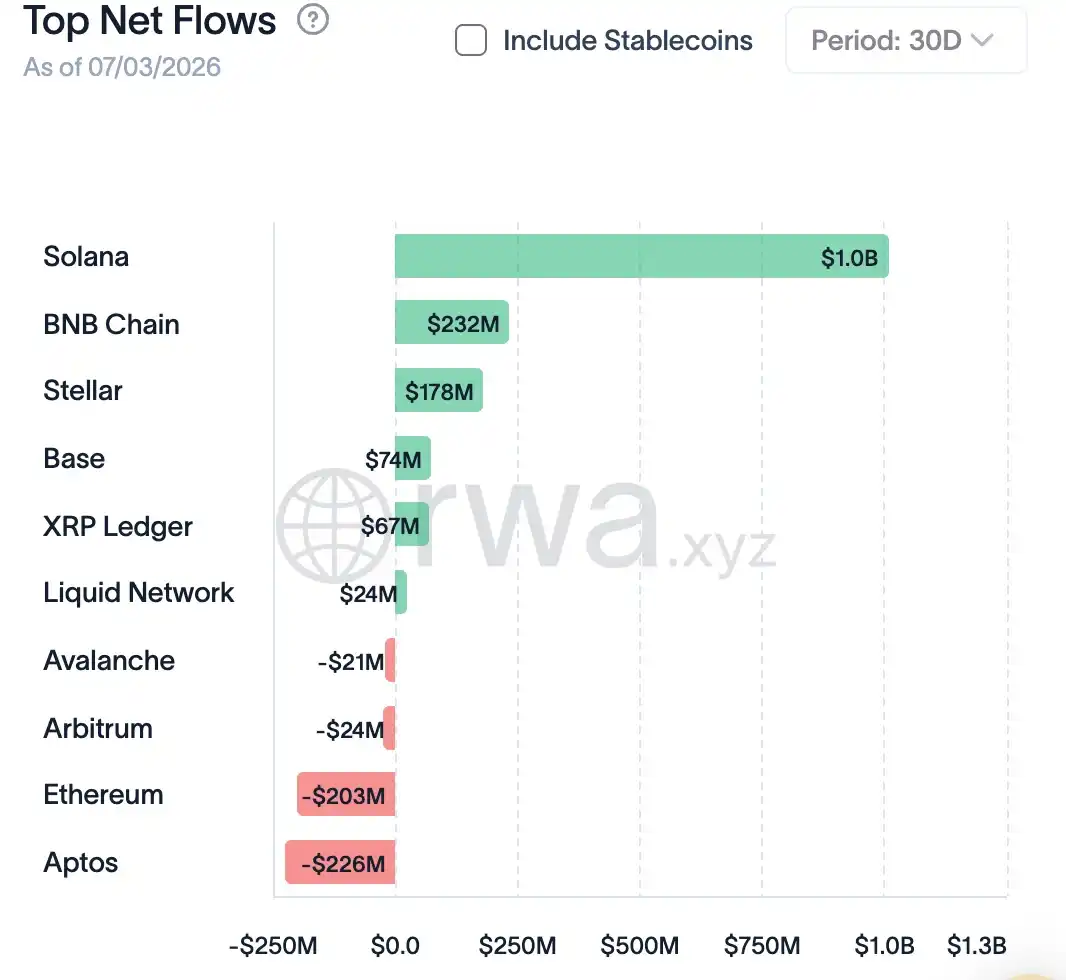
Tuy nhiên, xét về quy mô tài sản, Solana vẫn còn một khoảng cách khá lớn để đuổi kịp. Hiện tại, tổng giá trị RWA trên chain của nó khoảng 3.55 tỷ USD, vẫn còn chênh lệch đáng kể so với Ethereum. Nhưng nếu quan sát dòng tiền, dòng tiền ròng chảy vào RWA trên Solana trong 30 ngày qua đã vượt quá 1 tỷ USD, rõ ràng dẫn trước các blockchain như Ethereum, BNB Chain, Arbitrum, Base, XRP Ledger và Aptos, điều này chứng tỏ gần đây vốn đang chảy vào hệ sinh thái Solana.

Đằng sau sự tăng trưởng của thị trường RWA trên Solana lần này là từ sự mở rộng nhanh chóng của thị trường cổ phiếu token hóa.
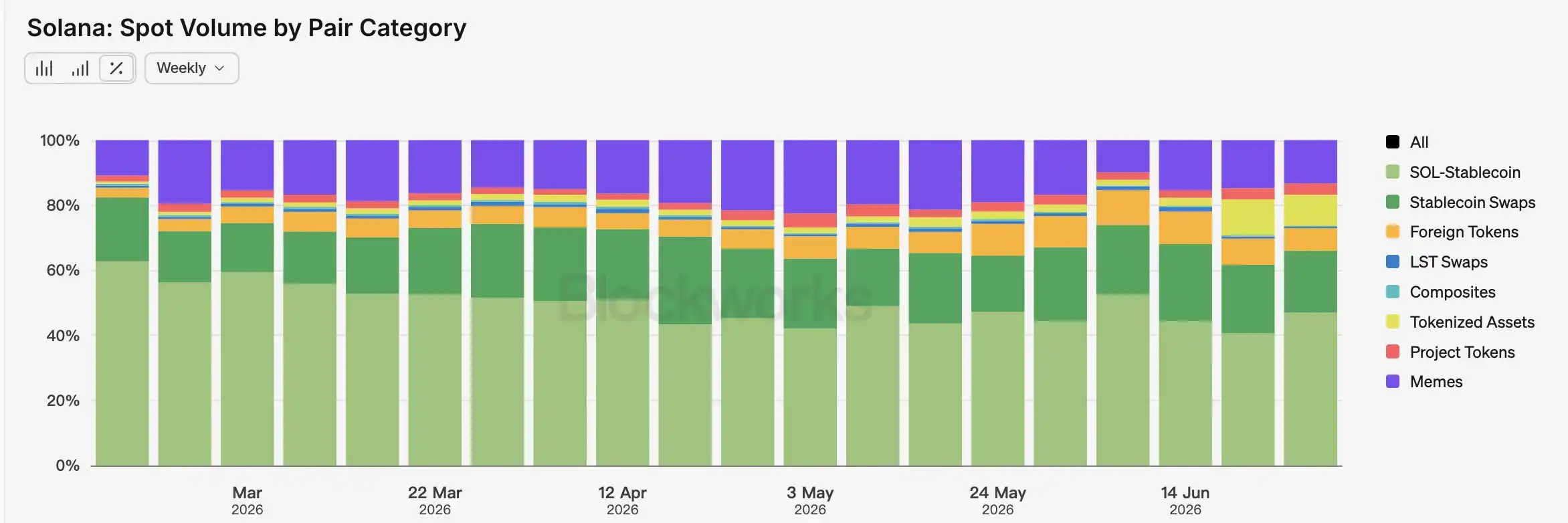
Theo dữ liệu mới nhất từ Blockworks, hiện tại tài sản token hóa chiếm khoảng 10% khối lượng giao dịch spot hàng tuần của Solana, trong khi tỷ lệ này đầu năm chỉ là 1%, giờ đây đã trở thành danh mục giao dịch lớn thứ hai chỉ sau meme coin.
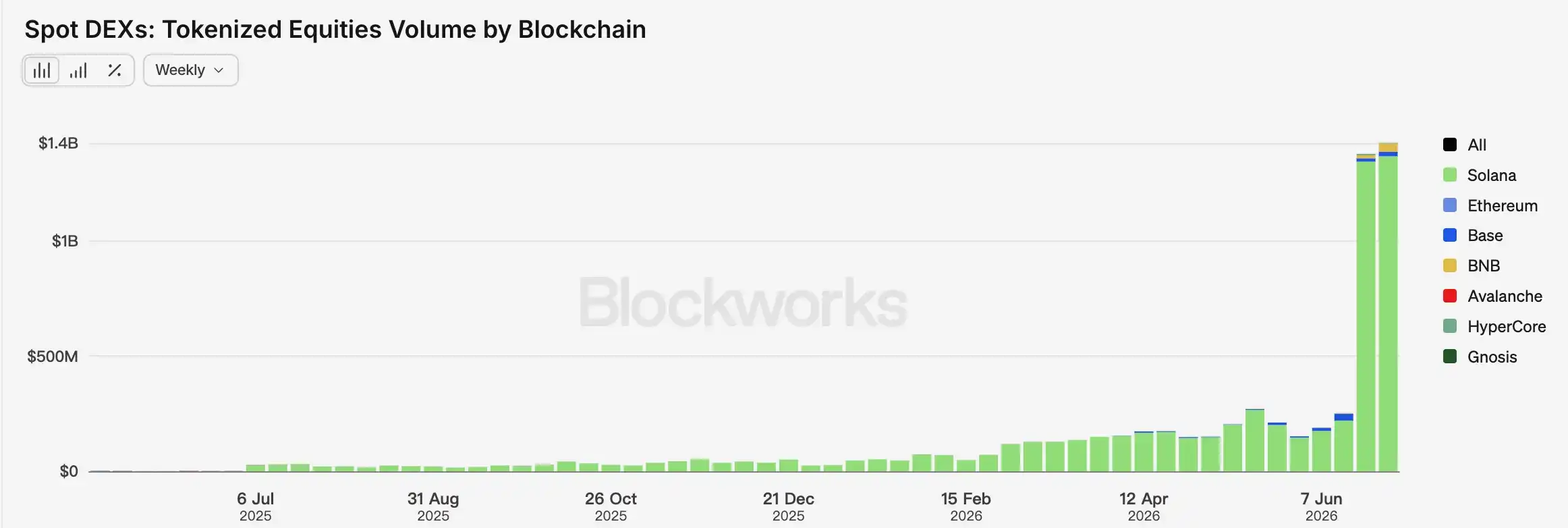
Đồng thời, khối lượng giao dịch hàng tuần của cổ phiếu token hóa trên Solana cũng đạt mức cao kỷ lục mới, vượt 1.42 tỷ USD, tăng 30.9 lần so với đầu năm, chiếm khoảng 96% thị phần giao dịch của toàn bộ thị trường cổ phiếu token hóa. Sự tăng trưởng này chủ yếu nhờ vào dịch vụ cổ phiếu token hóa do Backpack ra mắt vào tháng trước. Hiện tại, Backpack đã trở thành nền tảng phát hành cổ phiếu token hóa lớn nhất trên Solana, hai cổ phiếu token hóa SPCX và MU do họ phát hành lần lượt đóng góp khoảng 95% và 99% khối lượng giao dịch trên Solana.

Mặt khác, thị trường meme coin vốn trầm lắng từ lâu cũng bắt đầu ấm lên.

Gần đây, KOL Ansem công khai ủng hộ đồng meme coin cùng tên ANSEM, nhanh chóng thổi bùng nhiệt huyết giao dịch "hầm hào" trên Solana. Nhờ hiệu ứng người nổi tiếng, mức độ kiểm soát cao (Ansem nắm giữ 65% tổng nguồn cung token) và kỳ vọng airdrop, vốn hóa của ANSEM đã vượt mốc 180 triệu USD chỉ trong vài ngày.

Dữ liệu từ Dune cho thấy, tính đến ngày 3 tháng 7, Ansem đã airdrop token ANSEM trị giá hơn 12.57 triệu USD cho 979 địa chỉ. Đồng thời, hiện khoảng 94.75% nhà giao dịch ANSEM đang có lãi, tiếp thêm dầu vào lửa cho tâm lý thị trường.
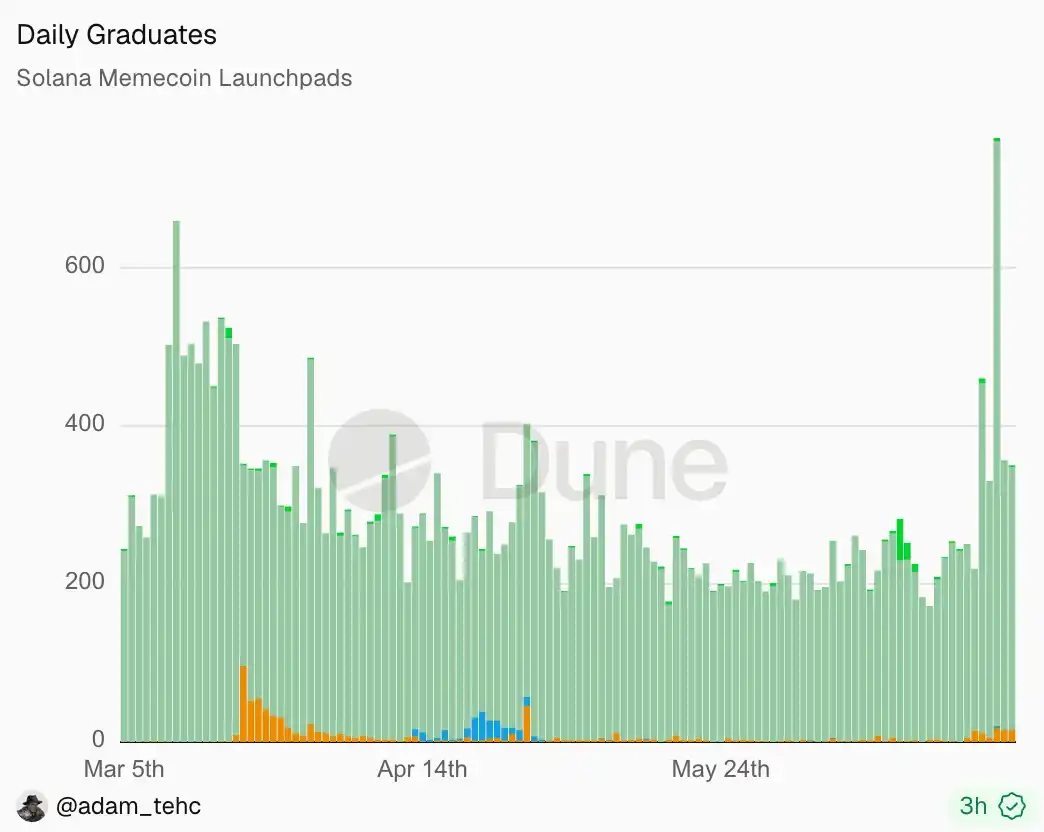
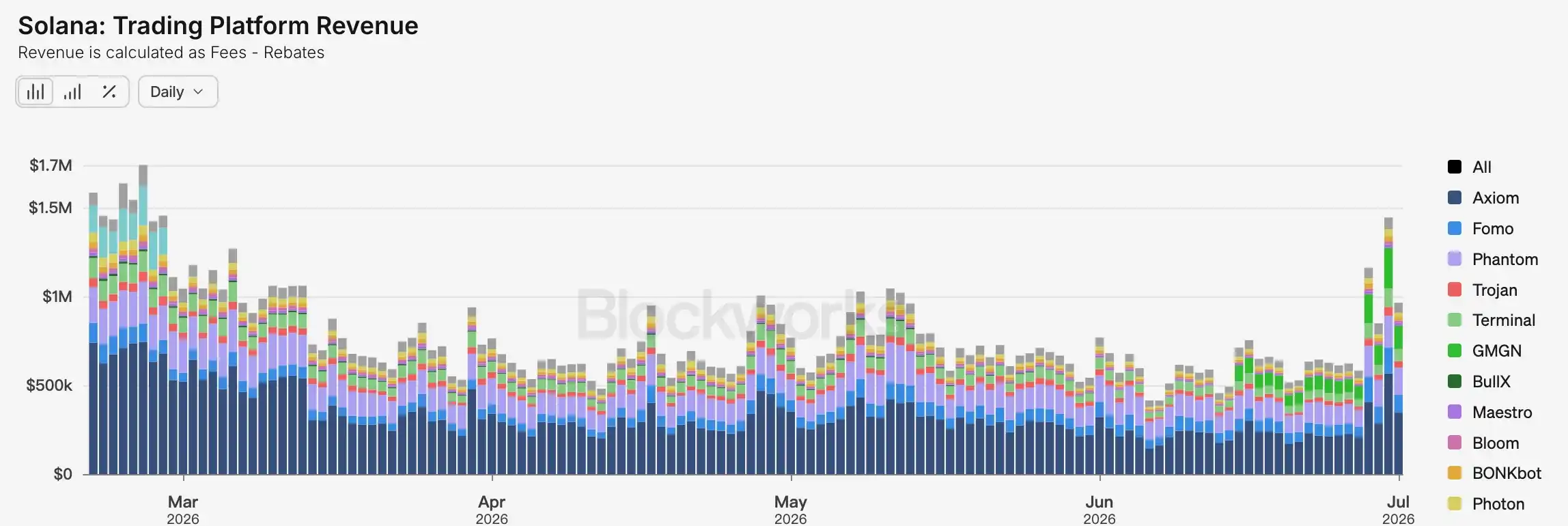
Được thúc đẩy bởi diễn biến của ANSEM, mức độ hoạt động của hệ sinh thái meme Solana cũng đồng thời phục hồi. Lấy Pump.fun làm ví dụ, dữ liệu từ Dune cho thấy số lượng token tốt nghiệp hàng ngày trên nền tảng này đã đạt mức cao nhất kể từ tháng 4, khối lượng giao dịch hàng ngày tăng hơn gấp đôi so với một tháng trước. Đồng thời, dữ liệu từ Blockworks cho thấy, doanh thu hàng ngày của các nền tảng giao dịch trong hệ sinh thái Solana như Axiom, Phantom, GMGN, Fomo gần đây cũng đã lập mức cao mới kể từ tháng 2 năm nay.
Quản Trị On-Chain Solana Đón Nâng Cấp Quan Trọng, 100,000 SOL Có Thể Đề Xuất Kiến Nghị

Gần đây, cơ chế quản trị on-chain của Solana đã đón nhận bản nâng cấp, mức độ phi tập trung trong việc ra quyết định của giao thức được nâng cao hơn nữa, hứa hẹn thúc đẩy hệ sinh thái phát triển lành mạnh hơn.

Vào ngày 2 tháng 7, Quỹ Solana thông báo chính thức ra mắt cơ chế quản trị on-chain Solana Governance Proposals (SGP), qua đó các trình xác thực có thể thông qua SGP để gửi đề xuất, ủng hộ và biểu quyết các quyết định cốt lõi của giao thức. Toàn bộ quá trình quản trị được thực hiện on-chain, sử dụng cơ chế bỏ phiếu dựa trên trọng số stake, và được xác minh thông qua Merkle proof.

Theo quy tắc, bất kỳ trình xác thực nào nhận được ủy quyền ít nhất 100,000 SOL (tương đương khoảng 8 triệu USD theo giá hiện tại) có thể đề xuất kiến nghị quản trị, trong khi trước đây những người stake chủ yếu tham gia gián tiếp thông qua việc ủy quyền cho trình xác thực. Trọng số bỏ phiếu sẽ được tính theo số lượng stake, đồng thời người ủy quyền có thể ghi đè lựa chọn bỏ phiếu của trình xác thực mà họ ủy quyền, điều này ở một mức độ nào đó đã nâng cao mức độ tham gia của cộng đồng, đồng thời hạ thấp hơn nữa ngưỡng quản trị.

Trước khi SGP ra mắt, việc quản trị giao thức của Solana chủ yếu dựa vào quy trình SIMD (Solana Improvement Documents).

Các nhà phát triển thường sẽ gửi đề xuất kỹ thuật trên GitHub, sau khi thảo luận công khai trong cộng đồng và được nhóm phát triển cốt lõi đánh giá, nhóm cốt lõi sẽ chịu trách nhiệm hoàn thành phát triển và phát hành phiên bản client mới. Sau đó, các trình xác thực tự quyết định việc nâng cấp phần mềm node của họ. Khi tỷ lệ stake hoạt động chạy phiên bản mới đạt ngưỡng đủ và mạng ổn định, các tính năng tương ứng sẽ được kích hoạt chính thức thông qua Feature Gate (công tắc tính năng) tại Slot hoặc Epoch được chỉ định.

Mô hình quản trị này về bản chất là sự đồng thuận off-chain kết hợp với việc áp dụng client thực tế, tránh hiệu quả việc chia tách mạng do hard fork gây ra, đồng thời duy trì hiệu quả lặp lại cao, nhưng mức độ tham gia trực tiếp của cộng đồng vào các vấn đề quản trị quan trọng tương đối hạn chế.

Đáng chú ý là SGP sẽ không thay thế SIMD, mà cả hai sẽ cùng tồn tại và phân công nhiệm vụ. SIMD tiếp tục tập trung vào nâng cấp giao thức và cải thiện ở cấp độ kỹ thuật, trong khi SGP tập trung vào các vấn đề quản trị quan trọng của hệ sinh thái, cung cấp một kênh ra quyết định thống nhất, minh bạch on-chain cho cộng đồng và các trình xác thực, đồng thời hạ thấp hơn nữa ngưỡng quản trị. Sự phân công quản trị rõ ràng này vừa nâng cao mức độ tham gia của cộng đồng, vừa có lợi cho việc duy trì tính độc lập và hiệu quả trong phát triển giao thức cốt lõi.

Để tránh tài nguyên quản trị bị tiêu hao bởi các đề xuất chất lượng thấp, Solana còn thiết lập ngưỡng: đề xuất quản trị trước tiên cần được đưa ra thông qua quy trình SGP và nhận được sự ủng hộ từ không ít hơn 15% lượng stake hoạt động, sau đó mới chính thức bước vào giai đoạn bỏ phiếu on-chain, đảm bảo các đề xuất vào được vòng biểu quyết đều có cơ sở đồng thuận cộng đồng nhất định. Hiện tại tổng lượng stake trên toàn mạng Solana khoảng 42.8 triệu SOL (chiếm khoảng 68% tổng cung), nghĩa là một đề xuất cần nhận được sự ủng hộ stake từ khoảng 6.42 triệu SOL mới có thể bước vào giai đoạn bỏ phiếu.

Ngoài việc nâng cấp cơ chế quản trị, Solana cũng đang đồng thời thúc đẩy tối ưu hóa tokenomics, các đề xuất SIMD-550 và SIMD-553 dự kiến triển khai vào năm 2026. Hai đề xuất này nhằm mục đích tăng tỷ lệ giảm lạm phát hàng năm của SOL từ 15% lên 30%, và dự kiến có thể giảm phát hành mới khoảng 18.9 triệu SOL trong 6 năm tới.

Nhìn toàn cảnh hệ sinh thái, sự phục hồi hiện tại vẫn chủ yếu tập trung vào các lĩnh vực nóng. Cho dù là số địa chỉ hoạt động on-chain hay quy mô giao dịch tổng thể, vẫn còn một khoảng cách đáng kể so với đỉnh cao của chu kỳ bull run trước, điều này có nghĩa là hệ sinh thái Solana vẫn đang trong giai đoạn phục hồi cục bộ, vẫn còn một khoảng cách nhất định so với sự phục hồi toàn diện.

Criptos en tendencia

Preguntas relacionadas

QSolana đang thể hiện tín hiệu hồi phục trong lĩnh vực nào?

ASolana đang thể hiện tín hiệu hồi phục rõ rệt ở hai lĩnh vực chính: Tài sản thực được mã hóa (RWA), đặc biệt là thị trường cổ phiếu mã hóa (tokenized stocks), và thị trường tiền Meme.

QNhững số liệu nào cho thấy sự tăng trưởng mạnh của thị trường cổ phiếu mã hóa trên Solana?

AKhối lượng giao dịch cổ phiếu mã hóa hàng tuần trên Solana đã đạt mức cao kỷ lục, vượt 1,42 tỷ USD, tăng gấp 30,9 lần so với đầu năm và chiếm khoảng 96% thị phần giao dịch của toàn thị trường cổ phiếu mã hóa. Backpack là nền tảng phát hành lớn nhất, với hai mã token hóa SPCX và MU chiếm lần lượt khoảng 95% và 99% khối lượng giao dịch trên chuỗi.

QMeme coin nào đã kích hoạt làn sóng giao dịch trên Solana gần đây và tại sao?

AMeme coin ANSEM đã kích hoạt làn sóng giao dịch trên Solana. Động lực chính đến từ việc KOL crypto Ansem công khai ủng hộ, cùng với các yếu tố như tỷ lệ nắm giữ cao (65% tổng cung), kỳ vọng airdrop và việc airdrop trị giá hơn 12,57 triệu USD cho 979 địa chỉ, dẫn đến việc hơn 94% nhà giao dịch ANSEM đang có lãi.

QCơ chế quản trị trên chuỗi mới của Solana (SGP) có những điểm nổi bật gì?

ACơ chế quản trị mới Solana Governance Proposals (SGP) cho phép bất kỳ trình xác thực nào có ít nhất 100.000 SOL được ủy quyền (khoảng 8 triệu USD) có thể đưa ra đề xuất quản trị. Quá trình bỏ phiếu diễn ra trên chuỗi, sử dụng cơ chế bỏ phiếu dựa trên trọng số stake. Người ủy quyền có thể ghi đè lựa chọn bỏ phiếu của trình xác thực họ ủy quyền, giúp tăng cường sự tham gia của cộng đồng và giảm ngưỡng tham gia quản trị.

QCác đề xuất SIMD-550 và SIMD-553 nhằm mục đích gì đối với tokenomics của SOL?

AHai đề xuất SIMD-550 và SIMD-553 nhằm tối ưu hóa tokenomics của SOL bằng cách tăng tỷ lệ giảm phát hàng năm từ 15% lên 30%. Dự kiến các đề xuất này sẽ được thực hiện vào năm 2026 và ước tính sẽ giảm khoảng 18,9 triệu SOL được phát hành mới trong vòng 6 năm tới.

Lecturas Relacionadas

Can Open USD Support Stripe's Ambitions?

Can Open USD support Stripe's ambition? The article argues that OUSD represents a pivotal strategic move for Stripe, shifting its narrative from being a superior payments API company to becoming a "money movement network." Unlike simply facilitating payments, this new model aims to organize and define the settlement layer, default assets, and economic distribution rules for future commerce. The analysis highlights OUSD's role in giving Stripe a potential default settlement asset, enabling deeper economics through reserve earnings, and providing a programmable money layer for emerging use cases like AI agentic commerce. Crucially, OUSD is presented not as a direct "USDC killer" but as an attempt to redefine the business model of stablecoins, proposing a collaborative governance structure where contributing partners share in the network's economic benefits and governance. For Stripe, this is about evolving from a powerful "abstraction layer" over traditional financial rails into an active participant and potential architect of the next-generation global settlement network. While OUSD alone cannot immediately realize this ambition, it signals Stripe's intent to move closer to the money layer itself, positioning itself at the center of future money flows in an increasingly automated, platform-driven, and AI-powered economy. The ultimate question is whether Stripe can transition from being a best-in-class payment processor to becoming the foundational infrastructure for internet-native money movement.

marsbitHace 5 min(s)

Can Open USD Support Stripe's Ambitions?

marsbitHace 5 min(s)

This Week's Crypto Watchlist|Jupiter, NEAR, Jito, and 7 Other Projects are Active. Understand Who's Worth Monitoring with a 'Catalyst Calendar'

This week brings a concentrated wave of catalysts for several crypto projects, based on a schedule compiled by an analyst. Jupiter (JUP) leads by launching a private testnet for its GUM unified market on July 6th, aiming to aggregate diverse assets on Solana. On July 7th, NEAR hosts a major livestream reveal focused on enterprise "black box" tech, likely detailing its SPICE upgrade. Also on July 7th-8th, Berachain executes its largest mainnet upgrade, "PoL Next," simplifying its tokenomics by retiring the BGT token and consolidating value into BERA. Zcash (ZEC) eyes recovery with its critical Ironwood network upgrade slated for July 21st, designed to restore trust after a recent privacy vulnerability scare. Looking ahead, Lighter (LIT) plans to launch tokenized stocks next week, leveraging its key position as the default perpetual DEX on the new Robinhood Chain. Jito (JTO) is rumored to launch its JTX trading platform in mid-July, targeting professional traders and promising substantial protocol revenue sharing. Lastly, Ether.fi (ETHFI) has proposed deploying a dedicated Aave V4 instance to power its EtherFi Cash Visa card, though this remains in the early governance stage. The week presents a mix of product launches, major upgrades, and strategic expansions, each carrying its own potential for momentum and associated risks like token unlocks or execution challenges.

marsbitHace 18 min(s)

This Week's Crypto Watchlist|Jupiter, NEAR, Jito, and 7 Other Projects are Active. Understand Who's Worth Monitoring with a 'Catalyst Calendar'

marsbitHace 18 min(s)

How Token Economy Reshapes the Business Rules of AI 'Measurement' | ToB Industry Observation

"Token Economy: How It Reshapes the Business Rules of AI's 'Metrics' | ToB Industry Observation" The article discusses how the token economy is fundamentally changing the business landscape for AI, moving from a phase of explosive technical supply to a focus on measurable value for enterprise demand. It highlights the astronomical growth in daily token usage in China, framing tokens as the new "measurement standard" or "electricity" of the intelligent era. A central challenge is determining a token's value, which varies drastically—up to 100,000x—across different applications, from drug discovery to casual chat. The concept of "high-quality tokens" that deliver real intelligence, versus "noise," is emphasized as crucial. Lenovo's Vice President shares three proposed "laws" of token economics: 1. **Law of Inertia:** The cost per token will continuously decline due to technological innovation, system optimization, and intelligent runtime scheduling. 2. **Law of Acceleration:** The value generated per token accelerates based on the depth of AI integration into business workflows, the level of engineering support, and organizational readiness. 3. **Law of the Singularity:** A tipping point where the value curve of AI application surpasses its cost curve, shifting from cost-saving to generating incremental, previously impossible value—enabling "innovation at scale." The article notes real-world struggles, such as companies exceeding AI budgets due to unpredictable token pricing and "token inflation" from agentic AI workflows. Solutions being explored include standardized metrics for token quality, transparent pricing, and new infrastructure like "Token Factories" for efficient, on-demand token production. The ultimate goal is for businesses to move past anxiety and reach the "singularity," where AI drives scalable innovation, akin to how electricity enabled countless modern appliances.

marsbitHace 31 min(s)

How Token Economy Reshapes the Business Rules of AI 'Measurement' | ToB Industry Observation

marsbitHace 31 min(s)

Trading

Spot

Artículos destacados

Qué es MEME 2.0

Memecoin 2.0: El Ascenso de $MEME 2.0 en el Mundo de las Criptomonedas Introducción En el panorama siempre cambiante de las criptomonedas, ha surgido un nuevo contendiente. Memecoin 2.0, simbolizada como $MEME 2.0, lleva el concepto de las monedas meme a un emocionante nuevo nivel. Como un subproducto del Memecoin original, este proyecto ha capturado la atención de la comunidad cripto al cambiar el enfoque de los incentivos financieros típicos a una experiencia comprometida y entretenida. Operando en la blockchain de Ethereum, Memecoin 2.0 redefine audazmente la participación de la comunidad en la esfera cripto. ¿Qué es Memecoin 2.0, $MEME 2.0? En su núcleo, Memecoin 2.0 es un proyecto de criptomoneda que prioriza el espíritu comunitario y la diversión asociada con la cultura meme. A diferencia de las criptomonedas convencionales, que se concentran en casos de uso prácticos y beneficios tangibles, Memecoin 2.0 se distingue al abrazar el lado más liviano de la moneda digital. El proyecto existe sin promesas de utilidad, un mapa estructurado o retornos financieros, enfocándose en cambio en fomentar una comunidad vibrante centrada en memes y en el disfrute compartido. Al hacerlo, aprovecha la creciente tendencia de la cultura meme en el espacio en línea, convirtiéndose en un jugador único en el mundo de los activos digitales. Creador de Memecoin 2.0, $MEME 2.0 A pesar de la extensa investigación sobre los orígenes de Memecoin 2.0, la identidad explícita de su creador sigue siendo desconocida. Esta anonimidad no es inusual en la comunidad cripto, donde muchos proyectos son liderados por individuos o grupos que prefieren permanecer en las sombras. La falta de información disponible públicamente sobre el creador podría verse como un movimiento estratégico, poniendo el foco en la participación comunitaria en lugar de la notoriedad individual dentro del espacio. Inversores de Memecoin 2.0, $MEME 2.0 La información sobre los inversores o el respaldo financiero de Memecoin 2.0 es escasa. Esta ausencia de detalles puede sugerir que el proyecto es autofinanciado o que su enfoque en la comunidad en lugar de las estructuras de inversión tradicionales ha atraído a un tipo diferente de apoyo. Dado que el mundo de las monedas meme generalmente involucra una participación más de base en lugar de inversión institucional, este enfoque está alineado con la ética de los proyectos impulsados por la comunidad. ¿Cómo Funciona Memecoin 2.0, $MEME 2.0? Memecoin 2.0 opera completamente en la blockchain de Ethereum, capitalizando sus robustas características de seguridad y escalabilidad. Al aprovechar las fortalezas de Ethereum, Memecoin 2.0 puede ofrecer un entorno seguro para las interacciones de los usuarios, asegurando que las transacciones sean tanto eficientes como rentables. Uno de los atributos únicos de Memecoin 2.0 radica en su estructura impulsada por la comunidad. El valor y la popularidad del token $MEME 2.0 derivan de la participación activa de sus usuarios, en vez de de una utilidad inherente. Este diseño refuerza el enfoque del proyecto en el aspecto de entretenimiento de las criptomonedas, lo que implica que la risa y la participación comunitaria son las verdaderas monedas que impulsan su éxito. Además, el proyecto encaja dentro del ecosistema más amplio de las monedas meme, donde el valor de cada moneda meme oscila basado en la cultura, tendencias y la participación de la comunidad, en lugar de principios económicos tradicionales. Cronología de Memecoin 2.0, $MEME 2.0 Para entender mejor la evolución y los hitos de Memecoin 2.0, aquí hay una cronología que destaca eventos significativos en su historia: 2024: Se reconoce la creación de Memecoin 2.0 como una ramificación del Memecoin original, estableciéndose dentro del contexto próspero de las monedas meme mientras opera en la blockchain de Ethereum. 13 de julio de 2024: Memecoin 2.0 se posiciona oficialmente como una moneda meme centrada en la comunidad en la red de Ethereum, enfatizando su enfoque centrado en el entretenimiento que invita a los usuarios a participar y crecer. Puntos Clave Sobre Memecoin 2.0, $MEME 2.0 Varios rasgos críticos definen a Memecoin 2.0: Enfoque Centrado en la Comunidad: La misión principal de Memecoin 2.0 es crear una experiencia comunitaria divertida y atractiva, capitalizando en el disfrute colectivo derivado de la cultura memética. Construido sobre Ethereum: Operar en la blockchain de Ethereum proporciona al proyecto una infraestructura esencial que garantiza seguridad y escalabilidad. Falta de Utilidad o Hoja de Ruta: En un notable desvío de las criptomonedas tradicionales, Memecoin 2.0 no promete características utilitarias ni retornos financieros, reafirmando su compromiso con la participación comunitaria y el compromiso social. Enfoque en la Cultura Memética: Al abrazar los aspectos humorísticos y culturales del fenómeno meme, Memecoin 2.0 proporciona una plataforma para que los usuarios interactúen con cripto tanto fuera de línea como en línea. Contexto Adicional: La Importancia de las Monedas Meme Las monedas meme han surgido como una clase distinta de criptomonedas, a menudo impulsadas por el humor y un enfoque desenfadado para el comercio. Estas monedas generalmente carecen de una utilidad significativa o hojas de ruta de desarrollo, atrayendo a los usuarios con la promesa de diversión, interacción comunitaria y relevancia cultural. En el panorama del ecosistema cripto más amplio, las monedas meme reviven la importancia de la participación comunitaria, revirtiendo enfoques únicamente motivados por el lucro. Proyectos como Memecoin 2.0 inauguran una era donde el entretenimiento puede armonizar con las aspiraciones financieras, convirtiendo la blockchain en un parque de diversiones para la creatividad y la interacción social. Conclusión Memecoin 2.0, o $MEME 2.0, encarna una nueva ola de criptomonedas que prioriza la participación comunitaria sobre estructuras financieras rígidas. Con un enfoque en el humor y la interacción social, capitaliza sobre la fascinación que rodea la cultura meme. Al operar en la blockchain de Ethereum, Memecoin 2.0 aprovecha las capacidades de la tecnología mientras se mantiene firme en su compromiso con el valor de entretenimiento de la moneda digital. A medida que el espacio alrededor de las criptomonedas continúa evolucionando, Memecoin 2.0 sirve como un testimonio de la noción de que el futuro de los activos digitales podría depender, en gran medida, de experiencias compartidas, risas y sólidas conexiones comunitarias. En el mundo impredecible de las criptomonedas, quizás la alegría pueda ser tan valiosa como la ganancia financiera tradicional.

117 Vistas totalesPublicado en 2024.04.04Actualizado en 2024.12.03

Qué es MEME 2.0

Cómo comprar MEME

¡Bienvenido a HTX.com! Hemos hecho que comprar Memeland (MEME) sea simple y conveniente. Sigue nuestra guía paso a paso para iniciar tu viaje de criptos.Paso 1: crea tu cuenta HTXUtiliza tu correo electrónico o número de teléfono para registrarte y obtener una cuenta gratuita en HTX. Experimenta un proceso de registro sin complicaciones y desbloquea todas las funciones.Obtener mi cuentaPaso 2: ve a Comprar cripto y elige tu método de pagoTarjeta de crédito/débito: usa tu Visa o Mastercard para comprar Memeland (MEME) al instante.Saldo: utiliza fondos del saldo de tu cuenta HTX para tradear sin problemas.Terceros: hemos agregado métodos de pago populares como Google Pay y Apple Pay para mejorar la comodidad.P2P: tradear directamente con otros usuarios en HTX.Over-the-Counter (OTC): ofrecemos servicios personalizados y tipos de cambio competitivos para los traders.Paso 3: guarda tu Memeland (MEME)Después de comprar tu Memeland (MEME), guárdalo en tu cuenta HTX. Alternativamente, puedes enviarlo a otro lugar mediante transferencia blockchain o utilizarlo para tradear otras criptomonedas.Paso 4: tradear Memeland (MEME)Tradear fácilmente con Memeland (MEME) en HTX's mercado spot. Simplemente accede a tu cuenta, selecciona tu par de trading, ejecuta tus trades y monitorea en tiempo real. Ofrecemos una experiencia fácil de usar tanto para principiantes como para traders experimentados.

244 Vistas totalesPublicado en 2024.12.12Actualizado en 2026.06.02

Cómo comprar MEME

Discusiones

Bienvenido a la comunidad de HTX. Aquí puedes mantenerte informado sobre los últimos desarrollos de la plataforma y acceder a análisis profesionales del mercado. A continuación se presentan las opiniones de los usuarios sobre el precio de MEME (MEME).

活动图片