Edel Finance 因闪电贷预言机攻击损失 40.3 万美元,xStock 借贷储备受影响

ambcryptoPublicado a 2026-07-01Actualizado a 2026-07-01

Resumen

Edel Finance(一个代币化股票的可编程市场层协议)遭遇闪电贷预言机攻击,损失约40.3万美元。攻击者通过操纵wGOOGLx(包装谷歌股票代币)的汇率,使其抵押品价值被短暂虚增约78倍,从而借出了远超抵押品实际价值的资产,导致协议产生巨额坏账。 尽管Edel Finance团队迅速行动控制了损失,但此次攻击暴露了预言机和抵押品定价机制的关键漏洞,凸显了代币化借贷市场中普遍存在的安全弱点。攻击事件严重打击了用户信心,导致协议总锁定价值(TVL)从约63万美元急剧下跌至不足1000美元,净流出资金达63万美元,创下纪录。 协议的复苏依赖于流动性的恢复、TVL的重建以及用户信心的重新获取。未来,更强的预言机防护和抵押品验证机制将是重建信任、促使资本回流的关键。

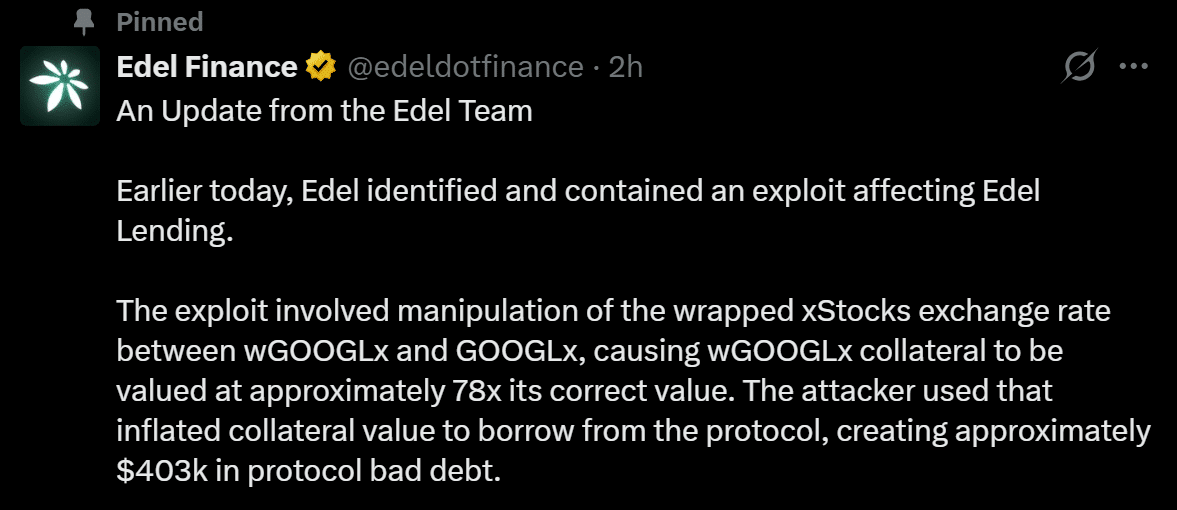
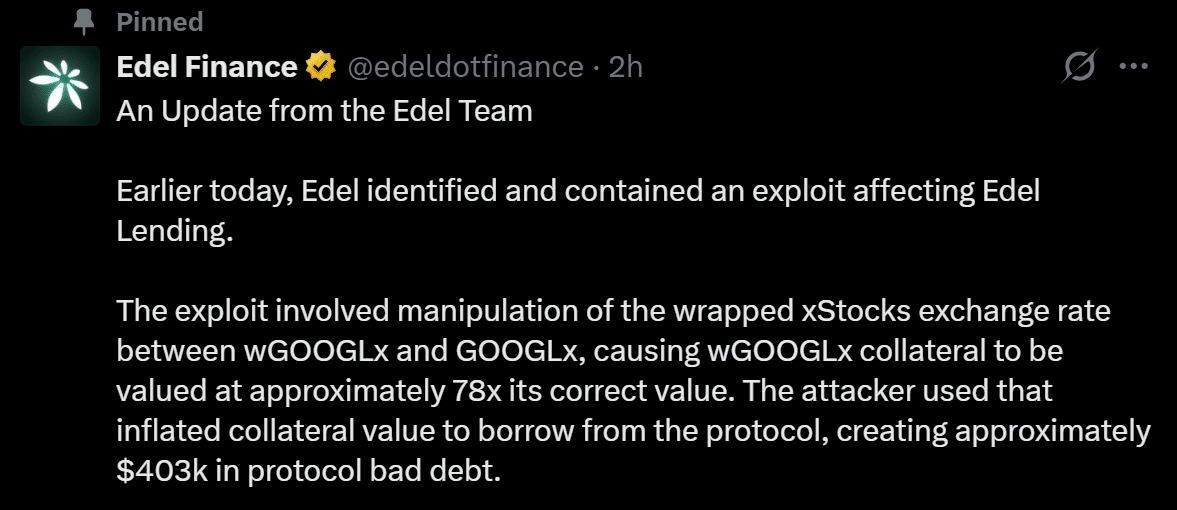
代币化股票的可编程市场层项目 Edel Finance 遭受了约 40.3 万美元的攻击。此前,攻击者通过闪电贷操纵了封装 xStocks 的汇率。

wGOOGLx 抵押品的价值在短时间内被推高至其真实价值的约 78 倍。虚高的估值使得攻击者能够借出远超抵押品真实价值的资产,给贷款方留下了巨额坏账。

对 Edel Finance 的用户来说幸运的是,他们能够在损失进一步扩大之前迅速采取行动以控制问题。

来源:X

此外,尽管 Edel Finance 反应迅速,此次攻击仍然暴露了一个重大漏洞。更重要的是,这次攻击突显了整个代币化借贷市场中,预言机和抵押品定价方面持续存在的弱点。

相反,除非这些漏洞得到彻底解决,否则市场信心依然脆弱。展望未来,更强的预言机保护和抵押品验证机制,将很可能决定信任回归的速度。

攻击后用户提款给流动性带来压力

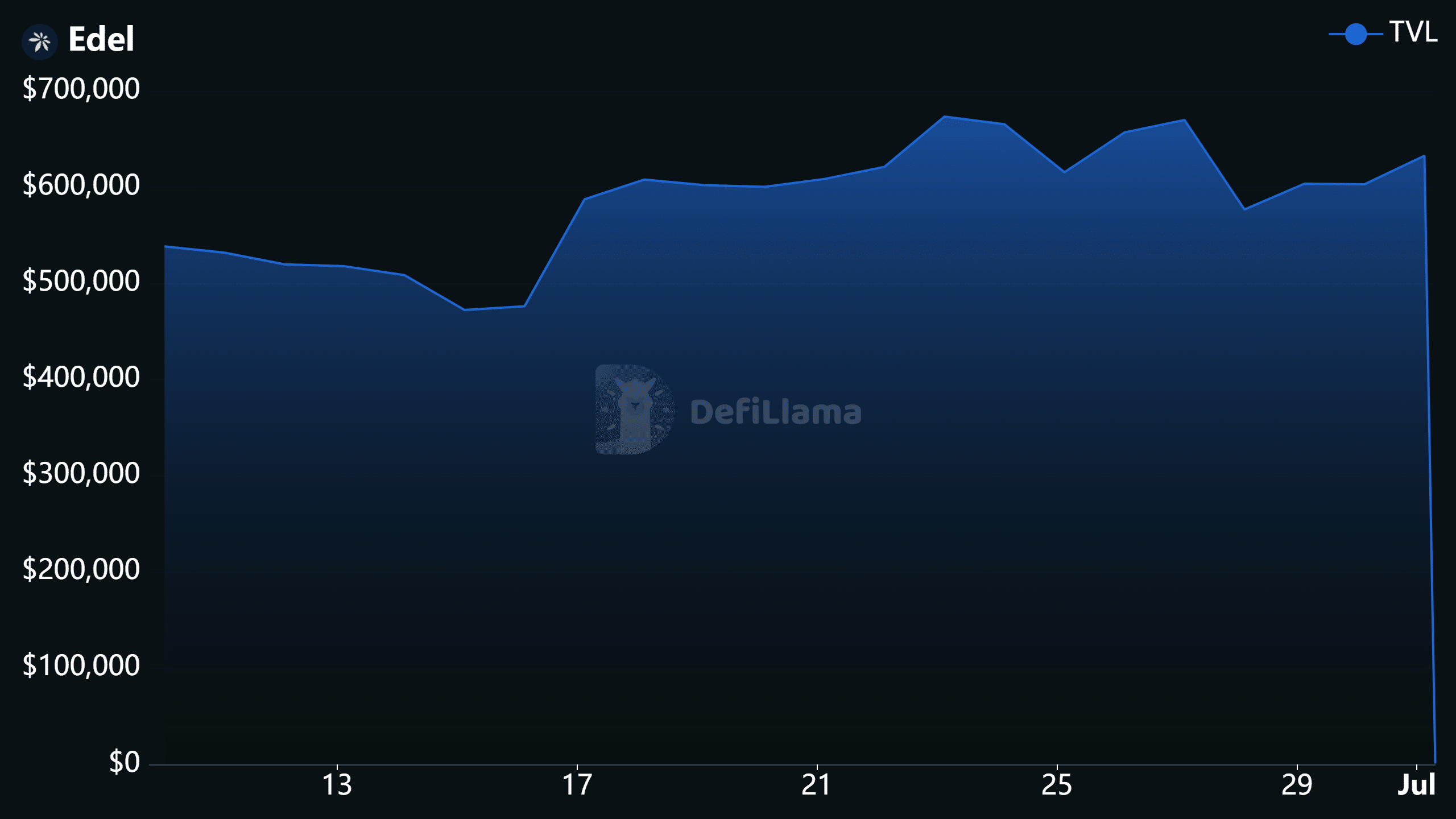
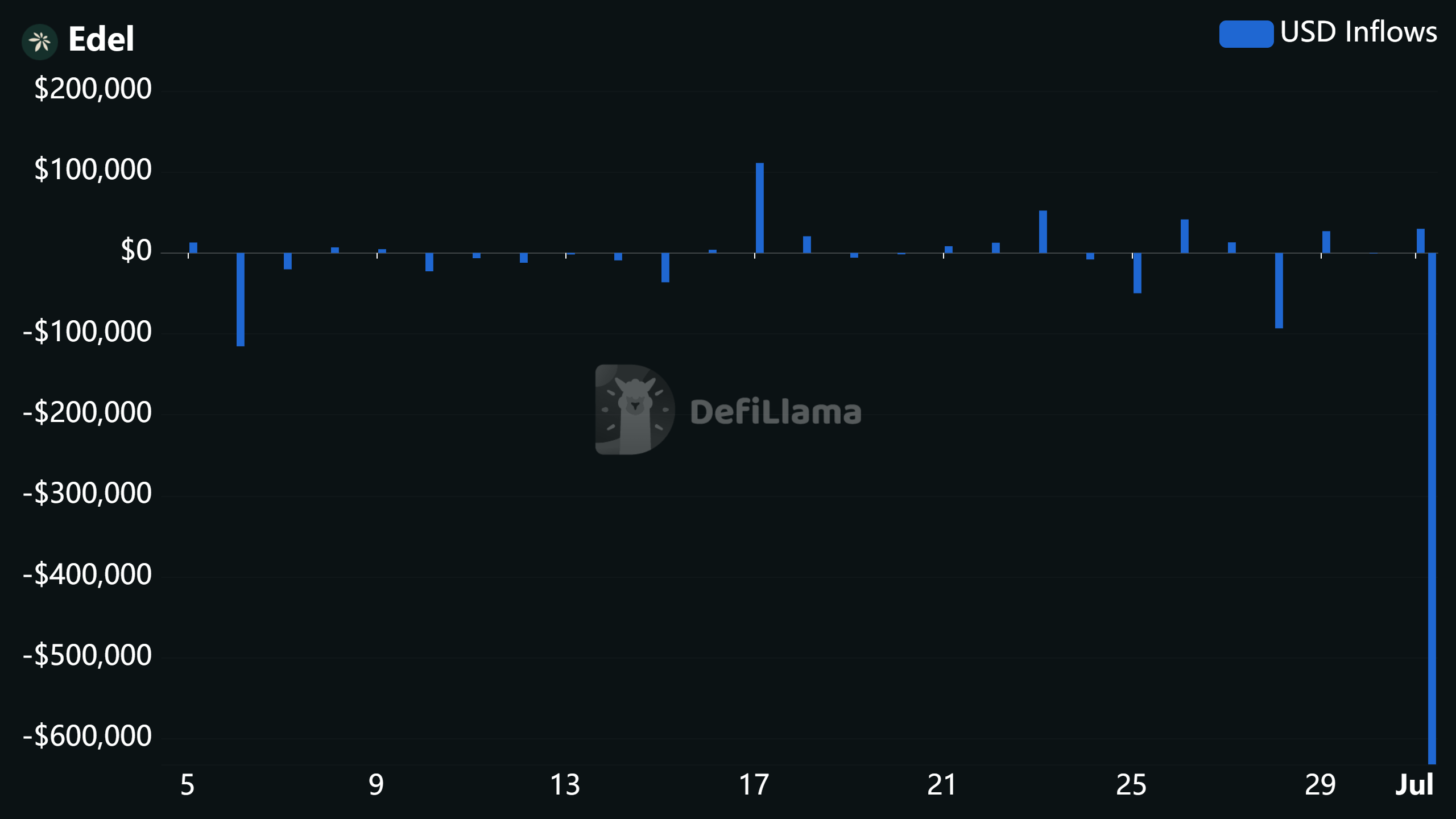
此次攻击的后果迅速波及了 Edel Finance 的流动性。随着信心恶化,其总锁定价值(TVL)从约 63 万美元暴跌至约 947 美元,反映了用户的一波快速提款潮。

来源:DeFiLlama

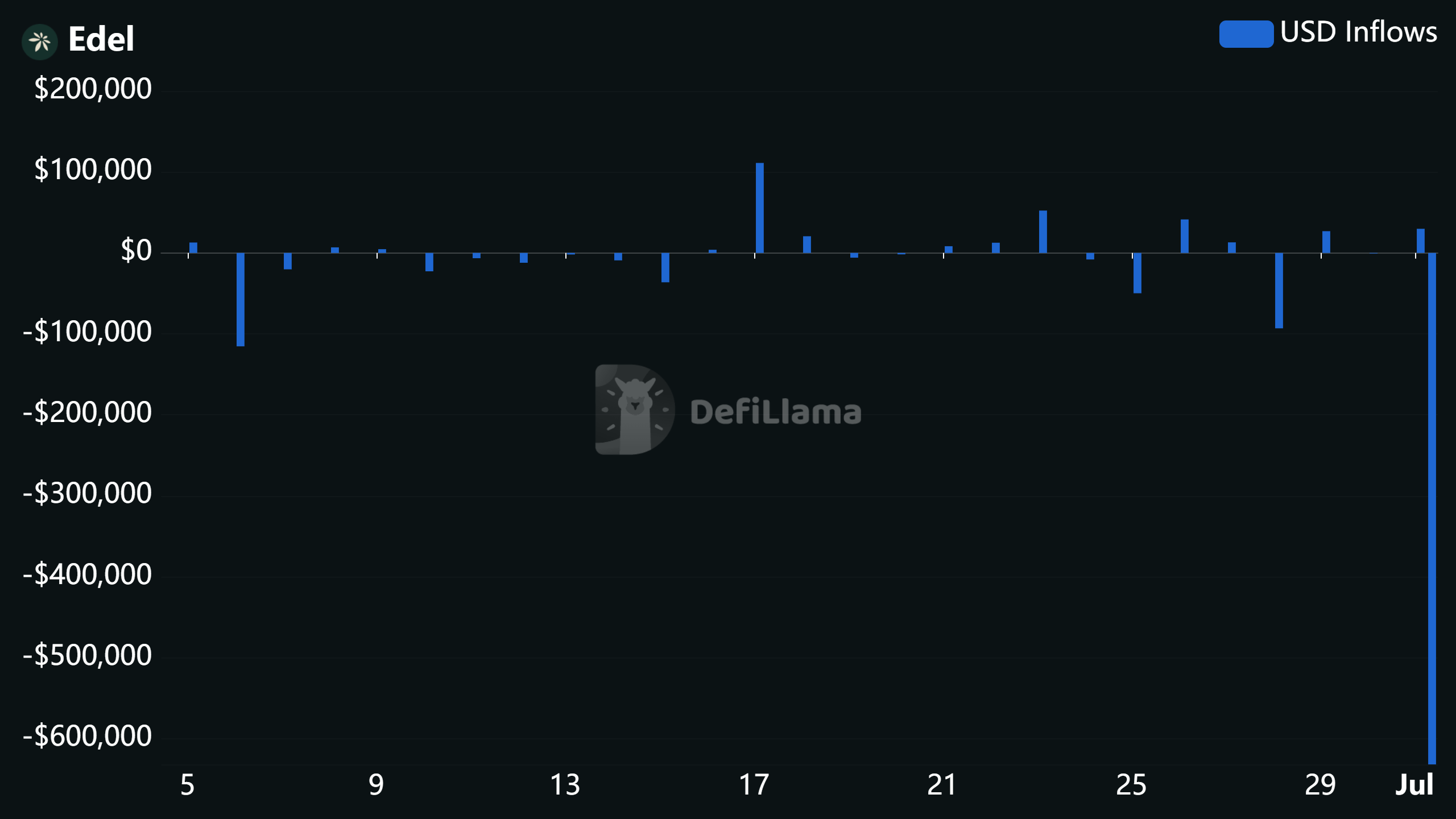
资金流动进一步强化了这一趋势。根据 DeFiLlama 数据,Edel Finance 录得约 63 万美元的净流出,创下有记录以来的最大流出额。早些时候,一笔 10 万美元的流入曾短暂支撑了流动性。即便如此,这仍未能抵消攻击发生后加速的提款。

来源:DeFiLlama

这些行为表明,在当前情况下,贷款人优先考虑的是保全资金,而非支持协议。未来,其复苏将取决于存款的持续增长、TVL 的稳定以及每日流出量的减少。

如果没有持续的存款增长,借贷能力将继续受限,最终将限制借贷平台恢复其流动性的能力,并延迟借贷市场恢复正常。

需要重建用户信心,资金才能通过持续使用借贷平台和加强的风险管理实践,开始大量回流至 Edel Finance。


最终总结

  • Edel Finance 的 xStock(wGOOGLx)攻击事件暴露了关键的预言机风险,突显了代币化借贷安全中持续存在的弱点。
  • Edel Finance 的恢复现在取决于恢复流动性、重建 TVL 以及重获用户信心。

Criptos en tendencia

Preguntas relacionadas

QEdel Finance遭遇的攻击造成了多大的直接经济损失?

A攻击导致Edel Finance遭受了约40.3万美元的损失。

Q攻击者是如何利用漏洞盗取资金的?

A攻击者通过闪电贷操纵了包装x股票(wGOOGLx)的预言机报价,使其价值被暂时夸大了约78倍,从而以其为抵押借走了远高于其真实价值的资金,给贷款方造成了坏账。

Q这次攻击对Edel Finance的流动性造成了怎样的影响?

A攻击导致用户信心动摇,引发了大规模资金外逃。其锁仓总价值从约63万美元暴跌至仅约947美元,净流出约63万美元,创下纪录,使平台的流动性承受巨大压力。

Q文章指出,这次攻击暴露了DeFi领域一个什么普遍性问题?

A这次攻击暴露了跨整个代币化借贷市场中,预言机和抵押品定价机制存在持续性的弱点与安全漏洞。

Q根据文章,Edel Finance未来恢复的关键取决于哪些因素?

AEdel Finance的恢复取决于:恢复流动性、重建锁仓总价值、以及通过持续使用平台和加强风险管理实践来重获用户信心。

Lecturas Relacionadas

1600 Lines of Code Create an Underwater Manhattan, Fable 5 Leaves Karpathy Stunned

Title: Fable 5 Stuns Karpathy with 3D Worlds Built from 1600 Lines of Code An AI model, Fable 5, has demonstrated a remarkable leap in generating complex, interactive 3D worlds with minimal code. Showcased by Peter Gostev of Arena.ai, the model created 63 diverse 3D environments across themes like immersive cityscapes, explorable famous paintings, natural wonders, and cosmic phenomena. Many were generated in a single attempt. A standout creation is a detailed, submerged Manhattan built with only 1600 lines of Three.js code. Other highlights include traversable versions of Van Gogh's "Starry Night," a bear catching a salmon with realistic physics, and a split Red Sea. The model's ability to cohesively manage vast numbers of elements within a scene represents a significant technical advancement. Andrej Karpathy, who recently joined Anthropic's pre-training team, expressed amazement, particularly at how the model intuitively understood and rendered complex real-world interactions like a fish struggling when caught. He coined the term "fablemaxxing" to describe this qualitative leap. While Fable 5 excels at world-building, Gostev notes current limitations in creating engaging, long-form gameplay. The model also sometimes requires prompting to fully utilize its capabilities. Having topped the Agent Arena benchmark for real-world task completion, Fable 5 signals that the boundaries of AI-generated content are rapidly expanding, with its full potential yet to be discovered.

marsbitHace 6 min(s)

1600 Lines of Code Create an Underwater Manhattan, Fable 5 Leaves Karpathy Stunned

marsbitHace 6 min(s)

From ANSEM to CZ, The Celebrity Coin Relay Race Between Solana and BSC

The past week was a whirlwind of on-chain activity, sparked by the meteoric rise of $ANSEM, a Solana-based meme coin that surged 600x and hit a $100 million market cap in a single day. This rally began when crypto influencer Ansem announced his return to buying Solana meme coins and publicly advocated for an airdrop from the platform pump.fun. Ansem’s subsequent "soft claim" of the token—promising to airdrop creator revenue to followers—ignited a frenzy, drawing comparisons to past community-led token distributions. However, his dual role as a co-founder of the trading terminal Bullpen, which later hosted the $ANSEM airdrop, suggests a strategic promotional element. The narrative quickly shifted to "celebrity coins," where tokens named after influencers are sent to their public addresses in hopes of endorsement. While a similar coin, $TJR, briefly gained traction, it faltered after the influencer TJR urged focus back on $ANSEM. Attention then turned to projects Ansem endorsed and coins found in his wallet, like $manlet, but momentum on Solana began to stall. The action then migrated to BSC with the viral resurgence of a 2021 tweet from former Binance CEO CZ, referencing a "final form" bull. This sparked the explosive launch of $CZ, which briefly approached a $90 million market cap despite expectations that CZ wouldn't actively engage like Ansem. Another BSC token, $TCC, gained attention due to CZ's interactions with its promoter. The BSC ecosystem saw faster-paced, albeit volatile, "celebrity coin" plays, with tokens like $dingaling experiencing rapid pumps and dumps without official endorsements. Currently, BSC shows more momentum for new token launches than Solana, with the market awaiting a new narrative to succeed the fleeting "celebrity coin" trend.

marsbitHace 16 min(s)

From ANSEM to CZ, The Celebrity Coin Relay Race Between Solana and BSC

marsbitHace 16 min(s)

A Decade of Change: The Demise of Crypto Startups

"The Decade-Long Transformation: The Demise of Crypto Startups" The article traces the dramatic evolution of the cryptocurrency industry from its anarchic beginnings to its current highly regulated and institutionalized state. In the early days (circa 2017), launching a crypto startup was remarkably simple: a whitepaper, a GitHub repository, and a Telegram group could attract thousands of retail investors via an Initial Coin Offering (ICO). Founders operated anonymously with near-zero regulatory and financial barriers, enabling rapid, global innovation but also widespread fraud. By 2026, the landscape is fundamentally different. To operate in major markets like the US, EU, and Asia, crypto businesses must now navigate a complex web of regulations akin to traditional finance. Compliance costs are prohibitive: estimates for a US multi-state operation range from $750,000 to $1.2 million in the first three years, with annual costs exceeding $2 million thereafter. Regulations like MiCA in the EU and New York's BitLicense have created high capital and operational hurdles that act as barriers to entry. Simultaneously, venture capital investment has shifted dramatically. Following the collapses of Terra and FTX, funding has concentrated in later-stage, established companies, creating a "barbell market." Early-stage and seed funding has shrunk significantly, while mega-funds like Andreessen Horowitz's $15 billion pool dominate. Most capital now flows to trading platforms, lending infrastructure, and B2B services. This environment favors mergers and acquisitions as the primary path for growth. Companies like Coinbase and Ripple are acquiring firms like Deribit and Hidden Road not for their technology, but for their licenses, banking relationships, and institutional trust—assets far more valuable than code. Distribution channels, compliance, and brand reputation have become the new moats, overshadowing pure technical innovation. The industry's maturation brings benefits: reduced scams, increased institutional participation, and clearer regulatory frameworks. However, it comes at a cost. The low-barrier, experimental ethos that defined crypto's first decade is fading. Entrepreneurs without substantial capital, pre-existing licenses, or institutional connections face immense challenges. Funding for exploratory fields like decentralized social media or novel governance models is drying up. Ultimately, the crypto industry is replicating the consolidation pattern seen in banking and tech after the 2008 financial crisis. While this brings stability and legitimacy, it raises a critical question: in this new, resource-intensive reality, is there still room for the disruptive, from-scratch innovation that gave birth to the sector?

Foresight NewsHace 1 hora(s)
A Decade of Change: The Demise of Crypto Startups

Foresight NewsHace 1 hora(s)

Trading

Spot

Artículos destacados

Cómo comprar LAYER

¡Bienvenido a HTX.com! Hemos hecho que comprar Solayer (LAYER) sea simple y conveniente. Sigue nuestra guía paso a paso para iniciar tu viaje de criptos.Paso 1: crea tu cuenta HTXUtiliza tu correo electrónico o número de teléfono para registrarte y obtener una cuenta gratuita en HTX. Experimenta un proceso de registro sin complicaciones y desbloquea todas las funciones.Obtener mi cuentaPaso 2: ve a Comprar cripto y elige tu método de pagoTarjeta de crédito/débito: usa tu Visa o Mastercard para comprar Solayer (LAYER) al instante.Saldo: utiliza fondos del saldo de tu cuenta HTX para tradear sin problemas.Terceros: hemos agregado métodos de pago populares como Google Pay y Apple Pay para mejorar la comodidad.P2P: tradear directamente con otros usuarios en HTX.Over-the-Counter (OTC): ofrecemos servicios personalizados y tipos de cambio competitivos para los traders.Paso 3: guarda tu Solayer (LAYER)Después de comprar tu Solayer (LAYER), guárdalo en tu cuenta HTX. Alternativamente, puedes enviarlo a otro lugar mediante transferencia blockchain o utilizarlo para tradear otras criptomonedas.Paso 4: tradear Solayer (LAYER)Tradear fácilmente con Solayer (LAYER) en HTX's mercado spot. Simplemente accede a tu cuenta, selecciona tu par de trading, ejecuta tus trades y monitorea en tiempo real. Ofrecemos una experiencia fácil de usar tanto para principiantes como para traders experimentados.

303 Vistas totalesPublicado en 2025.02.11Actualizado en 2026.06.02

Cómo comprar LAYER

Discusiones

Bienvenido a la comunidad de HTX. Aquí puedes mantenerte informado sobre los últimos desarrollos de la plataforma y acceder a análisis profesionales del mercado. A continuación se presentan las opiniones de los usuarios sobre el precio de LAYER (LAYER).

活动图片