SKYAI hits monthly lows after 36% drop – Yet THIS group isn’t backing off

ambcryptoPublicado a 2026-06-28Actualizado a 2026-06-28

Resumen

SKYAI plummeted 36.2% in 24 hours, hitting monthly lows, with its market cap falling to $238.26M. Despite a 70.85% surge in daily trading volume to $43.16M, the activity was driven by aggressive selling, not buying. Open Interest in derivatives dropped 36.65% to ~$69.66M, indicating traders closed leveraged positions. A modest positive exchange netflow of ~$340.75K signaled some holders moved tokens to exchanges, potentially for future sales. Buyers defended a key support zone around $0.168, preventing an immediate breakdown. However, technical indicators like MACD and Parabolic SAR remained bearish. The token's near-term direction depends on whether this support holds, allowing a potential recovery toward $0.335, or breaks, leading to further declines.

SKYAI recorded one of its steepest daily declines after losing 36.2% of its value over the last 24 hours, while traders continued flooding the market with fresh activity.

Daily trading volume climbed 70.85% to $43.16 million despite the heavy sell-off, showing that participants remained highly engaged throughout the correction.

The token’s market capitalization also dropped to $238.26 million, reflecting the broad decline in valuation.

However, the surge in trading activity did not translate into sustained buying strength.

Instead, the elevated volume accompanied aggressive selling pressure, indicating that market participants actively repositioned as volatility intensified across both spot and derivatives markets.

Such conditions reflected heightened uncertainty rather than renewed confidence, leaving SkyAI [SKYAI] under pressure as traders searched for signs of stability.

Why did traders cut leverage?

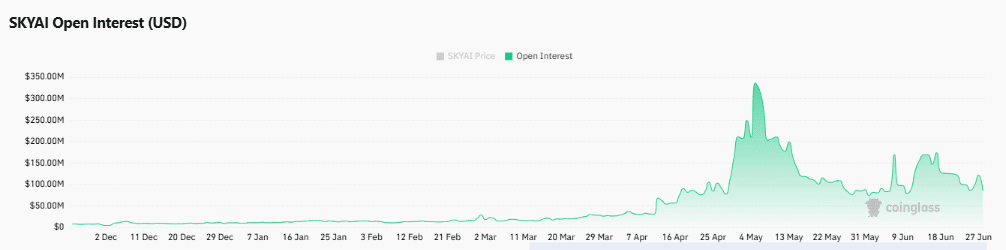
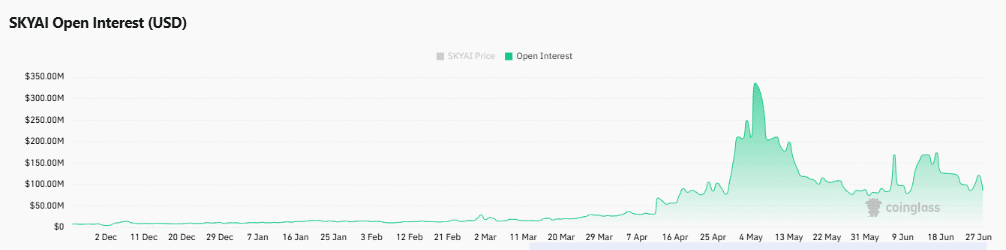
Derivatives activity weakened sharply after Open Interest declined [OI] by 36.65% to approximately $69.66 million.

The sharp reduction suggested that traders had rapidly closed leveraged positions during the correction instead of adding fresh exposure.

Rather than reflecting new bearish bets alone, the decline pointed to widespread liquidation and voluntary position exits across the futures market.

However, the sizeable contraction also reduced speculative leverage that had previously amplified price swings. This reset left the derivatives market considerably lighter than before the sell-off.

Even so, the shrinking OI failed to encourage an immediate recovery because buyers remained cautious after the aggressive decline.

Until traders gradually rebuilt conviction, leveraged participation would likely remain subdued despite the elevated trading activity.
Source: CoinGlass

Are exchange inflows becoming a concern?

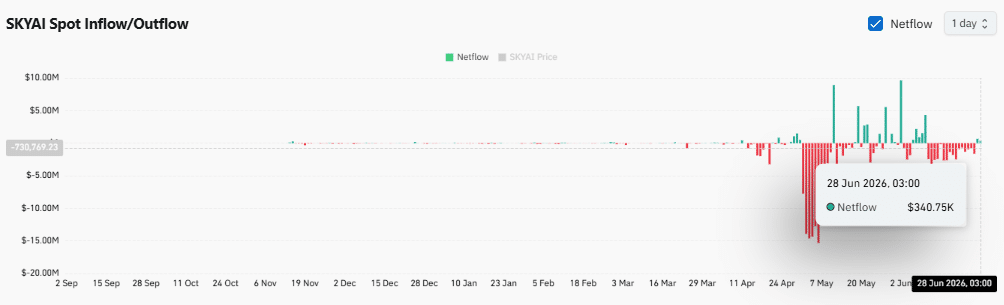
Spot flow data revealed a positive Exchange Netflow of roughly $340.75K during the latest session. The reading showed that more SKYAI tokens moved onto exchanges than left them, increasing the amount of supply immediately available for trading.

Unlike exchange outflows, which often reduce near-term selling pressure, these inflows suggested that holders prepared tokens for potential sales.

However, the relatively modest size of the inflow indicated that market participants had not yet triggered large-scale distribution.

Instead, traders appeared to react cautiously while monitoring price behaviour near an important support area.

If exchange inflows continue increasing over the coming sessions, additional selling pressure could emerge.

On the other hand, weakening inflows would suggest that distribution had begun to stabilize after the recent correction.
Source: CoinGlass

Can buyers defend support?

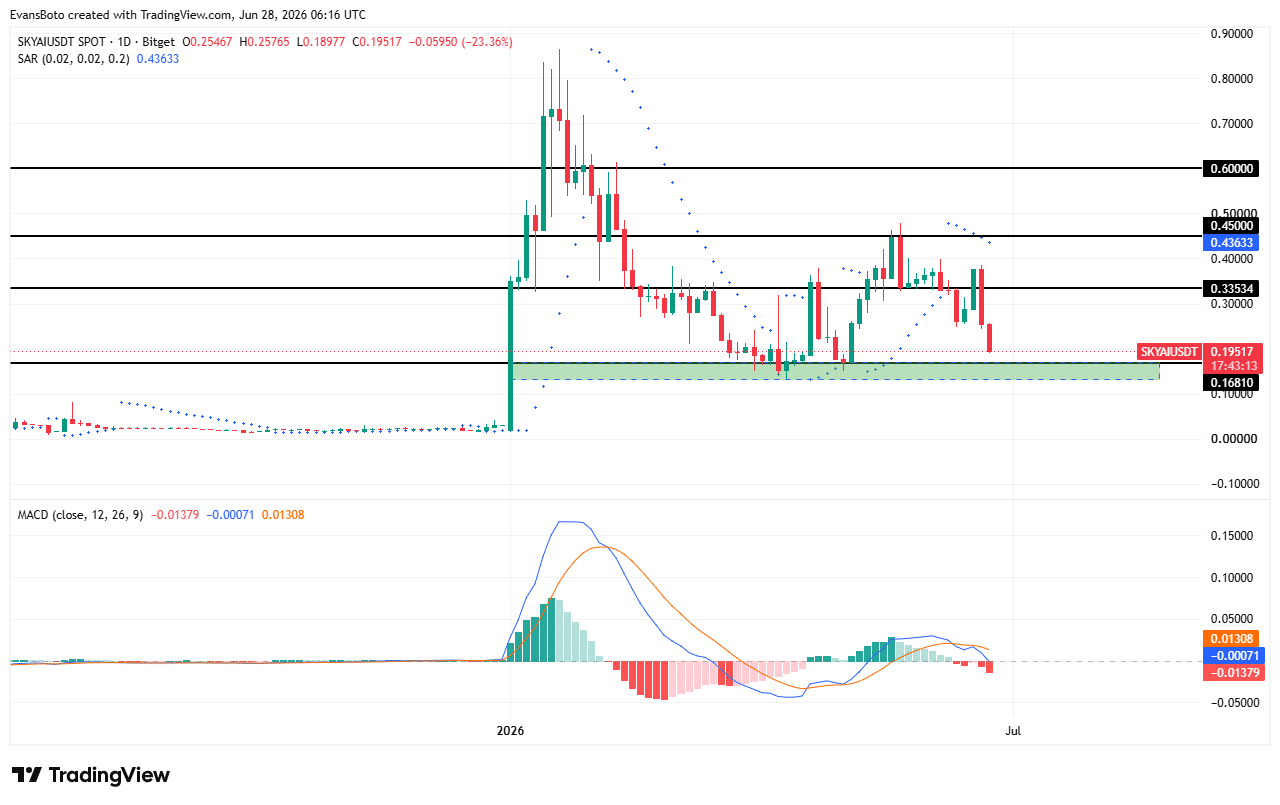
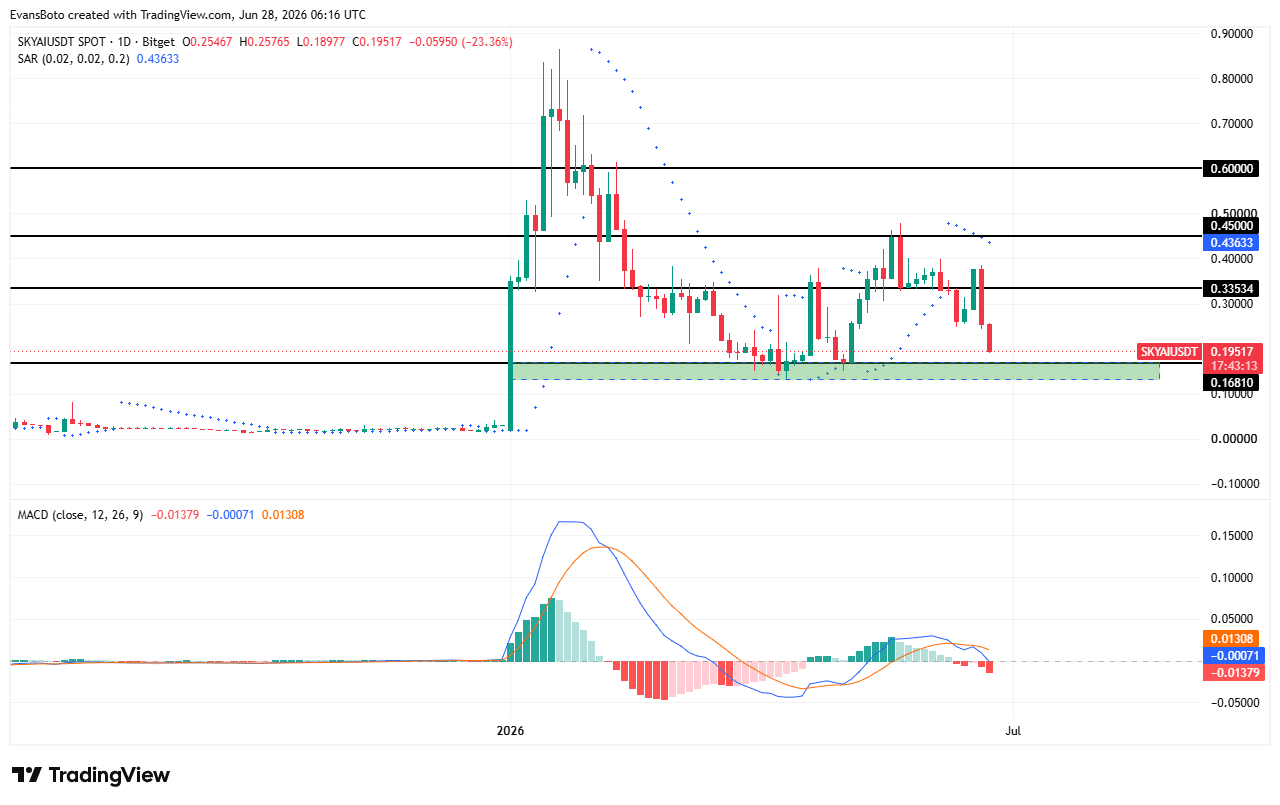
SKYAI revisited the demand zone around $0.168 after the latest sell-off erased much of its recent recovery.

Buyers responded near this region and prevented an immediate breakdown below support, allowing the price to stabilize above the highlighted zone.

Even so, the broader technical picture remained fragile. MACD stayed below the zero line while its histogram continued printing negative bars, showing that bearish pressure had persisted throughout the correction.

In addition, the Parabolic SAR remained above the price near $0.436, confirming that sellers still controlled the prevailing trend.

However, the repeated defense of the $0.168 support suggested buyers had not completely surrendered.

If this demand zone continues attracting fresh demand, SKYAI could attempt a recovery toward the $0.335 resistance. Otherwise, losing this support would likely expose the token to another leg lower.
Source: TradingView

Can SKYAI avoid another breakdown?

SKYAI remained under pressure as strong trading activity accompanied falling prices, shrinking Open Interest, and positive Exchange Netflow.

Buyers defended the $0.168 demand zone, but technical indicators continued to favor sellers.

If demand continued strengthening around the current support, the token could attempt a recovery toward higher resistance levels.

However, another decisive break below $0.168 would likely extend the correction before a sustainable rebound develops.


Final Summary

  • SKYAI buyers defended the $0.168 demand zone despite rising exchange inflows and selling pressure.
  • Falling Open Interest suggested leverage cooled, but bearish indicators still favored another downside test.


Criptos en tendencia

Preguntas relacionadas

QWhat was the main event described in the article regarding SKYAI's price action?

ASKYAI experienced one of its steepest daily declines, losing 36.2% of its value over 24 hours and hitting monthly lows, despite a 70.85% surge in daily trading volume.

QWhat does the sharp decline in Open Interest (OI) for SKYAI derivatives suggest according to the article?

AThe 36.65% decline in Open Interest suggests traders rapidly closed leveraged positions during the correction, indicating widespread liquidation and voluntary exits rather than just new bearish bets, which reduced speculative leverage.

QWhat is the significance of the positive Exchange Netflow mentioned in the article?

AA positive Exchange Netflow of roughly $340.75K indicates that more SKYAI tokens were moved onto exchanges than off them, increasing the immediate supply available for trading and suggesting some holders were preparing tokens for potential sales.

QWhat critical price level are buyers attempting to defend for SKYAI, and what is the potential consequence of losing it?

ABuyers are attempting to defend the demand zone/support level around $0.168. Losing this support would likely expose the token to another leg lower in its price correction.

QBased on the article's final summary, what two key factors create a mixed outlook for SKYAI's immediate future?

AThe mixed outlook comes from 1) Buyers defending the $0.168 demand zone, but 2) Bearish technical indicators still favoring another downside test despite the cooling of leverage (falling Open Interest).

Lecturas Relacionadas

In the AI Era, What's Left for Bitcoin?

As Bitcoin falls below $60,000, the author reflects on the relationship between AI and Bitcoin, seeing them as two sides of the same coin. In the AI era, the cost of generating content has plummeted, making fake text, images, and videos increasingly easy and cheap to produce. This has led to a fundamental shift: while AI dramatically lowers the cost of information production, it also undermines trust and authenticity online. What becomes truly valuable is not more content, but the ability to verify what is real—"verifiability." This perspective offers a new lens for Bitcoin. Its massive energy consumption, often criticized as wasteful, is reinterpreted. While AI burns energy to enhance "capability" and efficiency, Bitcoin burns energy to produce "verifiability." Its purpose is not to be trusted but to enable a system where no trust in intermediaries—banks, platforms, or developers—is needed. Every transaction and the entire ledger's history is secured by cryptography and a decentralized network of nodes, making it independently verifiable. AI cannot forge a transaction on the Bitcoin network because the system is designed for proof, not generation. The author draws a historical parallel to the Renaissance: the printing press drastically reduced the cost of copying knowledge, while double-entry bookkeeping reduced the cost of trust in commerce. Today, AI is the new printing press, reducing content creation costs to near zero. Blockchain, and Bitcoin as its pioneer, may be the modern equivalent of double-entry bookkeeping—a foundational technology for verifying digital asset ownership and historical records without centralized authorities. Thus, AI and blockchain are not competitors. AI lowers the cost of creation; blockchain lowers the cost of verification. In an age where AI can generate anything, true scarcity may lie not in more content, but in independently verifiable facts. Whether the market will reprice Bitcoin accordingly remains uncertain, but its core value proposition as a "machine for producing verifiability" becomes strikingly relevant.

marsbitHace 47 min(s)

In the AI Era, What's Left for Bitcoin?

marsbitHace 47 min(s)

In the Age of AI, What's Left for Bitcoin?

Author: Sevclub, Seven Research Amid Bitcoin's recent drop below $60k, the author reflects on a growing sense that AI and Bitcoin are two sides of the same coin. Today, encountering any content triggers a new default question: "Was this made by AI?" The cost of generating convincing text, images, and video is now negligible. While the internet lowered information *distribution* costs, AI is crashing information *production* costs to near zero. The consequence is a flood of content where truth and falsehood are increasingly indistinguishable. In this environment, what becomes truly valuable is not more information, but the ability to verify what is real—"verifiability." This reframes the common criticism that Bitcoin "wastes electricity." AI consumes power to produce "capability" (e.g., more powerful models). Bitcoin consumes power to produce something else: "verifiability." Bitcoin's core purpose isn't about belief or trust in any institution, developer, or even its creator. It's about enabling independent verification. Every bitcoin's origin, every transaction, and the integrity of the entire ledger are secured by mathematics, cryptography, and a global network of nodes. AI can fabricate convincing media, but it cannot falsify a transaction on the Bitcoin network. The expended energy makes篡改历史 (tampering with history) prohibitively expensive, purchasing a globally verifiable ledger. The author draws a historical parallel to the Renaissance. The printing press drastically reduced the cost of copying knowledge, while double-entry bookkeeping reduced the cost of trust in commerce—one enabled creation, the other verification. Today, AI is the new printing press, driving content production costs toward zero. The question becomes: what is this era's "double-entry bookkeeping"? Blockchain appears to be the leading candidate. It doesn't verify which news is true or which image is real, but it provides a foundational layer for independently verifying asset ownership and historical records in the digital realm without centralized authorities. Therefore, AI and blockchain are not in competition. AI lowers the cost of *generation*. Blockchain (and Bitcoin as a prime example) lowers the cost of *verification*. One creates, the other proves. Whether Bitcoin ultimately succeeds remains uncertain, facing potential challenges from quantum computing, regulation, and technical evolution. However, the author now sees it less as a "machine for making bitcoin" and more as a "machine for making verifiability." In an age where AI can generate anything, true scarcity may no longer be "more content," but "more independently verifiable facts." Whether the market will price this accordingly is a separate question.

链捕手Hace 55 min(s)

In the Age of AI, What's Left for Bitcoin?

链捕手Hace 55 min(s)

Trading

Spot

Artículos destacados

Cómo comprar SKYAI

¡Bienvenido a HTX.com! Hemos hecho que comprar SKYAI (SKYAI) sea simple y conveniente. Sigue nuestra guía paso a paso para iniciar tu viaje de criptos.Paso 1: crea tu cuenta HTXUtiliza tu correo electrónico o número de teléfono para registrarte y obtener una cuenta gratuita en HTX. Experimenta un proceso de registro sin complicaciones y desbloquea todas las funciones.Obtener mi cuentaPaso 2: ve a Comprar cripto y elige tu método de pagoTarjeta de crédito/débito: usa tu Visa o Mastercard para comprar SKYAI (SKYAI) al instante.Saldo: utiliza fondos del saldo de tu cuenta HTX para tradear sin problemas.Terceros: hemos agregado métodos de pago populares como Google Pay y Apple Pay para mejorar la comodidad.P2P: tradear directamente con otros usuarios en HTX.Over-the-Counter (OTC): ofrecemos servicios personalizados y tipos de cambio competitivos para los traders.Paso 3: guarda tu SKYAI (SKYAI)Después de comprar tu SKYAI (SKYAI), guárdalo en tu cuenta HTX. Alternativamente, puedes enviarlo a otro lugar mediante transferencia blockchain o utilizarlo para tradear otras criptomonedas.Paso 4: tradear SKYAI (SKYAI)Tradear fácilmente con SKYAI (SKYAI) en HTX's mercado spot. Simplemente accede a tu cuenta, selecciona tu par de trading, ejecuta tus trades y monitorea en tiempo real. Ofrecemos una experiencia fácil de usar tanto para principiantes como para traders experimentados.

239 Vistas totalesPublicado en 2025.04.22Actualizado en 2026.06.02

Cómo comprar SKYAI

Discusiones

Bienvenido a la comunidad de HTX. Aquí puedes mantenerte informado sobre los últimos desarrollos de la plataforma y acceder a análisis profesionales del mercado. A continuación se presentan las opiniones de los usuarios sobre el precio de SKYAI (SKYAI).

活动图片