When Transfers Become Truly Frictionless: How Sui Uses 'Zero Gas' to Become the Underlying Infrastructure for Stablecoin Payments

marsbitPublicado a 2026-06-22Actualizado a 2026-06-22

Resumen

Title: Sui Launches Zero-Gas Stablecoin Transfers to Become the Foundation for Stablecoin Payments Sui has introduced a zero-gas fee feature for peer-to-peer stablecoin transfers, eliminating the need for users or businesses to hold separate SUI tokens to pay transaction costs. This innovation, built on a new underlying account architecture called Address Balances, significantly reduces validator processing costs for eligible transactions. Currently, the feature applies to a whitelist of stablecoins for transfers meeting a minimum amount, effectively preventing spam. This development aims to unlock mainstream payment use cases for stablecoins—such as everyday purchases, remittances, and subscriptions—by removing cost and complexity barriers. It is also positioned to benefit high-frequency micro-payments for AI agents and institutional B2B payments, reducing operational friction. Major custody provider Fireblocks has already announced support. The move follows Sui processing over $1 trillion in stablecoin transfer volume since August 2025. Looking ahead, Sui plans to enhance this infrastructure with protocol-level confidential transactions later in 2026, aiming to provide scalable, free, and privacy-preserving payments. Together, these advancements strengthen Sui's goal of becoming the default settlement layer for stablecoin payments.

Author: Deep Tide TechFlow

If you go to an ATM to transfer money, and the ATM tells you that you must first buy "ATM usage coupons," you would probably think the ATM has gone crazy.

But this has been the operating rule for blockchain for over a decade: to make a transfer, first prepare the Gas.

As stablecoins play an increasingly critical role in the payment field, the cost of this threshold becomes clearer: new users are blocked outside, and payment scenarios are difficult to implement.

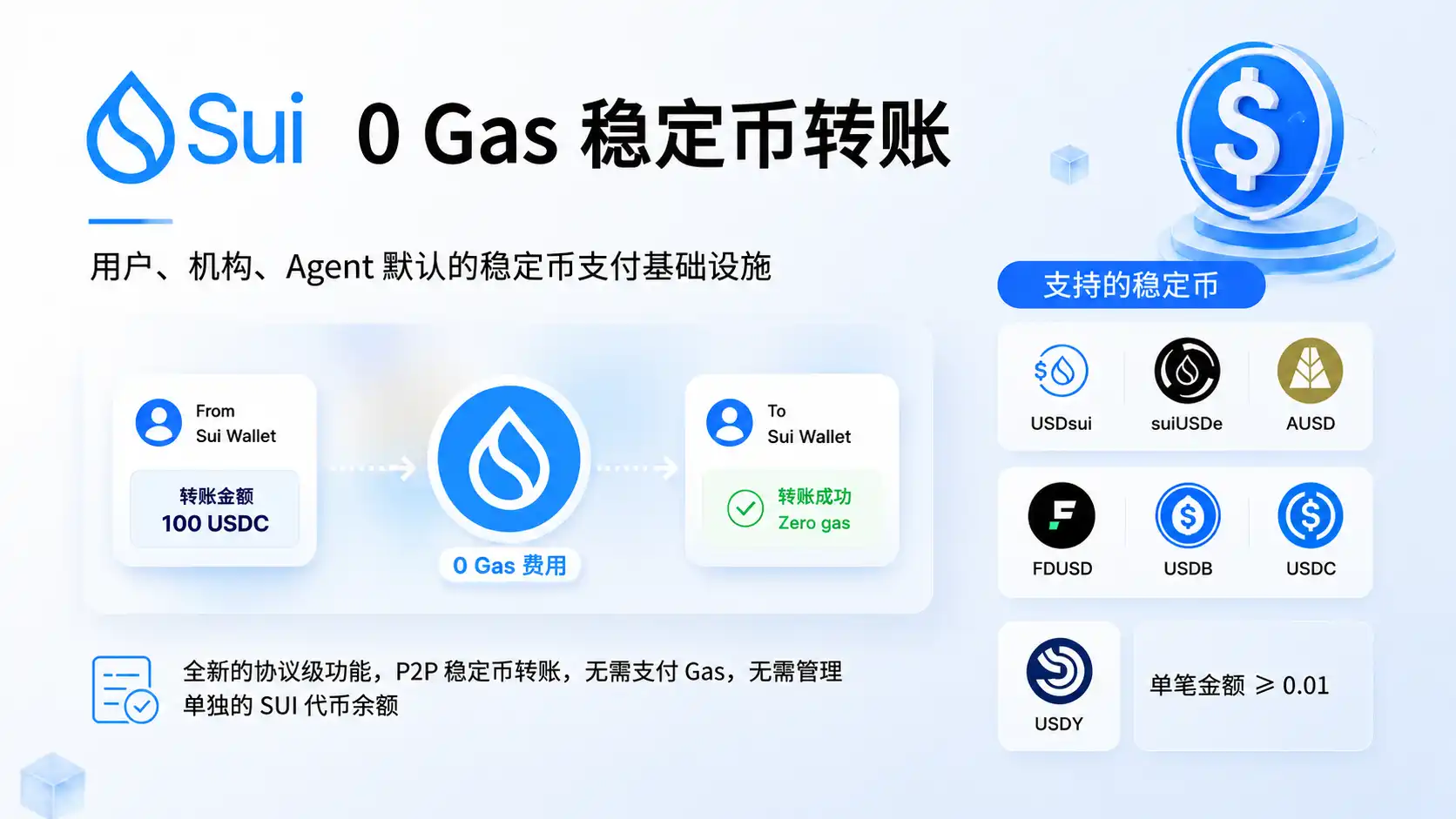
As a key initiative in building the "underlying infrastructure for stablecoin payments," on May 20, 2026, Sui announced the launch of a zero Gas stablecoin transfer feature, allowing users and enterprises to send stablecoins peer-to-peer without paying Gas fees, and without needing to manage a separate SUI token balance.

Although currently, this feature only supports P2P transfers of whitelisted stablecoins, stablecoins now have a real chance to transform from "crypto assets" into "payment infrastructure." The entity achieving this also further strengthens its position as a strong contender for the role of the "default foundation for stablecoin payments."
A New Kind of "Zero Gas": No One Is Paying for You in the Background

When mentioning zero Gas, most users' first reaction might be: Who paid the Gas for me?

This habitual thinking stems from past incomplete attempts at "zero Gas": either through subsidies or relays. The Gas never disappeared; someone was just quietly settling the bill in the background, a superficial solution that doesn't address the root cause.

Sui's "Zero Gas Stablecoin Transfer" targets the fundamental root.

It is built upon a new underlying account architecture called Address Balances. When tokens are sent using specific Move functions, they are automatically consolidated into the single balance of the recipient's address, eliminating the need to create or manage Coin objects. This saves the overhead of object creation, splitting, merging, and version tracking. The processing cost for validators is extremely low, low enough that they can refrain from charging users fees.

Costs are reduced, and boundaries must also be clearly defined: Under the highly restricted PTB mechanism, only P2P transfers of whitelisted stablecoins, with amounts no less than 0.01, are judged as zero Gas. This supports payment scenarios while isolating malicious transactions.
What Can This Infrastructure Run?

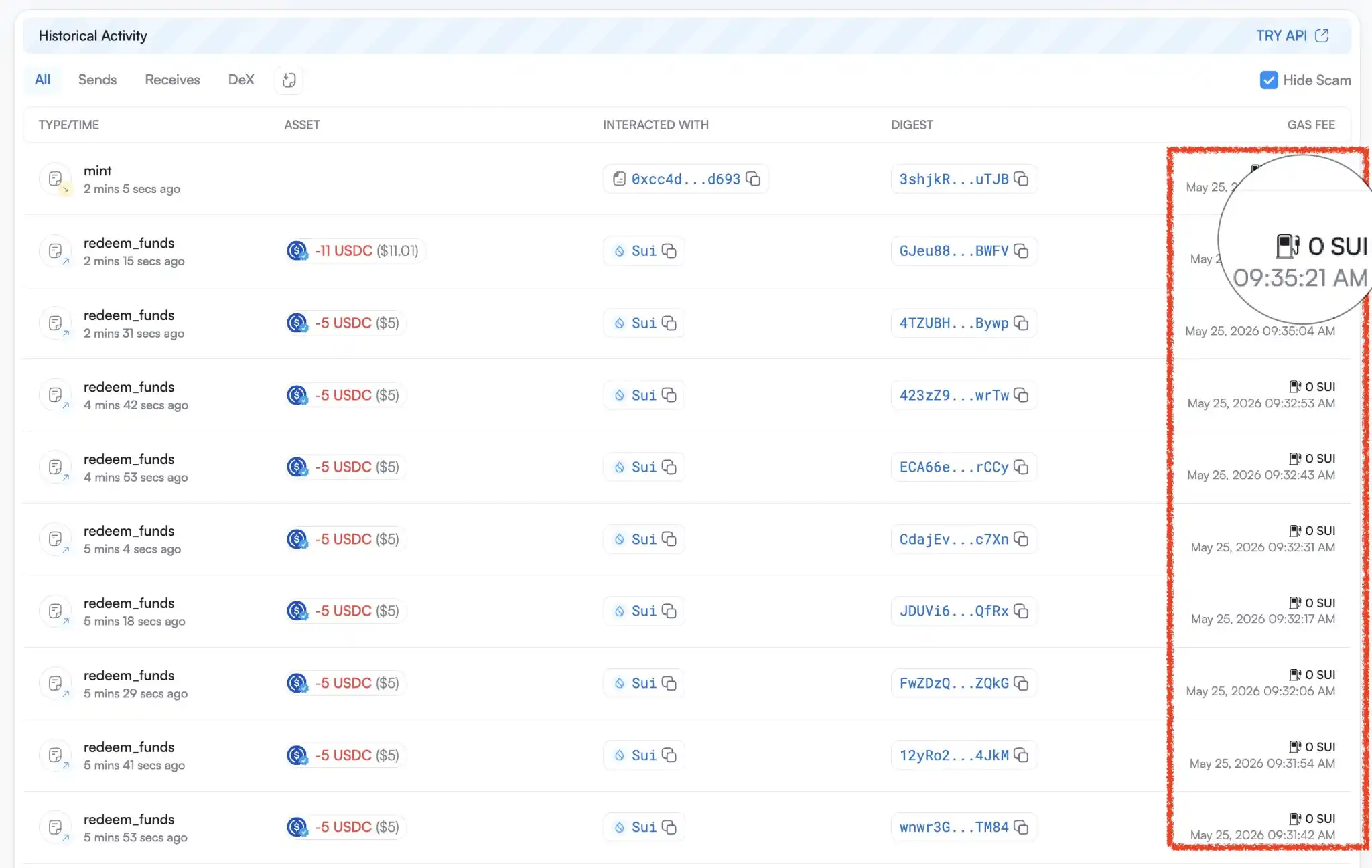
Firstly, it opens the door to daily payments. When the experience is frictionless and the cost is zero, those payment scenarios we once pinned high hopes on for stablecoins—including consumption, tipping, subscriptions, cross-border remittances, etc.—gain the potential for rapid penetration. Stablecoin payments, for the first time, possess the basic conditions to compete head-on with traditional payment tools, potentially even faster and better.

Of course, for high-frequency micro-payment scenarios, many will think of the Agent economy. In the past, actions like AI autonomous transactions and arbitrage required additional Gas management. The zero Gas stablecoin transfer will become the lowest-cost, least-resistance choice for Agents. Combined with Sui's high-performance advantages, it will further support the large-scale deployment of autonomous payment flows.

Another keyword is: Institutions. This is a group Sui officials specifically emphasize. Whether it's cross-border B2B payments, supplier settlements, or platform profit sharing, institutions often face higher payment friction. The protocol-level zero Gas mechanism transforms stablecoins into a payment tool that institutions can directly utilize.

Worth mentioning is that when the zero Gas feature was launched, Fireblocks had already announced support for address balances, and soon after, it supported Gas-free stablecoin transfers, further enhancing the accessibility of Sui's payment infrastructure for institutions. At the same time, several institutional-grade custody platforms and wallets have announced they will support zero Gas transactions.

Zero Gas: The First Half; Privacy: The Second Half

Since August 2025, stablecoin transfer volume on the Sui network has exceeded $1 trillion. This figure is sufficient to show that the underlying logic for stablecoin payments in the Sui ecosystem is already working. The launch of zero Gas stablecoin transfers will undoubtedly accelerate the construction of Sui's role as the "default foundation for stablecoin payments."

But this is only the first half of Sui's 2026 payment narrative.

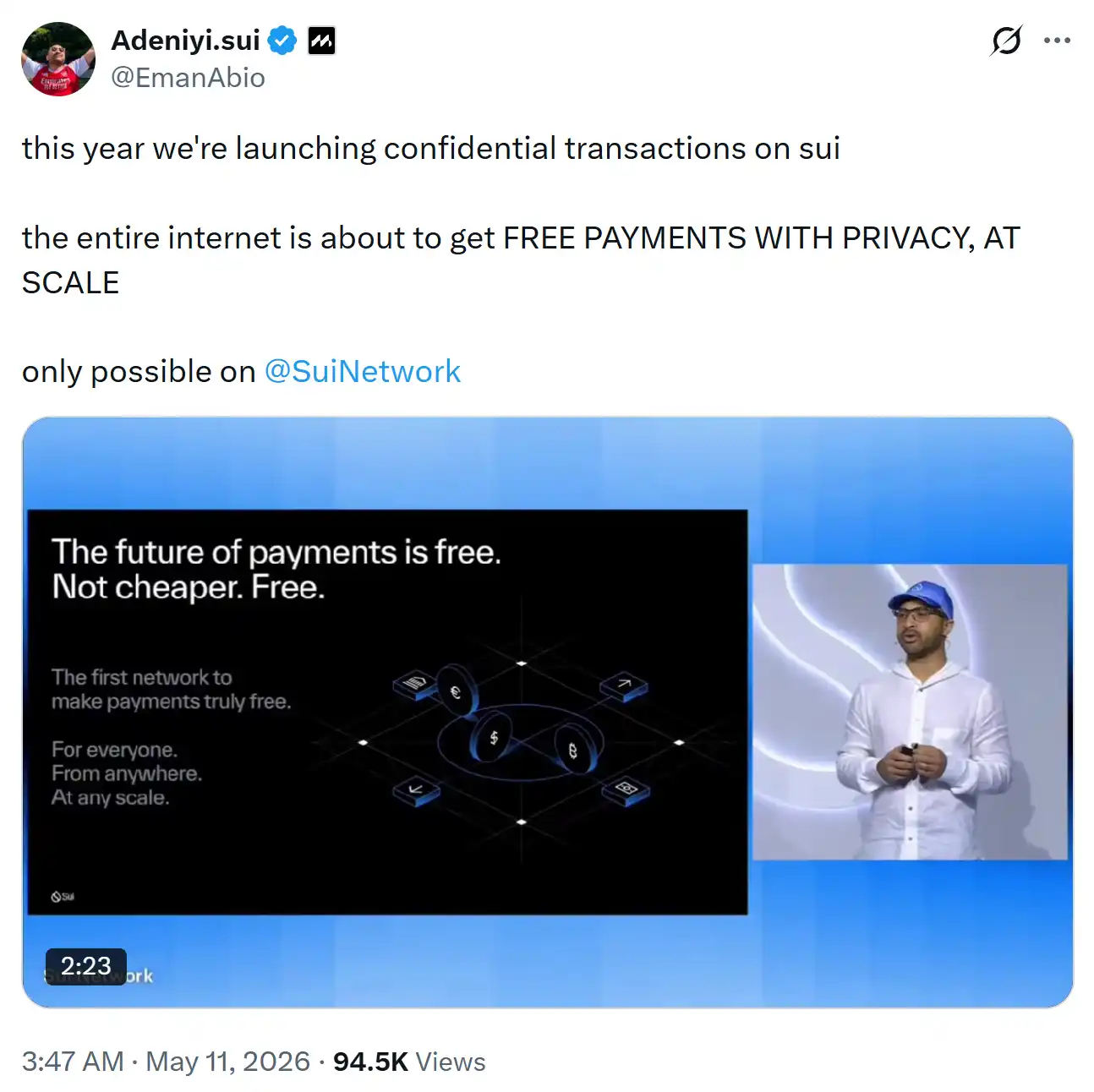
Regarding the second half, the Mysten Labs product team has hinted multiple times: Protocol-level confidential transaction functionality will be launched within 2026, aiming to achieve large-scale, free payments with privacy protection.

Transfers will not only be cost-free but will also be able to hide transaction amounts and certain details, while retaining necessary audit and compliance capabilities.

This combination is crucial for adoption, especially for institutions. The higher the compliance requirements, the greater the value of confidential transactions.
Let Money Flow Like Information.

This can be considered a phrase that runs through all of Sui's technological and ecosystem initiatives.

And now, from payments to Agents to institutions, the fuse that will decide large-scale adoption might just be lit by zero Gas stablecoin transfers.

Criptos en tendencia

Preguntas relacionadas

QWhat is the main announcement made by Sui regarding stablecoin transfers, and when was it announced?

ASui announced a zero Gas stablecoin transfer function on May 20, 2026. This feature allows users and businesses to send stablecoins peer-to-peer without paying Gas fees and without needing to manage a separate SUI token balance.

QHow does Sui's 'zero Gas' mechanism for stablecoin transfers fundamentally differ from previous attempts at eliminating Gas fees?

AUnlike previous methods that relied on subsidies or relayers where someone else ultimately pays the Gas, Sui's approach targets the underlying architecture. It is built on the new Address Balances system, where tokens are sent using specific Move functions and automatically merged into the recipient's single balance. This eliminates the overhead of creating, splitting, merging, and tracking Coin objects, reducing validator processing costs so low that fees can be waived for the user.

QAccording to the article, what are some of the key use cases or scenarios enabled by zero Gas stablecoin transfers on Sui?

AThe key use cases include: 1) Everyday payments like consumption, tipping, subscriptions, and cross-border remittances. 2) High-frequency micropayments for the Agent/AI economy, enabling autonomous transactions with minimal cost. 3) Institutional payments such as cross-border B2B payments, supplier settlements, and platform revenue sharing, where reducing friction is crucial.

QWhat is the 'second half' or next major development in Sui's 2026 payment narrative mentioned in the article?

AThe 'second half' of Sui's 2026 payment narrative is the planned launch of a protocol-level confidential transaction feature within the year. The goal is to enable large-scale, free (zero Gas), and privacy-preserving payments that can hide transaction amounts and certain details while retaining necessary audit and compliance capabilities.

QWhat underlying technical principle allows Sui to offer zero Gas fees for eligible stablecoin transfers?

AIt is enabled by the new Address Balances account architecture. When tokens are sent using specific Move functions, they are automatically merged into the recipient's address balance without creating individual Coin objects. This drastically reduces the computational overhead (like object creation, splitting, merging, and version tracking) for validators, making the cost so low that fees are not charged to users for qualifying transactions.

Lecturas Relacionadas

MSTR Discloses Sale of 3,588 Bitcoins, Stock Price Drops Over 5% at One Point During Trading

MicroStrategy, the world's largest corporate holder of Bitcoin, has significantly shifted its business model. Between June 29 and July 5, the company sold 3,588 bitcoins for approximately $216 million to fund quarterly dividends for its preferred stock. This marks its largest-ever Bitcoin sale and signals a strategic pivot: Bitcoin is transitioning from a "buy-and-hold" reserve asset to a liquidity management tool for the company. This move follows a recent authorization allowing Bitcoin sales when equity fundraising is less attractive. The announcement contributed to a more than 5% intraday drop in MicroStrategy's stock price, while Bitcoin fell to around $61,800—below the company's average holding cost of roughly $75,700. The sale represents a major departure from MicroStrategy's long-standing "never sell" commitment, which saw its first minor breach in May with a $2.5 million sale. The latest, hundred-times-larger transaction underscores growing financial pressures. Analysts note the company faces about $1.5 billion in annual preferred dividend obligations, far exceeding cash flow from its software business. As of July 5, MicroStrategy holds 843,775 bitcoins. Its current operational logic involves buying Bitcoin during favorable financing conditions and selling portions to cover dividends when needed, creating a flexible capital management cycle amidst a challenging market environment.

华尔街日报Hace 5 hora(s)

MSTR Discloses Sale of 3,588 Bitcoins, Stock Price Drops Over 5% at One Point During Trading

华尔街日报Hace 5 hora(s)

Q-Day Countdown: Will Quantum Computing End Cryptocurrencies?

Quantum Computing's Threat to Cryptocurrency: A Countdown to Q-Day Quantum computing, specifically Shor's algorithm, poses a fundamental threat to the public-key cryptography (e.g., ECDSA, RSA) that secures blockchain networks like Bitcoin and Ethereum. This critical juncture, known as Q-Day, is estimated to occur potentially within the next 5-15 years. The core vulnerability stems from the public and immutable nature of blockchains. Assets in addresses where the public key is already exposed on-chain (e.g., spent outputs) are at direct risk, as a sufficiently powerful quantum computer could derive the private key. This threatens the very trust model of cryptocurrencies. The response lies in Post-Quantum Cryptography (PQC)—algorithms like lattice-based ML-DSA and hash-based SLH-DSA, which are resistant to quantum attacks. NIST has standardized key PQC algorithms (FIPS 203, 204, 205), providing a migration path. However, the primary challenge is not technical but socio-economic and involves complex governance: * **Bitcoin's** path is constrained by its conservative ethos. Migrating requires a soft-fork to new address types, facing hurdles like significantly larger signature sizes and, most critically, the divisive governance question of how to handle at-risk legacy UTXOs without violating core principles. * **Ethereum** is pursuing a "cryptographic agility" strategy, with a multi-layered roadmap. It leverages account abstraction for user accounts and is developing compressed hash-based signatures (e.g., leanXMSS) for its consensus layer, aiming for a full-stack upgrade over time. In conclusion, quantum computing does not spell an instant end for cryptocurrency but initiates a critical countdown. The industry has a limited "engineering comfort window" to orchestrate a coordinated, ecosystem-wide migration to PQC. The ultimate bottlenecks are the immense coordination efforts and governance decisions required for this foundational transition.

marsbitHace 6 hora(s)

Q-Day Countdown: Will Quantum Computing End Cryptocurrencies?

marsbitHace 6 hora(s)

Trump, the President Who Knows Best How to 'Trade Stocks'

Former US President Donald Trump reported a record-breaking $2.2 billion in personal income for 2025, the highest annual income ever disclosed by a sitting president. This figure, from a 927-page government ethics filing, represented a 3.5-fold increase from his $600 million income in 2024 and boosted his net worth to $6.5 billion. The primary drivers were cryptocurrency (64% of income, approximately $1.4 billion) and real estate (26%, approximately $575 million). His crypto earnings stemmed largely from the launch of his personal meme coin, $TRUMP, generating over $600 million in licensing fees, and substantial profits from the WLFI token and its parent company. Despite a sluggish property market, his Mar-a-Lago resort and associated golf clubs saw revenue surges of 50% and 27%, respectively, attributed to their use as venues for presidential events. Trump's financial disclosure also revealed an unprecedented level of stock market activity, with over 22,000 trades executed in 2025, averaging 87 trades per market day. Media analyses noted several instances where significant trading coincided with major policy announcements, such as proposed tariffs, raising questions about potential conflicts of interest. While the White House stated these trades were handled by a family-managed trust fund and not Trump directly, critics highlighted this as a departure from the blind trusts traditionally used by presidents post-Watergate. The report has intensified debate over the commercialization of the presidency. Supporters view it as a success story of a businessman-president, while critics argue it demonstrates an unprecedented conversion of public influence into private wealth, with policy decisions potentially linked to personal financial gains. The controversy centers on whether Trump's earnings represent innovative entrepreneurship or a fundamental conflict of interest, sparking renewed calls for stricter ethics reforms in US governance.

marsbitHace 6 hora(s)

Trump, the President Who Knows Best How to 'Trade Stocks'

marsbitHace 6 hora(s)

Trading

Spot

Artículos destacados

Cómo comprar GAS

¡Bienvenido a HTX.com! Hemos hecho que comprar GAS (GAS) sea simple y conveniente. Sigue nuestra guía paso a paso para iniciar tu viaje de criptos.Paso 1: crea tu cuenta HTXUtiliza tu correo electrónico o número de teléfono para registrarte y obtener una cuenta gratuita en HTX. Experimenta un proceso de registro sin complicaciones y desbloquea todas las funciones.Obtener mi cuentaPaso 2: ve a Comprar cripto y elige tu método de pagoTarjeta de crédito/débito: usa tu Visa o Mastercard para comprar GAS (GAS) al instante.Saldo: utiliza fondos del saldo de tu cuenta HTX para tradear sin problemas.Terceros: hemos agregado métodos de pago populares como Google Pay y Apple Pay para mejorar la comodidad.P2P: tradear directamente con otros usuarios en HTX.Over-the-Counter (OTC): ofrecemos servicios personalizados y tipos de cambio competitivos para los traders.Paso 3: guarda tu GAS (GAS)Después de comprar tu GAS (GAS), guárdalo en tu cuenta HTX. Alternativamente, puedes enviarlo a otro lugar mediante transferencia blockchain o utilizarlo para tradear otras criptomonedas.Paso 4: tradear GAS (GAS)Tradear fácilmente con GAS (GAS) en HTX's mercado spot. Simplemente accede a tu cuenta, selecciona tu par de trading, ejecuta tus trades y monitorea en tiempo real. Ofrecemos una experiencia fácil de usar tanto para principiantes como para traders experimentados.

338 Vistas totalesPublicado en 2024.12.12Actualizado en 2026.06.02

Cómo comprar GAS

Discusiones

Bienvenido a la comunidad de HTX. Aquí puedes mantenerte informado sobre los últimos desarrollos de la plataforma y acceder a análisis profesionales del mercado. A continuación se presentan las opiniones de los usuarios sobre el precio de GAS (GAS).

活动图片