Latin America's Payments Landscape Is Not What You Think It Is

链捕手Publicado a 2026-06-21Actualizado a 2026-06-21

Resumen

This report challenges common misconceptions about Latin America's payment landscape, based on over 500 hours of firsthand research. Key findings include: 1) Crypto card transaction volume primarily comes from high-net-worth individuals receiving USDT salaries, not retail spending. 2) QR code payments (e.g., Brazil's Pix, Argentina's Mercado Pago) are the dominant payment method across most emerging markets, not cards. 3) A major untapped opportunity lies in enabling cross-border interoperability between domestic instant payment systems. 4) Payment competition is shifting from customer acquisition to owning the settlement layer (e.g., acquiring banks). 5) Latin America is not a single market; Brazil, Mexico, Argentina, and smaller "forgotten five" countries (e.g., Guatemala, Honduras) have vastly different dynamics. 6) Stablecoin-to-fiat conversion margins are collapsing toward zero, pushing companies to build value-added services on top. 7) Future payment winners will be multi-country brands, not single-corridor specialists. 8) Marketing must target specific user segments (e.g., digital nomads, unbanked immigrants) with tailored messaging, not a generic "Brazilian" audience. 9) Contrary to perception, Latin American regulators are often ahead of the US in creating frameworks for digital assets and instant payments, with clear licensing deadlines. The core takeaway is that the region's payment rules are being rewritten, moving beyond cards and stablecoin arbitrage towards int...

Author: Claudia

Compiled by: Jiahuan, ChainCatcher

The rules of payments in Latin America are being rewritten. 500 hours of on-the-ground investigation. Things most fintech companies haven't seen.

I spent almost a month in Latin America with broken Portuguese and worse Spanish. Over 500 hours on the ground, over 100 hours in the air, speaking with over 100 local users, developers, and more than 10 regulators.

The notes I brought back are different from what most payment professionals on this platform say. Some things even contradict my understanding before the trip.

In Brazil, the airline lost my luggage. In Mexico, a wheel broke off when the bag came down the conveyor belt. Friends kept saying that as an Asian woman traveling alone, this was brave.

But what I really want to say is: Latin Americans are the warmest people I've ever met. Strangers helped me with directions, translation, and fixing my broken luggage. In Peru, a taxi driver waited 20 minutes for me to figure out which hotel I had booked. In São Paulo, a bartender drew me a map on a napkin to direct me to a meeting I was late for.

For every story about Latin America being "dangerous," there should be a story about a stranger walking me to the right taxi. Even when the language didn't connect, the hearts did.

Here's what I learned, some of which I got wrong before this trip.

1. Do Crypto Cards Win on Cashback?

The real transaction volume of crypto cards doesn't come from retail users' high-frequency, small-amount spending, but from high-net-worth clients.

The typical pattern I saw repeatedly in Brazil is: A professional receives salary in USD or USDT (usually from a multinational employer or crypto company), loads it into a crypto card, and then withdraws to a local bank account via Pix when they need Brazilian Reais (BRL).

Whether it's Kast, RedotPay, or any other crypto card, the majority of volume comes from this group, not the person buying a $4 coffee with stablecoins.
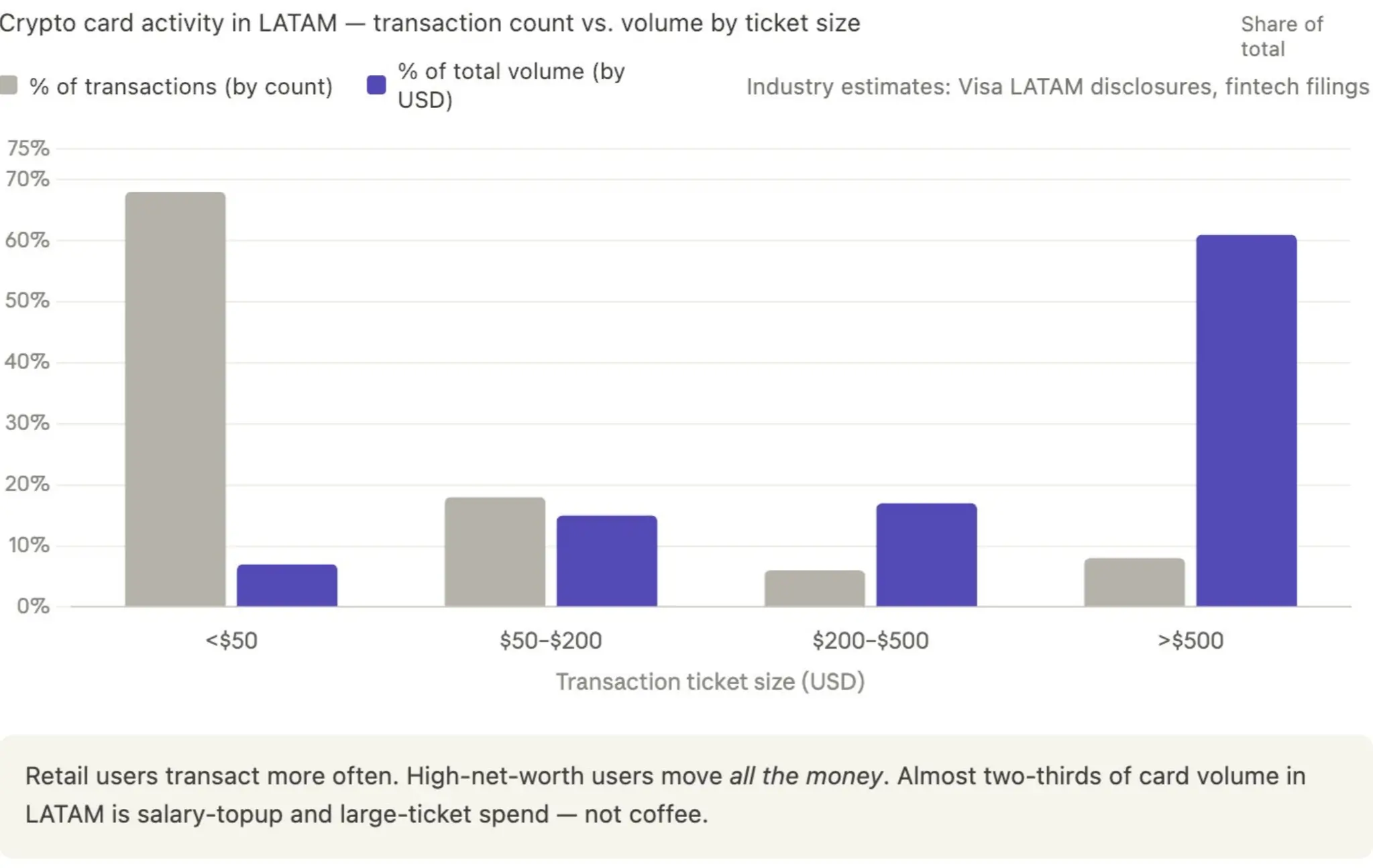
Brazil received about $5 billion in personal inbound remittances in 2024 (Central Bank of Brazil data), with the proportion arriving in stablecoin form rising rapidly, as employers pay in USDC or USDT to avoid FX friction. Latin American crypto card transaction volume is highly concentrated in amounts over $500, which is typical for professional salary top-ups, not retail spending.

2. QR Codes Are Eating the Next Decade

Everyone is competing on issuing cards, on user acquisition. They're missing the structural shift happening underneath.

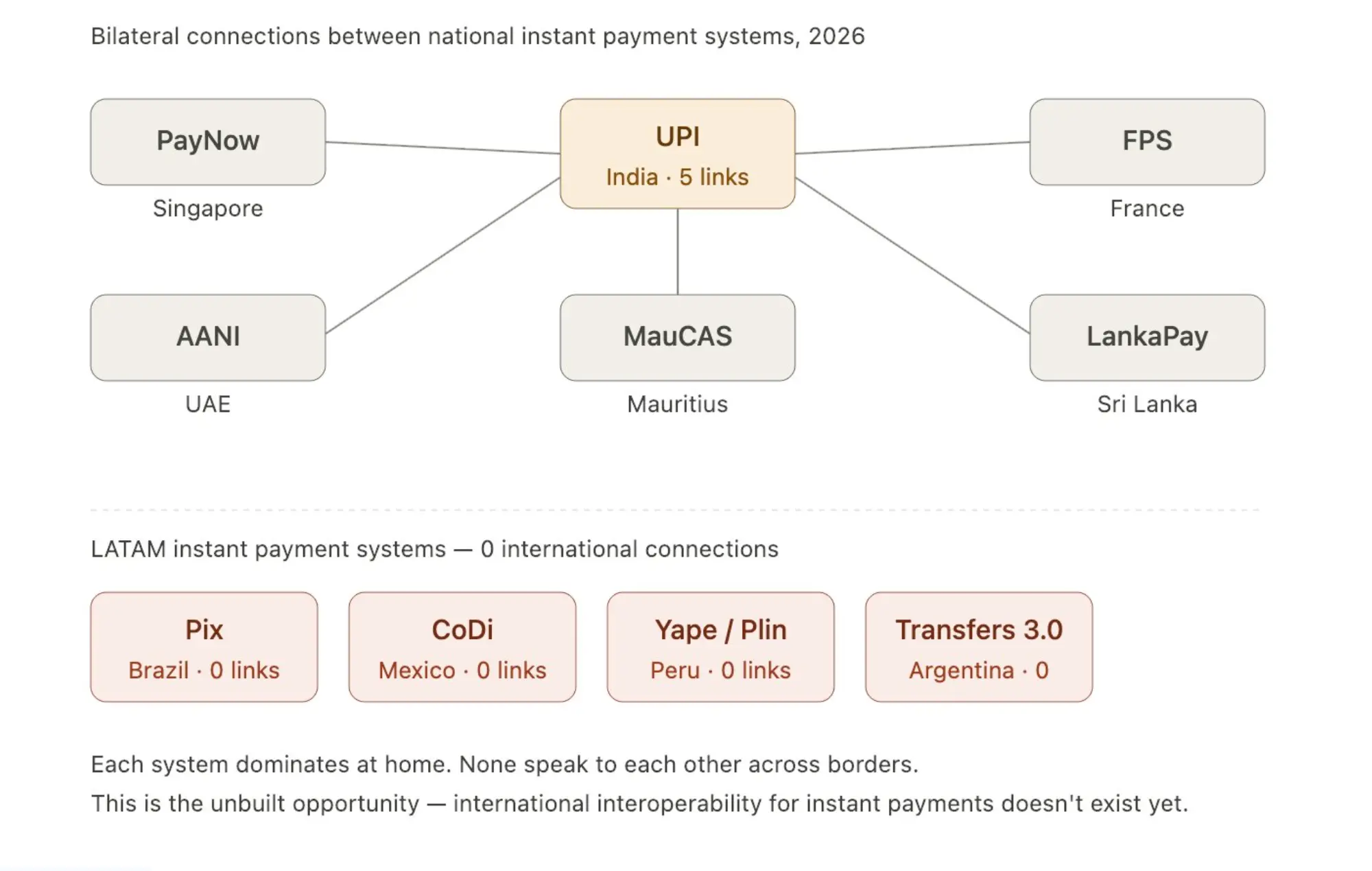
In emerging markets, QR code payments are quietly taking over the entire payment market. Brazil's Pix now processes over 6 billion transactions monthly. Argentina is covered with Mercado Pago QR codes. Peru has Yape and Plin. Mexico has CoDi. Merchants don't need POS terminals, customers don't need cards.

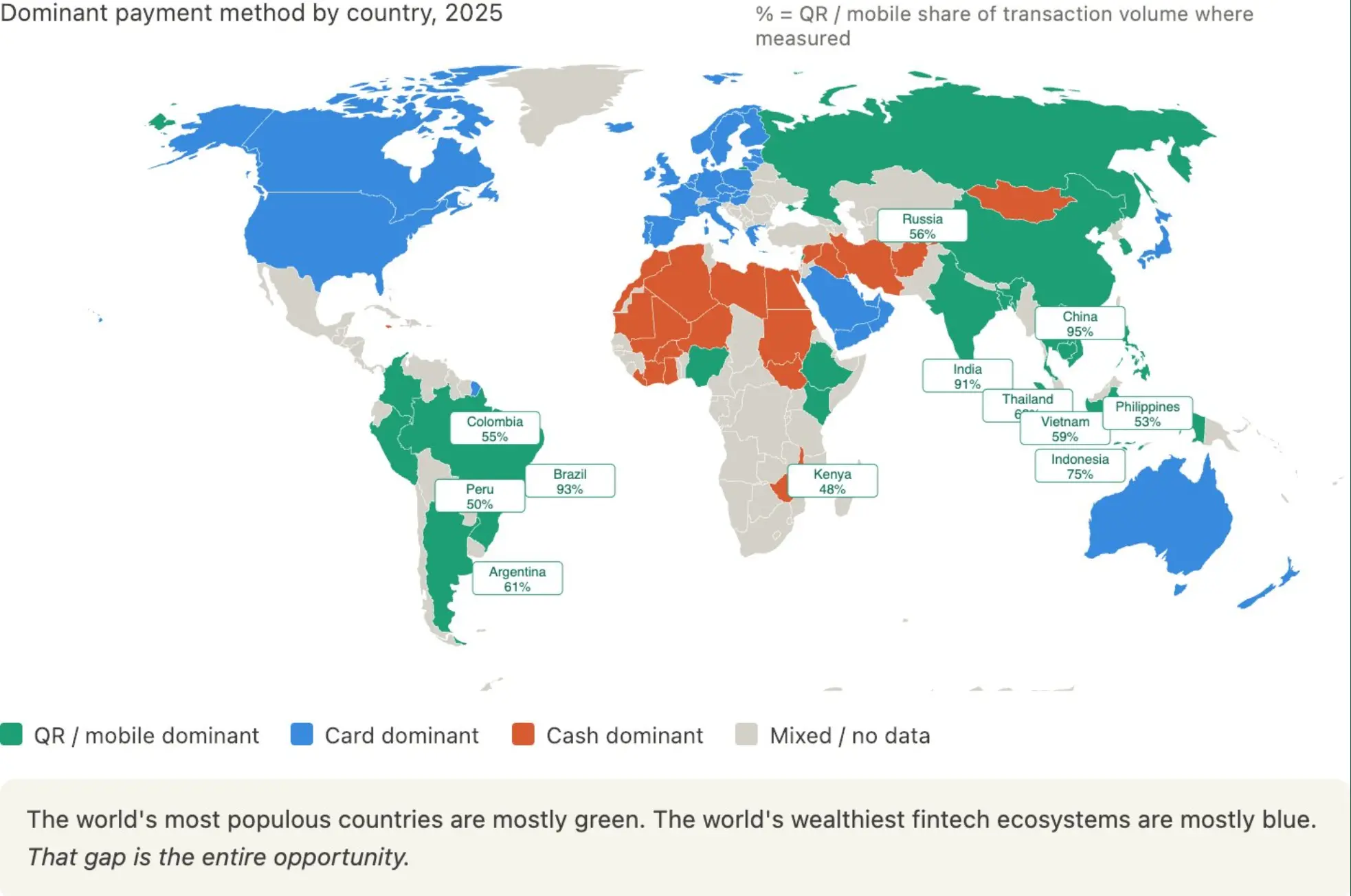
This isn't just a Latin American story. Look at the map of global payment dominance:

→ Brazil: 93% QR code. Pix dominates.
→ China: 95% QR code. Alipay and WeChat Pay have essentially flattened cards.
→ India: 91% QR code. UPI processes more transactions than all US card networks combined.
→ Indonesia: 75%. Thailand: 62%. Argentina: 61%. Vietnam: 59%. Colombia: 55%. Philippines: 53%. Peru: 50%.

Meanwhile, the US, Canada, Western Europe, and Australia remain card-dominated. Most of Africa and the Middle East remain cash-dominated.

One thing most Western fintech practitioners overlook: QR code payments are already the dominant payment method for the majority of the world's population. Card-dominated markets are becoming a shrinking minority, and these are precisely where venture capital, payment company HQs, and most fintech Twitter users are located.

The world's most populous countries are mostly green (QR code), the world's richest fintech ecosystems are mostly blue (cards). This gap is where all the opportunity lies.
Bringing the focus back to Brazil. Pix processed over $3 trillion in transaction volume in 2024, used by about 80% of Brazilian adults. Pix transaction volume already surpassed the sum of credit and debit cards in 2023, and the gap is widening. Mexico's CoDi grew 67% year-over-year in 2024. Argentina's Transferencias 3.0 transaction volume doubled in the same year.
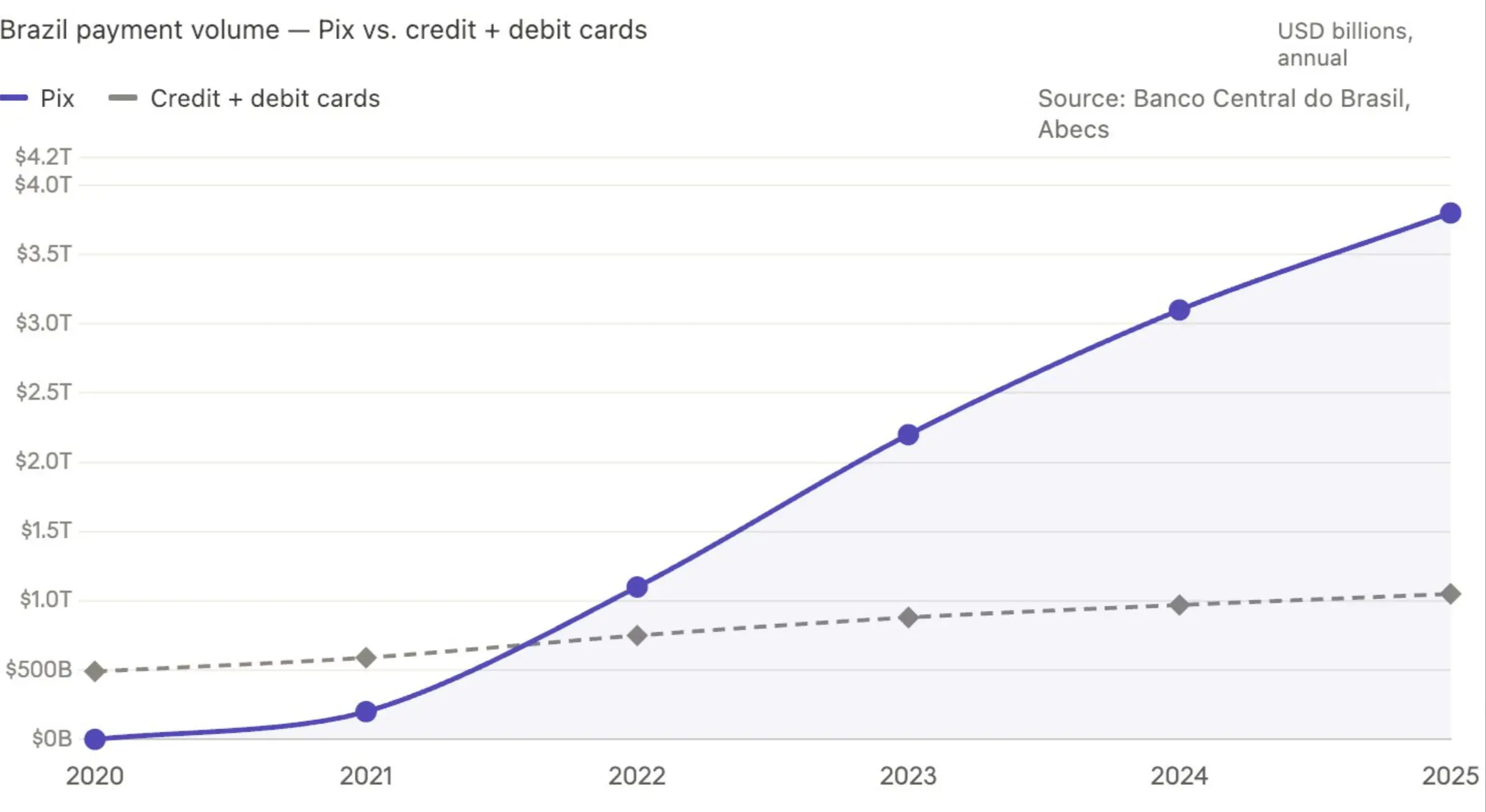
The logic of crypto cards assumes that the Visa and Mastercard card network rails will always be the main settlement layer in emerging markets. But the data says that's no longer the case. And this gap is widening faster than card networks can reinvent themselves.

If you're building a crypto card for emerging market users in 2026, your competitor isn't other crypto cards, but those payment rails that don't require a card at all.

3. The Biggest Unbuilt Opportunity in Payments

Visa and Mastercard unified the fragmentation of card networks, but didn't solve the fragmentation for merchants. Not every small merchant can afford a POS terminal. The cost of acquiring just doesn't make sense for a fruit stand.

QR codes and scan-to-pay solved the "last mile" within each country. Brazil's Pix, Mexico's SPEI, Peru's Yape, each dominates domestically.

But internationally, it's still fragmented. As a foreigner, you effectively have only two choices:

Choice A: Use a Visa or Mastercard to withdraw cash from an ATM. Cost: FX markup, fees, and you can only pay with cash.

Choice B: Download a local app. Link a card, do KYC verification. Cost: 3% to 5% FX loss, takes days, and only works in that one country.

Both paths end the same: you can only pay within that country. Change countries, it all resets, start over.
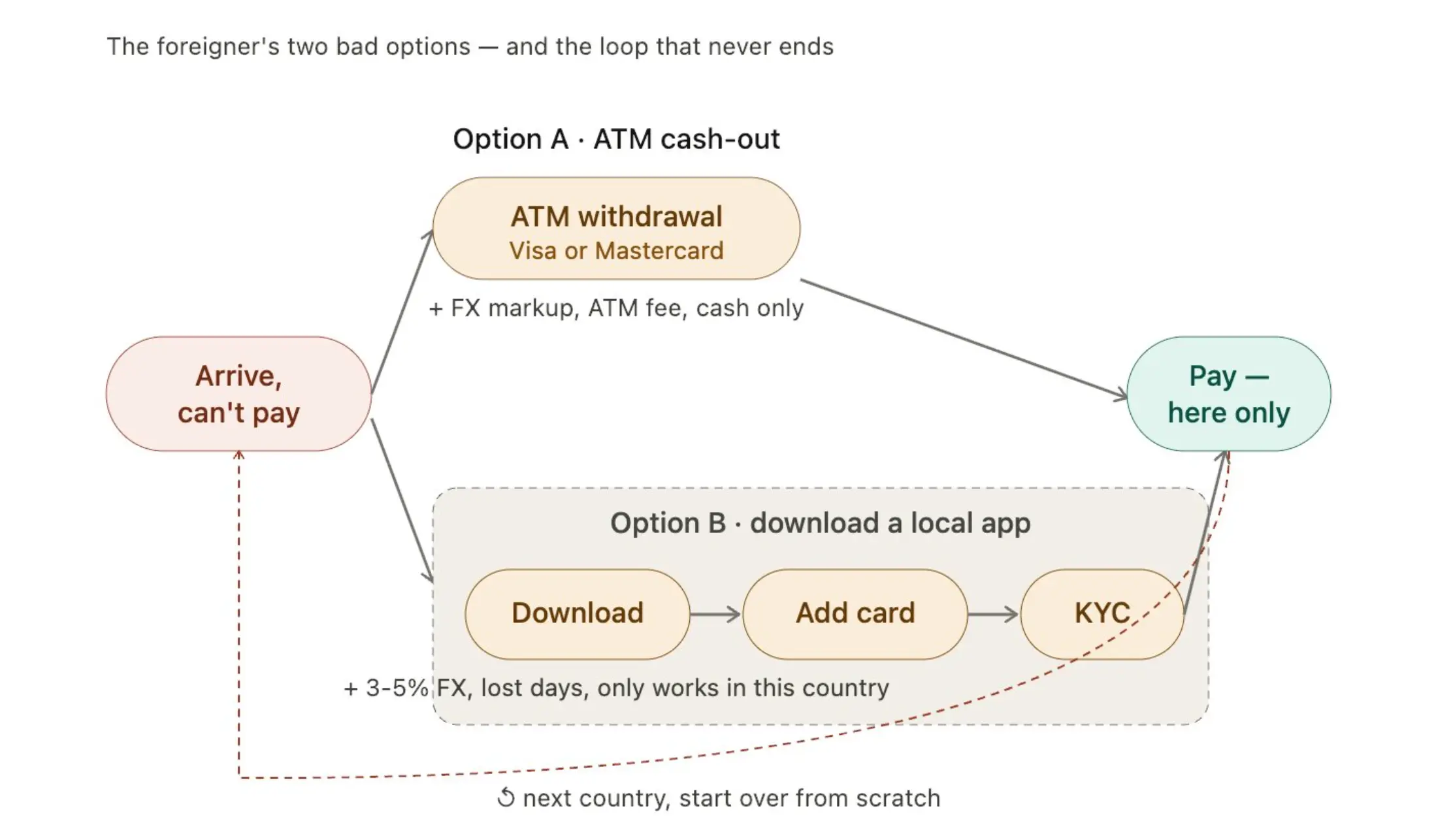
One rainy night, sitting in a bar in Brazil as a foreigner wanting to order an espresso martini, my Pix didn't work. My non-Brazilian wallet couldn't talk to the bar's POS (they only accept local payments). The layer of "international interoperability" between countries' instant payment systems doesn't exist yet.
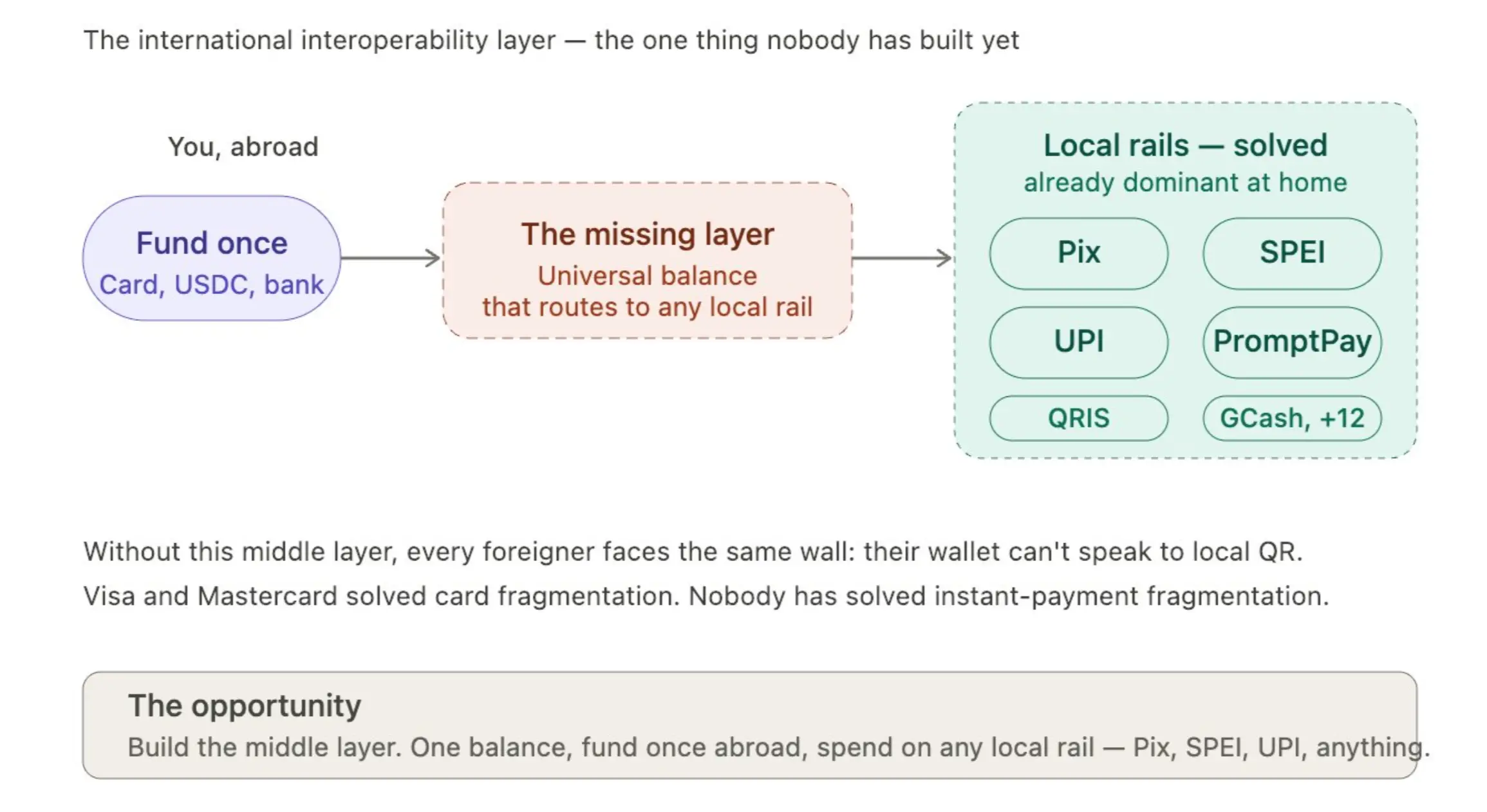
This is one of the biggest unbuilt opportunities in payments.

India's UPI already has bilateral connections with Singapore (PayNow), UAE (AANI), France, Sri Lanka, Mauritius. Meanwhile, Latin America's instant payment systems are almost entirely unconnected internationally. The Bank for International Settlements (BIS) Nexus project is working on this, but multilateral interoperability won't happen before 2027.
4. Payment Competition Is No Longer About Acquiring Users, It's About Owning Settlement

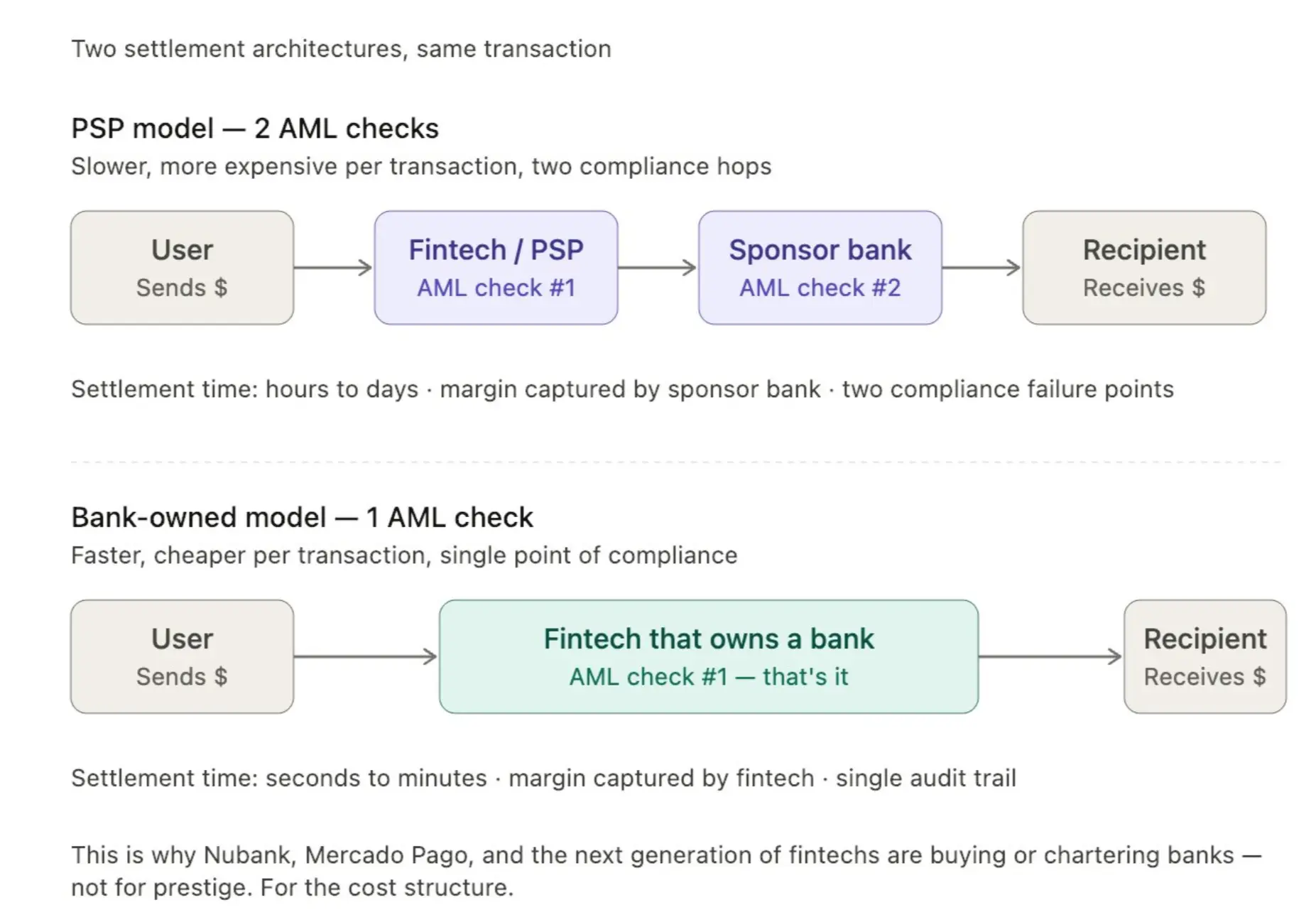
Most companies integrate a PSP (Payment Service Provider), letting the PSP shoulder the compliance and AML burden. At small scale, this model works.

But leading payment companies are now starting to buy banks directly. Why? Because owning a bank means doing AML checks only once per transaction, not twice. Settlement is faster, profits are earned not rented.

Hence you see Nubank's moves into banking, the wave of Brazilian fintechs acquiring small banks, and several stablecoin companies quietly applying for banking licenses.

Brazil now has over 1,400 licensed payment institutions, over 90 chartered banks. The model of "fintech with a banking license" is growing 3x faster than pure-PSP fintechs (Central Bank of Brazil 2024 data). In Mexico, just having an IFPE license is no longer enough; top players are seeking SOFOM or full banking licenses for cost reasons.
5. "Latin America" Is Not One Market

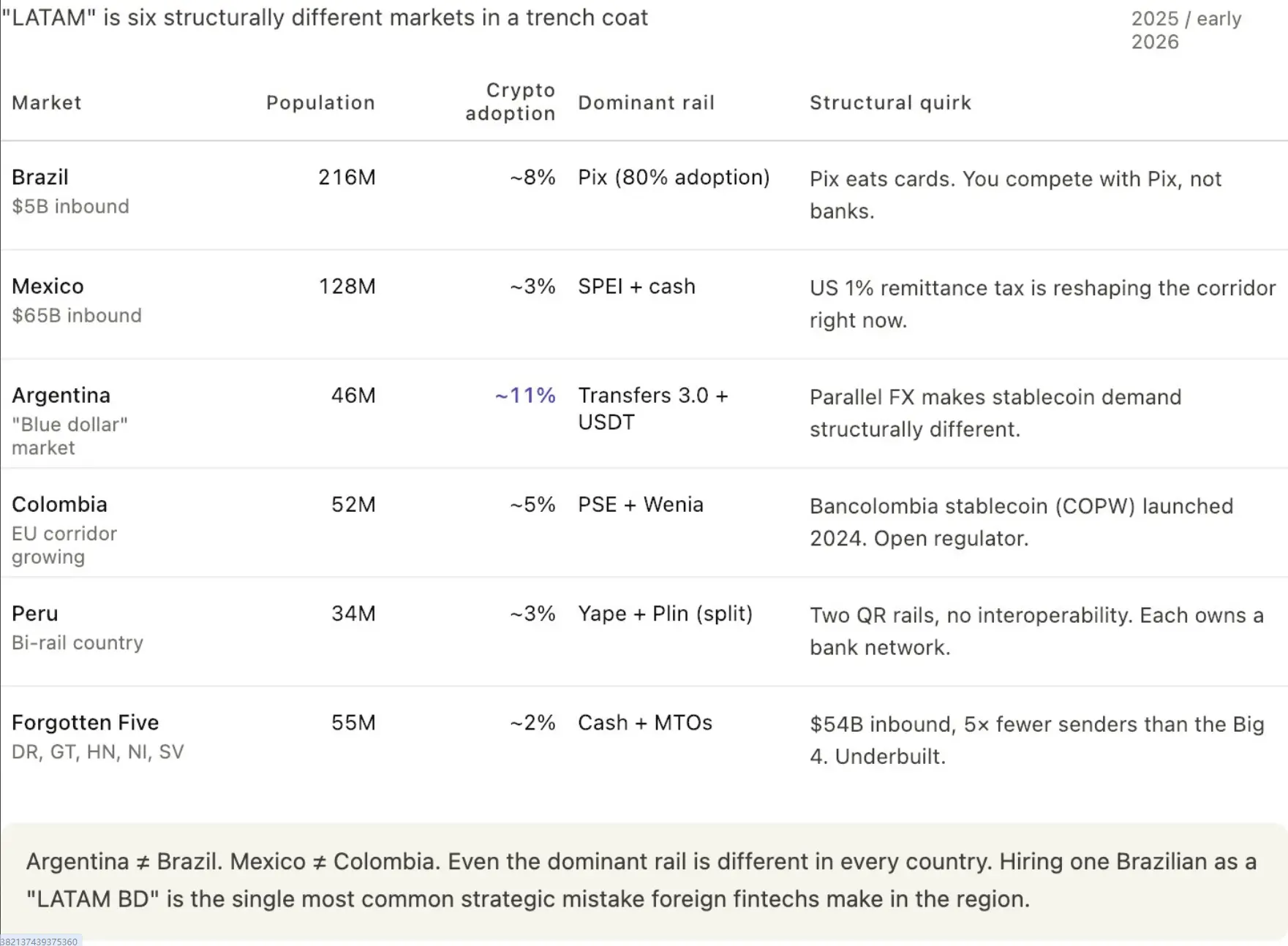
Most companies hire a Brazilian as a "Latin America BD" or community manager. This is a mistake.

Argentina is a big market, the transaction volume there is real. And because of history, culture, and football rivalry, Argentinians and Brazilians don't really get along, sometimes calling each other "monkeys" (both ways). Each country has its own currency logic, its own informal economy patterns, its own diaspora groups, its own history of capital controls.

If you can't tell the difference between Argentina's capital controls, Brazil's parallel exchange rate, and the Mexican peso's free float, you can't do Latin American payments.

Worth noting data: Argentina's population is only 46 million, yet it has over 5 million crypto users (~11% penetration, among the highest globally). Argentina's parallel FX market ("Blue Dollar") creates a structurally different demand for stablecoins than Brazil.

Mexico's remittance flow ($65 billion annually) is the world's second largest, but is being squeezed by both a US 1% remittance tax (passed Summer 2025) and tighter dollar supply from the Mexican central bank.
6. Neobanks Are Pivoting to Become FX

That stablecoin conference held in Mexico City this year was essentially a remittance and FX conference. Money from different countries was flowing cross-border, and that flow is being commoditized, becoming a price war.

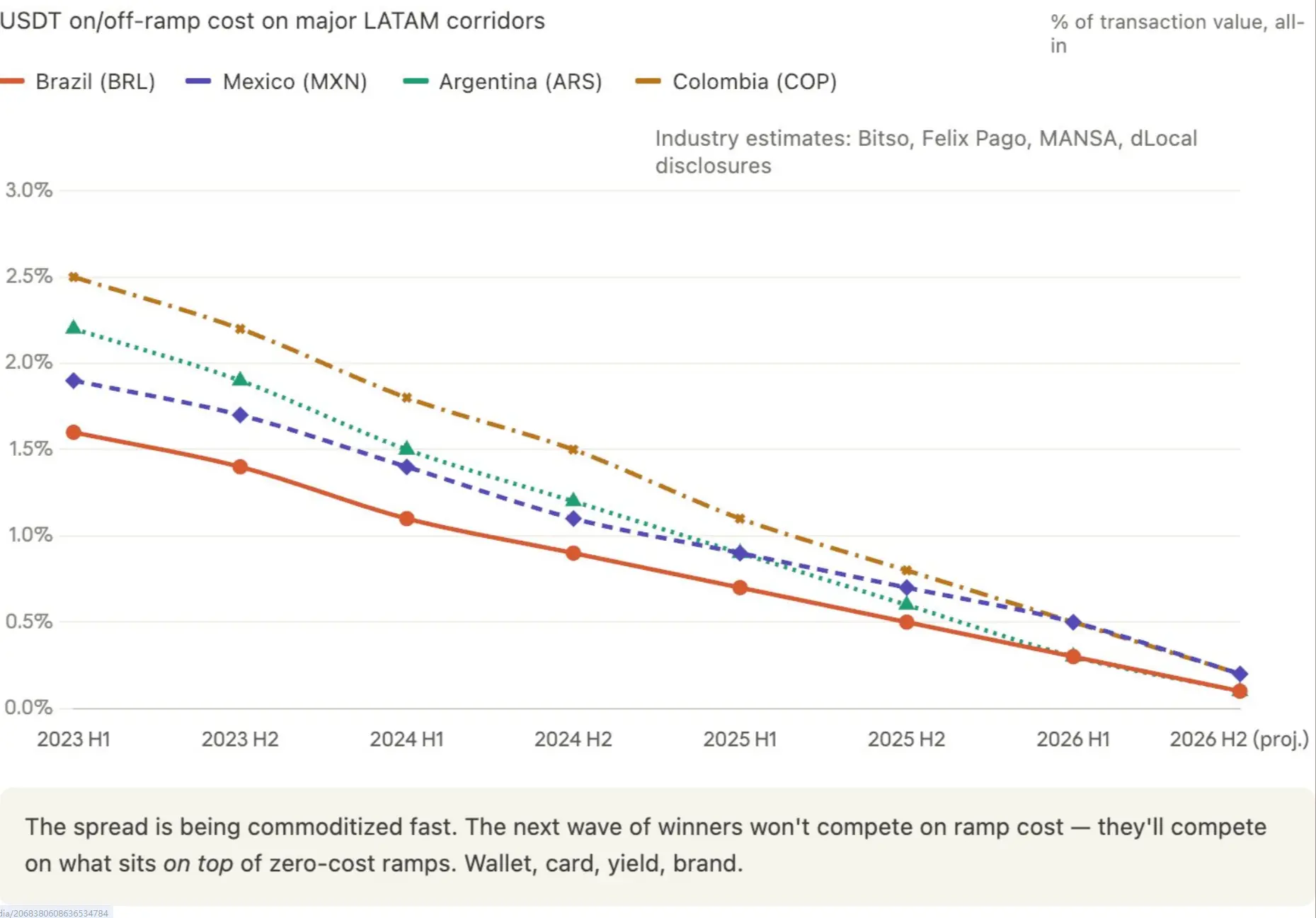
Margins are approaching zero. My prediction: Within the next 6 to 12 months, the cost of converting between USD and USDT will drop to zero on major LatAm corridors. Companies trying to make money on spreads will find themselves squeezed by infrastructure players who treat conversion as a loss leader for bigger products.

From July 2023 to June 2024, stablecoin transaction volume in Latin America was approximately $415 billion (Chainalysis data). Currently, about 71% of LatAm institutions use stablecoins for cross-border payments (Fireblocks 2025 data).

Cross-border stablecoin transfer costs dropped from 1.5% to 2% in 2023 to 0.3% to 0.8% in 2025. Cost compression is accelerating, with Bitso, Felix Pago, and a dozen smaller players racing to drive spreads to zero.
7. Cross-Border Expansion Is the New Frontier

Classic payments advice is: Pick a remittance corridor, go deep. Build relationships, get licenses, lock in merchants, become the default.

This advice is breaking down. VCs are telling me payments have become hard to invest in because of over-localization. Every company goes deep in one country, takes local profits, but then can't get out. They become kings of one corridor but can't be invested in as a cross-regional brand.

The next generation of payment companies needs international brand recognition from day one, with tech stacks that can scale cross-border. This is a generational shift in what fintech considers "good."

Stripe's over $90 billion valuation comes from cross-corridor expansion, not single-corridor depth.

Nubank's expansion to Mexico, Colombia, and now eyeing Argentina is precisely this multi-country play that unlocked its valuation, not just its depth in Brazil.

DollarAPP recently started entering Brazil too. Most down-round financings among LatAm fintechs between 2024 and 2025 happened to companies focused on a single country.

8. Brazil and Mexico Are Red Oceans

I spoke with Piero del Risco about the "Forgotten Five."

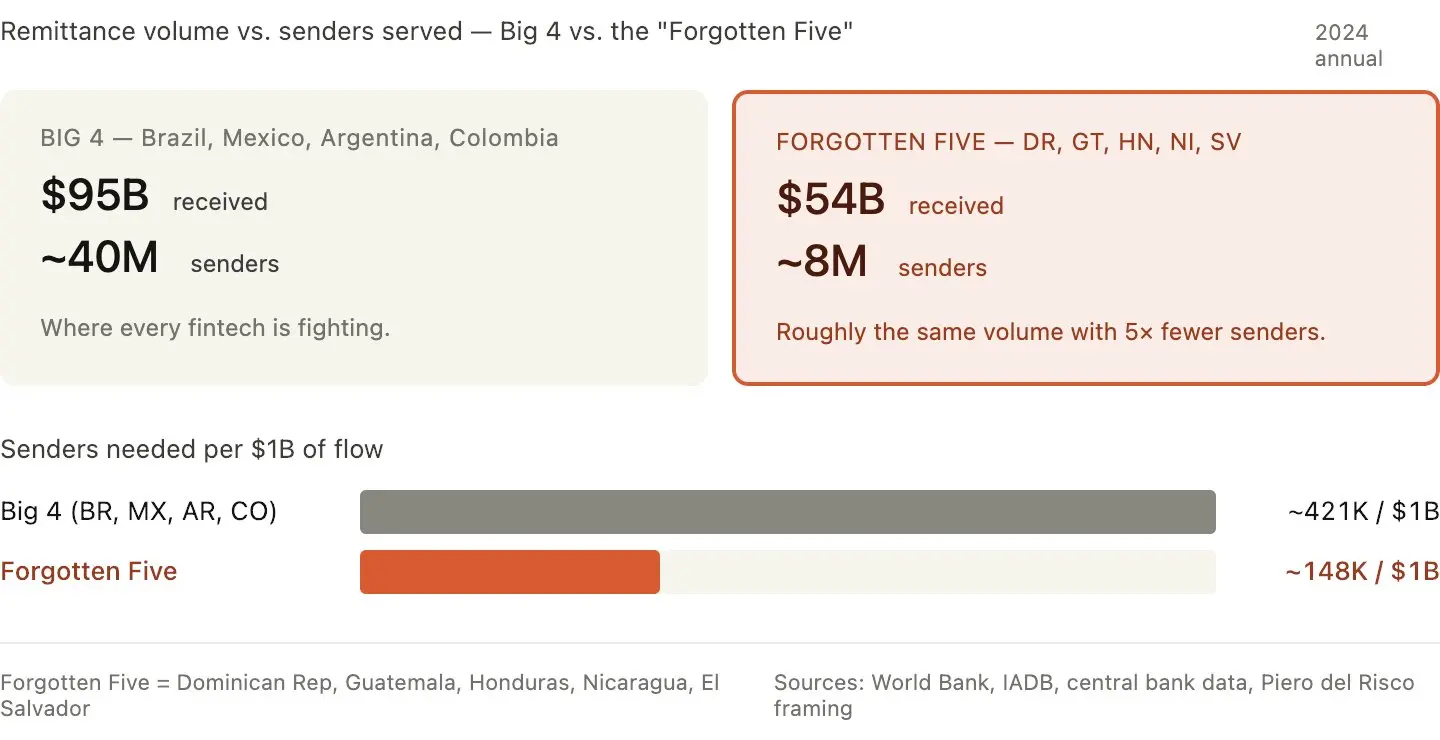
"Think about it: Dominican Republic, Guatemala, Honduras, Nicaragua, and El Salvador collectively receive about $60 billion in remittances. That's roughly equal to the total of Brazil, Mexico, Argentina, and other major markets combined. But serving these 'Forgotten Five' are only 8 million remittance senders, while serving the big markets are 40 million. We moved upstream, becoming program managers in the US, thus gaining a regulatory moat, providing banking services to senders at the top of the funnel, and owning the payment rails in each country downstream."

It's not just these five; there are a few small countries with a small but concentrated group of senders in the US receiving money equal to the entire "big" market. Everyone is fighting for Brazil and Mexico; almost no one is seriously building infrastructure for Guatemala or Honduras. With the same transaction volume, competition density here is 5x lower.

A few other overlooked corridors I'm watching:

Colombia → Europe (Spain, Italy, Netherlands)
Argentina → Bolivia (small but extremely concentrated)
Venezuela → Colombia (largest non-US LatAm corridor)

Guatemala received $20.3 billion in remittances in 2024 (15% of GDP). Other countries: Honduras $9.7b, El Salvador $8.6b, Nicaragua $4.8b, Dominican Republic $10.2b. Total $53.6 billion, about 33% of all LatAm remittances. Their combined population is less than a quarter of Brazil and Mexico's, with almost no fintech competition.

Cost per remittance for the "Forgotten Five" is also higher (6.5% to 8%, vs LatAm average of 6%), meaning more margin to capture.
9. Marketing Budgets Should Be Spent on the Right Places

Take Brazil as an example.

Every fintech pitching "Brazil" treats it as one user group. It's not. This country has at least five different money-flow segments, each requiring a different product, messaging, and payment rail. If you can't draw your user's money flow on a napkin, you're spending your marketing budget on the wrong people.

Here are the five segments I mapped on the ground:
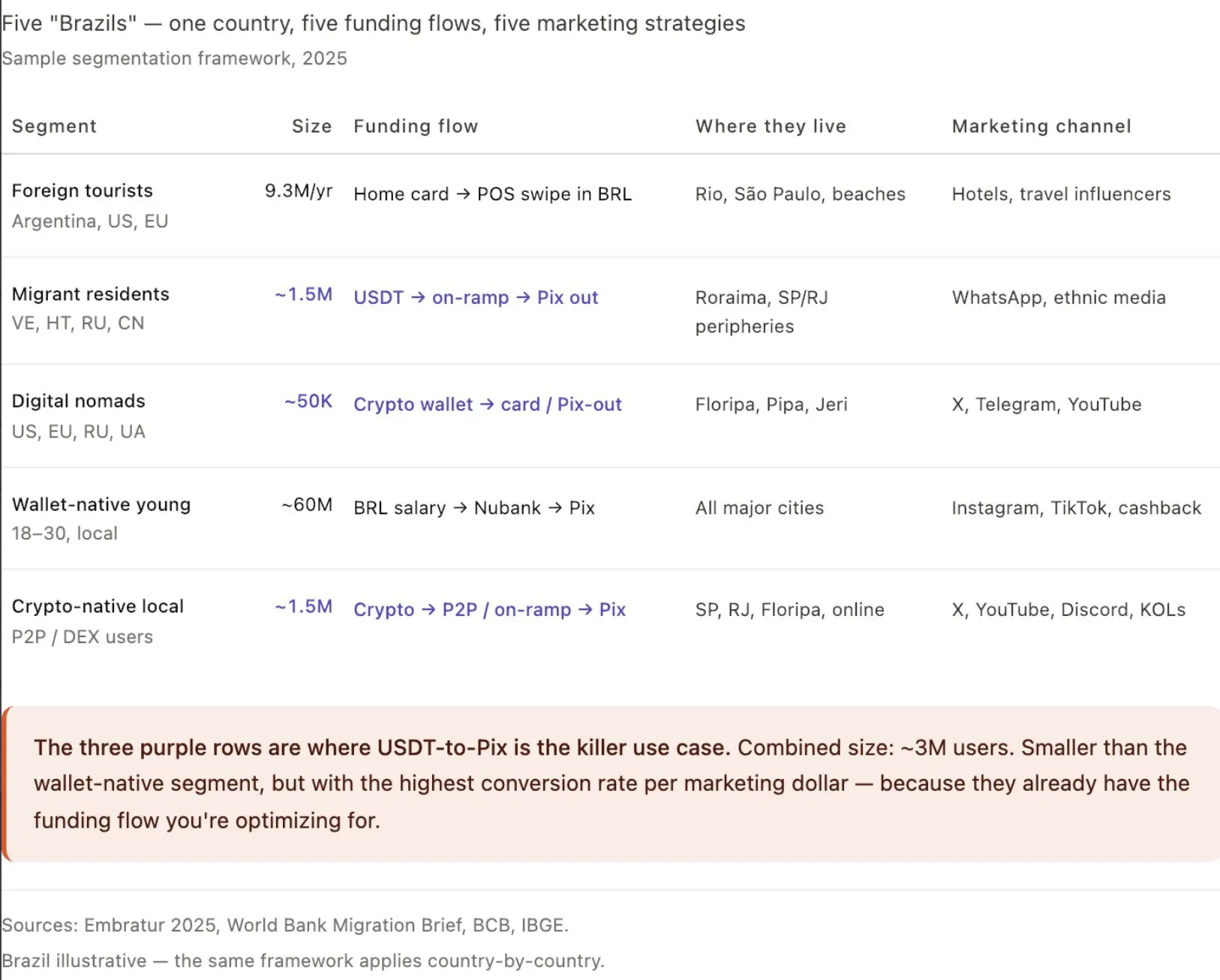
Segment 1: Foreign tourists. 9.3 million people in 2025, total spend $7.9 billion (~$847 per capita).

Main sources: Argentina 3.4 million (price-sensitive, love beaches), Chile 800k (high-value), US 760k (high-spending), followed by Paraguay, Uruguay, France, Portugal, Germany.

Their money flow: home country debit/credit card → swipe on Brazilian POS. They never directly touch BRL.

Effective marketing entry: airport transfers, FX savings vs home bank, one-click payments with no fees for attractions.

Segment 2: Long-term foreign residents without Brazilian bank accounts. Venezuelans (79% of immigrant population in Brazil), Haitians, Bolivians, Russians, Chinese, Syrians, totaling ~1.5 million immigrants. 62% already use digital wallets, not traditional accounts.

Their money flow: international USDT or USD income → conversion → Pix out for BRL spending. This is the highest-value segment for native stablecoin products; USDT to Pix is their killer use case. Zero education cost, direct conversion.

Segment 3: Digital nomads. Concentrated in Florianópolis, Rio, São Paulo, Pipa, Jericoacoara. Mostly Americans, Europeans, Russians, Ukrainians. Income from abroad, often USDT or BTC. Refuse to open Brazilian bank accounts due to bureaucratic hassle.

Money flow: crypto wallet → card spend or Pix out for rent, restaurants, Uber, phone bills. They are not sensitive to FX price, but extremely sensitive to experience. They'll switch providers for one less click.

Segment 4: Brazilian young digital wallet natives. They have "accounts," but with Nubank, Mercado Pago, PicPay, RecargaPay, not Itaú or Bradesco. They don't see themselves as bank customers, but as app users.

Money flow: BRL salary → digital wallet → Pix everywhere. Crypto exposure increasing, but core flow entirely local. Marketing entry is cashback, yield, convenience, not "stablecoin rails."

Segment 5: Crypto-native Brazilians. Hold USDT or BTC, frequent P2P use. Money flow: crypto balance → P2P or conversion → Pix → spending. Brazil has over 1.5 million active crypto users. This is the easiest to convert, but also the smallest.

This is where most fintechs get it wrong: they build one product, run one marketing campaign, targeting all of "Brazil." Result: sky-high CAC because segments 1, 2, 3, 4, 5 require completely different acquisition channels, different messaging, different money rails.

Russian-language YouTube ads targeting digital nomads in Florianópolis have vastly different conversion rates than Portuguese Instagram ads targeting young Brazilians in São Paulo. WhatsApp groups for Venezuelan immigrants in Roraima perform completely differently from US travel influencer partnerships targeting tourists.

After mapping these segments, the framework I use in any Latin American country is:
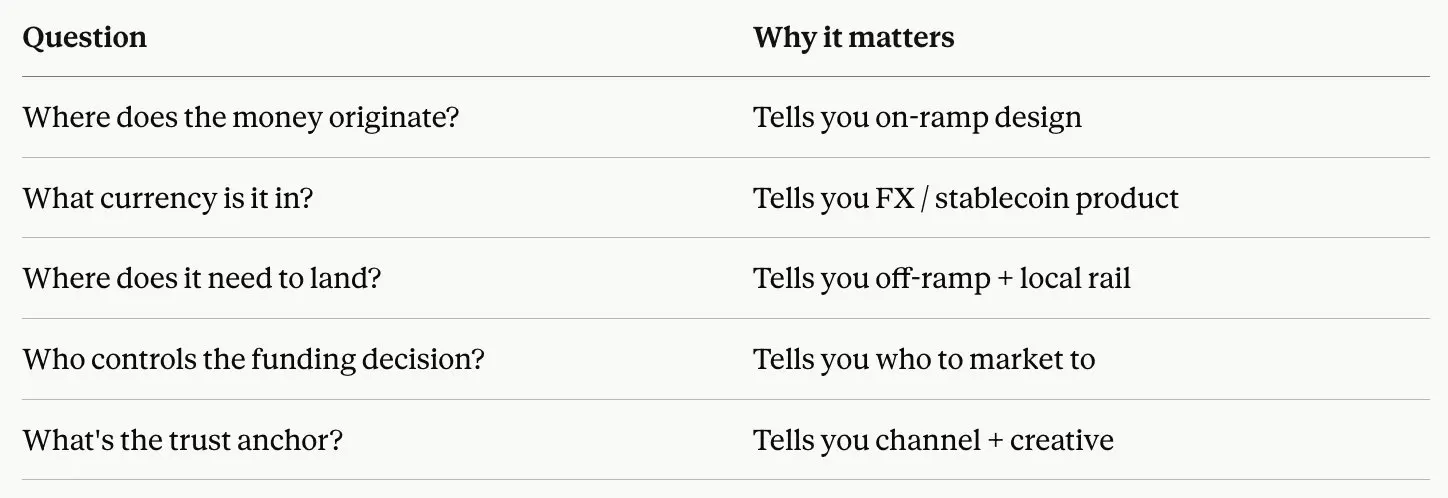
If you can't answer these five questions for each priority segment, you're not ready to spend marketing budget. What you should do is more user research.

The same logic applies to every Latin American country.

This Brazil example can be mapped one-to-one to Mexico (remittance senders from the US, Mexican professionals, US-Mexico cross-border SMEs, crypto-native youth, unbanked rural population), to Argentina (Blue Dollar holders, dollarized salary professionals, crypto-native traders, MercadoPago users, tourist arbitrageurs), and every market in the region.

Don't ask "Should I do Brazil?"

Ask "Which of these five Brazils am I doing?"

That's the only question that turns Latin American expansion into a fundable venture, not a money pit.

10. On Regulation, Latin America Is 5 Years Ahead of the US

Throughout the trip, I spoke with over 10 regulators. The biggest surprise: they aren't phased at all by stablecoins, P2P rails, crypto-fiat interoperability.

The Western narrative about LatAm regulation is "fragmented, slow, behind." But on the ground, it's the opposite. The US is playing catch-up.

Brazil. The central bank built Pix in 18 months and made it free on the payment side—something the Fed is still studying. The crypto regulatory framework is now set: Resolutions 519, 520, 521 issued in November 2025, effective Feb 2, 2026. Hard deadline for existing VASPs to apply for authorization is Oct 30, 2026.

After that, every institution regulated by the Brazilian Central Bank, including every Brazilian bank, every payment processor, every Pix service provider, is prohibited from doing virtual asset business with unlicensed counterparties. Read that sentence again.

This deadline isn't "you need a license," it's "if you don't have a license, every Brazilian bank you work with is legally required to cut ties with you." As of writing, about 4 months left.

Mexico. Mexico passed the Fintech Law in 2018, while the US still has no federal fintech law in 2026. The Mexican Central Bank's IFPE plus remittance licensing framework was built specifically for cross-border digital money flows. The US just passed a 1% federal remittance tax in Summer 2025 (the Big Beautiful Act). Mexican regulators noticed this earlier than US fintech practitioners. Several told me they're adjusting licensing strategy to capture money flows that will circumvent US cash channels.

Colombia. The Financial Superintendency approved Bancolombia's COPW peso stablecoin in 2024, a fully regulated end-to-end commercial bank stablecoin. The Fed hasn't approved a single US bank stablecoin yet.

Argentina. Despite the central bank prohibiting banks from touching crypto in 2022, the new VASP licensing sandbox (launched 2025) is more flexible than New York's BitLicense. Argentine regulators told me directly: "We can't stop dollarization, we can only make it safer." This level of candor is something most US regulators wouldn't have publicly.

Costa Rica and Paraguay. Both are running stablecoin remittance sandboxes, with clearer licensing paths than over 30 US states.

The most surprising part: LatAm regulators aren't trying to slow stablecoin adoption. Several proactively asked me "how can we make it safer for our citizens?" not "how can we stop it?"

This isn't a regulatory environment "behind" the US. It's a regulatory environment ahead of the US; they've moved past the existential debate the US is still stuck in.

If you're doing cross-border in LatAm and still waiting for "regulatory clarity," you've misread the situation. Clarity has been here.

The ambiguity is actually on the US side of the corridor.

In fact, most of these points are the opposite of what I believed before the trip.

The biggest shock for me was point 6. I went to LatAm thinking stablecoins were a structurally high-margin business. The reality seen on the ground is they're already racing to zero.

The winner won't be the one with the best conversion channel, but the one that builds the next layer on top of conversion (wallet, card, yield, brand) the best.

To every taxi driver, bartender, bank manager, and regulator who took the time to explain things to a foreigner with bad Spanish and worse Portuguese.

The wheel on my suitcase will get fixed, eventually.

But what I learned on this trip won't get worn down.

Criptos en tendencia

Preguntas relacionadas

QAccording to the article, who are the primary users generating most of the transaction volume for crypto cards in Brazil, and what is their typical use case?

AThe primary users are high-net-worth professionals, not retail users making small daily purchases. The typical use case is a professional receiving their salary in USD or USDT (often from multinational or crypto-native employers), loading it onto a crypto card, and then using Pix to withdraw Brazilian Reais (BRL) to a local bank account when needed. The transaction volume is highly concentrated in amounts over $500, which reflects salary top-ups rather than retail spending.

QWhat major structural shift in payment methods is occurring in emerging markets like Latin America, and why does the author believe this challenges the logic of crypto cards?

AThe major structural shift is the widespread adoption and dominance of QR code-based instant payment systems (like Pix in Brazil, UPI in India, Alipay/WeChat Pay in China). These systems are replacing cards as the primary settlement layer. The author argues that this challenges the logic of crypto cards because their business model assumes Visa/Mastercard networks will remain the dominant rails in emerging markets. However, data shows QR-code systems are processing more volume than cards in many countries, and the gap is widening faster than card networks can adapt. Therefore, the real competition for crypto cards in 2026 is not other cards, but these card-less payment rails.

QWhat does the author identify as one of the biggest unbuilt opportunities in the payments space, based on their experience in Brazil?

AThe author identifies the lack of international interoperability between domestic instant payment systems (like Brazil's Pix, Mexico's CoDi, Peru's Yape) as a major unbuilt opportunity. Currently, a foreigner has no seamless way to pay via these local QR-code systems. The opportunity lies in building a layer that connects these fragmented national systems, allowing cross-border payments to flow as easily as domestic ones, bypassing the high fees and friction of traditional card networks or localized app setups.

QWhy are leading payment companies in Latin America starting to acquire banks directly, according to the article?

ALeading payment companies are acquiring banks to move 'up the stack' from being Payment Service Providers (PSPs) to becoming direct settlement entities. Owning a bank means they only need to perform Anti-Money Laundering (AML) checks once per transaction instead of twice (once for themselves and once for their partner bank). This leads to faster settlement and allows them to retain more profit, as they are earning it directly rather than 'renting' infrastructure. This trend is reflected in the faster growth of 'fintechs with banking licenses' compared to pure PSPs.

QHow does the author's view of Latin American regulatory attitudes towards cryptocurrencies and stablecoins differ from common Western narratives?

AThe author argues that contrary to the Western narrative of Latin American regulators being 'fragmented, slow, and behind,' they are actually ahead of the United States by about five years. Regulators in Brazil, Mexico, Colombia, and Argentina have been more proactive and pragmatic. They have implemented specific frameworks for crypto assets (VASP licenses), launched instant payment systems (Pix), and in some cases, approved bank-issued stablecoins. The author notes that these regulators are not trying to slow crypto adoption but are asking, 'How do we make it safer for our citizens?' This represents a more advanced and settled regulatory stance compared to the ongoing debates and lack of federal clarity in the U.S.

Lecturas Relacionadas

TechFlow Intelligence Bureau: Anthropic IPO Odds Exceed 80%, Iran Closes Strait of Hormuz Again, Triggering Oil Price Volatility

**Market Digest** **AI & Tech:** Anthropic is widely expected to announce an IPO before November 2026, raising questions about balancing its trillion-dollar valuation ambitions with its core "AI safety" mission. Brands are increasingly adopting AI-generated virtual influencers for marketing. Cloudflare introduced temporary accounts for AI agents to ease automation workflows. **Infrastructure & Hardware:** Google's IPv6 traffic surpassed 50%, marking a major internet milestone. Goldman Sachs warned that massive projected AI capital expenditure ($5.3T) is approaching credit saturation limits, potentially curbing the "AI arms race." **Space & Robotics:** SpaceX's IPO saw a historic $370M retail buying frenzy in three days. Hyundai Motor Group plans to acquire full ownership of Boston Dynamics. Elon Musk speculated about future "septillion-dollar" investments in antimatter for interstellar travel. **Energy & Geopolitics:** Iran's military announced another closure of the strategic Strait of Hormuz, accusing Israel of violating a ceasefire, causing oil market volatility. However, ship-tracking data indicated some traffic continued. Concurrently, Iran resumed crude loadings at Kharg Island, potentially releasing up to 20 million barrels to the market. **Finance & Macro:** A European CLO (collateralized loan obligation) experienced its first post-2008-crisis-era equity tranche default, raising alarms in credit markets. Nomura warned that new Federal Reserve Chair Wash's perceived hawkish debut speech could signal a significant policy shift. **The Undercurrent:** Seemingly disparate events—the Strait of Hormuz tension, the European CLO default, and warnings on AI spending—point to a tightening of global liquidity and rising marginal costs across energy, credit, and tech investment. Meanwhile, capital continues chasing grand narratives like space exploration and advanced AI, highlighting a divergence where old-world leverage frays as new-world stories grow more ambitious.

marsbitHace 12 hora(s)

TechFlow Intelligence Bureau: Anthropic IPO Odds Exceed 80%, Iran Closes Strait of Hormuz Again, Triggering Oil Price Volatility

marsbitHace 12 hora(s)

Trading

Spot
Futuros

Artículos destacados

Qué es $S$

Entendiendo SPERO: Una Visión General Completa Introducción a SPERO A medida que el panorama de la innovación continúa evolucionando, la aparición de tecnologías web3 y proyectos de criptomonedas juega un papel fundamental en la configuración del futuro digital. Un proyecto que ha atraído la atención en este campo dinámico es SPERO, denotado como SPERO,$$s$. Este artículo tiene como objetivo reunir y presentar información detallada sobre SPERO, para ayudar a entusiastas e inversores a comprender sus fundamentos, objetivos e innovaciones dentro de los dominios web3 y cripto. ¿Qué es SPERO,$$s$? SPERO,$$s$ es un proyecto único dentro del espacio cripto que busca aprovechar los principios de descentralización y tecnología blockchain para crear un ecosistema que promueva la participación, la utilidad y la inclusión financiera. El proyecto está diseñado para facilitar interacciones de igual a igual de nuevas maneras, proporcionando a los usuarios soluciones y servicios financieros innovadores. En su esencia, SPERO,$$s$ tiene como objetivo empoderar a los individuos al proporcionar herramientas y plataformas que mejoren la experiencia del usuario en el espacio de las criptomonedas. Esto incluye habilitar métodos de transacción más flexibles, fomentar iniciativas impulsadas por la comunidad y crear caminos para oportunidades financieras a través de aplicaciones descentralizadas (dApps). La visión subyacente de SPERO,$$s$ gira en torno a la inclusividad, buscando cerrar brechas dentro de las finanzas tradicionales mientras aprovecha los beneficios de la tecnología blockchain. ¿Quién es el Creador de SPERO,$$s$? La identidad del creador de SPERO,$$s$ sigue siendo algo oscura, ya que hay recursos públicos limitados que proporcionan información de fondo detallada sobre su(s) fundador(es). Esta falta de transparencia puede derivarse del compromiso del proyecto con la descentralización, una ética que muchos proyectos web3 comparten, priorizando las contribuciones colectivas sobre el reconocimiento individual. Al centrar las discusiones en torno a la comunidad y sus objetivos colectivos, SPERO,$$s$ encarna la esencia del empoderamiento sin señalar a individuos específicos. Como tal, comprender la ética y la misión de SPERO sigue siendo más importante que identificar a un creador singular. ¿Quiénes son los Inversores de SPERO,$$s$? SPERO,$$s$ cuenta con el apoyo de una diversa gama de inversores que van desde capitalistas de riesgo hasta inversores ángeles dedicados a fomentar la innovación en el sector cripto. El enfoque de estos inversores generalmente se alinea con la misión de SPERO, priorizando proyectos que prometen avances tecnológicos sociales, inclusión financiera y gobernanza descentralizada. Estas fundaciones de inversores suelen estar interesadas en proyectos que no solo ofrecen productos innovadores, sino que también contribuyen positivamente a la comunidad blockchain y sus ecosistemas. El respaldo de estos inversores refuerza a SPERO,$$s$ como un contendiente notable en el dominio de proyectos cripto que evoluciona rápidamente. ¿Cómo Funciona SPERO,$$s$? SPERO,$$s$ emplea un marco multifacético que lo distingue de los proyectos de criptomonedas convencionales. Aquí hay algunas de las características clave que subrayan su singularidad e innovación: Gobernanza Descentralizada: SPERO,$$s$ integra modelos de gobernanza descentralizada, empoderando a los usuarios para participar activamente en los procesos de toma de decisiones sobre el futuro del proyecto. Este enfoque fomenta un sentido de propiedad y responsabilidad entre los miembros de la comunidad. Utilidad del Token: SPERO,$$s$ utiliza su propio token de criptomoneda, diseñado para servir diversas funciones dentro del ecosistema. Estos tokens permiten transacciones, recompensas y la facilitación de servicios ofrecidos en la plataforma, mejorando la participación y la utilidad general. Arquitectura en Capas: La arquitectura técnica de SPERO,$$s$ apoya la modularidad y escalabilidad, permitiendo la integración fluida de características y aplicaciones adicionales a medida que el proyecto evoluciona. Esta adaptabilidad es fundamental para mantener la relevancia en el cambiante paisaje cripto. Participación de la Comunidad: El proyecto enfatiza iniciativas impulsadas por la comunidad, empleando mecanismos que incentivan la colaboración y la retroalimentación. Al nutrir una comunidad sólida, SPERO,$$s$ puede abordar mejor las necesidades de los usuarios y adaptarse a las tendencias del mercado. Enfoque en la Inclusión: Al ofrecer tarifas de transacción bajas e interfaces amigables para el usuario, SPERO,$$s$ busca atraer a una base de usuarios diversa, incluyendo a individuos que anteriormente pueden no haber participado en el espacio cripto. Este compromiso con la inclusión se alinea con su misión general de empoderamiento a través de la accesibilidad. Cronología de SPERO,$$s$ Entender la historia de un proyecto proporciona información crucial sobre su trayectoria de desarrollo y hitos. A continuación se presenta una cronología sugerida que mapea eventos significativos en la evolución de SPERO,$$s$: Fase de Conceptualización e Ideación: Las ideas iniciales que forman la base de SPERO,$$s$ fueron concebidas, alineándose estrechamente con los principios de descentralización y enfoque comunitario dentro de la industria blockchain. Lanzamiento del Whitepaper del Proyecto: Tras la fase conceptual, se lanzó un whitepaper completo que detalla la visión, los objetivos y la infraestructura tecnológica de SPERO,$$s$ para generar interés y retroalimentación de la comunidad. Construcción de Comunidad y Primeras Interacciones: Se realizaron esfuerzos de divulgación activa para construir una comunidad de primeros adoptantes y posibles inversores, facilitando discusiones en torno a los objetivos del proyecto y obteniendo apoyo. Evento de Generación de Tokens: SPERO,$$s$ llevó a cabo un evento de generación de tokens (TGE) para distribuir sus tokens nativos a los primeros seguidores y establecer liquidez inicial dentro del ecosistema. Lanzamiento de la dApp Inicial: La primera aplicación descentralizada (dApp) asociada con SPERO,$$s$ se puso en marcha, permitiendo a los usuarios interactuar con las funcionalidades centrales de la plataforma. Desarrollo Continuo y Alianzas: Actualizaciones y mejoras continuas a las ofertas del proyecto, incluyendo alianzas estratégicas con otros actores en el espacio blockchain, han moldeado a SPERO,$$s$ en un jugador competitivo y en evolución en el mercado cripto. Conclusión SPERO,$$s$ se erige como un testimonio del potencial de web3 y las criptomonedas para revolucionar los sistemas financieros y empoderar a los individuos. Con un compromiso con la gobernanza descentralizada, la participación comunitaria y funcionalidades diseñadas de manera innovadora, allana el camino hacia un paisaje financiero más inclusivo. Como con cualquier inversión en el espacio cripto que evoluciona rápidamente, se anima a los posibles inversores y usuarios a investigar a fondo y participar de manera reflexiva con los desarrollos en curso dentro de SPERO,$$s$. El proyecto muestra el espíritu innovador de la industria cripto, invitando a una mayor exploración de sus innumerables posibilidades. Mientras el viaje de SPERO,$$s$ aún se desarrolla, sus principios fundamentales pueden, de hecho, influir en el futuro de cómo interactuamos con la tecnología, las finanzas y entre nosotros en ecosistemas digitales interconectados.

86 Vistas totalesPublicado en 2024.12.17Actualizado en 2024.12.17

Qué es $S$

Qué es AGENT S

Agent S: El Futuro de la Interacción Autónoma en Web3 Introducción En el paisaje en constante evolución de Web3 y las criptomonedas, las innovaciones están redefiniendo constantemente cómo los individuos interactúan con las plataformas digitales. Uno de estos proyectos pioneros, Agent S, promete revolucionar la interacción humano-computadora a través de su marco agente abierto. Al allanar el camino para interacciones autónomas, Agent S busca simplificar tareas complejas, ofreciendo aplicaciones transformadoras en inteligencia artificial (IA). Esta exploración detallada profundizará en las complejidades del proyecto, sus características únicas y las implicaciones para el dominio de las criptomonedas. ¿Qué es Agent S? Agent S se presenta como un marco agente abierto innovador, diseñado específicamente para abordar tres desafíos fundamentales en la automatización de tareas informáticas: Adquisición de Conocimiento Específico del Dominio: El marco aprende inteligentemente de diversas fuentes de conocimiento externas y experiencias internas. Este enfoque dual le permite construir un rico repositorio de conocimiento específico del dominio, mejorando su rendimiento en la ejecución de tareas. Planificación a Largo Plazo de Tareas: Agent S emplea planificación jerárquica aumentada por la experiencia, un enfoque estratégico que facilita la descomposición y ejecución eficiente de tareas complejas. Esta característica mejora significativamente su capacidad para gestionar múltiples subtareas de manera eficiente y efectiva. Manejo de Interfaces Dinámicas y No Uniformes: El proyecto introduce la Interfaz Agente-Computadora (ACI), una solución innovadora que mejora la interacción entre agentes y usuarios. Utilizando Modelos de Lenguaje Multimodal de Gran Escala (MLLMs), Agent S puede navegar y manipular diversas interfaces gráficas de usuario sin problemas. A través de estas características pioneras, Agent S proporciona un marco robusto que aborda las complejidades involucradas en la automatización de la interacción humana con las máquinas, preparando el terreno para una multitud de aplicaciones en IA y más allá. ¿Quién es el Creador de Agent S? Si bien el concepto de Agent S es fundamentalmente innovador, la información específica sobre su creador sigue siendo elusiva. El creador es actualmente desconocido, lo que resalta ya sea la etapa incipiente del proyecto o la elección estratégica de mantener a los miembros fundadores en el anonimato. Independientemente de la anonimidad, el enfoque sigue siendo en las capacidades y el potencial del marco. ¿Quiénes son los Inversores de Agent S? Dado que Agent S es relativamente nuevo en el ecosistema criptográfico, la información detallada sobre sus inversores y patrocinadores financieros no está documentada explícitamente. La falta de información disponible públicamente sobre las bases de inversión u organizaciones que apoyan el proyecto plantea preguntas sobre su estructura de financiamiento y hoja de ruta de desarrollo. Comprender el respaldo es crucial para evaluar la sostenibilidad del proyecto y su posible impacto en el mercado. ¿Cómo Funciona Agent S? En el núcleo de Agent S se encuentra una tecnología de vanguardia que le permite funcionar de manera efectiva en diversos entornos. Su modelo operativo se basa en varias características clave: Interacción Humano-Computadora Similar a la Humana: El marco ofrece planificación avanzada de IA, esforzándose por hacer que las interacciones con las computadoras sean más intuitivas. Al imitar el comportamiento humano en la ejecución de tareas, promete elevar las experiencias de los usuarios. Memoria Narrativa: Empleada para aprovechar experiencias de alto nivel, Agent S utiliza memoria narrativa para hacer un seguimiento de las historias de tareas, mejorando así sus procesos de toma de decisiones. Memoria Episódica: Esta característica proporciona a los usuarios una guía paso a paso, permitiendo que el marco ofrezca apoyo contextual a medida que se desarrollan las tareas. Soporte para OpenACI: Con la capacidad de ejecutarse localmente, Agent S permite a los usuarios mantener el control sobre sus interacciones y flujos de trabajo, alineándose con la ética descentralizada de Web3. Fácil Integración con APIs Externas: Su versatilidad y compatibilidad con varias plataformas de IA aseguran que Agent S pueda encajar sin problemas en ecosistemas tecnológicos existentes, convirtiéndolo en una opción atractiva para desarrolladores y organizaciones. Estas funcionalidades contribuyen colectivamente a la posición única de Agent S dentro del espacio cripto, ya que automatiza tareas complejas y de múltiples pasos con una intervención humana mínima. A medida que el proyecto evoluciona, sus posibles aplicaciones en Web3 podrían redefinir cómo se desarrollan las interacciones digitales. Cronología de Agent S El desarrollo y los hitos de Agent S pueden encapsularse en una cronología que resalta sus eventos significativos: 27 de septiembre de 2024: El concepto de Agent S fue lanzado en un documento de investigación integral titulado “Un Marco Agente Abierto que Usa Computadoras Como un Humano”, mostrando las bases del proyecto. 10 de octubre de 2024: El documento de investigación fue puesto a disposición del público en arXiv, ofreciendo una exploración profunda del marco y su evaluación de rendimiento basada en el benchmark OSWorld. 12 de octubre de 2024: Se lanzó una presentación en video, proporcionando una visión visual de las capacidades y características de Agent S, involucrando aún más a posibles usuarios e inversores. Estos marcadores en la cronología no solo ilustran el progreso de Agent S, sino que también indican su compromiso con la transparencia y la participación comunitaria. Puntos Clave Sobre Agent S A medida que el marco Agent S continúa evolucionando, varios atributos clave destacan, subrayando su naturaleza innovadora y potencial: Marco Innovador: Diseñado para proporcionar un uso intuitivo de las computadoras similar a la interacción humana, Agent S aporta un enfoque novedoso a la automatización de tareas. Interacción Autónoma: La capacidad de interactuar de manera autónoma con las computadoras a través de GUI significa un salto hacia soluciones informáticas más inteligentes y eficientes. Automatización de Tareas Complejas: Con su metodología robusta, puede automatizar tareas complejas y de múltiples pasos, haciendo que los procesos sean más rápidos y menos propensos a errores. Mejora Continua: Los mecanismos de aprendizaje permiten a Agent S mejorar a partir de experiencias pasadas, mejorando continuamente su rendimiento y eficacia. Versatilidad: Su adaptabilidad en diferentes entornos operativos como OSWorld y WindowsAgentArena asegura que pueda servir a una amplia gama de aplicaciones. A medida que Agent S se posiciona en el paisaje de Web3 y criptomonedas, su potencial para mejorar las capacidades de interacción y automatizar procesos significa un avance significativo en las tecnologías de IA. A través de su marco innovador, Agent S ejemplifica el futuro de las interacciones digitales, prometiendo una experiencia más fluida y eficiente para los usuarios en diversas industrias. Conclusión Agent S representa un audaz avance en la unión de la IA y Web3, con la capacidad de redefinir cómo interactuamos con la tecnología. Aunque aún se encuentra en sus primeras etapas, las posibilidades para su aplicación son vastas y atractivas. A través de su marco integral que aborda desafíos críticos, Agent S busca llevar las interacciones autónomas al primer plano de la experiencia digital. A medida que nos adentramos más en los reinos de las criptomonedas y la descentralización, proyectos como Agent S sin duda desempeñarán un papel crucial en la configuración del futuro de la tecnología y la colaboración humano-computadora.

496 Vistas totalesPublicado en 2025.01.14Actualizado en 2025.01.14

Qué es AGENT S

Cómo comprar S

¡Bienvenido a HTX.com! Hemos hecho que comprar Sonic (S) sea simple y conveniente. Sigue nuestra guía paso a paso para iniciar tu viaje de criptos.Paso 1: crea tu cuenta HTXUtiliza tu correo electrónico o número de teléfono para registrarte y obtener una cuenta gratuita en HTX. Experimenta un proceso de registro sin complicaciones y desbloquea todas las funciones.Obtener mi cuentaPaso 2: ve a Comprar cripto y elige tu método de pagoTarjeta de crédito/débito: usa tu Visa o Mastercard para comprar Sonic (S) al instante.Saldo: utiliza fondos del saldo de tu cuenta HTX para tradear sin problemas.Terceros: hemos agregado métodos de pago populares como Google Pay y Apple Pay para mejorar la comodidad.P2P: tradear directamente con otros usuarios en HTX.Over-the-Counter (OTC): ofrecemos servicios personalizados y tipos de cambio competitivos para los traders.Paso 3: guarda tu Sonic (S)Después de comprar tu Sonic (S), guárdalo en tu cuenta HTX. Alternativamente, puedes enviarlo a otro lugar mediante transferencia blockchain o utilizarlo para tradear otras criptomonedas.Paso 4: tradear Sonic (S)Tradear fácilmente con Sonic (S) en HTX's mercado spot. Simplemente accede a tu cuenta, selecciona tu par de trading, ejecuta tus trades y monitorea en tiempo real. Ofrecemos una experiencia fácil de usar tanto para principiantes como para traders experimentados.

1.0k Vistas totalesPublicado en 2025.01.15Actualizado en 2026.06.02

Cómo comprar S

Discusiones

Bienvenido a la comunidad de HTX. Aquí puedes mantenerte informado sobre los últimos desarrollos de la plataforma y acceder a análisis profesionales del mercado. A continuación se presentan las opiniones de los usuarios sobre el precio de S (S).

活动图片