SpaceX IPO Unlock Timeline

marsbitPublicado a 2026-06-17Actualizado a 2026-06-17

Resumen

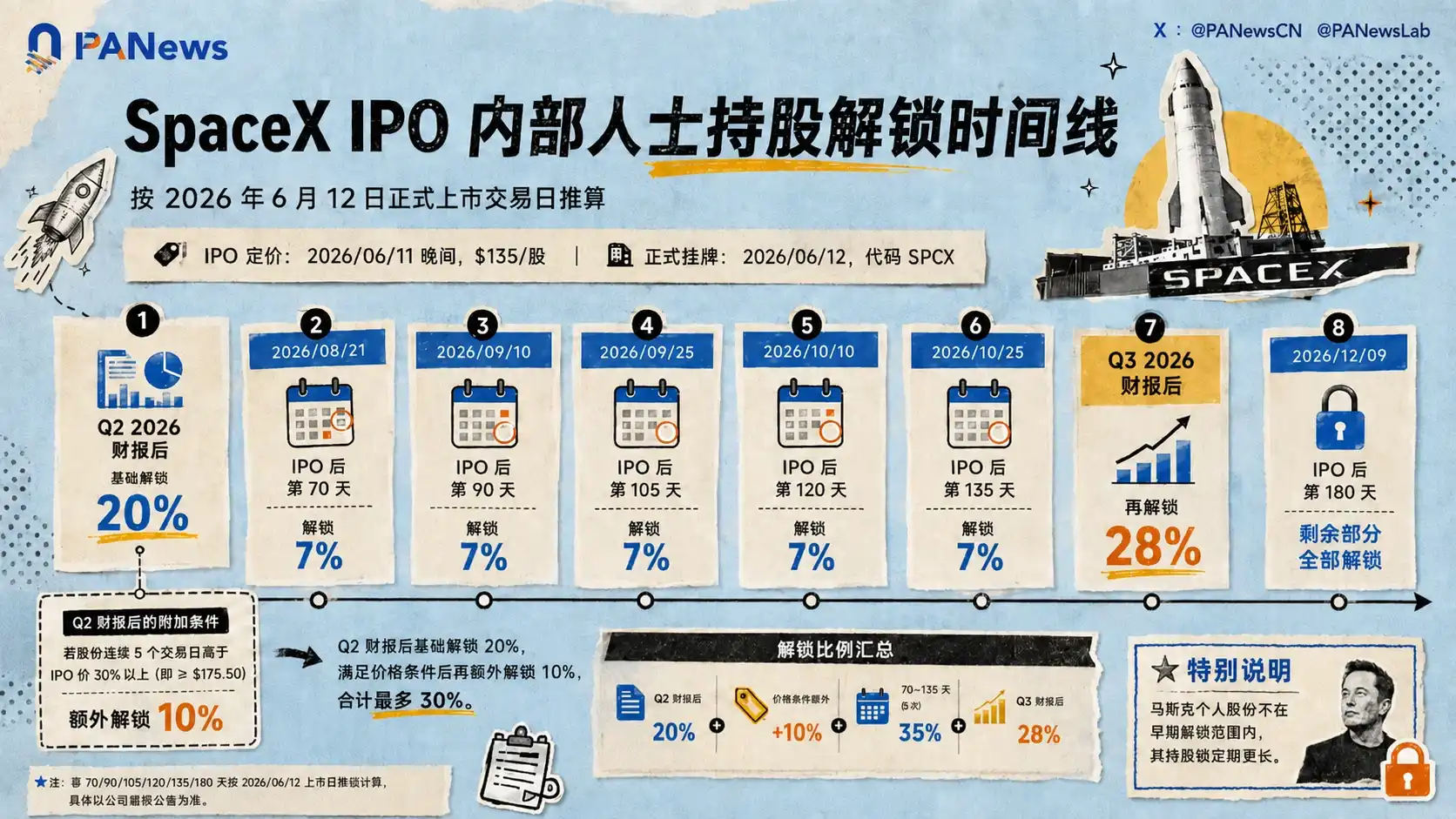
SpaceX (stock symbol: SPCX) shares have been rising strongly since its IPO, largely due to extremely low immediate float. Currently, only about 4.2% of total shares are freely tradable, locking approximately 96% of the equity. However, a series of share unlock events are scheduled, which could increase selling pressure. After the Q2 earnings report, up to 30% of locked shares may be released. Following that, an additional 7% is set to unlock approximately every 15 days. After the Q3 earnings report, another 28% will be released. The final remaining locked shares are scheduled for full release on December 9th, which is 180 days after the IPO. It is noted that Elon Musk's personal holdings are subject to a longer lock-up period and are not included in these early unlock phases.

SpaceX (SPCX) has been continuously rallying since its listing. The reason might be simple: currently, only about 4.2% of the total outstanding shares are floating, with 96% of the shares still unable to be sold.

But the pressure of unlocking is already counting down: Up to 30% will be released after the Q2 earnings report, followed by an additional 7% unlocked approximately every 15 days. Another 28% will be released after the Q3 earnings report. The remaining portion will be fully unlocked on December 9th (the 180th day after the IPO).

Elon Musk's personal holdings are not included in the early unlock scope and have a longer lock-up period.

Preguntas relacionadas

QWhat is the approximate percentage of SpaceX's total shares currently available for trading after its IPO?

AApproximately 4.2% of SpaceX's total shares are currently in the float and available for trading.

QAccording to the article, what is the main reason suggested for SpaceX's post-IPO stock price rally?

AThe main reason suggested is the extremely low float, with only about 4.2% of total shares initially available for trading, creating limited supply.

QWhat is the maximum percentage of locked shares that could be released after the Q2 earnings report?

AUp to 30% of the locked shares could be released after the Q2 earnings report.

QHow often will additional share unlocks occur after the initial post-Q2 release, and what is the size of each subsequent unlock?

AAfter the initial release, an additional 7% of shares will unlock approximately every 15 days.

QAre Elon Musk's personal shares subject to the same early unlock schedule as described in the article?

ANo, Elon Musk's personal shares have a longer lock-up period and are not included in the early unlock schedule.

Lecturas Relacionadas

Why Is DeFi Insurance Unpopular?

The article explores the core reasons why DeFi insurance remains largely unutilized despite its potential to eliminate traditional insurance inefficiencies and malicious claim denials through automated smart contracts. Key points include: 1. **Low Adoption & Minimal Payouts:** Leading provider Nexus Mutual has paid only ~$18M in claims since 2019, dwarfed by single hack losses (e.g., Kelp DAO's $292M loss). 2. **High Correlation Risk:** Unlike traditional insurance (e.g., house fires), DeFi risks (oracle failures, bridge hacks) are systemic and can simultaneously impact multiple protocols, threatening to drain entire insurance pools. 3. **Prohibitive Cost vs. Reward:** For many protocols (Aave, Morpho, Compound), insurance premiums (1.5%-6%) consume a significant portion or even all of the native yield (3%-4%), leaving investors with meager returns. In some cases (Maple Finance, Ethena), premiums can even result in net-negative yields. 4. **Inadequate Capacity:** The total DeFi insurance pool (e.g., Nexus Mutual's $81.56M) is minuscule compared to the hundreds of billions in total value locked (TVL), creating a massive supply-demand gap. 5. **Structural Flaws:** The claims assessment model (e.g., Nexus Mutual's member voting) creates a conflict of interest, as voters bear the loss if a claim is paid. There is also no regulatory mandate forcing DeFi protocols to obtain insurance. The industry is adapting by focusing on preventative measures (e.g., bug bounty coverage) and seeking external capital via reinsurance. However, the fundamental issues of small pool size, correlated risk, and misaligned economic incentives persist. The article concludes that DeFi insurance, like a public lighthouse, provides shared security benefits, but if everyone relies on others to pay for it, no one will, leaving the ecosystem vulnerable.

Foresight NewsHace 8 min(s)
Why Is DeFi Insurance Unpopular?

Foresight NewsHace 8 min(s)

Ethlabs Founded, Treasury Companies to Fund Ethereum Post-EF

Former Ethereum Foundation (EF) core researchers Ansgar Dietrichs, Barnabé Monnot, Caspar Schwarz-Schilling, Josh Rudolf, and Julian Ma announced the launch of Ethlabs, an independent non-profit R&D lab focused on Ethereum core protocol research and institutional-grade infrastructure. The initiative, backed by over 50 community participants including ETH treasury companies BitMine and Sharplink, Joseph Lubin, Hayden Adams, and Jesse Pollak, aims to make Ethereum the global economic settlement layer. This move comes amidst significant pressure on the EF, which has seen key departures and a strategic narrowing of its focus. A critical funding gap of approximately $30 million annually for core client development, following the expiration of the client incentive program, poses a near-term risk to the network's development. The context includes the evolution of ETH's value narrative. While mechanisms like EIP-1559 and the Merge previously supported the "ultrasound money" thesis, the success of L2 scaling via EIP-4844 has drastically reduced L1 fee revenue, leading to net ETH issuance and challenging that narrative. Ethlabs has listed ETH monetary economics as a primary research focus. Backing from corporate ETH treasuries like BitMine and Sharplink represents a strategic alignment, as these entities' asset values are directly tied to Ethereum's health and adoption. Their support is an investment rather than a pure donation. Ethereum's governance is shifting from a centralized EF model to a distributed network of specialized "manager nodes," including Ethlabs and a streamlined EF. While this promotes efficiency and reduces single-point failure risk, it introduces new challenges in coordination, priority alignment, and filling critical funding gaps across the decentralized ecosystem.

Foresight NewsHace 32 min(s)

Ethlabs Founded, Treasury Companies to Fund Ethereum Post-EF

Foresight NewsHace 32 min(s)

Trading

Spot
Futuros
活动图片