Investors Are Now Hunting for AI Projects on Bilibili and Xiaohongshu

marsbitPublicado a 2026-06-12Actualizado a 2026-06-12

Resumen

Investors Turn to Bilibili and Xiaohongshu to Source AI Projects The AI hardware boom is in full swing in 2025, with a surge in smart wearables like AI glasses, rings, toys, and companion robots. This frenzy has investors scrambling, not just sifting through business plans, but actively hunting for promising "under-the-radar" projects on youth and tech-enthusiast content platforms like Bilibili and Xiaohongshu. The logic is straightforward: for consumer-facing AI hardware, genuine user demand and potential pitfalls are often revealed earlier in public discussions, comments, and critiques on these communities than in formal pitches. As one industry insider notes, these products must ultimately be tested and understood by real people. This shift highlights a crucial challenge in the sector: user education. The success of AI hardware depends on moving beyond mere efficiency gains to fulfilling higher-order needs like "unleashing personal creativity." Products must convince users they are natural, unobtrusive additions to daily life. Early hype, as seen with devices like the Rabbit R1, often fades if the product fails to clearly solve real-world problems, leading to high return rates and market rejection. The market is now entering a shakeout phase. 2026 is seen as a year of commercial validation. Some projects have already stalled or been canceled due to market resistance, lack of differentiation, or financial woes. However, the long-term opportunity remains vast, with forec...

Author: Investment Community

"In the AI era, all hardware is worth remaking from scratch."

This statement might have sounded somewhat radical in 2024, but in 2025, its credibility has surged significantly—as we are witnessing, the wave of AI hardware entrepreneurship is rising, with financings following one after another. Across the ocean, the smart ring Oura Health has seen its latest valuation soar to a staggering 70 billion yuan.

This frenzy is sweeping up FOMO-stricken investors. This time, aside from sifting through thousands of pitch deck emails, they have strikingly turned their deal-sourcing gaze towards content communities densely populated by tech geeks and young people.

The underlying logic is rather simple: compared to spec sheets and roadshows, the real demand for a consumer-grade AI smart hardware product is often first exposed by whether it can be understood, discussed, and questioned in the public sphere.

Ultimately, all tech products aimed at the masses must go through the test of the crowd.

AI Hardware Explosion, Investors Scramble for Under-the-Radar Projects

We are experiencing a banner year for AI hardware.

Since 2025, extending from the wearable device track, more segmented smart hardware products such as AI glasses, AI toys, AI recording cards, AI rings, AI earphones, companion robots, and Agent Boxes have collectively seen an explosion.

Amid the fervor, certain details reveal the excitement in the investment circle: in the latter half of 2025, we frequently saw several top-tier institutions posting job openings to recruit AI/smart hardware investors, with the job descriptions almost invariably requiring the candidates to be based in Shenzhen, the hardware capital.

Good projects almost require 'repeated visits' and intense competition, especially those still under the radar with valuations not yet sky-high. Investors have even started approaching potential founders who haven't yet left their jobs. For instance, cafes near DJI are packed with VCs and FAs trying to 'persuade people to start a business.'
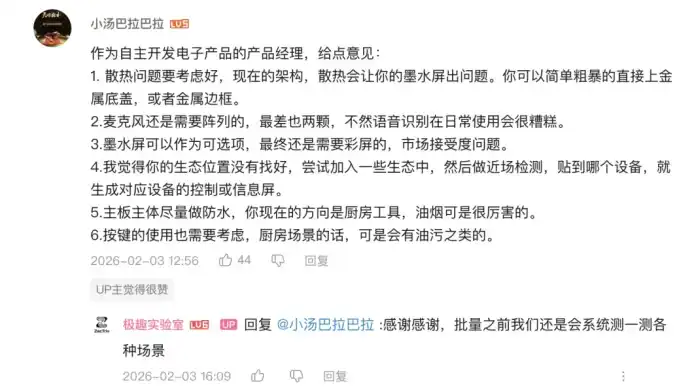
(Comment section of an AI sticky note product pre-sale video)

"After this content was posted, many technical discussion threads appeared in the bullet comments and comment section, and more users began sharing their similar needs: some mentioned frequently attending cross-border exhibitions, others talked about communication barriers when collaborating remotely with overseas teams, and some shared experiences where translation tools were inconvenient when accompanying foreign relatives for medical treatment or handling foreign affairs."

"These feedbacks not only helped us expand the direction for creator content but also directly influenced our thinking about the product line," Wu Zhen said.
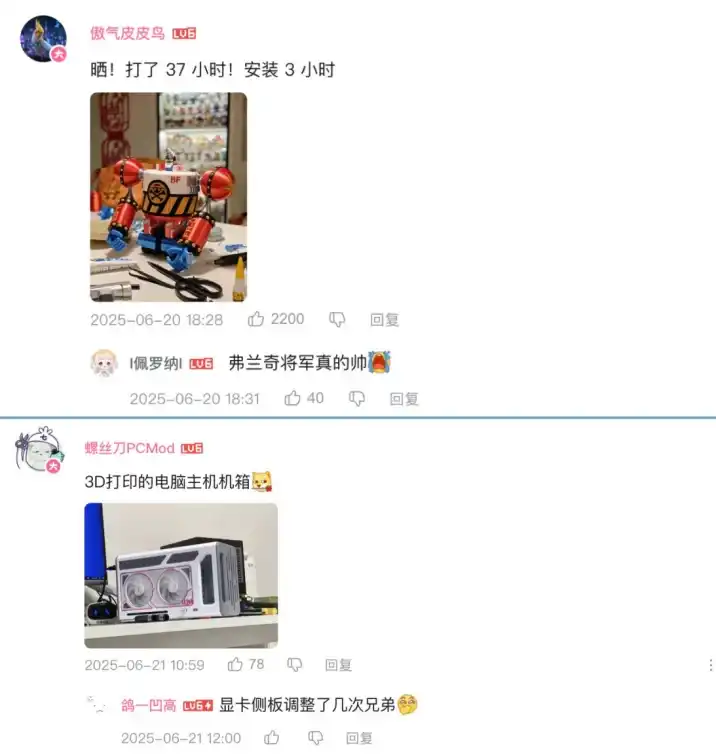
(Comment section of UP主影视飓风's video)

Enthusiasts Gather

Remember January 2024, at CES.

A little orange square box called Rabbit R1, touted as 'the world's first AI hardware device,' stirred a frenzy in the tech world. The market hailed it as the iPhone of the AI era, selling 100,000 units upon launch.

But what followed was not success. On the contrary, skepticism soon arose with comments like 'actually using it is not as good as a phone.' At the time, the high-flying Rabbit R1 failed to adequately explain to users: what exactly can Rabbit R1 do now and in the future? What real user problems does this innovation actually solve?

Even today, user education remains the most critical challenge for AI smart hardware—when AI enters consumer electronics, the product consumption logic is no longer limited to 'improving life efficiency' but also includes higher-dimensional needs like 'unleashing personal creativity' and 'liberating the mind.' In this context, whoever can make users understand, discuss, and pay in real-life scenarios truly crosses the threshold from a tech product to a consumer good.

But this is not easy. Regarding user education for AI glasses, INMO's CMO Wu Zhen told us frankly: This is not simply about conveying product information; it also requires overcoming a psychological barrier. Users must first complete a 'virtual try-on' in their minds, confirming that integrating this device into daily life feels natural and not awkward, before they can proceed to the next step.

In Wu Zhen's view, the process of psychologically preparing users for AI smart hardware might be longer than for most consumer electronics categories. "The day users naturally put on AI glasses to go out without reminding themselves 'I need to use AI glasses today,' this behavioral change might be more convincing than many data points."

Shakeout Begins, Battle for Attention Heats Up

While the frenzy peaks, a shakeout is underway.

There is now market consensus that 2026 will be the year of commercial validation for AI hardware. This also means that trend-chasers and狂热资本 will face rationality and冷静.

A winnowing process is unfolding: At the end of 2025, the AI wearable device Friend AI Necklace stalled after encountering severe market resistance; after its peak appearance in 2024, Rabbit R1, unable to keep up with product expectations amid negative feedback, saw abnormally high return rates, severely damaging its reputation, and ultimately陷入欠薪与现金流枯竭的困境 (fell into困境 of salary arrears and cash flow depletion).

Meanwhile, savvy players are also开始审慎调整和优化决策 (beginning to prudently adjust and optimize decisions). In February 2026, market rumors emerged that the Doubao AI glasses project was suspended; at least within the visible cycle, this product line is no longer considered a direction to pursue. Earlier, in January, smartphone manufacturer vivo halted its AI glasses project, citing the difficulty of achieving differentiation at present.

Such developments are a reflection of industry differentiation.

Nevertheless, it is undeniable that in this trillion-dollar-value赛道 (track), entrepreneurs still possess enormous确定性机会 (deterministic opportunities). According to AICC predictions, by 2030, the global AI-related hardware market will easily surpass several trillion dollars. In China, the industry expects the market size for consumer-grade AI hardware (excluding phones and cars) to突破 (break through) 1.27 trillion yuan in 2026 and reach 2.56 trillion yuan by 2030.

Currently, opportunities for exit and entry coexist. OpenAI just announced it will launch its first AI hardware device in the second half of the year, and Meta plans to double the annual production capacity of its AI smart glasses to 20 million units by the end of 2026. The latest scene domestically: a batch of AI smart terminals from京东 (JD.com), including AI desk lamps, AI cooking machines, AI mattresses, and AI wheelchairs, are酝酿上新售卖 (being酝酿 for launch and sale).

People remain convinced that the battle for入口之争 (portals) behind AI smart hardware will not stop. The AI era is still an era of用户主权 (user sovereignty).

The热浪 (heat wave) will push everyone forward. But when attention, product power, and user perception begin to compete on the same table, the final battle is just beginning.

Preguntas relacionadas

QWhat new strategy are venture capitalists adopting to find promising AI hardware projects?

AVenture capitalists are increasingly looking for promising AI hardware projects on youth-focused content communities like Bilibili and Xiaohongshu. They analyze user discussions, comments, and product reviews to gauge genuine market demand and real-world product understanding before these ventures become widely known or receive high valuations.

QWhy is user education considered crucial for AI consumer hardware adoption?

AUser education is crucial because the value proposition of AI hardware often involves higher-level needs like 'unleashing personal creativity' or 'liberating the brain,' not just efficiency. Consumers need to understand and visualize how these devices fit into their daily lives without being intrusive. This mental acceptance and natural integration into routines are considered more important than just product specifications for driving adoption.

QWhat are some examples of AI consumer hardware that faced significant market challenges?

AExamples of AI consumer hardware that faced significant market challenges include the Rabbit R1, which suffered from high return rates and negative feedback regarding its practical utility, leading to cash flow problems. The Friend AI Necklace also encountered severe market resistance and stalled development.

QWhat is the predicted market size for consumer AI hardware in China by 2030?

AIndustry predictions estimate that the market size for consumer AI hardware (excluding smartphones and cars) in China will reach 2.56 trillion yuan by 2030. It is projected to first exceed 1.27 trillion yuan by 2026.

QWhy are some companies adjusting their strategies in the AI hardware market in 2026?

ACompanies are adjusting their strategies because 2026 is widely seen as the 'commercial validation year' for AI hardware. The market is entering a phase of rationalization and consolidation. Projects that fail to demonstrate clear product differentiation, genuine user value, or sustainable business models are being paused or canceled, as seen with Doubao's AI glasses and vivo's AI glasses project, indicating an industry-wide shakeout.

Lecturas Relacionadas

Xpeng and NIO Compete on Computing Power, Li Auto Shifts Architecture

On June 15, 2026, Li Auto unveiled details of its self-developed chip, Mahe M100, for its new L9 Livis model. CTO Xie Yan stated the goal was not just a faster chip, but a fundamentally different one, targeting the chip architecture itself. While competitors like NIO, Xpeng, and Huawei highlight TOPS (computing power) figures for their self-developed chips, Li Auto’s Mahe M100 focuses on redesigning the underlying architecture. It employs a "dynamic data flow architecture" to address memory bandwidth bottlenecks in large model inference, claiming up to 3x the effective computing power of Nvidia's Thor U for its specific workloads and a 40% reduction in latency. The chip's design was peer-reviewed and accepted at ISCA 2026. However, this performance is highly optimized for Li Auto's own VLA2.1 algorithm, meaning it may not generalize as well to other tasks. Li Auto aims to achieve full-stack in-house development with Mahe M100, covering chip, compiler, OS, AI algorithms, and domain controller—a level of vertical integration few competitors match. Beyond the chip, CEO Li Xiang introduced a new strategic narrative: the "embodied intelligent vehicle," defined as an integration of an EV, a professional driver, an AI computer, and a life assistant. This shifts competition from features like large screens to systemic AI capabilities. A key commitment was that Li Auto's Mahe VLA autonomous driving model will match Tesla's FSD V14 by Q4 2026, with specific OTA milestones set for July, September, and December. Financially, Li Auto faces pressure with declining revenue and vehicle gross margins since Q4 2025, while maintaining high R&D investment (approx. ¥12B in 2026, 50% AI-related). Its 2026 sales target is 550,000 vehicles, up from 406,000 in 2025. The new L9 Livis garnered over 10,000 pre-orders in two weeks. The effectiveness of these strategic moves—new products, OTAs, and the novel chip architecture—will begin to show in Q3 2026 financial results, with the year-end FSD V14 benchmark being the ultimate test.

marsbitHace 54 min(s)

Xpeng and NIO Compete on Computing Power, Li Auto Shifts Architecture

marsbitHace 54 min(s)

The Year of AI Applications: Saying 'Yes' While Ignoring Risks? A Comprehensive Open Source Log of Software Development's Journey

The Year of AI Applications: Blindly Saying "Yes" While Ignoring Risks? A Software Development Log Goes Fully Open Source. AI-generated code harbors risks hidden within seemingly correct programs, potentially leading to data leaks or asset loss. The open-source project "Narwhal AI Code Risks," from Peking University's Narwhal-Lab, compiles real-world cases, early warning signs, and typical risk pathways. Its goal is to help developers identify potential hazards early and avoid repeating past mistakes. In 2026, code is generated faster than ever but deployed with less scrutiny. The danger often lies not in glaring errors, but in code that appears normal—syntactically correct, passing all checks—yet introduces subtle but critical flaws like non-existent dependencies, excessive permissions, or exposed databases. A stark example is the Moonwell cbETH oracle incident. A configuration file error, where a cryptocurrency price was set to ~$1.12 instead of ~$2,200, slipped through 28 checks and a pull request signed by both AI (Claude, Copilot) and human developers. This "semantic deviation" resulted in a loss of $1.78 million. The risk is that AI can produce functionally valid code that is semantically wrong for the business context. As AI moves beyond simple code completion to modifying configurations, installing dependencies, and operating via autonomous agents, it traverses longer, less traceable paths within software engineering, blurring traditional boundaries and oversight points. The Narwhal AI Code Risks project structures information into three layers: `/cases` for documented real-world incidents, `/inferred` for early warning signals, and `/scenarios` for clear, generalized risk patterns not yet tied to specific events. This aims to create a lasting, public record to prevent collective amnesia about past AI-coding pitfalls. Risks are categorized into seven areas: Software Supply Chain (e.g., recommending fake packages), Code-Level Vulnerabilities (e.g., reintroducing path traversal bugs), Cloud & Infrastructure Misconfiguration (e.g., overly permissive settings), Agent Risks (from autonomous tool execution), Vertical Domain Risks (e.g., in finance, healthcare), Intellectual Property & Compliance issues, and Human Factors (like over-reliance on AI output). The project's core value is transforming isolated incidents into reusable knowledge—a foundational resource for developers to spot similar issues, for security researchers to build upon, for toolmakers to create detection rules, and for the community to contribute new findings. As AI integration accelerates, this open-source "logbook" serves as a crucial navigational aid, charting past errors to help future projects steer clear of the same traps.

marsbitHace 54 min(s)

The Year of AI Applications: Saying 'Yes' While Ignoring Risks? A Comprehensive Open Source Log of Software Development's Journey

marsbitHace 54 min(s)

The Foundation of SpaceX's Trillion-Dollar Valuation: Who is Dividing Up Musk's Annual Tens of Billions in Capital Expenditure?

SpaceX's trillion-dollar valuation is built on its three core businesses: Starlink (profitable, 60% of revenue), rockets (driving down launch costs), and AI (a major investment area). This creates a financial cycle: Starlink funds rocket development, which enables low-cost launches for AI hardware, generating future revenue. This cycle fuels annual capital expenditures of tens of billions, flowing to a vast supply chain. Suppliers are categorized by their replaceability. The first group includes irreplaceable players like NVIDIA (GPU/CUDA ecosystem), Eutelsat (critical radio spectrum), Filtronic (specialized amplifiers), Materion (strategic beryllium), and STMicroelectronics (antenna chips). The second group consists of hard-to-replace suppliers due to high switching costs, such as Honeywell (flight control), Carpenter Technology (specialty alloys), Hexcel (carbon fiber), Broadcom (data exchange), and Linde (industrial gases). The third group comprises high-volume, cost-critical suppliers for mass-produced items like Starlink terminals. Key names include Wistron NeWeb (primary manufacturer) and several A-share companies like Shenzhen Sunway (connectors), Pies New Materials (forgings), Western Superconducting (alloys), and Yingliu (castings). Other niche players include Trimble (timing), Astronics (power distribution), and CTS (thermal management). The article argues that investing in these suppliers, rather than SpaceX stock directly, offers an alternative opportunity. The rationale is threefold: procurement is just beginning to scale, SpaceX's IPO brings new transparency to its supply chain, and the situation mirrors early stages of past "super terminal" ecosystems like Apple or Tesla. While risks exist (commodity cycles, geopolitical factors, technology shifts), the core thesis is that SpaceX's massive, ongoing procurement will translate into reliable revenue for its key suppliers, regardless of its own stock price volatility.

marsbitHace 1 hora(s)

The Foundation of SpaceX's Trillion-Dollar Valuation: Who is Dividing Up Musk's Annual Tens of Billions in Capital Expenditure?

marsbitHace 1 hora(s)

SpaceX's Trillion-Dollar Valuation Base: Who's Sharing in Musk's Annual Tens of Billions in Capital Expenditure?

**Title: The Foundation of SpaceX's Trillion-Dollar Valuation: Who Benefits from Musk's Annual $100 Billion Capital Expenditure?** This article argues that investors seeking to benefit from SpaceX's growth might find greater opportunities in its supply chain rather than directly investing in the company itself, drawing parallels to historical successes with Apple, Tesla, and NVIDIA suppliers. **SpaceX's Business Model & Cash Flow:** SpaceX generates revenue from three main areas: 1. **Starlink:** Its profitable core, earning $11.3B in 2023 (60% of revenue), funding other ventures. 2. **Rockets (Falcon/Starship):** Requires $3B+ in annual R&D but achieves the world's lowest launch costs. 3. **AI:** Currently unprofitable (-$6B+ in 2023), investing heavily in ground-based supercomputers (220,000 GPUs) and future orbital data centers. The cycle is: Starlink profits → fund cheaper rockets → low-cost launches deploy AI hardware → AI compute rentals generate future revenue. This cycle drives annual procurement spending of tens of billions of dollars. **The Supply Chain Beneficiaries:** Suppliers are categorized by their replaceability: **1. Nearly Irreplaceable (High Barriers to Entry):** * **NVIDIA:** Powers the Colossus supercomputer; its CUDA ecosystem creates immense switching costs. * **Eutelsat (SATS):** Controls critical radio spectrum for satellite communications; holds a ~3% stake in SpaceX. * **Filtronic (FTC):** Supplies millimeter-wave signal amplifiers for Starlink satellites; SpaceX constitutes 83% of its revenue. * **Materion (MTRN):** Global leader in beryllium production, a strategic material used in Starship structures. * **STMicroelectronics (STM):** Supplies phased-array antenna chips for Starlink satellites. **2. Replaceable, but Switching Cost is Prohibitively High:** * **Honeywell (HON):** Provides flight control and inertial navigation systems with decades of certification. * **Carpenter Technology (CRS):** Manufactures ultra-pure specialty steel alloys for Raptor engines. * **Hexcel (HXL):** Supplies custom carbon fiber composites developed over a decade with SpaceX. * **Broadcom (AVGO):** Manages high-speed data switching. * **Linde Group:** Supplies industrial gases (liquid oxygen/nitrogen) from facilities built near SpaceX launch sites. **3. High-Volume, Cost-Critical Manufacturing:** Focuses on mass-producing components like Starlink user terminals (target: 30 million units). * **Key Players:** Wistron NeWeb (6285, primary terminal manufacturer), several Chinese A-share companies (e.g., Sunway Communication, PAX New Materials, Western Metal Materials, Yingliu Co.), and smaller US firms like Trimble (TRMB, timing systems). **Why Now?** Three factors make the supply chain opportunity timely: 1. **Volume Ramp-Up:** SpaceX plans 100 launches in 2026, aims for 30 million Starlink terminals, and will deploy AI data centers, meaning procurement will accelerate. 2. **Increased Transparency:** The IPO provides public financial data, allowing investors to track supplier order growth. 3. **Historical Precedent:** The current phase is likened to Tesla's early mass-production stage (circa 2018), suggesting a long growth runway for suppliers. **Conclusion:** The article posits that while investing in SpaceX stock is betting on Elon Musk's ambitious vision at a high valuation, investing in its established suppliers is a bet on the tangible, recurring revenue from its massive procurement budget, which is largely decoupled from day-to-day stock price volatility.

链捕手Hace 1 hora(s)

SpaceX's Trillion-Dollar Valuation Base: Who's Sharing in Musk's Annual Tens of Billions in Capital Expenditure?

链捕手Hace 1 hora(s)

Trading

Spot
Futuros

Artículos destacados

Cómo comprar ERA

¡Bienvenido a HTX.com! Hemos hecho que comprar Caldera (ERA) sea simple y conveniente. Sigue nuestra guía paso a paso para iniciar tu viaje de criptos.Paso 1: crea tu cuenta HTXUtiliza tu correo electrónico o número de teléfono para registrarte y obtener una cuenta gratuita en HTX. Experimenta un proceso de registro sin complicaciones y desbloquea todas las funciones.Obtener mi cuentaPaso 2: ve a Comprar cripto y elige tu método de pagoTarjeta de crédito/débito: usa tu Visa o Mastercard para comprar Caldera (ERA) al instante.Saldo: utiliza fondos del saldo de tu cuenta HTX para tradear sin problemas.Terceros: hemos agregado métodos de pago populares como Google Pay y Apple Pay para mejorar la comodidad.P2P: tradear directamente con otros usuarios en HTX.Over-the-Counter (OTC): ofrecemos servicios personalizados y tipos de cambio competitivos para los traders.Paso 3: guarda tu Caldera (ERA)Después de comprar tu Caldera (ERA), guárdalo en tu cuenta HTX. Alternativamente, puedes enviarlo a otro lugar mediante transferencia blockchain o utilizarlo para tradear otras criptomonedas.Paso 4: tradear Caldera (ERA)Tradear fácilmente con Caldera (ERA) en HTX's mercado spot. Simplemente accede a tu cuenta, selecciona tu par de trading, ejecuta tus trades y monitorea en tiempo real. Ofrecemos una experiencia fácil de usar tanto para principiantes como para traders experimentados.

386 Vistas totalesPublicado en 2025.07.17Actualizado en 2026.06.02

Cómo comprar ERA

Discusiones

Bienvenido a la comunidad de HTX. Aquí puedes mantenerte informado sobre los últimos desarrollos de la plataforma y acceder a análisis profesionales del mercado. A continuación se presentan las opiniones de los usuarios sobre el precio de ERA (ERA).

活动图片